Mintable Review & Beginner’s Guide 2022

Mintable-NFTs-Marketplace-Review.j

Mintable is a marketplace for NFTs that was founded in 2018 and serves two crucial functions. Firstly, it allows NFT creators to mint (also known as creating/adding NFTs to the blockchain) NFTs and list them for sale. Secondly, it gives collectors a platform to browse and buy original NFTs. There are over 3,000 NFTs on the site, with a wide range of categories for collectors to choose from. Since its launch in July, the TRX token has risen steadily with a trading volume of around $1.3 billion and a market capitalization of over $2 billion.

The NFT Foundation has more than 177,000 NFTs, with a royalty rate for creators that is limited to 10% compared to Mintable’s unlimited. OpenSea, on the other hand, does not provide a gas-free minting possibility. OpenSea also has a 10% royalty limit, but it is comparable to Mintable in that it waives upfront gas expenditures for creators.

Ways to invest with Mintable

Mintable is a decentralized blockchain-based platform created to enable the creation and trading of NFTs. Both creators and collectors use Mintable, which only allows for ethereum blockchain minting (or the production and listing of NFTs). Instead of paying gas fees when selling a digital item on the market, Mintable enables creators to skip out. Mintable charges a 5% marketplace fee on all gas-free NFT sales. Its other two choices, however, have gas costs. Mintable collects a 10% marketplace fee on printable NFT transactions and a 2.5 percent charge for traditional NFT transactions.

You might be a collector if you like art, music, videos, collectibles, sports cards and other items. You’ll have access to over 9,300 collections, including art, music, videos, collectibles, sports cards and other items. On the secondary market, you can buy and sell NFTs that have been minted on the Ethereum blockchain. Mintable’s platform allows the original creators to get paid (usually 5-10% of revenue, although they can choose whatever percentage they like, according to Mintable).

Mintable’s extensive educational resources, which include Seller’s University (a video collection on all things crypto) and Mintable editorial;  a library of NFT blogs and guides, may be useful for both established businesses with existing relationships as well as new organizations looking to expand into the crypto market. Pro users also get access to both customer support 24/7. As for crypto wallets, Mintable supports MetaMask, Trust Wallet, and Rainbow, amongst others.

Is Mintable trustworthy?

We assess trustworthiness by reviewing each investment platform’s Better Business Bureau profile, but Mintable doesn’t have a profile at this time. BBB ratings generally reflect the bureau’s opinion of how well a company interacts with its customers. But although Mintable doesn’t have a profile; it’s nonetheless important to do your due diligence before setting up an account with any investment platform.

Mintable — Frequently asked questions (FAQ)

Is Mintable affordable?

Mintable offers a gas fee-free option for creators who want to mint NFTs, but it takes a 5% marketplace fee on sales for gasless NFTs. When it comes to normal NFTs, Mintable deducts a 2.5% marketplace fee. Mintable takes a 10% marketplace fee for printable NFTs.

How is Mintable gasless?

With Mintable’s gas-free option, creators can skip out on paying fees to mint NFTs and list them for sale. Buyers won’t have to pick up the gas costs; and the transactions are emission-free and harmless to the environment on both sides, according to Mintable.

What blockchain is Mintable?

Mintable relies solely on the ethereum blockchain for all of its NFT transactions. This is common among many NFT platforms, but some, like OpenSea, support additional blockchains like polygon and klatyn.
Why Have Bored Ape NFTs Become So Popular?

Why-have-Bored-Ape-NFTs-become-so-popular.j

The NFTs eco-space has vastly evolved, with about $25 billion spending in 2021 alone. Among all the NFTs being bought, sold, and exhibited, there is one NFT specific that everyone has seen. Yep, you know what I’m talking about; it is the bored ape NFT. While many are still skeptical of NFTs being the real deal or just a fad, this specific collection of NFTs has gained immense popularity. 

I’m sure you’ve seen one, but don’t recognize them as expensive. The bored ape NFT was listed for .08 ETH in April of 2021, and now they’re trading for thousands of dollars each. You need to read ahead to understand what BAYC is and why they are so popular.

What is the Bored Ape Yacht Club (BAYC)? 

As the name suggests, it is a club of members that own a bored ape NFT. The BAYC cannot have members exceeding 10,000 because the collection has 10,000 such bored ape NFTs in different styles and appearances. Hence, it is understood that to be a member of this club, you should own at least one of these ape NFTs. 

These 10,000 NFTs represent a unique collectible built on the Ethereum blockchain. Each of these NFTs in the collection is identified by their unique trait stored as an ERC-721 token. These traits could be clothing, headwear, facial expressions, etc. 

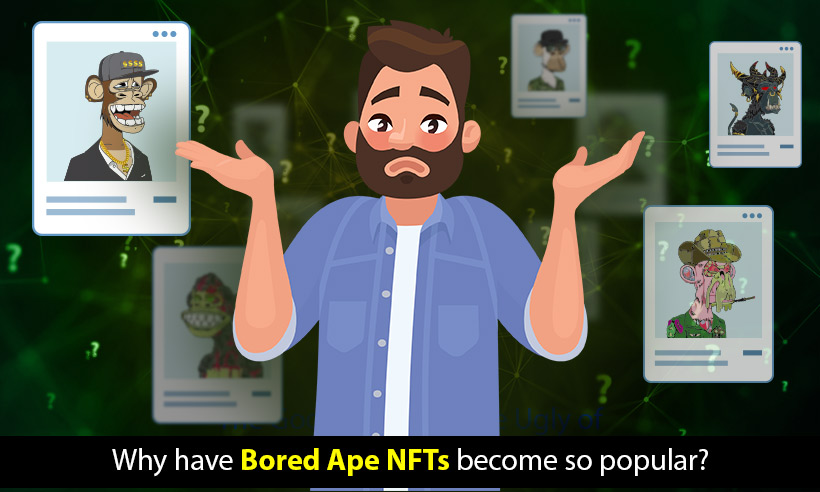
Fun Fact: Marshall Mathers, aka Eminem, dropped a whopping $462,000 on a BAYC NFT, which appears to be equipped with a green cap, a golden jacket, and a golden chain. 

Why is BAYC Gaining So Much Popularity?

Well, there is no one simple answer to this question. From the start, BAYC had a clear road map to the future. These NFTs were sold out within 12 hours of initial listing. While the reasons for the popularity of these NFTs could be highly subjective, we consider them to be the following: 

Celebrity involvement: Many celebrities, including Tyrese Halliburton, LaMelo ball, Stephen Curry, Justine Bieber, Eminem, Snoop Dogg, Neymar Jr, Jimmy Falcon, Logan Paul, etc., own these NFTs. Being a member of the BAYC is seen as a means to mingle with these celebrities. The owners of these NFTs have a separate discord server.  

Commercial Utility: Most NFTs can be utilized for many purposes. They can be used as a profile picture or a metaverse character, and they can be accessed to play to earn games or as an option to sell an NFT in exchange for a desirable cryptocurrency. Many celebrities use their NFTs as their profile picture to show their fans what they possess. They are the new status symbol.

Return on Investment: Bored ape NFTs carry a hefty price. The NFTs that first sold for nearly 0.08 ETH are now trading at six figures. These NFTs have a return of over 100,000%. The most expensive bored ape NFT that goes by Bored ape #3749 was sold for 740 ETH. Bored Ape NFTs have been increasing in value with every passing day. Some treat them as an investment. 

Engaging Community: The BAYC builds a community of members who interact and stay engaged. Yuga Labs, the entity behind the Boring Ape collection, has come up with their cryptocurrency called Ape Coin. They have further expanded their ecosystem by developing their metaverse (which goes by Otherside). 

Yuga Labs has organized events to keep its owners engaged. They came up with initiatives like the Bored Ape Kennel Club (the owners were allowed to adopt a dog NFT with characteristics similar to their bored ape NFT) and Mutant Ape Yacht Club (the owners were given a virtual vial of mutant serum that would turn their bored ape NFT into a mutant ape NFT). The kernel and mutant ape were freebies given to the owners as membership bonuses, and these collectibles are currently worth a lot. 

What’s Next? 

The creators behind the BAYC were the people who founded the Yuga Labs. The tweet updates regarding the BAYC were made by their pseudonyms Gordon Goner and Gargamel (the founders) and their friends No Sass and Emperor Tomato Ketchup. The BAYC has organized meet-ups for its owners in New York and California. The BAYC get-togethers were held in Hong Kong and the UK. 

BAYC has plans for its brand both in the virtual and real world. All bored ape NFT owners were airdropped about 10,000 Ape Coins in March 2022. These would be the primary currency for Otherside. Yuga labs launched their auction for land parcels for Otherside. 

Yuga labs announced that they had acquired $450 million in a fundraising round, increasing their valuation to $4 billion. They also have collaborations with brands like Adidas and Gucci. 

Considering all of the above, Yuga labs have a lot planned further for their members. They have been expanding their ecosystem with Ape coins and their metaverse. The craze for BAYC will likely continue to grow in the coming years.  

The Significant Value of NFTs Compared to Equivalent Traditional Financial Instruments 

The-Significant-Value-of-NFTs-Compared-to-Equivalent-Traditional-Financial-Instruments

For decades, the finance and investment world has been the prime focus of human beings as they try to keep up with the most lucrative asset on the market. The financial system is designed to create an illusion of a bog dog or a unicorn that everyone needs to own at that particular moment. Financial instruments are contracts for tradable assets that can be modified and purchased. 

The basis of these transactions is money, where one instrument is traded for cash. For instance, when one needs to buy shares, you will give some money worth the shares you will receive in return. Traditional financial instruments include securities, bonds, real estate, and cheques. However, the 21st century has seen a myriad of changes in the financial world and a sudden surge in technological advancements in fields such as mobile payments and blockchain databases.

How Do NFTs Work? 

To understand this concept, we need first to understand the meaning of fungible. A Fungible asset is anything that can be exchanged or traded for another asset of the same value. For instance, it is easy to acquire another dollar. Non-fungible, therefore, means that the asset is unique. It cannot be exchanged for any other asset that may be similar to it. 

The rarity of the asset gives it value in the market.NFTs were not originally designed to be financial instruments; they were often disregarded. They are codes representing an asset stored on a blockchain. The blockchain that currently has the most NFTs is the Ethereum Blockchain; however, other blockchains recently implemented the software needed to harbor NFTs.

The Value of NFTs Compared to Traditional Financial Instruments

1. Streamlining marketplaces

Physical assets are transformed into digital assets, NFTs allow investors to interact with the artists directly, and the decentralized systems do not require intermediaries. Traditional financial systems such as real estate need costly intermediaries to complete transactions. Bonds and shares also require banks to facilitate the transactions. 

However, for NFTs, you do not need middlemen to make the acquisition process more manageable. One can easily buy NFTs on platforms such as Opensea in the comfort of their homes. Digitization of assets enhances convenience as people will not require proof of ownership for every transaction, often bulky documents. Converting such documents into NFTs streamlines identification and management, thus making work more accessible.

2. Greater Security 

What has made decentralized ledger technology)(DLT) so famous is the transparency of the systems and the unique codes making hacking nearly impossible.NFTs are part of this technology that has proven safe in various utilities. Peer-to-peer transactions make it difficult to distribute and duplicate. 

This ensures that the assets are not prone to theft and alteration, unlike traditional assets such as securities where the accounts can be hacked. Traditional assets could not fully guarantee investors’ security, and the technology used to store them is prone to frequent attacks. Assets such as jewelry are easily accessible regardless of their value; when converted into NFTs, it is easy to maintain the asset’s value by ensuring its rarity.

3. Division of Ownership 

Traditional assets such as buildings could only be owned by one person or a defined group of people, whereas for NFTs, there can be as many owners.NFTs have a chain of ownership; the distinct records enable many people to own distinct portions of the NFTs. It is different from traditional assets such as bonds. 

Digitization of the assets expands the market base of the asset. This ensures higher prices and more liquidity in the asset. On an individual level, NFTs allow one to own a wide range of assets, thus revolutionizing portfolio creation in the financial world.

4. More Opportunities to Learn about Blockchain 

There is much to learn about blockchain technology; the distinctive characteristics of the new technology make it attractive to investors. We are only beginning to understand the utility of this technology, and its potential in the finance world is unknown. 

Traditional assets such as bonds and stocks used centralized systems and fiat. As fiat loses its relevance in this modern times, it is necessary to ensure as an investor to keep up with modern technology that may prove instrumental in the future in many other platforms. NFTs guarantee one to learn more about blockchain technology and its utility in the financial world.

Author’s Take 

Blockchain databases and decentralized ledger technologies can change how investors and traders carry out their activities. This also changes the perspective as many investors take to cryptocurrencies, DAOs, and other decentralized finance systems to input their money. Non-fungible tokens are perhaps among the most popular financial instruments that have recently revolutionized investments as more people purchase them.

NFTs and blockchain technology are revolutionary to the financial world. NFTs have so far proven to be more lucrative than traditional financial assets.NFTs will enable more streamlined markets and safer transactions compared to traditional assets. Investors need to learn more about the technology behind this, and NFTs allow them to do so. Through divided ownership, NFTs may also boost asset liquidity and prices.

Why the Metaverse is the Latest Technology Set to Revolutionize a Series of Industries

Why-the-Metaverse-is-the-Latest-Technology-Set-to-Revolutionize-a-Series-of-Industries

Current events point out how the Metaverse is a hot topic, with big companies like Microsoft and Meta staking claims. Initially, the term metaverse originated from the author of the novel “Snow Crash,” Neal Stephenson. He envisioned and explained how lifelike avatars met in 3D buildings or different virtual reality surroundings. 

Since then, various developments have been made, and mileposts have been reached towards creating a real metaverse. It’s a virtual online world that incorporates 3D holographic avatars, virtual reality, and even augmented reality. The metaverse is a 3D digital world where you can create avatars and do normal human activities like shopping or hanging out with friends. However, it’s all in a 3D virtual environment.

The Sandbox, Axie Infinity, and Decentraland have digital worlds already functioning. Other large corporations like Nvidia also seek to expand into the metaverse by creating their versions. 

The Metaverse Explained

In simple terms, the metaverse refers to the concept of an online virtual 3D digital world. The major idea and focus of the metaverse is to connect the globe through these virtual worlds. It envisions a world where individuals with common interests like being virtual sports fans or work colleagues can connect and interact in the metaverse. 

Axie Infinity and Decentraland have integrated various aspects that merge certain life elements into the online worlds. Even so, the metaverse is still in its early development stages. However, future predictions indicate an immense growth of the virtual world. 

The expansion goes beyond social media and video games. Some of the potential new features the metaverse could support include decentralized governance, digital identity, and virtual remote working.

In pursuit of offering an immersive virtual experience of the metaverse, tech companies keep amalgamating cutting-edge technologies that power the 3D virtual world. These technologies are inclusive of virtual and augmented reality (VR and AR), blockchain, artificial intelligence (AI), 3D reconstruction, and the Internet of Things (IoT).

Latest Developments of The Metaverse

Following Facebook changing its name to Meta in late October last year, the term metaverse became a popular buzzword. Spending over $10 billion in rebranding, the social media giant installed a new division referred to as Reality Labs. 

According to Meta CEO Mark Zuckerberg, VR and AR headsets will even be as popular and widespread as smartphones in years to come. He has poured lots of resources into developing the metaverse content, software, and hardware for a better online digital experience.

The recent happenings of the COVID-19 pandemic also paved the way for adopting metaverses. Interests in metaverse development increased as many individuals opted to work remotely through virtual 3D spaces to reduce physical interaction. Even with the decline of the coronavirus, people are still interested in using virtual spaces to work. 

Colleagues can host meetings and catch up through these virtual spaces. One example is the Microsoft Mesh installed in late November 2021. Using avatars, workmates can meet, mingle, and engage in the virtual space, working remotely from any location around the globe. 

Online games have also adopted the metaverse. The Pokemon Go AR mobile game was among the first to assimilate the metaverse concept. It allowed players to hunt virtual Pokemons, in reality, using their smartphone application. 

Even Epic Games, Fortnite’s parent company, has invested in and developed its activities in the digital world through the hosting of brand concerts. Alongside hosting these virtual events, virtual merchandise that’s used to customize the users’ avatars can be sold. Using V-bucks that are equivalent to real money, players can purchase skins or earn the bucks through in-game purchases.

Tech companies, including Nvidia, are also incorporating the use of the metaverse. Nvidia Omniverse facilitates virtual online collaboration between creators, designers, and engineers. It connects 3D spaces to a commonly shared universe to facilitate these virtual collaborations. Different industries have incorporated its use. For instance, BMW Group uses Omniverse to cut production time and improve the quality of their products through smart manufacturing.

Future of The Metaverse

The metaverse has proven to be a huge development and is still set to reach new heights. It’s the next big e-commerce market space. Goods existing only in virtual reality like NFTs can be sold and purchased through the digital world. Evidence of this is seen in the rising popularity of NFTs, with major sales including Bored Ape Yacht Club and MetaBirkins. As such, digital purchases using blockchain have proven to be a lucrative investment in the coming years. Owning digital property is highly profitable and is made possible by creating virtual worlds. Walmart also recently announced its step into the metaverse, providing currency and allowing the sale and purchase of NFTs.

Virtual social events are also part of the future trends expected to boost the development of metaverses. Digital events hosted in digital spaces could be the next trend in enjoying entertainment. Popular artists like Ariana Grande and Travis Scott have increased the metaverse popularity by hosting live virtual events through Fortnite. 

Final Thoughts

The metaverse is the future of online communication and e-commerce. Current trends predict that its adoption will facilitate the growth and expansion of industries. The metaverse continues to be a hot topic, and its incorporation by Meta and Microsoft makes it more popular. Assimilation of the metaverse won’t take place overnight. 

Technological advancements that gradually develop over time are what will foster its growth. The metaverse technology is set to leap the world to a new era, making life easier and more productive.

How NFTs, Web3 And The Metaverse Are Transforming Research

How are Developers Planning to Synchronize NFTs in the Metaverses?

In the world of science, blockchain technology is transforming scientific research. The decentralization of data, attribution and peer review has been a long-term goal of many scientific scholars.

Using decentralized platforms could revolutionize the production and dissemination of scientific publications. The current system is outdated, relies on publisher cartels and has resulted in poor reproducibility of published data and papers. The consequences are not only loss of public credibility but also decreased public funding.

How NFTs, Web3 And The Metaverse Are Transforming Research

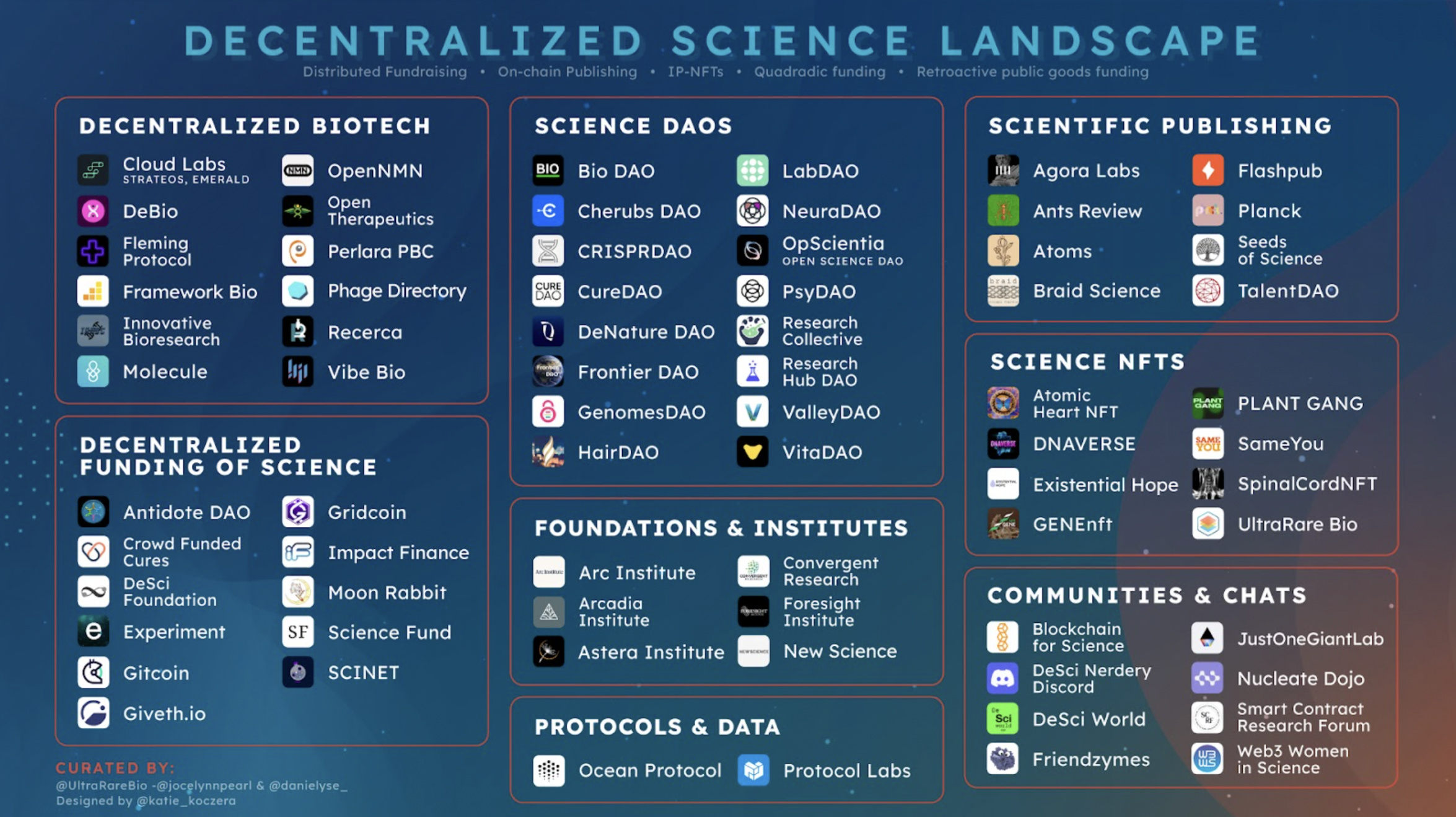
What Decentralization of Science Looks Like

The decentralization of science is a paradigm shift in funding, sharing, and monetizing science. Currently, scientists spend most of their time competing for increasingly inadequate funds. Unfortunately, a substantial amount of those funds go to the most famous researchers. Furthermore, the hypercompetitive nature of academia saps individual creativity and contributes to systemic biases that drive many scientists out of the field. DeSci offers an alternative to current science and supports decentralization over centralized control.

Creating a decentralized science organization will create more transparency and reduce redundancy-two key challenges of the scientific community today. For example, decentralized communities would enable peer review of scientific papers and award tokens to reviewers. 

A major problem with the current model of centralized science is the inability of participants to determine the course of the research. It is also obsolete and unable to take in decentralization at scale. Instead, scientists can choose to design a decentralized system in which they have greater influence over the final product than the people who will use it.

Blockchain Technology for Science

Scientists can use the power of blockchain tools, such as smart contracts and tokens, to boost collaboration and communication in scientific endeavors. A decentralized science technology, known as DeSci, is a mashup of blockchain and Web3 technologies. The technology’s decentralized nature can facilitate research and make scientific research easier and more accessible to the public. The future of science is here, and blockchain technology has the power to make it happen.

Clinical trials are a perfect fit for blockchain technology since they allow immutability, traceability, and varying access levels. Using blockchain in clinical trials can also facilitate the collection and management of patient consent, track patient samples, maintain trial protocols, and ensure there is secure communication between trial sites. IBM signed an initiative in 2019 to manage clinical trials in Canada. Furthermore, Triall is developing an application that integrates blockchain with clinical trial protocols. This technology is gaining acceptance in the scientific community.

The role of NFTs in Science

A DAO is a blockchain-based organization that allows scientists to sell their tokens to outside individuals. The token owners decide the future of scientific research and own the intellectual property generated from their work. Scientists submit proposals to VitaDAOs to conduct research. DAO members evaluate these proposals to determine whether the proposed research is methodologically sound. Creating a DAO devoted to one subject and selling it to multiple users is possible.

Many internet blogs have debated the role of NFTs in science and research. There are some concerns, however. First of all, NFTs can’t replace original manuscripts. Therefore, digital copies of scientific papers will be useless without an original manuscript. Second, NFTs may not be a perfect medium for research. However, digital manuscripts can serve as a commemorative artifact of patent disclosure. For instance, the original manuscripts of scientific papers are sometimes very valuable. Some famous scientists have even paid millions of dollars to acquire the manuscripts of these famous scientists.

NFTs in 2022, Will this Year Still be an NFT Year like 2021?

NFTs-in-2022,-Will-this-Year-Still-be-an-NFT-Year-like-2021

Non-fungible tokens are the new-age digital assets that represent real-world objects. It could be anything from videos, JPG images, artworks, or music, to name a few. They are bought and sold online, often using crypto coins, and they are generally encoded with the same underlying software as many cryptos. Each NFT has unique identification codes and metadata.

Even though they’ve been around starting around 2014, NFTs are now acquiring a reputation since they are becoming an undeniably famous method for purchasing and selling digital artwork.

Assortments of variables have added to the ascent of NFTs, including the connection with the metaverse and celebrities hopping on the NFT bandwagon. NFT sales have taken off, with some notable ones rounding up millions of dollars. The Bored Ape Yacht Club (BAYC), The Sandbox, and CryptoPunks are only a couple of the undertakings that have transformed the NFT industry, both imaginatively and monetarily.

As of 2022, sales of the Bored Ape Yacht Club NFTs have totaled over US$1 billion, and celebrities have purchased these non-fungible tokens.

Despite being among the first NFTs, CryptoPunks were not initially highly coveted. However, their prices began to skyrocket in 2021 as the broader NFT space expanded.

The year was inarguably lucrative for those in the hyped space, raising our debate on the NFT trends in 2022. Will it be another NFT year? Read on for a complete insight into the year 2022 for NFTs. 

The Art Industry

The rise of NFTs in the art industry has inevitably sparked debate about where art derives its value, the nature of artworks ownership, and what the creative industry holds in store for 2022 and beyond. 

Notably, digital art appeal resurfaced when digital artist Beeple’s sold for a record-breaking $69 million at an NFT auction. For the first time, the origin and ownership of digital data became verifiable and traceable under blockchain technology.

The buying and selling of tokenized pieces of real-world art from renowned painters eventually became the trend that is spreading over to 2022.

Tokenization allows institutional and individual investors to dive into the high-value digital assets, committing just a fraction of the whole price.

For instance, Indian artists made a splash in the NFT art scene in February 2022, which saw Gobardhan Ash hold the first NFT marketplace auction in the country. Ash is just one among the millions of art fans opening their eyes to the billion-dollar industry, focusing on tokenizing their works of art.

Metaverse

In 2021, gambling and video gaming proved to be among the top areas where non-fungible tokens were thriving. Gaming enthusiasts had blockchain-based play-to-earn games that reward players with in-game prizes, and NFTs too ushered in a new era of video gaming. For the first time, players can own the in-game assets and even sell on NFT marketplaces like OpenSea, for a profit. 

Axie Infinity, utilizing both NFTs and cryptocurrencies, was possibly the most famous game in 2021. Axie’s NFT market outperformed $1 billion in trading volume, and everyday dynamic player counts exceeded 1 million. Axie additionally tokenized its characters, requiring players to buy somewhere around three Axie NFTs before they could start playing. With a gaming population of over hundreds of million and one of the world’s biggest crypto markets, it’s inevitable before we witness an NFT gaming insurgency.

Raising the Fundraising Bar

Generally, in any industry with huge cash rewards, large investors, and valued things available for anyone, there is space for a noble cause. With the world finding peace with the advantages of tokenization, raising capital fast for startups has become a noteworthy contribution of NFTs. 

Utilizing shrewd agreements to plan NFTs to give cash to a valuable course naturally opens up more altruistic opportunities. Blockchain innovation gets NFTs and brilliant agreement calculations by giving a straightforward, freely recognizable information base that guarantees finances arrive at chosen foundation associations. Furthermore, crypto-based altruistic installments have lower exchange expenses and short repayment periods.

Social Communities

Lately, you might have seen an abrupt ascent in Instagram or Twitter profile pictures being some variety of a monkey, a giraffe, or some astounding creature version. You can chalk that too to NFTs. 

In January 2022, Twitter declared that clients can now trade their profile pictures as NFTs, while Meta quickly got on board with that fleeting trend. To beat the issue of ‘right snap and save,’ virtual entertainment organizations are thinking of some kind of identification to distinguish transferred pictures from NFTs confirmed inside the client’s cryptographic money wallet.

Also, there are metaverse social clubs and networks claiming a similar artist’s NFT is the shared factor. The Shibossh Social Club-a, a selective exclusive hangout for Shiboshi NFT proprietors, is a metaverse social club with an assortment of the north of 10,000 NFTs. For Example, other NFT assortments, the Bored Ape Yacht Club (BAYC), give social advantages to their individuals. NFTs will drive get-togethers of things to come.

Disrupting Industries

Due to the key NFT element of tokenization of unmistakable resources, plenty of conventional enterprises face major blockchain interruption sooner rather than later. Music and films are two of the greatest businesses promoted for a makeover from the effect of NFTs. 

Audience members will want to drop in and answer or deliver their music on stages in and across the metaverse. NFTs on the blockchain will compensate crowds with advantages such as early deliveries and extra tracks. In the interim, streaming has emphatically changed content conveyance in show business and music. NFTs have opened up a different station to the market, stock, and crowdfund film and TV projects. 

Author’s Take

NFT’s value is based entirely on what someone else is willing to pay for it. Therefore, demand will drive the price rather than fundamental, technical, or economic indicators, which typically influence stock prices and generally form the basis for investor demand.

The growth of the NFT market during 2021 was remarkable, with more investors than at any other time capitalizing on the trend of owning digital art. This trend gives no indications of halting in 2022, with a wealth of exciting NFTs filling in esteem and substantiating themselves as valuable resources on their own.

How Investors Can Build Sustainable Incomes in the Metaverse

How-Investors-Can-Build-Sustainable-Incomes-in-the-Metaverse

The Metaverse is becoming a household name, especially within the crypto media. It has gained the recognition that most other top assets yearn to have. Top companies, including Facebook, Adidas, Nike, and many others, have planned or invested in the Metaverse. Facebook, for instance, even changed its name to Meta as it plans to go deeper into the Metaverse.

A metaverse is a digital form of reality. It uses AR, VR, and other technologies to support human interactions across the globe. Basically, with the Metaverse, you can interact with other people from the opposite side of the world in real-time and even feel the environment. 

Aside from fostering human interactions, the Metaverse has also been a way for investors to build sustainable incomes. But how? Here are five major ways. 

Play to Earn in Metaverse!

One of the ways to generate sustainable incomes in the metaverse space is Play to earn. The concept of P2E has majorly popularized the idea of the Metaverse. The gamers play a game within the Metaverse and earn some income.

In the Metaverse, you can find different types of games, either 3D or 2D. In P2E, the gamer is often required to purchase an NFT or multiple NFTs to start playing. 

When playing, there are different ways to earn some income. For instance, gamers can garner in-game collectibles and sell them in the marketplace. Winning games and leveling up could also generate rewards for the gamer. P2E combines NFT lending, staking, and many other activities that can help build sustainable incomes. Games like Splinterlands, Gods Unchained, Town Star, Thetan Arena, and many others are good P2E games. 

Providing Metaverse Related Services

The Metaverse was conceived just a few years ago. Technologies used in Metaverse require some degree of actual knowledge of the blockchain space. Hence the need for service providers within the Metaverse space. These service providers help make the work of rookies and experts easy.  

One of the most prevalent services is cyber security. Blockchain projects lose millions annually from attacks. Therefore, providing cyber security assistance to Metaverse projects is a marketable service.

You can offer creative services. For instance, Metaverse projects need whitepapers and other pieces of content. Hence you can invest in creating such and make a fortune. You can also write other pieces of content about Metaverse for third-party web pages.

Developers can get jobs to create avatars for Decentraland, Sandbox, and other Metaverses on Fiver.com. In the Metaverse, people want to build things on their lands. They include structures like Casinos, museums, malls, theme parks, and others. 

Landowners will repeatedly need service providers for such constructions, and as such, you can make money by providing the services. Building and construction works require some knowledge in creating NFTs. 

Minting and Selling NFTs

Another excellent way to earn and make sustainable incomes within the Metaverse is by minting and selling NFTs. NFTs are among the most fundamental assets within the Metaverse. Why?NFTs can produce special characters within the Metaverse as a unique class of assets. 

The Metaverse allows you to create personalized avatars and perform other tasks in the Metaverse. These avatars are NFTs. Wearables in Decentraland are NFTs; you can sell such. Why don’t you invest in creating Decentraland wearables?

You can also purchase the already minted NFTs and sell them. Once you purchase an NFT, it gains value, and you can sell it to the next person at a profit. Hence, creating NFTs or trading them within the Metaverse is an excellent way to generate sustainable incomes. 

Virtual Real Estate

Yes, real estate has, for decades or maybe centuries, been one of the best ways for investors to build their wealth. It is one of the few investment opportunities that offer perpetual profits, regardless of the situation around financial markets. 

Now, the concept of real estate is already in the Metaverse, with the estates being referred to as spaces. The Metaverse has pieces of land. After purchasing your parcel of land in the Metaverse, you can rent it out for perpetual gains. Buying and selling or renting land is an excellent option to earn income in Metaverse. 

But, there is always the option of developing this land. You can split the land into cubes and develop it with buildings like art exhibition centers, retail shops, museums, lounges, and many other spaces. The land is an NFT. The developments are also NFTs. Trading or even renting these NFTs could also be a good income source.  

Invest in Metaverse Tokens

Finally, invest in metaverse tokens. So, metaverse tokens are types of crypto tokens that represent a small share in a particular metaverse. Holders of such tokens can trade them out and hold them as the prices continually rise. 

For instance, in the Decentraland metaverse, a native crypto token is MANA. Sandbox also has its native token, SAND, which trades in markets and helps in different activities. These tokens mean the holder can participate in governance and development tasks in many cases. 

Here is a list of all metaverse tokens, and some research can show you where you can trade them. You can follow the prices charts of those tokens in Coinmarketcap, and you will notice that the coins are suitable investments. For instance, MANA doubled in price between 2021 and 2022, while SAND nearly tripled.

Conclusion

This guide has discussed the most popular ways investors can build sustainable incomes within the Metaverse. They include P2E, selling NFTs, virtual real estate, trading metaverse tokens, and offering metaverse support services. The five ways are proven to bring good incomes. You can diversify your investments by choosing multiple investment options discussed.

However, the Metaverse is still a new concept. There will be more openings for people to participate, invest, and earn sustainable incomes within the Metaverse in the next few years.  

How Content Creators Can Benefit From NFTs

How-Content-Creators-Can-Benefit-From-NFTs

Using NFTs to monetize digital artwork is a powerful new way to generate revenue for creators. NFTs are social media tools that solve a common problem-“secondary sales.” Artists and content creators can now monetize their audience in traditional ways. For example, artists such as Beeple and 3LAU are developing new business models to help NFT owners generate income from their content. Moreover, musicians like Kings of Leon have monetized their fans through traditional methods. Entrepreneurs such as Tom Bilyeu, host of the popular Impact Theory podcast, are developing new ways to benefit from NFTs.

Content Creators and NFTs

NFTs Are A New Way To Monetize Digital Artworks

The newest trend in monetization is NFTs or networked tokens. It allows artists to sell their digital artworks directly from their creators. This makes it easy to distribute and store them without needing a physical asset. Hence, making NFTs a great way to promote art.

The concept behind NFTs is that the art assets traded on the NFT network are verified using blockchain technology. This records transactions and provides proof of ownership to buyers. The digital art world is experiencing a booming market for digital assets. NFTs enable artists, influencers, and sports franchises to monetize these products easily. The technology has met the art world’s authentication needs by permanently linking a digital file to its creator.

NFTs Are A Social Media Tool

If you’re not using social media for your content creation, you’re missing out on a valuable tool- “NFTs.” These are networks of other creators who create content. It’s possible to collaborate with them from virtually anywhere in the world. For example, Instagram offers a tool that allows creators to collaborate with other creators in other locations. TikTok has a similar tool, as do other video platforms like YouTube.

Marketing your NFTs on social media is similar to marketing any product. To succeed with your NFT marketing efforts, you must first build your target audience, engage your followers, and then convert them into paying customers. If you develop a solid social media strategy early on, you’ll increase your chances of success. There are numerous social media platforms where you can start your NFT marketing campaign.

NFTs Solve The Secondary Sales Conundrum

Content creators face a problem when trying to sell their works to second-hand users. The emergence of digital art has shuffled the deck on what is valuable. Therefore it creates the same problems as traditional art: confusing hype, the whims of wealthy collectors, and even theft. In fact, digital artists already have to contend with scammers who steal their art and sell it as user-generated T-shirts. In addition, NFTs pose yet another challenge, requiring content creators to check their rights and carefully evaluate their rights.

An NFT can solve the problem of the Secondary Sales dilemma by letting content creators profit off their assets while giving them greater autonomy over their earnings. Because NFTs contain unique codes, they can generate higher profits from the resale of digital creations. But these solutions aren’t without drawbacks. NFTs carry legal implications relating to intellectual property rights, taxation, and financial regulation. 

NFTs Are A Gamechanger

Content creators should be making money off their creations because traditional business models profit from them. You can easily plagiarize anything on the web, but with NFTs, you can sell your content directly on a digital marketplace. This way, you retain control over your content while also transferring ownership rights to the buyer. But before you start selling your NFTs, you should know the pros and cons of this new method of monetizing your audience.

NFTs attract potential buyers due to their uniqueness. Buyers can purchase them for personal use and later sell them for a profit. There are different types of NFTs, which are marketed differently by different content creators. Visual artist Beeple, for example, has sold an NFT for $69 million and has built up a following of over three million on Instagram. Another popular digital artist is Daniel Allan, an electronic pop artist who has most of his songs sold for thousands of dollars.

NFTs Give Creators New Rights

The NFT industry has emerged as a bright shiny new form of creative intellectual property, but it is far from a perfect formula. While NFTs give creators new rights and an entirely new source of income, they also bring a new set of challenges. For example, many creators sign contracts giving away their intellectual property (IP) without protection, while Hollywood exploits others at their own risk. 

NFTs Support Purpose-Related Activities

The creator economy and NFTs will support purpose-related activities and content partnerships and benefit consumers and brands. Brands will play an important role but must acknowledge that consumers may not be familiar with blockchains or cryptocurrencies. Therefore, brands must help content creators control their messages while still providing value to their audience to engage consumers. A recent study found that more than half of consumers haven’t even heard of blockchains.

The NFT is also valuable when used to authenticate access to digital experiences. Microsoft, for instance, launched a game celebrating women in science, which rewards players with NFTs to unlock secret games within Minecraft. Likewise, recording artist RAC issued his social token, $RAC, which grants token owners access to a private Discord group and early access to merch drops. Ultimately, this tokenized access helped make it possible to connect with the artist and his fans through his NFT.

Copyright Theft Is A Problem For NFTs

Copyright-Theft-Is-A-Problem-For-NFTs

The legality of selling NFTs based on original artwork is not entirely clear. For one thing, NFTs is an unauthorized copy, but they do not change the work’s meaning. While some crypto enthusiasts argue that minting and selling an NFT is no more a crime than taking a photo of the Mona Lisa, this argument is not entirely persuasive in court. If you set an NFT as your profile picture, you’re likely to be caught in a legal gray area.

NFTs pose many legal issues, including copyright theft. Owners should make sure their brands are protected from copyright thieves and take measures to protect their intellectual property. Copyright theft is a significant problem in the NFT industry, as it has resulted in numerous legal disputes. 

Copyright Theft Is A Problem For NFTs

Digital Nature Of NFTs

Unlike the tangible nature of works of art, NFTs are digital, and because they can be duplicated on the Internet, they raise issues relating to ownership and copyright law. While most people may not understand these issues, they are important for anyone investing in NFTs. You also need to know how the technology can work before committing to a particular product. The following are some examples of the issues that can arise when NFTs are used to purchase trademarked works.

First, NFTs are metadata files. While the owner owns the NFT of a Babe Ruth baseball card, the corresponding copyright of the Pikachu card does not belong to the owner. A derivative anime cartoon created from the Pikachu card does not belong to the owner. In similar ways, the owner of an NFT does not own the original underlying item or its copyright.

Tokenization is a problem for NFTs, particularly when the original works are public. Tokenization requires the author to grant consent to the copyright holder. In addition, separating an NFT token from the original work alters the nature of the work. Since copyright protection is based on the whole work, it is impossible to separate a copyrighted work from the NFT token.

Whether an NFT violates copyright protection is illegal or not is another issue. Infringement is when someone uses the work without authorization. This may include printing, placing in a digital frame, or sharing it on social media forums. A digital work is a part of the Ethereum blockchain, and the transactions in the blockchain are public. Despite the legal complications of copyright theft, NFTs remain a viable solution.

Lack Of A Strong Legal Framework In The NFT Market

Although NFT is a fairly new technology, many users still don’t understand copyright protection, and they have difficulty figuring out how to protect their intellectual property. This is especially true for computer code, which can be difficult to assign. In addition, a lack of a legal framework in the NFT market makes copyright theft even more likely.

Artists, creators, and investors are concerned that the lack of a strong legal framework will make it easier for criminals to exploit their intellectual property rights. In fact, the legal actors are more interested in molding the crypto art world into the traditional art world, which has many inequities and limitations. One strain of thinking suggests removing artists’ rights to royalties. If the NFT market ever reaches a mature state, it will need to eliminate these agreements. Instead, NFTs should be treated as digital personal property, and investors can easily access them.

One of the biggest issues with the NFT market is that buyers are often not aware that they are purchasing copyrighted artwork. Moreover, they assume they are buying the underlying work of art without knowing that they are actually buying the metadata associated with the copyrighted work. These purchases often only grant the purchaser a token of the copyrighted art, but the original creator retains exclusive copyright rights.

While it is possible to sue for infringement of a copyright in an NFT, this is highly unlikely to happen, as the transaction is often purely virtual. The owner of an NFT may also not be able to bring a claim if another person created it. Moreover, in some cases, the transaction can be fraudulent. The NFT platform may be liable for copyright infringement in such a scenario.

Potential For Piracy

As the market for non-fungible tokens explodes, the question of piracy is inevitable. But how big of a problem is NFT piracy? The Italian music industry’s Digital Content Protection agency recently announced the creation of a new unit to monitor unlicensed activities. The move comes in the wake of the HitPiece debacle, in which users copied artwork from the record industry and arguably exploited publicity and trademark rights.

Piracy is rampant on the NFT market, and NFT artists must be aware of this potential snatching before it becomes a problem. While many artists are concerned about piracy, the truth is that NFTs are not copies of the original artwork.

But even the best NFTs are vulnerable to piracy. One startup sued for copyright violations and allegedly created NFTs by using their music. Another company, OpenSea, said it is actively fighting plagiarism. Another anti-piracy company called Digital Content Protection is sweeping web 3.0 resources to root out bad actors and rug-pullers. While it’s too early to tell what NFTs will do, it’s worth considering.

While NFTs offer a new outlet for artists and creatives, they have also made it easy for pirates to mint knockoff copies with cryptocurrency and sell them to unsuspecting collectors. Most of these knockoff NFTs are identical to the real thing, so they’re difficult to detect. The shady actors only need a single unwitting buyer and a substantial payment to disappear into anonymity.

DMCA Takedown Requests for Copyright Theft

DMCA takedown requests are a form of dispute resolution involving digital content. This United States law applies to online games, videos, and other NFT content. It allows copyright owners to file these claims against the site responsible for the content. The DMCA is an important tool for copyright owners since it protects them from infringement by other parties. NFTs take advantage of DMCA takedown requests to remove infringing content from the Internet.

To combat the problem of infringement, NFT creators must file DMCA takedown requests to the right parties. Artists must file takedown notices to ensure that their copyrights are properly transferred to the platforms. Tokenization of other artists’ work is an ongoing trend, but Belton believes this trend is not likely to last, as NFTs will always remain a separate unit.

NFTs have also been the source of plagiarism since early 2021. Last fall, artists started a Twitter community called NFTTheft, highlighting fraudulent listings and copyright theft. The administrator requested anonymity because of fear of doxxing and crypto-evangelist backlash. 

To protect artists’ rights, NFT creators should first obtain permission from the copyright owner. Under the law, copyright ownership includes bundles of rights. This includes reproducing, preparing derivative works, distributing copies, and publicly performing and displaying work. In the case of music, the NFT creator would have to obtain permission from the musician to sample the work or embed the remix on their website. Any violation of these exclusive rights would constitute a copyright infringement.

NFT Hype Cools Off! Is the Non-Fungible Token Market Declining?

NFT-Hype-Cools-Off.

The usage of blockchain technology seems to always be undergoing a transformation, with a huge increase in the number of implementations and applications being produced at an alarming rate. One of these many applications is the use of NFTs, which are digital assets that are verifiable through the use of blockchain technology.

NFT is an abbreviation for a non-fungible token, which refers to a one-of-a-kind digital asset that cannot be traded for any other NFT. As a result, every NFT is a unique piece of artwork. 

NFTs are exchanged from one person to another via the use of blockchain technology, which produces a digital footprint from a seller to buyer that serves as proof of the transaction’s validity. NFTs, unlike physical art, cannot be damaged, lost, or destroyed since they are recorded on a blockchain. The majority of NFTs are built on Ethereum’s blockchain, however, there are others such as Cardano, Solana, and Binance Smart Chain.

NFTs are well-known in the crypto community and the art world. Although NFTs have existed since 2014, they gained significant popularity last year. Everything began with the $69.3 million sales of a work of digital art titled “Everyday: The First 5,000 Days” by digital artist Mike Winkelmann, which made him one of the most expensive artists in the world. 

NFT sales totaled around $2 billion in the first quarter of 2021 alone. According to a report from nonfungible.com, a website that tracks the sales history of the NFT market, NFT trading reached a total volume of more than $23 billion last year, a rise of more than 21,000 percent over the previous year’s total volume of $100,000.

NFT Hype Fading Off

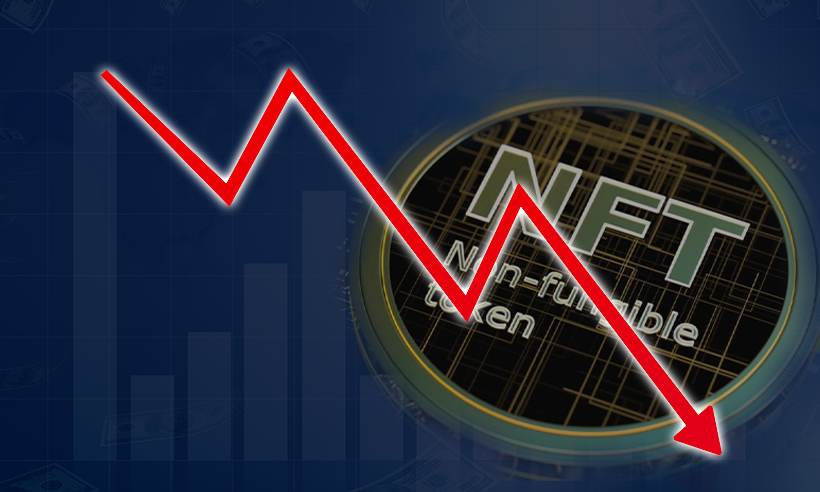
Despite the fact that the NFT buzz was practically unprecedented in the history of the digital art world, it seems that the euphoria is now fading, and the trading volume has returned to levels similar to those before the hype began. The volume of trading is an important statistic for assessing the strength of the NFT market, and it is currently at its lowest since June of last year.

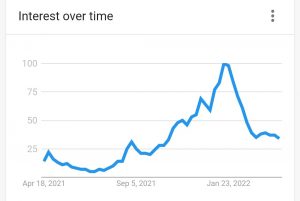
The graph below from Google Trends shows that the number of NFT mentions in searches has also been on a decline for a while.

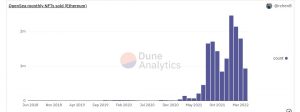
However, although the number of businesses working on NFTs continues to expand and usage continues to rise, the weekly and monthly market sales have started declining. Furthermore, sales on prominent NFT markets like OpenSea and Binance’s NFT marketplace are becoming less active. According to nonfungible.com, the weekly market volume of NFT transactions has dropped to roughly $176 million from its $924 million value in the last week of January.

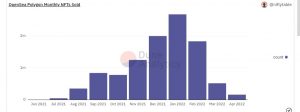
The pictures below show the decline in monthly NFTs sold on OpenSea, the biggest NFT marketplace.

Source: Dune Analytics

Is the Loss of Interest Temporary?

Although recent international events and the decline in the crypto market may be contributing to the drop in attention paid to NFTs, it is possible that the hype is just fading down after a period of delight and a general cooling in enthusiasm. In addition, it is possible that many who jumped into the hype to earn quick money are now starting to have a more realistic view of the sector.

However, since the NFT market is difficult to predict, it is possible that this decline in interest will be short-lived, given that the use of NFTs is still increasing and a large number of individuals and businesses are still expressing strong interest.

10 Misconceptions Regarding NFTs

10-Misconceptions-About-NFTs

Non Fungible Tokens (NFTS) are arguably the most interesting product in the blockchain space at the moment. Since the first-ever NFT, Quantum – sold last year for $1.4 million – was minted by Kevin McCoy in 2014, no one would have predicted, even with the clearest of a crystal ball, that the total value of all NFT transactions would significantly increase by 21,350% to more than $17 billion in 2021, from $82.5 million within the last one year from 2020 – 2021.

What is NFT?

Non-fungible tokens or NFTs as it is mostly called are unique decentralized tokens stored on the blockchain (mostly on the Ethereum blockchain) and cannot be exchanged with something else like fungible tokens like Bitcoin. They are digital versions of physical assets that can be sold and traded on the public blockchain.

There are over 5 million NFTs traded daily under different categories. Some of the categories include music, artwork, collectible items/trading cards, sport, fashion, gaming, memes, and more. Last year, the average price of an NFT rose from around $150 to $4,000 as interest in the digital world of art auctions exploded.

To paint a more vivid picture of the burgeoning NFT market, 2.4 million NFT were sold on the OpenSea platform alone, the biggest NFT marketplace, in January.

Examples of NFTs include CryptPunk, the popular digital collectibles of unique characters, NBA Top Shot, collectibles of top Basketball videos, collections of digital artworks like Beeple’s “Everyday: The First 5000 Days”, GiFs like Nyan Cat, Jack Dorsey’s first-ever tweet which was sold for $3 million, Decentraland, CryptoKitties, Cryptovoxels and millions more.    

NFT Misconceptions

There’s been a lot of distrust towards NFT reminiscence of the early 90s dot.com boom. This has created growing myths and misconceptions around the NFT space. Fortunately for NFT advocates, these myths have by no means derailed its adoption.  

Here are 10 misconceptions about Non-Fungible Tokens that you should stop believing:

1. NFT is a Type of Cryptocurrency

Cryptocurrencies are fundamentally different from NFTs. Their singular similarity starts and ends as a blockchain creation. As earlier stated, NFTs are Non-fungible, that is they cannot be exchanged, replaced, or divided. They are unique in their identity. For example, a digital painting of the Last Supper is a unique asset that cannot be replicated or exchanged. The same goes for any other artwork, music recording, or gaming items. 

On the other hand, cryptos are fungible assets. That is they can be exchanged and replaced. Examples include Bitcoin and Ethereum. Their singular units can be exchanged for an equivalent amount of the dollar which currently goes for $42,000 and $3,000 respectively.     

2. NFTs are Another Fraudulent Ponzi Schemes

Like cryptocurrency assets including Bitcoin and others, the idea behind NFTs is to decentralize the structure of owning digital artworks. Unfortunately, the millions of dollars some of these NFTs go for has made some unsuspecting victims fall for swindlers who push the false ‘get quick rich’ narrative with NFTs. This has given NFTs a somewhat bad reputation.

But if you are familiar with how blockchain technology work, it is practically near impossible for anyone to create an artwork, mint it as an NFT, give it a high price tag and sell it for thousands or millions of dollars! Most valuable NFTs are created by established artists who are known for their physical artworks. 

3. NFTs Are Complex to Understand

The buzz around NFTs has created some form of complexity for potential new users to keen observers who are interested in riding on the trend. But it is easy to grasp the fundamentals of NFTs you need to stay above the noise. 

NFTs simply work like owning a physical asset where ownership is determined by the rules governing the blockchain. You own a physical house based on deeds of titles just the same way you own a digital asset based on unique identifiers on the blockchain that gives the asset value and security.

4. NFTs Are Bad Investments

It’s easy to jump to this conclusion due to the highly speculative nature of most of the NFTs traded. Popular NFTs have seen their prices skyrocket to an all-time high that investing in them isn’t such a good idea. But there are still loads of NFTs that are still in their infancy and will give you increasing value on your investment in the long run.

5. NFTs Production ar Harmful to the Environment

There’s a bit of truth in this. The blockchain NFTs are created to consume quite a lot of energy. For example, the Bitcoin network generates so much energy that amounts to the emission of emitted an estimated 41 metric tons of CO2. 

But not all NFTs are created on the part of the blockchain that consumes this huge energy. NFTs produced on the Ethereum blockchain consumes way less energy. Besides, Bitcoin emits way less CO2 than the production of heavy metals like gold. 

6. The NFT Market is Easily Accessible With a Phone or Computer 

While most NFTs are built on the Ethereum cryptocurrency, the second largest after bitcoin, some are built on newer cryptocurrencies that are not as popular. If the underlying cryptocurrency is abandoned, then there will no longer be anyone “mining” it or providing computational power to create new transactions or entries in the ledger. 

This would make that market entirely inaccessible, even if two willing parties wanted to make a trade.

7. An Original NFT Cannot Be Copied

It is impossible to steal an original NFT, but nothing prevents anyone from copying the file to which the NFT put up for auction is linked and creating another NFT copy. These copied NFTs are traded on specially created marketplaces.

8. When You Buy an NFT, You Are Buying a Digital Work of Art

When you buy an NFT, you are not buying a digital work of art or that $3 million Jack Dorsey tweet, you buying a token certificate, which may guarantee your exclusive ownership rights, or may not guarantee anything other than the ability to own a unique digital token.

9. NFTs are Expensive and Unaffordable

There is no doubt that the prices some of these NFTs go for are astronomical; A Coin for the Ferryman, an artwork created by an artist known online as Xcopy was sold for a $6 million work of Ethereum in late 2021, CryptoPunk #7804, a digital art collection of unique characters went for 4200 Ethereum, about $7.6 million at that time, Human One, another artwork that was sold for close to $30 million last year and a few others.

But these expensive NFTs are only a fraction of the NFT ecosystem. There are still a lot of NFTs that are very affordable to purchase by all.

10. NFTs are All About Artworks

It’s easy to think that NFTs are all about digital artworks like paintings, GIFs, memes, and Tweets with mispronounced words given the amount of hype and money behind digital art NFTs right now. 

NFTs cut across virtually other sectors including sport, music, films, gaming, and even the adult film industry. And these sectors are beginning to gain massive traction with tokens like Axie Infinity, WarNymph, and NBA Top Shot sold for millions. 

Conclusion

NFTs are the real deal in the blockchain space at the moment. If you are a newbie looking to invest in the growing and disruptive crypto space, look no further than NFTs and the misconceptions around them shouldn’t stop anyone from jumping on the NFT bandwagon.

NFTs Instrumental To Bringing DeFi To The Masses

NFTs-Instrumental-To-Bringing-DeFi-To-The-Masses.

The Decentralized Finance (DeFi) ecosystem has witnessed enormous growth and adoption over the last several years. DeFi’s Total Value Locked (TVL) has skyrocketed from nothing in 2018 to over $200 billion in 2022. Ethereum alone has over 4 million users, with an 8x surge in 2021 alone. The excitement around DeFi is palpable. Young investors are inspired by their peers’ historic success, while others wonder what this means for the future of finance.

DeFi has been largely successful. However, its inability to include some of traditional finance’s more appealing features has kept it from completely breaking into the public. Take fixed interest rates, for example, which are almost non-existent in DeFi. Retail borrowers and lenders actively search for fixed interest rates to build wealth steadily over time. To avoid this, DeFi’s floating interest rates create a riskier environment that, while lucrative, is unsuitable for the average investor.

In addition, there are concerns about collateralization, liquidity, and security. Even though these assets have a lot of upside potential, moving them around and converting them to various products may be difficult. Furthermore, investors may encounter many roadblocks. Scams, hacking, and digital theft remain major roadblocks for DeFi.

NFTs Might Be Instrumental To Bringing Defi To The Masses

NFTs: The Unusual Solution!

Most people associate NFTs with freshly minted bitcoin billionaires splurging $250,000 for a cartoon ape. In 2021, NFTs were highly sought after in the art and promotional goods collecting fanciful worlds. Meanwhile, the underlying token standards offer a clean slate to build and deploy more complex financial products on DeFi. This is because NFTs can take any data and give it tangibility by cryptographically distinguishing it from any other batch of data. This could either be a 3D model, a document, an image, or basically anything. Anyone who does not have the necessary cryptographic keys cannot edit or access the encoded information.

NFTs aren’t just for speculative crypto assets. They may have special qualities relating to their functionality and inherent value. For example, this technology may tokenize existing financial products on the blockchain. This will offer investors a new way to access wider possibilities.

DeFi can also employ tokenized financial assets as collateral to obtain loans. Due to tokenization, the instrument’s newfound solidity makes it immeasurably more appealing to lenders than other digital assets. Thus its role as collateral gains more weight and opens up new possibilities. DeFi’s cover protocols that protect investors’ assets from scams, fraud, or cyber-attacks may include Financial NFTs.

Tokenization can tokenize commodities, real estate transactions, index funds, loans, and virtually anything else. This can help attract mainstream institutions, better equipped to operate in unfamiliar territory. NFTs enable new products, payment systems, supply chain systems, and other features that could help DeFi gain mainstream acceptance.

A New Type of Trade Finance Is Emerging

Even though financial NFTs model after traditional financial instruments, they offer all the advantages of being hosted on a blockchain. This means they are sure to reflect their underlying resources accurately. Furthermore, they can be delivered instantly anywhere in the world for a small fee with protection from forgery, fraud, and theft. NFTs can make DeFi safer, more efficient, and more accessible in practically every way than traditional finance.

Furthermore, NFTs have a lot of potential in supply chain management. They may help consumers verify the origin of goods and services. You can trace a product’s full supply chain history from source to sale via NFT tagging. Also, there’s immutable and automatic documentation of every step along the way.

NFTs can help companies deliver products quicker. They can do this while reducing costs associated with supply-chain inadequacies. This includes strict regulatory frameworks, human error, fraud, and an excess of middlemen in trade finance, which typically slow delivery.

NFTs may hold the key to bringing DeFi to the masses. This is possible thanks to their ability to help build new products and protect the interests of investors and businesses.

Decentraland Project Review : Virtual World Owned by Community

Decenterland project review

Nowadays, people are spending more time in the virtual world in comparison to the real world. People are using mobiles, laptops for both work and leisure. An introduction to the 3D world will create a more immersive experience for people. Websites and applications where people spend most of their time are controlled by a centralized entity. People don’t have any control over these applications. Decentraland, unlike other social networks, games are not controlled by a centralized entity. The community owns and has full control over this shared virtual world. 

What is Decentraland?

Decentraland is a shared virtual world that is powered by the Ethereum blockchain. Its users can create content and monetize it. Users can pay for experiencing various applications in Decentraland. The community permanently owns the land in Decentraland and has full control over it. The ownership of land can be claimed by users through a blockchain-based ledger of parcels. Each portion of land can be identified by a set of cartesian coordinates (x,y). Landowners decide what type of content can be published to their land, content can be static 3D scenes, interactive games. All the land in Decentraland is an NFT, stored in an Ethereum smart contract. To acquire land in Decentraland, the MANA token is used. Digital goods and services can also be purchased by MANA.

How does Decentraland work?

Decentraland has built a framework for supporting shared virtual worlds. A decentralized ledger stores all the data of ownership of land, contents of each parcel of land and also provides a peer-to-peer network for user interactions. Users can participate in governance functions and can propose policies and vote on upcoming LAND auctions.

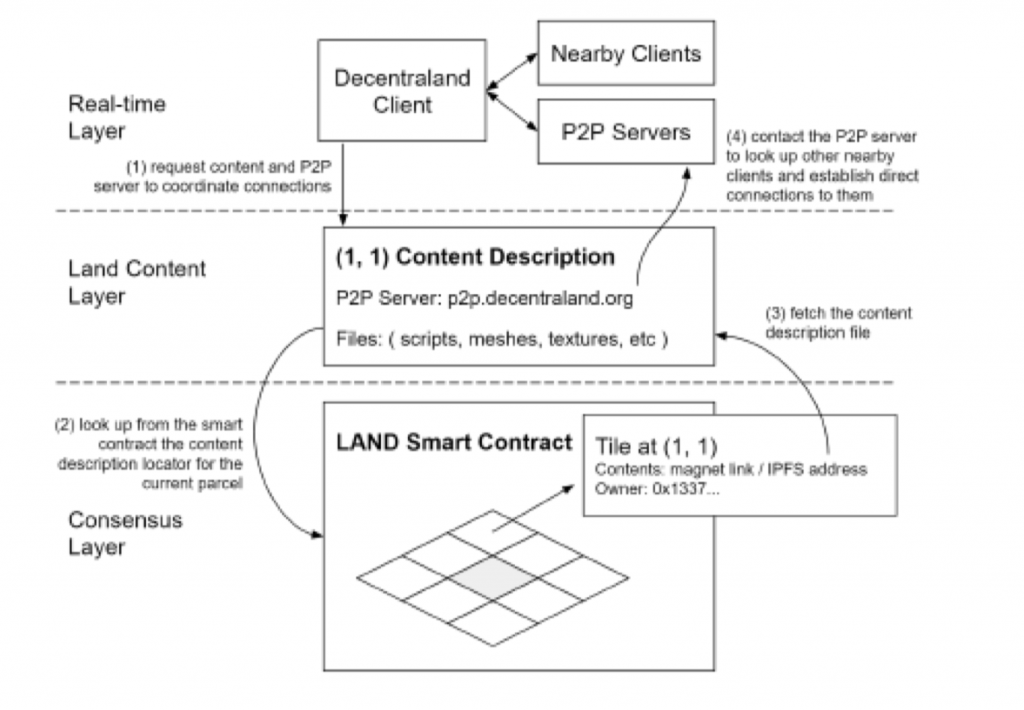
Decentraland’s protocol consists of three layers :

A consensus layer: This layer is used for tracking ownership of land and its content.

A LAND content layer: This layer uses a decentralized distributed system to download assets and for rendering content in the virtual world. 

A real-time layer: This layer is responsible for enabling users to connect with each other.


decentraland architecture

The above diagram shows the steps executed by the Decentraland client to provide the experience of a virtual world in a decentralized manner.

Each piece of land is marked by a unique set of cartesian coordinates. Content created by users can vary from 2D scenes to 3D scenes giving an immersive experience.  The consensus layer is responsible for tracking ownership of land, land content is referenced here as a hash of the file’s content. The content can be downloaded from IPFS or BitTorrent by using reference. The downloaded file of content contains a description of objects, sounds, textures, and other elements needed to render the content scene. 

Decentraland has two important systems which enable its economy to develop :

Payment Channel Infrastructure: It enables fast payment with low fees.

Identity System: It allows users to prove their ownership over their creations. 

Tokenomics


Decentraland has an ERC-20 token called MANA. It is used to buy, sell digital assets and can also be used for gambling in virtual casinos. It is also a governance token. Holders of MANA tokens can participate in governance functions. They can propose their own policy and can also vote on the different proposals. 

Decentraland is controlled by MANA holders through Decentraland DAO. The DAO owns the important smart contracts and assets such as the LAND contract, Estates contract, Wearables, Content servers, and Marketplace. 

1 MANA token gets you 1 vote and owners of LAND and Estates get 2000 votes.

The maximum supply of MANA tokens is 2.193 billion. As of writing this article, the circulating supply of MANA tokens is 1.32 billion, the market cap is 3.7 billion, and the price is 2.84 US dollars.

Applications of Decentraland

Content Curation 

Decentraland users can create content of shared interest of their neighbors. If a creator is living near a high traffic hub, then more users will drive to the creator’s content.

Advertising

Brands can drive users to their products, services, and events by using billboards to advertise in high-traffic hubs. Brands can create shared experiences to engage their audience so that users will be interested in using these experiences in their own land.

Digital Collectibles 

Digital assets are published, distributed, and collected by users on the blockchain. These digital assets can be traded easily by users in the Decentralnd. Rare or old digital assets are traded at a very high price. These digital collectibles are used to identify users and their land. 

Social

All the groups which are present in online forums, chat groups, discords can port their communities into Decentraland. People can form different communities on various subjects and can propose their policies through governance.

Conclusion

Decentraland has opened a new world of possibilities for internet users. Users can create their own content on a decentralized platform and can receive all the revenue generated by their content without giving any portion of revenue to the platform or any middleman. Internet users have full control over this virtual world and they decide how this virtual world operates and progresses. In the coming years, we will see many new innovative applications being created in Decentraland, providing mesmerizing experience to users.