Seven Reasons Why It’s Recommended to Hodl XRP

Hodl XRP

XRP is the native token of the technology giant company, Ripple. It was launched in June 2012. It is presently trading at $0.326. XRP has increased by 3.38% in the past 24 hours, which is a good rise amidst the current crypto market crash. Some of the reasons why is worth to hodl XRP are:

  • Increase in blockchain technology and cryptocurrency adoption.
  • Present return on investment
  • Relatively low volume in circulation
  • A possible rise in cryptocurrencies with banking products
  • Position of the community on CoinMarketCap
  • Possibility of a favorable judgement with its SEC lawsuit
  • Its price prediction data

Increase in Blockchain Technology and Cryptocurrency Adoption

The growth of the cryptocurrency market is worth watching. This rise is given demand for cryptocurrencies that has a tested history of resistance to zero decline. This is due to its longevity and lower volatility. Just like Bitcoin, Ethereum, and Litecoin with lower volatility, new investors in the industry are encouraged to start with them. XRP could be a good option due to its stand in reaching the unbanked and its very low transaction cost.

Present Return on Investment

Since the launch of XRP in June 2012 by the co-founders Chris Larsen and Jed McCaleb, it has had a return on investment of 5013% according to CoinMarketCap. Therefore, XRP initial holders will continue to gain. Also, investors that purchased XRP when it attained its current all-time low price of $0.002802 on July 7th, 2014, have received a 10617% return on investment. At the time of writing, this is worth $106.17 for each $1 investment.

Relatively Low Volume in Circulation

XRP is one of the top 8 cryptocurrencies, according to CoinMarketCap, with a low circulating volume. Its circulating volume is 48.343 billion XRP out of its 100 billion XRP maximum supply. It represents less than 48.4% of its maximum supply. This is comparatively lower than the top cryptocurrencies like Bitcoin and Binance Coin with over 90% of their maximum supply in circulation and Cardano with over 70% of its maximum supply in circulation. In a time of a bullish run, this low supply could favor the coins listed above.

A Possible Rise in the Demand for Cryptocurrencies with Banking Products

Irrespective of the position in some quarters that cryptocurrencies should be banned and that its volatility makes it similar to scams like ponzi schemes, there is still call for the creation of Central Bank Digital Currency’s (CBDC’s). This rise in countries that are to make favorable laws could lead to its adoption, thereby, giving a rise to the demand for cryptocurrencies with banking system. According to World Bank data, there are about 1.7 billion adults that are unbanked. With the present number of cryptocurrency users that is about 300 million, we can deduce that XRP might be in very high demand soon.

Position of the Community on CoinMarketCap

Another factor that could determine the future of a cryptocurrency is the sentiment in its Community. XRP Community on CoinMarketCap has been very robust and active. Many of the users believe that it is worth to hodl XRP. This attitude has made the coin to be on the watchlist by over 1.522 million users.

Possibility of a Favorable Judgement in the SEC Lawsuit

With the outlook of the present suit between the Security and Exchange Commission (SEC) on whether XRP is a security token could end up favorably. Some investors prior to now thought that the price of XRP would decline heavily due to the suit. However, XRP price has shown good growth during the time of a general market bullish run. The quest by the XRP team to see it resolved soon could surge the price of XRP for its long-term hodlers.

Its Price Prediction Data

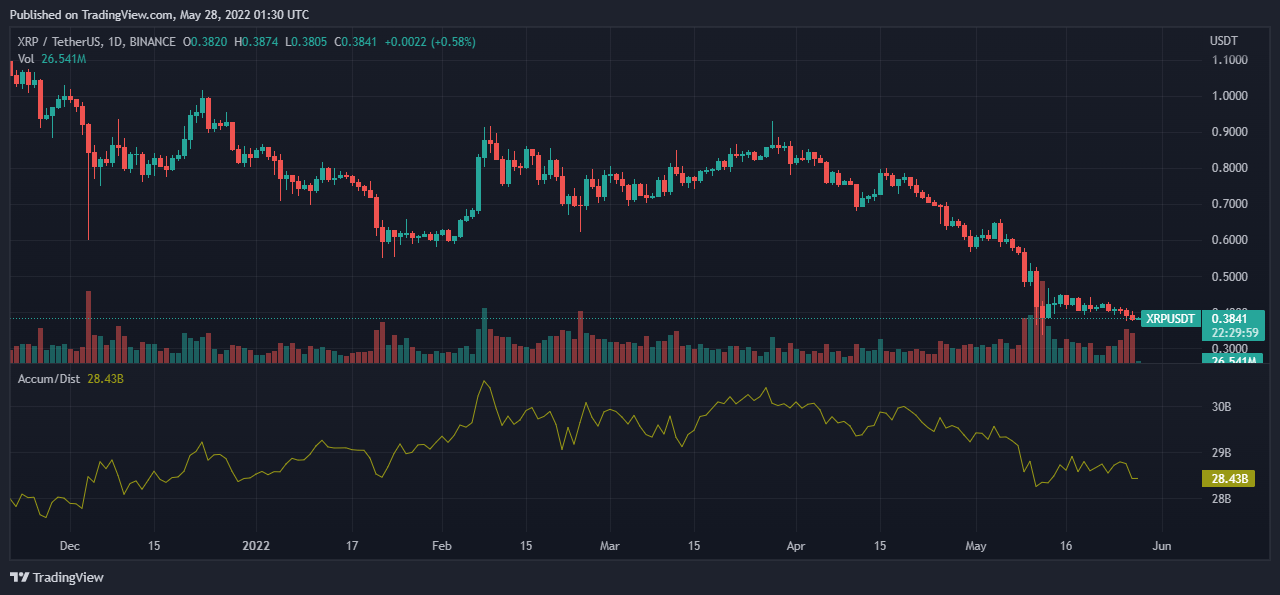
Hodl XRP

Source: TradingView

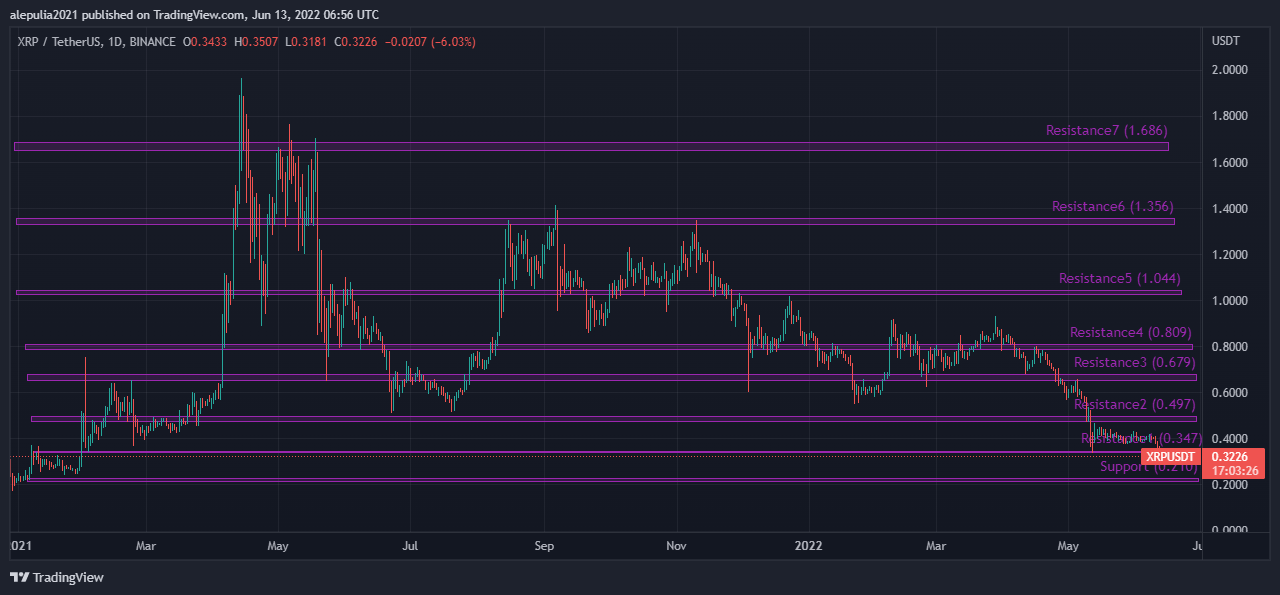
From the chart above, we can deduce that XRP is in a very critical point that all investors should be watchful of before taking any decision, to avoid losses. We can see that the following could take place:

1) The price of XRP could decline further to around $0.210. From the previous history, we can see that the price rose above the $0.347 mark and even surged above the $0.679 price. If this happens, then the price of XRP has increased by over 250% within a short duration.

2) The present price decline could reverse if the bulls have their way. This could push the price of XRP to around $0.804 at the resistance level. This will represent close to a 280% increase.

Conclusion

Although the price of Ripple’s native token XRP has decreased heavily in recent years since it attained its all-time high price of $3.84, long-term hodlers will benefit from its rising demand. This is because of the circular movement of its price. XRP could enter its next phase of a strong bullish run soon when we consider the factors above coupled with the strong commitment by the team led by Ripple’s Chief Executive Officer (CEO) Brad Garlinghouse. Therefore, if you own it, then it is wise to hodl XRP.


Some Reasons Why Crypto Users Prefer Cryptocurrency Exchanges Over Commercial Banks

Cryptocurrency Exchanges Over Banks

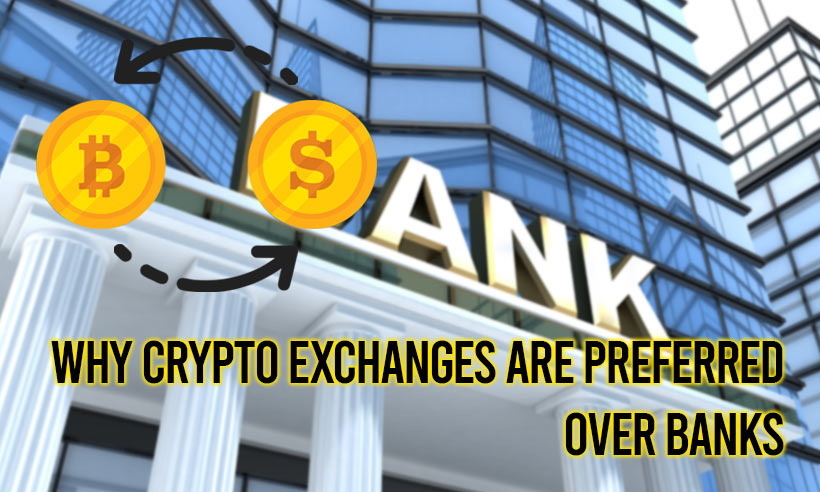
There were 25,000 commercial banks in the world in the year 2015. By 2020, there were 2582.8 commercial banks for every 100,000 adults. In 2021, there were about 300 million crypto users in the world. According to CoinMarketCap, there are 525 cryptocurrency exchanges in the world. This shows that there is an average of 571,428.57 users per cryptocurrency exchange at the time of writing. This is an indication that there are more preferences for crypto than banking with commercial banks by users.

The reasons are not far-fetched. Some of them include:

  • Comfort
  • Anonymous nature
  • Possibility of a huge returns
  • Low transaction fees
  • Void of government control
  • No bureaucracy
  • Larger coverage

Let’s try to see each of these reasons in detail to understand why many crypto users prefer cryptocurrency exchanges over banks.

Comfort

Cryptocurrency exchanges offer their users many options which can be executed from the comfort of their homes. Users can convert their assets to over 19, 000 cryptocurrencies that are present in the market. However, in the banking system, a customer needs to have a domiciliary account that has a given fiat currency for such transactions to be allowed. This makes crypto users prefer dealing with cryptocurrency exchanges over commercial banks.

Anonymous Nature

The decentralized nature of cryptocurrencies that are enabled on the blockchain makes a user’s cryptocurrency holdings remain anonymous. Most cryptocurrency exchanges allow their users to create accounts without any need of getting verified. Moreover, cryptocurrency users that hodl in their private wallets do not need any verification to handle transactions. No one knows who is responsible for a given transaction. Users can also use pseudo names for their wallet addresses.

However, commercial banks have the authority to have access to someone’s account, and the identity of an account holder is always known. Some individuals prefer to be independent and remain anonymous, so they prefer to deal with cryptocurrency exchanges over commercial banks.

Possibility of Getting Huge Returns

One of the reasons why some countries and banks are against cryptocurrency is its high volatility. Irrespective of this opposition, some crypto users prefer to hodl their money on cryptocurrency exchanges than keep it in commercial banks. This volatility could give huge returns on investment in a such duration. There might not be any bank package presently that has given the kind of returns that Bitcoin has given in less than 9 years. Within the past 9 years, the return on investment on Bitcoin is 46,334%. This means that a Bitcoin hodler has received $463.34 for each $1 investment in the past 9 years.

According to Gobankingrates.com, the highest global interest on a savings account is 37.64% per annum. This means, that in 9 years, an account holder would earn 1772% interest on their deposit. This represents a $17.72 profit on each $1 saving account holding. This means that a Bitcoin holder has earned more than 25 times what the use would have received as a maximum interest on their deposit in the past 9 years.

Low Transaction Fees

Sending money across the world has been made very easy by cryptocurrency. The huge and numerous debits that are charged by commercial banks have discouraged some bank account holders from attempting to do so. This ought not to be so. Recently, it was seen that someone was charged only $0.12 to execute a $300 million worth of Bitcoin (BTC) transaction. If this was done through a commercial bank, they might have paid over $10000 for it to be completed for banks with lesser charges.

Void of Government Control

Some crypto users prefer cryptocurrency exchanges over commercial banks due to the option of escaping from government sanctions. Some governments, especially in the developing nations, could sanction the account of a political opponent in a bid to limit their financial capacity. This is commonly seen during election time. However, with cryptocurrency exchanges, such sanctions cannot be implemented since they are not in control of the funds of crypto users. This makes crypto users prefer storing their assets with cryptocurrency exchanges over commercial banks.

No Bureaucracy

For some huge transactions to be done, a commercial bank customer might be required to do a lot of paperwork, asked to visit some officials, and then wait for days before permission is given from the headquarters. At other times, after waiting for all this while, the customer might be told that the bank has no capacity to execute the transaction. This has cost some account holdings profitable opportunities since they could not meet up with the deadlines for transactions to be done.

However, with cryptocurrencies, a crypto user can easily transfer any amount they wish from their account to a receiver, which is confirmed on the blockchain in a matter of seconds.

Larger Coverage

Prior to the evolution of cryptocurrencies, the SWIFT system helped businesses. However, cryptocurrencies have enabled its users to have access to even the unbanked people in the world. The likes of Stellar Lumens (XLM) and Ripple’s native token (XRP) were created to meet the needs of such users.

Conclusion

Irrespective of the risks that are involved with cryptocurrencies, most crypto users still prefer to deal with cryptocurrency exchanges than commercial banks. With the factors above, we can deduce that more crypto users will continue to prefer to store their tokens with cryptocurrency exchanges than with commercial banks as crypto adoption increases in the future.

Mina: World’s Lightest Blockchain Using zk SNARKs

Mina: World's Lightest Blockchain Using zk SNARKs

Mina is the first cryptocurrency with a succinct blockchain. Cryptocurrencies like Bitcoin and Ethereum currently contain hundreds of gigabytes of data, and their blockchains will only grow in size as time goes on.

What is Mina Protocol?

However, no matter how popular Mina becomes, the blockchain will always have the same size – around 22kb (the size of a few tweets). As a result, participants will be able to swiftly sync and test the network.

zk-SNARKs, a sort of succinct cryptographic zero-knowledge proof, have enabled this achievement. When a Mina node creates a new block, it also creates a SNARK proof verifying its validity. The short evidence, rather than the complete chain, can then be stored by all nodes.

The Mina protocol offers a decentralised at scale blockchain by eliminating the need to care about block size. As blockchains grow in size, validating data on the blockchain becomes more complex, resulting in the concentration of validators.

Mina aims to circumvent this constraint by employing a “simple blockchain,” which requires a fixed amount of time and data to verify the present status of the world (20 kilobytes/10 milliseconds), according to the developers.

The recursive composition of zk-SNARKs, which use constant-sized proofs of arbitrary, incremental computations, enables the concise blockchain. This means that the difficulty of verifying the chain is unaffected by its size, retaining the ease with which users can engage actively in the network.

Instead of preserving the entire chain, a user might merely hang on to the present state and confirm its existence via a SNARK (short non-interactive argument of knowledge). This enables the Mina protocol to scale to thousands of transactions per second while requiring significantly fewer resources to maintain than PoW blockchains.

Mina is made up of the following major components:

Samasika’s Ouroboros: A variant of the ouroboros proof-of-stake consensus process that maximises consensus inclusivity. On Mina, everyone acts as a full node. Anyone can participate in the consensus process and contribute to the network’s security.

Snapps: Generally speaking, Smart contracts with SNARK support. Because they’re constructed on SNARKs, they’re Turing complete like other smart contracts, with the added benefit of secrecy and verifiability.

SNARK workers: Snark workers are critical to the Mina network’s health since they are in charge of snarking or creating SNARK proofs of network transactions. Snark workers contribute to the Mina blockchain’s succinctness by producing these proofs.

How does Mina Works?

Mina is a layer one protocol that aims to fulfil blockchain’s original promise of complete decentralisation, scalability, and security. In theory, blockchains are intended to hold users accountable. When everyone may enforce the laws by validating an irreversible public ledger, authority is concentrated in the hands of a large number of people.

The network’s trustless transactions are made possible by its decentralised structure. In practice, however, this has not been the case. When a new user joins a legacy blockchain like Bitcoin or Ethereum, they must validate the validity of every transaction since the network’s inception, which can amount to hundreds of terabytes of data.

Most consumers can’t afford the computer power required to verify these complex networks on their own, so they’re forced to rely on increasingly powerful intermediaries. This means that most people can no longer connect peer-to-peer, resulting in a loss of decentralisation, a shift in power dynamics, and a more vulnerable network to censorship.

Mina protocol proposes an elegant solution: replace the blockchain with cryptographic proof that is easily verifiable and consistent in size. Mina decreases the amount of data that each user must download considerably.

Instead of checking the entire chain from the beginning, participants use recursive zero-knowledge proofs to validate the network and transactions (or zk-SNARKs) thoroughly.

The little evidence, rather than the complete chain, can then be stored by nodes. Mina protocol api remains accessible because of its uniform size, even when it scales to numerous users and accumulates years of transaction data.

How do zk-SNARKs operate?

Instead of sending the chain itself, they take a lightweight snapshot of the status of the entire blockchain and send it around. It’s like sending a postcard of an elephant instead of a vast live animal to a buddy. The following block in the network takes a snapshot of itself, with the prior state of the blockchain as the background.

The backdrop for the next block will be that new snapshot, and so on. Surprisingly, the snapshot always stays the same size, even though it can include proof of an endless amount of data.

Finally, the world’s lightest blockchain enables inclusive consensus. The Ouroboros proof-of-stake protocol, as adjusted, maximises consensus inclusivity. Anyone may participate in consensus, secure the blockchain, and keep Mina responsible since all participants operate as full nodes. Mina provides genuine decentralisation, scale, and security in this manner.

Tokenomics

The native utility token, MINA, has the following applications:

Staking: In exchange for staking benefits, users can run nodes and stake their MINA tokens to help protect the network (paid in MINA tokens). Users can also stake their tokens indirectly by delegating them to a third-party staking provider. It’s essential to keep in mind that any new delegated staking takes 2 to 4 weeks.

Transaction fees: Users will be charged network transaction fees (in MINA tokens) for each interaction with Snapps (dApps) on the Mina Network.

Block production: Block producers are validators who help the blockchain achieve consensus and provide security. Staking MINA tokens and establishing new blocks on the blockchain earns them block rewards.

Launch & Token Distribution

o(1) laboratories received $3.5 million in initial funding from Mina protocol investors in May 2018 to develop Mina (then known as Coda Protocol), followed by a $15 million follow-on round in April 2019. Since mid-2019, the network has been in a public testnet phase.

According to the developers, Mina released on the mainnet before the end of 2020. Mina launched Genesis on March 24th, 2020, a token programme that prepares users to become the network’s initial block producers and ensures substantial decentralisation when the mainnet goes live.

By completing challenges on the testnet to assist build the network, 1,000 Genesis founder members will be chosen to earn a distribution of 66,000 Mina tokens. Because they will have the expertise required to stake tokens when the mainnet goes live, Genesis founding members will be the network’s inaugural block producers.

Genesis founder members will receive up to 6.7 per cent of tokens from Mina. “The Genesis programme allows us to develop a community of engaged individuals who contribute to set the ecosystem’s rules,” stated Izaak Meckler, CTO and Co-founder. Such participation is necessary for developing infrastructure that meets the interests of its members.”

Conclusion

Mina protocol provides end-users with a low-barrier-to-entry mechanism to verify transactions independently by building a blockchain that remains constant in size. There’s no need to entrust trust to individuals who are willing to keep up with the requirements of running a full node, as in traditional blockchains.

A single SNARK that functions as a certificate for the entire blockchain and a tail-end Merkle path to get full node level security on nearly any device. The blockchain size can be kept under 20kB by using the recursive composition of SNARKs.

More end-users are equipped to participate in network verification, so having an extensive network of validating nodes enhances decentralisation which is good for the ecosystem.


Factors Responsible for Low Response of SHIB Community

Why-SHIB-Community-Received-A-Low-Response

Shiba Inu (SHIB) remains one of the most rewarding altcoins in recent times. Irresponsible for the crypto winter of recent months that saw most cryptocurrencies lose most of their previous gains, the return on investment on SHIB stands at 731880% according to CoinMarketCap. This means that the initial investors are having $7318.8 for each $1 investment.

This rise led to a strong positive sentiment towards the altcoin Shiba Inu (SHIB) which in some quarters is called “Doge Killer.” This sentiment led to the rise of SHIB to $0.00008845 on October 28, 2021, according to CoinMarketCap. Many investors were optimistic that the price would rise further. This has not been the case, since SHIB is trading at $0.00001173 with 24 hours decreased by 0.15%. This means that the price of SHIB has reduced by 650% in the past 7 months.

With the launch of a platform where Shiba Inu (SHIB) holders, will be rewarded for burning SHIB, the SHIB community had soon low response to it. This can be seen with the decrease in the price of SHIB by 42% in the past 30 days.

The news of this reward platform would have increased the price of Shiba Inu (SHIB), irrespective of the crypto winter since the market is trending towards the part of users’ sentiments.

Some of the factors that could be responsible for the low response of the SHIB community to the Shiba Inu burn to earn platform include:

  • The SHIB community was disappointed with Shiba Inu’s recent performance.
  • The inability of SHIB to rise after listing on Robinhood.
  • The low impact of the launch of the Shiba Inu Metaverse platform on the price of SHIB.
  • The crypto winter.
  • The short duration of the reward system.
  • The burning to reward ratio of SHIB to Ryoshis Vision.

The news that Shiba Inu (SHIB) had made its early investors millionaires about a year ago, made a lot of users buy and hodl the token because of fear of missing out (FOMO). Holders that believed that SHIB could attain a new all-time high after $0.00008845 in October 2021, are disappointed with their decision. They are of the belief that they would have taken their gain then than leaving at this present price which has reduced by over 650% in the past 7 months. The same regrets were shared by Terra LUNA investors before the market implosion after Terra Luna Classic (LUNC) attained a present all-time high price of $119.

The inability of SHIB to rise after listing on Robinhood

The SHIB community had always sent numerous tweets Robinhood team, demanding that they get Shiba Inu listed in their exchange. Many within the SHIB community that the next bullish run of SHIB would come once Robinhood gets SHIB listed. The SHIB community were optimistic that one day, they will succeed with their quest. Shiba Inu was finally listed on Robinhood, but its price could not rise to the point of breaking its present all-time high, rather it had fallen since then. With the failure of different analyst predictions on the positive impact of Robinhood listing on SHIB, some investors are now sceptical about news on Shiba Inu.

The low impact of the launch of Shiba Inu Metaverse platform on the price of SHIB

As the year began, the Twitter handle of the team that handles SHIB tweeted that the SHIB community should get ready for a development that would lead to a surge in the price of Shiba Inu. Some investors hodling SHIB believed that the news would have a strong impact on the bullish run of SHIB since it was associated with Metaverse. Their expected failed as the price of SHIB was relatively affected after the launch of Shiberse. About 100,595 virtual plots of land are to be sold.

Crypto Winter

The present crypto winter has made some short term investors to think long term on their Cryptocurrency assets. This has positioned them in a very difficult position to contribute to the Shiba Inu burning platform, irrespective of how good the idea might be. This is because, in the cryptocurrency market, the number is very important. Sending a given quantity of SHIB to the burn address could increase their waiting period to recover their gain in case of a strong bullish run.

The short duration of the burning reward period

Shiba Inu (SHIB) holders who contribute to SHIB burning can only receive rewards in Ryoshis Vision (RYOSHI) in 20 weeks after the announcement. This short duration had made some holders who would have contributed to the address for burning SHIB relax. Also, rewards for burning SHIB are not sent immediately but in two weeks’ time. Users are expected to also visit Shibaswap to claim the reward, with some vesting period also given to avoid dumping Ryoshis Vision.

The burning to reward ratio of SHIB to Ryoshis Vision

Since the launch of the reward platform, about 28 billion SHIB had been burned. This is low when we compare it to the amount of SHIB in circulation. Recent news noted that the largest amount of SHIB that had claimed a Ryoshis Vision (RYOSHI) reward for burning SHIB, received 119 billion RYOSHIS for burning 1.3 billion SHIB. With the present price of SHIB and RYOSHI, the user received about $4200 in RYOSHI reward for burning SHIB worth over $16,000. This low reward to burn ratio had contributed to the low interest of Shiba Inu holders in the SHIB burning platform.

Reasons Why Terra 2.0 LUNA Might Succeed

Reasons-to-Know-Why-Terra-LUNA-2.0-Might-Succeed.j

Terra blockchain has been affected since the market decline of some of its tokens like the original Terra which is now called Terra Luna Classic (LUNC), TerraUSD (UST) which is now called TerraClassicUSD (USTC), and Anchor Protocol (ANC).

TerraClassicUSD (USTC) is presently trading at $0.035 with a 24 hours increase of 21.2% while Terra Luna Classic (LUNC) is traded at $0.000117 within 24 hours decline of 26%. With the launch of Terra 2.0 which is the present LUNA in the market, there are diverse sentiments on its future.

Some of the reasons why Luna 2.0 (LUNA) will succeed irrespective of the past history of Terra Luna Classic (LUNC) are:

  • Correction of the congestion challenge.
  • TerraLunaClassic (LUNC) past history.
  • The rebranding.
  • The investigation that the implosion was not an attack.
  • Terra 2.0 (LUNA) recent run.
  • Top cryptocurrency exchange listing of LUNA.
  • Investors sentiments.

Correction of the congestion challenge

One of the reasons why the market implosion of Terra Luna Classic (LUNC), TerraClassicUSD (USTC), Anchor Protocol (ANC), and Mirror Protocol (MIR) was heavy was that top cryptocurrency exchanges that had them listed, suspended withdrawal and deposits on them. This was due to the fact that transactions are no longer completed as at when due which gave rise to congestion. However, the Terra team led by Do Kwon worked tirelessly to ensure that the challenge is solved. The team had a breakthrough which saw the exchanges that had previously suspended withdrawal and deposit activities lifting it. This shows that the Terra team that handles the present Terra Luna 2.0 (LUNA) is committed to face possible challenges that might arise and also bringing solutions to them.

TerraLunaClassic (LUNC) past history

Prior to the market implosion in the price of Terra Luna Classic (LUNC), it attained an all-time high price of $119.18 on April 5th, 2022 according to CoinGecko. LUNC became very competitive and in high demand which saw it in the eighth position in the CoinMarketCap ranking. By April 21st, the market capitalization of LUNC before the implosion as a result of the loss of the dollar peg of its stablecoin TerraClassicUSD (USTC) was $22 billion. Terra 2.0 (LUNA) might repeat the same history soon.

Rebranding

The effect of the market implosion in the price of TerraClassicUSD (USTC) led to team to consider various options on how to get the Terra blockchain fixed, with investors and traders in mind. This led to a rebranding of the original Terra (LUNA) to Terra Luna Classic (USTC) and TerraUSD to TerraClassicUSD (USTC). An airdrop of a new Terra called Terra 2.0 which is now the present LUNA in the market was made to holders of Terra Luna Classic (LUNC) and USTC before the implosion and after the implosion. The airdrop is determined by the date. This was completed on May 28th, in support of various cryptocurrency exchanges. Investors were able to receive an airdrop of Terra 2.0 (LUNA) which is trading at $9.73 at the time of writing. This will reduce the impact of the huge losses they had. In the same way, the Terra team is working hard to ensure that the same mistake does not happen with rebranded Luna 2.0.

The investigation that the implosion was not an attack

No investor wants to invest in a project that is prone to attacks or hacks. Rarely had there been a market implosion of a top token, with huge impact on investors and the market like the Terra implosion. This led to various statements in some quarters that this could be an attack.

The result of the research conducted by analytic firm Nansen refute the claim in some quarters that an attacker is working to destabilize UST.

The analytic firm in their report noted that:

“The de-peg of UST could instead have resulted from the investment decisions of several well-funded entities to abide by the risk management constraints, or alternatively to reduce UST allocations deposited into anchor in the context of turbulent macroeconomic and market conditions.”

This now shows that the present Terra 2.0 Chain is safe for investors and developers.

Terra 2.0 (LUNA) recent run

After the airdrop of Terra 2.0 (LUNA) to Terra Luna Classic (LUNC) and TerraClassicUSD (USTC) holders, the price of LUNA 2.0 attained a present all-time high price of $19.54 on May 28th, before plummeting to the present all-time low price of $3.63 same day. This made some investors to be sceptical of the future of rebranded LUNA. However, it has increased by over 180% in the past 3 days, after attaining 43.63 according to CoinMarketCap.

Additional listing of Terra 2.0 by cryptocurrency exchanges

Some cryptocurrency exchanges did not have their intention to support this upgrade. However, LUNA 2.0 (LUNA) had received support from top cryptocurrency exchanges like Binance, FTX, Huobi Global, LBank, Mexc, ByBit, and others. In price of LUNA increased by over 80% within 24 hours in preparation for the Binance listing. We should expect a continuous rise in the price of Luna 2.0 as more exchanges get it listed on their platform.

Investors’ and developers’ sentiments

Some blockchains like Binance and Polygon have signified interest to support the migration of Terra projects to their platforms by providing huge funds in millions. However, some Terra investors and developers of decentralized applications (Dapps) had not been quick to accept the offer. This shows their belief that the present Terra 2.0 Chain will provide solutions to the previous challenges with the Terra blockchain that led to the congestion.

In conclusion, since the crypto market is just a few years over a decade and is associated with challenges, those who never give up are always winners after a price surge.

Tether (USDT) Migration to Polygon Blockchain: What Next?

Tether (USDT) is the native token of Tether Limited, a Hong Kong blockchain technology. Tether (USDT) is controlled by the Cryptocurrency Exchange, Bitfinex. USDT can now be traded and exchanged on the Polygon blockchain. This was contained in an announcement on Friday, May 27th, 2022 by the Tether team.

With the Migration of Tether to the Polygon blockchain, USDT is now present in a total of 11 blockchains. Some other blockchains where Tether (USDT) exist are Bitcoin blockchain, Ethereum blockchain, Solana blockchain, Avalanche blockchain, Binance blockchain, Tron blockchain, Algorand blockchain, Kusama blockchain, Liquid, and Bitcoin Cash blockchain.

At the time of writing, Stablecoin Tether (USDT) is ranked in the third position and trading at $0.9994 with 0.04% increase in the past 24 hours. Polygon (MATIC) is in the 17th position and is trading at $0.6267 with a 24 hours increase of 5.10%.

Some of the possible outcomes for the migration of Tether (USDT) to the Polygon blockchain include:

  • Increased trust in Tether (USDT).
  • Increased ranking for Polygon and Tether.
  • The attraction of more projects into the Polygon blockchain.
  • More developments and upgrades on the Polygon blockchain.
  • Launch of decentralized finance projects on the Polygon blockchain.
  • Increased investment in the Polygon blockchain and Tether network.

Increased trust in Tether (USDT) Stablecoin

The recent market implosion of Terra blockchain native Stablecoin TerraUSD (UST), led to questions on the safety in hodling stablecoins?

However, the successful migration of Tether (USDT) which is pegged in a 1:1 ratio to the Polygon blockchain, has increased the trust of investors and cryptocurrency traders that the token is safe.

Increased ranking for Tether (USDT) and Polygon (MATIC)

Tether (USDT) has maintained the third position in the CoinMarketCap ranking of cryptocurrencies for some months now. This is after it displaced the likes of the Binance Coin(BNB), Ripple’s native token (XRP), that has occupied the position previously.

Ethereum (ETH) is presently occupying the second position in CoinMarketCap ranking with a market capitalization of about $229 billion. Tether (USDT) has a market capitalization of about $72.29 billion at the time of writing. This makes the market capitalization of Ethereum to be 216% of that of USDT. The 24-hour trading volume of ETH and USDT at the time of writing is $15.61 billion and $53.60 billion respectively. This means that USDT trading volume is over 250% that of Ethereum.

With this migration to the Polygon blockchain, more Tether (USDT) could be minted in order to meet the demand that will be generated from users on the Polygon blockchain.

Also, with the low transaction fees on the Polygon blockchain, the demand for Polygon native token (MATIC) could rise. This will also increase its price due to a rise in demand, which will directly increase its position in the CoinMarketCap ranking of cryptocurrencies according to their market capitalization.

The attraction of more projects in Polygon blockchain

Polygon blockchain is one of the blockchains just like Binance that wants to give support to Terra projects that wish to migrate to it. The multimillion-dollar fund called Terra Developers Fund will enable Terra projects to migrate to Ethereum sidechain layer 2 blockchain, Polygon blockchain.

Some developers might have doubts about why they should accept the offer to build on the Polygon blockchain. The migration of Tether (USDT) to the layer 2 blockchain, has added reasons why migration to Polygon blockchain is a good choice.

More developments and upgrades on the Polygon blockchain

At the time of writing, there are over 19650 cryptocurrencies that are listed on CoinMarketCap. New coins and tokens are added every day. This shows that there is a high level of competition in the market. Tron blockchain completes a high volume of daily transactions on Tether (USDT) TRC20. This is due to the minimal transaction fees of $1 that are changed by most exchanges on Tether withdrawal.

Since the present charge on the Polygon blockchain is $1, the Polygon team had to envisage other upgrades and developments in its blockchain, to make it the best option for users who wish to store or trade Tether (USDT).

Launch of decentralized finance projects on the Polygon blockchain

Tether (USDT) is one of the least volatile stablecoins in the market presently. USDT is used in staking in various platforms for long term investors that wish to reduce the risk that is associated with the high volatility of the cryptocurrency market.

The listing of Tether (USDT) on the Polygon blockchain, would give rise to the launch of more decentralized finance (DeFi) projects by developers on the Polygon blockchain. This could lead to a scarcity of USDT which will directly increase its value. In the past 24 hours, the price of USDT has increased by 0.04%.

Increased investment in the Polygon blockchain and Tether networks

News is one of the factors that could improve or reduce the public sentiments on a project or cryptocurrency. The news of this migration has a possibility of attracting more investors to the Polygon blockchain and the Tether network.

Conclusion 

We should expect the price of Polygon (MATIC) to regain most parts of its recent loss soon. This is a result of its increased trading volume. The trading volume of Polygon MATIC has increased by over 34% in the past 24 hours at the time of writing.

Why do Decentralized Crypto Exchanges have Poor Visibility?

decentralized crypto exchanges

Decentralized crypto exchanges allow users to interact with one another in a peer-to-peer environment. In decentralized exchanges, funds are not controlled by a central wallet. Users’ funds are not accountable to the exchange since they are not custodians of the funds. In most cases, users’ web wallets or app extensions are used to enable decentralized exchange protocols.

According to CoinMarketCap, 526 cryptocurrency exchanges are listed at the time of writing. 217 of these are decentralized exchanges. Thus, only 41.25 % of the cryptocurrency exchanges currently listed on CoinMarketCap are decentralized exchanges.

Uniswap (V2) is the largest decentralized cryptocurrency exchange, with a 24-hour trading volume of about $1.09 billion. In contrast, Binance’s exchange executed over $9.73 billion in the last 24 hours. Uniswap (V2), Pancakeswap, dYdX, Kine Protocol, Honeyswap, and Curve Finance are some of the prominent decentralized cryptocurrency exchanges. The decentralized exchanges with the lowest ranking are SashimiSwap, MOV, BEPswap, Demex, IDEX BSC, and Unifi Protocol DAO.

Some of the pros of decentralized crypto exchanges include no regulation, low transaction fees, no account bans, and more trading options. The cons include price manipulation, trading of scam assets, low safety, and few funding options.

However, irrespective of the pros and cons associated with decentralized exchanges, some of the factors that are responsible for their low visibility are:

  1. Negative sentiments
  2. Low liquidity
  3. Safety issues

Negative Sentiments

Investors prefer trading on centralized exchanges instead of using decentralized exchanges. Due to this, crypto token holders put pressure on the launch teams to list the cryptocurrency tokens on centralized exchanges. These negative sentiments have impacted the growth and visibility of some decentralized exchanges. It is worth noting that decentralized crypto exchanges that deal in decentralized finance (DeFi), like Uniswap (V2), and support tokens on Binance Smart Chain, like Pancakeswap, are not affected by these sentiments.

Low liquidity

Liquidity refers to the ability of a crypto asset holder to convert their asset to cash or other cryptos with ease. The lack of users on decentralized exchanges makes some asset holders place a sell order for days before it could be executed due to low liquidity. However, large funds in centralized exchanges make this possible with ease.

Safety

In decentralized crypto exchanges, users are responsible for the security of their funds. Many users are leery of using decentralized exchanges. People fear high risks as these exchanges invest fewer funds in the safety of users. This is due to their low transaction fees, unlike the high fees that are associated with trades on centralized exchanges. Hacking victims on decentralized exchanges face all the losses.

Is Ethereum Classic (ETC) Really Undervalued As Many Say?

Fidelity Ethereum custody

Ethereum Classic (ETC) is one of the top Ethereum forks that is trading in different cryptocurrency exchanges presently. ETC is one of the good investments for 2022 for long-term investors. ETC is presently trading at $22.85, with a 24-hour increase in price by 3.16%. ETC attained an all-time high price of $176.16 on May 6th, 2021. When this is considered with the present price, we can infer that ETC is undervalued. Ethereum Classic is ranked in position 28th in the CoinMarketCap ranking.

Ethereum Classic as a good long-term investment for 2022 could be undervalued due to the following reasons:

  • ETC had higher returns in the past 14 days than BTC and ETH
  • ETC comparative ranking when compared to Bitcoin forks

Ethereum Classic Had Higher Returns in the Past 14 Days Than BTC and ETH

In the past 14 days, Ethereum Classic has shown that it is a better investment for 2022 when compared to either Bitcoin (BTC) or Ethereum (ETH). ETC has gained 20.9% in the past 14 days for its long-term holders. In the same duration, Bitcoin has decreased by 0.9% while Ethereum has reduced by 9.8%. This makes ETC a good investment that is undervalued by some investors.

ETC Comparative Ranking When Compared to Bitcoin Forks

Ethereum Classic is the first Ethereum hard fork. ETC was launched in July 2016. The first Bitcoin hard fork called Bitcoin XT is no longer in existence. Also, Bitcoin Classic which was launched the same year as ETC is also not in existence. The closest Bitcoin fork that is within the top 100 cryptocurrencies in CoinMarketCap ranking is Bitcoin ABC which is presently called eCash (XEC). It is ranked in position 58 at the time of writing. This shows that ETC is a good long-term investment.

Ethereum Classic Price Prediction

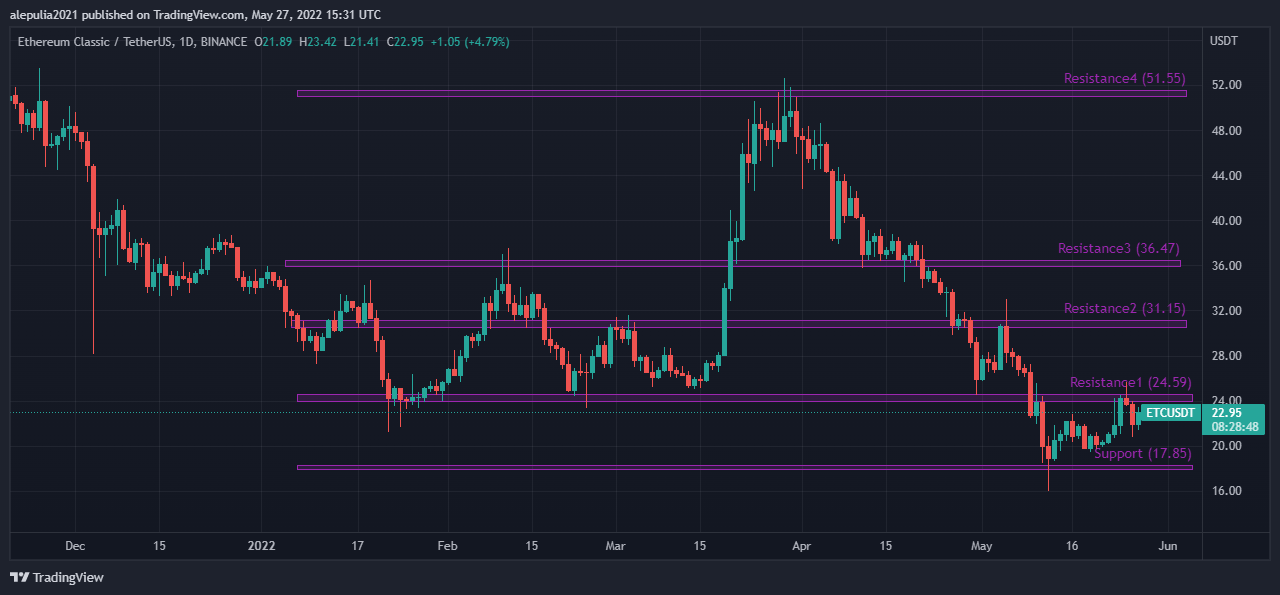
ETC/USDT 1Day Day showing the Key Levels

Source: https://www.tradingview.com/x/3Ng0Ggjv/

From the price prediction chart of ETC/USDT above, we can deduce the following:

  • The price of Ethereum Classic (ETC) might plummet to $17.85 at support levels.
  • If the present bullish momentum is maintained by buyers, the price of ETC has a high probability of breaking the $24.59 resistance1 levels. It could surge close to $31.13 at resistance2 before reversing due to the formation of double tops.
  • If buyers pressure keeps increasing, the price of ETC might increase to $36.47 at the resistance3 level or $51.55 at the resistance4 level.

Conclusion

With the possibility that Ethereum Classic (ETC) might break more psychological resistances soon, we can deduce that it is presently undervalued.

All About Livepeer: Future of Video Streaming Services!

All About Livepeer: Future of Video Streaming Services!

The open video infrastructure in Livepeer offers developers a great medium to create video streaming applications. The Livepeer network, which has been operational on Ethereum’s mainnet since May 2018, is managed by a decentralized network of token-holding node operators and powers both traditional and web3 video streaming at lower costs than existing cloud providers. Livepeer focuses on delivering value to a variety of stakeholders, including:

  • GPU Cryptocurrency Miners – Existing GPU miners can earn extra money by transcoding video on Livepeer without interrupting their mining profits because existing GPUs feature video encoding processors that stay idle while hashing.
  • Video streaming platforms – Reduce transcoding costs from cloud providers’ $3 per stream/hour to 10-100x lower over the open Livepeer network. Livepeer’s goal is to deliver scalable streaming without extensive DevOps.

Token holders can receive a piece of the network’s profits and inflationary token awards for providing security and quality assurance on the network by staking their tokens.

Working of Livepeer

  1. Users can engage in the following flow with the use of Livepeer technology and protocol:
  2. Send a video from your camera, phone, computer screen, or webcam to the Livepeer network.
  3. Nodes in the network will encode it into all of the required formats so that it may reach every supported device.
  4. Users who host these nodes will be rewarded with fees paid in ETH by the broadcaster and the ability to earn a reputation through the protocol token, which will allow them to conduct more work.

The network can be requested by any user to see the stream, which will be sent to them in near real-time. The Livepeer Media Server, The Livepeer Protocol, the Go-Livepeer node, and are the three main technical components of Livepeer (LPMS). The protocol is a set of Ethereum smart contracts written in Solidity that provide a marketplace for node operators where they can register their services, a payments settlement layer via a delegated stake based protocol for securing and QA’ing network work, and a governance mechanism for voting on and executing protocol upgrades.

Livepeer Media Server

The LPMS is an open-source media server that takes care of everything video-related, including transcoding logic, streaming and playback logic, origin services, ingest protocols, etc. Transcoding live video and audio input streams are required to make them usable on various devices, each with its format and bandwidth requirements. There are centralized services available, but they are usually pricey. The Livepeer Media Server is open-source can be used independently and is an integral part of the Livepeer Network.

Go-Livepeer

The Livepeer node’s go-livepeer implementation enables the protocol, communicates with the blockchain, and includes LPMS to handle video broadcast, transcoding, and streaming or playback. Almost 100 additional repositories and projects complement this essential technology, including front-end applications for staking and governance, DevOps scripts for operating network nodes, and a hosted version of the broadcasting capabilities at livepeer.com.

Tokenomics

The native work token of Livepeer is LPT, which is used in the following functions:

Protocol Incentivization: When users run a node or delegate to node operators on the platform, they can earn LPT tokens as a reward. Staking and node operation, both of which need LPT, are also ways for users to earn the fees paid in ETH.

Staking: Users can stake LPT tokens to protect the network against assaults and earn LPT tokens as a reward.

Governance: LPT token holders have the ability to propose and vote on network governance decisions.

Dual Mining: Users who stake to run GPU-backed Livepeer nodes can also mine additional GPU-based cryptocurrencies at the same time without interrupting their transcoding.

Token Distribution

There was no token sale for the Livepeer initiative. Instead, the community was given an initial allocation of LPT at genesis, which could then be used to stake as a transcoder or delegator. A Merkle mining mechanism was utilized to generate and distribute tokens. Users produce LPT in this process by submitting a Merkle proof proving they were part of the genesis state, which means they had at least 0.1 ETH in their account at a given block number. Users could only submit their proofs and generate their tokens during the initial stage, which began on May 1, 2018, known as the slow start.

On July 26, 2018, 3rd party mining became enabled, allowing users to submit proofs on behalf of other users who had yet to earn their token to share the remaining LPT. The tokens were divided between the user who submitted the proof (caller) and the person for whom the evidence was provided (receiver) based on an algorithm that raised the share awarded to the caller over time. On October 2, 2018, the genesis LPT was delivered, totalling 6,343,700 units. In addition to the 6,343,700 LPT distributed to the community, the founders and early team kept 1,235,000 LPT (vesting over 36 months), 1,900,000 LPT was sold in a pre-sale (vesting over 18 months), 500,000 LPT was put into a long-term development fund, and 21,300 LPT was given as a grant to a few early advisors and contributors.

LPT is inflationary since more LPT is produced regularly as a reward for transcoders’ verification and transcoding labour. The protocol specifies an inflationary timetable for token issuance. As a result, network engagement, whether through transcoding or delegation, is required to avoid being inflated away.

Governance

The Livepeer protocol’s governance role is three-fold: Determine whether common funds slashed from misbehaving nodes should be burned or appropriated. To ensure a robust, thriving network that is valuable to broadcasters, adjust network parameters. Proposed protocol modifications should be invoked in a decentralized manner.

Why is Livepeer needed?

Networks like Ethereum enable IPFS/Filecoin, and trustless computing to enable decentralized storage and content distribution. Bitcoin and various token projects facilitate p2p value transfer, and decentralized name registries like ENS and Blockcstack which provide human accessible names to content and identities, the vision of a decentralized web has begun to take shape in recent years.

These aspects lay the groundwork for decentralized applications (DApps) to be constructed as primarily static or infrequently updated online or mobile content. Still, DApps cannot currently add streaming media and data in an open and decentralized manner. The Livepeer project aims to decentralize internet-based live video streaming. The Livepeer Project gives a good overview of the present state of online live video. This article will focus on the Livepeer cryptoeconomic protocol features rather than the business case. However, in short, the current state of live streaming is described as rapidly increasing, centralized, and expensive.

In a truly decentralized P2P solution, nodes contribute their processing and bandwidth in streaming live video, which would be more open and scalable. The number of connections that could be serviced would be unlimited. To some extent, this technology is available. Still, there has been no incentive to encourage users to run nodes that provide this functionality, nor has there been adequate funding for developing a protocol that facilitates the entire internet rather than a single centralized company.

With the recent emergence of crypto token-powered protocols, there is now an opportunity to simultaneously incentivize users to contribute computation and bandwidth to live video broadcast in a way that aligns with funding the development of an open media server solution capable of delivering live-streamed video based on all the latest set standards and formats required to reach the full range of devices. Furthermore, the economic behaviours associated with token-powered protocols suggest that the cost to the broadcaster of using the Livepeer network could be less than the cost of any centralized alternative.

Use Cases

Pay-As-You-Go Basis

With a transfer of value transaction built into the protocol, broadcasters can now charge viewers directly to consume their live broadcast, without the need for a credit card, account, or centralized control over user identity. This has applications in education (paying to attend an online course), events (paying to watch a concert or live sporting event), entertainment (paying to watch a gamer or performer’s live stream), and a variety of other areas – all while maintaining the viewer’s privacy and allowing them to pay directly to the broadcaster for only what they consume.

Social Video Services with Auto-Scaling

Scaling infrastructure to accommodate the need for an increasing number of streams and customers as new users are added is one of the challenges of today’s consumer video services. Infrastructure developers who provide provisioning servers, licencing media servers, and efficiently manage resources to handle spikes will appreciate a service layer that allows developers to quickly start building their video solution on top of the Livepeer Network, which will automatically scale to support any number of streams and viewers as they go.

Uncensored Live Reporting

Current platforms like Twitter and Facebook offer great live video solutions for reaching a vast audience. Still, they’re also the first to be stopped or censored in various political crises. Using a decentralized network like Livepeer, it would be practically hard to keep the public in the dark about what’s happening on the ground in real-time.

Video Dapps

The Ethereum ecosystem is significantly driving the development of decentralized apps (DApps). However, due to WebRTC’s limitations, there hasn’t been a feasible method for embedding live video within a DApp without relying on a centralized solution or limiting the number of consuming clients.

Conclusion

The Livepeer protocol encourages nodes to offer their processing power and bandwidth to the network in exchange for the ability to transcode and distribute live video. The verification of work is handled via a scalable extension built on top of the Truebit protocol, which incentivizes nodes to complete transcoding operations correctly to receive fees and token allocations and maintain their value-generating function as a transcoder.

The economics of delegated proof of stake block reward accounting is used to overcome the gamification of the network and the falsework problem. It becomes more cost-effective to stake one’s tokens in a value-adding node rather than pay fees into the network to be distributed to other delegators when performing work without real demand.

The end product is a scalable, pay-as-you-go network for decentralized live video broadcasting, which Livepeer hopes will fill a need in the web3 stack.

EOS Token is Approaching Its 52-Week Low: What’s Next?

EOS Token Low

EOS is one of the most successful Initial Coin Offerings (ICO) in cryptocurrency history. It came into existence during the crypto bubble of late December 2017 and January 2018. It was launched on January 31st, 2018. At the time of writing, the price of EOS is $1.22. EOS has decreased by 3.65% in the past 24 hours. This present price of EOS token is close to its 52-week low price of $1.13. The recent crypto winter has made the price of EOS show a bearish trend. In the past 24 hours, the trading volume in EOS has decreased by 0.51%. This shows that there is a low buying activity on the EOS blockchain.

Irrespective of this present performance of EOS, investors are still positive that the price of EOS could surge again. The price history of EOS has not been good in recent months. In the past 7 days, the price history of EOS shows that it attained a minimum and maximum price of $1.19 and $1.43 respectively.

30 Days And 90 Days Price History of EOS

The price of EOS in the past 30 days is within a 30 days lowest price of $1.13 and a 30 days highest price of $2.37. The 90 days price history of EOS has a 90-day lowest price of $1.13 and a 90-day highest price of $3.14 according to CoinMarketCap.

EOS Price Prediction

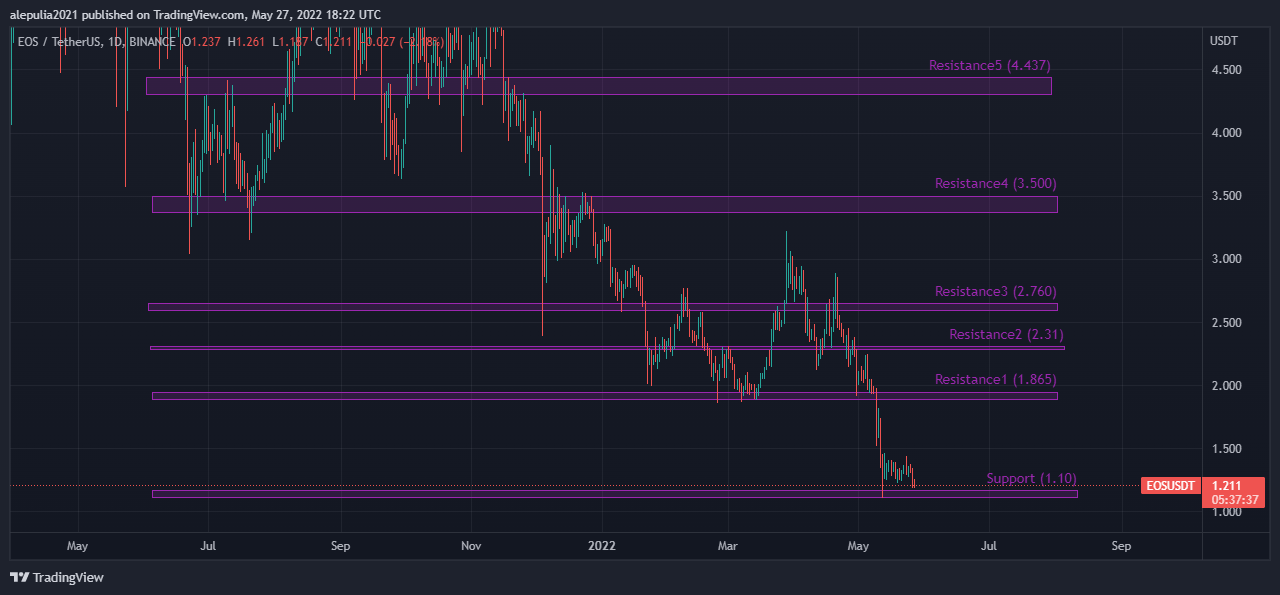
EOS/USDT 1Day Chart Showing the Key levels

From the EOS price prediction chart above, showing the resistance and support levels, we can deduce the following:

  • Since the buyer’s pressure is reducing, the price of EOS has a high probability of hitting the present 52 weeks low price of $1.13 and falling further.
  • Major news on upgrades and new developments within the EOS blockchain, might reverse the present bearish trend, and push EOS to an upward trend. This could make EOS break its $1.86 resistance1 level, and surge further to $2.31 at the resistance2 level.
  • Due to possible price actions, the price of EOS could consolidate for some time before continuing the bullish trend to $2.76 at the resistance3 level, or reverse to the resistance1 level.

EOS Technical analysis

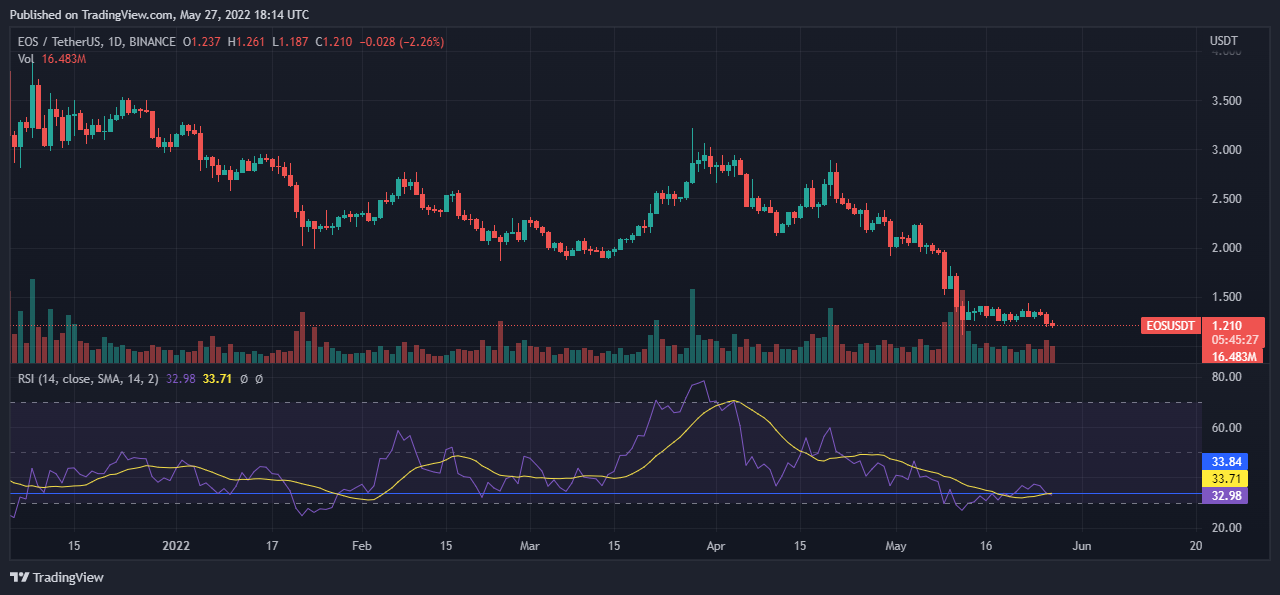
EOS/USDT 1Day Chart Showing Relative Strength Index

Source: https://www.tradingview.com/x/pvbQZ5oE/

The relative strength index (RSI) value of EOS from the technical analysis chart above is 32.98. This shows that EOS is presently having a weak trend since the value lies between 30 and 50. However, if buyers do not intervene soon, EOS could reach the oversold reach of 30, which will make the price plummet further.

Conclusion

With the present price of EOS token at $1.22, it is possible that it will break its 52 weeks low value of $1.13 soon. This is because of low buyer activities.

Fantom (FTM) Gains over 13% in 30 Days: What Next?

Fantom

Fantom (FTM) is a cryptocurrency that was created in 2018 as an alternative to the Ethereum blockchain. Its mainnet called OPERA was launched in 2019. The native token of the Fantom blockchain is called FTM. In the past 30 days, FTM has gained over 30%. At the time of writing, Fantom is trading at $0.36. Irrespective of the market dip, Fantom had remained bullish, by also gaining 5.89% in the past one hour, at the time of writing.

With the trading volume of most cryptocurrencies in a decline, FTM is not an exception. From the FTM price chart, its volume of trade has decreased by 22.22% in the past 24 hours at the time of writing.

FTM Past performance

In the last 60 days, the price of FTM started at a bullish price of $1.43 on March 28th, to its present price of $0.36. This represents a close to 300% decrease in value. This is due to a decline in Fantom trading volume from $622 million to the present value of $372 million within the same duration.

Fantom Price Analysis Chart

FTM/USDT 1Day chart showing the Accumulation/Distribution Indicator

Source: https://www.tradingview.com/x/k8aBIUfZ/

The accumulation Distribution indicator shows the trend in price to volume change. Since the price and the volume of trade are moving in the same direction, Fantom’s recent bullish gain might be short.

Fantom Price Prediction

FTM/USDT 1Day Chart Showing the Key levels

Source: https://www.tradingview.com/x/FNVD6XWd/

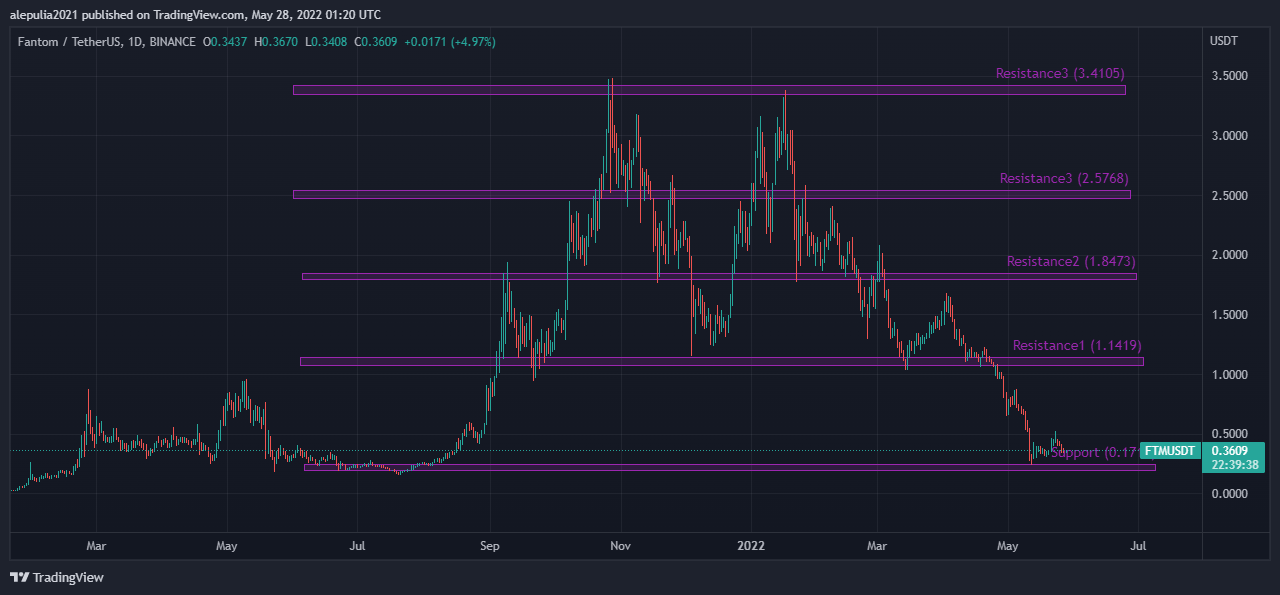
From the FTM price prediction chart above, showing the resistance and support levels, we can deduce the following:

  • Since the buyer’s pressure is reducing, the price of Fantom might consolidate around the $0.30 level before experiencing a trend change.
  • Long-term investors can keep hodling or even apply a strong buying pressure to change the present Fantom price chart that is a downtrend.
  • The price of Fantom could decrease further to close to the $0.17 support level if there is no major news around the FTM ecosystem or top cryptocurrencies like Bitcoin and Ethereum.
  • An FTM bullish trend reversal could push the price of FTM to close between $0.50 and $1.14 soon.

Conclusion

Bullish Fantom’s price prediction is around $1.14. This could be reached soon if this recent bullish run is maintained together with a bullish price reversal of the Bitcoin market.

Terra Name Service (TNS) Gains Over 150% in 24 Hours

Terra Name service

Terra Name Service is a cryptocurrency on the Terra network denoted with TNS. Terra Name Service (TNS) was created by inspiration received from Ethereum Name Service (ENS). TNS provides Terra Station users and other Terra account holders with the opportunity to use a name for their wallet address, instead of the long addresses used for transactions. TNS was launched in 2021 with an airdrop of about 17.7% of its total supply of 100 million to the community.

TNS Current and Past Market Status

At the time of writing, TNS chart shows that it is trading at $0.023. On May 20th, the price of TNS opened at a price of $0.0103 and closed at a price of $0.0404 on May 21st. This represents over 150% rise in price in 24 hours. This is due to a rise in TNS trading volume by over 12% within 24 hours. The present all-time high price of TNS is $2.34 and was attained on December 25th, 2021.

Terra Name Service Price Analysis

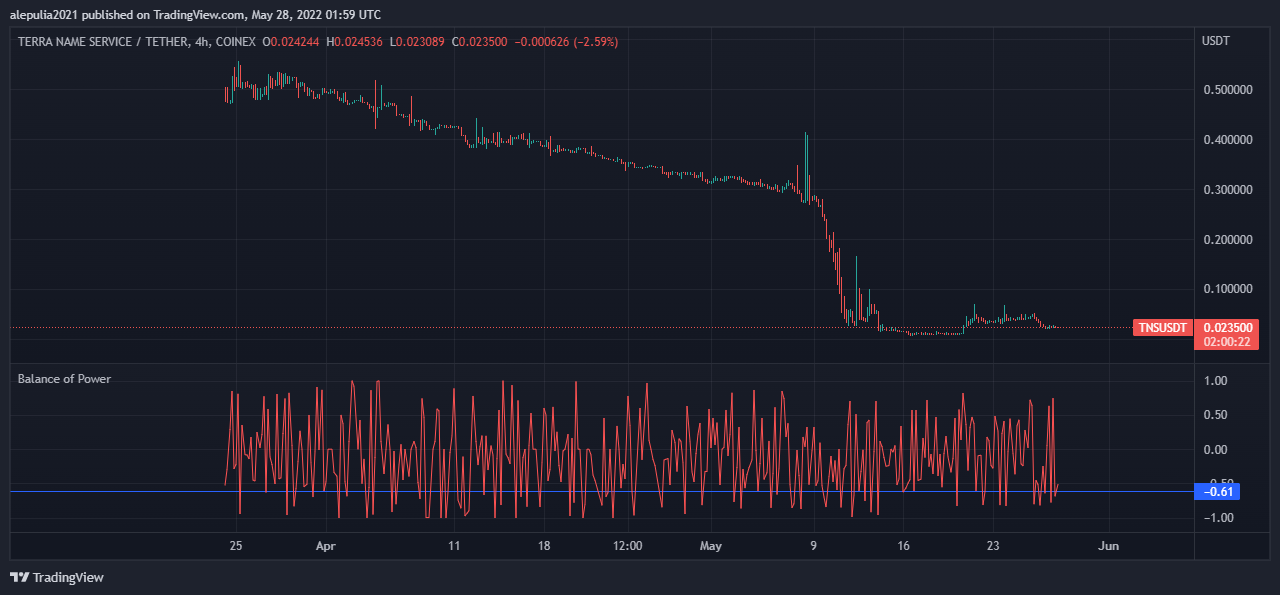
TNS/USDT 1Day chart showing the Balance of Power Indicator

Source: https://www.tradingview.com/x/HwzcWPLa/

From the chart above, we can see that the Balance of Power indicator reading of the Terra Name Service price chart is -0.61. This shows that it has a negative divergence in price and that the price might dip further. However, strong buyer pressure could push the price chart to a bullish trend reversal.

TNS Price Prediction Chart

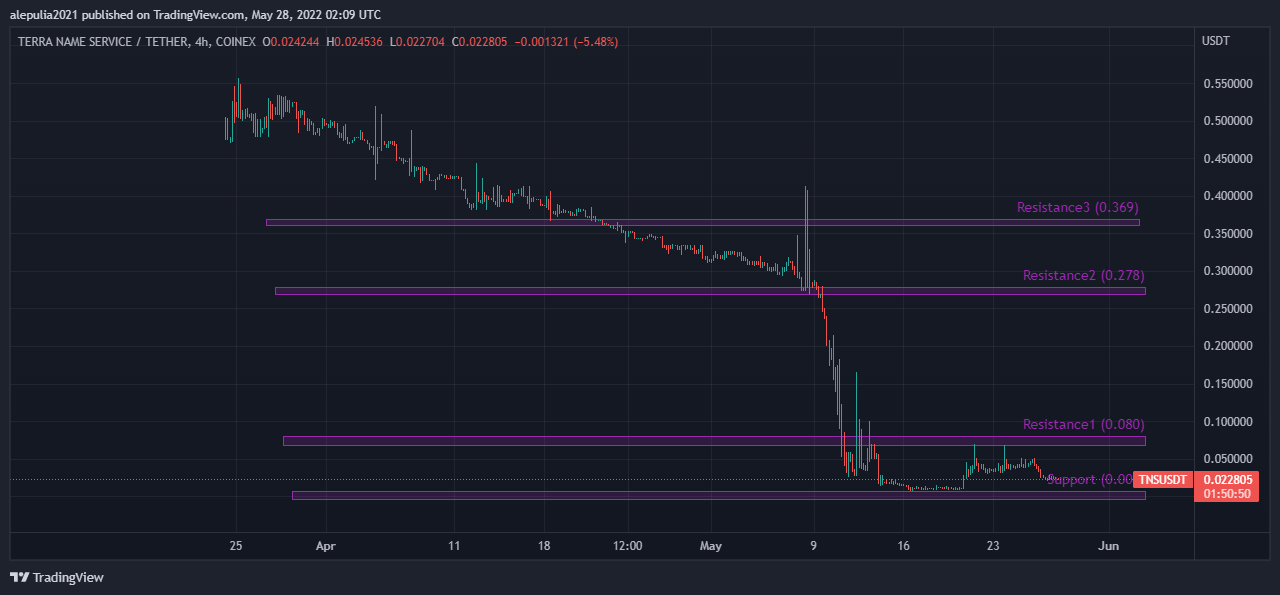
TNS/USDT 1Day Chart Showing the Key levels

Source: https://www.tradingview.com/x/vfMzHspC/

From the TNS price prediction chart above, showing the resistance and support levels, we can deduce the following:

  • Since the buyer’s pressure is reducing, the price of TNS fall below its all-time low price of $0.008 as indicated on the key level chart above.
  • Strong buying pressure can change the present TNS price analysis chart which has a negative Balance of Power value of -0.61.
  • The next bullish trend reversal could increase the price of TNS by over 200%. This is because it is expected to reach close to the $0.08 resistance1 level.

Conclusion

We expect the price of Terra Name Service to remain bullish for long-term hodlers when we consider the price history of Ethereum Name Service (ENS) in recent days.

The Possible Reasons for Binance Migration Plans for Terra Projects

Binance Terra

Binance exchange, the world’s number 1 cryptocurrency exchange, noted that it will support the migration of Terra projects to the Binance blockchain. This announcement came to some in the crypto industry as a surprise since Terra (LUNA) and Terra USD (UST) holders are counting their losses. Terra native token (LUNA) is trading at $0.0001343 while TerraUSD (UST) is trading at $0.03523.

However, some of the possible reasons why Binance is driving this migration are:

  • Big loss due to the collapse
  • To restore investors’ confidence

Binance Founders Huge Loss

Binance CEO, Changpeng Zhao was among the early investors and proponents of Terra. During the launch of Terra in 2018, Binance founder, investment $3 million for 15 million LUNA tokens. This investment was worth over $1.787 billion when LUNA attained its present all-time high price of $119.18 on April 5th, 2022. Presently, the 15 million LUNA token is worth $2014.5 since LUNA is trading at $0.0001343 at the time of writing. This is about 0.000112% of its value about 47 days ago. With this migration, some projects on Terra blockchain like Anchor Protocol could be saved from further collapse. Anchor Protocol (ANC) has decreased in price by over 800%. It is presently trading at $0.024 with a 24-hour decrease in the price of 19.95%.

To Restore Investors’ Confidence

Most investors on different projects on the Terra blockchain have lost confidence in the Terra team. A migration to Binance Smart Chain will ensure that the confidence is restored due to the rule that the Binance founder, played to ensure that the collapse of the Terra network was prevented. Holders of Terra (LUNA), TerraUSD (UST), and other Terra projects like Anchor Protocol (ANC) and Mirror Protocol (MIR), Binance users, can transfer both LUNA and UST from Terra Station to Binance exchange.

The following steps are required in other to transfer LUNA or UST from Terra Station to the Binance exchange:

  • On the Binance homepage, click on the wallet.
  • Then select fiat and spot.
  • Search for LUNA or UST.
  • Select Terra as the network, and copy the address and memo.
  • Go to Terra station, and select the token you wish to withdraw. Select either LUNA or UST.
  • Fill in the amount and also pick either LUNA or UST option for the transaction fee.
  • Click on send. The transaction is completed within a few seconds.

Although the Binance exchange suspended withdrawal of LUNA and UST during the Terra implosion on May 13th, this has been lifted. Binance users who wish to withdraw the Terra (LUNA) or UST holdings can take the following steps:

  • Go to Terra Station, and click on LUNA or UST.
  • Click on receive and copy the deposit address provided. Since this is a private wallet, you do not need a memo number unlike when transferring from an Exchange to Terra Station.
  • Go to Binance Exchange and Click on the wallet.
  • Click on fiat and spot. Search for LUNA or UST.
  • Click on withdraw.
  • Select the network which is Terra, and past the address.
  • Confirm your transaction and send.

Your LUNA or UST will arrive in the tour Terra Station wallet in a few minutes. With the recent news that Binance will support the airdrop of LUNA 2.0 for Terra and UST holders, we should expect a high demand for LUNA soon.

Top Four Solana Ecosystem Projects That You Should Know About

Top Four Solana Ecosystem Projects

Solana is one of the known blockchains in the cryptocurrency space. Its native token SOL  is used in the payment of transaction fees.

Solana Ecosystem Coin List

At the time of writing, there are 184 Solana ecosystem cryptocurrencies that are listed on CoinMarketCap. In the top 10 on the list are Tether (USDT), Solana (SOL), Chainlink (LINK), The Graph (GRT), STEPN (GMT), Arweave (AR), Audius (AUDIO), Serum (SRM), Render Token (RNDR) and Ren (REN). Some of the low cap Solana ecosystem coins include Human, YMAS, Dassi, FROG, MIM, Symmetry, and AstraDex.

Best Solana Ecosystem Coins

We shall discuss the best Solana ecosystem coins based on their performance in the past 90 days.

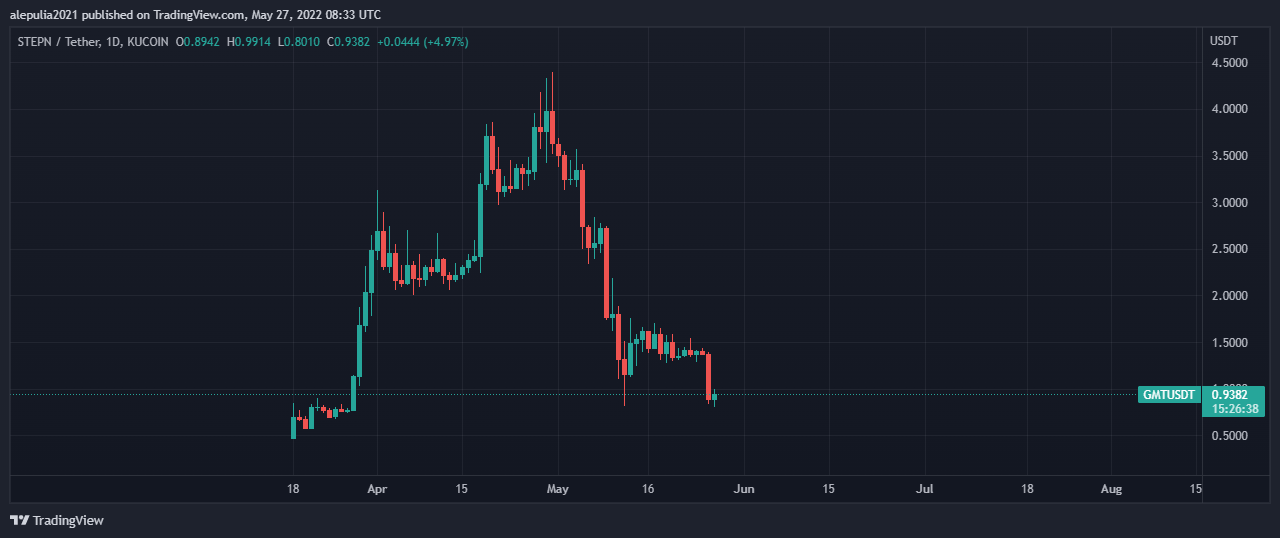
1. STEPN (GMT)

Is the best Solana ecosystem coin presently. It has had a yield of 704% in the past 90 days. It is presently trading at $0.93. It has a trading volume of $2.43 billion. GMT has decreased by 23% in the past 24 hours. STEPN is ranked in position 78 in CoinMarketCap. This is one of the Solana ecosystem projects that is listed on the Binance exchange.

Top Four Solana Ecosystem Projects

Source: https://www.tradingview.com/x/LkYiBlAR/

Some Reasons to invest in STEPN (GMT)

  • Low circulating volume: StepN (GMT) has a total supply of 6 billion. Presently, only 600 million GMT is in circulation. This circulating supply represents 10% of its total supply. Hence, early investors could make good profits as the demand keeps rising. At the time of writing, its trading volume has increased by 294% in the past 24 hours.
  • Positive Forecast: StepN has a present all-time high price of $4.11. According to Coinquora analyst price prediction, it could reach $400 by the end of 2026.
  • Positive sentiments towards a move to earn tokens: StepN (GMT) is one of the most successful moves to earn tokens in the Solana ecosystem. There is a positive sentiment toward fitness projects due to good returns. Since its launch, the return on investment on STEPN is presently 9248%.

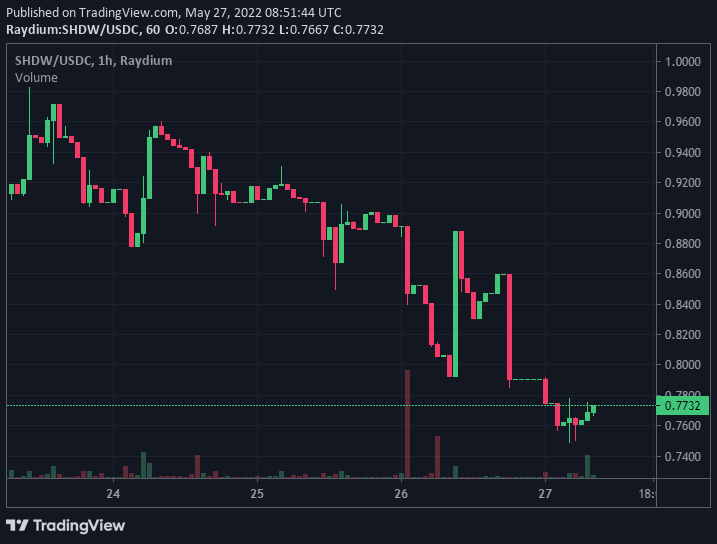
2. GenesysGo Shadow (SHDW)

Top Four Solana Ecosystem Projects

Source: https://www.tradingview.com/x/PhFHCIIb

Is the second in rank in the best Solana ecosystem coins presently. It has had a yield of 42.64% in the past 90 days. It is presently trading at $0.90. SHDW has decreased by 0.9% in the past 24 hours. It has a trading volume of $2.5 million. GenesysGo is ranked in position 2900 in CoinMarketCap.

Some reasons to invest in GenesysGo Shadow

Good ROI in the past three months: GenesysGo Shadow (SHDW) has increased by 64% after it attained an all-time low price of $0.5497 on Feb 24th, 2022. This shows that the price might still rise above its present all-time high of $2.62 soon.

Increasing trading volume: in the past 24-hours, the trading volume of SHDW has increased by 64%. This has made it increase in rank by 37 positions in the past 24 hours. It was previously ranked in 2937 position on May 26th.

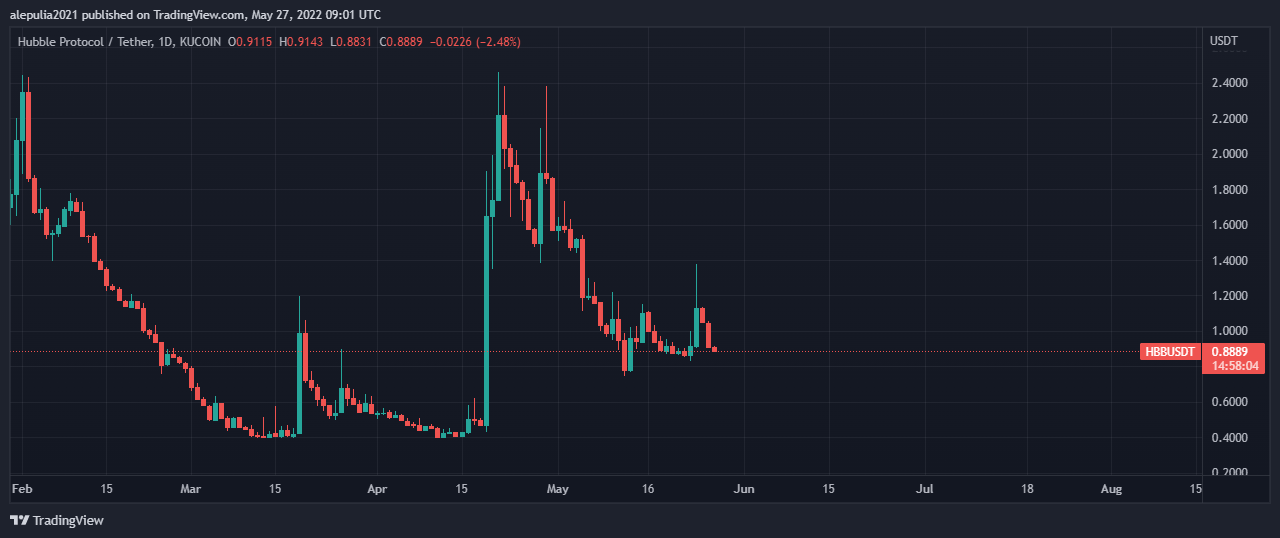
3. Hubble Protocol (HBB)

Is the third in rank in the best Solana ecosystem coins presently. It has a yield of 27.96% in the past 90 days. HBB has decreased by 8.45% in the past 24 hours.. Hubble Protocol is presently ranked in position 3088 in CoinMarketCap. It has a trading volume of $841 million.

Top Four Solana Ecosystem Projects

Source: https://www.tradingview.com/x/O1PfqXVf/

Some reasons to invest in Hubble Protocol

  • Its increase in trading volume: the trading volume of Hubble Protocol (HBB) has increased by 25% in the past 24 hours. This led to HBB’s increase in position by 42 places. It was ranked in position 3131 on May 26th, 2022.
  • Rise in demand for Stablecoins; due to the recent crypto winter, there has been a high demand for stablecoins in other to reduce losses due to high volatility. Hubble Protocol allows its users to mint USD Hubble (USDH) at 0% interest with multiple collateral options. This could lead to a surge in its parent token HBB soon.

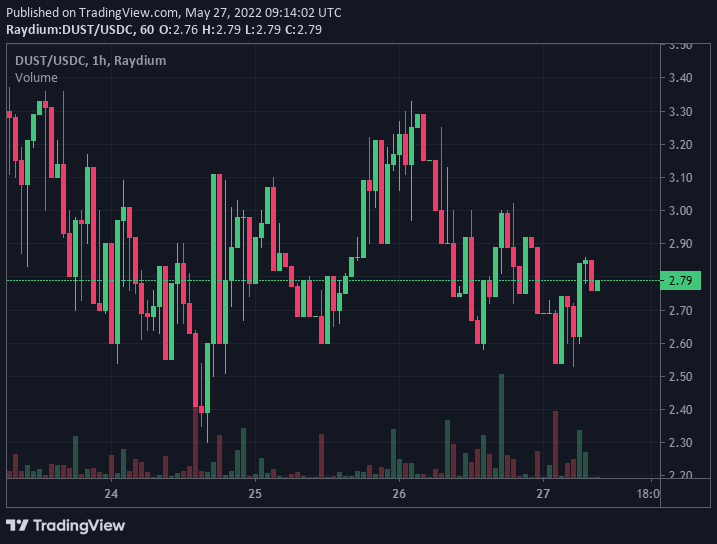
4. DUST Protocol (DUST)

Is the fourth in rank in the best Solana ecosystem coins presently. It has had a yield of 17.98% in the past 90 days. It is presently trading at $2.85. DUST has a 24 hours decrease in the price of 0.94%. It is presently ranked in position 3085 in CoinMarketCap. It has a 24 hours trading volume of $1.096 million.

Top Four Solana Ecosystem Projects

Source: https://www.tradingview.com/x/xngu52xR

Why invest in the DUST Protocol?

  • 247% ROI in two weeks: Dust Protocol token (DUST) attained a present all-time low price of $0.8209 according to CoinMarketCap on May 12th. However, its present price of $2.85 shows that it has gained about 247% in the past two weeks.
  • Its NFT application: there are growing markets for NFT projects. DUST can only be minted by burning NFTs. This could give investors an option to own an alternative currency instead of receiving no rewards for their token burn.

Check Out These 3 Least Volatile Stablecoins

Check Out Least Volatile Stablecoins

Stablecoins are cryptocurrencies that are pegged to a fiat currency or traded commodity in the ratio of 1:1. Stablecoins came into existence because of the high volatility that is associated with most cryptocurrencies. Stablecoins serve as a cushion asset in the period of high depreciation in price since they have low volatility.

Least Volatile Stablecoins

Although stablecoins are pegged to fiat currencies like the dollar, euro, and others, they still exhibit some levels of volatility. We shall consider the least volatile stablecoins based on their performance in the past 30 days, 60 days, and 90 days. This consideration is for the top 10 stablecoins according to CoinMarketCap. The price of stablecoins can also fluctuate based on the market volatility of top cryptocurrencies like Bitcoin, Ethereum, and their parent native tokens.

Some of the stablecoins with low volatile nature are:

  1. Tether
  2. USD Coin
  3. Binance USD

We shall now discuss them in turns.

1. Tether

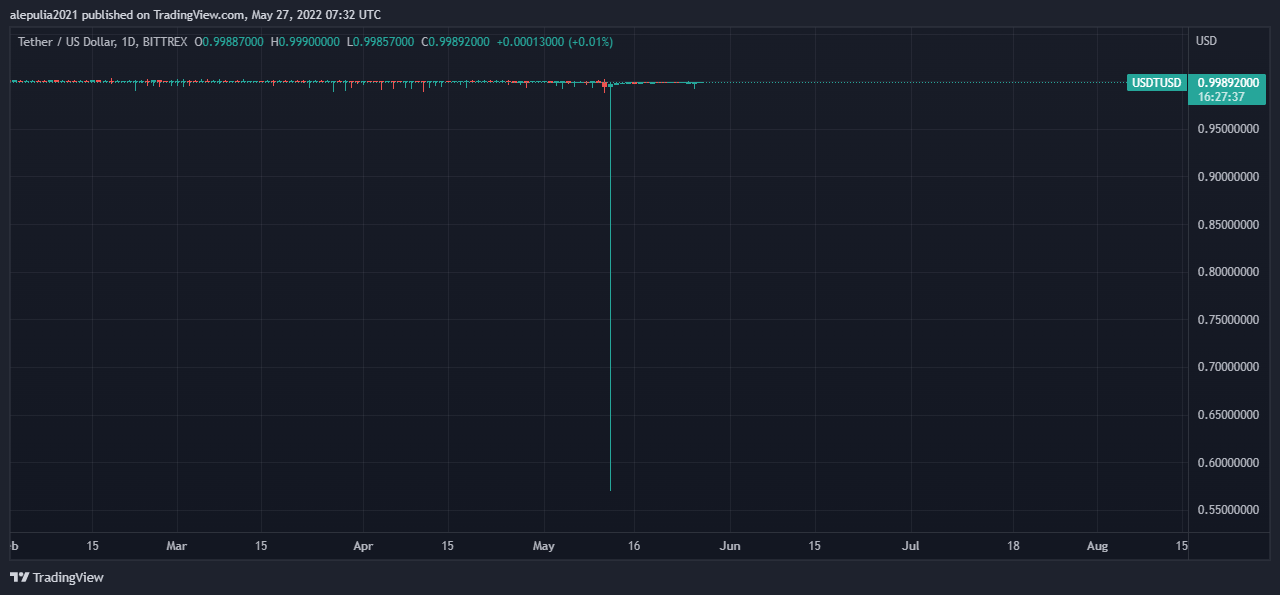
Is the number 1 stablecoin based on CoinMarketCap ranking of stablecoins.

Source: https://www.tradingview.com/x/NCjXAeAF/

Tether (USDT) was launched in 2014. The Co-founders of Tether are Brock Pierce, Reeve Collins and Craig Sellars. Tether is denoted with USDT. At the time of writing, Tether (USDT) is trading at $0.9991. The 24-hour trading volume of USDT is $79.6 billion.

According to CoinMarketCap, the circulating supply of USDT is 73.27B USDT. The all-time high price of Tether is $1.22 while its all-time low price is $0.5683.

The price of Tether (USDT) has decreased by 0.1%, 0.13%, and 0.14% in the past 30 days, 60 days, and 90 days respectively. Some of the top cryptocurrency exchanges for trading stablecoin Tether are Binance, Huobi Global, Kucoin, ByBit, and Gate.io.

Tether is multichain and is present on the Bitcoin, Binance Smart Chain, Tron, Ethereum, Algorand, and OMC blockchains.

2. USD Coin

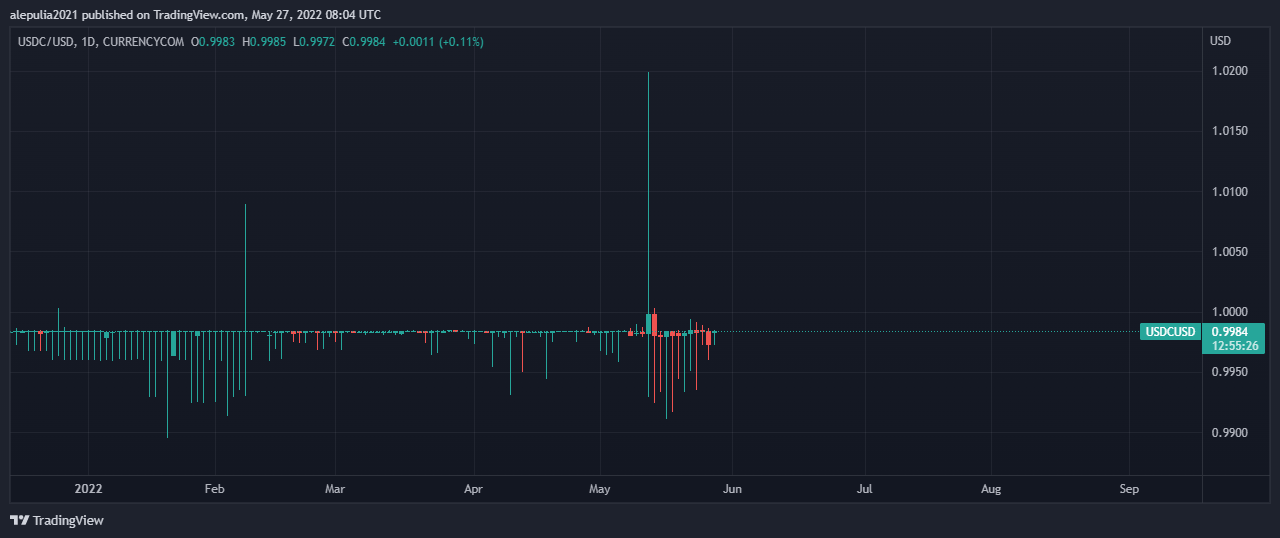
USD Coin is the second rank in the CoinMarketCap ranking of stablecoins. It is one of the least volatile stablecoins in the cryptocurrency market. USD Coin is denoted with USDC in the cryptocurrency market. In the stock market, it is denoted as (CRYPTO: USDC).

Source: https://www.tradingview.com/x/p5qryeVp/

USD Coin was launched in September 2018. It has a Motto “digital money for digital age.” At the time of writing, USDC is trading at $1. The 24-hour trading volume of USDC is $7.45 billion.

USD Coin stablecoin has a circulating supply of 53.25B USDC. The all-time high price of USDC is $2.35 while its all-time low price is $0.9292.

In the past 30 days, 60 days, and 90 days, the price of USDC has increased by 0.01%, 0.04%, and 0.03% respectively. Some of the top cryptocurrency exchanges for USD Coin are Binance, Kraken, Coinbase, Uniswap (V2), and Kucoin.

The major partners that cofounded USD Coin are Circle and Coinbase. USDC is mainly trading with Bitcoin (BTC).

3. Binance USD

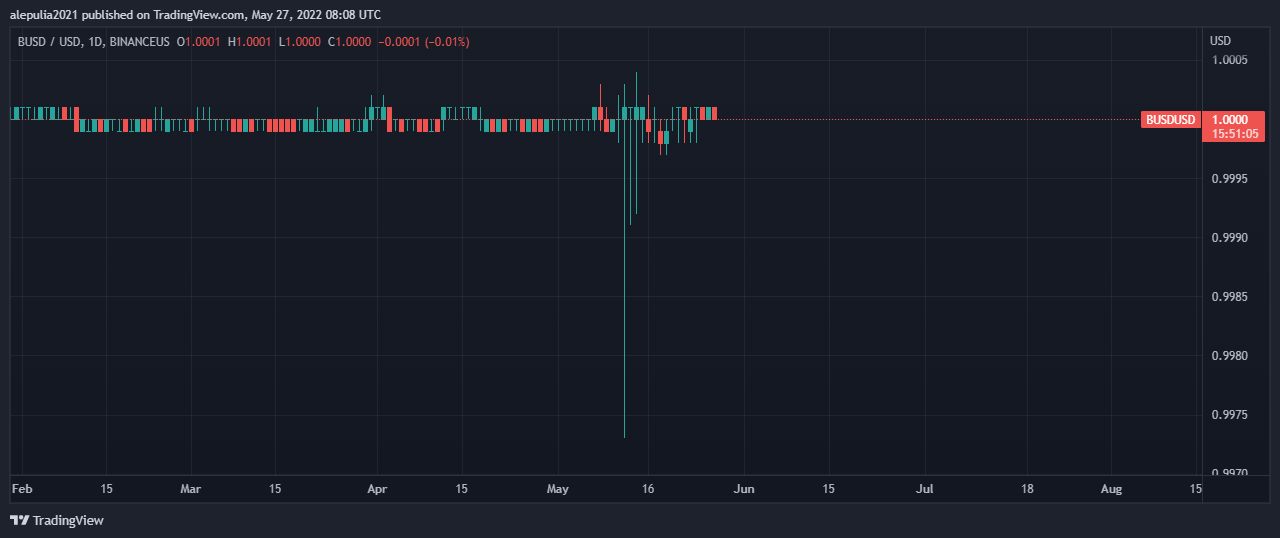
Binance USD is denoted with BUSD in the cryptocurrency market. It is ranked in the third position in CoinMarketCap ranking of stablecoins. It is one of the least volatile stablecoins in the market.

Source: https://www.tradingview.com/x/S1IMI4hO/

Binance USD (BUSD) was launched on September 5th, 2019. It has a circulating supply of 18.15B BUSD. At the time of writing, the 24-hour trading volume of BUSD is $7.43 billion.

In the past 30 days, 60 days, and 90 days, the price of Binance USD (BUSD) has shown volatility by increasing by 0.04%, 0.04%, and 0.04% respectively.

Binance USD is multichain and is present in Binance Smart Chain, Ethereum blockchain, Velas blockchain, Harmony blockchain, and Avalanche blockchain. The all-time high price of BUSD is $1.11 and the all-time low price of BUSD is $0.8861.

Binance USD (BUSD) is a stablecoin of the Binance exchange

Top Venture Capital Firms Supporting Upcoming Crypto Projects

Venture Capital Firms Crypto

A recent report suggests that venture capital firms made crypto investments worth $33B in 2021. The data shows that numerous investors are playing a pivotal role in the crypto/blockchain field. A venture capital majorly hosts a group of investors who hope to make returns from certain crypto projects. Simply put, venture capitalists act as financial contributors to start-ups. On the other hand, fund managers are solely responsible for proposing an investment opportunity to venture capitalists.

VC Crypto Meaning

In the context of cryptocurrencies, venture capital (VC) firms represent investors who provide financial support to upcoming crypto projects. Accumulating capital through retail investors can be difficult since it may delay a project’s goals. Such challenges are making VC firms more popular as they track the most suitable projects. Fund managers may also spread their investments across various portfolios to minimize certain risks and the effects of price volatility.

Top Crypto VC List

The following section describes the leading VC firms taking over the digital asset economy. The companies include:

Digital Currency Group

Digital Currency Group functions as a New York-based firm established in 2015. The firm describes itself as the epicentre of Bitcoin and blockchain technology. As such, DCG intends to support Bitcoin and blockchain projects with access to capital. The company also provides startups with consulting and networking services. Project teams receive all these benefits from the initial development stage of a digital asset platform.

Over 100 companies across 30 countries received DCG’s support, raising capital worth more than $1B. Some of the notable investments facilitated by DCG include Coinbase, Bitpay, Genesis, CoinDesk, and Grayscale.

Pantera

Pantera is a US-based fund manager launched in 2003. The company aims to invest in various blockchain projects, making it one of the leading investors in the blockchain arena. Pantera holds an impressive crypto portfolio because it supports various blockchain infrastructures like custodians, exchanges, and other DeFi solutions. At the time of writing, Pantera has $6B assets under management and successfully conducted 100 venture investments.

Coinbase Ventures

Coming in third is Coinbase Ventures, an investment body of Coinbase exchange. The company began its operations in 2018 with the aim of investing in crypto/blockchain start-ups. According to a blog, Coinbase agrees that the financial system needs to make some adjustments. The company is, therefore, ready to extend its support to those who come up with beneficial products and services. Once selected, early-stage projects can scale their offerings through the venture’s contributions. The venture has more than $1B assets under management at press time.

Paradigm

Paradigm runs as a US-based firm that backs new and existing crypto projects. The fund manager applies a flexible long-term investment strategy to generate returns. Teams under the Paradigm fund further receive technical and operational support to expand their platforms. The minimum amount that investors can receive from the firm is $1M, while the maximum stands at $100M. Paradigm’s crypto portfolio features notable platforms such as BlockFi, OpenSea, Compound, etc.

Andreessen Horowitz

Commonly known as a16z, Andreessen Horowitz is a VC firm launched in 2009. The fund operates as one of the top blockchain investors in the virtual currency space. It majorly ventures in DeFi, Web3 apps, social tokens, and NFTs.

A16z has over $3B assets under management and can maintain an investment for more than ten years. What’s more, the fund invests in all types of crypto projects, whether they are new or existing. Operational support is also available through the company’s background team. The team comprises of experienced individuals who can help in regulatory affairs, recruiting activities, and network governance.

Polychain Capital

Polychain Capital represents an investment firm founded in 2016. The fund majorly provides financial support to promising projects in the crypto/blockchain sphere. Polychain’s main objective is to generate adequate returns for its investors. It undertakes this objective by actively managing portfolios in the digital asset economy.  Among the platforms affiliated with Polychain’s investment portfolio include dYdX, Acala, and Celo.

Draper Associates

Draper Associates works as one of the earliest investment firms launched by Tim Draper in 1985. The fund is dedicated to supporting industry-transforming companies with higher growth potential. Initially, Draper’s investment focused on assisting healthcare, technological, and manufacturing projects. The VC fund then began to shift its attention to blockchain-based start-ups. Draper’s investment portfolio hosts popular platforms like Ledger, Maker, Bancor, and Ethereum.

Animoca Brands

Last on the list is Animoca Brands, a venture capital firm with a unique interest in the crypto and metaverse world. Animoca made investments in 200+ decentralized platforms and NFT projects. Some of the projects found in Animoca’s crypto portfolio include OpenSea, Axie Infinity, Harmony, and Alien Worlds.

Author’s Take

Venture capital firms play a significant role in the crypto market. The companies give financial assistance to start-ups with a higher potential of generating profits in the long run. Through their involvement, VCs could also extend some level of legitimacy to the platforms they support. The pressure to deliver optimum results could be one of the emerging downsides of VC firms. In other cases, the project may submit control to the fund managers. With sufficient capital at their disposal, start-ups can still build products and services that serve the growing crypto market.

What Makes SocialFi The Next Big Thing In The Crypto Space

SocialFi Crypto

The world of social media is changing because of SocialFi. SocialFi is a unique way of mixing social media and finance that enables future generations to produce innovative technology. What is SocialFi, what is its relevance in the crypto space, and how does it affect the way we use social media today? All of the answers can be found in the article below.

What is SocialFi?

SocialFi is an amalgamation of social media + finance, called Social Finance to create decentralized applications or dApps. Large companies control traditional social media, and there have been reports of privacy and security breaches in the past. SocialFi has developed a method of networking that protects users’ privacy and security while also giving them more control over the content they share. SocialFi allows users to make money from their content, but it also allows them to make money via decentralized activities like minting NFTs, converting crypto, and gaming.

By issuing coinage, social projects control the communities they build. The value of the community will continue to rise, which is why Social Tokens were created. Because there is a finite quantity of tokens, their value rises as demand rises. Benefits for community members can be added by the creator, garnering even more fans. The inventor can eventually use the tokens as a kind of remuneration as the value of the tokens rises.

Why Do Social Tokens Matter?

Social tokens, in my opinion, provide a novel way of rewarding creators whose work entertains, disturbs, or informs people. They turn the fan relationship into a two-way street, allowing celebrities to control their interactions with fans and fans to value their loyalty. Celebrities can use the blockchain to identify and reward their most ardent followers. Similarly, creators can adapt their work to improve connection and community by using token-related feedback.

For instance, a token created by a musician allows followers to invest in their career and profit as it grows in popularity is called a social token. Unable to earn a living, a collegiate athlete creating a social token to monetize their brand and reward their followers is another example.

SocialFi Coins to Watch Out For In The Crypto Space

Hive is a social blockchain based on graphene that was built as a fork of Steem and was founded on the principle of decentralization. At the time of writing, the coin’s market cap is $225.45 million, and its price is $0.52098.

Rally (RLY) gives creators the tools they need to create virtual economies that expand their brands while also delivering community benefits and new economic incentives for fans to interact with their favorite artists. On-chain metrics of the RLY token can be accessed here!

Status (SNT) is an open-source and free Android and iOS mobile client based solely on Ethereum technologies. The price of the SNT token is $0.03680 at the time of writing.

Link (LN) token belongs to LINE, a global messenger firm that launched the LINK initiative to build a blockchain platform and token economy for mainstream users. The cryptocurrency network that shares LINE Corp’s general-purpose coin LINK is known as the LINK ecosystem. The purpose of LINE Corp is to create a token economy that people can use easily and naturally in their daily lives.

Decentralized Social (DESO) is a web 3.0 decentralized social network that will be powered by DeSo, a new sort of blockchain. DeSo has been working to alleviate the difficulties caused by current social media centralization since its establishment in 2019. DeSo blends the open P2P financial system paradigm afforded by cryptocurrencies with an efficient and scalable database infrastructure, specifically designed to usher in the next generation of Web 3.0 social networks.

Final thoughts

Considering the volatility of crypto tokens and a lack of regulatory supervision, it is advisable that one must conduct due diligence on crypto projects before making any investments. It is always a good idea to look at the project’s website, go through technical documentation, and read their white paper or litepaper to familiarize yourself with the DeFi projects.

Investing without understanding what you are putting your funds into may prove unproductive and you may lose your money in the due course. Therefore, be aware of the risks involved in the crypto space before committing your efforts, time, and money.

Disclaimer:

This material should not be construed as a recommendation for any particular cryptocurrency. It is not a trading recommendation. The cryptocurrency market is full of unexpected twists and overvalued assets. Before you buy something, do some research. Don’t put more money into it than you can afford to lose.

Is FTX A Safe Exchange to Trade Cryptocurrencies?

FTX trade

FTX is a centralized exchange (CEX). This means that it is not decentralized like a DEX. However, this also means that it is subject to more regulation. CEXs are generally considered to be more user-friendly than DEXs and offer more features. However, they are also considered to be riskier due to the fact that they are centralized. The cryptocurrency derivatives exchange launched in May 2019. Besides, the exchange offers futures contracts, margin trading, and spot trading for a variety of digital assets. The assets include Bitcoin, Ethereum, Litecoin, Ripple, EOS, and more. But does FTX facilitate safe trade for its users? Let’s find out.

What Are The Unique Features of FTX?

Some of the unique features of FTX include:

  • Tokenized versions of popular indexes such as the S&P 500 and Nasdaq 100.
  • A variety of order types including limit, market, stop-limit, and iceberg orders.
  • Negative funding rates for some contracts which allow users to earn interest on their positions.
  • The ability to short spot cryptocurrencies with up to 100x leverage.
  • An intuitive and user-friendly interface.

The exchange does not seem to suffer from the issue of liquidity. In fact, there have been no reports of any problems with regard to liquidity on the exchange. This is probably due to the fact that FTX is a relatively new exchange and has not yet reached the level of popularity of some of the more established exchanges.

How Is FTX Ensuring Safe Trade For Its Users?

FTX is coming up with new and innovative ways to ensure safe trade on its platform. Some of the measures that FTX is taking include-

  • Employing multiple security measures such as 2-factor authentication and cold storage for user funds.
  • Regulation by the Cayman Islands Monetary Authority.
  • Offering customer service through a variety of channels such as email, Telegram, and Twitter.
  • Constantly updating its security measures to ensure that its users are protected.

Moving on, it’s important to note that cryptocurrency exchanges are generally considered to be high-risk investments. However, this is due to the fact that they are often subject to hacks and other security breaches. As such, it’s always important to exercise caution when using any exchange and to only deposit what you can afford to lose.

What Are Some of The Risks Associated With Using The Exchange?

As with any cryptocurrency exchange, there are always risks associated with using it. Some of the risks associated with using the exchange include:

  • Hacks or other security breaches
  • Loss of funds
  • Inadequate customer support
  • Lack of regulation
  • Loss of funds
  • Malfunction of the platform
  • Lack of customer support

What Does The Community Think About FTX?

The community seems to be generally positive about FTX. Besides, there are always going to be some people who are not happy with any exchange. Some of the complaints that have been made about FTX include:

  • Customer support not responding in a timely manner
  • Withdrawal issues
  • Some users have also complained about the high fees

How Do I Start Trading On the Exchange?

If you’re interested in starting trading on FTX, there are a few things that you need to do first. First, you need to create an account on the FTX website. Once you’ve done that, you’ll need to deposit some funds into your account. You can do this by transferring cryptocurrency from another exchange or wallet. Once you have deposited funds into your FTX account, you’re ready to start trading! To do this, simply go to the exchange page on the FTX website and select the currency pair that you want to trade.

Why Backtesting Your Crypto Investment Strategy Is A Must

Crypto Investment Strategy

The volatile nature of crypto prices presents both their selling points and their biggest drawback to every investor out there. If the cards are played right, a well-timed investment like buying the dip results in huge rewards as prices swing high. A good number of investors have, however, shied away after reporting huge losses. It all boils down to backtesting one’s crypto investment strategy. Read on to understand the importance of the process.

What is Crypto Investment Strategy Backtesting?

A crypto investment strategy backtesting refers to the application and running of a chosen trading strategy to historical trading data. The key purpose is to gauge how well the strategy performs against known parameters. It is an analytical method done by investors before implementing the said crypto trading strategy onto their investments. It determines the level of productive effectiveness held in the trading strategy, important in influencing the choice of its real-life application.

How to Run a Backtest

The backtest process contains complex mathematical simulations, often run using automated trading bots. The backtest itself is done to help investors understand how these trading bots function, a prerequisite for safe investment strategies. The first step involves selecting the market one wishes to run the backtest on. The investor then adds the required trading tools and indicators, including the trading bots onto the platform.

One has to then proceed by marking key performance indicators. They are broad and include the targeted profit levels, the trading activity period, and the stop losses to mark when to pull out among others. The next step involves recording and assessing the results after running the trade. The process must be done several times and with different data to generate a complete understanding and trust in the platform.

Why is a Backtest On Any Crypto Investment Strategy Important?

The comparison of different trading bots and automated trading systems has many benefits for investors. They include:

Increases Crypto Trade Efficiency

The first and most obvious importance of running backtests on crypto trading strategies is that it improves one’s trading efficiency. Rather than blindly moving into crypto purchasing and sales, one can take calculated steps that are well thought out. It minimizes one’s susceptibility to losses by equipping them with ways to systematically analyze bid-ask price positions. Such knowledge, which is learned from evaluating past market data, helps a user implement properly analyzed trading models. It is, therefore, crucial for executing crypto purchases and sales efficiently.

Users Learn How to Access the Best Quality Data

Simulating a backtest is quite demanding where data quality is concerned. One must know the exact timing for each trade for a precise reduction of market trends. They must know the exact trading fee charged as well as the commission by exchanges and the exchange spreads. They need to also precisely place the price slippage well for the market orders. Only with the accurate data at hand can a well-informed prediction of price movements be made.

Running a backtest will require one to have the best sources for all the information. After running several backtests, an investor will learn where to source which data and which sources to avoid at all costs. Such knowledge is very important since a loss is usually just a false piece of information away.

Equips Users With Trading  Technical Knowledge

To understand the trading bots, one has to understand all the market data presented and what its movements mean. Market data is often presented in the form of various important technical signals, which come in the form of graphs and charts. The signals which are good for making statistical analyses on trading activity movements include moving averages, candlesticks, and many others.

Such signals are the primary influencers of actions taken by trading bots and automated trading platforms. One inadvertently ends up well versed in how the trade signals work and what they mean- thanks to backtesting crypto investment strategies.

Equips Users with Knowledge Of a Crypto’s Trade History

More often than not, the price moments of cryptos tend to follow certain patterns etched into history. Trading bots help improve investor returns by accurately predicting how movements in prices could go. They are only able to do so after studying the coin’s trade historical data and statistics.

By running a backtest on trading strategies, one has to go through a wealth of past historical trading data of the said crypto. They have to then understand how the trading bots analyze the same to determine the next investment action.

In doing so, one emerges from the backtest with deep knowledge of a crypto’s trading history. It is important in gauging how well the bots are performing while executing a trade since the user can predict expected price movement.

Enables Users to Make Long Term Targets and Assessments

After running a backtest, an investor can make several well-informed long-term conclusions and decisions. By gauging a strategy’s ratio of wins and losses, they can calculate their annual returns on investments with a high degree of certainty.

A user can also determine the amount of capital to inject into an asset from their investment portfolio and when to do it. All this can be done after estimating their maximum upsides and drawdowns based on the data they have. It is possible after adjusting the average prizes of their filled entries and exits to better maximize profits.

Take Away

It is of utmost importance that every crypto investor makes the effort to backtest their crypto investment strategy. This process of backtesting is not too complex, with the article giving a brief guide on how to do so. There are several benefits to be realized from the process. One learns how to efficiently trade, knows where to source the best quality trade data, and learns how to make long-term assessments. The process also improves one’s knowledge, both in the form of understanding technical trade signals as well as on a crypto’s trade history.

The wide benefits gained as well as the immense trading risks averted make the effort of running a backtest worthwhile.


Crypto Signals to Look Out for When Experiencing FOMO

Crypto-Signals-to-Look-Out-for-When-Experiencing-FOMO

We all have emotions that help us go through life, and they are an essential part of who we are as individuals and can help us navigate various situations. However, these emotions can be detrimental when it comes to cryptocurrency trading. One of these is Fear of Missing Out(FOMO), which happens when the market experiences high price fluctuations leading to an emotional call when trading instead of a technical one.

When this happens, the investor might either sell too soon and lose the profits or buy very late, and prices tank. It could lead to portfolio damage and high losses over a long period due to impulse decision-making when a digital asset experiences extreme price swings. We shall look into the best indicator for crypto trading to help you when going through FOMO to decide on his article;

Fear & Greed Index

The Fear and Greed Index is a sentiment analysis tool that generates a number between 1 and 100 and can be used as a crypto FOMO indicator. It uses social media activity, Google trends, Bitcoin dominance, polling, volatility, and the trading volume to develop the index.

Investors tend to get greedy when the market rises, leading to FOMO. It is reflected in the fear that they might not be able to take advantage of the market’s opportunities. Hence, the index reads a higher number. On the other hand, when traders are more concerned with possible trend reversals, the Fear and Greed Index shows extreme fear. The score on the index shows a lower number.

It’s an excellent tool for people looking to keep track of market volatility and sentiment without going through the laborious process of actually reading and interpreting all of the data on crypto analysis.

It can also help people identify a good time to buy and sell. For instance, it can help determine when the market is in the direction of fear; it is an indication to buy, while in the direction of greed, it indicates that it is time to sell.

The score also indicates when prices will trend up(low score) or when the market will likely experience a correction(high score). Notably, users can use the index with other indicators to get a complete picture of the market.

Simple and Exponential Moving Averages

The moving averages are a calculation that considers the past prices of an asset for a certain period. Usually, these averages are used for different time frames, such as the 50-day, 100-day, and 200-day.

The goal of using moving averages is to show the consistent trend of the asset over time. If an asset is above its moving average, it shows that it is in an uptrend; while it is below its moving average, it is in a downward trend.

The 200-day and 50-day moving averages are often referred to as death crosses or golden crosses as they help investors identify both long-term and short-term trends. 

Meanwhile, moving averages come in two types; exponential and straightforward. The difference between the exponential and the simple moving average is that the former considers past prices while the latter focuses on the recent price trends.

Linear Regression Channel

The linear regression channel is a chart indicator that shows the trend channel over time within which the asset price fluctuates. The linear regression channel comprises three lines: the upper bound, the lower bound, and the median trend line. The upper bound is a resistance area where the asset price can’t break. The lower bound supports the price where it goes up, while the median line tends to hold the asset price in the last 100 price points of the asset.

The lower bound is a buy signal, while the upper bound is a resistance area that the asset price can’t break through, showing a correction will happen hence an opportunity to sell. 

Note that when looking for a short-term trade, set the chart time frame to hourly, while for longer trades, weekly or a daily time frame should do the trick. 

Relative Strength Index (RSI)

The relative strength indicator is a technical analysis tool that helps investors identify the direction of a cryptocurrency’s price movement to show its weakness or strength. The indicator can determine if the asset is being overbought or oversold.

In most cases, the RSI is calculated over a 14-day timeframe measured on a scale of 0 to 100. The indicator shows high and low levels of 70% and 30%, respectively. A level below 30 is considered oversold, while a level above 70 is considered overbought.

Folks can also use the relative strength index to predict the market’s direction. If the index goes below 70%, it can be considered a bearish signal; while it rises above 30%, it can be considered a bullish sign.

Author’s Take

The rise and fall of Bitcoin in 2017 were primarily attributed to the fear of missing out(FOMO). This psychological phenomenon can come in handy for investors who can exploit it. On the other hand, it can lead to massive losses that damage the investor’s portfolio. Observing the above crypto signals can allow you to avoid FOMO and develop a strong trading mindset to experience profits.

Top 5 Decentralized Derivative Exchanges of the Crypto Industry

Derivative Exchanges

A crypto derivative is an automated financial contract between two parties depending on the price of an asset at a future date. Any underlying token can be used for trading in a crypto Derivative Exchanges. Two parties enter a contract and speculate on the cryptocurrency token price on a future date. During the contract’s first phase, the parties agree on a selling/buying price for the cryptocurrency on a specific day, regardless of market pricing.

Traders can profit by going long and if the price gets increased. If the trader had bought a token at a lower level and sold it at a higher level, they earned a profit. Traders can also profit by going short if the price gets decreased. If the trader had short-sold a token at a higher level and closed the position at the lower level, they earned a profit.

Both centralized and decentralized Derivative Exchanges systems accept crypto derivatives for trading. Exchange owners can use the potential of cryptocurrency Derivative Exchanges to expand their reach to investors or traders.

A crypto derivative trading exchange has more advantages than Spot Margin trading, and it gives you access to markets that would otherwise be closed to you. We’ll look at the top five Decentralized Derivative Exchanges in this article.

dYdX

dYdX is a decentralized Derivative Exchanges based on the Ethereum network that provides users with critical financial instruments like perpetual, margin, spot trading, and lending and borrowing.

It provides off-chain order books with the on-chain settlement, allowing traders to short-sell tokens, raise exposure by longing with leverage, or collect interest on deposited tokens to move rapidly.

It uses a layer 2 solution i.e Starkware, with the help of Starkware there is no need to trust a centralized exchange while trading, giving it the security and transparency of a decentralized Derivative Exchanges combined with the speed and use of a centralized exchange.

dYdX Mechanics

The dYdX Perpetual is a decentralized derivative, non-custodial margin instrument that provides a synthetic exposure to a wide range of assets. The quotation asset for all perpetual markets is USDC, and the collateral is stored in USDC. By default, cross-margining is employed, which means that one account can create many positions with the same collateral.

Separate accounts (sub-accounts) under the same user can be used to create isolated margins. The liquidation engine may automatically terminate accounts whose total value falls below the minimum maintenance margin requirement. Positions are closed at a price, and the insurance fund absorbs any profits or losses.

Funding

Funding payments are exchanged by long and short traders to keep the price of a perpetual contract close to the underlying price. Long traders will generally make payments to short traders if the perpetual trades are at a premium to the index. In contrast, short traders will often make payments to long traders if the perpetual trades at a discount to the index.

The platform’s native utility token, DYDX, is used in the following functions:

Protocol Incentivization: DYDX tokens are awarded to users based on their trade volume on the dYdX platform.

Staking: Users can stake DYDX tokens in the Safety Module to get DYDX token staking incentives.

Note that staked DYDX may be sliced due to a shortfall event, such as solvency of exchange, smart contract hack, or other circumstances that have resulted in a shortfall by the dYdX governance. Transaction fees are reduced for DYDX token holders based on their DYDX ownership.

Network governance suggestions can be submitted and voted on by DYDX token holders. The Governance Forum allows anyone to engage, create off-chain DRCs, and suggest changes. Use this template to make a DRC (available on our Github).

Governance

Governance forums at forums. dydx community fuel the dYdX Governance Process, which is confirmed by dYdX Improvement Proposals (“DIPs”). The initial step in the governance enhancement process is to create off-chain dYdX Request for Comments (DRCs).

The Governance Forum allows anyone to engage, create off-chain DRCs, and suggest changes.

GMX

GMX is a decentralized derivative and spot exchange that allows you to trade assets on the blockchain without the need for an account, KYC, regional restrictions, or exorbitant centralized Derivative Exchanges fees.

The exchange currently supports both the Avalanche network and Arbitrum, an Ethereum-based layer 2 scaling solution, with ambitions to add more chains in the future. Users can use up to 30x leverage and complete swaps to buy or sell assets in the GLP pool. The pool is made up of high-quality crypto-assets that differ by network.

Mechanics of GMX

Traders on the Arbitrum network’s GMX platform can swap assets in ETH, BTC, LINK, UNI, and several stablecoins. They can also use leverage to trade these assets in both directions.

For example, when a trader enters a long position on Bitcoin, he rents out the upside from the Arbitrum GLP pool.

When a trader enters a short on Bitcoin, the upside of the Stablecoins vs Bitcoin is rented out from the Arbitrum GLP pool. Traders on the Avalanche network’s GMX platform can transfer assets between ETH, BTC, AVAX, and stablecoins. They can also use the assets in the pool to leverage trade these assets in both ways.

When a trader enters a long position on Bitcoin, he rents out the upside from the Avalanche GLP pool. A trader takes out the upside of the Stablecoins versus Bitcoin from the Avalanche GLP pool before launching a short on Bitcoin.

Fees

The exchange fees are completely dispersed back to GMX and GLP holders. 70% of these platform fees will be allocated to GLP holders, while 30% will be distributed to staked GMX holders. Holders of Staked GMX earn 30% of the fees collected by Arbitrum and Avalanche Exchanges.

The Arbitrum GLP token holders will receive 70% of the GMX (Arbitrum) platform fees in ETH. In comparison, holders of the Avalanche GLP token will receive 70% of the GMX (Avalanche) platform fees in AVAX because the GLP token is unique on each of these networks.

Perp Protocol

Perpetual System is a decentralized Derivative Exchanges that uses a Virtual Automated Market Maker to exchange perpetual contracts for any asset (vAMM). The initiative hopes to establish new financial instruments by democratizing Futures and other crypto-asset derivatives.

Furthermore, Perpetual Protocol is just a collection of programs (smart contracts) that operate on the Ethereum blockchain and were created to interact and duplicate derivatives market services. This implies Perpetual Protocol users don’t have to trust a specific institution or group of people to execute trades; all they have to believe is that the code will run as intended.

Perpetual Protocol was influenced by Uniswap, a successful decentralized exchange, and Synthetix, a synthetic asset derivative platform. On the other hand, it isn’t designed for spot trading or obtaining exposure to real-world assets; instead, it’s built for leveraged trading, and short holdings, with little slippage.

Perpetual Protocol uses a virtually automated market maker (vAMM) and a collateralization vault. These structures are intended to settle trades and provide anybody with access to sophisticated financial instruments such as perpetual contracts.

The platform’s native utility token, PERP, is utilized for the following purposes:

Token holders can vote on the next token listed on the platform or influence the protocol’s direction with their tokens.

Tokens can be staked on the protocol in exchange for staking incentives and a share of transaction costs. Each virtual market has a backstop provided by the speakers.

Governance

The core developer team currently manages the protocol’s governance to make the decision-making process quick and fluid. On the other hand, the team has drawn a clear plan to hand over protocol governance to the community. Future upgrades, such as on-chain governance voting, bug bounty programs, and ecosystem grants will be detailed in the plan.

Members of the community will be able to suggest and discuss governance proposals in the near future.

Mango Market

Mango provides a single platform for lending, borrowing, swapping, and derivative trading of crypto assets through a robust risk engine. It is based on the Solana blockchain and uses Serum DEX for spot margin trading, while permanent futures are transacted on the Mango order book.

MNGO holders are responsible for governing the Mango DAO.

Mango is a tremendously vital tool, here are some tips to help you get the most out of it. Borrowing/lending and leverage trading share collateral. If you deposit funds into your Mango account, those funds will generate interest and be available as collateral for leveraged trades or borrowing.

For derivative trading, funds are automatically borrowed. If you want to trade with leverage, place an order for the amount you wish to. If the required capital is more significant than your deposits, funds will be borrowed to cover the position (as long as account health is eligible). To avoid taking on a borrow or leverage position when trading in spot markets, uncheck the margin box in the trade form.

Mango Perpetual futures offer up to 20x leverage on Mango’s order book and 10x spot margin trading on Serum DEX. All traders earned the highest Serum fee tier from a liberally deposited MSRM.

Gains Network

Gains Network has created gTrade, the most liquidity-efficient, powerful, and user-friendly decentralized derivative trading platform.

Its synthetic architecture is 100 times more capital efficient than any other platform, and it allows for very-low trading fees, a wide variety of leverages (150x leverage on cryptos and stocks, 1000x leverage on forex), and any assets/pair (cryptocurrencies, forex, stocks, and soon many more).

The entire protocol focuses on the ecosystem’s ERC20 and ERC721 utility tokens (GNS and ERC721) (NFTs). The GNS and NFTs are intended to be used actively inside the platform. Gains Network’s entire trading architecture is based on the backing of GNS by DAI vault through burning and minting, and GNS NFTs fuel the bots that execute limit orders and liquidations.

Without the GNS token, the first product, gTrade, would not exist. The GNS/DAI liquidity is responsible for the collateralization of the DAI vault liquidity. It is at the heart of its synthetic design. The premise is simple: when traders win, GNS tokens are produced, and when traders lose, GNS tokens are burned. Until yet, nearly a quarter of the supply has been burned due to gTrade’s organic deflation.

It began as the $GFARM2 Ethereum token, distributed evenly in an ETH pool and a GFARM2/ETH LP pool. The development and government funds received 5% of the token distribution (10 percent total). Later, it was bridged to Polygon and split 1:1000 with $GNS.

 

Is Polygon (MATIC) Worth Hodling?

s Polygon (MATIC) Worth Hodling

Polygon is an open-source blockchain that supports the launch of Decentralized Applications (Dapps) on its platform. Its native token is MATIC.

At the time of writing, Polygon (MATIC) is ranked in the 17th position in the CoinMarketCap ranking of cryptocurrencies. Uniswap is the largest Decentralized exchange in the world presently. MATIC trades at $0.6442 at present with a 24 hours decrease in price by 7.39%.

Polygon (MATIC) has reduced by 55.5% in the past 30 days. MATIC 30 days low and high prices are $0.56 and $1.50 respectively.

Some of the reasons why MATIC remains a good hodl are:

  • Present data of sellers’ pressure.
  • The attraction of Non-Fungible Tokens projects to Polygon Blockchain.

Present data of sellers’ pressure

Technical analysis data on Polygon ( MATIC) shows that out of the 11 oscillator indicators analyzed, 1, 9, and 1 indicate sell, neutral, and buy signals respectively. Also, out of the 15 moving average indicators analyzed, 14,1, and 0 indicate sell, neutral and buy signals respectively. This means that 15, 10, and 1 indicators gave a sell, neutral, and buy signals respectively. The relative strength index of Polygon (MATIC) is 31.8. This means that it is close to it’s oversold/undervalued region of 30. If this happens, investors could see a bullish market reversal.

The attraction of Non-Fungible Tokens projects to Polygon Blockchain

In recent times, due to the recent explosion and gains that are associated with non-fungible tokens (NFTs), there has been an inflow of more investors to the market. One of the factors that had been a hindrance to its growth is the high gas fees associated with the Ethereum network. However, some of the market places for trading NFTs in the Decentralized market have now been adding trading on Polygon Blockchain as another option. This has attracted some of the projects and new ones to the Polygon ecosystem. With this rise, there will be more adoption of Polygon native token MATIC.

Conclusion

Polygon blockchain at present is competitive as an alternative to Ethereum blockchain. However, an inflow of more projects into it will attract more investors, which will directly increase the price of MATIC tokens.

Top Reasons to be a Tron (TRX) Long-term Investor

TRX

Tron (TRX)has been around since 2017. TRX was one of the top six cryptocurrencies in early 2018 and the young Tron founder, Justin Sun stated that one of his missions in 2018 was to displace Ethereum. The target has not yet been achieved though Tron blockchain has made a lot of success since then. Tron has a present price of $0.07432 which is 58.73% higher than its present 52-week price of $0.04682. TRX is presently in the 14th position in the CoinMarketCap ranking of cryptocurrencies.

Irrespective of this position, the Tron network token (TRX) might be an undervalued cryptocurrency for the following reasons:

Tron token (TRX) performance with respect to some top cryptocurrencies

In the past 30 days, the price of Tron (TRX) has increased by 18.08%. Bitcoin, Ethereum, and BNB within the same duration had reduced in price by 27%, 34.52%, and 27.02% respectively. This means that an investor who owns an equal amount of the four coins in United States dollars has increased by over 4.86 times when compared to investments in the other three cryptocurrencies (BTC, ETH, and BNB) put together. However, in recent times, the news had always been around Bitcoin, Ethereum, and BNB due to their higher position in the ranking.

Tron (TRX) Higher Rebouncing Capacity When Compared to Some Other Coins

Some cryptocurrencies went to extinction during and after the crypto winter of 2018. TRX was one of the tokens that were heavily affected by the heavy market dip. Its present all-time high price of $0.2316 was attained on January 5th, 2018 according to Coingecko. Although, it has not surpassed it since then: its present price of $0.07432 shows that it is down by 68% since then. The likes of Stellar Lumen (XLM) and Monero (XMR) attained their all-time high price on January 3rd, 2018 and January 9th, 2018. XLM has reduced by 85% while XMR has decreased by 69.4% since then. This shows that TRON has a higher rebouncing.

Adoption of its blockchain

Since the launch of the TRON blockchain in 2018, the number of its users has grown to 90 million in the space of 4 years, with over three billion transactions recorded on it. This shows that it is gaining a lot of attention and adoption. With this increase, more investors are attracted to its platform which will directly increase its price.

Conclusion

TRON (TRX) has a bullish future forecast according to the different analysts, and the present record shows that it could outperform other known cryptocurrencies.


Axie Infinity (AXS) Moving Towards Bullish Recovery?

Axie-Infinity-(AXS)-is-on-a-Part-of-Bullish-Recovery.j

Axie Infinity (AXS) is one of the fourth most popular metaverse tokens in the CoinMarketCap ranking. It has lost 53.30%, 58.55%, and 62.71% in the past 30 days, 60 days, and 90 days, respectively. On the total market capitalization, it is in the 44th position.

Presently, Axie Infinity’s price is $21.46, with a 24 hours increase of 1.44%.

Some of the reasons why Axie Infinity (AXS) could be a part of recovery include:

  • Its recent bullish run
  • Formation of inverted head shoulders
  • Its ability to withstand negative trends
  • Its comparison with top cryptocurrencies

Axie Infinity’s Recent Bullish Run

Axie Infinity (AXS) gained 11.7% of its lost price due to the crypto winter in the past seven days. Following a peak of $165.37 on November 6th, 2021, the gain indicates that the price might recover more in the upcoming weeks. Its seven-day low price is $17.57. It appears the price of AXS is in the process of bouncing back.

Formation of an Inverted Head and Shoulders

An inverted head and shoulders pattern indicates a strong bullish run is about to begin. The present sharp of the 1-day chart of Axie Infinity (AXS) shows its formation. It could mean that the current buyers could make a quick gain soon.

AXS’ Present Ability to Withstand Negative News

Cryptocurrency markets can be affected by the news. However, Axie Infinity (AXS) has remained profitable despite the recent hack of its discord server that cost them some tokens. This turn of an event may cause investors to panic, resulting in the falling price of Axie Infinity. We can infer that the recent increase of over 44% in the trading volume of AXS is mainly due to buyer pressure.

Its Comparison with Top Cryptocurrencies

Over the past week, the price of Bitcoin has increased by 1.1%. The value of Ethereum and XRP have decreased by 6% and 1.5% within the same duration. This change means that investment in AXS is more profitable than that of Bitcoin, Ethereum, and XRP put together in the past seven days.

Conclusion

Axie Infinity (AXS) holders and present buyers will inevitably receive satisfactory returns for the reasons above.

Present Data Shows that Elrond (EGLD) is Undervalued

Present-Data-Shows-that-Elrond-EGLD-is-Undervalued

Elrond is one of the top blockchains in the Cryptocurrency space. It uses its native token EGLD in payment for gas fees within its ecosystem. Elrond blockchain can complete 15,000 transactions per second. At the time of writing, the price of EGLD is $99.61. Developers and project creators can use the Elrond blockchain to create smart contracts and launch decentralized finance and internet of things projects.

Although Elrond is ranked in position 35th in CoinMarketCap, some reasons below show that it could be undervalued:

  • Its present return on investment
  • Its adoption
  • Its present relative strength index value

Its present return on investment

Elrond was created in 2017 but was announced in August 2019 and its mainnet was launched in July 2020. Since its launch into the market, EGLD has given its long term investors a return of 479%. However, in October 2020, it attained an all-time low price of $6.54. Its present return on investment since attaining this lowest price in about 19 months is 1421% according to CoinMarketCap. This is a good reversal since it has shown that it can attain higher highs. Its present all-time high is $542.58. Tokens with such a response to dips are worth investing in.

Its adoption

Due to the practical use of Elrond (EGLD), top crypto exchanges like Binance, OKX, and FTX, has it listed. Holders of EGLD can use it to stake and receive trading rewards. With the high adoption of projects in the internet of things (IoT), and farming in decentralized finance (DeFi), Elrond blockchain has a good future since the market is increasing always. Also, the low fees of about $0.001 in Elrond blockchain is making it a good alternative to Ethereum with high transaction fees and scalability issues.

Its present relative strength index value

The relative strength index value of Elrond native token EGLD is less than 40. This shows that it is approaching the oversold or Undervalued value of 30 soon. This has made most indicators to indicate a sell for it. When we check its performance in the past year with the likes of Ethereum and Binance Coin, we would see that it has the lowest volatility of -28.9%, when compared to Ethereum volatility of -37.6% and BNB volatility of -41.6%. Since investors are bullish on Ethereum and Binance Coin, we could see that the future if checked from the present record, makes Elrond more profitable than the ETH and BNB.

In conclusion, we have seen that holders of EGLD might enjoy a good return based on its returns on investment, real-life applications, and its low circulation supply of 21,949,486 EGLD.

Is Decentraland ( MANA) on the Part of Bullish Run?

Is-Decentraland-(-MANA)-on-the-Part-of-Bullish-Run.

Decentraland (MANA) is one of the top Metaverse tokens in the market. Its early investors have received a return on investment (ROI) that is over 4520%. This means that for each $1 initial investment, they have received over $45.20 as a gain.

Irrespective of the recent decline in the past months that led to a big dip in the worth of portfolios of Cryptocurrency investors, Decentraland has gained about 7.2% in the past 7 days. This could mean that it is on a part of a bullish run. At the time of writing, MANA is trading at $1.19 and is ranked in position 35th in CoinMarketCap.

Some of the data that shows that Decentraland could be on a part of a bullish run include:

  • Decrease in its trading volume
  • Increase in the number of indicators that give a buy signal

Decrease in trading volume

The direction of the volume of trade shows the trend the market might be taking soon. In the past 90 days, the trading volume of Decentraland has moved from $849 million to $375 million. This is from its statistical data between Feb 18th and May 17th. This represents a decrease in trading volume by 126.4%. This shows that Decentraland investors are holding for the long term. These fewer seller activities had also resulted in it’s decrease in trading volume by about 24% in the past day.

Increase in the number of indicators that give a buy signal

Prior to the recent reversal in the price of MANA in the past few days, most of the indicators show a sell signal. However, from the technical analysis of oscillators indicators and moving average indicators in the link above, three of them are now showing a buy signal, while 9 and 14 show neutral and sell respectively. This increase might be indicating a possible bullish run for Decentraland soon.

Conclusion

With the possibility that the price of Decentraland could attain a double bottom soon, if the price plummets further, long term investment should expect a strong bullish run when its price gets to around $1.09.

IMF Sanctions: Barrier to Crypto Adoption?

IMF-Sanctions-Barrier-to-Crypto-Adoption

1944 marked the founding of the International Monetary Fund (IMF). About 190 countries in its membership rely on it for exchange rate stabilization. In response to the emergence of cryptocurrencies over a decade ago, the International Monetary Fund (IMF) emphasized that this development can make the financial system of countries porous since the market is not regulated. IMF sanctions

El Salvador suffered IMF sanctions for adopting Bitcoin as a legal tender and making purchases of more Bitcoin during dips. Just a few weeks ago, the Central African Republic (CAR) joined El Salvador in adopting Bitcoin as a legal tender. This action brought a lot of criticism to the government of CAR by the International Monetary Fund and other international institutions.

The fear of IMF sanctions could impact negatively on the speedy adoption of cryptocurrencies in the following ways:

  • Fear of open support for cryptocurrencies by countries
  • Imposition of laws preventing citizens from participating in Crypto activities

Fear of Open Support for Cryptocurrencies by Countries

The membership had 190 countries in total. Due to the fear of sanctions, only a few countries in the membership adopted cryptocurrencies as legal tender. They worried these IMF sanctions would prevent them from accessing international loans during any financial crisis. Different countries that understand the importance of cryptocurrencies in the long term seek this support to align with the position of the International Monetary Fund. This fear reduces cryptocurrency adoption.

Imposition of Laws Preventing Citizens from Participating in Crypto Activities

Since the cryptocurrency market is porous, volatile, and unregulated, the International Monetary Fund suggests conducting more studies. Countries that support this stand have access to technical support, loan support, and structural adjustment. It ensures that recipient nations maintain strict monetary policies. It also inspires these governments to make laws that prohibit all forms of cryptocurrency activities by the citizens and businesses within their jurisdiction.

In conclusion, the fears of the International Monetary Fund are valid since they do everything to uphold the mandate that led to its creation due to the world economic crisis orchestrated by the Second World War. However, this directly impacts the adoption of Cryptocurrency in some countries negatively.

Various Consensus Mechanism and Their Working Explained

Various-Consensus-Mechanism-and-Their-Working-Explained

A consensus mechanism is a technology used by cryptocurrencies like Bitcoin and Ethereum to certify transaction validity and secure the underlying blockchain. This technique ensures that the blockchain contains all valid transactions and that each copy contains all valid transactions.

The role of consensus mechanisms needs to be understood to understand how Bitcoin and other cryptocurrencies work. We will have a detailed view of what they are, how they function, and how consensus mechanisms contribute to a secure, trustworthy blockchain experience for all users.

Types of Consensus Mechanism

Proof of work

Compared to other consensus mechanisms, the proof-of-work process requires a lot of energy and computing power to establish a consensus, making it a costly option. The essential concept is that miners in a network must demonstrate that they have put out a specific effort. Miners provide the computational power required to maintain the blockchain and validate transactions.

Miners also ensure that the network is secure against hackers. They compete against one another to connect a series of transactions, known as blocks. All verified transactions are stored on the blockchain and available to all network participants. Hash functions, or mathematical functions, are used by miners.

In simple words, hashing is the process of taking any length input string and producing a fixed-length result. The actual problem is that by solving mathematical riddles, a consequence with specific properties resulting from the hash function must be obtained. It can be demonstrated that the transactions (i.e. the computation path) were conducted without errors by solving the mathematical riddles.

If the block is mined correctly, it is added to the blockchain, and the miner who solves the mathematical challenge first receives a reward. Bitcoin is the most well-known crypto money that uses the proof-of-work mechanism.

Proof of Stake

Proof of Stake divides a miner’s voting power from its processing power, i.e. in PoS, mining power is distributed according to the percentage of tokens held by a miner. The more significant his or her proportion of the total tokens, the more likely this miner will be chosen to mine the block.

Despite this, the proof-of-stake system relies on a random method to reach a consensus. Though the number of tokens owned stake is significant (since the proportion of tokens held influences the likelihood that a miner will be authorised or selected to mine the next block), various other criteria play a role in determining who will mine the next block.

Delegated Proof of Stake

The Delegated PoS mechanism can be considered a more democratic version of the PoS process. Only those with the most tokens are authorised to confirm or validate transactions in DPoS.
To complete this activity, all token owners choose a group of delegates. Because all users in the network are allowed to select the group of miners that confirm transactions, the method remains decentralised.
The advantage of the centralised feature of DPoS over the PoS-mechanism, on the other hand, is the faster verification and transaction speed, which leads to great scalability. Both the EOS and Lisk projects use the DPoS-mechanism.

Proof of Capacity

Solutions to complex mathematical riddles are stored in digital storage such as hard discs using the Proof of Capacity approach. Plotting is the term for the entire procedure. Users can use a storage device to make blocks after it has been filled with mathematical puzzle solutions.

Users who find the solutions first are allowed to mine the block. Users having the most storage capacity will have a better chance of creating a new block.

Proof of Elapsed Time

The Proof of Elapsed Time method selects the producer of a new block at random and relatively depending on the time they have waited. The method does this by assigning each user an unexpected wait time, with the user whose wait time expires first producing a new block.

This consensus process only works provided the system can verify that no single user can start several nodes simultaneously and that the wait time is random.

Proof of Identity

A user’s private key is compared to an authorised identity in Proof of Identity. Proof of Identity is a cryptographic piece of proof for a user’s private key that is cryptographically associated with a specific transaction.

A blockchain network allows any recognised user to generate a data block that can be displayed to anybody else on the web. Proof of Identity ensures the data’s integrity and validity.

Smart cities can also employ blockchain consensus techniques such as Proof of Identity to validate their people’s identities.

Proof of Authority

The Proof of Authority mechanism is a modified Proof of Stake in which validators’ identities are at risk. The identity in this situation is the correlation between the validator’s identities and their official papers to aid in verifying their identity.

The network is where these validators stake their reputation. The only nodes allowed to produce new blocks in Proof of Authority are those that become validators. Validators whose identities are on the line are motivated to keep the blockchain network safe and secure. Furthermore, the number of validators is limited (i.e. 25 or less).

Proof of Activity

The Proof of Activity mechanism uses the combination of the Proof of Stake and Proof of Work Consensus mechanisms—Miners attempt to solve a puzzle and collect their reward in Proof of Activity. The Proof of Activity blocks, on the other hand, are simply templates with the mining reward address and header information.

After that, the header information is utilised to select a random group of validators for mining the blocks. Validators containing more stakes have a better chance of being chosen to sign a new block. Once the designated validators sign, a new block becomes a part of the blockchain.

If validators find an unsigned block, it is deleted, and a new block is used. The winning miner and the validators split the network fees produced throughout the operation. Despite having identical goals, different blockchain consensus methods use different approaches to achieve consensus. Although there is no single reliable consensus mechanism, existing ones have evolved to match the needs of blockchain.

As the underlying technology is still relatively new, identifying the type of blockchain consensus mechanism that will be more used and beneficial in the long run can be increasingly difficult.

As a result, business leaders who want to implement blockchain technology in their company should be familiar with the various blockchain consensus techniques.

Advantages of Consensus mechanism:

Forms the crypto-core market’s agreement:

Consensus methods enable confidence in a blockchain by synchronising data amongst all participating users.

Provides a safe environment:

For security, cryptocurrencies and distributed applications rely on consensus methods.

Anyone can participate:

The obstacles to becoming a miner or running their nodes are low with the most prevalent consensus techniques.

Disadvantages of Consensus mechanism:

Require a lot of energy:

Proof-of-work is an energy-intensive process that uses as much electricity as several countries.

Attacks are possible:

A 51 per cent attack is a form of hack that has a modest possibility of succeeding, among other minor flaws.

Tezos (XTZ) Price is Approaching the Oversold Region: What Next?

Tezos-(XTZ)-Price-is-Approaching-the-Oversold-Region---What-Next

Tezos is one of the unique blockchains in the cryptocurrency space. Its native token XTZ is presently trading at $1.81. Tezos is ranked in number 40th position in the CoinMarketCap ranking of cryptocurrencies in terms of their market capitalization.

Although Tezos blockchain supports the deployment of smart contracts and is open source, it does not support splitting into hard forks. This is one factor that makes it different from the Ethereum and Bitcoin blockchains.

At present, Tezos (XTZ) is approaching the oversold region as it has a relative strength index (RSI) value of 32.2. A relative Strength Index value between 0 and 30 means that the asset is in the undervalued or oversold region. Tezos is already approaching this region.

The following are possible at this stage:

Buyers have been on alert to see it touch a 30 RSI value

Once the relative strength index value of Tezos native token XTZ touches 30, more buyers might enter the market. This is because this value shows that buying XTZ at the present price or a price range between $1.74 and $1.80 is still good. This could reverse the present trend of XTZ where it has lost over 44.5%, 41.3%, and 56.5% in the past 30 days, 60 days, and 90 days respectively. The price could surge past $2 since the trading volume that is down by over 100% in the past 90 days after it moved from $131 million on Feb 17th to $61.5 million on May 16th will be increased.

Sellers involved in the panic sell

This would be a disaster for the token in various stages:

  • Its price could drop to around $1.79 and start reversing since it forms inverted head shoulders around that price. The price could then surge above $2.1.
  • The price of XTZ could further decrease to around $1.77 or $1.74 support levels. The price is expected to have a bullish reversal at either of the points due to the formation of a double bottom.

Conclusion

However, there are two ways through which the recent decline in the price of XTZ could be reversed:

  • Increased baking activities: baking is a term used in the Tezos ecosystem where an investor stakes a minimum of 8000 XTZ so as to get involved in making governance decisions. This will reduce its volume in circulation thereby increasing the price.
  • Increased staking rewards: some of the two top exchanges that allow staking in XTZ are Binance and Coinbase. If the average percent yield in XTZ stake is increased, more holders could hodl for the long term. This will directly impact the price of Tezos positively.

Apecoin Maintains Over 780% Gain in 60 Days!

Apecoin-Maintains-over-780%-Gain-in-60-Days

Apecoin (APE) is the Cryptocurrency of the Bore Ape Yacht Club (BAYC). It is one of the crypto tokens with a strong capacity to retain its previous gains irrespective of the crypto downtrend of recent weeks. In the past, to days after it was launched in March 2022, it has a return on investment of 784%. This means that its investors are still on the gain of $7.84 for each $1 investment.

Although, it is presently trading at $8.37 after attaining an all-time high price of $39.40 according to CoinMarketCap. It has remained profitable since its all-time low price is $1.

Some factors that had made this possible are:

Its unpredictable buyer’s pressure

Apecoin (APE) is one of the recent cryptocurrencies with unpredictable buyers. This has made it to always recover from its lows. Irrespective of the price that Apecoin attains, buyers sometimes apply strong pressure that tends to push its price higher. This helps it to regain its previous losses since the sellers increase the price.

Increased Volume in Circulation

Apecoin has a total supply of 1 billion APE. Out of this total supply, only 284,843,750 APE are in circulation. This represents about 28.84% of its maximum supply. This is low, which can easily lead to scarcity of the token whenever the buyer’s pressure is increased.

Future predictions on the token

With the commitment from Bore Ape Yacht Club Yuga Labs, investors are optimistic about a good return on investment on Apecoin. There are predictions in some quarters that the APE token could trade above $100 soon. This prediction has increased the hodling capacity of its investors.

Its use cases

Apecoin can be used by holders to participate in Decentralized Autonomous Organization (DAO) governance decisions of the Bore Ape Yacht Club. Holders can also receive airdrops of future tokens that can be launched by Yuga Labs. With Apecoin airdrop worth over $50,000 when it was received by CryptoPunks holders, the present investment does not wish to miss out on the future benefits.

In conclusion, these present returns might be surpassed soon, as holders remain positive due to possible applications of Apecoin in the metaverse space.