Magic Eden Offers Market Customers Discounts and Incentives System

Magic Eden Discounts

In accordance with their participation on the site, members of Magic Eden will now be able to earn awards, discounts, and other benefits. On December 14, Magic Eden Rewards will formally debut.

Magic Eden to Offer Discounts and Incentives

The action by Solana’s largest NFT and gaming marketplace comes after earlier attempts to increase user engagement on the network, including the reinstatement of the artists’ royalty protective measure and the employment of a Chief Gaming Officer named Chris Akhavan to expand web3 gaming sales on Magic Eden.

The CEO of Magic Eden, Jack Lu, and the head of marketing, Tiffany Huang, explained to the resources that this technology is distinct from Open Creator Protocol, with the goal of enabling creators to encourage royalty fees through various protocol-enabled methods, including variable royalties pricing, customizable transferability, and secured royalties.

Cost Abolishment Until 2023

The CEOs also said that even though Magic Eden costs would be abolished until 2023, consumers may anticipate transaction reductions between 5% and 45%, depending on the trader’s position, until the fees resume. Furthermore, even if the cost of Magic Eden Rewards NFTs is determined by market value, the business is collaborating with strategic partnerships to bring open beta invite codes and trade research tools to the offering.

Magic Eden Introduces a Protocol to Ensure Creator Royalties

Magic Eden Royalties

Magic Eden, a non-fungible token (NFT) exchange, has revised its stance on creator royalties. On Thursday, it announced the creation of a protocol that would impose fees on any new collections that choose to use the tool.

Magic Eden to Start Enforcing Royalties

Creators publishing new collections will have the option of having their royalties safeguarded due to the Open Creator Protocol (OCP), an open-source solution built on Solana’s SPL managed-token standard. Magic Eden will start enforcing payments on all collections that adhere to the standard on December 2 and will provide authors the alternative of banning markets that don’t impose royalties.

According to a press statement from Magic Eden’s CEO and co-founder Jack Lu, the Solana ecosystem has been looking for answers to NFT royalties. The statement further claimed that with the Open Creator Protocol, the company aims to provide payments for creators introducing new collections currently while working with ecosystem partners to find more alternatives.

Services Provide by Protocol

The new protocol also provides adjustable token transferability, which enables creators to gamify the laws of their collection’s trading behavior. The network will offer a free “Magic Mint” at the opening so that customers may try out the Open Creator Protocol and its capabilities.

The switch to an optional royalty arrangement, announced by the leading Solana NFT marketplace a month prior, had severe consequences for the ecosystem, according to a Twitter thread. Traders that want to sell quickly and profit are favored by variable royalties.

Phantom Crypto Wallet Will Now Support Polygon and Ethereum

Phantom Ethereum

Phantom, a cryptocurrency wallet, is extending to the Polygon and Ethereum blockchains, which might represent a threat to MetaMask. Within a few weeks, the cryptocurrency wallet is expected to be in the test, followed by a public launch.

Phantom Crypto Wallet Development

On the Solana blockchain, Phantom is the most widely used wallet. It was developed by a group of Ethereum engineers who established the 0x decentralized exchange. It quickly gained popularity because of its user-friendly interface and capability to display NFTs. Currently, it has over 3 million users worldwide. It is one of the most legitimate contenders to MetaMask’s market dominance because of its extensive popularity on Solana.

Enhanced Version of MetaMask

Phantom has taken a long time to reach Ethereum. The founding team initially intended to create an enhanced version of MetaMask but decided that building a new ecosystem first would be a superior go-to-market approach than immediately entering the market to contend. It is now competing against MetaMask, but not entirely from scratch, and with just around 10% of its customer base.

Phantom’s ability to display users’ tokens in a single view for all supported blockchains is one significant way it will be distinct from competing products. In contrast, MetaMask necessitates the user to navigate between blockchains to view each token’s details. The strategy used by Phantom is comparable to that of Zerion, which is also introducing a multi-chain web expansion.

Binance, OKX, and Bybit Halt USDT and USDC Deposits on Solana

Binance Fines US Regulators

After FTX’s failure, many cryptocurrency exchanges have continued to take action, most recently by stopping deposits in Solana-based Tether (USDT) and USD Coin (USDC). On November 17, Binance declared that USDT and USDC deposits have been temporarily halted on the Solana network until further notification. Due to the USDT and USDC stablecoins‘ continued availability for deposit through other blockchains, the exchange alluded to the tokens as “USDT (SOL)” and “USDC (SOL)”.

OKX and ByBit Removed Deposits

Binance did not disclose any other details on the move, just that it retains the right in its absolute discretion to revise or modify or revoke this statement at any moment and for any circumstances without advance notification. Later, the company began accepting deposits for Solana-USDT.

Solana-based stablecoins for deposits have also been removed from other exchanges, including OKX and ByBit. On November 17, UTC, OKX ceased their USDT and USDC deposits, while ByBit blocked similar deposits on its Solana Network as of the same day.

Bans on USDT and USDC

The bans of Solana-based USDT and USDC have caused more unfortunate news for SOL, with the coin falling 7% in response to the most recent information. According to CoinGecko, SOL is now trading at $13.1, down almost 60% over the previous 30 days. This information was released after Binance announced plans to stop allowing USDC to be traded on its platform.

SOL Technical Analysis: Solana Struggles to Rebound Above $15 Mark

Solana Token

The SOL technical analysis shows the continuation of a bearish trend as prices consolidate below $15 after a minor initial recovery, with an RSI below 45.

Hitting its one-year low of $12.43 earlier this week, Solana (SOL) is going through a prolonged bearish trend since early November. The downtrend gained strength owing to bearish sentiments in the market due to financial crises in FTX with the CEO resigning from the post. In the last 10 days, the SOL broke below the support zone of $30 and $25. Despite witnessing a 2.75% surge in prices over the past 24 hours, SOL remains below the psychologically important mark of $15, as buyers are seen as less enthusiastic. 

Key Points

  • RSI below 45% and MACD below signal line display bearish momentum 
  • SOL daily chart displays the possibility of a minor bullish reversal 
  • The intraday trading volume in SOL is $740.67 million. 

TradingView ChartSource: Tradingview

SOL Technical Analysis

In our previous technical analysis, SOL price actions displayed a downtrend with increased selling pressure, sliding below the crucial mark of $30 to make support at $25. But since November 6,  the SOL prices have been persistently on a bearish trend, crashing below the support zone of $30-$25. At the current trading price of $14.44, SOL makes support at $12.50. 

Due to a prolonged bearish trend in the market, the trading volume of SOL has fallen 42.26% in the last 24 hours to reach $740.67 million. However, at $5.25 billion, the SOL’s 24-hour market cap has seen a 2.84% rise. At present buyers’ sentiments, it is very unlikely that SOL will break its $25 resistance level. 

Technical Indicators

RSI dived down below 45% making a bearish divergence under the 14-day SMA, approaching an oversold boundary, signaling a bearish sentiment in the market. MACD line moves below the signal line making a bearish crossover under the halfway line as the histogram turns bearish.

Therefore, despite the initial recovery, the technical indicators exhibit increasing selling pressure as SOL prices struggle to move above the 50% level, with the trendline witnessing multiple high-price rejections. 

DeFi Exchange Platform dYdX Sets Solana to “Close Only” Mode

dYdX Solana

Decentralized exchange dYdX has placed Solana trades in “close only” mode, which means users can only close out their existing positions and not open new ones. According to dYdX, market volatility is the cause of the change.

The announcement that FTX, a cryptocurrency exchange that owns a significant investment in Solana, has gone bankrupt caused a sharp decline in the value of the SOL token for Solana today. SOL is now trading for $14.10, down 40% from $24 one day ago.

dYdX – Hybrid Decentralized Exchange

The entirety of dYdX’s activities is facilitated by code instead of a central intermediary, making it a hybrid decentralized exchange. According to CoinMarketCap, the platform supported $3 billion in transactions over the previous 24 hours, which makes it the largest DeFi exchange by daily trade volume.

Decentralized exchanges were created in reaction to centralized trading platforms like FTX that assume complete custody of user assets, a technique that some believe is incompatible with the self-sovereignty and trustlessness that were primary tenets of cryptocurrency when it was first developed.

Other Platforms to Limit SOL Transactions

Due to the extreme volatility and falling prices, dYdX does not represent the only trading platform limited to Solana transactions. Earlier today, the centralized exchange Crypto.com stopped accepting deposits and withdrawals made using Solana-based stablecoins. At the same time, OKX said that it would suspend listing new options and disband Solana futures.

Solend Struggling to Liquidate SOL Loan Due to Congestion

Solend loan

A sizable lending position on the Solana-based lending platform Solend is currently underwater, but infrastructural problems are keeping it from being effectively liquidated. Solend consequently runs the chance of racking up a bad loan.

Solend Liquidation

The loan is a part of Solend’s primary lending pool. The value of the collateral utilized as the loan’s security has decreased due to a drastic decline in Solana (SOL) prices, which have dropped by almost 50% in the last three days. Normally, other market players would have sold the loan to pay off the debt. However, the platform has encountered oracle challenges linked to network congestion, delaying their attempts.

The owner of this loan is a significant user who also occupies the strongest position in the primary pool. In exchange for $32.6 million in SOL security, the user currently pays the protocol $29.7 million in USDC. The amount of the stake exceeds Solend’s 85% liquidation limit, which is $27.6 million. In order to reduce the loan’s balance to below the liquidation level, the protocol must liquidate roughly $2 million in SOL collateral.

Solution of Congestion Problems

The project made it clear that, despite the technical difficulties, the owner of the substantial loan is being steadily liquidated. Solend tweeted that its congestion problems had been resolved and that partial insolvencies of the whale account had been proceeding without significant problems.

The protocol is having trouble finishing because of Solana’s congestion problems, even though it has been removing security from the position to safeguard its holdings.

Circle to Bring Euro Coin and Cross-Chain Transfer Protocol to Solana in 2023

Circle Euro Coin

In the initial half of 2023, the cryptocurrency payments operator Circle will introduce its Euro-backed stablecoin Euro Coin and Cross-Chain Transfer Protocol on Solana. Marcus Boorstin, director of engineering at Circle, stated during a discussion at the Solana Breakpoint event in Lisbon, Portugal, that there’s currently a lot of interest from the community for the release. He disclosed that FTX, a cryptocurrency exchange, will enable Euro Coin deposits and withdrawals on Solana. Furthermore, the DeFi protocols Radium and Solend, both based on Solana, have expressed their plan to do so.

Launch of Cross-Chain Transfer Protocol

Additionally, according to Boorstin, Cross-Chain Transfer Protocol by Circle would debut on Solana in the initial half of 2023, primarily allowing native transfers of its USDC stablecoin and eventually adding support for Euro Coin.

With the use of the permissionless infrastructure Transfer Protocol, USDC may flow naturally between supported blockchains. It operates by minting a comparable quantity of USDC on the destination chain while delivering UDSC on the departing chain to be burnt. In addition, he stated that support for Solana will come in the first half of 2023 when the protocol is anticipated to debut on Ethereum and Avalanche.

BetDEX to Launch on Solana Mainnet before the World Cup in Qatar

BetDEX Solana Mainnet

On November 17, the blockchain-based sports betting exchange BetDEX will launch on the Solana mainnet. Varun Sudhakar, the company’s CEO, announced that the sports betting market would launch at the start of the FIFA World Cup in Qatar. Users will be allowed to bet on football games, and wagers on World Cup games will not be charged any fees.

Currently, BetDEX is accessible in several nations in Europe, Asia, South America, and Africa. Under the Online Gambling Regulation Act, the sports exchange is fully authorized and governed on the Isle of Man.

BetDEX to Provide Tennis and Cricket Bet

Sudhakar explained to the sources that the sports betting industry fed its customers over the years by offering cheap products at high prices while simultaneously limiting their successful players.

In addition to offering consumers soccer betting in 2023, the exchange, based on the Monaco protocol, also intends to provide tennis and cricket wagering.

Criticism of the Betting Exchange

In the lead-up to the event, the FIFA World Cup in Qatar has drawn criticism. A number of problems, including the working conditions endured by construction employees as they construct the stadiums needed to host the event, have been brought up.

Solana Web3 Phone Gets Network Access from Helium Mobile

Solana Web3 Helium Mobile

Helium Mobile, the first cryptocarrier in the world, announced a partnership with Solana Mobile today at Solana Breakpoint to provide Saga phones in the United States. Helium Mobile employs a cutting-edge mobile carrier model to save costs and improve advantages for users by utilizing crowd-sourced coverage and crypto-economics.

Solana Web3 and Helium Mobile Collab

With the help of this collaboration between Solana Web3 and Helium Mobile, Saga phone customers in the US will get a free trial of Helium Mobile’s unlimited call and text service for 30 days when it launches in 2023. Users of Saga phones will be able to effortlessly link to the people-powered Helium 5G network and associate 5G networks around the country as subscribers to the industry-first service.

In June of this year, Solana Mobile, a division of Solana Labs, unveiled Saga, a premium Android smartphone. The Solana blockchain is fully integrated within the device, making it simple and safe to deal in web3 and handle digital assets like tokens and NFTs.

Solana (SOL) Experienced Eighth Network Outage In 2022

Solana Network Outage

According to statistics from Solana, a faulty node led the Solana network to cease processing transactions and go down on Friday. This was the fourth significant network outage for the well-known blockchain since January, when it had a succession of partial outages throughout most of that month.

Last Year’s Network Outage

After a roughly 18-hour network outage in September of last year, this one occurs now. Last year, Solana encountered a significant obstacle when its blockchain network was unavailable for more than 17 hours beginning on September 14. In its initial investigation of the incident, the Solana Foundation provided additional insight into the reason.

Meanwhile, SOL, the ninth-ranked cryptocurrency by market size, has dropped 81% in 2022 due to the severe crypto winter.

Solana Validator Behind Stakewiz.com

The Solana Status website, run by the Solana Foundation, reported on Friday night that the network was experiencing decreased performance and that Solana developers were trying to figure out the problem. The Solana validator behind Stakewiz.com tweeted that the event appeared to be a misconfigured node that had caused an irrecoverable network split.

According to Stakewiz, the Solana codebase was designed to address the problem but accidentally resulted in an irreversible split. According to them, the incorrect setting was accidental and was possibly a faulty node backup setup. The Solana mainnet network was resumed by developers at the most recent known time. At the time of publication, Solana had been down for two hours and forty-five minutes, and the restart was 49% complete.

The sources state that the Solana network is back online following a 6-hour network outage.

Helium Token Owners Approve the Switch

Last week, Helium token owners formally approved the company’s decision to migrate from its Layer-1 blockchain to the Solana protocol. The Helium Improvement Proposal (HIP 70), which intends to broaden the network to meet user demand, was formally approved by the community with an 81.41% majority.

Binance Owned Trust Wallet Adds Support for Solana dApps

Trust Wallet Solana dApps

Trust Wallet released the information on its official community platform on Tuesday. According to the statement,

“You can now link your Trust Wallet to the top Solana dApps directly using your dApp browser on iOS and Android, or by using the Wallet Connect protocol on your desktop.”

Trust Wallet Adds Support for Solana dApps

The Solana network is growing, and the most recent development will probably give decentralized applications (dApps) created on the web better exposure. Recently, Trust Wallet (TWT) declared that it supports dApps created on the Solana network. A list of the dApps covered in the initial support phase was also made available by the wallet. The exact Solana dApps that Trust Wallet currently has connection point access to in this early phase were also released.

Radium, Sonar, Marinade Finance, Bonfida, Solend, Mean Finance, and Jupiter are the 7 Solana dApps on the list. Thanks to this improvement, users of the supported dApps can link their accounts to their Trust Wallet.

Solana Blockchain

Solana has gained a lot of interest from the crypto community thanks to its promise of quick transactions and minimal costs. The Proof-of-History technique is one way the Solana blockchain aims to outperform its rivals. Solana can verify transactions more quickly than most rivals, thanks to the use of PoH. Despite this, there have been several outages and congestion problems with the blockchain. As occasional exploits get noticed, bad players have also targeted the network. A few months ago, Solana drained over $5M, where 8,000 Sol wallets were affected.

However, further information demonstrated that Slope Wallet, a third-party software, was responsible for the vulnerability. Despite criticism for its disruptions, Solana’s adoption rate has not decreased. This Trust Wallet integration will probably increase the network’s visibility.

SOL Technical Analysis: Will SOL Prices Drop To $25 Before October?

Solana Token

SOL price action creates an evening star pattern teasing a downtrend to the $25 mark as the selling pressure increase in the correcting market.

The SOL price chart shows a growing bearish influence over the consolidating trend teasing a potential down three in continuation to the crucial support level of $25. Moreover, the higher price rejection with an evening star pattern supported by the spike in the intraday trading volume displays a stronger bearish side. So, should you consider booking profits early or taking a bearish position?

Key Points:

  • The SOL price plunges with an evening star pattern.
  • A downtrend continuation might hit the bottom support of $25.
  • The intraday trading volume in Solana is $1.07 billion, indicating a 54% gain.

SOL/USD price Chart

Source – TradingView

SOL Technical Analysis

The SOL prices took a bearish reversal after failing to sustain above the $45 mark. The price drop takes support at the psychological mark of $30, accounting for a 35% price drop. Currently, the price trend takes a lateral shift slightly above $30, with higher price rejection. Thus, the technical analysis reflects an increase in the selling pressure.

Moreover, the increase in the intraday trading volume supports the evening star pattern formation. Also, the higher price rejection in the bearish candle projects a high possibility of a $30 fallout. The daily candle shows a lower price rejection with a growth of 1.23%, but the 15 hours left on the clock might result in a bearish reversal.

Drop below the $30 mark will result in a price drop to the crucial level of $25, accounting for a 15% price drop. On the other hand, if the SOL price recovers from the $30 level, the buyers may retry to reach the $40 barrier.

Technical Indicators

The daily-RSI slope continues a sideways trend in the nearly oversold zone, slightly above the 14-day SMA, reflecting a neutral position.

Furthermore, the fast and slow lines give a bullish crossover, restarting the positive histogram trend ref. Hence, the technical indicators reflect a minimal increase in the buying pressure.

Resistance Levels – $35 and $40

Support Levels – $30 and $25

Crypto Wireless Network Migration to Solana by Helium Developers

Helium Solana

Helium, the blockchain platform that leverages crypto token incentives to power decentralized wireless networks, might undergo a big transition soon if a recently announced proposal is approved: it could migrate from its blockchain to Solana.

The primary developers of Helium explain in the HIP 70 proposal, which was newly published publicly, why they wish to migrate the network from their custom chain to Solana, a leading crypto contract platform for decentralized applications (DApps), NFTs, and decentralized finance (DeFi) protocols. The developers believe this will increase Helium’s speed, durability, and capacity to serve more customers.

According to a blog post from The Helium Foundation,

“Solana offers significant benefits to Helium that include, but are not limited to, scale, community, and composability. This change will be momentous in scope, impact, and benefit to the Helium network and its users.”

The program calls for the Helium network to transfer all of its tokens – HNT, IoT, MOBILE, and DC (Data Credits) – from its blockchain to Solana. Additionally, it would rely on oracles, or third-party sources of information, to run Helium’s proof-of-coverage network and data transmission accounting features.

The proposal also claims that by using Solana, the Helium community would have a thriving developer ecosystem of hundreds of developers working on projects that are only achievable on Solana because of its quick and affordable transactions.

Helium Offers Crypto Tokens As Rewards

Helium is a decentralized wireless network that rewards customers with cryptocurrency tokens in return for permitting others to utilize their home internet service.

According to the current statistics, the platform first debuted with a network made for internet of things (IoT) gadgets like trackers and sensors, and it has now drawn more than 935,000 active node operators. Helium introduced a 5G network for smartphones, tablets, and other devices, which has approximately 3,300 nodes online at present.

Helium Foundation and Nova Labs

The Helium Foundation and Nova Labs, a startup made up of the network’s founders and a few core programmers, have declared their intention to adopt a “network of networks” strategy and go beyond the initial HNT reward token. Helium seeks to provide a greater variety of decentralized wireless protocols by including IoT, Mobile, and other future coins.

The proposal also states that upon moving to Solana, miners will receive a large proportion of HNT incentive tokens, with a 6.85% increase over the current scheme. Starting on September 12 and concluding on September 18, the Helium Foundation will conduct a token-based community vote on the proposal.

OptiFi Mistakenly Shuts Down Locking Up $661,000

OptiFi

According to a Tuesday project announcement, the DeFi options trading protocol OptiFi mistakenly shut down its mainnet, locking out $661,000 in user money. According to the team’s incident report, the error occurred when attempting to upgrade the protocol’s mainnet.

Solana Program Shut Down

As per the team’s incident report, they made the error when updating the protocol’s mainnet. According to the team, the procedure took longer than anticipated due to network congestion on Solana. Consequently, they stopped the upgrade, however, not before creating an intermediary account.

The developers then attempted to undo this creation by closing the program. The team used the command “solana program close.” They had no idea that it actually shuts down the protocol, freezing all tokens permanently. Thus, the entire value of the platform, amounting to $661,000, is now locked. According to the team’s incident report,

“Here, it turned out that we didn’t really understand the impact and risk of this closing program command line. Solana program close is actually for closing the program permanently and sending the SOL tokens in the buffer account used by the program back to the recipient wallet.”

Peer Surveillance Method

OptiFi claims they have learned from the mistake and will take precautions to avoid repeating the same situation. According to the Solana DeFi protocol, future contract implementations will utilize a “peer-surveillance method.” At least three people will assess the deployer’s actions to ensure that no errors will occur in the future. Additionally, OptiFi stated that it planned to compensate all affected consumers.

Fireblocks Adds Support for Solana Blockchain’s DeFi, NFT, Gaming Apps

Fireblocks

The firms announced Tuesday that cryptocurrency custody provider Fireblocks has started offering support for the Solana blockchain’s ecosystem of non-fungible token (NFT) applications, decentralized finance (DeFi) developers, and other Web3 activities.

Despite a dismal market environment for cryptocurrencies, Solana has grown, notably in recent times, when it comes to NFTs, where it has surpassed Ethereum. Thanks to this integration, users of Fireblocks can now connect to and communicate with Solana-based decentralized applications directly. Additionally, developers will access a set of technologies that improve security for contractors operating within the Solana ecosystem.

Solana Blockchain Ecosystem

Solana’s non-fungible token (NFT) ecosystem is now the second-most active among all blockchain ecosystems regarding total volume traded. NFTs, in particular, are becoming increasingly popular, resulting in a simultaneous rise in scams and hacks. NFTs worth more than $100 million got reportedly stolen in the previous year, according to Elliptic.

Fireblocks Raises $310 Million

Fireblocks raised $310 million in the Series D fundraising round in July of last year with the help of VCs like Coatue and Sequoia Capital. The company has a value of $2 billion in that round. Fireblocks collaborates with several Web3 businesses, including Animoca, MoonPay, Xternity Games, Griffin Gaming, Wirex, and Utopian Game Labs, and connects to 35 different blockchain networks.

A press release states that the most recent Solana integration takes advantage of WalletConnect V2, an updated protocol for connecting decentralized apps that safely enables vault connections to DApps that are not on the EVM chain. The WalletConnect2 protocol is made more widely supported throughout the Solana ecosystem as a result of this integration, according to Shaulov. It’s a significantly more effective, safe, and scalable method of interacting with decentralized apps. Before it, you had to implement numerous proprietary, non-scalable solutions.

NFT-Linked Solana Summer Shandy Beer Sold Out by BarrelDAO

NFT-linked Solana Summer Shandy beer

Concentrating on breweries and distilleries, BarrelDAO On Friday, released a collection of non-fungible tokens (NFTs) that could be redeemed for a special beer with a Solana theme, but it has already sold out. This NFT-linked Solana Summer Shandy beer has been introduced by BarrelDAO, as opposed to the Solana store and smartphone initiatives of the Solana Foundation and Solana Labs.

The NFTs will be dropped by BarrelDAO on Magic Eden, an NFT exchange built on the SOL blockchain. The price of a single 16-pack is 1.35 SOL or approximately $45 at the time of writing. The cost of beer delivery to the US, UK, and Australia is already included in the purchase.

The NFT-linked Solana Summer Shandy beer serves as a kind of advertisement for the SOL network-based initiatives. In addition to the distinctive avatars that are included with the sets, the artwork makes allusions to a diverse variety of Solana-based NFT initiatives. The images feature representations of several initiatives, such as Degenerate Ape Academy, Okay Bears, Solana Monkey Business, DeGods, etc.

NFT Commercialization

The majority of NFT projects on the market let owners make money off of their creations. The artwork might be used for other projects or to make items. The Bored Ape Yacht Club (BAYC), which has appeared in restaurants, liquor, sweets, packaging, and more, is one of the most marketed NFTs.

The IP rights of NFTs have, nevertheless, been a topic of controversy. The business behind Yuga Labs, BAYC NFT, has raised questions about whether the given rights to intellectual property would stand up in court. A study published last week claimed that Bored Ape licenses had contradictions about IP ownership and that the firm had misled NFT owners on the scope of NFT rights they owned.

SolanaFM Raises $4.5 Million, Wants to Expand to Aptos

SolanaFM

SolanaFM, a blockchain researcher and indexing provider, has secured $4.5 million in a seed funding round. Japanese financial company SBI Group’s Digital Asset Opportunity Fund led the round. According to a news announcement on Friday, the round also included investments from Spartan Group, Mirana Ventures, D1 Ventures, and Petrock Capital.

Nicholas Chen, Bing Huang, and Fathur Rahman, the startup’s co-founders, chose to concentrate on blockchain infrastructure solutions during a Solana hackathon, which gave rise to the Singapore-based company.

SolanaFM, which comprises two essential tools, is the result of this. The first component is an indexer, which makes it possible for users to acquire and access Solana data quickly and effectively. Rahman said,

“The second is a blockchain explorer to view and interact with Solana data.”

Etherscan – Well-Known Blockchain Explorer

Individuals may search through data recorded on the blockchain using a blockchain explorer. Etherscan is among the most well-known blockchain explorers. Rahman noted that Etherscan did an excellent job designing a simple explorer.

According to Rahman, SolanaFM seeks to improve this experience for the Solana ecosystem by developing a user-friendly and visually appealing experience that will help attract “normies” to the ecosystem.

Provision Of Indexing

As stated by Rahman,

“We built it solely because we felt there was an issue right there and that we need to fix it. The indexer will be the predominant way the startup earns revenue through indexing as a service.”

The proceeds from the latest financing will be used to expand SolanaFM and make staffing investments. Additionally, the business received an undisclosed sum in December from a funding round headed by Etherscan and Coinhako.

Aptos Expansion

According to Rahman, despite its name, SolanaFM is not blockchain-specific. Along with current services on Solana, the business is considering providing comparable technology on the Aptos blockchain. Rahman claimed,

“Once you build an explorer, and people love it, and we know that people love it, then it sticks with them, [so] it makes sense for us to actually expand into Aptos as well. They already known how to interact with it in Solana, so when they go into Aptos, it is a similar experience.”

Coinbase CEO Brian Armstrong Makes Big Crypto Prediction

Brian Armstrong

The director of the largest cryptocurrency exchange in the US outlined his views on the present and the future of the crypto industry. Brian Armstrong, CEO of Coinbase, spoke in an interview with CNBC. In a newly aired interview with CNBC, Coinbase CEO Brian Armstrong discussed his belief that leading tech companies like BlackRock and Meta would participate in the future stage of the crypto-powered internet.

“We want all the companies in the world to integrate into cryptocurrencies. It is like saying that we want all companies to have an Internet presence or to use the internet in some way. Even if they’re not an internet business, they’re going to have a home page or maybe get new customers online or take payments.”

Further in the interview, he stated that, according to him, Big Tech would have a crucial role in crypto. He said some industry giants like Meta and BlackRock have connected with Coinbase, which shows how companies can successfully execute transactions with customers, which will be encouraging for the future.

When it comes to the crypto winter that has affected the market since late last year, the tech entrepreneur believes it will end by mid-2023. He stated that companies are no strangers to recessions in this economic climate, but the companies would recover in time.

Coinbase Focuses On Long-Term Objectives

Armstrong emphasized that Coinbase is focused on long-term goals instead of changing price charts. He remarked,

“We have this internal saying that I like to repeat a lot, which is – It is never as good as it seems. It is never as bad as it seems.”

Consequently, he said, Coinbase’s success stems from the fact that it is not unaffected by short-term market fluctuations.

“If we don’t get distracted and keep building great products, we’re going to do fine over the next five or 10 years.”

In conclusion, the CEO said he is pleased by how expanded staking has improved the crypto space, particularly projects like Ethereum (ETH), Polygon (MATIC), Optimism (OP), and Solana (SOL).

Gemini Launched Staking for MATIC, DOT, SOL, and ETH

Gemini Creditor Committee

The debut of Gemini Staking was announced by cryptocurrency exchange Gemini. Customers in Singapore, Hong Kong, and the United States (except New York) will be able to acquire and retain stake prizes.

Gemini is one of the most established and well-known exchanges. Its competitors managed hundreds of millions or billions of dollars within the same period, but it only managed $52 million over 24 hours.

Starting on August 18, customers may secure their belongings inside their accounts and receive a reward on Polygon’s MATIC token. In the near term, staking will also be accessible for Polkadot (DOT), Ethereum (ETH), Audius (AUDIO), and Solana (SOL). Through Gemini’s support programs, customers can stake and unstake any quantity of cryptocurrency without incurring any fees.

In addition to covering infrastructure expenses and gas prices related to staking and unstaking, the corporation will also pay for cutting fines and other ways to recover staking penalties.

Ethereum Merge

The much-awaited Merge of the Ethereum blockchain, set for September 15, coincides with other cryptocurrency companies expanding their staking options. Gemini made its statement at the same time.

Franck Kengne, Product Manager at Gemini, stated that –

“The launch of Gemini Staking underscores our continued commitment to offering a full suite of innovative options for our customers to put their crypto assets to work.”

SOL Technical Analysis: Triangle Teases A 35% Price Jump

SOL Technical Analysis

The SOL price action shows an ascending triangle pattern holding the potential of a bull run above $50 to reach the $58 resistance level. 

Key Technical Points:

  • The Solana (SOL) price has increased by almost 15% in the last week.
  • However, the price trend attempts to break above the 100-day SMA.
  • With a market cap of $15.13 billion, the intraday trading volume of Solana has increased by 6.25% over the last 24 hours to reach $1.49 billion.

Past Performance of SOL

The Solana (SOL) price trend had been oscillating inside a symmetrical triangular pattern in the daily chart for the last month. The pattern’s breakout rally forms an ascending triangle pattern with the support of the 50-day SMA and the $45 mark acting as the overhead resistance. Currently, the price showcase a sideways trend between the 50 and 100-day SMA, projecting a contraption of trend momentum.

TradingView Chart

Source – Tradingview

SOL Technical Analysis

The SOL technical chart shows a bullish candle with lower price rejection resulting in a jump above the 100-day SMA. However, the price action confirmation will be the ultimate buying signal for traders hoping to ride the breakout rally.

As the market price exits the trap within the 50 and 100-day SMA, the unleashed trend may soon gain bullish momentum.

The daily-RSI slope showcases a diagonal trend above the halfway line, reflecting a bullish incline in the underlying sentiments. Moreover, a bullish crossover in the MACD and signal lines project the possibility of a $45 breakout.

In a nutshell, the SOL technical analysis keeps an optimistic standpoint for the upcoming price trend.

Upcoming Trend

If the SOL price action shows a bullish breakout of the ascending triangle pattern, the unleashed bullish momentum will drive the uptrend to the $58 mark.

However, a bearish breakdown of the 50-day SMA will test the support level at the $35 mark.

Resistance Levels: $45 and $58

Support Levels: $35 and $25

Slope Wallets Assumed to Be the Culprit of the Solana Attack

Slope Solana

As per the investigation and reports of the attack, the Solana exploit is done by a third party. Users of Solana have been subjected to malicious attacks over the last few days, and unidentified bad actors have stolen cryptocurrency valued at several million dollars.


The security crew at Solana spent some time hunting for the point of entry, and it appears they have located the likely offender. Even though Solana users were the attack’s focus, Solana is not to blame. Instead, Slope, a third-party wallet provider, is accused of the act.

Slope Hardware Wallets

Solana has thus far confirmed that no hardware wallets have been attacked, and the issue appears to affect Slope’s hot wallets. However, regardless of the sort of wallet they use, the Solana developers strongly advise that every Slope user create a new seed phrase.

Phantom Wallets

Since Phantom wallets were also drained, it was initially believed that the problem was more widespread while the data breach investigation was still ongoing. But it soon became clear that the Phantom wallets being targeted weren’t Phantom users after all. Austin Federa, the director of communications at Solana, acknowledged that the drained Phantom wallets had also used Slope. Later, the developers of Phantom corroborated this assertion and advised Phantom customers who had made their wallets with Slope to transfer their cash to non-Slope wallets.

Alleged Server-Side Storage of Seed Phrases

As the inquiry continues, rumors also surfaced that the Solana network breach via Slope is not the result of subpar code on Slope’s end either. The vulnerability allegedly happened due to Slope logging seed words on its servers.

About 9000 wallets appear to have been drained of various cryptocurrencies, with significant amounts in SOL and USDC, resulting from this cybersecurity malpractice. Post-mortems will be released by all parties involved once the precise attack tactics have been determined while the investigation is still ongoing.

Charles Hoskinson Reacts to Solana Hack with Star Trek Reference Meme

Charles Hoskinson Solana

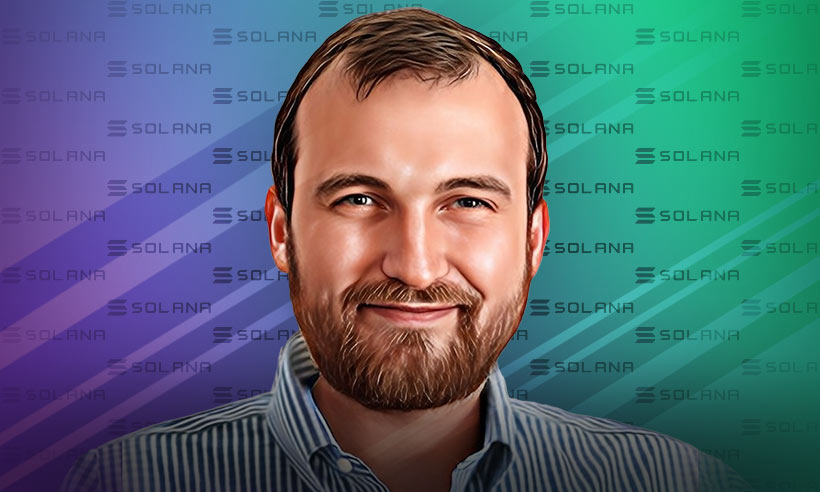
Solana wallets were hacked today for a million dollars. Cardano founder and blockchain developer Charles Hoskinson, who frequently makes scathing remarks about his competitor Solana, had the most partial opinion.

As of 5 am UTC on Wednesday, an unidentified attacker stole from 7,767 wallets on the Solana network, according to the Solana Status Twitter account. However, the cryptocurrency tracker of the blockchain security company, SlowMist, discovered that hackers had emptied over 8,000 wallets. Reports state that the loss, up to this point, is about $8 million.

In response to the hack’s revelation, which has reportedly cost more than $10 million, Hoskinson tweeted a gif of a famous meme showing Captain Jean-Luc Picard, Star Trek movie star, face-palming. With a sarcastic statement that supports the image: “Smart Contract standards,” Hoskinson mocks Solana’s claims of being a smart contract expert.

The Solana And Cardano Rivalry

Everybody knows about the rivalry between Solana and Cardano, which is quite long. However, in this case, the supporters of each side did not want to hold back having an alternation on social media platforms.

Cardano supporters started arguing in an online debate about the superiority in terms of security and dependability of their favorite crypto platform. On the other hand, Solana fans immediately adopted a more direct strategy and started making disparaging remarks about their more subdued rival.

Solana “Hot” Wallets – Victim Of The Latest Multimillion-Dollar Attack

Solana Hot Wallets Hack

Solana has recently become a victim of a crypto wallet hack. Solana is going through an attack, with over 8,000 wallets drained till now, according to blockchain auditors OtterSec. Users reported that their funds drained out of their wallets with no information from major internet-connected “hot wallets,” including Phantom, Slope, and TrustWallet.

Solana Hot Wallets Drained In Attack

The attack on the wallets occurred on Tuesday evening and is still in action. Reports indicate that several Solana addresses are linked to the hack, amassing at least $5 million in SOL, SPL, and other Solana tokens from unwitting users. The reason for the attack is still not solved. Mobile wallet users suffered the most from the hack.

Somehow, the attacker managed to initiate and approve user transactions, implicating that the service of a trusted third party had been breached. The location of the attackers is still not known. Victims say that their wallets are drained without their knowledge. A representative of Phantom, the largest Solana hot wallet, announced,

“We are evaluating the incident impacting Solana wallets and are working closely with other teams in the ecosystem to get to the bottom of this. We will issue an update once we gather more information.”

“The team doesn’t believe this is a Phantom-specific issue at this time,” the representative added.

Questionable Safety of Hot Wallets

As a result of the attack, a long-running controversy will resurface over the security of hot wallets, which are constantly connected to the internet to give users convenient crypto transfers. On the other hand, cold wallets are not as suitable as hot wallets. One question remains, however, whether the vulnerability is exclusive to Solana Blockchain.

A Guide to The Top 5 NFT Marketplaces

Top 5 NFT Marketplaces

NFTs were the center point of attraction during this bull run. Daily million dollars worth of NFTs were traded on several NFT marketplaces. These marketplaces generated millions of dollars in revenue. They made the whole user experience of buying & selling NFTs easy for the public. NFT artists were able to reach a large number of people due to these marketplaces. This article will serve as a guide to NFT marketplaces. Here is a list of the top 5 NFT marketplaces where you can buy and sell NFTs.

Top 5 NFT Marketplaces

1. Open Sea

One of the world’s first and top 5 NFT marketplaces, you can think of OpenSea as eBay for digital collectibles.

Devin Finzer and Alex Atallah established OpenSea in New York City in 2017. They soon submitted the business to the renowned Y Combinator startup incubator, where it was immediately backed with $2.7M.

It is a P2P marketplace exclusively created for NFT users. More specifically, OpenSea offers the setting necessary for producing and exchanging NFTs. The benefit of this platform is that it makes the majority of its operations, if not all of them, possible on the blockchain.

Decentralization is a vital component of the platform since users can produce, purchase, and sell NFT-based digital goods without the assistance of a middleman. The ability of OpenSea to streamline the challenging procedures involved in controlling and profiting from NFTs is another noteworthy aspect of the platform.

You don’t need to know how to code to develop NFTs on OpenSea. There are also no technical requirements for using its trading interface. OpenSea is the best option for beginners because all of the essential procedures may be carried out without any issue.

2. Magic Eden

Magic Eden was launched on September 17, 2021. While many of Magic Eden’s rivals operate on the Ethereum blockchain, buying and selling NFTs on the Magic Eden marketplace requires the SOL token and a Solana-compliant wallet (such as Exodus or phantom). It is the top NFT marketplace based on the Solana ecosystem.

It is not required to consider the cost of each transaction because listing, purchasing, and adjusting the price of NFTs on Solana is far cheaper than it is on Ethereum. For the novice and seasoned producers and purchasers of NFTs, Magic Eden cut the entry hurdle by placing the transaction price at 2 percent and removing the listing fee entirely.

The transaction process on Magic Eden is considerably more cost-effective than its rivals, thanks to Solana’s cheaper gas expenses, which are typically just pennies. On Ethereum, for instance, gas costs can be in the range of $100, sometimes even exceeding the NFT’s value.

Magic Eden has developed into a fiercely competitive cryptocurrency video game market because of its vibrant community of NFT buyers and developers. It claims to control 92 percent of the gaming market in Solana as of the debut of its new gaming platform, Eden Games.

The NFT marketplace has said that it will allocate a portion of its Series A capital to expanding its Magic Eden ecosystem-related gaming platform.

3. LooksRare

LooksRare set out to unseat OpenSea from the top rank in the NFT marketplace. It is a decentralized, community-focused NFT marketplace that actively compensates users for using the service, including traders, token holders, creators, and collectors. The platform was started by two unnamed founders using the aliases “Zodd” and “Guts” in January 2022, with a team of 11 people working on the project’s development. It is the best NFT marketplace among all decentralized marketplaces.

The native token that drives the LooksRare marketplace is called LOOKS. At the time of writing this article, it has a 468 million circulating supply and is trading at $ 0.34.

Users of LooksRare can stake their LOOKS tokens to earn over 64 percent annual percentage yields in both WETH (wrapped ether) and LOOKS. With a rise in stakeholder onboarding, the APR will gradually decline.

Active and passive staking are both different. Most token investors are active investors, and their LOOKS tokens are fully unlocked. For passive stakeholders, their LOOKS tokens—such as treasury, team, and strategic sale tokens—are locked for trade but unlocked for staking. When passive stakers stake LOOKS, they do not receive additional tokens.

4. Rarible

Rarible, the first community-owned NFT marketplace, uses its RARI token, the first governance token in the NFT space, to power this style of platform managed by the community. Rarible is taking a page out of the DeFi playbook by providing users with a token that has governance abilities.

Alex Salnikov and Alexei Falin created the Moscow-based website Rarible at the beginning of 2020, which is essentially a digital NFT platform with an emphasis on art materials. Similar to OpenSea, Rarible has a marketplace where users can exchange different NFTs. Users can also produce NFTs, or non-fungible tokens, using Rarible, a process known as “minting”. It’s a significant deal for many content producers. An artist might, for instance, offer their works as NFTs, such as books, music CDs, or movies.

Most significantly, Rarible is putting a lot of effort into developing an independent platform that a community governance model governs. Additionally, Rarible is now making significant progress toward becoming an actual decentralized autonomous organization (DAO).

5. SuperRare

One of the top 5 NFT marketplaces, SuperRare is a niche cryptocurrency art marketplace that features a carefully curated selection of digital artwork created by established NFT artists and up-and-coming artists.

The SuperRare NFT marketplace started as a centralized platform in 2018, that used its core team to vet artists. However, in 2021, the company issued its RARE governance token, beginning the process of becoming a decentralized autonomous organization (DAO) run by a group of artists and collectors.

In general, the SuperRare NFT marketplace does not list NFTs linked to digital game assets, domains, or music because it is focused on art-oriented NFTs. From psychedelic and conceptual art to photorealistic graphics, SuperRare contains works that cover a wide range of artistic genres.

SuperRare began as a high-end art gallery that only featured exclusive NFT collections from well-known artists, which its core team had approved. However, in 2021, the platform introduced its RARE token to simplify platform governance, transforming it into a decentralized autonomous organization (DAO) led by its community of creators and collectors.

Conclusion

NFT marketplaces are bringing new features to their platform which is boosting the NFT ecosystem. OpenSea is outrightly a leader in the NFT space, due to its smooth UI/UX and reliable services. There is tough competition in the NFT space among the top 5 NFT marketplaces to maintain and grow their user base. It’s possible in the future that a decentralized marketplace will take the first spot from OpenSea.

SOL Technical Analysis: Downfall Under $35 Warns 25% Crash

Solana Token

The SOL prices fail to exceed $45, conducting to a bearish current below the 50-day SMA. Will the correction wave break the crucial support of $35?

Key Technical Points:

  • The SOL prices dropped by 15% in the last 48 hours.
  • The reversal from $45 breaks below the crucial support level at $35.
  • The 24-hour trading volume of Solana is $1.25 billion, indicating a drop of 13.2%.

Past Performance of SOL

The SOL prices have broken the long-term impact of a resistance trendline in the symmetrical triangle, surpassed the 50-day SMA, and reached $45. But, following a sharp reverse, the market decreases by 20% below that 50-day SMA to reach the lower support limit at $35. The increased selling pressure predicts the market to fall below $35 to test the broken resistance trendline with the ultimate support level of $25.

TradingView Chart

Source – Tradingview

SOL Technical Analysis

The SOL price has dropped by 15% in the last two days, negating the rise in the breakout rally and signaling the possibility of a downtrend continuation. Additionally, the sharp increases in trading volume are an element of the bearish continuation theory.

The market price is breaking lower than the 50-day SMA, and the sentiments of bears are growing significantly. Additionally, the dramatic drop in the daily-RSI’s slope pushes it under the halfway line as well as that of the average for 14 days, which indicates an exponential increase in overall negative sentiment.

The MACD and signals lines do not sustain above the halfway line, resulting in a bearish crossover, teasing the possibility of a continuation of the downtrend.

In simple terms, the technical indicators support a bearish view and predict an eventual drop in price below $35. However, the SOL technical analysis recommends traders wait until the candle, on a daily basis, closes below $35.

Upcoming Trend

A drop below $35 would lower the SOL price to the following level of support at $25, which is an increase of 25 percent.

In contrast, a bullish reversal with lower price rejection would likely push the overhead resistance to $45.

Resistance Levels: $40 and $45

Support Levels: $35 and $30

Solana Protocol Cardinal Raised $4.4 Million in Seed Funding

Cardinal

Cardinal, a Solana-based infrastructure platform that seeks to increase the usefulness of non-fungible tokens (NFTs), has raised $4.4 million in a seed fundraising round. Cardinal broke the news on Friday, stating that Solana Ventures and the recently established cryptocurrency venture capital firm Protagonist jointly led the seed round. Additionally participating were Alameda Research, Delphi Digital, and CMS Holdings.

According to Cardinal co-founder and CEO Spencer Rust,

“Founded eight months ago, Cardinal offers a Solana protocol with use cases such as rentals, staking, and ticketing to help improve the utility of NFTs. Rentals, for example, allow rented NFTs to “physically sit in renters’ wallets” while maintaining the impossibility of default.”

https://twitter.com/cardinal_labs/status/1550517616405491715

Cardinal Released First Iteration Earlier this Year

According to Rust, “many thousand rentals” have already been completed using the site since Cardinal released the first iteration of its rental marketplace earlier this year. The second version, which will have a revised user interface and experience, is anticipated to be released soon. Rust said, the business also provides “escrow-less” NFT staking, enabling stakeholders to continue enjoying any benefits their tokens may provide. We’ve observed that, among other verticals, gaming companies that desire to develop staking efforts for their customers without interfering with their ability to play the games benefit from this. According to Cardinal, their protocol has already been used to stake more than 65,000 NFTs.

Cardinal currently only concentrates on Solana, but it intends to support additional blockchains in the future. At some point, Rust stated,

“We have cross-chain aspirations and aim to investigate building on EVM [Ethereum virtual machine] chains and others like Near and Aptos.”

Cardinal has received $5.2 million in total capital due to the seed funding round. Neo Ventures provided the company with pre-seed capital of $750,000 last year.

Solana-Based Gaming Metaverse Star Atlas Announces the Launch of DAO

Star Atlas DAO

The Star Atlas DAO officially began operations on Thursday during the 426LIVE community event hosted by the Solana-based game metaverse Star Atlas. The DAO will use Star Atlas’ POLIS governance token to let users participate in voting. According to the DAO, its voting escrow scheme favors community members with a solid long-term commitment to the Star Atlas vision. As a result, the company also disclosed POLIS locking, allowing holders to commit their tokens for five years.


Star Atlas Virtual Gaming Metaverse

Star Atlas is a virtual gaming metaverse released in 2020 by Wagner and Pablo Quiroga and is set in the year 2620. The MUD region, dominated by humans, the Ustur Sector, ruled by sentient androids, and the ONI Region, led by a confederation of extraterrestrial species, are the three factions that contend for resources, territorial conquest, and political dominance.

DAO Used for Allocating Taxes

The three in-game factions will each have their own DAO that will be utilized for establishing and allocating taxes for their individual governed zones. The other DAOs require players to have localized commitments to engage in politics, except the Star Atlas DAO, which is accessible to all POLIS holders. Along with the DAO, the Solana-based game metaverse revealed an update to its Galactic Marketplace that includes new gaming foundations that are DAO-enabled and a redesigned user interface. The ability for players to trade assets directly with other players has now been included.

OpenSea Announced Kicking Off The Solana Launchpad

OpenSea Solana

To enable producers to host a new mint from start to finish on the NFT marketplace, OpenSea announced the creation of the Solana launchpad.

The official blog article states that in addition to helping creators with all post-mint and secondary sales, OpenSea will advise them on handling all pre-mint activities and allowlist minting for their community and fans. The objective of enabling users to have custody of their NFTs is to create “the best Solana experience” inside the NFT ecosystem.

“We’re excited to start this program with two Solana creators as part of our launchpad experience. We are excited to launch and learn with these first drops, and we’re committed to expanding primary drops on OpenSea.”

OpenSea Supports Solana

Three months after OpenSea turned on support for Solana, the development happened. One of the biggest winners from the bull run that occurred in 2020 and 2021 has been the NFT giant. It recently raised hundreds of millions of dollars from investors at a valuation of $13.3 billion. However, a good amount of drama has been attracted by the growth.

One of the company’s former product managers was charged with insider trading by the US Justice Department and detained earlier last month. Several leading sector businesses reduced their staff after the big decline in the cryptocurrency market to prepare for the coming crypto winter. The same was true of OpenSea. Last week, the marketplace revealed the lay-off of 20% of its employees.

SOL Technical Analysis: $44.77 and $29.02 Key Levels to Watch

Solana Token

Key technical points:

  • SOL technical analysis is bullish today.
  • SOL price is up by barely 2% today.
  • The closest resistance is found at $44.77.

Past Performance of SOL

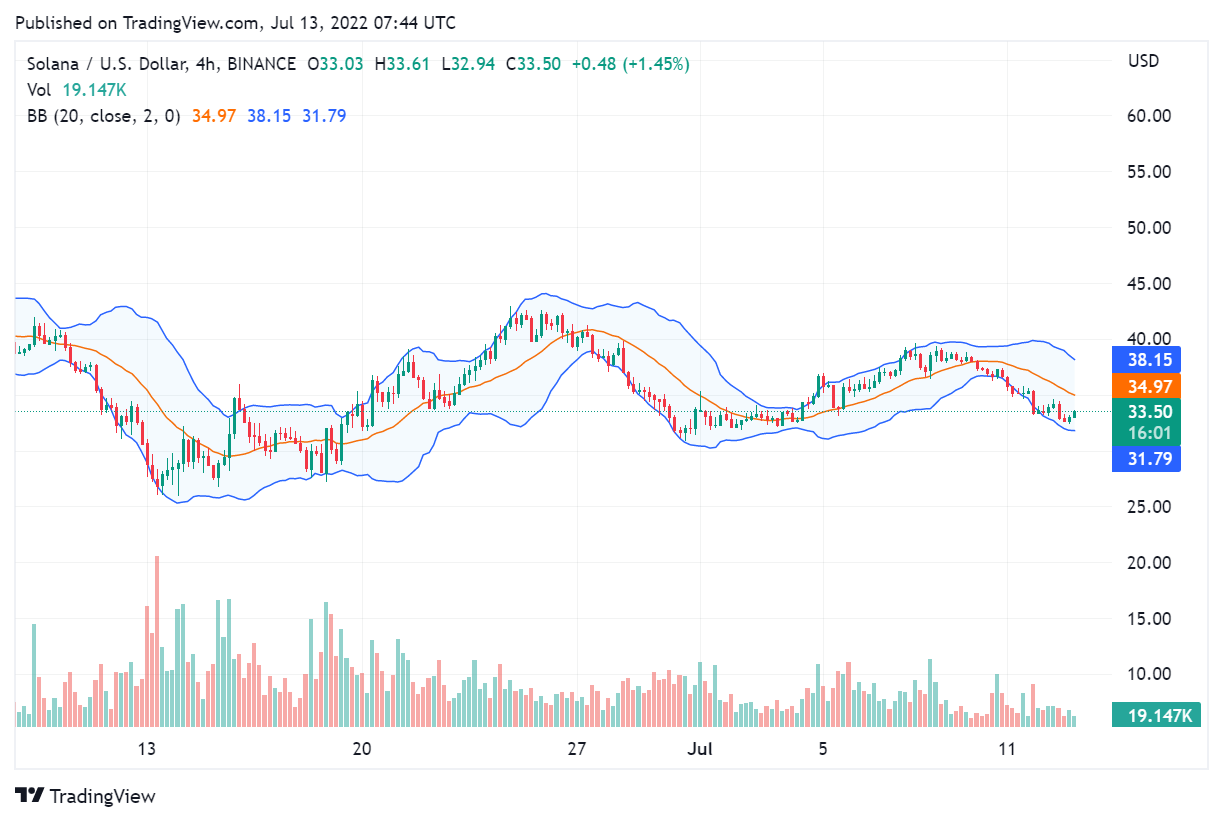
SOL technical analysis for today is positive as the coin records a 2% price surge in the last 24 hours. SOL is currently trading at $33.27. The recent high was set at $44.77, and the current support is found at $29.02.

On the 4-hour chart, the price is currently testing the descending trend line. A breakout above this level could see SOLUSD retesting $44.77 resistance. However, if the price breaks below the support at $29.02, it could signal a further decline in SOL’s price.

SOL technical analysis

Source- Tradingview

SOL Technical Analysis

The RSI indicator is in the overbought region but not close to the top level. This means there is space for a price increase before seeing bearish price action. MACD is also in bullish territory, and the signal line is about to cross over the main line, which signifies further momentum. The support levels are $29.02 and $26.62, while the resistance levels are $44.77 and $48.54.

The Bollinger bands have been relatively tight over the past few days, which signals low volatility. However, we are seeing a slight increase in volatility which could lead to a breakout from the current range.

Upcoming Trend

If the price can break out of the descending trend line, we could see a move towards $44.77 resistance. However, if the price breaks below support at $29.02, it could signal a further decline in SOL’s price.