Maple Finance 2.0 Redesign Aims to Expedite Loan Default Process

Maple Finance

In response to recent failures, the cryptocurrency lending platform Maple Finance has released a significant protocol improvement (Maple Finance 2.0) that should make defaults and liquidation processes easier.

Maple Finance 2.0 Protocol Enhancement

According to the protocol paperwork, it permits managers to issue loans from its lending pools based on a specific set of risk-management criteria rather than requiring mortgages to be overcollateralized. However, the platform saw two significant defaults from platform borrowers after FTX’s demise.

With the “Maple Finance 2.0” protocol enhancement, smart contracts will be upgraded to allow loan managers also referred to as “pool delegates” to manage and resolve defaults more efficiently.

Pool Delegates Can Announce Early Default

Prior to this change, a borrower’s obligation to make payments could only be terminated if the grace period had already expired. It followed that collateral could not be liquidated, even if the borrower had already acknowledged that they would be unable to make payments.

According to Maple, who wrote a blog post outlining the platform’s new capabilities, pool delegates will now have the option to announce an early default if a borrower satisfies a criterion of default, making the loan instantly due. Additionally, if a borrower does not pay during the fixed term, the delegate may liquidate the loan, causing other pool lenders to instantly experience a loss until recovery efforts are made.

Additional Features of the Enhancement

The latest edition of Maple Finance also has features designed to improve the lending platform’s life quality. The redesign also includes the addition of automatic compounding of interest, which means that any money generated is immediately reinvested into the pool and does not require additional deposits.

The implementation of ERC-4626 standards, which permits more decentralized finance (DeFi) connections and collaborations and better statistics and dashboards, are further enhancements.

Aave Protocol Review : Market Leader in DeFi Innovation

Traditional financial systems might get transformed to DeFi due to its ability to provide various financial services in a decentralized manner. People are using DeFi products without the need of any third parties such as banks and other financial institutions. Most of the big DeFi protocols are providing thousands of users with financial services. One of the leaders in the lending category, Aave is setting an example for other DeFi protocols to follow.

What Is Aave?

Aave is the eighth-largest DeFi protocol and second-largest lending protocol where users can lend or borrow cryptocurrencies. Lenders also earn interest on their deposited cryptocurrencies. Borrowers have to pay interest after borrowing cryptocurrency, and they have to put some cryptocurrency as collateral also.

 Aave protocol is available on Ethereum, Polygon, Avalanche, Fantom, and Harmony, etc. networks for public use. The protocol has its own native token called AAVE. Moreover, AAVE is a governance token, and holders of AAVE tokens can participate and vote in governance proposals that give them the power to decide the future direction of the protocol collectively.

How Does Aave Works?

Lenders deposit their crypto assets into a lending pool of Aave and borrowers borrow from this pool. Aave follows pool-to-peer lending instead of peer-to-peer lending, where all the liquidity is stored on these pools. Lenders and borrowers deposit and borrow from these pools.

Borrowers have to pay interest on the loan, while lenders earn interest on their deposited assets. Borrowers need to put up collateral to take the loan amount. The collateral deposited must be greater than the borrowing amount. As loans are provided to borrowers without considering their line of credit and taking their personal details. So, to safeguard the assets deposited by lenders, protocol sells the borrower’s collateral when the borrower fails to pay back the loan amount with interest.

Lending Mechanism

Lenders deposit their assets into the pool and in exchange they receive atoken which equally represents their deposited amount.

Lenders can get their deposited assets back anytime by returning their atoken to the protocol. The atoken balance represents the deposited amount and the interest that accrued on the assets. Interest rates changes with borrowing demand on the protocol. When a lender returns atoken, they receive their deposited assets and interest accrued on them.

Borrowing Mechanism

Borrowers deposit their cryptocurrency assets into the pool as collateral for taking loans. In exchange, they can borrow the amount of an asset as defined by each collateral’s loan-to-value. 

The maximum amount of cryptocurrency that can be borrowed by depositing specific collateral is defined by Loan-To-Value. It is expressed in percentage: at LTV=75%, after putting 1BTC worth of collateral, the user will be able to borrow 0.75BTC. After borrowing, LTV may change with market conditions. 

Borrowers must return the borrowed assets with interest if they wish to close their position. 

Tokenomics

The total supply of Aave tokens is 16 million tokens and 13.5 million AAVE tokens are currently in circulation. Around 3 million tokens are allocated to the Aave ecosystem reserve for protocol incentives. Aave holders decide how reserves of the ecosystem are allocated through governance.  

Assets of Aave protocol are secured by the Safety module, tokens staked by AAVE holders act as insurance in case of any shortfall events. AAVE holders who stake their tokens are called stakers. Generally, stakers earn AAVE tokens as well as protocol fees as a safety incentive.

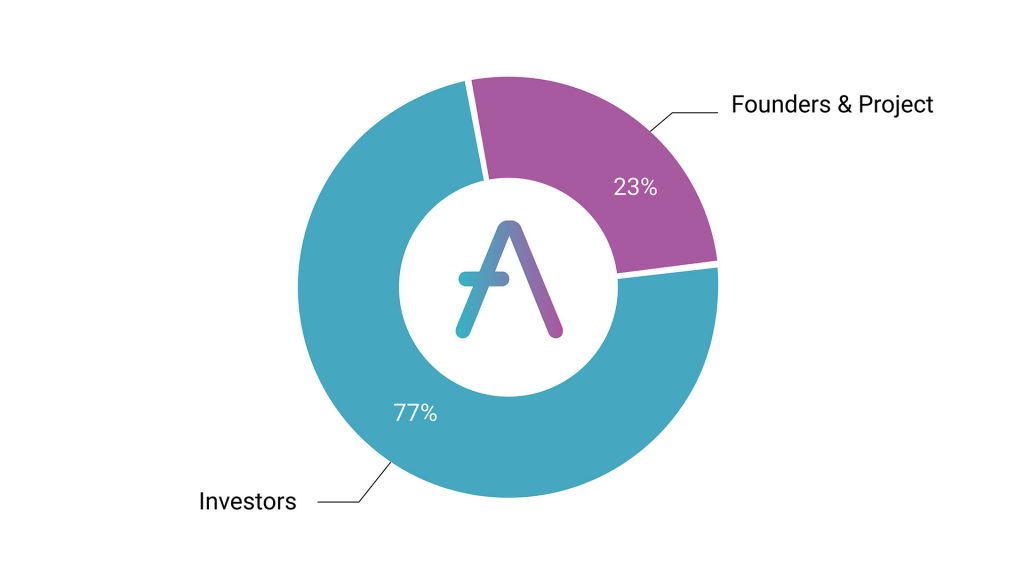
Fig. AAVE’s Initial Token Distribution

As of writing this article, the price of the AAVE token is 262 US dollars and the market cap is 3.52 billion US dollars. Total value locked, i.e., the total amount of cryptocurrency deposited in the protocol is worth 14.3 billion dollars. 

Main Features of Aave protocol 

A Large Number of Collaterals 

Aave supports more than 20 different assets as collateral for borrowers such as DAI, ETH, BAT, LINK, MANA, MKR, SNX, USDT, etc.

Flash Loans

A flash loan enables users to borrow cryptocurrency without requiring collateral. Flash loans should be paid back in the same transaction. The transaction will fail if they do not reimburse.

Its use cases include arbitrage, collateral swapping, self-liquidation, and others. 

Switching of Interest Rate

Aave protocol adjusts interest rate algorithmically on the basis of supply and demand, i.e., when the deposited amount by lenders increases, liquidity increase in the pool, interest rates decrease and borrowers have to pay less interest on their loans and when the borrowing demand increases, it reduces available liquidity, interest rates rise, and depositors generate more income. The protocol allows users to switch between stable and variable interest rates so that users can choose the best rate for them.

Conclusion

Aave protocol has set an example for other Defi protocols by its continued innovation in DeFi space. They have brought new features for their users with every major upgrade. Aave being on multiple chains have increased their user base in comparison to other lending protocols that are only on the Ethereum blockchain. It also provides its users with a variety of assets for lending and borrowing. Aave is providing way better interest rates to its users as compared to banks. In the future, more and more institutions may start using Aave to get a better interest rate on their assets. 

When NFT Meets DeFi: Doors of Monetization Open for NFT Owners

When NFT Meets DeFi: Doors of Monetization Open for NFT Owners

Decentralized finance and NFT were hot topics in the market. Everyone in the crypto world realized the benefits of using DeFi protocols as they provided financial services with no barrier to entry and can get a high yield with no paperwork and high maintenance charges required. People were rushing to buy NFTs of their choice. Celebrities including Snoop Dogg, Jimmy Fallon, Grimes, and Tom Brady have released and/or purchased notable NFTs.

NFTs can be used for revenue generation with the help of DeFi protocols. There are many protocols that are working on creating value by using NFTs in Defi protocols. These protocols will create opportunities for NFT owners to use their NFTs for revenue generation. We will see many applications of NFT-DeFi integration in the year 2022.

What Are DeFi and NFTs ?

Decentralized finance allows users to use financial services in a decentralized manner with the help of blockchain technology. In decentralized finance, only the user has access to their money. Users can access various financial services like lending, borrowing, buying insurance, and investment services such as trading and investing in assets, trading derivatives, and options. All of these services can be used without relying on central intermediaries such as banks, brokers, and financial institutions.

DeFi has grown at an impressive pace since the summer of 2020. In June last year, TVL sat at about 1 billion dollars worth of cryptocurrencies deposited in DeFi apps. Now in December 2021, this figure has reached above 100 billion dollars. 

On the other hand, NFTs (non-fungible tokens) are unique digital items that can’t be replaced with anything else. Any digital files like images, videos, music, etc., can be converted into an NFT. NFTs are tokens that are used to represent ownership of unique items. It uses blockchain technology to provide proof of ownership for owners of NFTs. Some of the most popular examples of NFTs are Beeple’s “Everydays: The First 5000 Days,” CryptoPunks, and the Bored Ape Yacht Club NFT.

Role of NFTs in DeFi

NFT Ownership Use in DeFi 

NFT owners can sell their NFTs on marketplaces like OpenSea, WazirX NFT, Rarible,  etc. NFTs are the best medium to provide ownership rights and profits to the original creators. NFTs integrated with DeFi platforms could be used to solve the concerns of royalty sharing, licensing, and copyright ownership. A marketplace can be created that will enable users to buy NFTs of songs to earn royalties as their songs increase in popularity. NFTs’ integration with DeFi can also be used to earn revenue for NFT owners by the use of a concept named fractionalized NFTs. The concept of fractionalized NFTs allows NFT owners to mint tokenized fractions of their NFTs and share ownership rights of their assets with others by selling these fractionalized NFTs.

Solving the Problem of Collateralization

Traditional art has been used as collateral in the real world for many years. Therefore, using NFTs as collateral in the digital world is a reasonable step. NFTs collectibles can be used as collateral against DeFi lending. A DeFi platform can enable borrowers to request a loan amount with the NFT that will serve as collateral. The lender, after evaluation of the loan amount alongside the collateralized NFT, can provide the loan amount requested by the borrower.

The art world suffers from the problem of liquidity. NFTs solve this problem by enabling tokenization of art. Tokenization offers the ease of trading digital items. An example of using tokenization of NFT would be if the owner of Beeple’s $69 million worth “Everydays: The First 5000 Days” piece was to tokenize the work, splitting it into 69 million tokens at $1 each. This will make an illiquid asset such as a piece of art easily tradable.

Solving the Problem of Curve Model 

Another use case of NFT in DeFi is solving the problem of the Curve Model. A curve model was introduced to provide the distribution of liquidity across the entire curve. It also meant that a large portion of liquidity was not producing the payment for providers. However, the use of NFT with DeFi has solved this problem by selecting desired custom price sizes for liquidity providers. This reduces the downside risk for liquidity providers.

NFT Staking on DeFi Platforms

NFT staking can be done to earn passive income in the crypto world. NFT owners can lock their NFTs in DeFi platforms and can earn staking rewards based on APY, staking duration, and the number of NFTs staked. NFT staking opens more opportunities for NFT owners to use their NFTs to earn extra income. Most NFT staking is done on play to earn games like MOBOX and Zookeeper. NFT staking has created new use cases for NFTs.

Platforms that Combine DeFi with NFTs

OpenSea

OpenSea is the world’s first and largest NFT marketplace. It is a peer-to-peer marketplace for NFTs, rare digital items, and crypto-collectibles that allows users to buy and sell their NFTs with ease. Users can also create their own NFTs on OpenSea. Furthermore, OpenSea allows users to trade NFTs in different currencies.

NFTX

NFTX is a platform for creating liquid markets for illiquid non-fungible tokens (NFTs). Users can deposit their NFT into an NFTX vault and mint a fungible ERC20 token (vToken) that represents a claim on a random asset from within the vault. vTokens can also be used to redeem a specific NFT from a vault.

Polyient games

This group is all over NFT financialization, from investing in the sector to building tools to make it more robust. It runs a decentralized exchange for NFTs, has its own approach to fractional ownership, and also has products built for NFT security. Polyient Games is an investment vehicle for startups focused on blockchain gaming infrastructure.

Charged Particles

This protocol aims to enable any NFT to be wrapped or embedded with an ERC-20 token. So just in case, there was any doubt an NFT had value, a user could wrap it with interest-earning tokens, such as the Aave tokens, and it would have value beyond any doubt.

Ark Gallery

An Ark gallery is an Ethereum-based application that allows you to buy and sell CryptoPunks together with other users. Ark Gallery provides a new way to collect NFTs by introducing digital community ownership.

Conclusion

Applications of NFT and DeFi together open various sources of value creation for NFT owners. NFT owners can take loans by putting their NFTs as collateral. Moreover, fractionalized NFTs provide another source of revenue generation for owners by selling their NFTs to a number of people. NFTs integration with DeFi solves the problems such as royalty sharing, licensing, and copyright ownership for the creators. It even makes illiquid assets such as pieces of art tradable.

In the future, we will be seeing more use cases of NFTs integration with DeFi. It will be interesting to see how much more innovation lies ahead in this space.