
Sygnum Bank Expands Crypto Services With Cardano Staking Support

Sygnum Bank Cardano Staking

Cryptocurrency-friendly bank Sygnum adds the support for Cardano (ADA) staking as part of the ongoing expansion of its cryptocurrency offerings. Sygnum reveals that it had integrated Cardano into its bank-grade staking solution, enabling customers to earn incentives by staking ADA through the bank’s institutional-grade platform.

ADA now joins Sygnum’s expanding portfolio of crypto-staking assets, which already includes the three Proof-of-Stake (PoS) protocols Ethereum 2.0, Tezos, and Internet Computer.

Staking Services: Important Part of Sygnum

According to the statement, staking services are a crucial component of Sygnum’s platform and are accessible to customers via the bank’s eBanking platform. The services integrate with Sygnum’s banking platform, which uses capabilities like segregated wallets, secure private key management, and others to deliver institutional-grade security. Proof-of-Stake (PoS) blockchains do not require mining activities and instead rely on users locking up their currencies to maintain a network, in contrast to Proof-of-Work (PoW) networks like Bitcoin.

Sygnum, a Swiss central bank under regulation, introduced cryptocurrency around two years ago. Tezos staking will begin in November 2020. In July 2021, Sygnum also declared that it would make Ethereum 2.0 staking available on its platform.

Cardano Staking Added to Sygnum

Many institutional investors’ exposure to the digital asset will rise due to Cardano staking added to Sygnum. The company reported in January that Sygnum’s institutional client base would be close to 1,000 by early 2022, following a tenfold growth in gross revenues in 2021.

Many cryptocurrency businesses have been developing Cardano-focused services in the wake of the impending Cardano Vasil hard fork. Ledger, a leading manufacturer of hardware wallets, revealed the integration of 100 Cardano tokens on its Ledger Live wallet software at the end of July. Cardano’s network should become substantially faster and more scalable due to the Cardano Vasil hard fork, making it more suited for smart contracts and decentralized applications.
Ethereum Registers Over 5 Million Unique Addresses Before Upgrades

Ethereum Addresses Upgrades

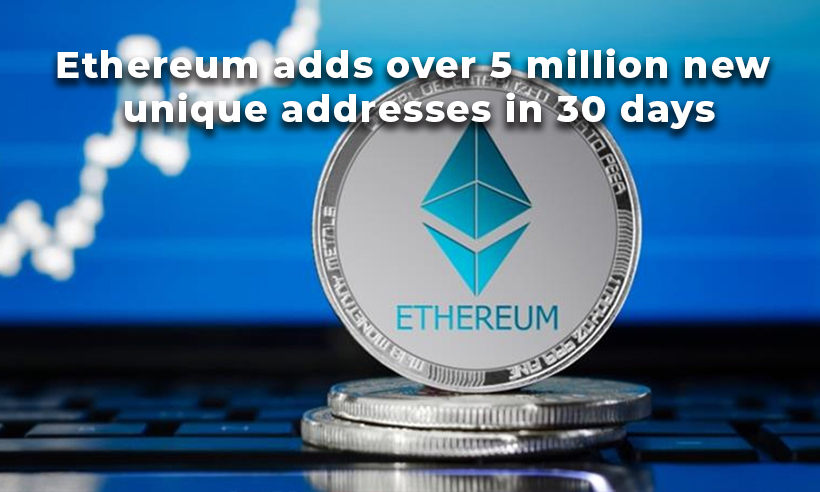
The world’s second-largest cryptocurrency, Ethereum, has added more than 5 million new addresses in the last 30 days, as anticipation around the upcoming upgrades continues to surge. 

Data indicates Ethereum registered roughly 5.37 million addresses between Jun 6th,2021 – July 6th,2021, which means the network added approximately 173, 235 uniques addresses each day.

Ethereum Adds More Active Addresses Before Future Upgrades

Ether demand has grown exponentially over the last few days which has contributed to the rise in the number of daily active participants transferring the token. Last week, the asset surpassed Bitcoin in terms of active addresses for the third time in a month. 

According to Celsius Network CEO Alex Mashinsky, Ethereum has already started to flip Bitcoin with broader adoption on the horizon. He believes layer-2 solutions will benefit Ethereum’s ecosystem and fix the prevailing issues in the foreseeable future.

Mashinsky also suggests that ETH 2.0, which promises to solve Ethereum’s scalability issues, will be a major improvement on layer-2 solutions but will also work in tandem with them.

With Ethereum overtaking Bitcoin in a key transaction and trading metric, many expect that the asset is poised to become the largest cryptocurrency in the market. For instance, investment bank Goldman Sachs highlighted in a note to its investors that the asset may surpass Bitcoin to become a better store of value.

Ethereum’s London hard Fork and EIP-1559 Upgrade

Starting August 4, the Ethereum network will implement a highly anticipated upgrade dubbed the London hard fork which contains the EIP-1559 proposal. ETH’s principal developer Tim Beiko stated on July 6 that the mainnet upgrade will take place at block 12,965,000, due to which the London hard fork has been scheduled in August, instead of mid to late July as originally expected.

The protocol upgrade will introduce a new fee structure, which has been hotly debated for reducing miner revenue. It will also make Ethereum mining more difficult on the network, thereby “freezing” the proof-of-work before the transition to proof-of-stake consensus.

Swiss Digital Asset Bank Offers Ethereum 2.0 Staking to Clients

Swiss digital asset bank Sygnum has begun offering Ethereum 2.0 staking to its clients via its institutional-grade banking platform. The institution will enable clients to earn a 7% annual yield on their staking and will integrate the staking services into its own platform with a user-friendly interface.

Sygnum is well-aware of Ethereum’s capabilities to host powerful decentralized finance(DeFi) applications and would like to establish a secure setup for its client to gain exposure to the asset. The bank had previously hinted at its plans of introducing crypto staking accounts for its customers.

Speaking on the benefits of the new offering, Thomas Eichenberger, Head of Business Units at Sygnum Bank, said, “Ethereum is the second-largest blockchain protocol, and Ethereum staking is a core element for digital asset portfolios which can now be accessed in a convenient, secure and regulated setting.”

He added, “This further expands Sygnum’s offering of attractive, regulated yield generating products to meet the needs of clients to accumulate other forms of return in addition to capital appreciation.”

With a market capitalization of $250 billion, Ethereum is the biggest smart contract platform that has several DeFi protocols built on top of it.

The Ethereum 2.0 Upgrades

Ethereum 2.0 is a collection of upgrades aimed at making the network more scalable, sustainable, and secure. These upgrades would see the Ethereum blockchain transition from proof-of-work to proof-of-stake model, which is widely considered to be more eco-friendly.

To date, the ETH 2.0 contract has garnered more than $14 billion in staking. The changes proposed in the upgrades are expected to be implemented in late 2021 or early 2022.

Sygnum Bank to Offer Custody Services for ICP Tokens

Sygnum custody services

Swiss-regulated digital asset bank Sygnum is offering custody and banking services for Internet Computer (ICP)  tokens. Holders of ICP tokens will now be able to deposit their tokens with the bank’s institutional-grade segregated wallets.

Sygnum Bank Launching Custody Services for ICP Tokens

Switzerland-based cryptocurrency bank Sygnum is launching custody and banking services for Internet Computer (ICP) utility tokens, becoming the first bank to do so.

ICP holders will be now able to deposit their tokens with Sygnum, followed by the rollout of 24/7 spot trading, options trading, and loans against ICP holdings in the near future.

The bank also expects to offer Sygnum Lombard loans for ICP at a later date, allowing clients to access liquidity against ICP token holdings.

Incubated and launched by Dfinity, a Zurich-based nonprofit scientific research organization, Internet Computer is a blockchain project aimed at offering smart contract functionality at internet speed, creating a decentralized global computer based on its own ICP protocol.

In the announcement release, Manuel Krieger, Co-Founder, and member of Sygnum Bank’s Board of Directors, said:

“We believe that the decentralized and open nature of the Internet Computer will spark a wave of innovation across internet services, software platforms, and user experiences. Our active involvement reflects the open values of our company and our commitment to realizing the trusted, secure, and efficient digital asset ecosystem we call Future Finance.”

ICP Most Disruptive Tech After Bitcoin, Ethereum

According to Dominic Williams, Founder and Chief Scientist of the Dfinity Foundation, the ICP is the third most disruptive technology in the blockchain industry after Bitcoin and Ethereum, adding:

“It supports smart contract software that can run at web speed and serve web to users for the first time, and a network that can scale its compute capacity with user demand, greatly increasing the potential applications of a public blockchain.”

Despite ICP token the receiving much-needed support from Sygnum bank, the cryptocurrency was down by approximately 29.5% in the past 24-hours and is currently trading around $142.

With over 469,213,710 circulating supply of ICP tokens, the cryptocurrency’s fully diluted valuation stands at $66,231,773,479.