Even as the crypto market weathers a rough patch — with Bitcoin trading near $67,000 after steep declines — Eric Trump doubled down on a bold forecast: he still believes Bitcoin will hit $1 million per coin. In a recent CNBC interview at the World Liberty Forum, the Trump Organization executive described himself as “never more bullish on Bitcoin in my life.”
He didn’t sugarcoat it: volatility is part of the game, but the tremendous upside has him confident that Bitcoin’s long-run trajectory remains intact.
Bitcoin’s Current Turmoil: Is the Dip Just Noise?
Bitcoin’s price has pulled back sharply from its October 2025 peak above $126,000, dropping more than 45% over recent months and spending time below $70,000.
This broad market correction — often dubbed a crypto winter — hit prices across the board, shaking investor confidence and fueling bearish sentiment. Despite this, Trump framed the downturn as natural volatility, not a death knell for crypto’s future.
JUST IN: 🇺🇸 President Trump's son Eric says "I've never been more bullish on bitcoin in my life."
"I do think it hits $1 million…You're going to have volatility with something that has tremendous upside" 🚀 pic.twitter.com/uxToAluAGs
Eric Trump’s optimism isn’t random hype. He pointed to three key drivers:
Institutional involvement and growing Wall Street acceptance.
Bitcoin’s fixed supply and long-term store-of-value narrative.
Broader crypto adoption through stablecoins and digital infrastructure.
He also highlighted stablecoins as a bridge for global capital flows — a subtle hint that digital assets could underpin more than speculative plays.
What Critics and the Market Are Saying
Not everyone agrees.
Prominent skeptics argue that meme coins and celebrity-backed tokens have hurt confidence, contributing to the slower recovery. Others warn that traditional risks — from regulatory uncertainty to macro stress — still cloud the outlook.
Still, voices like Coinbase’s Brian Armstrong and crypto analyst Arthur Hayes have echoed that Bitcoin’s pullback could be **temporary” and even healthy for long-term resilience.
Final Take
Whether Bitcoin will truly reach $1 million is still up for debate — but Eric Trump’s reaffirmed call shows high-profile bullish sentiment remains alive even in tough markets.
One thing’s clear: Bitcoin’s journey is far from linear — it’s oscillating between fear, hope, and big predictions.
Bitcoin’s price action has been shaky, with traders and analysts increasingly debating whether the world’s largest cryptocurrency is gearing for a fresh downward leg. After plunging from above $90,000 to re-test $60,000 support in early February, BTC has been stuck inside a choppy range — signaling a potential big move on the horizon.
The volatility on #Bitcoin is the lowest it has been since the crash.
That means; there's a big move on the horizon.
If we dip, I'll be a big buyer, for sure.
If we go back upwards, I'll start taking some profits on a test at $80-85K to be trading the trend.
Bitcoin has been trading sideways under $70,000 for days, showing lower volatility than investors expected. Analysts like Michaël van de Poppe point out that this low-volatility pattern usually precedes a sharp breakout — either up or down.
Adding to the cautious tone:
BTC recently flirted with support around the $67K zone, a key pivot for short-term traders.
According to on-chain data firms like Glassnode, a break below those levels could open the door to deeper selling pressure, potentially down to $55,000 or lower.
If BTC slumps below $60,000, automated liquidations and risk-off trading could accelerate volatility.
Defensive price structure suggests BTC could slide toward $60K or even $54K if major support breaks.
Large options bet clusters and liquidation thresholds sit close to critical levels, meaning a breach could trigger forced selling.
Bullish Counterpoints:
Some traders are eyeing the dips as buy zones, betting long-term holders and institutional players could absorb the weakness and spark a rebound.
People are losing money in #Bitcoin, down 50% from its ATH against the inflationary USD. It’s bad to lose money, but it’s even worse to lose it in terms of USD. At the same time, GOLD is 10% away from ATH. This is why 2026 is the year of metals
The BTC price struggle isn’t happening in isolation:
Fear & Greed Index has plunged into “Extreme Fear,” often seen before volatile swings. Crypto marketcap volatility is rising amid broad risk-off sentiment in equities and macro markets. Traditional assets like tech stocks and gold have shown mixed signals, pressuring risk assets like Bitcoin.
Bitmine Immersion Technologies — the institutional juggernaut led by Tom Lee — has boosted its Ethereum treasury to 4.326 million ETH (~$8.8B+), following a 40,000 ETH (~$83.4M) purchase in a single day, according to on-chain tracking. That positions Bitmine as one of the largest known corporate holders of Ethereum, representing roughly 3.6% of circulating supply.
What Happened? Bitmine’s Aggressive ETH Accumulation
Blockchain analytics first spotted Bitmine buying 20,000 ETH (~$42.3M) from BitGo, then repeating the trade hours later — totaling 40,000 ETH in one session.
Bitmine’s Chairman, Tom Lee, signaled that the accumulation is part of a long-term strategy, not a short-term price play:
“We view this pullback as attractive, given the strengthening fundamentals… ETH’s role as the future of finance isn’t priced in yet.”
It seems that Tom Lee(@fundstrat)'s #Bitmine bought another 20,000 $ETH($42.3M) from BitGo 7 hours ago.
Institutional Confidence in Ethereum Is Rising Bitmine’s buy — one of the largest single-day acquisitions this year — underscores rising institutional conviction in ETH’s fundamentals and future utility.
Market Impact and Sentiment Insight While ETH prices have shown retail-driven volatility, large treasuries like Bitmine’s can remove supply and may reduce available circulating tokens — something traders watch closely through supply dynamics and sentiment.
Staking & Yield Strategy Of the 4.326M ETH, ~2.9M is currently staked, generating ongoing yields and signaling Bitmine’s commitment to Ethereum’s long-term ecosystem — particularly yield-oriented infrastructure builds.
What’s Next for Bitmine’s ETH Holdings?
Bitmine has publicly articulated an ambitious goal of accumulating up to 5% of all ETH supply — a benchmark some analysts have dubbed the “Alchemy of 5%.” Continued accumulation could keep ETH supply tighter if prices remain depressed and institutional appetite persists.
Meanwhile, traders and market watchers will be watching:
How Bitmine’s buys influence ETH price structure
Whether other institutions follow suit
Impact of staking yields and broader macro catalysts
Bitcoin is back in the limelight — trading just under the $90,000 mark as bulls attempt to reclaim momentum in early 2026. Buying pressure across large caps is lifting market sentiment, while mid-cap cryptos are exploding with double-digit gains, signaling renewed optimism among traders.
How Close Is Bitcoin to $90K — And Why It Matters
Bitcoin (BTC) has been inching toward the critical $90K psychological level, trading around $88,300–$89,000 as bulls re-enter the market. This uptick is significant because breaking and holding above $90K often triggers fresh institutional interest and broader market confidence — a catalyst that historically accelerates rallies.
Altcoins Are Surging — Which Ones Are Leading the Charge?
Alongside Bitcoin’s move, major altcoins are showing strength:
Tokenized real-world assets (RWAs) just hit a major milestone — topping $21 billion — but the rise of newer chains could be the real story this year.
In the fast-evolving world of crypto, real-world assets — digital tokens backed by actual assets like US Treasuries, commodities, and private credit — are gaining serious traction. Ethereum still leads by a wide margin, but challenger networks are beginning to attract attention from institutional investors and builders alike.
What’s Driving the $21B Tokenized Asset Boom?
Tokenized RWAs have crossed the $21 billion mark in total value locked (TVL) — a milestone that reflects growing demand for on-chain versions of traditional financial assets.
Here’s how the landscape looks:
U.S. Treasury debt dominates with over ~$9B total value locked.
Commodities and private credit follow as secondary drivers.
Corporate bonds and institutional funds are gaining share, while real estate and private equity remain smaller but emerging categories.
Experts have projected massive long-term growth for tokenized assets — from $2-4 trillion by 2030 (McKinsey) to as much as $10-16 trillion in some industry forecasts.
Bottom line: Tokenization is no longer a niche experiment — it’s becoming an institutional trend.
Ethereum Still Dominates — For Now
Ethereum continues to be the primary home for tokenized assets, hosting the lion’s share thanks to its deep liquidity, mature tooling, and broad developer ecosystem.
Stablecoins still represent the largest category by value on Ethereum, which helps explain why it remains the go-to network for issuers and institutional players.
But a key question on the minds of experts now is: How long will Ethereum’s dominance last?
Are New Chains Starting to Matter?
Here’s where the narrative gets interesting: some alternative blockchains are beginning to capture real RWA demand.
For example, Arbitrum-based tokenized products have amassed substantial TVL, driven by predictable fees, strong liquidity, and flexible architecture — factors that matter greatly to institutional users.
Lower-cost networks like Arbitrum and others could see increasing adoption, especially as institutional players explore options beyond Ethereum’s fee structure and scalability.
Why This Matters to Crypto Investors Now
Tokenization is rapidly bridging TradFi and crypto:
Institutional demand for on-chain exposure is rising.
Traditional financial firms (including NYSE and investment platforms) are building 24/7 token trading infrastructure.
Regulatory discussions continue to shape frameworks for tokenized securities.
This combination is transforming tokenized assets from “cool tech” into legitimate financial infrastructure.
KEY TAKEAWAYS
Tokenized RWAs have surpassed $21 B in TVL.
Ethereum remains the dominant network for tokenization.
Alternative chains like Arbitrum are gaining traction.
Analysts forecast exponential growth through 2030.
Despite talk of a “perfect bull trap,” large holders known as sharks are stacking Bitcoin aggressively — reminiscent of the 2013 accumulation cycle. Data shows this group (wallets holding 100–1,000 BTC) is net-positive on accumulation, signaling long-term confidence even as prices corrected from recent highs around ~$98K to the mid-$80K range.
Shark wallets have been scooping up Bitcoin at rates not seen in over a decade, marking the highest accumulation pace since the 2013 cycle. These wallets are often early adopters, institutional desks, or sophisticated investors who see market pullbacks as buying opportunities rather than sell signals.
This trend aligns with broader on-chain indications that smart money continues to absorb supply — even while retail traders exit or cash out. Such divergence between large holders and smaller traders often precedes strong long-term rallies.
Bull Trap Warnings — Is Bitcoin Price Headed Lower?
Not everyone is bullish. Several market analysts tracking Bitcoin’s four-year cycle have raised alarm bells, suggesting the current price action may resemble past false breakouts or bull traps. The term “perfect bull trap” refers to price structures that lure buyers into thinking a breakout is underway — only to reverse sharply.
According to these skeptics, market patterns could push BTC significantly lower before resuming any sustained uptrend — with some calling out scenarios where the price might revisit deeper support levels.
This chart perfectly predicted the current Bull Trap to ~$97K.
It's the EXACT same Double Top setup from 2021.
If the 4-year pattern is still in play, $BTC will dump to $35,000 in February.
Data from sentiment and on-chain analytics platforms shows an interesting behavioral split:
Large holders (whales & sharks) are accumulating supply steadily — even amid sideways price action, echoing market moves seen in late 2013 and other earlier cycles.
Retail and small wallets are reducing exposure, with small BTC holders selling into rallies, often driven by short-term profit taking or FOMO.
This dynamic — smart money buys the dips while retail sells the highs — has historically set the stage for stronger price trends once accumulation phases conclude.
Bottom Line: Is This a Buying Opportunity or a Trap?
Here’s the takeaway for traders and investors:
Bullish case: Large holders loading up on BTC suggests confidence in longer-term fundamentals and potential upside.
Bearish caution: Technical analysts warn that without confirmed breakout structure, the market could still be in a bull trap — and deeper corrections are not off the table.
In volatile crypto markets, it’s classic to see contrarian behavior — smart money accumulating while shorter-term participants panic or take profits.
January 21, 2026 — Crypto Markets Dive as Gold and Safe Havens Surge
Bitcoin has plunged sharply this week, sliding below $88,000 in a massive sell-off that wiped out nearly all its 2026 gains and sent shockwaves across the broader crypto market. Meanwhile, gold and other traditional safe-haven assets continue rallying, attracting capital away from riskier digital assets.
Why Did Bitcoin Crash Below $88K?
Investors are pointing to a mix of geopolitical tensions, macro risk-off sentiment, and market liquidity stress as key drivers behind Bitcoin’s sharp drop. Headlines around renewed U.S.–Europe trade friction, trouble in the Japanese bond market, and rising global uncertainty were enough to trigger risk-averse capital rotations into gold and precious metals — traditionally seen as safer stores of value.
Market analytics show that as Bitcoin slid, billions in futures and leveraged positions were liquidated, amplifying the downward move. Some traders saw total crypto market liquidation figures climbing into the billion-dollar range over just 48 hours.
Bitcoin briefly fell below $88,000, sparking sell-offs in altcoin markets like Ether, which also dipped toward multi-week lows.
At one point, total market cap losses exceeded $200 billion in a matter of days, dragging major tokens lower.
Technical analysts are now watching critical support zones near $85K to $80K, while resistance remains strong near the $92K–$95K range.
This sell-off ripples through not just crypto but risk assets broadly, as macro uncertainties continue to expand.
Why Is Gold Surging at the Same Time?
In contrast to Bitcoin’s slump, gold prices have hit fresh all-time highs, soaring past $4,800 per ounce as traders seek shelter amid market uncertainty. Silver has followed suit, and other traditional stores of value are attracting inflows typically seen during risk-off periods.
This creates a classic capital rotation from risk to safety, where assets like gold benefit when equities and digital assets sell off — a story familiar from other turbulent markets.
What Traders Are Asking Now
“Much of today’s market upheaval stems from Japan,” said Liz Thomas, Head of Investment Strategy at SoFi.
Much of today's market upheaval stems from Japan. Look no further than 30-year Japanese bond yields: Up 27bps today (a 7-standard deviation move & the most in any day on record), the yield is now approaching 4%–unthinkable just a few years ago. pic.twitter.com/R9pVbgvTMq
Is Bitcoin no longer a hedge? Many market watchers are debating whether Bitcoin still behaves like a “digital gold.” In times of stress, it has at times correlated more with risk assets than safe havens — especially when macro forces drive sharp sell-offs.
Could BTC fall further before rebounding? Analysts are divided. Some see further downside risk if key supports fail, while others suggest this could represent a strategic buy-the-dip opportunity ahead of a broader recovery — especially if macro conditions stabilize.
Should investors rotate to gold or stay in crypto? This tug-of-war between safe havens and digital assets underscores the evolving narrative in markets today: gold as short-term shelter vs. Bitcoin as longer-term growth play.
What just happened? — Cardone Capital buys $10M Bitcoin, boosts BTC treasury
Grant Cardone’s real-estate empire just made another big splash in crypto. Cardone Capital disclosed a fresh $10 million Bitcoin purchase, bringing its corporate BTC holdings to around 1,000 BTC — part of a bigger play blending real estate cash flows with long-term Bitcoin accumulation.
Unlike typical crypto buys funded by debt or outside capital, this BTC stack is being funded directly from rental income on properties like Cardone’s multi-family units in Boca Raton, Florida.
Cardone Capital just scooped another $10M of Bitcoin 🚀💰
Paid straight from apartment cash flow — no loans, no fluff.
$5.3B real estate beast → already stacking ~1,000 BTC → now quietly buying more with rental income.
Why Cardone’s Latest BTC Buy Matters — and What Comes Next
Real-Estate Cash Flow Now Bitcoin Fuel
Cardone Capital is diverting rental proceeds into systematic Bitcoin purchases (dollar-cost averaging) instead of payouts or new property investments. It’s a strategic twist — turning reliable real-world cash flow into a crypto treasury engine.
This kind of hybrid capital allocation blurs lines between traditional finance and crypto, and signals a fresh wave of institutional Bitcoin treasury strategies that lean on stable revenue streams.
What’s Cardone’s BTC Target?
According to CEO Grant Cardone:
3,000 BTC by end of 2026
10,000 BTC long term
To help reach this, the firm is planning a 2026 IPO of a dedicated Bitcoin treasury entity, backed by real-estate income and depreciation advantages.
That’s a bold ambition — and puts pressure on Bitcoin bulls to prove if the market can support growing treasury demands from non-traditional powerhouse holders.
What This Means for Bitcoin Bulls and the Market
This move raises a couple of big questions:
Can Bitcoin markets handle the increasing pressure of institutional treasuries feeding on real-world cash flows?
Will other companies follow Cardone’s hybrid model instead of traditional treasury strategies?
If so, Bitcoin supply could tighten, influencing price dynamics long-term as more firms anchor BTC to real-asset cash flows rather than debt or speculation.
Quick Takeaways
Cardone Capital just bought $10M in Bitcoin, now holding ~1,000 BTC.
Funding this buy with rental income is a standout strategic shift.
3,000 BTC is the 2026 near-term goal — 10,000 BTC long term.
A Bitcoin treasury IPO is planned for 2026 to accelerate accumulation.
What Analysts Are Watching
While BTC price drivers still include ETFs, macro trends, and halving expectations, institutional treasury strategies are emerging as a key structural factor. For 2026, forecasts range widely, but demand pressure from treasury accumulation can shift market dynamics.
Veteran Bitcoin advocate and Jan3 CEO Samson Mow ignited fresh discussion this weekend after declaring that the now-common “10x Bitcoin” price prediction feels too modest, not bold enough to capture where BTC could be headed in the coming years. His comment on social media has the crypto community buzzing about whether the next major Bitcoin breakout could be far larger than what many analysts forecast.
📈 What Did Samson Mow Say About Bitcoin’s Future?
Mow took to X (formerly Twitter) on Jan. 17 to argue that a 10x gain — often touted by analysts as a major upside scenario — actually underestimates Bitcoin’s potential. In his view, the crypto’s scarcity, institutional flows, and structural growth could result in much bigger moves beyond what a 10x metric implies.
Unlike some commentators, he didn’t peg a specific price figure this time — but by dismissing 10x as too conservative, Mow clearly signals ultra-bullish expectations for Bitcoin’s future value trajectory.
🧠 Why Mow Thinks Market Is Still Underestimating BTC
According to the CEO of Jan3:
Bitcoin’s fixed supply and shrinking issuance continue to bolster scarcity.
Institutional participation and spot Bitcoin ETF inflows are steadily increasing demand.
Large treasury holders and firms are accumulating BTC long-term.
These dynamics, he argues, suggest the crypto market may be stuck thinking small, especially if traditional forecasts fail to account for structural tailwinds.
📉 Bitcoin Price Still Mixed, But Mow Stays Bullish
Mow’s confident forecast comes even as Bitcoin’s price action lags behind the hype, trading slightly lower amid broader market volatility. Despite that short-term weakness, his long-term conviction hasn’t wavered — a stance that keeps bulls optimistic and skeptics skeptical.
🔍 What This Means for Investors & Traders
Whether you’re a long-term HODLer or a short-term trader, Samson Mow’s latest comments nudge the market to think bigger on BTC’s potential. While a 10x scenario remains a popular benchmark, Mow’s positioning suggests a much higher bar could be on the table — potentially reshaping expectations around Bitcoin’s next major rally.
Nayib Bukele, the El Salvador president and a well-known Bitcoin maximalist, appeared on Twitter to passionately highlight the significance of Bitcoin amid the continuing volatility in the cryptocurrency market. He wrote that the defunct cryptocurrency exchange FTX is different from Bitcoin. He brought up how completely different the business models of FTX and Bitcoin are because of FTX’s lack of transparency and unethical management of customers’ cash.
FTX is the opposite of #Bitcoin#Bitcoin ’s protocol was created precisely to prevent Ponzi schemes, bank runs, Enron’s, WorldCom’s, Bernie Madoff’s, Sam Bankman-Fried’s…
El Salvador President – Passionate Supporter of Bitcoin
Nayib Bukele is a passionate supporter of Bitcoin and thinks it can protect the world economy from the enormous scandals and Ponzi schemes to which it is subject. He said that even the present FTX infection was prevented by the dominating DeFi pioneer. Bailouts, insolvencies, and bankruptcy would not cause chaos.
Bukele denounced FTX CEO Sam Bankman-Fried and other financial fraudsters, such as Bernie Madoff, noting that the Bitcoin protocol stops such bad actors from financial misdoings.
Market Valuation Limit
Additionally, he emphasized in his speech in favor of bitcoin that it has a 21 million market valuation limit, making it a genuinely unique asset to acquire globally. He gets answers that dominated the cryptocurrency community’s responses.
The Securities and Exchange Commission (SEC) turned down Grayscale Investments’ request for a spot Bitcoin exchange-traded fund (ETF), prompting Grayscale to file an official complaint.
According to Grayscale, the SEC approaches spot Bitcoin ETPs with extreme severity and exceeds its statutory authority. On Tuesday, Grayscale’s chief legal officer, Craig Salm, stated that if the SEC agrees with how futures contracts are valued by exchanges that allow spot market trades, it should be happy with the underlying asset.
SEC Over Bitcoin ETF Refusal
Salm argued that the allowance of futures without the approval of a spot ETF is a “distinction without a difference in the context of Bitcoin” because “CME Bitcoin futures themselves are priced under the spot Bitcoin market.” The business expanded on its position in the initial brief submitted in the lawsuit.
In late June, the regulator turned down Grayscale’s request to turn its flagship fund, GBTC, into an ETF. The business declared it would appeal the ruling the same day, making good on earlier threats to file a lawsuit. The argument in today’s brief is that the 850,000 investors who already possess shares in the Trust would suffer because the SEC rejected GBTC’s conversion.
SEC Approves Futures-Based Bitcoin ETFs
When the SEC approved the launch of futures-based Bitcoin ETFs in October of last year, many in the sector hoped that the SEC would reverse its position on spot bitcoin ETFs. Some believed it indicated the SEC was getting closer to a physically held product at the time. Those hopes were quickly dashed, though, as the SEC kept rejecting requests for a spot Bitcoin ETF, most recently on Tuesday with WisdomTree’s application.
In a letter it submitted to the SEC in November of last year, when the regulator started issuing a wave of new rejections, Grayscale laid the groundwork for what would eventually become its legal case. Grayscale warned that the SEC’s propensity to approve futures products without identifying them would violate the Administrative Procedures Act.
The U.S. Securities and Exchange Commission (SEC) has rejected the proposal from One River to list and trade a carbon-neutral bitcoin ETF. In a statement released by the SEC today, NYSE Arca, Inc filed a proposed rule change to list and trade shares of the One River Carbon Neutral Bitcoin Trust. According to the same statement, the order has been disapproved after The Commission concluded that
“NYSE Arca has not met its burden under the Exchange Act and the Commission’s Rules of Practice to demonstrate that its proposal is consistent with the requirements of Exchange Act Section 6(b)(5).”
Why Did The SEC Reject The Proposal From One River On Listing A Bitcoin ETF?
The One River carbon-neutral ETF proposal is, in essence, a plan to develop a bitcoin exchange-traded fund that incorporates the purchase of carbon credits in an effort to make it more carbon-neutral. This proposal was submitted by One River in May of last year. The SEC requires that the ETF plan be structured to avoid fraudulent and manipulative activities and practices, as well as to safeguard investors and the public interest. However, the proposal does not do any of these things, so it does not meet the requirements of the SEC. The filing explained,
“The Trust intends to offset the carbon footprint associated with bitcoin by purchasing and retiring carbon credits necessary to account for the estimated carbon emissions associated with the bitcoins held by the Trust.”
The SEC has already been embroiled in a lawsuit with Ripple Labs where it has recently filed an objection to the amici request made on behalf of a group of XRP token owners.
The world’s largest asset manager, BlackRock has just launched its new blockchain-focused ETF that allows investors to gain exposure to the blockchain industry without directly investing in cryptocurrencies.
BlackRock Forays Into Blockchain ETF
On Wednesday, the world’s largest asset manager, BlackRock which manages approximately $10 trillion in assets listed its new Blockchain and Tech ETF (IBLC) to its megatrends product suite or iShares product line.
The $4.7 million ETF does not directly own cryptocurrencies themselves but instead tracks a line of companies that are involved in the crypto/blockchain industry.
The said ETF comprises of 41 separate holdings, with the largest single holding being US-based crypto exchange Coinbase making up 11.45% of the fund, followed by Bitcoin miners Marathon Digital Holdings at 11.19% and Riot Blockchain Inc. which accounts for 10.41% of the total holdings. Other holdings include Galaxy Digital, IBM, Hive Blockchain Technologies, Bitfarms, and PayPal.
Fidelity Launched Similar ETF Just Days Ago
An ETF is a popular investment product that lets people buy shares that represent an asset such as real estate, and foreign currencies including Bitcoin (BTC). Like any ETF, BlackRock’s new blockchain fund will not directly track cryptocurrencies but rather companies involved in the decentralized space.
The new blockchain ETF comes just a week after brokerage firm Fidelity launched two ETFs that track the crypto and the metaverse industry namely the Crypto Industry and Digital Payments ETF (FDIG) and its Metaverse ETF (FMET).
Australian asset management firm ETF Securities and Switzerland-based ETF issuer 21Shares has announced the launch of two ETFs which are set to go live next week.
The ETFS 21Shares Bitcoin ETF and ETFS 21Shares Ethereum ETF will track the price of BTC and ETH in Australian dollars and trade on the Chicago-based CBOE Exchange. Both are fully backed by BTC and ETH held in cold storage by Coinbase.
Hany Rashwan, 21Shares founder, confirms that Australia is the eighth country to launch a spot bitcoin ETF, “Our experience of running the longest-standing, physically-backed bitcoin ETP was helpful, so we could share our experience from Switzerland and the rest of Europe.”
21Shares has roughly $2.5 billion in assets under management. Its products are listed on 10 regulated European and Swiss trading exchanges. The firm has already launched a handful of ETPs this year, with Aave (AAVE), Chainlink (LINK), and Uniswap (UNI) as their underlying assets, and is considering supporting the top 50 cryptocurrencies by the end of the year.
Australia’s recent Bitcoin and Ethereum ETF launch come amid the US Securities and Exchange Commission (SEC) serial denial of spot bitcoin ETF proposals.
Once, bitcoin miners celebrated breaking a record by generating almost $4 million in bitcoin mining incentives in a single hour. Since then, the bitcoin network has come a long way. The demand for bitcoin is at an all-time high as major corporations get their hands on the flagship crypto.
It’s important to remember that despite the surge of new miners and market players, the quantity of bitcoin is finite. Moreover, 19 million bitcoins have now been mined from the total supply of 21 million bitcoins. That leaves less than 2 million to mine, and given current economic conditions, that amount will be gone soon.
Only two million more Bitcoins need to be mined to reach the milestone of 21 million total. On April 1, mining participants reached a tipping point, as they can now only mine two million additional coins into circulation. Because there are only 21 million Bitcoins in existence, this is the case. As of block time at 7:05 p.m. Eastern Time (ET), there were 19,000,004,68 BTC in circulation, according to data from Bitcoin.com.
Satoshi Nakamoto is supposed to have set a limit of 21 million bitcoins when he built the Bitcoin network; however other experts believe that the amount is far lower than 21 million. It’s impossible to determine how many Bitcoins are in circulation since there are unreachable or lost Bitcoins that will never be used. Nakamoto has previously stated that the lost Bitcoins make the currency more valuable because of their scarcity. According to estimates, block rewards will cease producing new bitcoin around the year 2140.
Looking at the massive growth of the Bitcoin mining industry, the question remains, what’s the future of the Bitcoin network with all coins mined?
What’s Beyond the 21 Million Bitcoins for Miners?
To create bitcoins, miners solve cryptographic problems to verify and authenticate a block of transactions on the network, which is why they are so important. To compensate them for participating in the network, miners get block rewards that comprise both the newly-minted bitcoin and any transaction fees paid in a given block.
All that miners have to contend with is a block reward that, on average, gets cut in half every four years. To begin with, it was halved to 25 bitcoins in 2012, and by 2016, it had dropped to 12.5 bitcoins. The reward then dropped to 6.25 bitcoin for each new block in May 2020.
Miners solve complicated mathematical riddles that demand high-end computing hardware (such as GPUs and CPUs) that use enormous quantities of energy throughout the mining process.
The revenue that the miners get from the block reward is used to offset their operating costs and turn a profit.
This activity will become unprofitable for miners as the payouts are half every four years. As a result, mining may become an unprofitable business model for them in the future.
Since only a limited number of transactions may be validated every 10 minutes, transaction costs are expected to climb over time. While this can compensate miners for the lack of block rewards, the transaction value is dependent on the future status of the network. Miners might embrace innovation to improve energy efficiency and reduce expenses.
Bitcoin’s network is its most critical component. It is the distributed ledger concept at the core of all cryptocurrencies that makes them what they are.
Increasing the volume of transactions in the network might cause the pace of the transactions to slow down in the future. Speed isn’t as important to Bitcoin’s design as it is to its accuracy and integrity.
Bitcoin may become a reserve asset if the quantity of transactions on the network falls. Small retail traders will be replaced by huge institutional investors, which might lead to higher transaction costs and more expensive trading.
What Does This Mean For Bitcoin?
Bitcoin’s scarcity is likely to lead to a rise in the currency’s value. Fear of losing out may cause a rush to purchase this scarce asset, putting those who own it in a strong position to resell it. However, future regulations are expected to help keep volatility under control.
Bitcoin lovers in the United States are getting impatient as the Securities and Exchange Commission (SEC) is not making a clear take on Bitcoin ETF. Due to concerns about manipulation, liquidity, and transparency, SEC has delayed deciding on Grayscale’s pending application to convert its Bitcoin Trust into a spot ETF. The SEC’s notice published on Friday didn’t reveal anything new about Grayscale’s pending application, which comes as no surprise.
SEC Wants Written Submissions From People
According to the 10-page notice, the SEC expressly requests ‘written comments’ from ‘interested people’ in the general public to provide their ‘ideas, statistics, and arguments’ addressing the regulator’s previous concerns about market fraud, manipulation, and overall lack of transparency.
According to the notice, the public has 21 days from today, as specified in the Federal Register, to submit written data, views, and arguments on whether Grayscale’s application should be granted or denied, with a 35-day window for rebuttal. According to the notification, individuals interested in submitting comments to the SEC can do so either electronically or on paper.
The SEC has a History of Rejecting Spot ETF Applications
Grayscale, the world’s largest digital asset management firm, applied in October to convert shares of its Grayscale Bitcoin Trust (GBTC) into a spot Bitcoin ETF, attempting to reverse previous rejections of BTC spot ETF applications by the regulator.
Unfortunately, the SEC announced two months later that it would be delaying its decision on Grayscale’s application, citing major issues such as market fraud, manipulation, and transparency. According to a tweet, Grayscale has $36.5 billion in assets under management as of February 4th, with its GBTC product accounting for nearly 71% of total assets.
The SEC also rejected Fidelity’s Wise Origin Bitcoin Trust at the end of January, just seven days after rejecting a spot bitcoin ETF proposal from First Trust and SkyBridge Capital. Surprisingly, in rejecting Fidelity, the SEC went into great detail on surveillance-sharing agreements and the SEC’s responsibility to ensure that exchanges follow the Exchange Act’s requirements.
It’s worth noting that the SEC approved ProShares Bitcoin Strategy ETF in October of that year, making it the first Bitcoin futures fund to be allowed in the US, followed by a pair of Strategy ETFs from Valkyrie and VanEck.
The U.S. Securities and Exchange Commission (SEC) has rejected a Fidelity spot bitcoin exchange-traded fund (ETF), adding to a list of applications that have been denied. Fidelity’s proposal for the Wise Origin Bitcoin Trust was denied by the Securities and Exchange Commission on Thursday, just seven days after the SEC rejected an application for a spot bitcoin ETF filed by investment advisory firm First Trust and hedge fund SkyBridge Capital.
Currently, SEC is preferring ETFs that track bitcoin futures. “While we are disappointed by the outcome of the SEC’s deliberations resulting in today’s disapproval order, we reaffirm our belief in market readiness for a physical bitcoin exchange-traded product and look forward to continued constructive dialogue with the SEC,” stated a Fidelity spokeswoman. In December, Krypton’s proposal to list a spot Bitcoin ETF was also rejected.
VanEck and WisdomTree’s plans for a spot bitcoin ETF were also denied. ProShares, which trades on the New York Stock Exchange, introduced the first-ever ETF backed by bitcoin futures in October. The VanEck Bitcoin Strategy ETF and the Valkyrie Bitcoin Strategy ETF have also been approved.
The SEC of the United States has rejected the proposal of WisdomTree Bitcoin ETF and Cboe BZX Exchange’s proposed rule change.
Bitcoin ETF from Wisdomtree Gets Rejected by US SEC
The SEC rejected the second Bitcoin spot ETF, citing a lack of surveillance sharing agreements and the inability to prevent fraudulent or manipulative operations in the BTC spot market.
The regulator’s decision on WisdomTree’s spot Bitcoin ETF in 2021 has already been delayed multiple times. The business submitted its application to the SEC for the first time on March 26. In April, the regulator said that the application would be available to the public for comment and that it would take longer to reach a judgment on the proposed rule change.
The SEC rejected a requested rule modification from the Cboe BZX Exchange to enable traders to trade shares in the company’s Bitcoin Trust, claiming that any rule change in favor of approving the ETF would jeopardize investor protection and the public good.
Commission’s Rules of Practice
Furthermore, the securities regulator noted that the BZX had failed to meet its obligations under the Exchange Act and the Commission’s Rules of Practice. The proposed Bitcoin ETF, according to the SEC, would make it impossible for the agency to identify or get the information needed to investigate fraud and market manipulation.
BZX also failed to give adequate information to address concerns about possible sources of fraud, manipulation, wash trading, and other risk factors, according to the government. In November, the SEC rejected VanEck’s Bitcoin ETF for identical grounds. While there is a desire for bitcoin ETFs among digital asset investors, the regulator denied several BTC ETF applications.
One of the largest asset managers, Fidelity Investments, is planning to join the spate of companies. Companies have provided investors access to Bitcoin through a Canadian ETF, but US regulators have refused to approve the funds.
Fidelity Advantage Bitcoin ETF Will Invest in BTC
According to a Nov. 22 filing, the Fidelity Advantage Bitcoin ETF would invest in Bitcoin directly or through derivative instruments. Users will be able to buy the fund in Canadian or US dollars. The exchange-traded fund, which will trade under the ticker FBTC on the Toronto Stock Exchange, could debut as early as Thursday (Dec. 2, 2021).
The registration comes after Fidelity officials from Boston met with the Securities and Exchange Commission to lobby for establishing a comparable ETF in the United States. In contrast to most applications, including Fidelity’s, SEC Chairman Gary Gensler has indicated that any such funds would be required to follow the most demanding mutual fund standards. In March, Fidelity filed for a Bitcoin ETF in the United States.
Spot Bitcoin ETFs have yet to be approved in the United States, even though numerous Bitcoin futures ETFs have just been approved. On the other hand, Canadian authorities have embraced Bitcoin ETFs, which have drawn billions of dollars in investment.
On Twitter, Bloomberg Senior ETF Analyst Eric Balchunas stated, “This should be embarrassing for the SEC that one of America’s biggest, most historic names in investment is compelled to go up North to serve its clients.”
SEMI-SHOCK: Fidelity launching a spot bitcoin ETF in Canada this week. Didn't know about this. Will easily be the biggest asset manager to date with a bitcoin ETF. pic.twitter.com/H2XJRBY3O6
BTC Has Proven to Be One of the Decade’s Best Performing Assets
Despite bursting issues about its value and price manipulation, Bitcoin has proven to be one of the best performing investments of the decade after breaking into the general consciousness in 2017. Over the last five years, the largest cryptocurrency by market capitalization has returned roughly 6,000 percent. While Fidelity will serve as the fund’s custodian, State Street Trust Co, Canada will serve as the registrar and transfer agent.
Jack Dorsey released a white paper detailing his decentralized Bitcoin exchange. It’s a peer-to-peer token swap platform run by Square, not a decentralized exchange in the traditional sense.
Jack Dorsey released a white paper detailing a decentralized Bitcoin exchange
Twitter and Square co-founder Jack Dorsey presented a white paper Friday revealing plans for Square’s decentralized Bitcoin (BTC) exchange tbDEX. There will be no governance token for tbDEX since it does not use a trustless paradigm, unlike other decentralized exchanges, or DEXs. A communication protocol, rather than a federation, is meant to promote trust relationships without controlling access.
Additionally, the tbDEX wants to contain numerous features that make it less decentralized than a DEX in the proper meaning of the term. There are a few things to keep in mind when it comes to the Know Your Customer (KYC) checks that are required for all participants in the procedure. To trade, users must first link their wallets to the exchange.
Paper advocating the use of analytic tools
The white paper also advocated for the use of blockchain analytic tools, either incorporated within the DEX or by a third party, to monitor transactions on the platform. Introducing a new class of blockchain-based forensic solutions is certain to spark debate. KYC information and payment IDs would likely be cross-referenced in such a system to reveal the identity of persons involved in transactions. However, proponents argue that this kind of surveillance is important to avoid illegal conduct.
TbDEX’s centralization might also appeal to cryptocurrency aficionados. Chargebacks, which are not available on most DEXs, are covered in the white paper. Square’s ability to reverse tbDEX transactions might prevent investors from suffering irrevocable losses during decentralized finance rug pulls. A new Twitter account has been set up by Square to solicit input on the white paper.
Since late October, BITO withstands a total of $1.4 billion worth of spreads. According to an expert, VanEck’s Bitcoin spot ETF has a 200-1 chance of gaining approval by the SEC.
On Oct. 19 Proshares Bitcoin ETF was launched. Until today, futures exchange-traded fund (ETF) has been a saleable option with traders emerging to the top 2% of all ETFs concerning total trading volume.
Proshares Bitcoin Futures Asset Surge at 2%
On November 11, Eric Balchunas – the Senior ETF analyst in Bloomberg acclaimed, “ProShares Bitcoin Strategy ETF (BITO) transposed $400 million worth of shares only yesterday, ranking the overall volume in the top 2% of all ETFs.”
BITO witnessed $112.79 million combined in rushing since the last nine days. While the figure diminishes on the third day, the fund’s listing inflows from $567.16 million to $489.51 million.
Baluchunas illustrates, “for a newly launched ETF, this type of uniform flow-age is extremely rare”.
Track & approve the spot price procedure
There’s a little prospect of a Bitcoin ETF coursing spot price being approved in the nearest future. Balchunas suggests, “VanEck’s spot ETF will most probably be imbibed by the U.S. Securities and Exchange Commission (SEC) on the Nov. 14 deadline.”
November 10, 2021: ProShares investment strategist Leks Gerlak addressed U.S. News & World Report stating, “There is no single credit price for Bitcoin. The trading price of Bitcoin varies from one exchange to another, mostly between 1% to 2%, and seldom by 4% to 5%.”
On October 19, 2021, BITO launched the New York Stock Exchange. This launch yielded more than $1.4 billion worth of assets under management (AUM).
Although the price of BITO has failed to rush worth $42.3, investor voracity for the fund remains multistorey which is moderate than its initial listing price of around $43.2.
According to a person familiar with this situation, the Securities and Exchange Commission (SEC) has asked at least one asset manager to reject the concept for a leveraged Bitcoin exchange-traded fund (ETF).
Why The SEC Decided to Reject the Concept for a Leveraged Bitcoin ETF?
According to the person, the SEC has indicated that it wants to limit new Bitcoin-related products to those that offer unleveraged exposure to Bitcoin futures contracts, such as the ProShares Bitcoin Strategy ETF BITO, which was launched last week.
The decision is the biggest obstacle in the asset’s management industry efforts to capitalize on the investor industry in cryptocurrencies by launching new products.
Product launches have been slowed by regulators to limit investor exposure to offerings that they believe are vulnerable to fraud, manipulation, and other risks.
Valkyrie Investments proposed on Tuesday to launch a fund that would use 1.25 times leverage, or borrowed money, to boost the daily returns of a portfolio of Bitcoin derivatives, including futures contracts and options.
According to the person familiar with the discussions, Valkyrie was asked to withdraw its proposal.
Valkyrie’s filing was still active as of Wednesday afternoon.
About Direxion
Later that day, Direxion filed plans for an ETF that would effectively allow investors to bet against the Bitcoin futures contracts used by the ProShares ETF. Direxion refused to comment.
Direxion provides investors who are motivated by conviction with ETF solutions that are purpose-built and precision-tuned.
These solutions are available to a wide range of investors, whether they are looking to execute short-term tactical trades or invest in these strategies.
Direxion’s reputation is built on the development of products that accurately convey market viewpoints and allow investors to control their risk exposure.
As of June 30, 2021, the business has roughly $26.6 billion in assets under management.
The U.S. Securities and Exchange Commission (SEC) has reportedly rejected Valkyrie’s leveraged Bitcoin ETF alongside Direxion Bitcoin Strategy Bear ETF, signaling that the regulator is not yet ready for those that provide leveraged exposure to bitcoin futures.
U.S. SEC Rejects Leveraged Bitcoin Filings
According to the Wall Street Journal, the U.S. Securities and Exchange Commission has rejected a bitcoin exchange-traded fund just a day after Valkyrie filed for a leveraged Bitcoin futures ETF and Direxion applied for an inverse fund for bears.
On Oct. 26, Direxion filed for a Bitcoin Strategy Bear ETF that enables speculators to buy futures that short the price of Bitcoin. The same day, Valkyrie filed for a leveraged BTC futures ETF that would have offered up to 1.25x exposure to the digital asset.
While Direxion products would have only invested in futures, Valkyrie would have held futures, swaps, options, and forwards. Reportedly, SEC is currently only interested in direct futures product funds that buy contracts from the Chicago Mercantile Exchange (CME).
At the moment, the regulatory agency is not interested in approving any products that invest in the asset itself or anything other than CME futures contracts to limit investor exposure to offerings that are deemed vulnerable to fraud, manipulation, and other risks.
SEC Finds Leveraged ETFs Risky Even for Sophisticated Investors
Direxion initially filed for a Bitcoin ETF in 2018, but it ended up in the pending files with others that the SEC had delayed at the time. Ben Johnson, an analyst at Morningstar, commented on SEC’s on-again, off-again issues with leveraged ETFs, saying:
“This is a product the SEC has long had a case of approver’s remorse around. These products tend to get quite a lot of attention for all the wrong reasons.”
Earlier last month, SEC Chair Gary Gensler said that ETFs “can pose risks even to sophisticated investors, and can potentially create systemwide risks by operating in unanticipated ways when markets experience volatility or stress conditions.”
At the same time, the agency this month approved two new ETFs that allow investors to make leveraged or inverse bets on futures contracts on the Cboe Volatility Index or VIX.
Retracting from its recent bullish run that broke yet another BTC all-time high, the asset today plunged well below $60,000 for the first time in 10 days.
Reacting to the excitement around the approval of the first American Bitcoin futures ETF, BTC went surging to $59,400 on 14th October. As the news of the SEC allowing the ProShares Bitcoin ETF to start trading hit the market, Bitcoin witnessed a growth of 4% within the time span of an hour. Taking the bullish run a step ahead, later in the month SEC went on approve the Valkyrie Bitcoin Strategy ETF, driving BTC straight to break another all-time high of $67,000 in 2021.
However, as the market went crashing into a sudden dip today, bitcoin plunged to fall by 6.6% in the last 24 hours. And as the price actions today work vigorously against the recent bull run, it certainly seems that the charming effects of the launch of the ETFs have started to fade off.
Futures ETFs- Not for Retailers
It’s no news that the growing crypto community has long anticipated a Bitcoin ETF making its debut in the United States, Bitcoin Futures ETFs are not exactly the same thing. And while that entirely makes sense, it didn’t stop the market to rejoice in a short-lived celebration, explaining the increased volatility in bitcoin’s trading value for the past month.
Simply put, Futures ETFs won’t be that favorable for general retail investors. Shares offered by Bitcoin Futures ETF won’t be backed by Bitcoin itself but would be rather tied with Bitcoin futures, which are basically contracted to purchase the asset at some time in the future. Thus, it is safe to assume that retail investors won’t be comfortable with complicated financial tools such as Futures ETFs which generally work well for professional investors and institutions.
So while bitcoin may have shouldered another ATH on the recent progress, it is still skeptical if Futures ETFs would actually play any significant role in driving the main steam adoption. However, despite the sudden plunge, technical indicators over the past week and analysts do suggest another break for BTC, stretching its value to a potential $90K.
Crash Or A Mere Pullback For 90K
According to the CEO and founder of Eight, Micheal van de Poppe, BTC seems to be making its way to $90K. In his recent tweet, van de Poppe clicked the next target for BTC at $90K, stating:
After breaking ground to new highs last week, BTC took a 10% dip, however, this week was resonating with the idea that bitcoin is well in its trading flow. And while the expectations from bitcoin stay as high as the sky, October has been forecasted to conclude somewhere in the line of $63K.
Uncanny Resemblance to 2017 Price Actions
According to TechDev, a popular analyst, Bitcoin is charting similar price action to that of 2017 with drastic accuracies. Resembling the market that carved one of its most iconic bull runs in the history of cryptocurrencies, Bitcoin is suggesting higher price levels before the end of the year.
Conclusion
Despite the volatility that swirled the crypto market around, especially BTC all the way to another ATH, Bitcoin driving into mainstream adoption would take more than Futures ETF to be triggered. Much beyond the bounds of technical indicators and analytical accuracies in predictions, inflation is still a biting concern. With the increasing rate of adoption of blockchain technology and cryptocurrencies, defi is on its way to altering the very foundation of centralized financial systems in leading economies.
The Chair of the Central Bank of Russia (CBR), Elvira Nabiullina, recently said that the country is not yet ready to allow Bitcoin ETF Trading. This has come when cryptocurrencies are managing to receive a positive acknowledgment as the country is considering them as the replacement of the dollar.
Elvira Nabiullina of CBR Tells Media that Russia is not Ready to Allow Bitcoin ETF Trading
In a recently held press conference, the head of CBR, Elvira Nabiullina, released a statement to the media saying that the Central Bank was not ready to allow ETFs based on cryptocurrencies in the Russian market.
When asked if the European country was going to follow the steps of the United States, which recently approved its first Bitcoin ETF, ProShares Bitcoin Strategy ETF, she revealed the above-mentioned status of ETFs in the country.
It has been noticed that the regulatory bodies of Russia, have constantly been warning the Russian banks and investors to be careful of the digital assets. Also, back in the month of July, the Central Bank issued a warning to the stock exchanges to avoid listing of tickers that have backgrounds related to crypto and said that they:
“Increased risks of losses for people who do not have sufficient experience and knowledge.”
Russia Considering Cryptocurrencies for Foreign Trade
The political scuffle between Russia and the United States has definitely motivated Russia to consider cryptocurrencies instead of the US dollar for conducting foreign trade.
Vladimir Putin, the President of Russia, also commented on the situation and shared a bullish stance on cryptocurrencies.
In addition to this, Putin revealed that there is a possibility of using cryptocurrencies as a means of settling contracts with the supply of oil. He mentioned that the asset class though has the potential of being used as a means of payment, it was too early for use in setting trade of oil contracts.
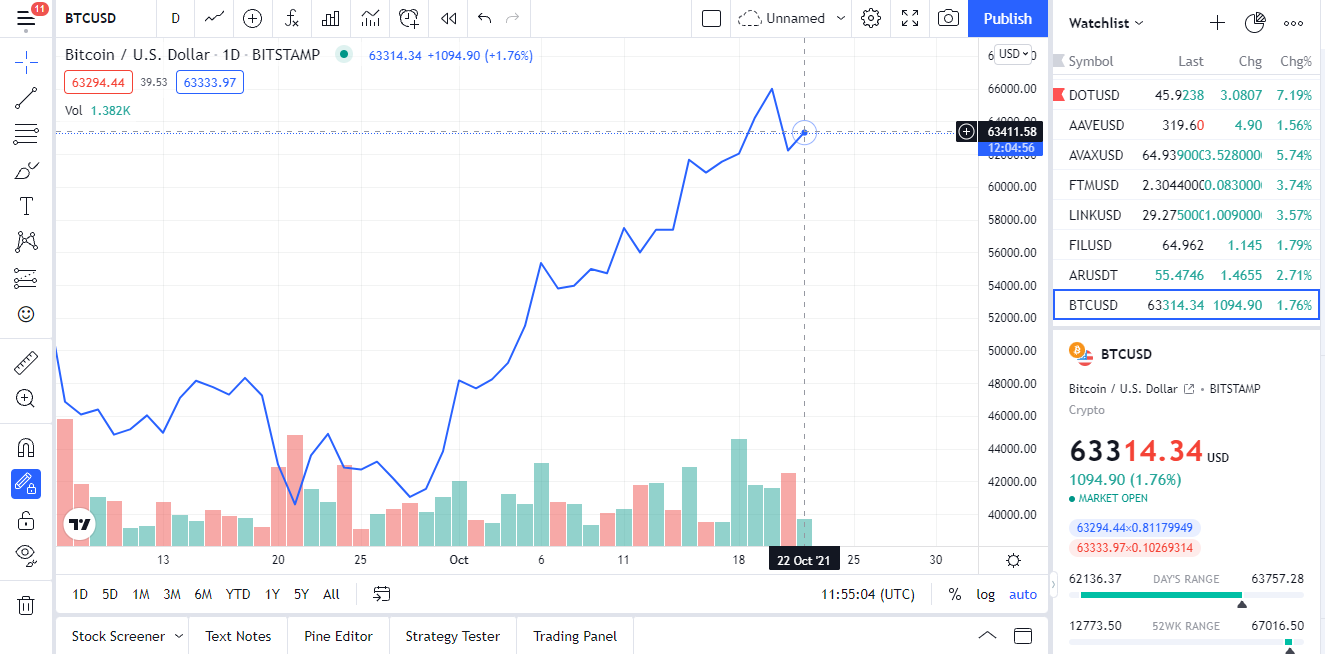
The ProShares futures-based bitcoin ETF made its market debut on the New York Stock Exchange under the ticker “BITO”. This comes after months of applications to the Securities and Exchange Commission (SEC) by multiple ETF providers. The anticipation of the IPO propelled the price of Bitcoin to new highs. And institutional investors have returned to BTC, seeing the possibility for increased demand. As a result, Bitcoin has hit its new ATH after months, taking the price to over $66000 this week.
BTC Chart
Following this announcement, not only Bitcoin but also the entire crypto market is again gaining momentum. However, some crypto experts have other things to say about this. They are still skeptical and not sure about the SEC’s decision to approve a futures-based Bitcoin ETF. Tyrone Ross, CEO of Onramp Invest, says:
“This is not something for retail investors to buy, in my opinion. There’s plenty of outlets to buy bitcoin directly. Buying a futures ETF, where the average retail investor does not understand ETFs or futures, which are complicated, is not the best product for retail investors.”
Note that Onramp Invest provides crypto asset management technology for financial advisors, tells CNBC Make It. This article will help you to understand everything you need to know before you decide to buy BTC ETF Futures.
Understand What You Are Buying
The one and probably the most important thing that you need to understand here is that you are not buying Bitcoin. A bitcoin futures ETF tracks contracts that speculate on the digital asset’s future price rather than the cryptocurrency’s current or “spot” price. As a result, the ETF’s and Bitcoin prices will diverge. This means that the price of a bitcoin ETF based on futures could trade at a premium in a bull market or a disadvantage in a bear market.
Futures market events, such as when the manager must roll out of an expired contract and into the current contract, will have an impact on this fund’s capacity to monitor bitcoin’s actual price and could raise trading costs. Ross says, “…the futures market is very obtuse for the average investor. But, overall, I think the main thing to understand is, you’re not buying bitcoin.”
Though Ross believes that the creation of a futures-based bitcoin ETF is beneficial to the larger bitcoin and crypto markets, he cautions that it may not assist individual retail investors.
“An ETF is going to drive more of that institutional money in, but they’re going to make a ton of money. It does help the liquidity of the market, but what about the retail investor? We’re supposed to help those folks, [and that’s] not necessarily what is happening here,” Ross stated.
Other financial professionals, as well as some members of the cryptocurrency community, concur with Ross. Some claim that hedge funds and providers involved in a possible ETF investment would benefit more than regular investors, especially if the ETF trades at a premium during bull markets.
A futures-based bitcoin ETF could be useful for people who aren’t sure how to buy bitcoin safely or who don’t want to be responsible for protecting and securing their bitcoin wallet. Bitcoin’s price fluctuates a lot, so an investor buying the cryptocurrency directly would have to be ready to deal with it.
Difference Between BTC ETF & BTC Futures-Based ETF
The distinctions between a Bitcoin ETF and a Bitcoin futures ETF aren’t just theoretical. The Commodity Futures Trading Commission, not the Securities and Exchange Commission, regulates the futures market. Spot markets, on the other hand, are more susceptible to manipulation, according to Gensler and the SEC.
Furthermore, while both trade like stocks and track the price of a basket of assets, the price of Bitcoin would be tightly related to a regular ETF. BTC might be included in the portfolios of everyday investors, including those saving for retirement, in the same way, that Apple or Tesla shares might be.
A Bitcoin futures ETF, on the other hand, is linked to Bitcoin futures contracts, which are speculative wagers on the cryptocurrency’s future price that allow investors to lock in a price in advance. Unlike a pure ETF, which would give investors exposure to the current price of Bitcoin, the present lineup of futures ETFs exposes investors to market sentiment.
The bullish mood is at an all-time high right now. It would most likely rise if it were held in a regular ETF. Regrettably, that is not on the agenda for investors.
SEC Is Yet To Make A Decision on BTC ETF
Meanwhile, an original bitcoin ETF is awaiting to hit the US Stock Exchange. Many investors had hoped for a “pure” Bitcoin ETF this year—one that wasn’t dependent on BTC futures—for the time being, it appears like more Bitcoin futures ETFs will be launched to compete with ProShares.
The SEC in the US has a backlog of applications that do not require approval. They can silently come into existence if the agency does not object. (However, if the SEC formally approves them, they could take effect sooner).
As a crypto investor-favored platform, Cryptoknowmicsrecommends using conscience and due diligence while investing in Bitcoin futures ETFs.
By the end of its first day of trading on the New York Stock Exchange (NYSE), the ProShares Bitcoin Strategy ETF ($BITO), the first bitcoin exchange-traded fund in the U.S., has hit $1 billion in assets under management in just two days.
ProShares Bitcoin ETF Is the Second-Most Traded ETF in Record
The ProShares Bitcoin Strategy ETF hit $1 billion in assets under management in just two days to become the second-most traded fund on record, according to data from Bloomberg.
It took the previous record holder, the gold ETF GLD, three days to hit the billion mark with $BITO entering it in only two days. Since going live on October 19, the fund has traded over $2 billion in volume with more than 24 million shares traded during its debut day.
Bloomberg senior ETF analyst Eric Balchunas commented that there may not be any contracts left to buy if this volume continues, referring to a post by ETFStore President Nate Geraci stating that nearly 45% of BITO exposure is now in November futures contracts.
If $BITO keeps up this pace of inflows it wont have any futures left to buy by the end of the month due to pos limits (via rough back of envelope calc w/ @JSeyff ). https://t.co/KauFuaPzhb
The highly anticipated launch of the first Bitcoin futures exchange-traded fund in the United States comes following approval by the Securities and Exchange Commission (SEC) last Friday.
Bitcoin Sets New All-Time High
BITO is an alternative investment vehicle for retail and institutional investors interested in indirect bitcoin exposure. The fund invests in bitcoin futures contracts, rather than actual BTC.
The crypto industry has longed for a bitcoin-based ETF for years now. In about 2017, asset managers began applying to launch spot bitcoin ETFs, but their proposals were rejected by the Securities and Exchange Commission. The rush of applications for futures-based ETFs came this year, shortly after blockchain-friendly Chairman Gary Gensler became the chairperson of the regulatory agency.
The Bitcoin ETF approval has driven Bitcoin prices to a new all-time high of $67,276 on Oct. 20. At the time of writing, the digital asset has retreated slightly and is currently trading at $65,253.
SEC Chairman Gary Gensler has explained why the Securities and Exchange Commission (SEC) chose to approve a Bitcoin futures exchange-traded fund (ETF) for trading on the New York Stock Exchange (NYSE).
Meanwhile, the Commission has not approved the creation of a spot Bitcoin ETF.
Why DId the SEC Approve Bitcoin Futures ETF?
As the first future-based Bitcoin exchange-traded fund (ETF) in the United States debuted on the New York Stock Exchange (NYSE), the chairman of the United Staṭēs Securities and Exchange Commission (SEC) explained why the regulator approved a Bitcoin futures ETF but not a spot Bitcoin ETF.
SEC Chairman Gary Gensler underlined Tuesday in an interview with CNBC that his organization “should be technology-neutral, but not policy neutral.” He continued, saying,
What we’re trying to do is ensure to the best we can within our authorities to bring projects into the investor protection perimeter.
“Bitcoin futures have been overseen by our sibling agency, the Commodity Futures Trading Commission [CFTC], which I was once honored and proud to serve there and that’s been four years,” the SEC chief continued.
One of the applications “went effective with regard to those products over at the Chicago Mercantile Exchange [CME] that our sibling agency oversees,” he added.
In response to the query why the SEC approved a Bitcoin futures exchange-traded fund (ETF), but not a spot Bitcoin ETF, Gensler said he will not comment on any individual application or initiative.
The SEC’s chairman, on the other hand, clarified:
What you have here is a product that’s been overseen for four years by a U.S. federal regulator, the CFTC, and that’s being wrapped inside of something that’s within our jurisdiction called the Investment Company Act of 1940. So, we have some ability to bring it inside of investor protection.
Is Future ETFs A Better Investment Option?
While noting that bitcoin is “still a very speculative asset class,” the SEC chairman continued, “our sister agency is supervising this for four years and then it brings it within an 80-year-old law here at the SEC.”
The ProShares Bitcoin Strategy ETF, symbol BITO debuted on the New York Stock Exchange (NYSE)
“The fund seeks to provide capital appreciation primarily through managed exposure to Bitcoin futures contracts, its website details, adding that it “does not invest directly in Bitcoin.”
On its first day, the ProShares Bitcoin Strategy ETF experienced enormous trade volumes, making it the second-highest traded fund ever.
BITO rose around 4.9% to $41.94 on the day, according to Bloomberg data.
The BITO options will begin trading on the NYSE Arca Options and NYSE American Options exchanges on October 20, according to the article.
The long-awaited Bitcoin futures fund was finally approved by the Securities and Exchange Commission late last week and began trading on the New York Stock Exchange on Oct. 19 with an opening price of $40.88.
A Historic Day For the Enormous Bitcoin Futures ETF Trade Volume
Stephane Ouellette, CEO, and co-Founder of crypto-focused capital-markets platform FRNT Financial Inc. stated that the launch was a huge success, adding:
“Given the number of avenues retail investors already have to participate in BTC, clearly the U.S.-based ETFs are nonetheless satisfying some kind of latent, even if niche, demand.”
Simeon Hyman, a global investment strategist at ProShares, remarked on Bloomberg TV that the newly released investment product was a handy method to invest in BTC through conventional brokerage accounts.
He added that it was “going to allow many people who have been waiting for an easy way to do this and a robust way to do this to now be involved and have it in their portfolios.”
BITO was one of the most bought assets on Fidelity’s platform with clients placing over 8,800 purchase orders before the market closed yesterday.
Sam Bankman-Fried, CEO of FTX and crypto millionaire described the week as ‘incredibly bullish’
Peter Schiff, a gold bug, couldn’t help but put a downer on things, stating:
“My beef is that Bitcoin pumpers will now use the approval to sucker in more buyers based on the government’s supposed endorsement of Bitcoin by approving the ETF.”
There Is No Volatility …
Although analysts predicted significant turbulence to follow, Bitcoin prices have inched closer to their all-time high during the Wednesday AM Asian trading session.
According to CoinGecko, BTC was trading at around $63,500 at the time of writing, barely 1.3% off its high price.
Analysts anticipate that the Valkyrie Bitcoin Strategy ETF, which will trade under the ticker BTFD, would begin trading this week, perhaps adding to the frothy momentum.
Following the debut of ProShares’ Bitcoin Strategy ETF later today, analysts anticipate that Valkyrie will introduce futures-based Bitcoin ETF trading this week.
This Week, Valkyrie Might Launch A Bitcoin Futures ETF
After being authorized for listing on the Nasdaq market last week, Valkyrie’s Bitcoin (BTC) futures-based ETF is “expected” to launch in the next days, according to Bloomberg analyst Eric Balchunas on Oct. 19.
If confirmed, Valkyrie’s fund would be just the second Bitcoin ETF to start in the United States, following ProShares’ futures-based ETF, which is set to begin trading on the New York Stock Exchange under the symbol $BITO on Oct. 19.
According to fellow Bloomberg analyst James Seyffart, Valkyrie’s Bitcoin Strategy ETF ($BTF) will launch on the same day as ProShares’ offering.
Balchunas, on the other hand, tweeted earlier today that Varlkyrie’s fund will “likely” open on Oct. 20 or Oct. 21 and that ProShares will have the “market to itself” for the time being.
Update: Valkyrie not going live tomorrow. Likely looking to launch Wed or Thu tho, but we'll see. Anyway, $BITO will have market to itself tomorrow. https://t.co/G2Ucit6yxM
Balchunas also mentioned that Valkyrie has changed its ticker symbol in its application from BTFD to BTF.
Invesco Withdraws From The Contest To Develop A Bitcoin ETF Based On Futures Contracts
Despite the optimistic atmosphere surrounding the Securities and Exchange Commission’s (SEC) approval of the United States’ first Bitcoin ETF, Invesco stated on Oct. 18 that it has withdrawn its application for a futures-based ETF.
While observers expected that Invesco’s futures ETF would be approved by the SEC this week, the business said on Oct. 18 that it has withdrawn its application, adding that it intends to work on creating a spot Bitcoin ETF in conjunction with crypto broker-dealer Galaxy Digital. According to Invesco,
“We have determined not to pursue the launch of a Bitcoin futures ETF in the immediate near-term; however we will continue to work in partnership with Galaxy Digital to offer investors a full shelf of products with exposure to this transformative asset class, including pursuing a physically-backed, digital asset ETF.”
However, on Anthony Pompliano’s “Best Business Show” on October 19, Seyffart and Balchunas claimed that the approval of a spot BTC-backed ETF is unlikely to happen anytime soon.
SEC chairman Gary Gensler, according to Balchunas, is much more “comfortable” with Bitcoin futures-based ETFs since they provide better consumer safeguards than spot-backed funds.