AXA Hong Kong Partners with Sandbox, Becomes First to Enter Metaverse

Sandbox Metaverse

The Sandbox has announced a partnership with AXA Hong Kong, a renowned international insurer, making it the first Hong Kong-based insurer to enter The Sandbox metaverse. The leading global insurer has acquired a 3×3 LAND, providing its clients with a cutting-edge interactive environment.

AXA Joins Dynamic Virtual Community

With the Mega City cultural hub housing numerous Hong Kong businesses, artists, and entertainers, Hong Kong plays a significant and expanding role in The Sandbox. AXA joins this dynamic virtual community as a forerunner in the sector by being the first insurer to participate in The Sandbox. The business will try to give its clients new digital experiences through AXA’s LAND, working together to co-create the future of insurance in the metaverse.

The Sandbox-DBS Collaboration

Recently, The Sandbox collaborated with the Singapore-based financial services group DBS to venture into the metaverse space. The partners will introduce visitors to the DBS BetterWorld interactive metaverse experience. DBS would purchase a 3×3 plot of LAND, a type of virtual property in The Sandbox metaverse. The area would have interactive components, emphasizing the importance of creating a sustainable environment.

The bank’s different engagement platform, DBS BetterWorld, would inform visitors to The Sandbox about current environmental, social, and governance (ESG) issues. According to the most recent contract, DBS would buy carbon offsets to make the development of DBS BetterWorld carbon neutral.

South Korea’s MSIT Unveils Ethical Principles for Metaverse

Ethical Principles for Metaverse

The Ministry of Science and ICT (MSIT) of South Korea recently released the first version of the critical ethical principles for metaverse essential for developing and taking part in the metaverse. The three values of the science ministry for those who participate in the metaverse include self-identity preservation, secure enjoyment, and sustained prosperity.

MSIT Suggests Eight Ethical Principles for Metaverse Ecosystem

The ministry suggests eight principles to uphold while participating in the metaverse ecosystem to put the three values into practice: authenticity, autonomy, reciprocity, respect for privacy, fairness, data protection, inclusiveness, and accountability. To ensure that these ethical principles for metaverse can be applied to the real world, the MSIT intends to include feedback from pertinent departments, experts, businesses, and civic organizations before finalizing the document at the end of this year. In a news release, the ministry said there are growing worries about how people interact online regarding copyright, juvenile protection, and personal information. Numerous minors sexually harassed or abused on the metaverse have occurred recently.

South Korea Staked $185 million in Metaverse

The development of the country’s metaverse ecosystem would cost KRW 223.7 billion (US$185 million), according to a February announcement from South Korea’s Ministry of Science and ICT. The ministry will utilize its war fund to promote companies creating VR/AR gadgets, foster talent, and grow the decentralized creator economy.

To address challenges in the virtual world, such as protecting private information and intellectual property and overseeing criminal activities, a pan-government council was formed. The science ministry unveiled a five-year plan to rank among the top five worldwide metaverse leaders in January as local companies, well-known individuals, and investments continue to pour into the industry.


Makeup Brands Bracing to Enter the Metaverse

Metaverse

A Metaverse connects users from around the world through virtual reality, cryptocurrencies, social media, and games. The digital universe is a hot topic with hopes of going mainstream this year, and makeup brands are not getting left behind. The Metaverse is spearheading digital beauty innovations that give rise to advanced cosmetic tech, e-commerce, and digital solutions based on AR and AI support features. These solutions offer personalization and virtual customer engagement that boost brand visibility.

Also, considering the interoperability of avatar-virtual skins, the beauty industry seems to have a part to play in landing the Metaverse. Makeup brands like Givenchy are joining the digital space. Even Perfect Corp took the lead in launching metaverse-style virtual booths and planned to incorporate fashion and beauty NFTs.

Other makeup brands are bracing to enter the Metaverse, and here’s why:

3D E-commerce

The COVID-19 pandemic affected the global economy with shifts to digital channels for day-to-day activities and interactions. Following the closure of stores due to regulations, many beauty customers turned to these channels for inspiration and beauty advice. Currently, e-commerce is experiencing a popularity boom, with brands like L’Oreal having a 30% growth and Unilever experiencing a 38% rise in e-commerce growth.

Among the popular beauty brands, the Perfect Corp YouCam Makeup app recorded over 17 billion beauty virtual try-ons in 2021. It joined a multi-channel agreement with behemoth Coty to boost personalization and the customers’ digital experience in its Covergirl brands and Kylie Cosmetics.

Lancome also unveiled a virtual UK popup store that ByondXR powers. Noam Levavi, the brand CEO of Lancome, also approved that 3D e-commerce is a vital asset in improving customer engagement. Following the launch of ByondXR in early February 2021, customer engagement in its virtual stores increased by 350%.

Digital Solutions

Most beauty companies are shifting to digital tech to ensure customers are satisfied and have successful NPD. Brands like Givaudan launched DigiPulse. DigiPulse decodes spontaneous online comments from customers about fine fragrances. This AI-powered technology is considered the first olfactory social listening device.

It can even market fragrances in a smell-without-smelling e-commerce environment. Several brands are launching online skin analysis tools powered by AI, such as the Silk Skin Checker launched by the Sensei makeup line. This technology also introduced Foundation Finder and Virtual Make-Up. It has recently announced its intentions to combine digital and real-world technologies through Artificial Intelligence for skin analysis.

Creativity and Experimentation

As the pandemic forced the closure of retail stores, makeup beauty brands had to keep up with innovative ways to uphold the interest of their customers in their products. They decided to enter and explore the virtual world. Some study results indicate that people prefer skincare routines over beauty products. Most of these makeup brands offer virtual makeup testing on their apps. These apps use augmented reality (AR) to simulate the makeup testing procedure.

Customers can explore different lipstick shades, nail polish, and foundation before purchasing them online. The Metaverse is a virtual world where people can conduct day-to-day activities. Therefore, it is only logical that these technologies appear on that platform.

Launched by Naver Z Corp, Zepeto has partnered with various beauty brands that offer makeup looks. Here customers can try new looks and explore more options in the same brand.

Livestream Shopping and NFTs

Major makeup brands are also promoting their products by offering  NFTs. Givenchy Parfums, Nars, and Clinique are just a few brands offering non-fungible tokens. Thus, the Metaverse allows customers to acquire and own rare and exclusive products. Also, Livestream shopping allows its customers to interact and have an immersive experience in the Metaverse. 

Livestream shopping has also become a popular strategy used by influencers and content creators to expand their audience.

Self-Expression

Since avatars exist in the Metaverse as the virtual counterparts of real-life individuals, people can express themselves in the virtual world similarly to how they do in real life.

Makeup brands can understand the desires and whims of their customers through the digital space. Customers can experiment and voice their preferences using the virtual setup without compromising their tastes.

Conclusion

The virtual space is a profitable and growing market. Makeup brands can also be part of the digital universe, improving customer engagement. Virtual world users can express themselves through avatars that mimic their real-life appearance. Thus, the use of makeup becomes possible in the Metaverse.

Also, the virtual world inspires creativity and innovation that can boost the product quality of a brand, which in turn will improve customer satisfaction. As more beauty brands brace to enter the Metaverse, it is evident that the virtual world is the new trend for better customer engagement.

Top Iconic Brands that Have or Plan to Venture into Metaverse

Metaverse

The internet’s potential is becoming more visible to millions of users around the world. A few decades ago, the internet’s acceptance rate was lower since individuals were unfamiliar with the innovative network. However, users began to rely on the web as part of their everyday life as years went by. 

Conversations around metaverse concepts are also gaining similar attention on the internet. By definition, a metaverse represents a digital universe where users interact through augmented or virtual realities. 

Metaverse further applies blockchain technology to enhance this digital environment with decentralization. While it may seem far-fetched, several prominent companies are already leveraging the ecosystem to build an online presence. 

At the same time, other iconic brands hope to use metaverse to improve their interactive strategies with customers. Among the companies that are onboard, the metaverse bandwagon includes:

Facebook

Facebook’s journey into the metaverse began in October 2021 at an augmented virtual and reality conference. The event was meant to address the development of a digital universe where users can work and play. According to Mark Zuckerberg, Facebook’s CEO, hosting a metaverse will attain several objectives over the next decade. 

These goals include supporting a valuable digital commerce market, providing jobs to developers/content creators, and ultimately connecting approximately one billion users.

Furthermore, the social media giant projects to use virtual and augmented realities to establish the digital space. In the event, Zuckerberg attested that metaverse may become the next generation of mobile internet.

Facebook, therefore, plans to invest billions of dollars into the metaverse over the next couple of years. To kickstart the metaverse initiative, Facebook launched its first social VR universe known as Horizon Worlds in December 2021. 

The social app lets developers establish their mini-games through Meta’s base game. In return, participants in the Horizon Worlds app stand a chance of winning a reward from the $10M creator fund set up by Meta.

Nike

Nike is yet another international brand taking up the metaverse solution. The global sports clothing company released its first virtual environment known as Nikeland in November 2021. The immersive metaverse runs on Roblox’s architecture, enabling anyone to program and play games designed by other developers. 

Through Nikeland, users can play different types of minigames such as dodgeball and tag. Roblox’s engine further enhances the player’s experience using advanced AR hardware, which automatically detects a player’s movement.

Aside from the minigames, Nikeland users also have access to a digital showroom. Here, users can customize their avatars with outfits like the Nike Blazer or the Air Force 1. Within five months, Nikeland attracted approximately 7M visitors from 224 nations across the globe.

Samsung

Third on the list is Samsung, a South-Korean corporation dealing with the development of telecommunication equipment. The global brand made its way into the metaverse through a virtual reality platform known as Decentraland. 

837x, Samsung’s metaverse world, allows users to access live content, events, and expeditions which appear every month. Participants can explore the metaverse by connecting their MetaMask wallet or visiting the space as a guest. 

Linking a MetaMask wallet lets users collect and store NFT badges offered by the 837x’s reward mechanism. Getting on board as a guest gives users a limited immersive experience where users cannot acquire any NFT. 

Even so, guests can still explore the metaverse, watch shows, and hang out without necessarily logging in.

Mastercard

In April 2022, Mastercard successfully filed 15 applications with the United States Patent and Trademark Office. The applications comprise NFTs and metaverse trademark platforms. Mastercard has significant plans which aim at establishing a strong digital community. 

The payment giant hopes to promote a metaverse-based payment system, digital events, and an eMarketplace. Therefore, these applications make use of MasterCard’s name, logo, or “priceless” slogan within a metaverse or other virtual environments.

Louis Vuitton

Unlike other iconic brands, Louis Vuitton is not entirely on board with the metaverse concept. LVMH’s CEO, Bernard Arnault, explains that the brand is solely interested in dealing with real goods instead of selling virtual products.

While referring to the metaverse, he notes that the market should be wary of bubbles that could mislead the masses. 

However, the luxury goods manufacturer is optimistic that it could test out the metaverse as a business opportunity in the future.

Ubisoft

Last on the list is Ubisoft, a French-based gaming company. In February 2022, Ubisoft partnered with Sandbox to obtain its metaverse land. Sandbox operates as a digital world where users can buy land in the form of NFTs. 

In the Sandbox metaverse, participants can develop and monetize their interactive ecosystems. By acquiring land through Sandbox, Ubisoft can heighten its gaming experience in a virtual universe with NFTs.

Into the Future: The Metaverse 

Without a doubt, there is a notable change in the adoption rate of metaverse worlds. The concept blends key features such as blockchain, NFTs, and AR/VR technologies to bring this idea to life. 

Thus, major global corporations will gradually test their working theory with such solutions. Employing the metaverse also serves as a marketing strategy since it boosts the company’s interactions with its customers or investors. 

While it is not yet clear how the metaverse industry could grow, one thing is for sure; it is a revolutionary innovation that may reform the current Web2 phase.

Hot Virtual Job Opportunities to Start Preparing for Inside the Metaverse

metaverse market

The metaverse has had different explanations over the past few months. However, it is a space where people can interact virtually through devices that simulate real-life experiences through computer software. The innovation exists as a virtual world where normal day-to-day activities are carried out.

Like other innovations, the metaverse will come with new job opportunities. These opportunities will cut across the world economy since it simulates the world in all ways it exists. However, newer opportunities like metaverse technicians will come up.

If you have been wondering about the skill to capitalize on the job opportunities that the metaverse will offer, worry no more. Read on to see the jobs and skills available in the crypto space.

How Will the Metaverse Change the Economic Sector?

The metaverse will change many things. It will mostly affect how people socialize since it functions as a virtual world. It is also heavily tied to the crypto space seeking to reshape the financial sector. Therefore, the metaverse will reshape the economic sector either directly or indirectly.

The metaverse might reshape the economic sector in the following ways:

  • Decentralization

The metaverse will rely on blockchain technology. Therefore, it might borrow some aspects of the crypto sector, like decentralization. If it does, then the economies in the metaverse will be governed through consensus and will give more returns to the metaverse citizens.

  • E-commerce opportunities

The metaverse presents a lot of opportunities in the e-commerce sector. It will allow businesses and brands to connect t to more people than the current internet iteration. Below are some of the e-commerce opportunities that metaverse will bring.

  • The margin of offline and online commerce
  • Economic inclusion
  • Improving personalization of goods for sale
  • Improving the interaction between brands and their customers.
  • Better Marketing

The metaverse will offer new space for businesses to capitalize on. It has many opportunities for e-Commerce that will allow businesses to grow at fast rates. Some of the opportunities that it will come with are better marketing. Since brands can interact better with their users, they can be marketed at a more personal level. As a result, experienced and new marketers will be needed to fill this gap. 

  • Blockchain denominated payment systems

The economies will be forced to adopt blockchain-denominated payment systems if they need to run on the metaverse. As a result, some jobs will rise like technicians to advise users on how to tackle issues arising from the usage of the blockchain payment systems. Customer service desks will also be available for similar roles where some companies may opt to use

  • New job opportunities

The metaverse will change the economic sector by introducing new jobs, like metaverse specialists and technologists. Below are other job opportunities that will be made available by the metaverse.

What Are the New Job Opportunities That the Metaverse Will Create?

Content Creation

The metaverse focuses on empowering artists. The process will encourage more content creators to join the space. It plans on introducing the decentralization of talents which will be a huge chance for artists to make a name for themselves. Therefore, this will be one of the most beneficial jobs in the crypto space. 

Marketing

The metaverse is all about bringing people together. Businesses and brands will have the chance to interact closely, and marketing will be easier and more productive. However, t=brands will need to increase their labor force to cover the new space, which will create new positions for both new and experienced marketers.

E-Commerce Opportunities

As discussed earlier, the metaverse will offer many opportunities tied to the e-commerce sector. Therefore, it is advisable to start gaining and improving skills in the e-commerce sector as different industries will require different sets of skills there.

Decentralized Hosting

Event hosting will be important in the crypto space. However, it might be decentralized. Therefore talented tv show hosts and event hosts should prepare to capitalize and adjust to the requirements in the crypto space.

Entertainment Opportunities

Since people will be convening in the metaverse, entertainment will be required. Artists, DJs, and other players in the entertainment sector should be prepared to fill that space up.

Fashion Design Opportunities

Virtual fashion design shows are already a thing. They will gain traction on the metaverse, which necessitates proper preparation for the players in this industry to fill the space up.

P2E Gaming 

Currently, people are being paid to play games. Whether as game testers or in P2E gaming. Although P2E won’t give many returns, it can be considered a job opportunity as some will be employed to test the games.

Virtual Consultancy Services

Any consultancy services given in the normal world will be required in the metaverse. Therefore people should prepare to open lounges in the metaverse to increase the scope of their services.

Metaverse Tour Guides

Tour guides will always be needed in the real world and the metaverse. Therefore, it is an enticing job opportunity in which anyone with the right skills could thrive.

Metaverse Technologists

Since the metaverse is a technological innovation, some will have technical problems. Therefore, there will be a need for virtual Metaverse technologists and technicians to aid them.

Author’s Take 

The metaverse will reshape the world in many ways. It will mainly touch on the economy tied to the crypto space, which looks to change how money is exchanged between people. It will also offer other opportunities in how people socialize and carry out their daily activities.

Therefore, people should research it as its advantages and opportunities are not to be looked down upon. However, it is best to be cautious while researching it as there are many projects out there that may fail.


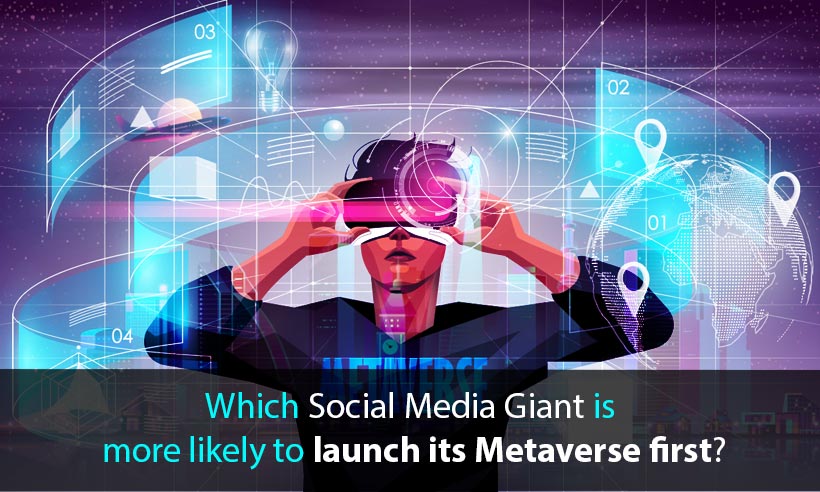
Which Social Media Giant is more likely to launch its Metaverse first?

Which-Social-Media-Giant-is-more-likely-to-launch-its-Metaverse-first

The Metaverse has been one of the hottest topics on the internet and social media networks for the better part of 2021 and 2022. It has been a source of gain for many people, with many investors diversifying their portfolios into Metaverse tokens. 

Together with financial benefits, The Metaverse brought excellent experiences to the gaming and entertainment industries. For that reason, some top companies began to announce Metaverse plans to rip the benefits. 

Social media platforms were never left behind. Platforms like Facebook, Twitter, and Instagram began involving themselves in the crypto space, joining the Metaverse race. But the question is, which social media giant is likely to launch its Metaverse first?

Meta Social Network Company

Meta seems to have taken a step ahead in the race to launch a Metaverse. This network and its social media platforms have always been making plans to launch a Metaverse in the future. In fact, due to Metaverse plans, Facebook rebranded to Meta.  

Social networks like Instagram, Whatsapp, Facebook, and Facebook Messenger are all under the Meta shade. Some of these networks are likely to play a major role in the upcoming Metaverse. Among them include; 

1) Instagram

One of the largest social media networks is likely to be the first in the race for the Metaverse. Instagram is a photo-sharing app for people all over the globe. It has around 1.13 billion users as of 2022.  

According to reports, in early 2022, Mack Zuckerback announced that NFTs would soon be coming to Instagram. A similar report was leaked sometime in January 2022, indicating that there are actual plans of bringing NFTs to Instagram. 

As many already know, NFTs are the actual backbone of the metaverse economy. Without NFTs, there is no Metaverse. Hence, Instagram’s integration of NFTs is a strong statement toward their launch of the Metaverse. 

2) Facebook

This is the largest social networking platform globally, with a user base of nearly 3 billion people. It’s the eldest of all social media platforms housed by Meta. 

Like Instagram, Facebook has recently been planning to introduce NFTs. According to reports, the NFT support for the Facebook social media platform will also start sometime in 2022. Hence, Facebook is keen on introducing its Metaverse very soon.

3) Whatsapp

Another social networking site housed by Meta, Whatsapp, could also be on its way to the Metaverse. In late 2021, a report indicated that a Whatsapp 3D version could be in Metas plans. This Whatsapp will come as part of the Metaverse.  

4) Twitter

Many people have noted that Twitter could be planning a move into the Metaverse. Twitter has always had an eye for the crypto space. There is already a project team dealing with the merger of NFTs into the network. NFTs could lead Twitter to the Metaverse. 

Elon Musk purchased a significant share of Twitter. His involvement in the company could foster innovation. Could musk use the blockchain and Metaverse to improve speech freedom on Twitter? 

5) Youtube

Youtube is another social networking platform created solely for sharing videos for global consumption. This network, owned by Google, allows creators to post videos and a comment section. In 2022, there were reports that Youtube lost some of its creators to the Metaverse. Thus, Youtube began exploring the meta-universe. 

According to reports, Youtube announced that it would start offering a metaverse experience as it aims to benefit from the same. But, based on the reports, Youtube does not intend to launch its Metaverse. Instead, the network aims to ensure the videos within the network feel more real. The reports show that youtube will improve its video experience, especially for game streamers.

6) ByteDance’s Paiduidao

Paiduidao is a social media network launched by Tiktok owners ByteDance. This small social networking platform operating within China is already giving users a metaverse-like experience. According to reports, this new app allows users to interact with other community members using Avatars. This network is the first social media platform to bring about the Metaverse, but it’s tiny compared to the other giants. 

7) Reddit

Reddit is another social networking site linked heavily with the blockchain space. It’s mainly a source of suitable learning materials. However, the network has shown interest in NFts and Metaverse. 

They recently launched a pack of NFT Avatars that its users can purchase. These Avatars are commonly used within the Metaverse. Yes, Reddit has no official Metaverse plans, but they support the Metaverse space. 

Meta/Facebook is Already Ahead!

In the race for introducing a metaverse, Meta and all its products, including Facebook and Instagram, are probably already ahead. The change of name by Facebook to Meta was a show of commitment to the Metaverse. However, as already mentioned, the network has already been exploring different ways to enter the Metaverse. Meta could choose to launch the Metaverse with Facebook first to attract people back. 

The introduction of a 3D version of WhatsApp in the Metaverse could drive a lot of traffic into the digital universe. Most other social networks have very vague plans for the Metaverse. Musk’s influence on Twitter could make The social network launch a Metaverse sooner than later.

Adidas to Launch Metaverse Avatar Creation Platform

Adidas to Launch Metaverse Avatar Creation Platform

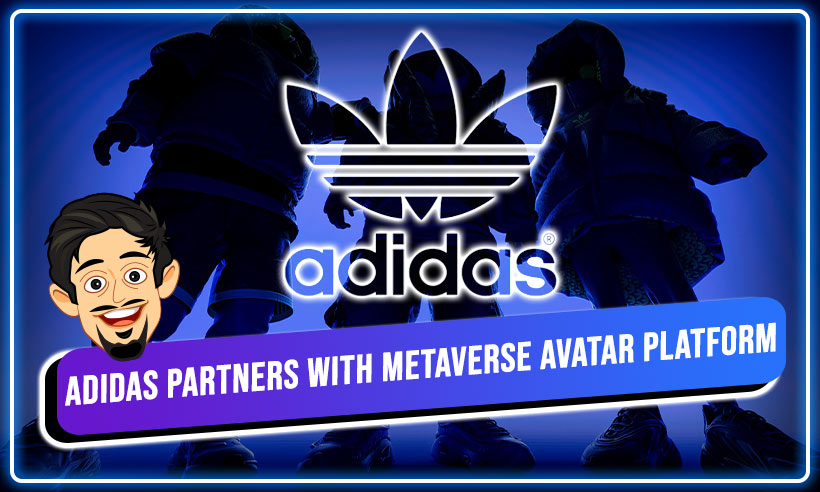
Sneaker giant Adidas is launching the world’s first personality-based AI-generated avatar creation platform in partnership with Ready Player Me, a cross-game avatar platform for the metaverse.

World’s First Personality-Based Avatar Creation Platform

Sportswear giant Adidas is taking yet another step into the metaverse by launching the world’s first personality-based AI-generated avatar creation platform, in partnership with Ready Player Me.

Launching on Apr 8 alongside the arrival of Adidas’ latest Ozworld collection of sneakers, the upcoming Ozworld experience on the platform will allow users to create their own unique avatars via Ready Player Me.

When creating the avatar, users will be required to answer a series of questions about who they are. The answers will then be translated to a digital avatar that takes aesthetic information from the visual codes of the Ozworld sneaker collection.

After generating their avatars, users can also experiment with animation as well as digitally try on or purchase sneakers from the Ozworld collection. In addition, users will also be able to download their avatars into stickers and GIFs to be used on social media.

The collaboration with Ready Player Me is the latest metaverse project by Adidas following the success of its first NFT project Into The Metaverse (ITM). Holders of ITM NFTs as well as adiClub members will be granted early access to the online Ozworld experience via a unique URL. The first installment of avatars will arrive on Apr 28.

Top Metaverse Coins By Market Capitalization

Metamall

We can exist as digital identities in the metaverse, which is a parallel virtual universe. The tech industry has made it obvious that the metaverse is not a fad, but rather the future of human connections and transactions across a wide range of industries. Businesses have already begun investing in it, even though it is still in its early stages of development.

Metaverse coins are the next big thing right now. These cryptocurrencies, the next undiscovered possibility, have the potential to transform how companies interact and engage with their audiences. The value of these coins has only increased when Facebook changed its name to Meta.

In 2022, the introduction of metaverse has redirected the entire cryptocurrency market trend in a new direction. With cryptocurrency markets currently trading sideways, Metaverse crypto coins are extremely discounted and represent an excellent buy opportunity. This Cryptoknowmics article examines our top Metaverse crypto coins according to their global market cap. But before that, let us have a brief and clear understanding of Metaverse coins. 

What are Metaverse Coins?

People in the metaverse utilize metaverse coins as a form of payment. Coins can be used to buy anything in the 3D world, from avatar apparel to real estate. They can also use the platform to manufacture and sell products, goods, and services. Some tokens can only be used within their metaverses, while others can be purchased on cryptocurrency exchanges like Binance. Metaverse tokens, however, are more than just in-game currency; they have worth both inside and outside the metaverse.

For example, the currency can be used to represent unique assets such as community members. By using these coins, you can also gain access to VIP features and compete with other players. Metaverse coins can also be exchanged for real money. Non-fungible tokens (NFTs) can be used to prove ownership of digital assets such as artworks and collectibles.

Metaverse coins, like any other investment, require careful examination to decide whether you’re making a wise decision. The market capitalization of the asset is one factor that investors analyze. Therefore, this article will give you a better understanding of which coin has the most potential in the market and is doing good. 

Top Metaverse Coins by Their Market Cap

The current market capitalization of Metaverse-related crypto has surpassed $23 billion, (at the time of writing) according to Coinmarketcap. Traditional crypto investors are increasingly diversifying their assets into the metaverse industry as the number of initiatives grows. The reason to base this list on the market cap of each coin is that it speaks volumes about how far a coin can go. 

Market cap is significant because it evaluates a cryptocurrency’s value, provides a more complete perspective of a cryptocurrency, and compares its value to that of other cryptocurrencies. As a result, stakeholders may be able to make more informed investment decisions. This also enables users to assess a cryptocurrency’s potential for growth as well as its volatility in comparison to other cryptocurrencies. Now, let us move ahead with the list. 

Gods Unchained (GODS) 

The token is trading at $1.07, with a market cap of $25 million. Gods Unchained is a free-to-play tactical card game in which players have complete control over their in-game assets. Magic’s former game director is in charge. The Gathering: Arena is a competitive card game in which players must strategically outsmart their opponents by designing decks that can combat a wide range of techniques. Players in Gods Unchained have entire ownership of their digital goods, allowing them to trade, sell, and utilize them in any way they see fit – just like they would with actual, tangible cards.

Gods Unchained is the top Metaverse crypto game featuring a Hearthstone-style trading card game and the popular play-to-earn mechanism, which was released in October 2021. Gods Unchained uses NFTs to tokenize in-game assets, keeping up with the latest crypto innovation and trends. The principles of the game are similar to those of Hearthstone, and it includes GODS, the game’s native utility token. The token can be used to buy cards, take part in in-game events, and so on.

With a large number of social media followers, the game has quickly expanded in popularity. As a result, the total amount of money made has increased as well. So far, more than $7 million in cards have been traded, and blockchain experts consider this game to be the next best thing after Bitcoin. Once the native token GODS is listed on several cryptocurrency exchanges, it will gain even more popularity. It is unquestionably a game worth playing and profiting from. 

Highstreet (HIGH)

The token is trading at $3.71, with a global market cap of $45 million. HIGH Currency (Highstreet) is the native token of a decentralized commerce-focused play-to-earn metaverse with support for virtual reality (VR). Highstreet (HIGH) presents a market where in-game things can be redeemed for real-life objects, in addition to enabling a two-way financial flow between the physical and virtual worlds. Users can explore the metaverse, fight monsters, and complete tasks while earning things that are both digital and real-world usage. The initiative intends to establish a new era of retail by providing an easy, secure, and enjoyable way to make online purchases.

It has an MMORPG Metaverse game in which players may take on different roles such as Archers and Brawlers. The purpose of the game is to eliminate monsters and protect cities, and users are rewarded for their efforts. With their game, Highstreet connects the digital and physical worlds by transforming products into in-game assets that are solely owned by the player base. 

In the Highstreet World, players can explore a continent called Solera as well as an ever-expanding archipelago of unknown islands. Users will be able to buy armor and gear in-game and customize their characters to fight in fights and explore the Metaverse’s large open environment. 

Decentraland (MANA)

The token is trading at $2.34, with a global market cap of $4 billion. Decentraland is a virtual reality platform that allows you to purchase property tracts. You can expand the plot by constructing and monetizing whatever you want on it. Decentraland, which was created in 2017, was one of the first to attempt to create a decentralized virtual reality based on Ethereum. Only 90601 parcels of LAND are available, each measuring 16 square feet. 

The ecosystem’s native token, MANA, has a 2.2 billion supply. The total number of tokens in circulation is 1.8 billion. This platform is used by gamers, creators, and businesses who want to profit from metaverse opportunities while also having fun. The currency will be in high demand if it has a huge target audience. Decentraland is an appealing investment because of this.

According to CoinMarketCap, an investor who purchased MANA in 2017 would have received a nearly 12,000 percent return. It increased nearly 4,000% in one year, from about 8 cents to $3.27. Decentraland was designed for content creators, businesses, and individuals seeking a new artistic medium, business opportunity, or source of entertainment.

Axie Infinity (AXS)

The coin is trading at $47.06, with a market cap of $2 billion. Axie Infinity is one of the most popular and profitable blockchain games ever created. Do you remember the game ‘Pokemon Go’? Axie Infinity, like Pokemon, is a charming NFT pet game that has fattened the wallets of crypto nerds and laypeople who would otherwise avoid the crypto market. By playing their game, players can earn AXS, the Axie token. It has been a huge success, with some reportedly quitting their jobs to pursue the ‘play-to-earn’ lifestyle. It permits the use of its tokens in its metaverse. At Axie Marketplace, the AXS token can be exchanged for ETH and used to purchase NFTs.

Axie is the market leader in the P2E sector, with impressive numbers and growth to back up its claim. Axieinfinity.com is the world’s 1,072nd most popular website, and the world’s 18th most popular finance website, according to Similarweb. In November, the website received 26.6 million visitors. Axie Infinity is the Philippines’ 38th most visited financial website.

In March, Axie Infinity gained 2% in the very first week of the month. The cryptocurrency reached an all-time high of $160 per AXS on November 6. Among the metaverse currencies, Bitcoin could soon reach new highs. AXS may be traded on several exchange platforms as of March 2022, including Binance, Huobi Global, Coinbase, FTX, Bithumb, KuCoin, Gate.io, and Kraken.

SandBox (SAND)

The coin is trading at $2.81, with a global market cap of $3 billion. The Sandbox is a virtual environment where gamers can use the SAND token to create, own, and monetize their gaming experiences on the Ethereum blockchain. Players can generate digital assets in the form of Non-Fungible Tokens, sell them on the market, and use Game Maker to integrate them into games. The Sandbox gives creators actual ownership of their works in the form of NFTs and compensates them for participating in ecosystem activities and interactions including transaction fees, staking, and buying and selling game objects, among other things.

Anyone can create fantastic 3D games for free using Game Maker. No coding is required because users can utilize visual scripting tools to build aesthetically spectacular games in minutes. Users can also upload, publish, and sell their VoxEdit creations on the marketplace. 

And recently, Sandbox has topped 2 million registered users during its play-to-earn season two alpha launch. The crypto game, which is backed by NFTs and its native SAND coin, has been in development for nearly four years, and the current peak comes just a few months after the game’s long-awaited season one alpha debut in late November 2021.

Conclusion

Since 2017, a slew of new cryptocurrencies has entered the burgeoning cryptocurrency market. Initially, meme coins were just used for amusement, but cryptocurrencies such as Dogecoin and Shiba Inu have demonstrated that they can be real investment vehicles. This year, however, appears to be the year of the Metaverse Projects, with investors hopeful. 

What is Sandbox: A Beginner’s Guide to the Sandbox Metaverse

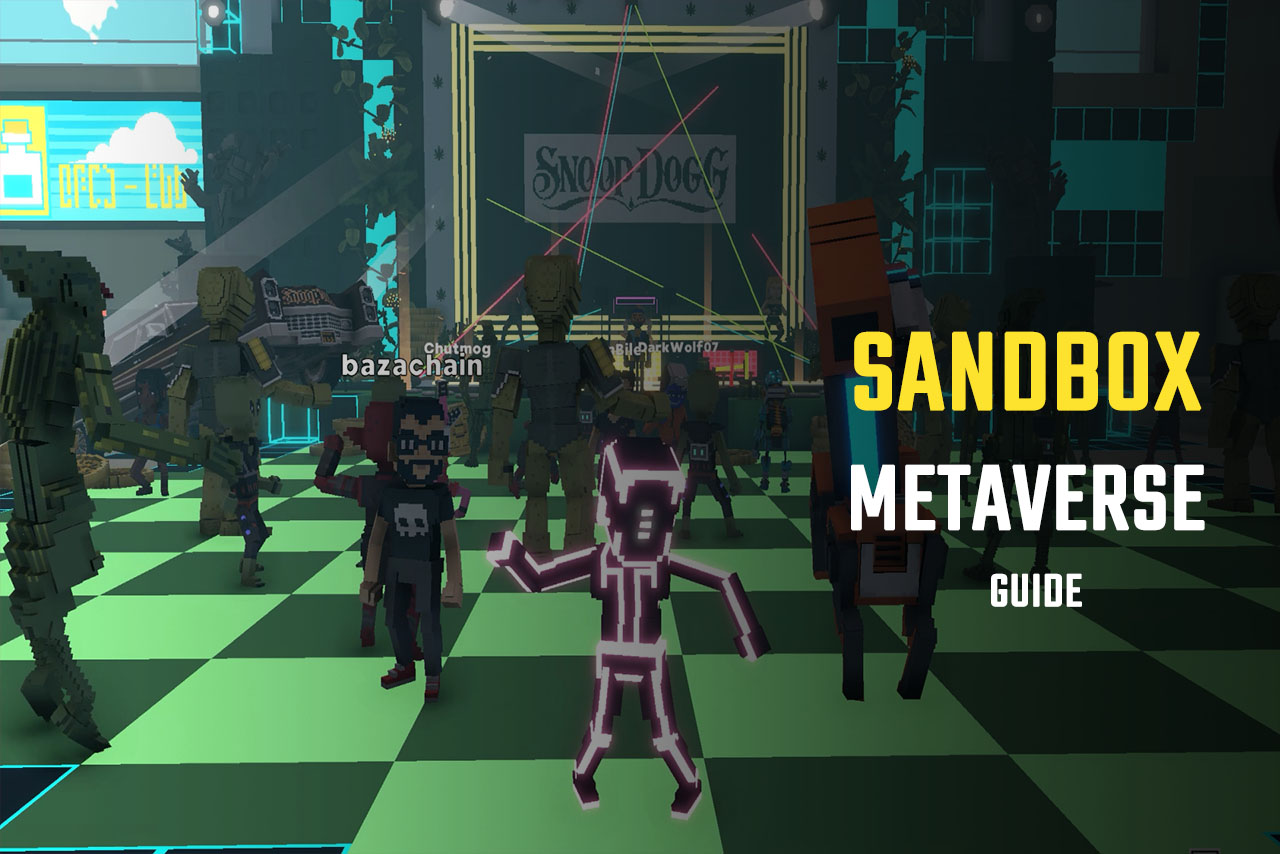
SANDBOX METAVERSE GUIDE

Virtual worlds are no longer just for entertainment and they have become valuable real estate in their own right as a result of people’s willingness to invest time and money in them. It is irrelevant whether these goods and spaces are digital or not, whether they are virtual or real- they are valuable because they are created by people who care about them.

Minecraft is one of the first games with no goals or rules, and the game is open for players to build and explore at their leisure. This is referred to as a “sandbox game”, and these games are designed in the sandbox style, allowing children to build whatever they want.

What is the Sandbox?

The Sandbox is a virtual world in which players can create, own, and monetize their own gaming experience. The platform is based on the Ethereum Blockchain Network and includes an in-house governance and utility token known as SAND. In-game items will be tokenized as non-fungible tokens, making them freely tradable on marketplaces.

The Sandbox’s virtual world is divided into 166,464 lands. These lands are the metaverse spaces where players can create and monetize games. Land and estates can be combined to form districts, and districts can be combined to form estates. The project was launched in 2018 and is still in the early stages of adoption and development.

The Sandbox’s three main components are Vox Edit, the Marketplace, and the game itself. Let’s take a closer look at the Sandbox’s components.

1. Vox Edit:

VoxEdit is a 3D voxel modeling software that enables artists to create and animate 3D objects such as people, animals, tools, and so on. These in-game assets can be used in the game by the artists or sold on the market.

2. Marketplace:

Users of the Sandbox project will be able to sell their creations in VoxEdit in the form of non-fungible tokens (available in ERC-721 standards). This will provide creators with an open market to monetize their creations.

3. The Sandbox Game Land:

The virtual world of Sandbox is divided into several lands. After purchasing land, a user can use it to create a game and place their in-game assets. Users can use assets to decorate their land and incorporate gameplay features by assigning predefined behaviors to the assets. This can transform a piece of land into a full-fledged game.

4. The SandBox Avatar:

An Avatar is an in-game virtual reality representation of a player that can be customized to suit the needs of Sandbox players. Users can try different outfits, hairstyles, and colors to get a unique look. They can also boost the attributes of their avatar with various items available in the marketplace.

5. SAND Token:

Sand is the in-house utility and governance token of the Sandbox ecosystem and can be staked on a specific piece of land. As a staker, you will receive a few gems and catalysts as a staking reward, which can be used on the platform or sold on the marketplace. By 2023, the platform’s ecosystem will be converted into a DAO (Decentralized Autonomous Organization).

6. Land and Lands Map:

Lands are physical spaces in the metaverse owned by players to create and monetize games and can be rented to game creators. Anyone who purchases a piece of land will be granted a LANDS token, which is an ERC 721 (Non-Fungible Token standard) token. There are a total of 166,464 land areas that can be purchased and 58% of the land has already been sold on the platform.

Revenue Model of The Sandbox platform

The Sandbox team has identified the following five revenue streams that would help in managing and growing the platform:

1. Advertising Revenue 

Businesses will be able to advertise their products or services on the Sandbox platform, and the platform will charge a fee for these services.

2. Company NFT Sales 

In addition to the NFTs created by the individual artists, the company also has its own in-house NFT to be sold in the marketplace.

3. LAND sales 

Sandbox has been selling the LAND pieces in auctions, which has generated revenue for the platform.

4. Player Subscription and Services 

The company would make money from players by charging them subscription fees and other service fees in order to give them access to exclusive in-game features and premium assets.

5. Transaction Fee 

The Sandbox would charge a 5% transaction fee on every transaction on the platform. As a result, as the platform grows in popularity, transaction fees will become the primary source of revenue.

Partnerships

The Sandbox has several renowned partners, such as:

  • Atari
  • Axie Infinity
  • Binance
  • CryptoKitties
  • Dapp
  • Harmony Network
  • Kyber Network
  • Polygon Network

Conclusion

The Sandbox is a new virtual world that aims to replicate the success of Minecraft in the gaming industry and monetize the whole gaming experience. The founding team has excellent experience in developing games in this genre and has already successfully adopted these games in their previous ventures, such as Atari, The Smurfs, etc.

Decentraland Project Review : Virtual World Owned by Community

Decenterland project review

Nowadays, people are spending more time in the virtual world in comparison to the real world. People are using mobiles, laptops for both work and leisure. An introduction to the 3D world will create a more immersive experience for people. Websites and applications where people spend most of their time are controlled by a centralized entity. People don’t have any control over these applications. Decentraland, unlike other social networks, games are not controlled by a centralized entity. The community owns and has full control over this shared virtual world. 

What is Decentraland?

Decentraland is a shared virtual world that is powered by the Ethereum blockchain. Its users can create content and monetize it. Users can pay for experiencing various applications in Decentraland. The community permanently owns the land in Decentraland and has full control over it. The ownership of land can be claimed by users through a blockchain-based ledger of parcels. Each portion of land can be identified by a set of cartesian coordinates (x,y). Landowners decide what type of content can be published to their land, content can be static 3D scenes, interactive games. All the land in Decentraland is an NFT, stored in an Ethereum smart contract. To acquire land in Decentraland, the MANA token is used. Digital goods and services can also be purchased by MANA.

How does Decentraland work?

Decentraland has built a framework for supporting shared virtual worlds. A decentralized ledger stores all the data of ownership of land, contents of each parcel of land and also provides a peer-to-peer network for user interactions. Users can participate in governance functions and can propose policies and vote on upcoming LAND auctions.

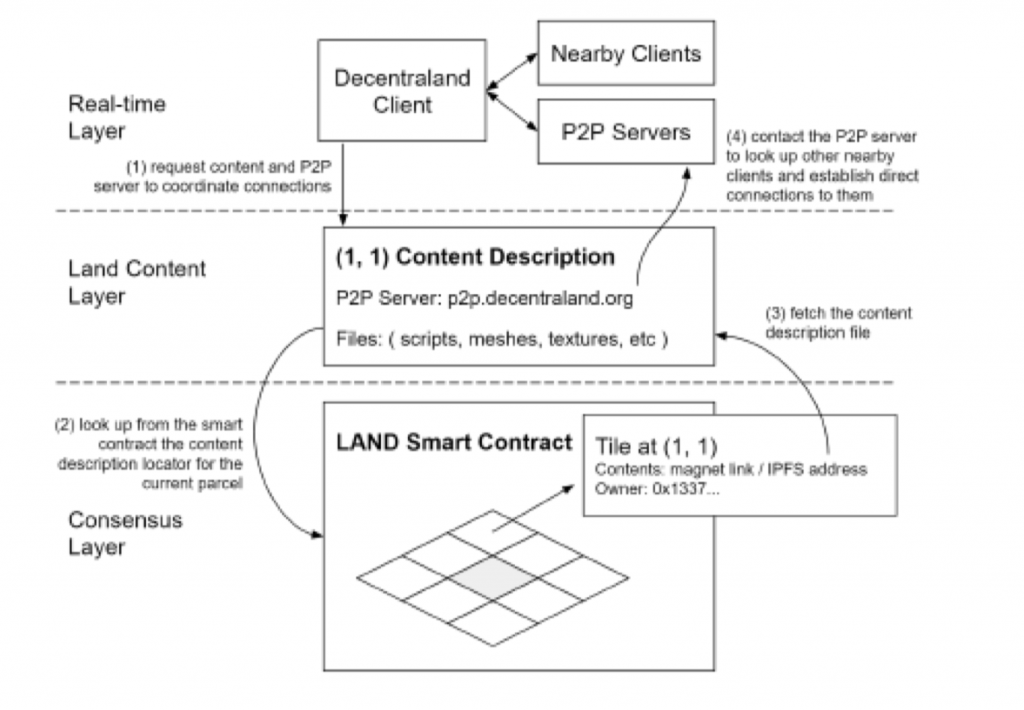
Decentraland’s protocol consists of three layers :

A consensus layer: This layer is used for tracking ownership of land and its content.

A LAND content layer: This layer uses a decentralized distributed system to download assets and for rendering content in the virtual world. 

A real-time layer: This layer is responsible for enabling users to connect with each other.


decentraland architecture

The above diagram shows the steps executed by the Decentraland client to provide the experience of a virtual world in a decentralized manner.

Each piece of land is marked by a unique set of cartesian coordinates. Content created by users can vary from 2D scenes to 3D scenes giving an immersive experience.  The consensus layer is responsible for tracking ownership of land, land content is referenced here as a hash of the file’s content. The content can be downloaded from IPFS or BitTorrent by using reference. The downloaded file of content contains a description of objects, sounds, textures, and other elements needed to render the content scene. 

Decentraland has two important systems which enable its economy to develop :

Payment Channel Infrastructure: It enables fast payment with low fees.

Identity System: It allows users to prove their ownership over their creations. 

Tokenomics


Decentraland has an ERC-20 token called MANA. It is used to buy, sell digital assets and can also be used for gambling in virtual casinos. It is also a governance token. Holders of MANA tokens can participate in governance functions. They can propose their own policy and can also vote on the different proposals. 

Decentraland is controlled by MANA holders through Decentraland DAO. The DAO owns the important smart contracts and assets such as the LAND contract, Estates contract, Wearables, Content servers, and Marketplace. 

1 MANA token gets you 1 vote and owners of LAND and Estates get 2000 votes.

The maximum supply of MANA tokens is 2.193 billion. As of writing this article, the circulating supply of MANA tokens is 1.32 billion, the market cap is 3.7 billion, and the price is 2.84 US dollars.

Applications of Decentraland

Content Curation 

Decentraland users can create content of shared interest of their neighbors. If a creator is living near a high traffic hub, then more users will drive to the creator’s content.

Advertising

Brands can drive users to their products, services, and events by using billboards to advertise in high-traffic hubs. Brands can create shared experiences to engage their audience so that users will be interested in using these experiences in their own land.

Digital Collectibles 

Digital assets are published, distributed, and collected by users on the blockchain. These digital assets can be traded easily by users in the Decentralnd. Rare or old digital assets are traded at a very high price. These digital collectibles are used to identify users and their land. 

Social

All the groups which are present in online forums, chat groups, discords can port their communities into Decentraland. People can form different communities on various subjects and can propose their policies through governance.

Conclusion

Decentraland has opened a new world of possibilities for internet users. Users can create their own content on a decentralized platform and can receive all the revenue generated by their content without giving any portion of revenue to the platform or any middleman. Internet users have full control over this virtual world and they decide how this virtual world operates and progresses. In the coming years, we will see many new innovative applications being created in Decentraland, providing mesmerizing experience to users.