Could Optimistic and Zero-Knowledge Rollups Transform and Improve Network Performance?

Could Optimistic and Zero-Knowledge Rollups Transform and Improve Network Performance?

Due to its popularity and the number of decentralized apps (dApps), Ethereum has experienced network congestion. This move has limited scalability, high fees, and slow transactions. Layer 2 (L2) protocols, which are platforms that operate on top of the underlying blockchain, have been one answer to these challenges. 

One sort of L2 solution is zero-knowledge rollups, which are aimed to provide improved transaction speeds and cheap costs. The other top solution is optimistic rollups parallel to the main Ethereum chain on layer 2. This feature can improve the scalability of the network by not requiring any computation. Instead, after a transaction, it will propose a new state to Mainnet.

The main issue with Ethereum is how developers and users will choose the most advanced technology for their app. Convenience usually wins unless the technology is better. This article will discuss how optimistic and zero-knowledge rollups transform and improve network performance. Let’s dive in:

What are Rollups?

A rollup is an Ethereum-based scaling solution that allows users to perform transactions outside the network’s Layer 1. It will enable the key to maintain its security while scaling the network.

Because just a portion of the data from rollup transactions must fit within Ethereum blocks, moving transaction execution off-chain enables a more significant number of transactions to be executed. Rollup transactions are processed on an entirely distinct chain capable of running a rollup-specific version of the EVM.

In most cases, a rollup deploys smart contracts on layer 1 of its network to handle various tasks, such as processing deposits and withdrawals. Multiple types of rollups use different types of proof. The optimistic rollups utilize fraud proofs. On the other hand, ZK rollups employ validity or zero-knowledge proofs to verify the credibility of transactions.

Optimistic Rollups and their Role

In optimistic roll-ups, data is assumed to be correct before posting to Layer 1, hence “optimistic.” As long as the published information is valid, no action is necessary. Rollups with optimistic assumptions benefit from not having any extra work to do.

However, if an invalid transaction has been submitted, the system should be able to identify it and take appropriate actions. An optimistic rollup uses a dispute resolution mechanism to prevent fraudulent transactions from resolving disputes. It eliminates the incentive for bad actors to submit false claims.

The party that can submit transactions to layer 1 in Optimistic rollup should provide a bond in Ether. If a transaction gets rejected, another network participant can submit a fraud-proof, and then the system enters the Dispute Resolution mode. The transaction is then executed again and again until it gets resolved. If the transaction is rejected, the responsible party will be penalized with their Ether bond.

To prevent bad actors from sending fraudulent transactions to the network, parties that wish to submit fraud-proof must also provide a bond in ETH. Due to the nature of the transactions executed on a rollup, it has to implement a system to identify the transaction’s actual state.

This process can be pretty complex, as it involves creating a contract that automatically updates the state of the rollup whenever a transaction is executed. Getting into the Dispute Resolution mode should be an exceptional experience, as it involves the right incentives.

ZK Rollups and their Role

Unlike other dispute resolution mechanisms, ZK rollups do not have a dispute resolution mechanism. Instead, they use a cryptography mechanism called Zero-Knowledge Proof (ZKP).

Instead of exchanging core information such as passwords, the two parties can resolve their disputes through puzzle pieces. The prover must provide the information required to complete the puzzle pieces.

Imagine that you’re playing a video game where the player has to unlock a locked door. You don’t have to reveal the secret code to prove that you know how to unlock the door. All that matters is that you won the game.

Instead of revealing the secret code, the prover must demonstrate control over the information. It ensures that no unauthorized person can access the critical data. The ZKP is incredibly secure because it only requires a simple verification to confirm that the puzzle has been completed.

Optimistic Rollups vs ZK Rollups

Scaling

The ZK and optimistic rollups can quickly scale the Ethereum network up to around 15 to 45 transactions per second. The upcoming release of Ethereum 2.0 and the Sharding method will create a fantastic synergy between rollups and blockchains. Combining the ZK and Sharding methods will allow Ethereum to reach transaction speeds of up to 100k transactions per second.

EVM-compatibility

Due to the complexity of the ZK roll-up technology, it’s hard to create an EVM-compatible version without rewriting the entire application logic. ZkSync has been working on developing an EVM-compatible understanding of its roll-up. The first version of this project, zkSync 2.0, was released in June 2021. The zkEVM virtual machine can perform smart contracts in a way that’s compliant with the Zero-Knowledge Proof algorithm.

Unlike ZK rollups, which have a lot of issues with EVM compatibility, optimistic rollups can quickly create an EVM-compatible version without any changes.

Computation Requirement

When it comes to computation, ZK rollups need more computing power than Optimistic rollups. Because of this, machines that compute Zero-Knowledge Proof must be high-spec, making it difficult for average users to run.

Final Thoughts

Adding Layer 2 to Ethereum will help make the platform more robust and complement the more significant scalability issue work. Some prominent outsiders share the same view as many in the blockchain industry.

In their announcement of their $25-million investment in Optimism, Andreessen noted that there is little debate about the need for scaling Ethereum. However, it is often seen as a competition between the platform’s various services.

One of the lessons that internet history has taught us is that developers immediately create applications that demand more supply when a new computing platform is given to developers. It is believed the same will be valid for Ethereum; the answer to scaling is “all of the above“.

Although rollups are not as robust as the other layer two solutions, they are still considered the best. They are a natural fit for the PoS and sharding features of the Ethereum 2.0 project. It is no coincidence that Vitalik Buterin, Ethereum’s creator, is quite fond of them.

Bitcoin DeFi – How it can revolutionize the flagship crypto

Bitcoin-DeFi---How-it-can-revolutionize-the-flagship-crypto

Bitcoin, the first functioning blockchain that popularized the underlying technology, was designed to be a “pure peer-to-peer version of electronic cash” that “allows online payments to be sent directly from one party to another without going through a financial institution.” So far, Bitcoin has shown to be remarkably robust, and with the advent of the Lightning Network, it is also beginning to grow in order to become feasible for micro-transactions.

However, payments are just the beginning, and there are many more trade-fi verticals to be conquered in the future. Smart contracts, notably on Ethereum, have opened up a whole new world of decentralized finance, enabling crypto users to access various financial service verticals directly on-chain, in a permissionless and trustless manner, the same way Bitcoin payments are processed.

Despite the fact that other chains may have gained the lead in DeFi development, the Bitcoin community has not rested on its laurels and has continued to push forward with the implementation of DeFi dApps on the blockchain. We dug deep into this emerging ecosystem, and here are some significant findings that not many might be aware of.

Bitcoin dApps are being implemented on the second layer

Peer-to-peer payments have been the sole focus of the Bitcoin network since its creation. During the first stages of Bitcoin’s development, the focus was on making the network more secure, reliable, and scalable. This means that the Bitcoin blockchain was not supposed to be a platform for smart contracts and decentralized applications (dApps). While this may change with the Taproot update deployed in late 2021, smart contract capability for the Bitcoin blockchain has to date been enabled through sidechains/layer 2 solutions.

There are a variety of Bitcoin sidechains and Layer 2 implementations. Some instances are:

  • Rootstock/RSK – Layer 2 smart contract platform for Bitcoin.
  • Liquid Network – Private sidechain developed by blockstream for inter-exchange settlement
  • Lightning Network – Layer 2 network built for instant transfers, developed using Bitcoin’s native smart-contract scripting language.
  • DeFiChain – Sidechain for Bitcoin with a hybrid PoW and PoS consensus mechanism, written in C++
  • Stacks – Sidechain for Bitcoin with a unique Proof of Transfer consensus mechanism, built using the Clarity programming language.

There isn’t a perfect solution, and each has advantages and disadvantages. The Liquid Network and the Lightning Network were early scaling options for Bitcoin and presumably don’t have the same level of programming flexibility as the other two (RSK, DeFiChain, and Stacks). It hasn’t, however, deterred many from attempting to do so.

Most Bitcoin DeFi projects still target Specific Sectors

Based on the current efforts, the Bitcoin DeFi ecosystem is certainly still in its infancy. DEXes, stablecoins, lending protocols, and oracles are required DeFi primitives for every DeFi ecosystem. As an example, if there are no liquidity mining incentives on DEXes and lending protocols, there is no need for yield aggregators and no need for insurance.

While there are still gaps, the ecosystem is expanding into complex DeFi sectors like derivatives. Some may argue that this has been done before, but the Bitcoin ecosystem can learn from other networks’ successes and failures. There remains a lot of room for progress when it comes to designing tokenomics for DeFi protocols, and having a clear path to follow can help. Since Bitcoin’s credo has always been stability and security, having solid, non-scammy DeFi implementations would further boost user confidence in the premiere cryptocurrency.

Finally, it’s worth noting that while we’re focusing on the DeFi ecosystem, there are other intriguing initiatives being implemented on the Bitcoin sidechains and Layer 2s. Projects like CityCoins, Bitcoin NFTs, and cross-chain bridges are equally intriguing and help to enhance the broader Bitcoin ecosystem.

Bitcoin’s DeFi TVL has seen a significant rise

By mid-February 2022, the DeFi ecosystem had $1.15 billion in TVL locked within its dApps. While TVL may not be a perfect measure of a chain’s DeFi ecosystem, it does show general user interest and engagement. While this is still a modest portion of the overall DeFi economy, it represents an almost threefold rise since January 2021.

When it comes to TVL, DeFiChain, thanks to its DEX and lending protocol, is the uncontested leader among the many sidechain / layer 2 implementations. While Stacks began in 2021, its TVL has swiftly caught up to those locked into RSK, which has a considerably longer history.

Across all DeFi sectors, DEXes (DeFiChain DEX, Stackswap, and Sovryn) retain the most TVL.

Looking ahead, there are reasons to be optimistic about DeFi on Bitcoin

We remain hopeful and optimistic about the Bitcoin DeFi ecosystem’s possibilities. Regardless of your opinions on Bitcoin, it is still the first choice for newcomers to the crypto-verse, both retail and institutional. This explains the proliferation of Bitcoin wallets and fiat on-ramps. As crucial as bringing in new users is, DeFi could also serve as a showcase for what they can do with their newly acquired BTC beyond just Hodling or transacting with it. On the institutional side, there may be chances to hedge downside risk or provide access to more yield-generating opportunities.

With more money and skill flooding into crypto, there has never been a greater time to explore and design DeFi protocols than now. There may not be much of a DeFi innovation advantage in the Bitcoin ecosystem, but its repute for stability and security may provide it an advantage over rival chains.

Should Changes Be Made To The Bitcoin Protocol To Lower Consumption?

Angel Studios bitcoin

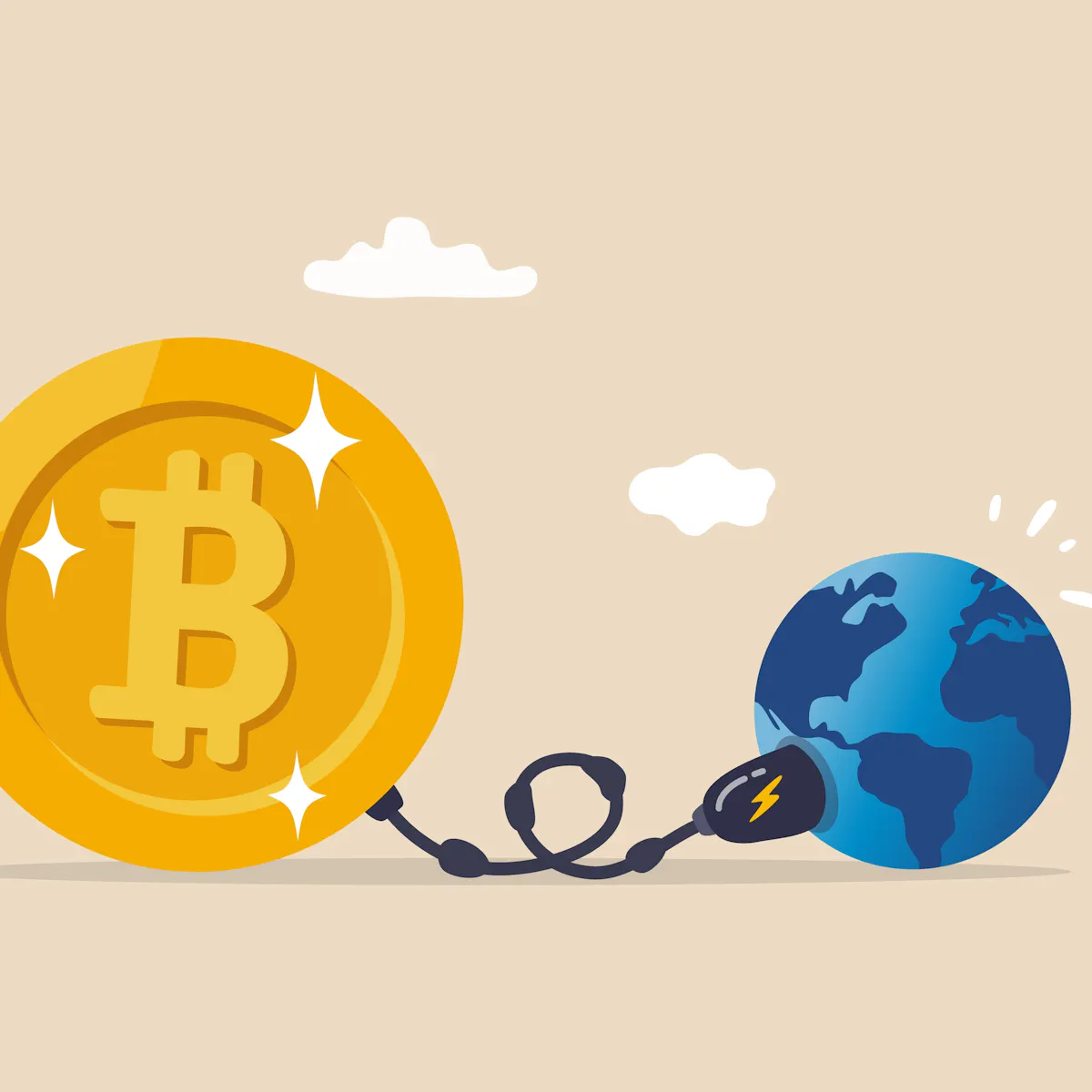
The question “Should changes be made to the Bitcoin protocol to lower consumption?” is complex. This is because so many factors can influence it. Indeed, the environmental impact of Bitcoin is hard to quantify. Moreover, many of the concerns are exaggerated, based on faulty assumptions and misunderstandings of the protocol’s operation. If you are a Bitcoiner, you most likely feel the same way about the Bitcoin protocol.

Bitcoin's energy consumption

Exaggerated Power Consumption of The Bitcoin Protocol 

The power consumption of the Bitcoin protocol is vast. Still, it is comparable to the energy consumption of about a dozen utility-scale nuclear reactors in the U.S., which provides 20 percent of its electricity. While the amount of energy bitcoin uses is small in comparison to large countries, the energy used by this digital currency is a significant source of carbon emissions. Bitcoin users also expend large amounts of energy and computing power to create the “blockchain” of bitcoin transactions.

It is impossible to quantify the exact amount of energy used by the Bitcoin protocol. However, its estimated power usage is comparable to other industrialized financial systems. Bitcoin’s energy consumption is not as high as some economists believe. However, the value of its cryptocurrency investment is a good indicator of its environmental impact. Many emerging economies rely on a system that uses excessive power but becomes more efficient over time.

More than 1 million transactions are currently using Bitcoin per second. This traffic volume is causing the Bitcoin network to use half of the world’s total power consumption. This is similar to the energy consumption of countries like Argentina. Although bitcoin has little importance in the world economy, the Bitcoin network’s energy consumption raises questions about the environment.

The Difference Between PoS And PoW?

The basic difference between PoS and the proof of work network is how to distribute the hashpower. The proof of work network requires large amounts of computing power. In addition, PoW is more prone to centralization of mining. For example, China alone controls 80% of the world’s Bitcoin hashing power. As a result, Chinese miners can join forces to launch an 80% attack.

While both types of blockchains use cryptography for their security, Proof of Stake has several advantages. For one thing, it’s much simpler to implement than PoW. In addition, Proof of Stake eliminates the energy costs associated with mining. This allows any network node to be a forger. Ethereum plans to migrate to Proof of Stake as its 2.0 version, which is currently in development. It is not clear if this conversion will occur soon, but we expect this to happen within a few years.

Proof of Work (PoW) is the original blockchain consensus algorithm. It requires network users to prove a computational task. For example, solving a mathematical equation requires a computer known as a node. When the equation is solved, a new block is validated. Because this computational task requires time, the first miner to solve the puzzle wins. This helps provide security to blockchain transactions. It also makes the chain more complex than PoS, making it less susceptible to double-spending attacks.

PoW is the most widely used type of blockchain as far as how a blockchain works. It was developed by the company “Peercoin.” It holds the same purpose as PoW, with the difference that the first block is hardcoded into the software. The difference between PoS and PoW is in the method of transaction validation.

Bitcoiners’ Opinions About This

When asked whether they think it’s necessary to change the Bitcoin protocol to reduce consumption, most users are ambivalent. For example, some Bitcoiners believe that the network should be completely decentralized to avoid government intervention. Others argue that the system needs state currency backing to reduce risk. In addition, others cite other concerns, such as corruption. Despite the mixed reactions, Bitcoin users seem to be fairly sure that Bitcoin is a trustworthy and decentralized network.

While some argue that the monetization of natural gas with Bitcoin reduces emissions, some say it’s just a subsidy for the fossil fuel industry. Indeed, Bitcoin miners’ income is a mere drop in the ocean when you compare it to the overall demand for fossil fuels. Still, while this may be the case, the external demand for fossil fuels isn’t going away any time soon, and the extraction of oil and gas will continue for many years to come. Bitcoin miners may even have the chance to bring back decommissioned fossil fuel power stations. In addition to that, the Bitcoin mining industry has reopened a former coal power station in New York as a bitcoin mine. The company Greenidge Generation Holdings has a Bitcoin mining operation there.

Despite the widespread evidence of the risks and benefits of Bitcoin, many participants on r/bitcoin justify their continued use of the cryptocurrency by citing its “trustless” nature. Because there is no central authority, no third party can control the transactions. Furthermore, there is no possibility of fraud. Those in the community support this attitude. Indeed, previous work on the role of trust in the Bitcoin community has found a close link between this mindset and True Bitcoiner ideology.

Global Measures on Bitcoin Protocol

Sustainable consumption is about reducing the use of toxic materials, fossil fuels, and waste and reducing pollution. By 2050, we expect the global population to grow to 9.6 billion people, and we would need three planets to sustain our current lifestyles. The debates over sustainable consumption began in the 1990s, with pioneering thinkers such as Andre Gorz, Herman Daly, Serge Latouche, Tim Jackson, and Kate Raworth arguing for action.

The debate over the changes to the Bitcoin protocol has raged over the past several years. The EU has recently encouraged the adoption of a “poS” system. Although Bitcoin’s users cannot run full nodes, they must trust the large-scale providers of the network to use the network. Otherwise, Bitcoin would cease to be a decentralized system. The seeds of this disagreement were planted from the start of the Bitcoin protocol, and a major conflict erupted from 2015 to 2017.

The shift in consumption pattern is dramatic and could save billions of dollars for businesses and city governments alike. For example, reducing red meat consumption could prevent 170,000 deaths a year in some high-income cities and save cities as much as $11 billion in costs. In addition, it could save cities billions of dollars by not having to build new buildings. Clearly, global measures to lower consumption are worth it. But how do we do it?

How Play-to-Earn (P2E) is Impacting Online Gaming and the Crypto Community

How-Play-to-Earn-P2E-is-Impacting-Online-Gaming-and-the-Crypto-Community

William Higginbottom, a physicist, created what is widely regarded as the very first video game in 1958, and the world has not looked back since. It was a simple tennis game and won plaudits at the Brookhaven National Laboratory’s open house. Higginbottom’s game slowly morphed into a number of other games, and the video-gaming industry started booming. 

Virtual gaming started in the 1960s with games such as Spacewar, which focused on solo gameplay. However, by the 1970s, the trend shifted towards the incorporation of a social component to the competitive experience of gaming, fuelled by the explosion of arcade gaming. Arcade gaming was instrumental in that it allowed players competing for bragging rights at the same game to do so in the same setting. 

Virtual games thus built on this popularity, evolving to enable players to interact with each other primarily through competition and collaboration. This new level of interaction inevitably attracted more gamers, and developers started embedding multiplayer game logic at the core of their products. 

The Dawn of P2E

In 1984 the Islands of Kesmai, allowing up to 100 people to play simultaneously, was released, paving the way for multiplayer-driven virtual games. The collapsing prices of computer networking in the 1990s and the increasing adoption of personal computers further accelerated the prevalence of multiplayer-driven virtual games. 

Early games such as Second Life and EverQuest greatly benefited from these monumental technological and platform shifts towards massive multiplayer gaming, reaching even possibly iconic status. In the two decades since their release, a combination of enormous general technological advancement and growth of the mobile internet has led to games penetrating mainstream culture, with an estimated 2.8 billion video games in existence globally as of 2020.

Play-to-Earn Games

As of late 2021, an estimated 3billion people across the globe play video games while there is a whole infrastructure around professional gaming, one which has generated significant opportunities and wealth for the best players. 

BITKRAFT Ventures, taking into account the widespread hardware, software, and intellectual property involved, reports that the video gaming industry stands at a $336billion market capitalization. Indeed, gaming is now the most prominent media category ahead of the film, linear TV, music, and on-demand entertainment. 

As the gaming industry has grown, certain peculiar characteristics have developed. Most significant is that all game-based economic activity is centralized, thereby vesting the rights to everything going on in the games to the publishers. 

While this model makes business sense for the developers as it enables them to capture the billions of dollars generated in the games when users sell virtual game items and purchase subscriptions, it also means that the players themselves lack a mechanism through which to share in the value generated without pursuing the course of professionalization. 

This traditional model of ownership and sharing of profits has been maintained throughout the industry’s growth. Still, it is on the verge of transformation with the advent of Play-to-Earn games which seek to enable players to truly earn and own their digital assets, which they may also sell outside the game at will. 

How does Play-to-Earn Work?

Play-to-Earn games are a relatively new phenomenon in the gaming industry, hoping to provide a holistic experience by combining fun and money. Most P2E games feature an in-game token used to reward players, whose worth is determined by the liquidity in the token. 

Play-to-Earn games are designed for gaming enthusiasts seeking to bridge the chasm between virtual spaces and physical reality. They allow users to own their assets, usually in the form of Non-Fungible Tokens (NFTs), and increase their worth by engaging in in-game activities like unlocking upgrades, breeding creatures, and much more. 

Essentially, by participating in the in-game economy, players create value for the developers and developers who earn a cut of the microtransactions carried out. Players generate liquidity through two main methods: purchase or sale of in-game NFTs or playing to earn in-game digital currencies. 

In the case of NFTs, users may create unique NFTs and sell them to other players either for fiat or cryptocurrency, whereas in the case of in-game crypto, a gamer may use the tokens to purchase more in-game content or exchange them for fiat or other cryptocurrencies. 

Impact of P2E on Online Gaming and the Crypto Community

When the COVID-19 pandemic swept the globe in March 2020, many people were forced into lockdown in addition to losing their jobs. In several nations of the global south, such as the Philippines and Indonesia in Asia and certain parts of Africa and Latin America, several people who lost employment due to the pandemic found a way to eke out a living by playing blockchain-based video games. 

Games like Axie Infinity which moved from a mere 4,000 daily active users to a staggering 2 million just within a few months, demonstrate the potential of P2E to contribute toward building a new economy. Players in countries such as the Philippines and Venezuela have been able to earn more in the Axie Infinity game than they would otherwise earn in their local physical economy.

Does P2E Gaming Serve Its Purpose?

Play-to-Earn games do not inherently or in totality eliminate the centralization characteristic of games because they still require the publisher’s authority to define, issue, and limit the asset. Nevertheless, P2E games’ greatest promise is still their potential to decentralize marketplaces for the minting, ownership, and exchange of digital assets, along with the potential created when these marketplaces can be linked with the traditional economy, allowing gamers to convert their digital time, effort, and assets into disposable income in real life.

How Investors Can Build Sustainable Incomes in the Metaverse

How-Investors-Can-Build-Sustainable-Incomes-in-the-Metaverse

The Metaverse is becoming a household name, especially within the crypto media. It has gained the recognition that most other top assets yearn to have. Top companies, including Facebook, Adidas, Nike, and many others, have planned or invested in the Metaverse. Facebook, for instance, even changed its name to Meta as it plans to go deeper into the Metaverse.

A metaverse is a digital form of reality. It uses AR, VR, and other technologies to support human interactions across the globe. Basically, with the Metaverse, you can interact with other people from the opposite side of the world in real-time and even feel the environment. 

Aside from fostering human interactions, the Metaverse has also been a way for investors to build sustainable incomes. But how? Here are five major ways. 

Play to Earn in Metaverse!

One of the ways to generate sustainable incomes in the metaverse space is Play to earn. The concept of P2E has majorly popularized the idea of the Metaverse. The gamers play a game within the Metaverse and earn some income.

In the Metaverse, you can find different types of games, either 3D or 2D. In P2E, the gamer is often required to purchase an NFT or multiple NFTs to start playing. 

When playing, there are different ways to earn some income. For instance, gamers can garner in-game collectibles and sell them in the marketplace. Winning games and leveling up could also generate rewards for the gamer. P2E combines NFT lending, staking, and many other activities that can help build sustainable incomes. Games like Splinterlands, Gods Unchained, Town Star, Thetan Arena, and many others are good P2E games. 

Providing Metaverse Related Services

The Metaverse was conceived just a few years ago. Technologies used in Metaverse require some degree of actual knowledge of the blockchain space. Hence the need for service providers within the Metaverse space. These service providers help make the work of rookies and experts easy.  

One of the most prevalent services is cyber security. Blockchain projects lose millions annually from attacks. Therefore, providing cyber security assistance to Metaverse projects is a marketable service.

You can offer creative services. For instance, Metaverse projects need whitepapers and other pieces of content. Hence you can invest in creating such and make a fortune. You can also write other pieces of content about Metaverse for third-party web pages.

Developers can get jobs to create avatars for Decentraland, Sandbox, and other Metaverses on Fiver.com. In the Metaverse, people want to build things on their lands. They include structures like Casinos, museums, malls, theme parks, and others. 

Landowners will repeatedly need service providers for such constructions, and as such, you can make money by providing the services. Building and construction works require some knowledge in creating NFTs. 

Minting and Selling NFTs

Another excellent way to earn and make sustainable incomes within the Metaverse is by minting and selling NFTs. NFTs are among the most fundamental assets within the Metaverse. Why?NFTs can produce special characters within the Metaverse as a unique class of assets. 

The Metaverse allows you to create personalized avatars and perform other tasks in the Metaverse. These avatars are NFTs. Wearables in Decentraland are NFTs; you can sell such. Why don’t you invest in creating Decentraland wearables?

You can also purchase the already minted NFTs and sell them. Once you purchase an NFT, it gains value, and you can sell it to the next person at a profit. Hence, creating NFTs or trading them within the Metaverse is an excellent way to generate sustainable incomes. 

Virtual Real Estate

Yes, real estate has, for decades or maybe centuries, been one of the best ways for investors to build their wealth. It is one of the few investment opportunities that offer perpetual profits, regardless of the situation around financial markets. 

Now, the concept of real estate is already in the Metaverse, with the estates being referred to as spaces. The Metaverse has pieces of land. After purchasing your parcel of land in the Metaverse, you can rent it out for perpetual gains. Buying and selling or renting land is an excellent option to earn income in Metaverse. 

But, there is always the option of developing this land. You can split the land into cubes and develop it with buildings like art exhibition centers, retail shops, museums, lounges, and many other spaces. The land is an NFT. The developments are also NFTs. Trading or even renting these NFTs could also be a good income source.  

Invest in Metaverse Tokens

Finally, invest in metaverse tokens. So, metaverse tokens are types of crypto tokens that represent a small share in a particular metaverse. Holders of such tokens can trade them out and hold them as the prices continually rise. 

For instance, in the Decentraland metaverse, a native crypto token is MANA. Sandbox also has its native token, SAND, which trades in markets and helps in different activities. These tokens mean the holder can participate in governance and development tasks in many cases. 

Here is a list of all metaverse tokens, and some research can show you where you can trade them. You can follow the prices charts of those tokens in Coinmarketcap, and you will notice that the coins are suitable investments. For instance, MANA doubled in price between 2021 and 2022, while SAND nearly tripled.

Conclusion

This guide has discussed the most popular ways investors can build sustainable incomes within the Metaverse. They include P2E, selling NFTs, virtual real estate, trading metaverse tokens, and offering metaverse support services. The five ways are proven to bring good incomes. You can diversify your investments by choosing multiple investment options discussed.

However, the Metaverse is still a new concept. There will be more openings for people to participate, invest, and earn sustainable incomes within the Metaverse in the next few years.  

Defi Hacks and their Frequencies; Is There Hope for Slowing Down

Defi-Hacks-and-their-Frequencies;-Is-There-Hope-for-Slowing-Down.

Wormhole, a bridge between Solana and other blockchains, suffered an attack in early February 2022. In what was termed the second-largest Defi attack, the hackers stole about 120,000ETH, valued at over $320 million. 

Defi hacking is one of the biggest problems facing the Defi space, with projects losing millions and billions to such attacks. It is when criminals take advantage of smart contracts to steal funds. The most basic definition of hacking is when an individual looks for breaches in digital devices, exploiting the network’s weaknesses. The attackers may manipulate the smart contracts into committing errors that benefit them. 

In general, hacking takes different forms, thus giving the different types of Defi hacks. Let’s look at the types of these hacks and their frequency.  

Flashloan Attack

One of the major types of Defi hacks is flashloan attacks, which mainly occur on Defi lending platforms. A flashloan is a type of uncollateralized loan in Defi lending, which must be paid in the same transaction as the borrow transaction. It requires no checks or limits. 

However, hackers may try to take advantage of these flashloan attacks to benefit. In such hacks, the attacker takes a flashloan but uses various tricks so that they make a short, quick and profitable transaction. As a type of hack, flashloan attacks involve multiple applications, hence are complex to carry out.  

Today, there are many instances of Flashloan attacks in the crypto space. They include; 

  • In May 2021, Pancakebunny, a BSC-based yield farming protocol, suffered eight flashloan attacks, increasing the prices of $BUNNY. The hacker earned $45 million in profits.  
  • Cream finance, another lending protocol, also lost over $130 million in October 2021. In February 2021, Cream Finance lost over $37.5 million in a flashloan attack. In August 2021, another flashloan attack targeting AMP token went away with $25 million. 

The instances discussed above are just a few of the many cases of flashloan attacks in the Defi space. At least once every month, a flashloan attack occurs. 

Re-Entrancy Attacks

Another hacking in the Defi space is Reentrancy attacks. By definition, a reentrancy attack happens when the criminals continually hit the withdrawal function. The contract does not update the victim’s balance, allowing the attacker to continually withdraw and steal funds from the victim.

Like flashloan attacks, Reentrancy attacks are also pretty common. These affect every kind of Defi project, including DEXs, lending platforms, and others. 

The 2016 DAO hack remains one of the most significant reentrancy attacks in the crypto space. But, the Defi space has seen its fair share of cases of such attacks. Among them include; 

  • In March 2022, Hundred Finance suffered a reentrancy attack, losing $6.5 million. 
  • Agave Finance also lost nearly $4.5 million in reentrancy attacks. The same criminal attacked both Hundred Finance and Agave. 

Reentrancy attacks are also quite prevalent, occurring a couple of times per year. Like flash loans, reentrancy attacks are capable of siphoning millions from Defi networks.

Price Oracle Manipulation Attacks

In this type of attack, the hacker attacks the oracle smart contracts and manipulates them, causing severe damage. Oracle networks are protocols designed to provide real-world data in the blockchain space. Often, the oracle networks will provide weather data, price feeds, and other forms of data. 

Most oracle manipulations often target the price feeds, hence why it’s called price oracle manipulation. Attackers can manipulate the Oracles to trick Defi platforms and generate high profits. 

Consider a person acquiring a loan in an ETH/BAT lending pool. They notice that the pool fetches data from a specific price oracle network. They manipulate the price feed from the oracle to acquire more BAT tokens than they were supposed to. 

The general idea is to manipulate the prices of one token to gain more rewards. The best examples of price oracle manipulation attacks include:

  • Synthetic 2019. A price manipulation attack made away with about 37 million sETH. 
  • In April 2022, Inverse Finance reported a $15 million loss owing to oracle manipulations. The attackers manipulated INV prices to get away with the funds.

Price oracle manipulations are prevalent and could occur multiple times a year. They steal millions in funds and can recur on the same platform. 

Bugs and Vulnerabilities

Hackers can also use bugs and vulnerabilities to attack a Defi project. The hacker identifies a bug or a vulnerability in the smart contracts and takes advantage of the same. 

This was the case in the wormhole attack in early February 2022. The team behind the project had noticed a vulnerability in the contract and even created a fix. However, the hackers attacked the network before the solution was deployed, leading to losses. 

Bugs may be visible in the early stages of project development or later when the size of the project starts to show up. If one hacker spots any vulnerabilities, they will attack. 

Other Types of Defi Attacks

Of course, hacking is one of the biggest problems for the Defi space. However, there are other types of Defi attacks that have been quite prevalent;

  • Rug pulls. Rug pulls occur when the Defi project founders encourage people to invest, only for them to withdraw funds from investors’ wallets. A report by Chainalysis indicates that in 2021 alone, Defi investors lost over $2.8 billion in rug pulls. 
  • Phishing attacks. Phishing is when attackers trick investors into willingly releasing their wallet information and stealing from them. It’s different from hacking since the latter is forcefully taking such details.

Is There Hope for Slowing Down?

Most of those attacks occur more than once every month, while others occur only a few times a year. In fact, in 2021, Adrian Hetman released a monthly report of Defi hacks and attacks. The reports were titled Monthly Defi Blood Bath. According to the reports, multiple attacks occur every month. The trend has been going on since the early days of Defi. 

But is there hope for slowing down? There is no direct answer. Often, many people will say that auditing can help end such attacks. But, most of the platforms suffering hack attacks have been audited multiple times. 

Auditing alone cannot be the solution to hacking attacks. You hear about another Defi project losing $320 million when you think it’s over. 

The simple lesson is that the Defi space is still in its infancy. Expectations about its growth over the next decade are very high. Hackers will also find new ways to attack. While concluding their analysis of Defi hacks, City AM said that it could probably take another five years for Defi protocols to be stable.  

How Content Creators Can Benefit From NFTs

How-Content-Creators-Can-Benefit-From-NFTs

Using NFTs to monetize digital artwork is a powerful new way to generate revenue for creators. NFTs are social media tools that solve a common problem-“secondary sales.” Artists and content creators can now monetize their audience in traditional ways. For example, artists such as Beeple and 3LAU are developing new business models to help NFT owners generate income from their content. Moreover, musicians like Kings of Leon have monetized their fans through traditional methods. Entrepreneurs such as Tom Bilyeu, host of the popular Impact Theory podcast, are developing new ways to benefit from NFTs.

Content Creators and NFTs

NFTs Are A New Way To Monetize Digital Artworks

The newest trend in monetization is NFTs or networked tokens. It allows artists to sell their digital artworks directly from their creators. This makes it easy to distribute and store them without needing a physical asset. Hence, making NFTs a great way to promote art.

The concept behind NFTs is that the art assets traded on the NFT network are verified using blockchain technology. This records transactions and provides proof of ownership to buyers. The digital art world is experiencing a booming market for digital assets. NFTs enable artists, influencers, and sports franchises to monetize these products easily. The technology has met the art world’s authentication needs by permanently linking a digital file to its creator.

NFTs Are A Social Media Tool

If you’re not using social media for your content creation, you’re missing out on a valuable tool- “NFTs.” These are networks of other creators who create content. It’s possible to collaborate with them from virtually anywhere in the world. For example, Instagram offers a tool that allows creators to collaborate with other creators in other locations. TikTok has a similar tool, as do other video platforms like YouTube.

Marketing your NFTs on social media is similar to marketing any product. To succeed with your NFT marketing efforts, you must first build your target audience, engage your followers, and then convert them into paying customers. If you develop a solid social media strategy early on, you’ll increase your chances of success. There are numerous social media platforms where you can start your NFT marketing campaign.

NFTs Solve The Secondary Sales Conundrum

Content creators face a problem when trying to sell their works to second-hand users. The emergence of digital art has shuffled the deck on what is valuable. Therefore it creates the same problems as traditional art: confusing hype, the whims of wealthy collectors, and even theft. In fact, digital artists already have to contend with scammers who steal their art and sell it as user-generated T-shirts. In addition, NFTs pose yet another challenge, requiring content creators to check their rights and carefully evaluate their rights.

An NFT can solve the problem of the Secondary Sales dilemma by letting content creators profit off their assets while giving them greater autonomy over their earnings. Because NFTs contain unique codes, they can generate higher profits from the resale of digital creations. But these solutions aren’t without drawbacks. NFTs carry legal implications relating to intellectual property rights, taxation, and financial regulation. 

NFTs Are A Gamechanger

Content creators should be making money off their creations because traditional business models profit from them. You can easily plagiarize anything on the web, but with NFTs, you can sell your content directly on a digital marketplace. This way, you retain control over your content while also transferring ownership rights to the buyer. But before you start selling your NFTs, you should know the pros and cons of this new method of monetizing your audience.

NFTs attract potential buyers due to their uniqueness. Buyers can purchase them for personal use and later sell them for a profit. There are different types of NFTs, which are marketed differently by different content creators. Visual artist Beeple, for example, has sold an NFT for $69 million and has built up a following of over three million on Instagram. Another popular digital artist is Daniel Allan, an electronic pop artist who has most of his songs sold for thousands of dollars.

NFTs Give Creators New Rights

The NFT industry has emerged as a bright shiny new form of creative intellectual property, but it is far from a perfect formula. While NFTs give creators new rights and an entirely new source of income, they also bring a new set of challenges. For example, many creators sign contracts giving away their intellectual property (IP) without protection, while Hollywood exploits others at their own risk. 

NFTs Support Purpose-Related Activities

The creator economy and NFTs will support purpose-related activities and content partnerships and benefit consumers and brands. Brands will play an important role but must acknowledge that consumers may not be familiar with blockchains or cryptocurrencies. Therefore, brands must help content creators control their messages while still providing value to their audience to engage consumers. A recent study found that more than half of consumers haven’t even heard of blockchains.

The NFT is also valuable when used to authenticate access to digital experiences. Microsoft, for instance, launched a game celebrating women in science, which rewards players with NFTs to unlock secret games within Minecraft. Likewise, recording artist RAC issued his social token, $RAC, which grants token owners access to a private Discord group and early access to merch drops. Ultimately, this tokenized access helped make it possible to connect with the artist and his fans through his NFT.

Web3: Voodoo or Vector for Future?

Web3 Middleware Protocols

WebWhat?

There’s a buzzword that tech, crypto, and venture capitalists have recently been obsessed with. It’s now sprinkled throughout conversations, and you’re not serious about the future until you include it in your Twitter bio: Web3.

It’s a catch-all word for a variety of concepts aimed at cutting out the large middlemen on the internet. Navigating the web in this new era no longer entails signing up for Facebook, Google, or Twitter.

Web 1.0 was the first version of the Internet in the 1990s. The web was considered as a tool to democratize information access, but there were few good ways to navigate it beyond visiting a friend’s GeoCities page. It was a bit chaotic and overpowering.

Then, starting in the mid-2000s, came Web 2.0. Google, Amazon, Facebook, and Twitter were created to provide order to the Internet by making it simple to connect and transact online. Critics claim that these corporations have accumulated too much influence over time.

The goal of Web3 is to reclaim some of the power.

People in a Web3 world control their own data and use a single personalized account to go from social media to email to shopping, generating a public record of all of their activities on the blockchain.

The Good, the Bad, and the Unknown

All of this appears to be intriguing. But if Web2 has taught us anything, it’s that even the most exciting technology has drawbacks and unanticipated consequences. At first glance, Twitter appeared to be a fun method to tell others what you had for lunch, and then for a brief time, it appeared to be a tool that may aid in the liberation of oppressed people. It took us a long to learn that it might also be a hotbed of hatred and deceit. This time, we need to be far more cautious about potential drawbacks.

To begin with, some argue that blockchain is a terrible way to use computing power and that cryptocurrency “mining” — stringing together racks of computers to generate cryptocurrency — is an irresponsible waste of energy in a world facing a dire climate crisis; some estimates put annual bitcoin electrical usage at the equivalent of a country the size of Sweden.

Another daunting obstacle is that Web3, at least in its current state, is not at all user-friendly. Also, because Web3 is still so young — and because its whole premise opposes centralized control or management — there isn’t much in the way of consumer protection at the moment. Basically, none. Web3 supporters believe that because their system of linked computers provides a “trustless” economy, you don’t need government agencies or mega-platforms to secure you and your possessions. You shouldn’t need the oversight of huge governments or big enterprises because every transaction is recorded in public and confirmed by the blockchain. In actuality, Web3 is riddled with incompetence, costly flaws, and outright scams, such as intriguing projects that vanish once the organizers have taken your money. You’ve been “rugged,” which means you’ve had the rug yanked out from under you in crypto terms.

We are not a new species because of new technology. This means that even the most hopeful version of Web3 could resurrect some of Web2’s or the rest of the world’s problems.

While advocates like to point out that Web3 allows anyone with a web connection to join, regardless of who they are or what they look like – many Web3 users and supporters are fully anonymous — its early user base and supporters appear to be as male-dominated as traditional tech. The fact that some of the most outspoken supporters adopt a public tone that alternates between evangelizing and defensive also makes me skeptical of the whole enterprise. Perhaps this is because so much of the Web3 conversation takes place on Twitter, which still appears to be geared to bring out the worst in people.

On Web3, basic supply and demand still exist, which means that we may still have hierarchies in which individuals in developing nations are willing to perform more work for less money than people who are already wealthy.

The ability of platforms to de-platform is something to be afraid about in the Web3 environment. We might find out soon, especially if the value of the cryptocurrencies that power so much of Web3 continues to plummet. On the other hand, if even any of the claims made by Web3 supporters turn out to be true, the computing world will be reshuffled at the very least.

The Wrong Solution to a Real Problem?

The web’s concentration is a real problem that entrepreneurs — and even governments — will have to confront. Is Web3 the answer, though?

People want solutions that are quick, slick, and easy to use. They also want someone to turn to in the event of a mishap. That is something that Web3 does not provide. It may continue to generate attention in the future years, but unlike Web 1.0 and 2, it is unlikely to transform the world.

Baffled King that is Web3 with a Promise to Behold

The total value of all cryptocurrencies is currently $2.3 trillion. Venture capitalists are one of the greatest drivers of the crypto boom, having spent more than $27 billion on crypto-related companies last year, more than in the preceding ten years combined.

Despite the fact that blockchain technology has been around for more than a decade, it has yet to find many practical applications for people who aren’t crypto speculators or criminals. Even still, much of Web3’s potential remains speculative.

The idea of a decentralized internet is cast as a bulwark against tyranny at the highest levels of Web3 discourse. Web3 is inherently more favorable to Western liberal democracies that prioritize democracy and personal privacy from a conceptual standpoint. Through firewalls, censorship, and coercion of technological platforms, China and Russia have already set up methods to spy on and control the current Web2 infrastructure. Such totalitarian controls would be considerably more difficult with Web3.

Both Web3’s proponents and detractors may be found to be somewhat correct in the coming years. The objectives of the Web3 crowd must be regarded seriously: It appears to have the cash, clout, and sheer marketing that might make the fantasy a reality, but accepting its bullies’ narrative — and dismissing the skeptics — is to hand over control of the future to a small group of noisy and powerful individuals. That is precisely what Web3 is designed to prevent.

Educational Institutions Should Adopt Blockchain

Educational-Institutions-Should-Adopt-Blockchain.

The field of computer science is growing rapidly, and many major universities are beginning to offer classes on cryptography. Students are the future of the crypto world, so why not include them in the school curriculum? Students learn about math, science, and history to prepare them for the real world and all of its responsibilities in educational institutions. But are these students getting the tools they need to succeed? They may not be if they aren’t learning about cryptocurrency and blockchain as part of their curriculum.

It may seem strange to teach students about money in educational institutions; they will soon learn that on their own once they get a job! However, teaching students about money now will allow them to make the right decisions later when they have real money. That’s why schools should adopt and teach cryptocurrency.

Blockchain for Education – Klaspad

Education And Blockchain Technology

Educating students about blockchain technology offers many benefits. For example, institutions can use blockchain to secure digital syllabi, as they currently rely on hard drives and worry about losing. Furthermore, blockchain can protect these documents, as every user on the network has a copy of them. Furthermore, blockchains can improve educational processes by allowing students to receive cryptocurrency rewards for learning. 

Blockchain technology can provide widespread access to open educational resources (OER), which are teaching materials in the public domain, free to share and use. With blockchain technology, schools can share such resources across networks for free. This can greatly improve educational processes and increase trust, security, and privacy. Therefore, educational institutions should use it in educational settings as part of a blended learning experience.

In addition to helping educational institutions, blockchain technology can also help verify educational qualifications. Many countries find it difficult to certify their institutions, so blockchain could make it much easier. It could also help verify applicants’ skills. For example, smart contracts can allow instructors to create examination papers and include an answer key. Consequently, students can take digital exams, and the smart contracts will grade their responses. Schools will most likely start exploring blockchain technology for educational purposes in the future.

Educating Students About Cryptocurrencies

One of the most obvious benefits is that the field of cryptocurrency is still fairly new and growing. Furthermore, it will only continue to expand with the kids of today. Blockchain technology, for example, is a new field that is just scratching the surface. But as the technology continues to grow and mainstream markets adopt it, the field of cryptocurrency will become more important than ever. Therefore, educating students about cryptocurrencies gives them an advantage over their peers and will encourage them to be leaders of this technological movement. 

Bitcoin, or “BTC,” has become the latest craze on Wall Street. The bitcoin price is constantly in the news, and the currency has exploded in value. While prices have been stabilizing since their peak, you can teach students about their value and how they can make money with them. 

Educating Students About Blockchain  As A Career Option

If you are an education professional and are looking for a new career, consider teaching a course in cryptocurrencies. This technology transforms the way people buy, sell, and trade goods. In contrast to credit cards that we use to make online purchases, cryptocurrency is based on blockchain technology. Therefore, it might be a good idea to teach students about blockchain as a career option because blockchain technology may give them an added advantage in the future.

Elementary school students are ready for more complex thinking, and they are gaining the education necessary to understand complex concepts. While it is important to teach students about crypto and blockchain, it’s also vital to provide hands-on experience. Introducing students to the basics will encourage them to study the field further. For elementary school students, try to incorporate a video that teaches about cryptocurrencies and blockchain basics.

To help students visualize the field, start with an infographic on the job market. Then, have them read articles from reputable sources to keep up with current developments in the field. This will give students a leg-up over their competitors.

What Crypto Regulations Look Like In Asia In 2022?

What-Crypto-Regulations-Look-Like-In-Asia-In-2022

Asia, being the world’s largest cryptocurrency trading market, also has one of the most diversified regulatory frameworks. Several Asian countries have opened the way for cryptocurrency adoption. Others have enacted laws to restrict or outrightly ban cryptocurrencies due to fraud and money laundering concerns.

Despite the potential benefits, cryptocurrency regulation has been slow to move in Asia. Hong Kong’s regulatory sandbox framework and Singapore’s licensing regime are examples of soft regulatory approaches.

What Crypto Regulations Look Like In Asia In 2022

The Conflicting Reactions — Pakistan, India, Singapore, and Thailand

As a country that has gained independence from the British empire, Pakistan faces the challenges of foreign investment. While the economy has not shown signs of significant growth in recent years, it is still one of the top 3 crypto holders globally. However, alongside their Central bank, their government is making moves to ban crypto transactions.

Despite recent developments, India is still one of the leading jurisdictions globally when it comes to regulating crypto. India is actively encouraging the use of blockchain and cryptocurrencies. India’s government announced new proposals on Feb. 1, which will likely become official in the coming months. The new proposals include a 30% tax on all crypto gains and a 1% tax deducted at source on all transactions.

While many countries in the region have weak regulations, Singapore and Thailand have relatively lax crypto regulations. Singapore’s Payment Services Act, a strict money laundering and terrorist financing law, has largely regulated the crypto industry.

Singapore is taking advantage of the Chinese crackdown on cryptocurrencies and is establishing itself as a regional crypto hub. Consequent to the Monetary Authority of Singapore (MAS)’s recent regulatory efforts, Singapore has regained international interest in its crypto industry. After all, the Chinese government’s crackdown on crypto led many high-profile service providers to relocate to Singapore. Hence, this makes it an attractive jurisdiction for new investment and cryptocurrency activity.

Adoption And Rejection – South Korea, China, and Japan

As the global cryptocurrency market booms, South Korea has taken a more active role in adopting crypto. The new president, Yoon Suk-yeol, has pledged to deregulate the crypto industry and implement favorable tax laws for crypto investors. Hence, we expect South Korea to take the lead in cryptocurrency trading soon. They were one of the early adopters of technology-driven transformation.

Cryptocurrency is undergoing regulatory uncertainty in China. The People’s Bank of China has recently banned the mining of cryptocurrencies within the country, and it has also outlawed the use of crypto exchanges in September 2021. These moves effectively banned the use of crypto exchanges in the country, and their subsequent selloffs were significant. Currently, there are ways around these regulatory hurdles by using foreign websites and platforms.

Financial regulators in Japan believe in the potential of blockchain technology. Japan’s companies are adopting cryptocurrencies. Therefore, many have begun accepting Bitcoin, Ethereum, and a few other cryptocurrencies after the government approved Bitcoin as a payment method. Bithumb, a Japanese crypto exchange, has announced cooperation to make it easier to spend cryptocurrency like fiat money.

Is Regulation Necessary?

The growing interest in NFTs and the potential for their use in the financial system poses risks for the digital asset ecosystem and investors. Concerns about the exploitation of the market by bad actors prompted the Crypto Regulation Asia Summit (2022) to focus on the growing risks associated with this emerging asset class. The panel discussions addressed these issues and the regulatory scenery for crypto markets in Asia, including the risks and benefits of DeFi, the surge in financial crime in the CeFI ecosystem, and governance and market conduct issues.

As the number of digital assets grows, the demand for regulations must too. In Asia, regulators are tightening their grip on crypto transactions. The latest set of regulations in the region covers ICOs and crypto exchange activities. 

Meanwhile, Hong Kong, the Philippines, Australia, and Thailand have adopted more moderate regulations. In the Philippines, cash remittances account for more than 9% of GDP, making cryptocurrencies convenient for transferring money within and outside the country. 

Conclusion

Despite the recent changes in the global regulatory landscape, the conclusion of crypto regulations in Asia in 2022 is still uncertain. China has already banned all crypto transactions and made all tokens illegal. Other jurisdictions are moving in with similar legislation, but the future is still uncertain. Huong Hauduc, the general counsel of Bequant, a Malta-regulated cryptocurrency exchange, and investment company, is a key figure in determining how regulators will act in the region.

Defi Technology Trends To Keep An Eye On

Defi-Technology-Trends-To-Keep-An-Eye-On

Investing in a new cryptocurrency may be a great way to take advantage of DeFi technology. The potential for DeFi is immense, but some traditional financial institutions may not fully integrate the technology into their processes. This article will outline some DeFi technology trends to keep an eye on. Defi is the future of financial transactions, so it’s important to stay abreast of this growing technology.

cryptocurrencies: Why DeFi is the biggest thing in the history of finance - The Economic Times

Blockchain Bridges

Blockchain bridges are a vital part of the cryptocurrency ecosystem, connecting different chains. They monitor both networks simultaneously and “pick up” the tokens in one network and “issue” them in the other. The teams behind blockchain bridge projects have a deep understanding of this technology, with world-class fintech and cloud engineering backgrounds. The teams can combine consulting, design, and engineering at scale.

Before, only one chain can exchange assets from one with another. Hence, it was not possible to use ETH in Solana Dapps without transferring it through exchanges. A cross-chain bridge, on the other hand, provides this interoperability. The WBTC bridge is the largest blockchain bridge, with over $12 billion in TVL. However, hardline decentralization advocates may argue that WBTC is less secure than decentralized bridges. However, there are several other benefits of bridging assets.

Blockchain bridges allow users to use tokens on different networks without switching platforms. This is particularly useful for projects with only a six-month history. They can also facilitate better gaming and eCommerce experience. Blockchain bridges are an important component of the cryptocurrency ecosystem, as they allow users to access the benefits of different networks without sacrificing liquidity, network effect, and other features. Furthermore, they encourage innovation across ecosystems.

While blockchain bridges are relatively new and still in their early stages, they have the potential to drive innovation within the ecosystem. However, they also come with risks, so teams need to carefully choose their implementation. A recent hack of the Poly Network demonstrated the importance of security over time to market. For this reason, developers need to design bridges with security in mind. With that said, a homogeneous bridge would be ideal. However, bridges are not yet fully developed and are subject to exploits and hacks.

Self-Repaying Loans

Digital money opens up new avenues for innovation and use cases. Self-repaying loans are one such innovative new concept emerging in DeFi technology. In the traditional finance industry, loans are often made using collateral. In DeFi technology, self-repaying loans can be made without collateral and repaid in the same blockchain transaction. This enables peer-to-peer transactions that were previously unthinkable.

Another benefit of the self-repaying loan model is that interest from the collateral is used to repay the loan. The collateral that the borrower deposits is returned to the borrower after the loan is repaid. While this method avoids liquidation, depreciation will increase the time to repay the loan. But while this is a boon for the economy, it also comes with a risk.

The Alchemix team recently detailed plans for their v2 platform, representing a significant protocol upgrade and self-repaying loans. In addition, the team detailed the revamping of the platform, new collateral types, yield-bearing strategies, and collateral utility. Currently, Alchemix is the 37th most popular DeFi protocol with more than $1 billion in locked value. But its current price suggests that it may be long before it reaches its potential.

The Alchemix platform, for example, offers a self-repaying loan model, wherein users deposit crypto assets as collateral and borrow against them. The future yield of these crypto-assets then pays off the debt. Thus, the Alchemix system is one of the most promising applications of DeFi technology. Further, it may even allow time travel. If Alchemix is successful, it could also be a game-changer in the field of finance.

Smart-Contract Technology & Artificial Securities

There is an extraordinary level of interest in open financial engineering that DeFi technology can facilitate. However, this emerging technology poses some risks. While DeFi is not widely in use yet, its value recently crossed the 10 billion USD mark. These value estimates relate to the reserves locked into smart contracts and are available for various purposes. DeFi technology may be a game-changer for our current monetary system if a successful deployment occurs.

One application of DeFi is the ability to issue collateralized debt positions using crypto assets. These debt positions enable the issue of new tokens, with the number varying according to the collateralization ratio and token target price. These new tokens work similarly to traditional savings accounts, with higher interest rates. It is possible to monitor interest in real-time and can get payout daily, weekly, or monthly.

Smart contracts can lead to countless new applications and ecosystems, but a key issue is determining how these new technology trends will affect the financial industry. It’s also important to keep an eye on regulatory changes, as these innovations will require revisions to existing laws.

What To Look Out For 

There are many advantages of DeFi, but what should you look out for? With DeFi, there is no need for a government-issued ID or social security number. Instead, all the information needed to make a transaction is stored on a blockchain and monitored by smart contracts.

Among the common risks in DeFi projects are fatal code flaws, URL hacks, and smart contracts. “Rug pulls” occur when a project masquerades as decentralized or open-source but in reality becomes one entity taking advantage of all of its users’ funds. To avoid being a victim of a “rug pull,” carefully research DeFi projects before investing. Make sure to check the company website for any news regarding possible protocol hacks.

A big concern with DeFi is the governance model. DeFi is a form of direct democracy with a decentralized decision-making process. At its onset, a single person may be running a DeFi application, but as momentum builds, the individual may want to step aside from the project and hand over control. A good way to avoid this situation is to look for a company with a centralized leadership structure.

DeFi offers several benefits, including privacy and accessibility. Traditional lending requires lenders to know the borrower’s identity to assess their ability to repay the loan. DeFi doesn’t require a lender to know the borrower’s identity, preserving privacy and mutual trust. The benefits of DeFi are not limited to privacy, but they may be worth considering for your finances. So, what are you waiting for? Start using DeFi today!

Here’s Why Ethereum Gas Fee Reached Its Lowest In Six Months

Here's-Why-Ethereum-Gas-Fee-Reached-Its-Lowest-In-Six-Months

Calculated in small units of Ether called gwei, gas fees are payments paid by users to the Ethereum blockchain for the computer energy necessary to process and confirm transactions on the network. These gas fees are majorly influenced by transaction demand between miners and users of Ethereum. The demand for transactions can become so high that miners can opt to prioritize those who pay the most, which will in turn encourage users to pay more in exchange for the ability to have their transactions completed fast.

Ethereum’s gas fees are known to be more expensive than those of other cryptocurrencies. This may be related to the increase in the price of ETH as well as the increase in the quantity of traffic on the network. The value of ETH is increasing, and transaction fees are becoming higher when compared with fiat.

As more and more Ethereum decentralized applications are being adopted, the gas fees tend to go higher. For instance, the average gas fees were as high as $68 in May of last year, around the same time DeFi and NFTs gained a lot of popularity. As the demand for ETH increased with more people buying NFTs, the gas fees increased in tandem with the rise in the crypto price.


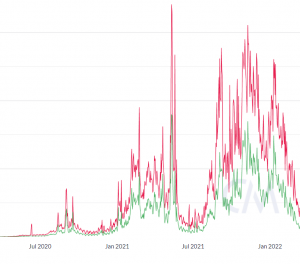
Image from CoinMetrics showing the average and median price of ETH gas fees

Why Did ETH Gas Fees Fall to the Lowest in Six Months?

According to CoinMetrics data, ETH gas fees have been falling since the second week of January, recently reaching the lowest level since August of 2021.

The recent decline in gas costs can be attributed to a decline in interest in Ethereum-based decentralized applications. The high Ethereum gas fees have been a constant concern for users. In order to address this issue, decentralized apps are being developed on different networks with lower gas prices and faster transaction speeds like Solana, Binance Smart Chain, and Avalanche, among others.

The price of Ethereum wasn’t spared when the general crypto market suffered a setback after the news of Russia’s invasion of Ukraine broke out, reaching a low of $2,800 at one point. A Lower Ethereum price value equals a lower gas fee.

There has also been a waning interest in NFTs, with trading volume at its lowest this year. Ethereum fuel prices were at their greatest point when NFT popularity was booming last year. Due to their popularity, there was a spike in traffic on the network, which resulted in an increase in gas prices. The reduction in NFT interest will result in a reduction in transaction congestion, which will in turn result in a reduction in gas fees. 

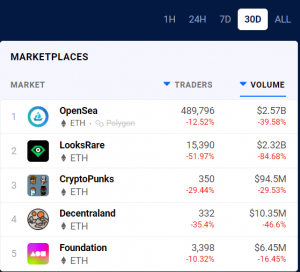
According to DappRadar, which tracks and analyzes decentralized applications, trading activities in NFT platforms have been down drastically in the past 30 days. Ethereum trading volume on major NFT platforms like OpenSea and CryptoPunks have been down 39.58% and 29.53% respectively in a 30-day period.

Image from DappRadar showing trading volume on major NFT platforms.

Ethereum developers have been working on switching the network from proof-of-work to proof-of-stake to reduce gas fees and make the network faster. That, however, is yet to come as Ethereum core developer Tim Beiko recently confirmed in a tweet that the switch will come later than expected.

Copyright Theft Is A Problem For NFTs

Copyright-Theft-Is-A-Problem-For-NFTs

The legality of selling NFTs based on original artwork is not entirely clear. For one thing, NFTs is an unauthorized copy, but they do not change the work’s meaning. While some crypto enthusiasts argue that minting and selling an NFT is no more a crime than taking a photo of the Mona Lisa, this argument is not entirely persuasive in court. If you set an NFT as your profile picture, you’re likely to be caught in a legal gray area.

NFTs pose many legal issues, including copyright theft. Owners should make sure their brands are protected from copyright thieves and take measures to protect their intellectual property. Copyright theft is a significant problem in the NFT industry, as it has resulted in numerous legal disputes. 

Copyright Theft Is A Problem For NFTs

Digital Nature Of NFTs

Unlike the tangible nature of works of art, NFTs are digital, and because they can be duplicated on the Internet, they raise issues relating to ownership and copyright law. While most people may not understand these issues, they are important for anyone investing in NFTs. You also need to know how the technology can work before committing to a particular product. The following are some examples of the issues that can arise when NFTs are used to purchase trademarked works.

First, NFTs are metadata files. While the owner owns the NFT of a Babe Ruth baseball card, the corresponding copyright of the Pikachu card does not belong to the owner. A derivative anime cartoon created from the Pikachu card does not belong to the owner. In similar ways, the owner of an NFT does not own the original underlying item or its copyright.

Tokenization is a problem for NFTs, particularly when the original works are public. Tokenization requires the author to grant consent to the copyright holder. In addition, separating an NFT token from the original work alters the nature of the work. Since copyright protection is based on the whole work, it is impossible to separate a copyrighted work from the NFT token.

Whether an NFT violates copyright protection is illegal or not is another issue. Infringement is when someone uses the work without authorization. This may include printing, placing in a digital frame, or sharing it on social media forums. A digital work is a part of the Ethereum blockchain, and the transactions in the blockchain are public. Despite the legal complications of copyright theft, NFTs remain a viable solution.

Lack Of A Strong Legal Framework In The NFT Market

Although NFT is a fairly new technology, many users still don’t understand copyright protection, and they have difficulty figuring out how to protect their intellectual property. This is especially true for computer code, which can be difficult to assign. In addition, a lack of a legal framework in the NFT market makes copyright theft even more likely.

Artists, creators, and investors are concerned that the lack of a strong legal framework will make it easier for criminals to exploit their intellectual property rights. In fact, the legal actors are more interested in molding the crypto art world into the traditional art world, which has many inequities and limitations. One strain of thinking suggests removing artists’ rights to royalties. If the NFT market ever reaches a mature state, it will need to eliminate these agreements. Instead, NFTs should be treated as digital personal property, and investors can easily access them.

One of the biggest issues with the NFT market is that buyers are often not aware that they are purchasing copyrighted artwork. Moreover, they assume they are buying the underlying work of art without knowing that they are actually buying the metadata associated with the copyrighted work. These purchases often only grant the purchaser a token of the copyrighted art, but the original creator retains exclusive copyright rights.

While it is possible to sue for infringement of a copyright in an NFT, this is highly unlikely to happen, as the transaction is often purely virtual. The owner of an NFT may also not be able to bring a claim if another person created it. Moreover, in some cases, the transaction can be fraudulent. The NFT platform may be liable for copyright infringement in such a scenario.

Potential For Piracy

As the market for non-fungible tokens explodes, the question of piracy is inevitable. But how big of a problem is NFT piracy? The Italian music industry’s Digital Content Protection agency recently announced the creation of a new unit to monitor unlicensed activities. The move comes in the wake of the HitPiece debacle, in which users copied artwork from the record industry and arguably exploited publicity and trademark rights.

Piracy is rampant on the NFT market, and NFT artists must be aware of this potential snatching before it becomes a problem. While many artists are concerned about piracy, the truth is that NFTs are not copies of the original artwork.

But even the best NFTs are vulnerable to piracy. One startup sued for copyright violations and allegedly created NFTs by using their music. Another company, OpenSea, said it is actively fighting plagiarism. Another anti-piracy company called Digital Content Protection is sweeping web 3.0 resources to root out bad actors and rug-pullers. While it’s too early to tell what NFTs will do, it’s worth considering.

While NFTs offer a new outlet for artists and creatives, they have also made it easy for pirates to mint knockoff copies with cryptocurrency and sell them to unsuspecting collectors. Most of these knockoff NFTs are identical to the real thing, so they’re difficult to detect. The shady actors only need a single unwitting buyer and a substantial payment to disappear into anonymity.

DMCA Takedown Requests for Copyright Theft

DMCA takedown requests are a form of dispute resolution involving digital content. This United States law applies to online games, videos, and other NFT content. It allows copyright owners to file these claims against the site responsible for the content. The DMCA is an important tool for copyright owners since it protects them from infringement by other parties. NFTs take advantage of DMCA takedown requests to remove infringing content from the Internet.

To combat the problem of infringement, NFT creators must file DMCA takedown requests to the right parties. Artists must file takedown notices to ensure that their copyrights are properly transferred to the platforms. Tokenization of other artists’ work is an ongoing trend, but Belton believes this trend is not likely to last, as NFTs will always remain a separate unit.

NFTs have also been the source of plagiarism since early 2021. Last fall, artists started a Twitter community called NFTTheft, highlighting fraudulent listings and copyright theft. The administrator requested anonymity because of fear of doxxing and crypto-evangelist backlash. 

To protect artists’ rights, NFT creators should first obtain permission from the copyright owner. Under the law, copyright ownership includes bundles of rights. This includes reproducing, preparing derivative works, distributing copies, and publicly performing and displaying work. In the case of music, the NFT creator would have to obtain permission from the musician to sample the work or embed the remix on their website. Any violation of these exclusive rights would constitute a copyright infringement.

Is Bitcoin Becoming A Petro-Asset? New Move Could Send Prices To The Moon

paying taxes in Bitcoin

For the last 50 years or so, oil has been traded exclusively in dollars. Oil-exporting countries receive dollars for their exports, making their economies dependent on the value of the American currency.

History Of The Petro-Dollar System

The petro-dollar system has its roots in the historical gold standard system. After the Second World War, with most of Europe in disarray, the United States held the bulk of the world’s gold supply.

In a bid to both rejuvenate the global economy and position itself as a world leader, the U.S. agreed to redeem any dollar for its value in gold if other nations pegged their own currencies to the American dollar.

At the 1944 Bretton Woods conference, 44 allied nations signed on to the deal offered by the Americans and formally established the U.S. dollar as the world’s reserve currency.

But in 1971, with the U.S. suffering from high inflation and a stagnating economy, many of the nations that had signed up to the gold standard asked to redeem their dollars for gold. After the run on American gold, President Richard Nixon removed the dollar from the gold standard system in order to protect whatever remained in the country’s gold reserve.

Almost a decade later, the United States entered into a pivotal economic partnership with the Kingdom of Saudi Arabia, where they agreed to use the dollar for oil contracts. With Saudi Arabia becoming the largest exporter of oil in the world, the influence of the dollar in global trade has grown by leaps and bounds.

The United States, in turn, used the dollar’s power and influence in the hugely important petroleum industry to enforce its foreign policy. 

Many nations that have found themselves on the receiving end of American sanctions have been unable to fight back, fearing the collapse of the petro-dollar system and, with it, the global economy.

Russia And China Seeking Petro-Dollar Alternatives

Recently, major economic powers like Russia and China have made calls to replace the dollar as the global reserve. However, it was felt that there were no good alternatives.

Now, there is a growing feeling among analysts that Bitcoin could be the neutral reserve asset opponents of the dollar system have been looking for.

Russia’s invasion of Ukraine and the subsequent sanctions and embargoes placed on it by the United States and its NATO allies have forced Russia to rethink how it sells its oil and gas and how it organizes its national wealth fund.

US.-led sanctions caused the Russian ruble to lose more than 20% of its value in just a few short weeks. The sanctions also made it impossible for Russia to access its dollar reserves, worth an estimated $185 billion, to shore up its economy and its ailing currency.

The world’s leading producer of natural gas and second-largest exporter of oil has been experiencing difficulties selling its products because of the petro-dollar system.

But recent events suggest that Russia is thinking of taking advantage of the statelessness of the cryptocurrency system to circumvent restrictions placed on its oil-exporting business.

Pavel Zavalny, chairman of the State Duma Committee on Energy, recently suggested that countries like China and Turkey, which Russia considers friendly, could be allowed to pay for Russian oil and gas using their own currencies. 

More interestingly, Zavalny also mentioned that countries friendly to Russia could also make oil payments using Bitcoin. This new direction could see Bitcoin play a prominent role in the global economy and signal the loosening of the dollar’s vice-like grip on international trade.

What was once merely a hopeful concept could become a practical application with major geopolitical ramifications.

Australian Oil Retailer Set To Accept Bitcoin Payments

Meanwhile, in the land down under, an oil marketer’s decision to accept Bitcoin payments is also shining a spotlight on the growing importance of BTC in the petroleum industry.

On The Run (OTR), one of Australia’s largest oil retailers is allowing its customers to use Bitcoin to pay for gasoline. The company is partnering with Crypto.com, a Singapore-based cryptocurrency trading solution, to roll out processing terminals in more than 170 gas outlets owned by OTR to facilitate BTC payments.

This move has been hailed by industry observers as further proof of Bitcoin’s growing importance in the energy sector. Referring to OTR’s decision, UK-based digital assets analyst Marcus Sotiriou, said:

“This adds more weight to the idea of Bitcoin becoming a petro-asset after Putin recently allowed friendly countries to pay for oil in Bitcoin.”

Bitcoin Miners Use Natural Gas To Power Mining Operations

Bitcoin’s newfound association with the oil industry is not limited to being a medium of exchange alone. Bitcoin miners are also taking advantage of “stranded” natural gas to power their mining activities. 

Mining BTC is an energy-intensive process, and environmentalists have protested against the huge carbon footprint created by Bitcoin mining. It is estimated that one Bitcoin transaction uses enough energy to power a typical American household for more than two months.

At the same time, oil companies have been venting and flaring natural gas that could not be commercially exploited, especially on offshore rigs. Every day, nearly 1.5 billion cubic feet of natural gas are wasted in this way in the U.S. And just like BTC mining, flaring and venting natural gas leaves an indelible carbon footprint too. 

But now, these two groups have come up with a more environmentally friendly solution to both their problems: a need for cheap and plentiful electricity and a way to stop polluting the atmosphere with methane. How have they done this? The oil companies are running unwanted methane into generators to produce electricity, which is then sold or given for free to BTC miners. 

Bitcoin’s Dalliance With Oil Could Do Wonders For Its Price

So now, not only is Bitcoin being used as a medium for petroleum transactions but its very creation will soon be anchored on the back of the petroleum industry.

This progressive intertwining with the global energy sector could potentially see the price of BTC reaching a new all-time high (ATH) in the near future.

There is a probability that the crisis in Ukraine will prompt more countries to reconsider their dependency on the dollar. And if, in the near term, Russia and her allies successfully use Bitcoin to bypass sanctions, then the cryptocurrency could be well-placed to usurp the dollar as the world’s go-to reserve asset. 

But first, there will be a need to overcome BTC’s relative lack of liquidity if the cryptocurrency is to support the sort of high-value transactions that happen in the oil export industry.

While talk about Bitcoin hitting the million-dollar mark is currently a bit far-fetched, there is no doubt that if Bitcoin became an acceptable medium of exchange in the oil economy, then they’re certainly would be a sharp increase in its value.

Bitcoin’s volatility has mostly been caused by retail investors and speculators betting on BTC’s price increase with nothing in the way of fact or reason to back them up. 

But now, the crypto market is more mature, and institutional investors are taking bigger bites of the Bitcoin cherry. Additionally, regulatory authorities are making rules to govern the crypto sphere and cull the lawlessness that once existed in the space.

With more stability and potential use-cases in key economic sectors, the price of Bitcoin can only go up and even surpass the $68,789 ATH set in November 2021.

Undercollateralized Loans in DeFi – Why the future of lending is decentralized?

Undercollateralized Loans in DeFi

Since gaining prominence in recent years, cryptocurrency has significantly impacted the global financial market, especially with the development of decentralized finance (Defi) and Undercollateralized Loans in Defi. Today, multiple independent financial platforms provide various sorts of crypto loan services, which offer considerable benefits to borrowers and lenders alike.

For 1.7 billion individuals worldwide, traditional credit markets are still mostly inaccessible. To begin, you’d need a credit score and assets (collateral) or income to entice the banks’ credit assessors. Without even mentioning the enormous red tape and long loan approval processes by traditional banks.

To remove these limitations, decentralized lending platforms like Aave (AAVE), Compound (COMP), and Maker (MKR) allow anybody anywhere to acquire loans (MKR). There’s no need for bank accounts or lengthy credit checks with the initial generation of decentralized lending protocols. But there is a problem with this type of trustless, overcollateralized loan – collaterals. Underbanked or unbanked users can’t afford (or don’t have) the requisite crypto collateral. We need a new solution for these individuals – uncollateralized crypto loans are the answer.

The Birth of DeFi Lending with Overcollaterized Loans

With no third parties and no KYC processes, decentralized money marketplaces like Aave run trustlessly. Undercollateralized Loans in DeFi are heavily overcollateralized to preserve their trustless nature. This implies consumers must deposit more than the loan value. For example, a 70% collateral factor means that $100 in collateralized deposits only permits users to borrow $70 in assets. The collateral is locked to mitigate counterparty risk, diverting funds that could be used more productively elsewhere. Overcollateralized loans are just inefficient capital allocation.

Then there’s the use of overcollateralized Undercollateralized Loans in DeFi and their target demographic. Serving the unbanked may seem wonderful, but overcollateralized borrowing does not reach those in need. Rather, it is typically employed to enter a leveraged long position by recursive lending and borrowing. This has allowed many crypto maxis to obtain rapid consumption without selling stakes. Instead of selling your ETH to buy an iPhone 20, you may deposit it on Aave and borrow USDC/USDT to buy the phone.

That’s excellent, but how can I receive a loan if I don’t have enough money? That’s why I needed the loan in the first place! Imagine asking for a $200k mortgage but being told to put down $300k first.

Undercollateralized Lending

Over-collateralized loans are beneficial but not for the typical borrower. The crypto over-collateralization requirement prohibits most borrowers from engaging. Crypto loans can be made more accessible by eliminating or reducing the demand for collateral. The concept may seem impossible, yet there are existing DeFi protocols that provide such a service to their consumers.

Undercollateralized Loans in DeFi are loans that are not fully or even partially collateralized. In the event of default, the collateral (if any) will not cover the principal. The market for uncollateralized lending (including non-collateralized lending) may be divided into eight types:

  1. Crypto Native Credit Scores
  2. Thrid-Party Risk Assessment
  3. Flash Loans
  4. Personal Network Bootstrap
  5. Real-world Asset Loans
  6. NFTs as Collateral
  7. Off-chain integration
  8. Digital Asset Loans

Per Defillama, lending and borrowing account for the second-largest market in DeFi, immediately behind Decentralized Exchanges (DEX), with approximately $44 billion in TVL (excluding borrows) at press time.

While significant, it is dwarfed by the $11 trillion loan market in traditional finance. Researching Undercollateralized Loans in DeFi will be critical in allowing users to get loans without the usual red tape and complexity that traditional finance entails.

Even within the crypto ecosystem, undercollateralized lending is still not the preferred alternative for lenders and borrowers. As of February 2022, the TVL of undercollateralized lending protocols was only $1.2 billion, which is less than 3% of overall lending TVL. Clearly, the community prefers third-party assessment protocols now, with Maple Finance, TrueFi, and Goldfinch leading the pack and Wing Finance filling out the top four as a credit native assessment platform. However, bear in mind that this doesn’t include flash loans, another sort of no-collateral loan.

For this article, we’re going to talk about flash loans, third-party risk assessment, and crypto native credit scores, which are the three most popular options to extend credit that isn’t fully collateralized.

Flash Loans

In the crypto sector, flash loans are the most common type of Under collateralized loans. In 2021, Aave’s flash loan volume hit $3 billion. A flash loan involves borrowing and repaying the loan in a matter of seconds, as the name implies. Because both borrowing and repayment must take place simultaneously, there is no risk for either party because any deviation will result in the transaction being reversed.

Flash loans have a bad reputation due to their involvement in several DeFi protocol attacks. However, the majority of them are used for arbitrage. Flash loans are designed to allow arbitrageurs to swiftly profit on price differences between two platforms in a single transaction. Peer-to-peer lending, collateral shifting, and strategic self-

That being stated, a flash loan is intended for specialized uses and is not intended to be used in conjunction with traditional loans or to serve the ordinary borrower.

Third-party Risk Assessment!

Aside from flash loans, third-party risk assessment is the most prominent undercollateralized lending option. Interestingly, this sort of loan mimics the regular financial industry fairly closely, with the proviso of being decentralized and on-chain.

A bank’s internal credit team/credit committee generally verifies, evaluates, and approves debt products based on the applicant’s risk profile. Similarly, Goldfinch and Maple Finance protocols add a third-party credit assessor between lenders and borrowers to assess risk. If a default occurs, the collateral pledged by users who desire to function as credit assessors will be cut first. Conversely, they are rewarded for timely loan payback. On Goldfinch, there is a second stage of verification by third-party auditors to validate the information given by the borrowers. This is similar to the maker and (multiple) checker method used by financial organizations.

The human level checks introduced by third-party risk assessment help screen against high-risk candidates and potential frauds. Thus, DeFi may be used for personal loans, microfinance, and even prime brokerage, allowing borrowers to get funds without collateral. This allows for future on-chain lending and borrowing on additional protocols.

Overall, if properly implemented, this may be a realistic, decentralized alternative to the conventional loan approval methodology used by banks.

Crypto Native Credit Scores!

Imagine applying for a loan with no or bad credit. The bank would have a tough time assessing you because there is no evidence to base their decision on. However, a long history of punctual credit card payments suggests that you are a responsible borrower. As a consequence, lenders will be more willing to lower lending rates.

In the same way, a wallet address with a long history of on-chain actions, such as loan repayment, yield farming, governance engagement, etc., might be utilized to build a crypto credit profile. This profile is unique to the wallet address and may be used across different platforms to help ease loan evaluations, similar to how traditional financial institutions maintain, access, and analyze your credit history. But this strategy has severe flaws.

In terms of the ordinary borrower, especially those who are unbanked, there is just not enough on-chain data available. Because wallets are pseudonymous, if a person defaults on a loan, they may switch to another wallet when applying. On-chain IDs connected to a single wallet (i.e., off-chain integration) is one option widely suggested, although this goes against the principle of decentralization championed by DeFi from its inception. One solution is to introduce zero-knowledge-proof (zk-proof) off-chain data.

Many projects are already working on this, like Wing Finance and EasyFi, which operate their own lending protocols. It will allow platforms to properly curate and analyze on-chain profiles, similar to how lenders in traditional finance utilize Credit Scores.

Some other means of acquiring Uncollaterized loans include:

  • Off-chain Credit Integration – incorporating off-chain data (e.g., KYC and credit score) to aid in the evaluation and underwriting of uncollateralized loans
  • Personal Network Bootstrap – invite-only borrowing to limit public access and provide lenders control over the borrower pool
  • Loans Against Real-World Assets – real-world assets represented on-chain via NFTs and used as collateral for a cryptocurrency loan
  • NFTs as Collateral – Loans secured by NFTs that also provide more liquidity for NFTs

Looking Ahead

Overall, DeFi lending is still small compared to regular credit markets, and the undercollateralized loan category is much smaller. The bright side is that there is still lots of space for development as mainstream use looms. In its current form, DeFi lending to the unbanked has limited applications. Sure, there is a compelling case for not giving credit to everyone who needs it, however, partially secured / unsecured lending on DeFi should be provided to reach a larger population.

The adoption of traditional financial procedures by undercollateralized lending and borrowing protocols is ironic but vital to bootstrap the user economy. Crypto native credit ratings seem promising in setting the groundwork for fully on-chain and decentralized lending in the future, but only when crypto reaches mainstream adoption. Currently, the ordinary user lacks sufficient on-chain activity to construct a crypto credit profile.

That being said, we are still in the early stages of Undercollateralized Loans in DeFi, and it is difficult to predict which system will prevail. Also, a new inventive option may emerge to surpass the competition. What we do know is that getting started as early as possible, even if it’s just now, is very advantageous. So, get a wallet and build up your credit history; you’ll need it for future loan applications.

NFT Hype Cools Off! Is the Non-Fungible Token Market Declining?

NFT-Hype-Cools-Off.

The usage of blockchain technology seems to always be undergoing a transformation, with a huge increase in the number of implementations and applications being produced at an alarming rate. One of these many applications is the use of NFTs, which are digital assets that are verifiable through the use of blockchain technology.

NFT is an abbreviation for a non-fungible token, which refers to a one-of-a-kind digital asset that cannot be traded for any other NFT. As a result, every NFT is a unique piece of artwork. 

NFTs are exchanged from one person to another via the use of blockchain technology, which produces a digital footprint from a seller to buyer that serves as proof of the transaction’s validity. NFTs, unlike physical art, cannot be damaged, lost, or destroyed since they are recorded on a blockchain. The majority of NFTs are built on Ethereum’s blockchain, however, there are others such as Cardano, Solana, and Binance Smart Chain.

NFTs are well-known in the crypto community and the art world. Although NFTs have existed since 2014, they gained significant popularity last year. Everything began with the $69.3 million sales of a work of digital art titled “Everyday: The First 5,000 Days” by digital artist Mike Winkelmann, which made him one of the most expensive artists in the world. 

NFT sales totaled around $2 billion in the first quarter of 2021 alone. According to a report from nonfungible.com, a website that tracks the sales history of the NFT market, NFT trading reached a total volume of more than $23 billion last year, a rise of more than 21,000 percent over the previous year’s total volume of $100,000.

NFT Hype Fading Off

Despite the fact that the NFT buzz was practically unprecedented in the history of the digital art world, it seems that the euphoria is now fading, and the trading volume has returned to levels similar to those before the hype began. The volume of trading is an important statistic for assessing the strength of the NFT market, and it is currently at its lowest since June of last year.

The graph below from Google Trends shows that the number of NFT mentions in searches has also been on a decline for a while.

However, although the number of businesses working on NFTs continues to expand and usage continues to rise, the weekly and monthly market sales have started declining. Furthermore, sales on prominent NFT markets like OpenSea and Binance’s NFT marketplace are becoming less active. According to nonfungible.com, the weekly market volume of NFT transactions has dropped to roughly $176 million from its $924 million value in the last week of January.

The pictures below show the decline in monthly NFTs sold on OpenSea, the biggest NFT marketplace.

Source: Dune Analytics

Is the Loss of Interest Temporary?

Although recent international events and the decline in the crypto market may be contributing to the drop in attention paid to NFTs, it is possible that the hype is just fading down after a period of delight and a general cooling in enthusiasm. In addition, it is possible that many who jumped into the hype to earn quick money are now starting to have a more realistic view of the sector.

However, since the NFT market is difficult to predict, it is possible that this decline in interest will be short-lived, given that the use of NFTs is still increasing and a large number of individuals and businesses are still expressing strong interest.

What Bitcoin’s Lightning Network Means for Tether

What-Bitcoins-Lightning-Network-Means-for-Tether.

For those unfamiliar, Tether (USDT) is a U.S. Dollar stablecoin. It exists outside the current financial system and is transferred over cryptocurrency networks. Tether is centralized because a firm that maintains a reserve of USD and other assets (including bitcoin) manages it. They back each Tether 1:1 with a USD counterpart. For years, the U.S. government has been after Tether. This is because they have successfully run outside of the regular system while supplying people worldwide. All of this is to imply that people would only hold Tether if it were necessary to conduct a transaction.

Having said that, there is little question that Tether is in high demand throughout the world. More so, as people try to avoid the short-term bitcoin’s price volatility. Many users in developing countries don’t have the luxury of sitting back and stomaching bitcoin’s rollercoaster price changes. So, they store some of their holdings in stablecoins. By doing this, they do not have to worry about not being able to purchase what they want when they want to spend.

Tether’s Case for Migration to The Bitcoin Blockchain

Leveraging on the Omni Layer Protocol

What’s remarkable about Synonym’s Tether implementation on Lightning Network is that it uses the Omni Layer protocol. Tether’s first introduction was to this protocol. As on-chain fees rose in the subsequent years, there was a shift from Tether usage to other chains. The reason for this was to take advantage of their lower fees. Since then, it’s been a game of hot potato – jumping from one chain to the next.

Is Synonym’s implementation of Tether on Lightning Network something that will drive Tether usage back to the bitcoin stack? Especially given that the Lightning Network already offers magnanimous low fees on top of the world’s most secure ledger? We’ll see what happens. It would be interesting to see Tether (or other stablecoins) migrate to bitcoin. This is logical, seeing that the USD is falling miserably, and stablecoins are nothing more than a transitional mechanism that provides a bit of volatility cover as we transition from a fiat standard to a bitcoin standard.

What is the Omni Layer Protocol?

Omni is a platform that allows users to develop and trade their cryptocurrencies and digital assets. The Omni Layer is a software layer built on top of Bitcoin, the most well-known and secure Blockchain.

The Omni Layer, formerly known as Mastercoin, came into existence in 2013 by its chief architect, JR Willett. After that, there was a statement by a white paper release that its technology was available. Their reference implementation, Omni Core, is an update to the Bitcoin Core. It incorporates all of Bitcoin’s capabilities and extra Omni Layer features.

Using the Omni Layer, it can easily build tokens to represent bespoke coins or assets and trade them on the Bitcoin network. Omni’s robustness and simplicity have been a great help in pushing it to become the leading Bitcoin-based token protocol. However, this functionality isn’t as popular as Ethereum’s ERC-20 or Tron’s Trc-20.

What is OmniBOLT?

OmniBOLT is a derivative of the OmniLayer network, allowing building assets on top of bitcoin. It was the first network to mint Tether (USDT).

The framework of OmniBOLT is on the Lightning Network specification’s core theory. It defines how Lightning channels enable the dissemination of OmniLayer assets. It also describes how smart assets profit from this unique swift payment theory.

Furthermore, OmniBOLT offers more flexible contracts for decentralized upper layer apps. The OmniBOLT daemon is a golang implementation of this specification. It is an open-source, off-chain decentralized platform atop the BTC/OmniLayer network that implements atomic multi-currency swaps, basic HTLC payment, and more off-chain contracts on the Lightning Network channels.

The DeFi sector demands a far more flexible, extendable, and less expensive smart assets circulation solution to tackle the main chain scalability challenge. Hence, the lightning network is a reliable solution to this problem.

Conclusion

We need a protocol to handle a larger range of assets for upper-layer applications such as gaming, payment, finance, or situations that need stable currencies, according to the BOLT (Basis of Lightning Technology), a layer-2 protocol standard for off-chain bitcoin transfer.

Meanwhile, Omnilayer is a safe and reliable on-chain smart asset issuance system. Building Lightning Network channels on it automatically acquire the capacity to temper resistance, issue assets, and on-chain settlement. This is the foundation of OmniBOLT.

Once Known As the Dogecoin Killer, Is Shiba Inu Past Its Glory Days?

Once Known As the Dogecoin Killer, Is Shiba Inu Past Its Glory Days?

Everyone in the crypto community is aware of Shiba Inu, be it from the cryptocurrency’s surge in price last year or as a result of references from popular names like Elon Musk, the world’s wealthiest man. Nobody can dispute that Shiba Inu has made significant strides in the past year. Since late 2020, the cryptocurrency has undergone a staggering gain of more than 41,000,000% in value as a result of its ability to capture the attention of investors.

This cryptocurrency, also known as the Dogecoin killer, was created in August 2020 by a founder who goes by Ryoshi with the aim of overtaking Dogecoin as the most popular meme coin, and it has definitely proven to be much more than your conventional meme coin.

Since it is built as an ERC-20 on top of Ethereum’s blockchain, unlike Dogecoin, which can only be used as a digital currency due to having a code that is similar to Bitcoin, Shiba Inu can be used to create much more advanced applications, such as decentralized exchanges and non-fungible tokens (NFTs). The SHIB meme coin surpassed Dogecoin as the most valued meme currency in November 2021 and it had a price of $0.00008845 when it hit its all-time high.

Is the Hype Cooling Off?

However, despite Shiba Inu’s quick rise in popularity and price, it seems that the hype is wearing off, as the meme coin’s current price is now a long way from its all-time high. Since its highest value of $0.00008845 in late October 2021, the dog-based meme coin has fallen by more than 75% to $0.00002252. Since then, Dogecoin has resumed its position as the most valuable meme-based cryptocurrency. 

According to CoinMarketCap, SHIB is now the 15th most popular cryptocurrency. The total market cap has also dropped to around $12.5 billion from more than $40 billion at its all-time high.

Will Shiba Inu Make a Big Comeback?

Despite the fact that it isn’t easy to predict the direction of cryptocurrency markets due to the volatility and lack of a strong history of cryptocurrencies in general, Shiba Inu’s developers are making a variety of attempts to take advantage of the many adaptive features of the Ethereum blockchain in order to increase the versatility of the token. 

Recently, developers announced Shiberse, a metaverse based on Shiba Inu. This announcement sent pressure waves across the internet, particularly among meme coin enthusiasts, and resulted in a temporary spike in the price of the meme cryptocurrency. Shiba Inu is predicted to expand significantly if the metaverse project is successful. Using Shiba Inu tokens, people will be able to buy virtual goods, NFTs, and purchase virtual land in the metaverse. 

Developers also built ShibaSwap, a decentralized exchange where users can swap and stake their tokens to make a profit rather than just holding and waiting for the value to rise.

Another significant Shiba Inu-related development is AMC Entertainment’s recent announcement that Shiba Inu owners can now purchase movie tickets in all AMC theaters using the SHIB.

Although it can be almost impossible to say how well the token will perform in the near future, Shiba Inu’s community members are still holding on and hoping that it will experience a resurgence very soon.

10 Misconceptions Regarding NFTs

10-Misconceptions-About-NFTs

Non Fungible Tokens (NFTS) are arguably the most interesting product in the blockchain space at the moment. Since the first-ever NFT, Quantum – sold last year for $1.4 million – was minted by Kevin McCoy in 2014, no one would have predicted, even with the clearest of a crystal ball, that the total value of all NFT transactions would significantly increase by 21,350% to more than $17 billion in 2021, from $82.5 million within the last one year from 2020 – 2021.

What is NFT?

Non-fungible tokens or NFTs as it is mostly called are unique decentralized tokens stored on the blockchain (mostly on the Ethereum blockchain) and cannot be exchanged with something else like fungible tokens like Bitcoin. They are digital versions of physical assets that can be sold and traded on the public blockchain.

There are over 5 million NFTs traded daily under different categories. Some of the categories include music, artwork, collectible items/trading cards, sport, fashion, gaming, memes, and more. Last year, the average price of an NFT rose from around $150 to $4,000 as interest in the digital world of art auctions exploded.

To paint a more vivid picture of the burgeoning NFT market, 2.4 million NFT were sold on the OpenSea platform alone, the biggest NFT marketplace, in January.

Examples of NFTs include CryptPunk, the popular digital collectibles of unique characters, NBA Top Shot, collectibles of top Basketball videos, collections of digital artworks like Beeple’s “Everyday: The First 5000 Days”, GiFs like Nyan Cat, Jack Dorsey’s first-ever tweet which was sold for $3 million, Decentraland, CryptoKitties, Cryptovoxels and millions more.    

NFT Misconceptions

There’s been a lot of distrust towards NFT reminiscence of the early 90s dot.com boom. This has created growing myths and misconceptions around the NFT space. Fortunately for NFT advocates, these myths have by no means derailed its adoption.  

Here are 10 misconceptions about Non-Fungible Tokens that you should stop believing:

1. NFT is a Type of Cryptocurrency

Cryptocurrencies are fundamentally different from NFTs. Their singular similarity starts and ends as a blockchain creation. As earlier stated, NFTs are Non-fungible, that is they cannot be exchanged, replaced, or divided. They are unique in their identity. For example, a digital painting of the Last Supper is a unique asset that cannot be replicated or exchanged. The same goes for any other artwork, music recording, or gaming items. 

On the other hand, cryptos are fungible assets. That is they can be exchanged and replaced. Examples include Bitcoin and Ethereum. Their singular units can be exchanged for an equivalent amount of the dollar which currently goes for $42,000 and $3,000 respectively.     

2. NFTs are Another Fraudulent Ponzi Schemes

Like cryptocurrency assets including Bitcoin and others, the idea behind NFTs is to decentralize the structure of owning digital artworks. Unfortunately, the millions of dollars some of these NFTs go for has made some unsuspecting victims fall for swindlers who push the false ‘get quick rich’ narrative with NFTs. This has given NFTs a somewhat bad reputation.

But if you are familiar with how blockchain technology work, it is practically near impossible for anyone to create an artwork, mint it as an NFT, give it a high price tag and sell it for thousands or millions of dollars! Most valuable NFTs are created by established artists who are known for their physical artworks. 

3. NFTs Are Complex to Understand

The buzz around NFTs has created some form of complexity for potential new users to keen observers who are interested in riding on the trend. But it is easy to grasp the fundamentals of NFTs you need to stay above the noise. 

NFTs simply work like owning a physical asset where ownership is determined by the rules governing the blockchain. You own a physical house based on deeds of titles just the same way you own a digital asset based on unique identifiers on the blockchain that gives the asset value and security.

4. NFTs Are Bad Investments

It’s easy to jump to this conclusion due to the highly speculative nature of most of the NFTs traded. Popular NFTs have seen their prices skyrocket to an all-time high that investing in them isn’t such a good idea. But there are still loads of NFTs that are still in their infancy and will give you increasing value on your investment in the long run.

5. NFTs Production ar Harmful to the Environment

There’s a bit of truth in this. The blockchain NFTs are created to consume quite a lot of energy. For example, the Bitcoin network generates so much energy that amounts to the emission of emitted an estimated 41 metric tons of CO2. 

But not all NFTs are created on the part of the blockchain that consumes this huge energy. NFTs produced on the Ethereum blockchain consumes way less energy. Besides, Bitcoin emits way less CO2 than the production of heavy metals like gold. 

6. The NFT Market is Easily Accessible With a Phone or Computer 

While most NFTs are built on the Ethereum cryptocurrency, the second largest after bitcoin, some are built on newer cryptocurrencies that are not as popular. If the underlying cryptocurrency is abandoned, then there will no longer be anyone “mining” it or providing computational power to create new transactions or entries in the ledger. 

This would make that market entirely inaccessible, even if two willing parties wanted to make a trade.

7. An Original NFT Cannot Be Copied

It is impossible to steal an original NFT, but nothing prevents anyone from copying the file to which the NFT put up for auction is linked and creating another NFT copy. These copied NFTs are traded on specially created marketplaces.

8. When You Buy an NFT, You Are Buying a Digital Work of Art

When you buy an NFT, you are not buying a digital work of art or that $3 million Jack Dorsey tweet, you buying a token certificate, which may guarantee your exclusive ownership rights, or may not guarantee anything other than the ability to own a unique digital token.

9. NFTs are Expensive and Unaffordable

There is no doubt that the prices some of these NFTs go for are astronomical; A Coin for the Ferryman, an artwork created by an artist known online as Xcopy was sold for a $6 million work of Ethereum in late 2021, CryptoPunk #7804, a digital art collection of unique characters went for 4200 Ethereum, about $7.6 million at that time, Human One, another artwork that was sold for close to $30 million last year and a few others.

But these expensive NFTs are only a fraction of the NFT ecosystem. There are still a lot of NFTs that are very affordable to purchase by all.

10. NFTs are All About Artworks

It’s easy to think that NFTs are all about digital artworks like paintings, GIFs, memes, and Tweets with mispronounced words given the amount of hype and money behind digital art NFTs right now. 

NFTs cut across virtually other sectors including sport, music, films, gaming, and even the adult film industry. And these sectors are beginning to gain massive traction with tokens like Axie Infinity, WarNymph, and NBA Top Shot sold for millions. 

Conclusion

NFTs are the real deal in the blockchain space at the moment. If you are a newbie looking to invest in the growing and disruptive crypto space, look no further than NFTs and the misconceptions around them shouldn’t stop anyone from jumping on the NFT bandwagon.

Blockchain and Climate Change: The Transition from ‘Villain’ to Unsung Hero

Blockchain and Climate Change: The Transition from ‘Villain’ to Unsung Hero

Blockchain is rising to prominence as the world looks to digital technology to speed up responses to challenges such as climate change.

One of the primary uses of blockchain technology is to validate and track complex multi-step transactions. Although it is best recognized for its function in Bitcoin, blockchain technology is being used in a variety of applications, from monitoring the environmental impact of products to real-time pollution monitoring.

There are two main points to consider. Even if we know what to do to slow or stop climate change, we don’t know how to achieve it. We confront a climate-governance crisis at the same time. The 2015 Paris Agreement marked a historic turning point for global climate action. 

The pace of climate change has slowed a bit, but it is still expected to rise over the previously agreed-upon thresholds. It’s time to come up with fresh ideas and push nations who aren’t following the Paris Agreement to account. Things get a lot simpler when blockchain is included in the arsenal of tools used to address climate change. How, then, can this be done?

Going Green with Smart Contracts

Until recently, the inability of blockchains to interact effectively with real-world data, particularly environmental data, impeded the creation of green smart contracts. Recent years have seen the development of ‘oracles’ — entities that can shepherd facts about the world into blockchains. In recent times, these oracles are broadcasting agricultural data sets straight onto blockchains, allowing smart-contract developers to construct applications around crop yields and more. As additional environmental data sets — such as weather patterns or IoT sensor readings – are put into blockchains, developers are starting to construct an array of eco-friendly smart contract apps. These are three instances.

  1. Regenerative Farming

Smart contracts can help everyday people battle climate change by facilitating regenerative agricultural initiatives. These include attempts to encourage communities worldwide to minimize their carbon footprints by conserving and growing trees.

Automated payments for land stewardship can be made feasible via smart contracts that interact with real-world data. Examples include the Green World Campaign’s smart contracts, which use satellite data to automatically compensate people who effectively regenerate land by increasing tree cover, improving soil, and other ways. Payouts are made when oracles use satellite data to activate smart contracts on a blockchain, ensuring that individuals on the ground are compensated appropriately.

  1. Conscious Consumption

Smart contracts can also empower eco-friendly people and groups. In the case of reforestation, an individual may be rewarded in the form of tokenized carbon credits, which could be sold to charities, crowdfunding campaigns, or even enterprises trying to demonstrate their green impact. Because tokenized carbon credits can only be issued if satellites or IoT devices report considerable reforestation to a smart contract, these organizations can verify that their funds have truly had an impact.

Smart contracts can also provide eco-friendly consumers with greater alternatives for energy use. Using smart contracts, decentralized energy networks like the Brooklyn Microgrid Project are allowing users to create and trade solar power with their neighbors through a blockchain-based exchange. Solar energy trading between neighbors can cut energy transit costs and greenhouse gas emissions.

While many consumers are already adjusting their own consumption patterns, a social transition will likely involve linking financial incentives with more sustainable buying decisions. Using smart contracts and real-world data, users may automatically receive incentives or punishments depending on their consumption patterns, triggering behavioral changes that education alone would not have achieved. Another project working on such initiatives is NetObjex is placing IoT sensors in hotels to track guests’ water and energy usage. Using oracles, smart contracts may automatically compute and compensate visitors depending on their consumption stats.

  1. Using Crop Insurance to Mitigate Risk

Global climate change is already affecting weather patterns. Agriculture is particularly vulnerable to changes in weather patterns, such as droughts and winds, because it is largely uninsured and unregulated. The traditional insurance firms have failed to adequately cover small-time farmers in emerging nations, despite the fact that 75% of agricultural risks remain uninsured. As a result, most have highly uncertain circumstances. Bad weather may cause farmers to lose money, causing families to be relocated and crops to be destroyed. Agricultural producers will be hit hard if the effects of climate change continue to escalate.

Fortunately, smart contracts that use oracles to adjust to changing weather conditions can help mitigate risk for those with limited resources. For example, Arbol and Etherisc provide smart contract-based crop insurance to farmers worldwide. For example, farmers may utilize smart contracts to specify requirements for contract execution (such as a specific quantity of rainfall) and then use oracles to track weather patterns. The farmer is paid automatically if the oracle network reports a given measure has been reached. A farmer may now safeguard their financial future with only a smartphone and smart contracts that can connect to meteorological data through oracles.

  1. Enforcing Climate Commitments

Using smart contracts, blockchains could minimize the risk of moving backward, by pressuring states to make their obligations to climate action with a fund. If a state fails to meet its carbon offset promises, its deposit may be seized and redistributed to those who have. Commitments are more easily enforced when they are staked on the blockchain.

Closing Thoughts!

Similar to how the internet today is far more than just emails and databases, blockchain technology is much more than just decentralized money. This new era of smart contracts powered by blockchains and oracles can offer totally new forms of incentives for sustainable human consumption. As climate change continues to be a heated topic of discussion, we must emphasize that the environmental effect of this budding ecosystem will be determined by more than just one project’s consensus mechanism.

The Bitcoin Situation Beyond 21 Million!

The Bitcoin Situation Beyond 21 Million!

Once, bitcoin miners celebrated breaking a record by generating almost $4 million in bitcoin mining incentives in a single hour. Since then, the bitcoin network has come a long way. The demand for bitcoin is at an all-time high as major corporations get their hands on the flagship crypto.

It’s important to remember that despite the surge of new miners and market players, the quantity of bitcoin is finite. Moreover, 19 million bitcoins have now been mined from the total supply of 21 million bitcoins. That leaves less than 2 million to mine, and given current economic conditions, that amount will be gone soon.

Only two million more Bitcoins need to be mined to reach the milestone of 21 million total. On April 1, mining participants reached a tipping point, as they can now only mine two million additional coins into circulation. Because there are only 21 million Bitcoins in existence, this is the case. As of block time at 7:05 p.m. Eastern Time (ET), there were 19,000,004,68 BTC in circulation, according to data from Bitcoin.com.

Satoshi Nakamoto is supposed to have set a limit of 21 million bitcoins when he built the Bitcoin network; however other experts believe that the amount is far lower than 21 million. It’s impossible to determine how many Bitcoins are in circulation since there are unreachable or lost Bitcoins that will never be used. Nakamoto has previously stated that the lost Bitcoins make the currency more valuable because of their scarcity. According to estimates, block rewards will cease producing new bitcoin around the year 2140.

Looking at the massive growth of the Bitcoin mining industry, the question remains, what’s the future of the Bitcoin network with all coins mined?

What’s Beyond the 21 Million Bitcoins for Miners?

To create bitcoins, miners solve cryptographic problems to verify and authenticate a block of transactions on the network, which is why they are so important. To compensate them for participating in the network, miners get block rewards that comprise both the newly-minted bitcoin and any transaction fees paid in a given block.

All that miners have to contend with is a block reward that, on average, gets cut in half every four years. To begin with, it was halved to 25 bitcoins in 2012, and by 2016, it had dropped to 12.5 bitcoins. The reward then dropped to 6.25 bitcoin for each new block in May 2020.

Miners solve complicated mathematical riddles that demand high-end computing hardware (such as GPUs and CPUs) that use enormous quantities of energy throughout the mining process. 

The revenue that the miners get from the block reward is used to offset their operating costs and turn a profit.

This activity will become unprofitable for miners as the payouts are half every four years. As a result, mining may become an unprofitable business model for them in the future.

Since only a limited number of transactions may be validated every 10 minutes, transaction costs are expected to climb over time. While this can compensate miners for the lack of block rewards, the transaction value is dependent on the future status of the network. Miners might embrace innovation to improve energy efficiency and reduce expenses.

Bitcoin’s network is its most critical component. It is the distributed ledger concept at the core of all cryptocurrencies that makes them what they are.

Increasing the volume of transactions in the network might cause the pace of the transactions to slow down in the future. Speed isn’t as important to Bitcoin’s design as it is to its accuracy and integrity.

Bitcoin may become a reserve asset if the quantity of transactions on the network falls. Small retail traders will be replaced by huge institutional investors, which might lead to higher transaction costs and more expensive trading.

What Does This Mean For Bitcoin?

Bitcoin’s scarcity is likely to lead to a rise in the currency’s value. Fear of losing out may cause a rush to purchase this scarce asset, putting those who own it in a strong position to resell it. However, future regulations are expected to help keep volatility under control.

Chris Larsen’s Bitcoin Greenification Plan is Impractical

Chris-Larsen's-Bitcoin-Greenification-Plan-is-Impractical

Chris Larsen is one of the co-founders of the embattled crypto-payments company Ripple. He has reportedly committed $5 million of his own money to a public campaign to make bitcoin (BTC) greener. In collaboration with Greenpeace and other organizations, he is supporting a series of advertisements spanning the month of April, urging bitcoiners to “Change the Code, Not the Climate.” According to Bloomberg, the idea is to pressure the Bitcoin community to switch from power-intensive proof-of-work mining to a proof-of-stake mechanism that requires far less energy.

Larsen’s approach appears to be intriguing at first look. The environmental effect of proof-of-work mining is probably Bitcoin’s most significant disadvantage. It is also a persistent impediment to the general public’s understanding of cryptocurrency. For example, rhetoric about environmental damage has contributed to widespread and sometimes misguided animosity toward non-fungible tokens (NFT) in the art world.

However, industry experts and onlookers have reacted with skepticism and distrust to Larsen’s efforts. This is due, in part, to the fact that as noble as Larsen’s intention appears to be, the campaign’s proposals are exceedingly risky, totally unrealistic, and maybe even absurd. More importantly, Larsen’s motivations for the idea are highly dubious. He has spent the last decade as a co-founder of Ripple, arguably competing with Bitcoin.

Environmental protection group and founder of Ripple launch 'code change from climate change' campaign to urge Bitcoin to reduce energy - GIGAZINE

Risks Involved

The first issue with Larsen’s plan is that moving Bitcoin to proof-of-stake security would be extremely risky. The change would be so significant that it would almost certainly be impossible to achieve via a traditional “hard fork.” This happens when certain members of the Bitcoin network move to an incompatible software version. Hard forks have previously been utilized to create modified versions of Bitcoin, most notably in the 2017 Bitcoin Cash split.

However, Bitcoin Cash and related forks only tweaked technical parameters originally set in the proof-of-work mechanism, such as block size. Rather than modifying current parameters, a proof-of-stake-based Bitcoin would almost certainly need a complete redesign. This is because a proof-of-stake system runs on a completely new security architecture. This would entail a considerably more complex operation of moving existing wallet balances to a new network called “Bitcoin.”

Ethereum’s move from proof-of-work to proof-of-stake exemplifies this. Ethereum 2.0  will be a phased transition to a new system. Rather than a direct continuation of the present Ethereum chain. For years, a “Beacon Chain” for the new system has been operating alongside Ethereum 1.0. The merger of the two has been carefully handled by a strong core group of Ethereum companies and developers.

There’s a little probability that a similarly unified and powerful organization will emerge to handle such a transition for Bitcoin. One cause is widespread skepticism about proof-of-stake security. Many people in the Bitcoin ecosystem have interests and agendas that might diverge dramatically if large network modifications are proposed. Bitcoin miners, for example, who have invested millions of dollars on specialized chips known as ASICs (application-specific integrated circuits) for proof-of-work mining are extremely unlikely to support a proof-of-stake transition.

Reactions from Bitcoiners

These facts help explain why Larsen’s plan has come with not just dissent but also vehement and frequently quite personal condemnation from bitcoiners. Like Twitter and Facebook, Bitcoin is heavily reliant on “network effects.” It becomes more helpful as more people use it. While Larsen’s idea has little chance of convincing every bitcoiner to transition to a new proof-of-stake system, it may convince some of them. This may result in a “hard split” in the community, if not in the network itself.

This division has the potential to damage Bitcoin. Furthermore, Larsen’s history appears to have fueled uncharitable conjecture about the campaign’s real objectives. Ripple has often claimed over the past decade that the XRP currency established by its co-founders is a superior system to Bitcoin. The company has sold over $1.3 billion of the token to the public despite relatively little progress in its ambition to develop an interbank transfer system.

Conclusion

This has resulted in a big, continuing struggle with the U.S. Securities and Exchange Commission and many bitcoiners harboring enduring hostility toward Larsen and the whole Ripple organization. This, in many regards, is intrinsically and deeply antagonistic to Bitcoin.

DeFi Is Becoming More Functional Thanks to Ethereum Layer 2 Solutions

Defi Is Becoming More Functional Thanks to Ethereum Layer 2 Solutions

Over the last two years, there has been a dramatic expansion in the decentralized finance (DeFi) industry. The ecosystem’s total value locked (TVL) was over $250 billion by the end of 2021. This was possible through an ever-expanding spectrum of decentralized applications (dApps).

Since its inception, Ethereum has been a key player in the market. The motive behind the network is to serve as a foundation for Web3 and the Metaverse. But there’s a catch: Ethereum has a serious scalability problem.

There is a hindrance to user experience, and there is a limitation to its widespread adoption by rate limits and the ever-increasing transaction fees. The result of this difficulty of Ethereum to scale is a huge migration to alternative Layer 1 platforms like Binance Smart Chain, Solana, and Polkadot. Despite the popularity of these so-called “eth killers,” Ethereum still controls 54% of the DeFi industry, with $111 billion in TVL. This is mostly owing to the network’s better levels of security and decentralization.

Many developers now use “Layer 2″ blockchain technology to help native Ethereum decentralized applications (dApps) scale and serve more users. Layer 2 protocols take several forms. However, they are generally independent blockchains that sit “on top” of Ethereum and offload transaction traffic from the main chain. This significantly boosts capacity, decreases latency, and lowers prices. Hence, there’s a revival of the DeFi industry on Ethereum.

Defi Is Becoming More Functional Thanks to Ethereum Layer 2 Solutions

Ethereum’s Scalability Battle

Optimistic rollups operate by adopting smart contracts to relay transaction data from the core Ethereum chain to a Layer 2 network. The protocol gathers multiple transactions into bigger batches. Then it sends verification of the entire collection to the main chain in a single transaction. This decreases traffic on the underlying network dramatically, decreasing latency and transaction costs.

Unlike their Z.K. Rollup siblings, Optimistic Rollups, do not check every proof each transaction submits. Optimistic rollups conserve computing resources by presuming that all transactions are valid unless there is a dispute with proof. They carry out Cryptographic confirmations – ensuring security while reducing resource use. One advantage of this rollup is that it is naturally compatible with the Ethereum Virtual Machine (EVM) and Solidity. This makes it a logical choice for scaling Ethereum.

There are even platforms that use both the Optimistic and the Z.K. stacks. Z.K. rollups can also validate data from the underlying Blockchain. However, unlike the Optimistic variant, they provide more thorough finality and security at the expense of more resources. Networks can be extremely flexible in when and how they reach consensus by exploiting several types of rollups. They do this by employing more or less network delay as necessary in a particular circumstance.

Other Significant Developments

Other significant developments include transferring value in and out of the network in minutes by using on- and off-ramps supported by liquidity pools. This prevents cash from becoming “locked” to the network, a typical problem with L2 systems.

Then there’s “hybrid computing,” which enables Ethereum developers to run code off-chain using web-scale frameworks such as AWS Lambda. This enables developers to execute more complex algorithms like machine learning models that would otherwise be too complex or expensive to run on-chain.

Finally, sidechains function as extra blockchains that can process data “on top” of the core network. This takes lots of traffic from the first layer, and numerous side chains can work together to achieve open scalability. All information on these additional tiers is encrypted using the mechanism mentioned earlier. This ensures that these transactions are safe and trustworthy.

With so many solutions moving in the same direction, the race to scale Ethereum will likely have several winners. Combining these protocols will promote inclusion and liquidity in the industry by combining lower costs and better speeds with improved interoperability. This will incentivize both developers and users, paving the road for realizing DeFi’s true vision – and functionality.

Crypto-to-Fiat Bridges Can Help with On-and-Off Ramp Problems

Crypto-to-Fiat-Bridges-Can-Help-with-On-and-Off-Ramp-Problems

The introduction of cryptocurrencies or digital assets offered a glimmer of hope to our world’s under-represented, marginalized, unbanked, and under-developed populations, who are now denied the bare minimum of financial facilities. Their global affordability and accessibility stand in stark contrast to brick-and-mortar banks’ lack of accessibility and international bank transfers fees. However, while cryptocurrencies are widely available, they are not universally accepted, and these digital assets have yet to find a viable use in people’s daily lives.

Sure, one may use cryptocurrencies to transact cross-border international payments in minutes. But the crypto payment may not be of immediate benefit to the receiver in many circumstances. This is when things become intricate.

Cross-Chain Bridges That Connect 5 Different Blockchains to Ethereum – Defi Bitcoin News

Value Transfer Between Two Different Financial Systems

Consider an online business that accepts cryptocurrency as a means of payment. Due to global payments, the business owner has an easy on-ramp into the crypto highway and huge crypto assets. However, suppose the business owner resides in a region where they don’t recognize or acknowledge cryptocurrencies. In that case, they will have difficulty exiting the crypto highway and putting their assets to real use.

This is because converting from crypto-to-fiat or vice versa involves the transfer of monetary value between two financial institutions that operate under different regulations. As a result, such transactions are bound to cause friction. On-ramping was a major issue in the early days of the crypto industry. Converting various fiat currencies into their digital equivalents was a big deal. However, introducing a wide range of cryptocurrency exchanges gave a practical solution.

It is now easier than ever to jump on the crypto highway with not just exchanges but also options to accept crypto payments, earn crypto for work, and through reward programs such as airdrops. However, getting off the highway remains a challenge for users. Although centralized exchanges are feasible, users must still choose an exchange that permits off-ramps to their chosen currency. Even then, exchanges can take days to disburse the cash, and some have withdrawal limits. All of these add to the off-ramping friction.

When Off-Ramping Is A Problem

When off-ramping is a problem, there is an impairment in the mass adoption of crypto. This is because ordinary people do not have the option of easily holding onto crypto savings. So, what the crypto industry requires today is a system that allows people to readily enter and exit the crypto highway at their leisure to meet their diverse demands. In this regard, the industry’s most recent advances in crypto-fiat bridges may provide a solution.

The objective of these crypto-fiat bridges is straightforward. They make it easy to convert crypto assets into fiat currencies. Some of these systems leverage the debit card model, allowing users to put their crypto holdings into the card and use it for ordinary payments.

Platforms, such as SafeGram, allow users to transfer a 1:1 ratio of their crypto holdings in fiat currency. This method is not only the most practical, but it is also the most efficient. It integrates the two financial systems smoothly and allows users to effortlessly switch from one to the other.

Business owners may still offer clients the option of paying with cryptocurrency while receiving cash payments. On the other side, if people prefer to keep crypto, they may use their assets to make direct fiat payments for their daily needs. This reduces the barrier to entry into cryptocurrency and opens up new use cases for the asset class.

Taking Advantage Of Defi’s Convenience

Despite its numerous achievements, the global financial system has long failed the great majority of the world’s poor and middle-income people. However, the emergence of blockchain technology and digital assets propels us towards a conceivable future. A future where there is the provision of superior financial services to everyone on a gold platter throughout the world.

We cannot emphasize the significance of the newly emerging crypto-fiat bridges in this context. By establishing themselves in the middle of these two financial ecosystems, they make it easier for users to enjoy the convenience of decentralized finance. They also benefit from cutting-edge financial architecture, even in the traditional financial world.

Elon Musk Joins Twitter – What It Means For DOGE?

elon's doge

While managing his billion-dollar empire, Elon Musk also actively shared his thoughts on the global social media platform Twitter. A few days ago, he also shared that he is giving a ‘serious thought’ to having his social media platform that seems to have come true.

In a recent development at Twitter, Parag Agrawal – CEO announced that Elon will be joining as a board member of the company.

Elon Joins Twitter - What It Means For DOGE?

As per reports, Elon bought 9.2% shares of the social media giant Twitter for USD 3 billion, which is more than double the position of Jack Dorsey (co-founder of Twitter). Besides, Elon has also continuously promoted cryptocurrencies on Twitter over recent months, especially Dogecoin. The news of Elon joining the Twitter board was also taken positively by the Dogecoin community, which saw the coin rallying up to a 30% gain in a month.

Doge currently stands at the US $0.1513 on CoinMarketCap at the time of writing this article. But there are questions surrounding Elon and Dogecoin – will the rally continue, or will Elon promote Doge the same way on Twitter despite being the board member?

Elon and Dogecoin: Story So Far

Over the past year, Elon has promoted Dogecoin exclusively on Twitter, increasing its adoption. Recently, Tesla also announced taking DOGE as one of the payment modes for its supercharging stations and merchandise stores.

Despite the influence, Tesla’s CEO has also faced scrutiny multiple times from compliance bodies for his tweets. But it has not affected DOGE promotions in any way. He also shared his views on integrating cryptocurrencies on social media platforms, including DOGE. 

While Twitter launched tipping features for Ethereum and Bitcoin last year, Dogecoin co-founder also requested the same. Elon joining the Twitter board has raised speculations of Twitter integrating DOGE in the coming days.

Speculations and Reality!

Since Parag Agrawal – CEO of Twitter – shared this news on April 5, many speculations have been doing the rounds. While the Dogecoin community welcomed this move, others believe that Elon has ‘too much control’ for an individual. A key member of Stock Think Tank said,

“It is wishful thinking of the Dogecoin community. If anything, being a board member of the company will only make it hard for Elon to express his views on Twitter, as he has been doing over the years. He can face more scrutiny from the regulatory bodies.”

After the news, Elon organized a poll on Twitter for it to be open-source and have an edit button. While Elon’s term as a Class II Director of the company ends in 2024, it may be interesting to see what may be achieved in reality.

Elon, Twitter, and Doge – Future Possibilities

Tesla CEO – Elon Musk – is already under the radar of the Securities and Exchange Commission (SEC). But this may not stop Elon from bringing changes to the global social media platform.

There are also speculations of Elon pushing DOGE as a payment method for Twitter’s services like ads or promotions. The news of Tesla CEO’s all businesses accepting crypto payments has also been doing rounds largely related to DOGE.

Some even think this has been long due. And if it becomes a reality, the possibilities of growth for both social media and the crypto space are vast.

Until then, all we can do is wait and keep an eye on the space, for there might be possibilities for every individual to grow with it.

Metaverse Influencer Marketing: What You Should Know?

Metaverse

Have you recently heard of virtual real estate being sold out for millions of dollars? Hollywood celebrities like Snoop Dogg are rushing to buy a piece of virtual land on The Sandbox and Decentraland. But how did it get so big that even celebrities are investing in these projects? 

Metaverse marketing is becoming a thing of the future where influencers will play a major role. Decentraland and The Sandbox are one of the leading metaverse platforms that are taking a unique approach to exploring the virtual world.

Metaverse in a Nutshell

The metaverse is an online virtual 3D space where anyone can play games, work, meet, or socialize with others from across the globe. It is a growing concept that is poised to take our work and social life completely online.

Talking about online things, metaverse influencer marketing will also play a major role in the adoption and exploration of businesses. 

Influencing Metaverse

While metaverse sounds like a sci-fi concept, it is the modern internet that combines Web 3.0, VR/AR, AI, and similar technologies. Since it is a growing digital space, we can’t ignore the fact that there will be influencers promoting the concept and businesses running in it. But how? 

A survey of social media influencers suggests the virtual space is evolving faster than the phoenix rising from ashes.

Here are some key stats from a report:

  • 56% of the influencers currently participate in the metaverse
  • 71% of social media users support metaverse ads and businesses
  • 51% of the influencers are actively considering making money in the space (21% of the influencers are already doing it)
  • 85% of the influencers have already played metaverse-based games like Minecraft at least once
  • 73% of all respondents play virtual world games

If these are not lucrative enough to experience a virtual world, here are some more benefits that metaverse influencer marketing brings to the table.

  • Community Building

Metaverse is a new concept and building a community requires a lot of effort. This is where influencers can help spread the magic as they already have a community. Building a loyal community on the metaverse will be key for the better use of the technology. 

  • Collaboration and Niche Marketing

Besides community building, influencer marketing via social media platforms like Twitter and Instagram can make it easy for people to understand and explore the virtual world. Metaverse will not only easily foster an environment for seamless collaboration, but it will also help increase the one-on-one relationship with the users. 

Any businesses running in the metaverse can profit off these communities or be part of one to promote their services. Furthermore, brands and independent creators can collaborate to build content that suits their niche audience, making niche marketing a preferred tool.

  • Budget-Friendly

Since metaverse is digital, the cost of logistics and operation reduces to a greater extent than will benefit the creators, brands, and their community members. Marketing in the metaverse with the help of influencers will become budget-friendly for all brands having an online presence.

Role of Twitter Metaverse Influencers

Twitter is a social media platform with millions of active users from across the globe. It has also been a major platform for promoting metaverse, blockchain, cryptocurrencies, and NFTs wherein many big names of all industries share their thoughts. It is also a great space to find tips and insights into the decentralized space, making it one of the major platforms to influence metaverse adoption. 

To capitalize on it, finding the right influencer becomes the key. Once the right community and people are found, businesses can explore their opportunities to grow, collaborate, and monetize.

Twitter hashtags or trends can also help increase engagement Moreover, the platform not only helps build brands or promote services, but Twitter also helps people educate themselves on the latest happenings in various industries. 

Overall, the role of Twitter metaverse influencers ranges from promoting a service or product to educating people.  

Metaverse Influencer Marketing: A Growing Story

Education and promotion are a major part of influencer marketing and Twitter, of all social media platforms, excels in all departments. Collaborating with niche creators or audiences can really help crypto brands build their business in the virtual world. 

Metaverse is a new-age virtual space that is still in its nascent stage. Poised to become a part of our lives soon, metaverse can help raise many crypto brands for the future. It will be interesting to see in the coming months how the blockchain and crypto communities grow together into the metaverse.

Vampire Attacks in DeFi, What Is It All About?

Vampire-Attacks-in-DeFi,-What-is-it.

The recent developments in the DeFi space have resulted in AMMs (automated market makers) becoming increasingly popular on decentralized exchanges (DEXs). Liquidity is a key component of DeFi applications, specially DEXs. They need constant supply and demand to stay liquid, and without trading activity, they will fail.

Traditional order book-based models were incapable of enforcing liquidity consistency when decentralized participants were involved in DEX protocols. As a result of AMMs, those who use smart contracts (code deployed on the blockchain) do not have to be concerned about the liquidity requirements of a DEX.

It’s important to cover some ground before diving into the details of vampire attacks on AMMs and the effects they have on these platforms.

DEXs and AMMS:

Using a DEX, users can trade crypto tokens with each other without the need for a third-party intermediary. Customers do not have to submit any personal information to use the platform, making it possible for them to trade anonymously. But since all transactions are recorded on the blockchain, DEXs are not completely anonymous.

DEXs can be classified into two main categories:

  • DEXs Based on Order Books: A DEX based on an order book enables users to buy and sell orders at their desired prices, while orders are recorded in a central ledger and users retain ownership of their assets.
  • Liquidity Pools Bases DEXs: Most of these DEXs rely on automated market makers (AMMs) for asset pricing. Collections of token pairs can be traded in smart contracts using Liquidity Pools (LPs). Some liquidity pools allow the use of more than two tokens or crypto pairs. AMMs, which are essentially smart contracts that manage liquidity pools, help facilitate cryptocurrency trading on DEXs. A small fee paid by traders to fund the pool creates a win-win situation for both the liquidity providers and the traders, who benefit from this arrangement.

So, what Are Vampire Attacks?

There is a simple concept behind crypto vampire attacks. Its objective is to create a protocol that is similar to or identical to the current one but with a more lucrative and appealing incentive mechanism.

Having a DEX with a more advantageous incentive mechanism will attract investors who are looking for the best possible rates.

Why do Vampire Attacks transpire?

The goal of a vampire attack is to persuade users to switch from their current protocol to one that is more profitable for them.

A vampire attack targets a popular protocol to gain the following three things:

  1. Users
  2. Liquidity
  3. Trading Volume

One of the most infamous vampire attacks was carried out by SushiSwap, the dominant DEX platform that offered better liquidity provider rates than UniSwap. A significant number of Uniswap Investors moved their assets to SushiSwap in response to this development.

Types of Vampire attacks:

Migration Mining

Migration mining, or MM, is a means of getting liquidity on a Liquidity dependent protocol from other protocols. The two most important things for migration mining protocols to work are a long lock-up period and the migration process itself. So, this method works as follows:

  • The user sees the chance for further liquidity incentives and withdraws his money from protocol A
  • The Liquidity is supplied to protocol B
  • The liquidity is locked up for a certain period of time
  • The user receives a reward in protocol B tokens for providing liquidity

The lock-up duration is critical in Defi because it assures long-term lockup of liquidity inside protocol B. Keep it till the opponent (initial protocol A) is eliminated. Vampire attacks are so termed because project B literally sucks the liquidity from project A.

Simple Liquidity Vampire Attacks

In Defi, a simple vampire attack relies on the fact that the “fork protocol” B has its native token, while protocol A does not have it. Liquidity attacks in this context are easy to execute.

There are no reward tokens in Project A, and only a small portion of a transaction fee is paid out to liquidity providers. The lack of incentives in project A means that LPs will look for other ways to engage.

This leads to LPs migrating their liquidity to Protocol B because they see attractive opportunities there. Protocol B tokens are the reward in return. As a result, project A’s liquidity starts to deteriorate and trade volume begins to decline. Uniswap has recently been the victim of this type of attack.

Advanced Liquidity Vampire Attacks

Protocol A and Protocol B should both have a token in the advanced model of a liquidity vampire attack.

The conspiratorial project B begins lending as many A protocol tokens as it can ahead of time. Then it begins to sell A tokens while simultaneously purchasing its own B tokens from the market, thereby driving up the price of token B.

The price of token A is falling and LPs are thinking about moving their liquidity to other protocols as the price continues to fall. There are attractive terms for LPs in the case of migration and long liquidity lock-up for vampire protocol B at this time. As a result, LPs begin to switch from Protocol A to Protocol B.

It’s like protocol A is being “sucked” out of existence while protocol B gains from its competitor’s decline.

Preventing Vampire Attacks:

These attacks are common against big players like Uniswap and Curve, but not exclusively. Vampire forks may be known to protocol developers if the protocol is open-sourced. Here are some ways for avoiding vampire attacks:

  • Adding a lock-in period for new liquidity providers, which prevents them from withdrawing capital for a predetermined period of time.
  • The number of LP tokens that a user can withdraw at a time is being restricted in order to prevent a large number of users and liquidity from leaving the platform at once.
  • A way for users to vote on which protocol they prefer to use.

Vampire attacks can be mitigated by these solutions, which should allow for healthy competition between protocols.

Ending Note

In the case of big, VC-backed players like UniSwap, this kind of attack is rather foreseeable. Any system that would allow capital to leave quickly is vulnerable, as LPs can be better rewarded for performing a similar activity on another network.

Meta’s Entry into The Metaverse: Latest Developments 

Meta's Entry into The Metaverse: Latest Developments 

According to Meta’s CEO Mark Zuckerberg, the metaverse concept will be the successor to the mobile internet. He adds that the defining quality will be a feeling of immersiveness like never before. The primary objective is to provide individuals with a realistic interaction with others in a completely new environment without fear of expression.

The future of the web will be virtual and “Meta,” the corporation is known to the general public as Facebook, says that 1 billion people are going to be working and playing within the immersive, three-dimensional world, the metaverse.

Facebook already features a professional version of metaverses: Horizon Workrooms, an app that lets Oculus-sporting workers enter virtual offices and hold meetings. As it stands, Zuckerberg has had the thought of creating an interactive virtual space for a while, as Oculus could stand as his starting point. 

Nonetheless, why is there so much interest in the current virtual spaces utilizing blockchain technology and web 3.0 to create a wholesome experience for users?

Realistic Experiences within Virtual Spaces

Interactions with other people will feel realistic such that one can see their facial expressions or visual communication. The concept offers the ability to move to anywhere you want in a virtual world instantly. This factor is not to discredit the possibility of having experiences of commuting within the virtual world. 

Users will also be able to create avatars within the virtual world that resemble their appearance within the actual world. However, a metaverse is an opportunity to transcend the limitations in the real world and explore your fantasies. Therefore, there is no limitation of race, gender, language, and more within the spaces. 

The avatars will be as common as profile pictures on social media sites, but “instead of a static image there’ll be living, 3-D representations of your preferred appearance. Users could also readily customize their avatars for work and play.

Meta assures that it does not want to own its metaverse and is making tools available to allow developers to connect its platform with other developers. Tools that allow creators to connect various physical locations into augmented reality experiences for virtual tours and scavenger hunts are also on the way. In his opinion, it leaves room for growth for the Meta community, commerce, and economy.

Controversies Associated with Meta

But the expansion of the metaverse also will mean more scrutiny for a corporation that’s currently under attack for failing to safeguard user data properly. In October 2021, former Facebook employee Frances Haugen publicly came forward after leaking thousands of documents. The documents revealed that company executives knew the platform helped spread misinformation for years but did not do enough to combat the negative effects.

Recently, Zuckerberg said one among the teachings he has mastered within the past five years is that privacy and safety are the basis of building a successful metaverse. Therefore, he encourages metaverse developers to exercise responsible creation from the word go.

The company believes in offering end users products that they want. Furthermore, collaboration with different parties, including developers, content creators, and marketers, among others is necessary for success.

Additionally, appreciating the lack of regulations in decentralized spaces increases the need for stringent security measures to protect users, their data, and investments. Instead of hurrying, the platform wishes to take time to perfect Meta as a product as it grows. 

Nonetheless, a growing group of regulators, politicians, and advocacy groups still raise concerns about Meta’s plans after its controversies.  

Anti-Competitive Concerns in The Metaverse 

The company, formerly known as Facebook, spent nearly two decades cementing its position as the biggest social media company globally — that is, largely by buying other social media startups, like Instagram and WhatsApp.

Critics have accused Mark Zuckerberg and his company of employing a “copy-acquire-kill” strategy to pressure its would-be competition into selling or risk being crushed by Facebook. There is great concern that Meta may be employing the same tactics in the metaverse sector.

Antitrust regulators argue that Meta is an unbeatable social media behemoth. Some state that other companies lack the needed resources to combat the dominance of the social media king. This factor places it at the best vantage point to take over the VR space. 

Some competitors complain that Meta is not playing fair in the new metaverse market. Mark Zuckerberg has said that he wants its metaverse to permit other companies to create in this space. But some independent developers argue that Meta is not as open as it says it is. 

One Big Issue: Some AR/VR hardware companies say Meta is discounting its VR headsets, selling at several hundred dollars below any comparable device: this is major because it is hard for smaller startups to compete. The FTC is reportedly considering that Meta is selling Quest headsets at a loss to undercut competitors and drive them out of the market, a practice known as predatory pricing.

In response to concerns about whether its AR/VR platform is truly open to third-party developers, Meta pointed out that the company still allows the games it has acquired to run on third-party gaming systems.

How Meta Became an Antitrust Target

The Meta virtual space remains a part of a hypothetical future, which makes accusations that Meta is monopolizing are hard to prove. And while Meta had issues with the FTC, the agency allowed it to accumulate the businesses that helped it become the dominant force it still is today. Clearly, the FTC is reconsidering that now.

In their lawsuits against Meta, the FTC and attorney generals argued that the company’s acquisitions and anti-competitive practices helped it dominate social media. Meta is also guarded against the competition in upcoming spaces like mobile and messaging, which it had been unable to try on its own. Other companies found their access to Facebook’s platform restricted or limited if they worked with competitors or were competitors themselves.

FTC is now posing for acquisitions of Instagram and WhatsApp — alongside other assets found to harm competition — to have been illegal. This step would effectively backtrack the corporate now referred to as Meta.

Meta’s Unclear Future

Antitrust action can distract or discourage tech companies from new markets as evidenced in the cases of IBM and Microsoft. Currently, we cannot tell whether Meta will be similarly impacted.

There is a huge gap between the fast-moving technology industry and the government’s response, which is notoriously slow. Antitrust cases take decades to resolve and attempts to reform legislation can take even longer.

There’s still a lot that is unknown about how exactly the metaverse will shape out. Meta’s plans may fail not only due to regulation but also to business realities.

Regardless of the success or failure of Meta’s business plans in the metaverse sector, having the looming threat of regulation as a constant headache is detrimental. What’s clear is that no matter what happens, regulators are trying to get ahead of its metaverse, and Meta won’t be able to skate by as easily as it has in the past.

NFTs Instrumental To Bringing DeFi To The Masses

NFTs-Instrumental-To-Bringing-DeFi-To-The-Masses.

The Decentralized Finance (DeFi) ecosystem has witnessed enormous growth and adoption over the last several years. DeFi’s Total Value Locked (TVL) has skyrocketed from nothing in 2018 to over $200 billion in 2022. Ethereum alone has over 4 million users, with an 8x surge in 2021 alone. The excitement around DeFi is palpable. Young investors are inspired by their peers’ historic success, while others wonder what this means for the future of finance.

DeFi has been largely successful. However, its inability to include some of traditional finance’s more appealing features has kept it from completely breaking into the public. Take fixed interest rates, for example, which are almost non-existent in DeFi. Retail borrowers and lenders actively search for fixed interest rates to build wealth steadily over time. To avoid this, DeFi’s floating interest rates create a riskier environment that, while lucrative, is unsuitable for the average investor.

In addition, there are concerns about collateralization, liquidity, and security. Even though these assets have a lot of upside potential, moving them around and converting them to various products may be difficult. Furthermore, investors may encounter many roadblocks. Scams, hacking, and digital theft remain major roadblocks for DeFi.

NFTs Might Be Instrumental To Bringing Defi To The Masses

NFTs: The Unusual Solution!

Most people associate NFTs with freshly minted bitcoin billionaires splurging $250,000 for a cartoon ape. In 2021, NFTs were highly sought after in the art and promotional goods collecting fanciful worlds. Meanwhile, the underlying token standards offer a clean slate to build and deploy more complex financial products on DeFi. This is because NFTs can take any data and give it tangibility by cryptographically distinguishing it from any other batch of data. This could either be a 3D model, a document, an image, or basically anything. Anyone who does not have the necessary cryptographic keys cannot edit or access the encoded information.

NFTs aren’t just for speculative crypto assets. They may have special qualities relating to their functionality and inherent value. For example, this technology may tokenize existing financial products on the blockchain. This will offer investors a new way to access wider possibilities.

DeFi can also employ tokenized financial assets as collateral to obtain loans. Due to tokenization, the instrument’s newfound solidity makes it immeasurably more appealing to lenders than other digital assets. Thus its role as collateral gains more weight and opens up new possibilities. DeFi’s cover protocols that protect investors’ assets from scams, fraud, or cyber-attacks may include Financial NFTs.

Tokenization can tokenize commodities, real estate transactions, index funds, loans, and virtually anything else. This can help attract mainstream institutions, better equipped to operate in unfamiliar territory. NFTs enable new products, payment systems, supply chain systems, and other features that could help DeFi gain mainstream acceptance.

A New Type of Trade Finance Is Emerging

Even though financial NFTs model after traditional financial instruments, they offer all the advantages of being hosted on a blockchain. This means they are sure to reflect their underlying resources accurately. Furthermore, they can be delivered instantly anywhere in the world for a small fee with protection from forgery, fraud, and theft. NFTs can make DeFi safer, more efficient, and more accessible in practically every way than traditional finance.

Furthermore, NFTs have a lot of potential in supply chain management. They may help consumers verify the origin of goods and services. You can trace a product’s full supply chain history from source to sale via NFT tagging. Also, there’s immutable and automatic documentation of every step along the way.

NFTs can help companies deliver products quicker. They can do this while reducing costs associated with supply-chain inadequacies. This includes strict regulatory frameworks, human error, fraud, and an excess of middlemen in trade finance, which typically slow delivery.

NFTs may hold the key to bringing DeFi to the masses. This is possible thanks to their ability to help build new products and protect the interests of investors and businesses.

Blockchain Courts in Session: Place Where Law and Justice Meets Blockchain Technology

Blockchain Courts in Session: Place Where Law and Justice Meets Blockchain Technology

Blockchain technology is a technological advancement that is common in the modern-day world. This technology generally refers to the use of blocks of data that are generated using cryptography. The data is permanent and normally comprises more information related to the particular transaction or item in question.

While normally associated with cryptocurrencies and financial systems, blockchain technology shows promise for its application in many different areas.

The legal sector is one of the most unique areas where blockchain technology shows great promise. The use of this technology in the legal system is an application that may not be apparent to many people. However, the use of blockchain technology to store evidence has some practical benefits that may revolutionize the legal system. 

The use of this system will result in increases in efficiency and transparency. These positive changes result in the general overhaul of the legal system, something that is already in motion in several states around the world such as China, Dubai, and Taiwan.

How the Blockchain Recording Process Works

In the modern world, blockchain technology is known for its significance as a means of keeping records. This feature has driven the growth of the crypto economy as it serves as the backbone of digital transactions. 

Creation of Blocks

This system works primarily through the use of blocks. These blocks are records created through the use of cryptography. The blocks contain data associated with the transactions made in a particular system. 

These blocks also include timestamps and hash data that point out the previous block in the chain. As more data related to the transactions are added, more blocks are made and added to the chain.

This process also involves a peer-to-peer network that owns similar copies of the blockchain ledgers that record transactions. These records cannot be tampered with or changed due to the foolproof system. Therefore, any changes made in this case will result in the addition of more data to the blocks, and more blocks to the chain.

Significance in the Legal Sector

In the legal system, evidence storage is a critical aspect of the operation of the system’s day-to-day activities. Evidence is important since it determines the nature of judgments made. 

Thus, storing evidence securely is important to ensure that individuals tried in court experience free and fair trials as required by the constitution. By achieving this, the legal process can save on resources and time. 

The use of such a system ensures that justice is served by promoting transparency. Through the system’s documentation of events and evidence in chronological order, unethical activities are less likely to occur. The system can be used to document events from as early as the investigation phase till the sentencing phase.

As such, innocent individuals will be less likely to experience wrongly sentencing. The system will also ensure that those who break the law will be correctly dealt with in a timely manner that is open to any form of scrutiny.

Due to the blockchain system’s tamper-proof and record-savvy aspects, it provides a unique opportunity for courts around the world. The use of this technology enables courts to easily store data relating to cases in an efficient and secure system. 

This system will therefore serve to meet the immediate and future needs of the legal sector and promote the dispensation of justice.

Nations that Apply Blockchain to Store Court Evidence

Given the kind of buzz around this technology, its relevance has been tested and in some countries, officially adopted. The system is used in China, Dubai, and Taiwan.

In Asia, the use of this technology has already proven to be effective. In China, President Xi Xingping paved the way for blockchain reform adoption in 2018. A Chinese court in Guangzhou already adopted the technology that allowed for online cross-examination of evidence. 

In the system, individuals can submit the evidence online. Opposing parties can also ask questions and make statements, all of which are recorded on the blockchain. The system has also been replicated in Taiwan.

In Dubai, the system has also been adopted by the Dubai International Financial Center (DIFC) Courts. The DIFC is tasked with settling both domestic/international, civil, and commercial disputes. The court has successfully integrated blockchain technology to help document the criminal justice process. The adoption of the process allowed for increased levels of cooperation in swiftly settling tasks. 

Final Word

Blockchain is a technological advancement that hopes to transform many different sectors. One of these sectors happens to be the criminal justice system. The use of blockchain in documenting evidence from as early as the investigation phase is a gamechanger in the sector. 

The process has proven to be a secure and efficient method of evidence storage that helped dispense justice. By applying the system, states such as China, Dubai, and Taiwan can carry out their tasks in a comprehensive, fair, and transparent manner.