The Death Hoax That Rocked Solana: Why Everyone Thought Jonathan the Tortoise Was Gone

Solana Username3

If you were scrolling through Crypto Twitter today, you might have seen a wave of “RIP” posts that sent a specific corner of the Solana ecosystem into an absolute meltdown. Rumors began swirling that Jonathan the Tortoise, the world’s oldest living land animal at 194 years old, had finally passed away.

But before you shed a tear for the St. Helena legend, here is the good news: Jonathan is alive and well. The rumors turned out to be a classic “death hoax” designed to shake up the price of a popular Solana meme coin inspired by the tortoise. While the “JONATHAN” token saw a massive spike in volume as traders tried to “buy the news” (or sell the tragedy), official reports from his home on St. Helena Island confirm that the big guy is still munching on his favorite greens and enjoying the 2026 sunshine.

Did Jonathan the Tortoise die? The truth behind the 194-year-old legend.

No, Jonathan is not dead. In fact, for a creature born in 1832, he’s doing remarkably well. The hoax seems to have started from a spoofed news account that gained traction on social media, claiming that the Governor of St. Helena had made a formal announcement.

Local officials were quick to debunk the claim, stating that Jonathan is in stable health and continues to be the island’s most famous resident. In the wild world of 2026 meme coins, “death hoaxes” have unfortunately become a common (and pretty dark) tactic used by “pump and dump” groups to create artificial volatility.

How did the Solana meme coin react to the Jonathan death hoax?

The reaction was exactly as chaotic as you’d expect from the Solana network. The “JONATHAN” token, which had been trading sideways for weeks, saw a sudden 400% surge in volume within thirty minutes of the rumor hitting the “X” (formerly Twitter) feed.

Traders jumped in, expecting a massive “tribute pump.” However, as soon as the debunking tweets started rolling in from reputable journalists, the price did a complete U-turn, leaving “top buyers” underwater. This “V-shape” recovery—and subsequent crash—is a textbook example of why trading on unverified social media news is a high-stakes gamble.

Why are animal-themed meme coins so volatile in 2026?

We’ve moved past the era of just “Dog” and “Frog” coins. In 2026, meme coin culture has shifted toward “Real-Life Legends.” Whether it’s a famous zoo animal or a 194-year-old tortoise, these tokens trade on emotional sentiment rather than financial utility.

Because these coins have no underlying revenue or “roadmap,” their value is tied 100% to social media attention. When a story as big as the “death of the world’s oldest animal” hits, it triggers algorithmic trading bots that scan for keywords. These bots buy in milliseconds, pushing the price up before a human can even check if the news is real.

“The Jonathan hoax shows the dark side of the meme coin ‘attention economy,'” says one crypto analyst. “When a 194-year-old tortoise’s life becomes a ‘trading signal,’ you know the market has reached peak absurdity.”

What is the lesson for Solana traders after the Jonathan hoax?

If there is one takeaway from today’s drama, it’s this: Verify before you buy. The Solana ecosystem is faster than ever in 2026, but that speed is a double-edged sword. If you’re trading tokens based on the health or status of real-world figures or animals, you are playing a game of “information arbitrage” where the first person to find the truth wins. Jonathan might be 194 years old, but his “meme” is just getting started—thankfully, with the tortoise himself still very much in the picture.

Solana Price Target: Will SOL Hit $167 After This Market Shift?

solana

Solana (SOL) is making waves again as the first week of 2026 kicks off. After a rocky end to last year, the “Ethereum killer” is flashing signs of a massive comeback. Following a recent rally that saw the token reclaim the critical $130 level, market analysts are now seeing a decisive shift in Solana’s market structure. This structural change has many traders setting their sights on a mid-term target of $167, as bullish momentum finally begins to outpace the sellers.

Why is Solana’s market structure turning bullish right now?

The recent surge in Solana’s price isn’t just a random pump; it’s a technical shift that has flipped previous “ceilings” into “floors.” After weeks of being pinned down by heavy resistance, SOL has successfully closed above its 20-day and 50-day exponential moving averages (EMAs).

This move signals that the short-term market sentiment has shifted from “sell the bounce” to “buy the dip.” On-chain data also supports this, showing a 35% increase in trading volume and a significant rise in open interest, suggesting that institutional money is beginning to flow back into the Solana ecosystem as we enter the new year.

Can SOL really hit the $167 resistance level?

Technical analysts are looking at the current setup as a classic “bullish breakout.” Having cleared the $130 hurdle, the path to $150 is relatively clear. However, the real prize is the $167 zone, which aligns with a major Fibonacci retracement level and a historic area of liquidity.

According to several chart-based signals, if SOL can sustain a daily close above the $147 mark, the momentum could accelerate rapidly. Experts believe that a successful push beyond $167 would not only confirm a macro reversal but could also set the stage for a much larger run toward the $200 psychological barrier by the end of Q1 2026.

What are the potential risks of a Solana “fake-out”?

Despite the optimism, some caution is warranted. The Relative Strength Index (RSI) is currently hovering near 63, which means SOL is gaining strength but is not yet “overbought.” However, if the broader market—specifically Bitcoin—faces a rejection at its own resistance levels, Solana could see a brief pullback.

Key support zones to watch are currently at $130 and $123. As long as Solana holds above these levels, the bullish structure remains intact. But a breakdown below $117 would likely invalidate this breakout and send the token back into a period of sideways consolidation.

Cardano & Solana Founders Tease Revolutionary Cross-Chain Bridge

Solana

The cryptocurrency world is buzzing after a surprise interaction between two of the industry’s most influential figures. Charles Hoskinson, the creator of Cardano, and Anatoly Yakovenko, the co-founder of Solana, have hinted at a potential technical collaboration. This interaction has sparked a wave of speculation regarding a sophisticated cross-chain bridge intended to connect the two massive ecosystems.

A Collaborative Spark: Moving Beyond Rivalry

The excitement began when Yakovenko reached out to Hoskinson on social media, suggesting that it might be “time to get cooking” on a project together. Hoskinson quickly responded with enthusiasm, signaling a major shift from the historically competitive relationship between the Cardano and Solana communities. This public exchange suggests that the barriers between these two prominent Layer-1 networks might finally be coming down in favor of deep interoperability.

Leveraging Midnight for Secure Connectivity

At the heart of this potential partnership is Midnight, Cardano’s privacy-focused partner chain. Hoskinson has previously noted that “Midnight is built for this” type of high-security, cross-chain functionality. By utilizing zero-knowledge proofs and Midnight’s unique architecture, a bridge between Cardano and Solana could offer a level of security and data protection that current third-party bridge solutions often lack. This move aims to solve the industry-wide problem of fragmented liquidity and risky cross-chain transfers.

Building a Multi-Chain Future

A direct bridge would allow assets and data to move seamlessly between the two networks, benefiting both developers and retail users. For Cardano, it provides a gateway to Solana’s high-speed DeFi landscape, while Solana gains access to Cardano’s rigorous security standards. As the founders move past old rivalries, the focus shifts toward a unified multi-chain future that prioritizes user experience over ecosystem tribalism.

Solana Officially Confirms XRP Integration with $100M Wxrp Launch

Solana Network Outage

Solana recently made headlines when they announced XRP is officially joining their ecosystem at Solana Breakpoint global conference, revealing Hex Trust and LayerZero will facilitate bridging and issuing of Wrapped XRP (wXRP) across their high-performance network, unlocking significant liquidity while adding new decentralized finance (DeFi) utility for the longstanding payment asset. This major step could unlock significant liquidity as well as new DeFi utility.

The Solana team applauded XRP as a currency that has “withstood the test of time”, noting its deep liquidity and reliable payment utility. Their integration represents an effective combination of established payment utilities with low-cost, high-speed infrastructure solutions like Solana.

Focused $100 Million Launch

Hex Trust, who issued and secured the wrapped asset, confirmed that wXRP is fully backed 1:1 by native XRP held in institutional-grade custody.

Built using LayerZero’s Omnichain Fungible Token (OFT) standard, wXRP can be seen as “XRP designed for DeFi.” It offers users a compliant and secure way to utilize XRP across a multichain environment while still enjoying 24/7 redemption rights in its native XRP Ledger. Initial rollout includes Solana Ethereum Optimism HyperEVM; signalling an aggressive push for cross-chain use cases of XRP.

Ripple USD (RLUSD) Provides New Liquidity

One key element of Ripple’s launch was pairing wXRP with Ripple USD (RLUSD), its stablecoin. This pairing should bring new liquidity opportunities for institutions, market makers and liquidity providers alike.

Retail users will now have direct access to essential DeFi services like swaps, lending markets and yield opportunities on Solana without depending on unregulated third-party bridges. Ripple SVP Markus Infanger noted how this move aligns with Ripple’s overall stablecoin efforts – providing users with a safe way to participate in next-gen DeFi solutions through both wXRP and RLUSD stablecoins.

Coinbase Disrupts Listing Model with On-Chain Swaps for Solana

Coinbase Crypto Regulations

Coinbase is revolutionizing how users access the dynamic Solana token market by offering instant trading of virtually every Solana asset without going through traditional listing processes. This major update gives Coinbase’s users access to this vibrant token market with greater ease than ever.


This announcement marks a strategic shift toward an open and blockchain-driven exchange model. Solana positions this feature as a way for users to participate immediately in Solana’s fast token creation cycle without the hassle of decentralized exchanges (DEXs) or special tools.

Instant Access and Simplified Trading.

Coinbase’s new workflow enables its users to instantly trade for newly issued Solana tokens as soon as they appear on-chain and gain sufficient liquidity, with payment made using multiple methods such as USDC, bank accounts, cash balances or debit cards. This eliminates any waiting period associated with formal platform listing – dramatically streamlining access to Solana’s expanding ecosystem for millions of mainstream users.

Coinbase’s app acts as a seamless bridge to on-chain liquidity pools, giving users access to a much wider array of decentralized assets without disrupting their trusted exchange interface.

Lowering Barriers for Solana Developers

This expansion provides Solana developers and new projects a significant boost. Any token that achieves sufficient liquidity on Solana network is now instantly discoverable by Coinbase users – eliminating long-standing obstacles of visibility that required intensive marketing or lengthy centralized listing processes.

Coinbase announced an enhanced Solana integration is imminent, with Solana assets soon appearing in their app’s main interface alongside established assets like Bitcoin and Ethereum. This development showcases how established platforms are evolving to accommodate blockchain innovation by letting its algorithms determine which assets become instantly tradable rather than central gatekeepers determining which assets become instantly tradeable.

Solana Feverens Crypto Rivalry By Referencing Classic XRP Symbolism

Solana Network Outage

Solana has unexpectedly entered into the long-simmering rivalry between Solana and XRP communities by making two historic, highly symbolic references in their posts on X. These provocative posts on X included one entitled, “Time to flip the switch”, featuring images and numbers deeply embedded into XRP culture – prompting strong reactions from members of both communities.

Reimagining of “Castle” Illustration

Bearableguy123 first popularized the “Castle Illustration,” an iconic and influential artwork depicting three towers representing BTC, USD and an elevated version of XRP that symbolised an emerging “new order” in finance that elevated XRP over its competitors.

Solana’s altered image depicted him as the tallest tower, replacing XRP symbolically and moving it back towards historical associations of US Dollar usage; this moved XRP away from being represented as under corporate control – something which did not sit well with many within the XRP community. Bearableguy had previously used imagery that represented that XRP’s tower was stronger and more secure due to lack of volatility symbols (Phoenix) or financial control (Ouroboros) found on BTC/USD towers – suggesting corporate control.

The Infamous “XRP to 589” Nod

Solana posted the castle imagery as part of a post that contained just four characters: 589. This number is an inside joke among XRP community members linked with Bearableguy123’s riddles and popularized through a Simpsons meme which suggested that token would hit $589+ before End Of Year (EOY).

The use of symbols created a stir. Vet, an influential XRPL dUNL validator, responded sharply by accusing Solana of cultural appropriation by borrowing symbols that belong exclusively to the XRP community. Vet’s comments coincided with Solana Breakpoint conference scheduled in Abu Dhabi; thus some speculated these jabs might have been designed as marketing attempts designed to generate publicity by engaging one of crypto’s largest fan bases.

Solana Price Set to Challenge $150 Resistance on Technical Strength

solana

Solana (SOL) is capturing significant market interest as a convergence of technical improvements and strong network fundamentals suggest the token could target the $150 resistance level by year-end. Analysts are pointing to the robust development roadmap and an evolution in user activity as the primary catalysts driving this bullish outlook. The current technical posture shows SOL trading comfortably above short-term moving averages, supported by rising momentum indicators and trading volumes sufficient to facilitate a major price move.

Major Network Upgrades and Core Fixes

The backbone of this optimism lies in Solana’s commitment to core infrastructure hardening. The network has announced several critical planned upgrades, including Alpenglow, MCP, and BAM. These updates are specifically designed to address technical vulnerabilities, reduce on-chain voting overhead, and modify consensus mechanisms following a research paper from ETH Zurich. Developers are now adopting a more structured and research-driven approach, a shift that observers believe will significantly strengthen long-term confidence in the network’s stability.

Shift to Utility and Developer Momentum

Crucially, the user base on Solana has undergone a meaningful transformation following the end of its speculative memecoin distribution phase. Remaining network participants are now focusing on practical applications rather than transient tokens. Network data shows sustained high activity across diverse sectors like prediction markets, gaming, and AI-linked projects. This elevated developer activity, marked by the release of new tools, indicates that the network’s underlying utility is growing, maintaining a baseline activity level higher than in previous market cycles.

The Path to $150 and Key Resistance

While current technicals are supportive, analysts are keenly watching the $150 level, which served as a previous market peak. Overcoming this resistance requires sustained network progress and consistently high trading volume. If market activity continues to follow historical trends, which often see elevated volumes in December, and the key upgrades are successfully implemented, a push toward this year-end target remains a strong possibility for the high-throughput blockchain.

The Ultimate Guide to the Best Solana Wallets (2025)

Best Solana Wallets of 2022

The Solana blockchain is reputed for its very low fees and extremely fast transaction speeds making it an ideal platform for the Web3 activities. In order to participate fully in this ecosystem, you will need a non-custodial wallet which allows you to keep your private keys to sign the transactions yourself. This is an in-depth review of the Best Solana wallets, which analyzes the top contenders in different categories.

Best Picks Software Wallets for Solana Ecosystem Integration

Software wallets are also deemed hot wallets, as the most convenient to use are those which are connected to the internet and take the form of apps as software or extensions in browsers.

1. Phantom Wallet Ecosystem Favorite

Highly regarded as the Solana wallet, it is also the most popular among newer users.

Features: Phantom displays a sleek, minimal design and has a commendable NFT gallery. Its simplicity is in the interface that is made use of to execute complex tasks like staking and swapping as well as the management of the various NFTs. Offers seamless dApp marketplace integration such as in Magic Eden and Raydium, a DEX.

Security and Accessibility: Phantom is a non-custodial wallet and hence available as both a mobile app and a browser extension. It has secure private key storage and also allows users to integrate a hardware wallet, such as a Ledger, which is an added security measure.

2. Solflare Wallet: The Advanced Staking Powerhouse

Solflare was one of the first wallets made for the Solana Network and is still one of the best wallets for people wanting to earn passive income.


Key Features: Among the wallets on the Solana Network, Solflare is one of the best for staking as it provides the most advanced features to control for and track which validators, and for how long, users track and manage reward.

Versatility: Supports all SPL tokens and NFTs and is also availably across more platforms than most of its competitors (browser extension, web app, mobile app).

3. Backpack: The Next-Gen xNFT and NFT Hub

Backpack is a newer, cutting-edge wallet made by the team behind the ‘Mad Lads’ NFT collection.

Key Features: xNFTs (executables NFTs) are essentially tokenized dapps (decentralized applications) and are its most popular feature among advanced Solana users and NFT collectors.

Maximum Security: Hardware Wallet Integration for HODLers

For long-term holders and users with a lot of value to store, hardware wallets are the best. HODLers need to keep your private keys physically offline and are the best protection against online malware and hacks.

Ledger (Nano S Plus, Nano X, Stax)

For the best security on Solana, Ledger wallet devices are most recommended.

Key Features: They store private keys on a Secure Element (SE) chip. Although Ledger saves the keys, the software wallet such as Phantom or Solflare facilitates the management and viewing of your assets. This combination gives the flexibility of both security and convenience.

Tangem Wallet

Tangem provides an innovative card-based solution for cold storage.

Key Features: It has no seed phrase and is a hardware wallet that employs NFC smart cards with highly secure chip (EAL6+ certified). This is a good choice for users that would be beginners. It can be overwhelming to manage a 12 or 24-word seed phrase. You simply tap the card to your phone to perform the transaction.

SafePal

SafePal is reasonably priced. They have the backing of Binance and with that comes decent, air-gapped security.

Key Features: It is a multi-chain wallet and buffer. The SafePal S1 air-gapped technology (no Bluetooth, Wi-Fi, or USB) allows for an isolated signing of transactions. You can only sign transactions with a QR code and it isn’t connected to the internet. It is secured with the Solana wallet and it is a fully functional device.

Notable Features: Passive Income Generation – Staking.

An exceptional feature of the Solana network is the Proof-of-Stake consensus mechanism. It allows users to earn rewards through token delegation to a validator. The optimal Solana wallets ensure that this process is safe and convenient.

How to Stake Solana Using a Non-Custodial Wallet:

Wallet Funding: Before starting, make sure your non-custodial wallet (i.e. Phantom or Solflare) has enough SOL to stake (and a small amount to cover transaction costs).

Staking Interface: Go to the wallet app to access the staking option.

Validator Selection: Select a trustworthy validator for your SOL delegation. Top validators have high uptime and good commission rates.

Delegation: Specify the amount of SOL to stake to finalize the transaction. After a warm-up period (usually one epoch, or 2-3 days) rewards will start to accrue.

Non-Custodial Wallets: Wallets like Phantom, or Solflare maintain that your SOL is in your custody, while staking it, you only override the ability to control it. You only give them the rights to stake the SOL assigned for your control.

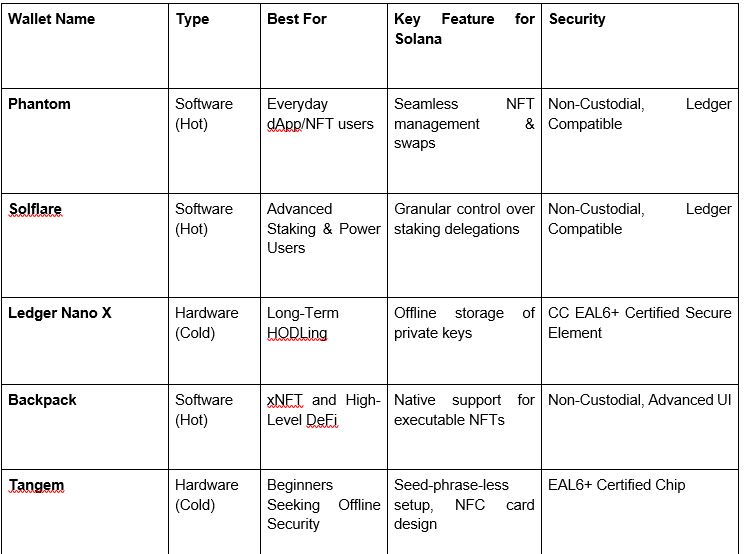
Final Wallet Comparison Summary

wallet comparison

Conclusion: Choosing your most suitable Solana Wallets

Selecting the most suitable wallets from the list of best Solana wallets boils down to your primary use case. For a DeFi user and NFT collector, Phantom is the most user friendly and compatible option. For additional security, pairing a piece of hardware such as Ledger or Tangem with a software wallet like Phantom is the best option. For focused stakers, Solflare provides the autonomy necessary to maximize Solana staking reward. Be sure to keep your 12 or 24 word seed phrase stored offline and confidential.

Frequently Asked Questions (FAQ)

Q1: What is the most secure way to store SOL?

A: The most secure way to store SOL is by using a hardware wallet (cold storage) like Ledger or Tangem. This ensures your private keys are never connected to the internet, making them immune to online hacking and malware.

Q2: Can I use MetaMask for Solana?

A: No, MetaMask does not natively support the Solana blockchain or the SPL token standard. You need a wallet specifically built for the Solana network, such as Phantom or Solflare.

Q3: What is an SPL token?

A: SPL stands for Solana Program Library. SPL tokens are the native token standard on the Solana blockchain, similar to how ERC-20 tokens are used on Ethereum. All major Solana wallets fully support the SPL standard.

Q4: Do I lose my SOL when I stake it?

A: No. When you stake SOL using a non-custodial wallet, your tokens are only delegated to a validator; they are not sent to them. You retain full control and ownership of your staked SOL at all times.

Q5: What is a seed phrase and why is it important?

A: The seed phrase (or recovery phrase) is a list of 12 or 24 words that serves as the master key to your entire wallet. If you lose your device or wallet app, this phrase is the only way to recover your funds. Never share it with anyone.

Bitwise Solana ETF: The Biggest Catalyst for SOL Price Rebound?

Solana Network Outage

The recent launch of the Bitwise Solana Staking ETF (BSOL) on a major U.S. exchange is rapidly gaining recognition as the single most powerful catalyst for a sustained price rebound in Solana (SOL). Despite recent market-wide volatility, the institutional product has successfully channeled substantial, consistent inflows, underscoring strong and resilient institutional demand for the asset. This formal integration into traditional finance (TradFi) structures is the key reason why analysts believe the ETF will fuel SOL’s recovery and future growth.

The successful launch by Bitwise, which has quickly accumulated hundreds of millions in assets under management (AUM), confirms Solana’s status as a high-conviction asset among sophisticated investors, setting it apart from other struggling altcoins.

Unprecedented Institutional Demand and Staking Yield

The primary reason the Bitwise Solana ETF is so influential is its structure, offering both direct exposure to the spot price of SOL and the integrated ability to earn staking rewards. By aiming to stake nearly 100% of the fund’s assets, the ETF is designed to pass on Solana’s significant yield (historically around 7% annually) to investors. This feature makes it highly attractive to institutional clients who seek competitive yield alongside capital appreciation in a regulated vehicle.

The demand has been notable; the Bitwise ETF (BSOL) has demonstrated one of the strongest initial launches in the crypto ETF space, recording impressive inflows in its first week. This continued accumulation, even when the underlying SOL price faced short-term downward pressure, indicates that institutions are treating Solana as a high-conviction long-term play, rather than a speculative short-term trade.

Cementing Solana’s Position in TradFi

The ability of a regulated ETF to facilitate seamless, passive investment in SOL is a fundamental game-changer. It removes the complexities of self-custody, staking infrastructure management, and direct compliance hurdles. This convenience is crucial for wealth managers, RIAs, and family offices now viewing SOL as a mandatory diversification tool beyond Bitcoin and Ethereum.

As Bitwise Chief Investment Officer Matt Hougan noted, “Solana is one of the most exciting investment opportunities in cryptocurrency today.” This sentiment, combined with the successful fund launch, accelerates the narrative that Solana is permanently cemented as one of the few institutional-grade crypto assets, making the ETF the essential bridge for the next wave of capital.

Why BlackRock is Absent from the Current Wave of Solana ETF Filings

Solana Network Outage

Despite a flurry of activity from competing asset managers, including Fidelity and VanEck, who are aggressively filing for and launching Spot Solana Exchange-Traded Funds (ETFs), the industry titan BlackRock remains a notable exception. While BlackRock quickly established dominance in the Bitcoin (BTC) and Ethereum (ETH) ETF markets, the firm’s leadership has publicly expressed skepticism regarding the current level of institutional demand for other altcoins, particularly Solana (SOL).

This strategic absence highlights a crucial divergence in institutional views regarding which cryptocurrencies are ready for prime-time adoption in regulated investment products.

Prioritizing BTC and ETH Demand

BlackRock’s approach, according to its executives, is client-driven. Robert Mitchnick from BlackRock previously indicated that the firm’s institutional clients show overwhelming interest in the two largest cryptocurrencies—Bitcoin and Ethereum—with minimal demand surfacing for other assets like Solana. The firm views Bitcoin as a global monetary alternative and Ethereum as the leading platform for applications, a dual focus that covers nearly 90% of the crypto market capitalization.

This calculated restraint suggests BlackRock is either waiting for the market to mature and generate clearer demand signals for altcoin ETFs, or it believes the regulatory risk and potential market size for Solana products do not yet justify a major filing effort.

Competitors Seize the Altcoin Opportunity

In contrast, other major asset managers are moving swiftly to capture what they see as the next frontier of crypto ETFs. Firms like Fidelity, VanEck, and Bitwise view Solana’s high throughput, low fees, and rapidly expanding ecosystem as the next logical step for institutional product development. The successful launch of competing Solana ETFs and the continuous inflows into these products underscore a belief that a significant segment of institutional capital is ready to diversify beyond the top two assets.

The competition is intense, with some firms even employing creative regulatory maneuvers and offering staking-enabled ETFs to gain a first-mover advantage. While BlackRock has recently expanded its tokenized fund, BUIDL, onto the Solana network, this is a distinct product from a spot ETF and does not signal an immediate shift in its core ETF strategy.

A Waiting Game for Market Share

For now, BlackRock appears comfortable letting competitors test the waters, a strategy that allows them to gauge market reception and regulatory comfort before committing their formidable resources. If Solana ETF demand continues to soar, analysts predict BlackRock could “swoop in” with a filing, leveraging its brand and scale to quickly capture market share. Until then, its focus remains squarely on consolidating its already dominant position in the Bitcoin and Ethereum ETF segments.

Solana (SOL) Battles for $142 Support Amid Extended Market Correction

solana

Solana (SOL) has recently experienced a notable decline, dropping to the critical $142 price level as the broader cryptocurrency market continues to consolidate under heavy selling pressure. The drop represents a significant correction from its recent highs, testing the resolve of bulls and placing the network’s native token at a precarious technical juncture. Market analysts are now keenly watching key support levels to determine the next major direction for SOL.

The Critical $142 Price Hurdle

The price area around $142 has historically served as a significant level of interest for Solana. Successfully holding this level is crucial for preventing a cascade of further selling. However, technical indicators currently suggest that the market sentiment remains predominantly bearish. The short-term price action, characterized by lower highs and lower lows, indicates that the downward trend is still firmly in control.

In particular, the coin’s price is trading below key Exponential Moving Averages (EMAs), which technical traders use to gauge short-term momentum. As long as SOL remains below these moving averages, the likelihood of a sustained recovery is low, and the immediate price outlook remains gloomy.

Next Target: The $120 Fallback Zone

Should the intense selling pressure push Solana below the current psychological and technical support zone near $142, analysts predict the next major support level could be found around the $120 mark. This area represents a robust historical support zone, which, if reached, would likely attract a large wave of fresh buying interest from both retail and institutional investors looking for a significant discount.

While the current market action is challenging, the long-term fundamentals of the Solana ecosystem—including its high throughput and growing ecosystem of DeFi and NFT projects—are often cited as reasons to expect a recovery once the general market sentiment turns bullish. For the immediate future, however, the focus remains on the $142 pivot point and the potential for a deeper correction toward $120.

Solana Aims to Pioneer On-Chain IPOs, Unveiling a Vision of “Everything Tokenized”

solana

The world of traditional finance may be headed for a revolutionary merger with blockchain technology, as articulated by Lily Liu, President of the Solana Foundation. In a recent keynote at the Shanghai Blockchain International Week, Liu shared a bold vision for the future, stating her belief that “everything can be tokenized,” with Solana positioned to become the core infrastructure for this new digital financial internet. Her comments strongly suggest that even complex financial instruments like Initial Public Offerings (IPOs) may soon find a native home on high-throughput blockchains like Solana.

Tokenizing $500 Trillion in Traditional Assets

Liu’s perspective centers on two pillars of blockchain: assets and financial infrastructure. While current blockchain-native assets represent a multi-trillion-dollar market, this pales in comparison to the estimated $500 trillion value of traditional financial assets globally. Solana aims to bridge this massive gap.

By facilitating the tokenization of all asset classes—from traditional stocks, bonds, and real estate to entirely new digital assets—Solana seeks to make them instantly tradable, usable, and collateralizable on-chain. This paradigm shift would replace cumbersome, slow, and expensive legacy systems with the speed and efficiency of a decentralized network. The capability for native, on-chain IPOs would democratize access to corporate fundraising and public markets, lowering barriers for both issuers and investors.

Solana’s Technical Edge for Financial Giants

To realize this ambitious vision of becoming the “technology platform for Internet finance,” Solana relies on its unique, high-performance architecture. Liu highlighted that the network’s current throughput exceeds 1,000 transactions per second (TPS), with transaction fees as low as $0.0005.

These metrics place Solana’s efficiency close to that of traditional financial networks like Visa and NASDAQ, making it a viable and scalable foundation for institutional adoption. Solana’s focus on speed, low cost, and a single, unified network state is critical for handling the high volume and speed required by market mechanisms like stock market trading and native tokenized IPOs, further solidifying its growing influence in the global digital asset landscape.

Solana Co-Founder Predicts Pump.fun Will Be TikTok’s Major Social Rival

Solana Network Outage

Anatoly Yakovenko, co-founder of Solana (SOL) Labs, has made a bold prediction regarding the future of social media, suggesting that the Solana-based meme coin launchpad, Pump.fun (PUMP), could emerge as a serious rival to the global video content giant, TikTok. This forecast comes as Pump.fun continues its rapid adoption by integrating crypto-native features that revolutionize content monetization.

Yakovenko shared his views on X, stating, “The next social network war is going to be TikTok vs Pump.” He argues that Pump.fun’s decentralized model offers a distinct advantage by directly tying creation and community engagement to financial incentives.

Decentralized Monetization vs. Centralized Ads

The core of Yakovenko’s argument lies in Pump.fun’s integration of crypto-native features, such as meme coins, ownership rewards, and direct creator fees. Unlike traditional platforms like TikTok, where advertising revenue primarily flows to the platform, Pump.fun allows creators and their communities to immediately monetize their content and participate in the ecosystem’s success through token ownership.

This model of built-in monetization could give Pump.fun the leverage needed to compete with centralized platforms, despite TikTok’s current dominance with over 1.5 billion global users. The recent move by crypto-focused media brand Unchained to launch a streaming presence and a branded meme coin on Pump.fun—collecting a standard creator fee—highlights the platform’s strategic use of crypto-native distribution for social media.

Growth Despite Criticism

The Solana-based meme coin factory has seen massive growth and community traction, evidenced by the PUMP token’s value jumping 58.69% in the last 30 days.

This growth has continued despite past controversy, including criticism from Ethereum founder Vitalik Buterin, who claimed the project did not prioritize ethics. Nevertheless, the platform’s momentum and the confidence shown by a major industry leader like Yakovenko underscore the potential for decentralized applications to disrupt the established social media hierarchy.

Solana ETFs Embrace Staking Feature as SEC Decision Looms

Solana Network Outage

A major new development in the digital asset market has put Solana (SOL) firmly back in the spotlight. A wave of prominent financial issuers, including Grayscale, Fidelity, Bitwise, VanEck, Franklin, CoinShares, and Canary, have strategically revised their Spot Solana Exchange-Traded Fund (ETF) applications to the U.S. Securities and Exchange Commission (SEC). The crucial update? The inclusion of staking. This adjustment would allow the funds to generate additional yield by putting their Solana holdings to work on the blockchain, distributing the resulting rewards as income directly to ETF shareholders. Analysts view this enhancement not only as a means to boost potential returns but also as a powerful move designed to strengthen the case for regulatory approval ahead of a looming deadline.

Staking Feature Bolsters Case for Regulatory Green Light

The addition of staking reflects the competitive nature of the crypto investment product space, aiming to make Solana ETFs more appealing to income-focused investors. According to commentary from Bloomberg’s James Seyffart and ETF specialist Nate Geraci, the SEC could deliver a final decision on these filings in as little as two weeks, pointing toward a decisive moment in early October. Momentum for Solana-based investment products is already evident globally. In Europe, institutional inflows have surged, with Bitwise’s Solana staking product attracting $60 million in its first week. The US market is also showing strong adoption, where the REX-Osprey Solana + Staking ETF has already amassed over $250 million in assets shortly after its launch.

The Ethereum Precedent

Market watchers believe that recent regulatory streamlining for Ethereum products has set a positive precedent that will likely clear the path for Solana ETFs. Earlier this month, the SEC reduced the need for one-off approvals for Ether investment vehicles, suggesting a developing framework that can be applied to other major proof-of-stake cryptocurrencies. This shift in regulatory winds, combined with the strategic addition of income-generating staking, signals that Solana is becoming a core component of institutional crypto investment strategies, paving the way for wider mainstream adoption.

Solana Price Poised for Potential 30% Rally

Solana Network Outage

Solana (SOL) is showing strong signs of a significant price rally, with analysts eyeing a 30% upside driven by the upcoming Alpenglow upgrade and other powerful catalysts. The Alpenglow upgrade is considered the most substantial protocol improvement in Solana’s history, aiming to drastically reduce transaction finality times from 12.8 seconds to approximately 150 milliseconds. This would make Solana one of the fastest layer-1 blockchains in the market, a development that has already secured over 99.6% of the necessary votes from the community for confirmation.

Key Catalysts Fueling the Momentum

Beyond the technical upgrade, several other factors are contributing to a bullish outlook for SOL. The recent launch of World Liberty Financial’s (WLFI) USD1 stablecoin on the Solana network is expected to significantly boost liquidity for decentralized finance (DeFi) protocols within the ecosystem. This development coincides with the strong growth of Solana’s DeFi sector, which has seen its Total Value Locked (TVL) reach an all-time high of $30.5 billion. Additionally, the network’s perpetual trading volume hit a new monthly record of $43.88 billion in August, showcasing robust market activity. While SOL’s price has been trading within a typically bearish descending triangle pattern, a confluence of bullish signals from technical indicators like the Supertrend and MACD suggests a potential breakout is on the horizon, with a target of $257.

Solana Validators Vote on Alpenglow Upgrade for Faster Finality

solana

The Solana community is currently in the process of a crucial vote on a major network upgrade known as Alpenglow. This upgrade, also referred to as SIMD-0326, is being hailed as the most significant in the blockchain’s history, with the primary goal of dramatically improving block finality. If the vote passes, the time it takes for a transaction to be considered final will shrink from the current 12.8 seconds to an incredible 100-150 milliseconds. This near-instant speed would put Solana on par with traditional Web2 applications, a major win for developers and users.

How the Upgrade Aims to Boost Performance and Security

The Alpenglow upgrade aims to achieve this speed by overhauling Solana’s core consensus mechanism. It plans to replace the existing Proof-of-History (PoH) and TowerBFT systems with a new, more efficient direct-voting protocol called Votor. This new system uses a cryptographic method to achieve consensus with less network data, which helps cut down on costs and bandwidth. The upgrade also introduces a “20+20” fault tolerance and a new Validator Admission Ticket (VAT) to improve economic fairness and security. The vote requires a two-thirds majority of participating validators to pass, and its success would significantly redefine Solana’s competitive standing in the Layer-1 blockchain space.

Solana ETF Inflows Signal Potential Rally to $250

solana

Solana (SOL) is showing strong bullish momentum, with a major catalyst coming from institutional investment. The REX-Osprey Solana + Staking ETF (SSK) has attracted significant inflows, indicating a growing appetite from traditional finance for exposure to the token. While the original reference pointed to a specific $13M figure, recent data shows the SSK ETF’s assets under management (AUM) have grown substantially, with some reports indicating inflows have surpassed the $100M mark. This influx of capital is seen by analysts as a key driver that could propel Solana’s price to new highs.

A Shift in Investor Behavior and Price Outlook

The SSK ETF is particularly attractive because it’s structured to provide on-chain staking rewards as dividends, combining both growth and income for investors. This unique feature is drawing in registered investment advisors and institutional allocators who are looking for crypto yield strategies. With the increasing institutional interest, many analysts are turning bullish on Solana’s short-term price action. While the token has been in a “tug-of-war” between buyers and sellers, technical and on-chain analysis points to a likely rally. Several technical indicators, including a bull flag pattern and an inverse head and shoulders, suggest that a breakout is imminent. If this momentum holds and inflows continue, a rally to $250 is considered a realistic target for the near future.

Top Asset Managers Update Solana ETF Filings Amidst Shifting SEC Stance

Solana Network Outage

Several prominent asset management firms, including Franklin Templeton, Bitwise, Fidelity, Grayscale, and VanEck, have updated their filings for a spot Solana (SOL) exchange-traded fund (ETF). This wave of revised S-1 registration statements signals a new phase of coordination between these financial heavyweights and the U.S. Securities and Exchange Commission (SEC), suggesting a path toward potential approval for a Solana ETF.

A More Favorable Regulatory Climate

The updated filings from these firms come at a time when the SEC’s stance on crypto-related financial products appears to be softening. The agency has recently assented to in-kind redemption for Bitcoin and Ethereum spot ETFs and has extended option limits to Bitcoin funds. Further reinforcing this shift, SEC Chair Paul Atkins announced “Project Crypto,” an initiative aimed at modernizing outdated regulations, and stated that the “vast majority of crypto assets are not securities.” This new position stands in stark contrast to previous regulatory viewpoints and has created an atmosphere of optimism within the industry.

Preparing for a New Wave of Crypto Funds

The new filings, such as Grayscale’s disclosure of a 2.5% fee for its proposed Solana fund, indicate that issuers are actively preparing for a more favorable regulatory environment. Industry experts, including Nate Geraci, President of NovaDius Wealth, believe these actions are a result of ongoing discussions to align fund documentation with the SEC’s evolving expectations. This proactive approach by both the asset managers and the SEC suggests that the U.S. market may soon open its doors to spot SOL ETFs. Such an approval would not only legitimize Solana as a mainstream investment asset but also provide a regulated and accessible avenue for both institutional and retail investors to gain exposure to the network.

Solana Shows Bullish Signs: Can SOL Target $185 Next?

SOL Technical Analysis

Solana (SOL) is currently displaying renewed bullish momentum, sparking optimism among investors and analysts about its potential for further price appreciation. Following a recent surge, the cryptocurrency is trading above key levels, leading to speculation that it might be gearing up to test the $185 mark in the near term. This latest uptick comes after a period of mixed performance for the altcoin throughout the year.

Recent Gains and Market Outperformance

As of July 11, 2025, Solana has registered a notable 3.5% increase in the last 24 hours, with its price hovering around $163.76. This daily gain contributes to a more substantial upward trend seen since the start of July, with SOL climbing 11.74% this month alone. Over the past week, Solana has outperformed many of its altcoin counterparts, posting a respectable 7.4% gain and highlighting its current strength in the broader crypto market.

A Year of Volatility and Resilient Recovery

Solana’s journey through 2025 has been marked by significant volatility. The cryptocurrency started the year with robust growth, seeing a 22.3% increase in January. However, the first quarter concluded with a notable 34.1% loss, primarily driven by dips of 36% in February and 15.7% in March. The second quarter, however, brought a resilient rebound, with gains of 18.6% in April and 6.11% in May, despite a minor setback of 1.08% in June.

The current rally in July is now under close observation. The key question for investors is whether this latest surge represents a short-term price spike or signifies the beginning of a more sustained upward trend that could propel SOL towards the coveted $185 target, building on its recent market outperformance and underlying ecosystem developments.

Solana-Based PMP FUN Token Sale Pulled from Gate.io Amid Confusion

Solana Username3

An anticipated token sale for PMP FUN, a Solana-based memecoin launchpad, has been abruptly removed from the cryptocurrency exchange Gate.io, sparking widespread confusion and speculation within the crypto community. The planned sale, which aimed to raise a significant amount of capital, has now been shrouded in uncertainty due to a lack of clear communication from both PMP FUN and Gate.io.

Details of the Pulled Sale

The now-deleted page on Gate.io had outlined plans for PMP FUN to offer 150 billion tokens at a price of $0.004 each, targeting a $600 million raise. This sale was set to account for 15% of the total supply of 1 trillion tokens, implying a fully diluted valuation (FDV) of $4 billion for the project. The offering was initially scheduled for July 12, 2025, and was intended to be a public sale. However, the sudden disappearance of the page without official explanation has left investors and observers with more questions than answers.

Uncertainty and Community Concerns

The rapid removal of the token sale page, which now displays a 404 error, has led to various theories within the community, ranging from potential hacks or incorrect details to regulatory concerns. While Gate.io’s support team reportedly issued a vague statement about removing the pre-market OTC following negotiations, it did not provide clarity on the future of the token sale or a confirmed reopening date. This lack of transparency has intensified speculation and underscored the inherent risks associated with emerging crypto projects and their fundraising endeavors.

PMP FUN, known for facilitating the creation of millions of new tokens and generating substantial revenue on the Solana blockchain, had seen its volumes plummet since the memecoin frenzy of early 2025. The platform’s co-founder had even previously advised against expecting a native token. The current situation with the pulled sale and the absence of official statements from either party emphasizes the need for caution and verified information in the volatile memecoin ecosystem.

VanEck Issues Warning: Micro-Cap XRP and Solana Treasury Plans Likely Scams

Solana (SOL) Price Hits New All-Time High Over $200

VanEck’s Head of Digital Assets, Matthew Sigel, has issued a stark warning regarding a recent trend of small-cap companies announcing ambitious plans to acquire significant amounts of XRP and Solana for their corporate treasuries. Sigel suggests that many of these initiatives are likely “insider pump and dump attempts,” designed to artificially inflate stock prices rather than genuinely build crypto reserves.

The Rise of Suspicious Treasury Declarations

In recent weeks, numerous companies, often with minuscule market capitalizations, have declared intentions to accumulate hundreds of millions of dollars worth of altcoins like XRP and Solana. These announcements frequently come from firms in seemingly unrelated industries. A notable example is Singapore-based Trident Digital Tech, with a mere $16 million market cap, announcing plans to raise $500 million for an XRP treasury. Similar declarations have emerged from educational tech and automotive companies, outlining multi-million dollar plans for Solana and XRP acquisitions.

VanEck’s Skepticism and Red Flags

Matthew Sigel explicitly voiced his skepticism, stating, “If the market cap is de minimus and there is no disclosure of new anchor investors, I assume it’s a scam.” He likened the trend to the “Michael Saylor’s MicroStrategy” effect, where Bitcoin accumulation significantly boosted a company’s stock, but warned that these smaller firms lack the fundamental backing and transparency. Sigel previously highlighted a case of a “$3 million, market cap US-listed penny stock with all Chinese management” announcing plans to buy $800 million of BTC and TRUMP coin, underscoring the absurdity of such claims without credible financial backing.

Protecting Investors from Deceptive Practices

This cautionary stance by a prominent asset management firm like VanEck serves as a crucial alert for investors. It emphasizes the need for rigorous due diligence when evaluating companies making grand cryptocurrency treasury announcements, especially those with small market valuations and a lack of transparent funding plans. The warning aims to protect investors from potentially deceptive schemes designed solely to manipulate stock prices.

Solana Whale Dumps Escalate, Raising Concerns for SOL Price

Solana Network Outage

The Solana (SOL) market is currently experiencing an increase in significant whale dumps, where large holders are selling off substantial amounts of the cryptocurrency. This growing selling pressure has raised concerns among investors and analysts about whether SOL’s price can maintain its crucial $140 support level.

Escalating Whale Activity

Recent on-chain data indicates a notable uptick in selling activity from large Solana holders, often referred to as “whales.” These significant transactions can inject considerable supply into the market, potentially overwhelming buying demand and leading to price depreciation. The pattern suggests a strategic move by these major players, which can influence market sentiment.

Testing the $140 Support Level

The increased whale dumps are putting SOL’s critical $140 support level to the test. This price point is often considered a psychological and technical barrier, and a sustained break below it could trigger further sell-offs, leading to a more significant price plunge. The market is closely watching to see if this support can hold amidst the selling pressure.

Market Implications and Future Outlook

The current situation highlights the inherent volatility of the cryptocurrency market, especially when large holders decide to liquidate positions. While whale dumps can be a bearish signal in the short term, the long-term trajectory of SOL will depend on broader market conditions, the strength of the Solana ecosystem’s development, and the ability of new demand to absorb the selling pressure. Investors are advised to monitor market indicators closely.

SOL Strategies Files $1 Billion Shelf Prospectus for Solana

Solana Network Outage

SOL Strategies has announced the filing of a $1 billion shelf prospectus, signaling its intent to offer a significant amount of Solana (SOL) to investors. This strategic move highlights the firm’s proactive approach to providing flexible investment opportunities within the rapidly evolving digital asset market.

Unlocking Investment Flexibility

A shelf prospectus allows a company to register securities with regulators for future issuance, offering considerable flexibility in terms of timing and pricing. For SOL Strategies, this means they can now offer up to $1 billion worth of Solana to the market as conditions become favorable, without needing to file a new registration statement for each offering. This adaptability is crucial in the volatile cryptocurrency landscape, enabling the firm to respond swiftly to market demands.

Confidence in Solana’s Ecosystem

The substantial size of this shelf prospectus, valued at $1 billion, underscores SOL Strategies’ strong confidence in the long-term potential and stability of the Solana ecosystem. It suggests a belief that Solana will continue to grow and attract significant investor interest, making it a valuable asset for large-scale offerings. This move could also be seen as a bullish signal for Solana, as a major player is positioning to facilitate substantial investment into the asset.

Implications for Institutional Engagement

This development could pave the way for increased institutional engagement with Solana. By preparing such a large offering, SOL Strategies is streamlining the process for institutional investors to gain exposure to SOL, potentially attracting new capital into the Solana market. It reflects a growing trend where traditional financial mechanisms are being adapted to accommodate digital assets, bridging the gap between conventional finance and the cryptocurrency world.

XRP or Solana: Analyst Ponders Best $100,000 Investment

Solana Network Outage

Veteran market analyst Peter Brandt has posed a compelling question to the cryptocurrency community: which asset, XRP or Solana (SOL), represents a better option for a $100,000 investment? This inquiry highlights the ongoing debate among investors regarding the long-term potential of these two prominent digital assets.

Weighing the Investment Options


Brandt‘s question encourages a deeper comparative analysis of XRP and Solana. Both cryptocurrencies offer distinct value propositions and operate within different ecosystems, making the choice for a substantial investment like $100,000 a complex one. Factors such as network utility, regulatory landscape, and historical performance come into play.

XRP’s Use Case and Regulatory Context

XRP, primarily associated with cross-border payments and enterprise solutions, has a well-established use case. However, its trajectory has been significantly influenced by ongoing regulatory challenges. Investors considering XRP often weigh its potential for widespread financial adoption against the uncertainties of its legal status.

Solana’s Scalability and Ecosystem Growth

Solana, on the other hand, is known for its high transaction speeds and rapidly expanding decentralized application (dApp) ecosystem. Its focus on scalability and developer-friendly environment has attracted significant attention, positioning it as a strong contender in the smart contract platform space.

The Analyst’s Perspective

Brandt’s open-ended question invites market participants to consider the fundamental strengths and weaknesses of each asset. The ultimate decision for a $100,000 investment will likely depend on an investor’s risk tolerance, investment horizon, and belief in each project’s long-term vision.

Solana Co-founder Anatoly Yakovenko Proposes ‘Meta-Blockchain’

Solana Network Outage

Anatoly Yakovenko, the co-founder of Solana, has introduced a concept for a “meta-blockchain.” This proposal envisions a network that could potentially integrate and unify various existing blockchain ecosystems.

Envisioning Interconnected Blockchains

Yakovenko’s meta-blockchain concept aims to address the issue of fragmentation within the blockchain space. By creating a unified architecture, the proposal seeks to enable seamless communication and interaction between different blockchains.

Enhancing Interoperability

The core idea behind the meta-blockchain is to enhance interoperability. This would allow for the transfer of assets and data across different networks, potentially unlocking new use cases and increasing the overall efficiency of the blockchain ecosystem.

Potential Industry Impact

The proposal has the potential to significantly impact the blockchain industry. If realized, a meta-blockchain could streamline operations, reduce complexity, and foster greater collaboration among various blockchain projects.

Solana Developers Address Critical Bug Amidst Growing Scrutiny

Solana Network Outage

Solana’s developers and validators have swiftly implemented a fix for a critical bug that temporarily halted block production on the network. This incident has, however, amplified existing criticism regarding the network’s stability and its history of outages.

Rapid Patch Deployment

Following the halt in block production, the Solana team acted quickly to identify the root cause and deploy a patch. Validators then coordinated to restart the network, restoring functionality in a relatively short time frame. This rapid response aimed to minimize disruption and reassure users.

Mounting Concerns Over Network Stability

Despite the swift resolution, the incident has reignited concerns about Solana’s network stability. Critics point to previous outages and argue that these recurring issues hinder its potential to become a truly reliable and scalable blockchain for widespread adoption. The latest bug has led to renewed discussions about the network’s architecture and testing procedures.

Community and Developer Response

While the core development team and validators worked diligently to resolve the issue, the Solana community has expressed a mix of frustration and understanding. Some users have voiced concerns about the frequency of such incidents, while others acknowledge the complexities of maintaining a high-throughput blockchain. Developers building on Solana are also closely watching these developments to assess the platform’s reliability for their applications.

Solana’s Recent Overnight Performance and Today’s Market Snapshot

Solana Network Outage

Solana (SOL) continues to be a focal point in the cryptocurrency market, with its overnight trading often setting the stage for intraday movements. Analyzing this activity, alongside the latest market data, provides a crucial understanding of the current trends influencing SOL’s price and network dynamics.

Overnight Trading Dynamics and Price Fluctuations

Solana’s overnight price action and trading volume are key indicators of global market sentiment towards the asset. Examining these movements can reveal reactions to news, technical levels, and broader market trends originating from different geographical regions as their trading days commence.

Key Drivers Influencing SOL’s Activity

As of the latest update (April 18, 2025), Solana is trading around $134.60, showing a 3.66% increase in the last 24 hours according to CoinMarketCap data. This positive movement suggests renewed buying interest. The 24-hour trading volume stands at a robust $3.46 billion, indicating significant market participation.

Network Inflows and Ecosystem Developments

The sustained network inflows discussed in previous reports appear to be contributing to this positive price action. Increased activity within Solana’s DeFi and NFT ecosystems, along with ongoing project developments, continues to attract capital and users to the platform. Recent news, such as the launch of new projects and increased Total Value Locked (TVL), further bolsters this positive outlook.

Technical Levels and Market Sentiment

Technical analysts are likely monitoring key resistance levels above the current price to gauge the potential for further gains. The overall market sentiment surrounding Solana appears to be improving, supported by the increased network activity and positive price momentum.

Looking Ahead: Maintaining Momentum in the Solana Market

The current market data suggests a positive trajectory for Solana in the short term. Sustained network inflows, coupled with positive ecosystem developments and a favorable broader market sentiment, could pave the way for further price appreciation. Traders will be closely watching if SOL can maintain this momentum and overcome key resistance levels in the coming trading sessions.

Solana Network Sees Inflow Surge: Price Rally Next?

Solana Network Outage

The Solana (SOL) network is currently witnessing a notable increase in inflows, indicating growing interest and capital entering the blockchain ecosystem. This surge in network activity has led to speculation among traders and analysts about the potential for a corresponding rally in the price of Solana’s native cryptocurrency, SOL.

Analyzing the Increase in Solana Network Activity

The rise in network inflows suggests a growing demand for utilizing the Solana blockchain, potentially driven by increased adoption of its decentralized applications (dApps), non-fungible tokens (NFTs), or other ecosystem projects. This heightened activity often precedes positive price movements as more capital enters the Solana ecosystem.

Historical Correlation Between Inflows and Price Action

Historically, periods of significant network inflow on various blockchains have often been followed by an appreciation in the price of the native cryptocurrency. This correlation suggests that increased utilization and capital commitment can positively impact market valuation.

Technical Indicators and Potential Breakout Scenarios

Technical analysts are likely examining Solana’s price charts in conjunction with the inflow data to identify potential breakout scenarios. Increased buying pressure resulting from the network activity could push SOL past key resistance levels, leading to a sustained upward trend.

Broader Market Sentiment and Solana’s Ecosystem Growth

The potential for a SOL price rally will also be influenced by the broader cryptocurrency market sentiment and the continued growth and development within the Solana ecosystem. Positive news and successful project launches on Solana could further amplify the impact of the network inflows on SOL’s price.

Looking Ahead

Market participants will be closely watching how the price of Solana responds to this surge in network inflows. A decisive break above key resistance levels, supported by strong trading volume, could confirm the speculation of an impending rally. The correlation between network activity and price action will be a key indicator for SOL’s near-term trajectory.

Solana Ecosystem Experiences Significant Surge in Growth and Activity

Solana Network Outage

The Solana blockchain ecosystem is currently experiencing a period of rapid expansion and increased activity, fueled by recent developments and a growing influx of new projects and users. This surge highlights Solana’s increasing prominence within the decentralized finance (DeFi) and non-fungible token (NFT) spaces, solidifying its position as a significant layer-1 blockchain.

Key Factors Driving Solana’s Ecosystem Growth

Several factors are contributing to the supercharged growth of the Solana ecosystem. These likely include recent technological advancements on the network, successful project launches attracting users and capital, and increasing developer activity building innovative applications on the Solana blockchain.

Flourishing DeFi and NFT Activity on Solana

The DeFi and NFT sectors within the Solana ecosystem are witnessing substantial growth. New DeFi protocols are launching with innovative financial instruments, while the NFT marketplace on Solana continues to attract creators and collectors, driving transaction volume and network usage.

Growing Developer Interest and Innovative Projects

https://twitter.com/LoopscaleLabs/status/1910424337078690218

The ease of building on Solana, coupled with its high transaction speeds and low fees, is attracting a growing number of developers. This influx of talent is leading to the creation of a diverse range of innovative projects spanning various sectors, further enriching the ecosystem.

Increased User Adoption and Network Utilization

The combination of compelling applications and a thriving ecosystem is driving increased user adoption on the Solana network. Higher transaction volumes and greater network utilization are testaments to the platform’s growing popularity and real-world use cases.

Looking Ahead: Continued Expansion of the Solana Ecosystem

The current momentum suggests a positive outlook for the continued expansion of the Solana ecosystem. With ongoing development, new project launches, and increasing user adoption, Solana is poised to further solidify its position as a leading blockchain platform in the evolving Web3 landscape.

Solana Futures ETFs Set to Debut on Wall Street Amid Rising Demand

SOL Technical Analysis

In a major development for crypto investment products, Volatility Shares LLC is set to launch the first-ever Solana futures ETFs on Wall Street. This marks a significant expansion in the digital asset space, following the success of Bitcoin and Ethereum-based ETFs.

Introducing SOLZ and SOLT ETFs

Two new products—Volatility Shares Solana ETF (SOLZ) and Volatility Shares 2X Solana ETF (SOLT)—will begin trading tomorrow. SOLZ will track Solana futures, while SOLT offers 2x leveraged exposure, catering to more aggressive traders. The ETFs come with expense ratios of 0.95% (SOLZ) and 1.85% (SOLT).

Volatility Shares first filed for these ETFs in December 2023, tapping into growing investor demand for regulated crypto exposure.

Why Solana Futures ETFs Matter

While a spot Solana ETF is yet to be approved, these futures-based ETFs act as a stepping stone. Historically, both Bitcoin and Ethereum saw futures ETFs before spot ETFs received regulatory approval. Analysts believe a spot Solana ETF could follow soon, with current market sentiment leaning 88% in favor of approvals this year.

Crypto ETF Market Keeps Expanding

Despite crypto’s price volatility, institutional appetite remains strong. Spot Bitcoin ETFs have attracted $92 billion since launch, and interest in altcoins like Solana, Avalanche, and SUI is rising.

The regulatory landscape is also evolving, with the Trump administration’s pro-crypto stance fueling optimism. Major firms like Grayscale, VanEck, and Franklin Templeton have already filed for spot Solana ETFs—hinting that this is just the beginning.