Ether (ETH) May Continue to Lose Momentum Until Upgrade, BofA Says

Ethereum Upgrade

The Ether (ETH) price increase from mid-July to mid-August may have peaked. Ethereum’s technical upgrade will convert it into a Proof-of-Stake (PoS) network and future blockchain upgrades, according to a note published by Bank of America on Friday. It will help investors better comprehend the ramifications of the Merge. Additionally, the investment bank anticipates that unless Ethereum overcomes its current challenges, other blockchains like Binance Smart Chain, Tron, Avalanche, and Solana will acquire market share.

Ether Impends To Switch Proof-of-Stake

In a note to clients, BofA analyst Alkesh Shah stated that “investors likely realized that Ethereum’s seemingly impending switch to Proof-of-Stake (PoS) will neither address scalability problems nor high transaction costs.” The native currency of Ethereum, Ether (ETH), has seen a short-term price increase, possibly due to the Merge. However, traders have noted that the asset’s long-term outlook is still gloomy due to a dire macroeconomic outlook and technical indicators for bitcoin that indicate a decline.

Ethereum Merge

Investors “presumably realized that Ethereum’s supposedly forthcoming migration to Proof-of-Stake (PoS) will neither address scalability difficulties or high transaction fees,” according to BofA analyst Alkesh Shah in a note to clients. The Merge may have temporarily increased the price of Ether (ETH), the native currency of Ethereum. Still, traders have observed that the asset’s long-term outlook remains bleak due to a poor macroeconomic outlook and technical signs for Bitcoin that point to a drop.
Bank of America Loses 50% of Its Active Crypto Users

Bank of America

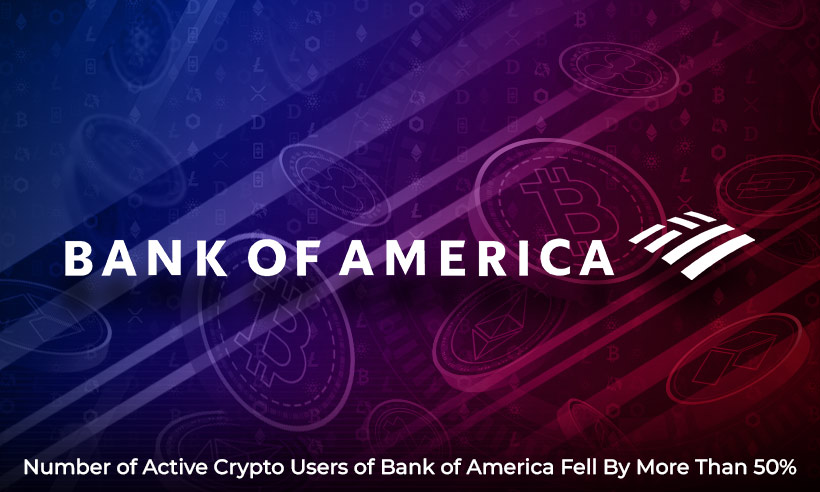
Bank of America has lost more than 50% of its active crypto users between its peak of one million in November and just 500,000 users in May as Bitcoin (BTC) posts its worst quarter in more than a decade.

Bank of America Sees Decline in Crypto Users

Citing internal data from the bank, Bloomberg noted that Bank of America’s cryptocurrency users dropped below the 500,000 mark in May, from more than 1 million users back in November of last year when the flagship cryptocurrency was at its all-time highs and the industry’s total market capitalization was well above $1 trillion.

Bitcoin’s (BTC) price has since fallen by more than 70% from its November all-time highs to just below $20,000. Overall, cryptocurrency market capitalization has dropped from roughly $3 trillion in November 2021 to less than $1 trillion.

The data was derived by looking at anonymized internal customer data and by analyzing the number of customers sending or receiving payments to or from a cryptocurrency platform. In the meantime, the data doesn’t show the actual transactions.

Investors’ Declining Sentiment in Bitcoin

Bitcoin has posted its worst quarterly performance in over a decade, as in the second quarter of this year it lost around 58% of its value, going from $45,524 to just under $19,000 at the end of the three months.

Prices dropped along with sentiments toward the leading cryptocurrency between April and June. The bank saw a rise from 21% to 30% in investors who said they had not invested and did not intend to invest in cryptocurrency between April and June.

The bank noted that cryptocurrencies comprise less than 1% of overall U.S. household financial assets, suggesting that “relatively few people view crypto assets as a reliable long-term investment.”

90% of Respondents Plan to Buy Crypto This Year: Bank of America Survey

Crypto Bank of America

Despite the sharp correction in crypto valuations, most Americans remain bullish on the cryptocurrencies and have plans to purchase “some amount of crypto” before the end of the year, according to a Bank of America survey.

Americans Still Remain Bullish on Cryptocurrencies

The survey, which included 1,000 people and was conducted in early June, found that nearly 91% of respondents were preparing to buy cryptocurrencies within the next six months, which was the same percentage as those who said they had bought in the last six months. Additionally, 30% of respondents said they do not plan to sell any of their cryptocurrency in the next six months. The report also noted that 39% of respondents use crypto as an online payment method, and 34% use it for in-person payments. Bank of America analyst Jason Kupferberg said on Monday,

“It’s certainly interesting to use it as a payment method, and we think what’s highlighting is the growing adoption of crypto-to-fiat type products.”.

Most Respondents Were Short-Term Investors

The survey also found that cryptocurrencies made up less than 10% of overall financial investments for 65% of respondents but allocations varied, with 15% holding more than 25% of their total financial investments in digital assets. Most of the respondents were short-term investors, 77% holding crypto for less than a year, the report added. Meanwhile, the CEO of Bank of America stated that the bank has no plans to enter the cryptocurrency market because of the current U.S. regulation, which does not authorize activities involving cryptocurrencies.

The CEO of Bank of America Dismisses Cryptocurrency

graph

Bank of America CEO Brian T. Moynihan stated that the banking giant was not in a rush to enter the cryptocurrency market.

“There’s nothing we’re missing out on. We’re causing payments to skyrocket,” Moynihan remarked.

While acknowledging cross-border payments as an actual use case for cryptocurrencies, Moynihan stated that the emerging asset class is hindered by strict regulation. Bank of America is confined to researching cryptocurrencies on the trading side, but it cannot manage customers’ accounts with digital assets; in July, the bank established a specialized crypto research team.

They’ve said:

“You have to ask us before you do it, and by the way, don’t ask.’ It was the tone,” Moynihan commented on regulatory scrutiny.

According to the most recent earnings conference from Bank of America, digital channels account for 53 percent of client purchases. According to Moynihan, the bank has 54 million digital users. According to the banker, Bank of America has “hundreds” of patents on the blockchain. The number of blockchain-related patents increased by 86% in 2021. The technology doesn’t entirely convince the bank of America despite owning more blockchain patents than any other financial institution globally. Cathy Bessant, a member of the bank’s executive management board, stated in 2019 that she was skeptical about blockchain technology.

Metaverse-Upcoming Trilllion Dollar Oppurtunity

Metaverse-Upcoming Trilllion Dollar Oppurtunity

People are spending more and more time in the virtual world. From playing to working, millions of people are doing these activities in the virtual world. The digital economy has boomed in the last few years. There have been many predictions about Metaverse in recent times by various banks and Investment funds. 

Recently, Goldman Sachs predicted that Metaverse could be an $8 trillion opportunity. In a recent episode of ‘Exchanges at Goldman Sachs‘ titled Understanding the metaverse and web3.0, Eric Sheridan, an analyst in Goldman Sachs was asked about the evolution of Metaverse ahead and how big the potential opportunity could be. 

Eric replied, “We think this could be as much as an $8 trillion opportunity on the revenue and monetization side.”

Eric further said “We look at the digital economy today, which is roughly about 20 percent, 25 percent of the global economy. We see the digital economy continuing to grow, and on top of that we see a virtual economy that will grow within and alongside this digital economy.”

Eric clarified their prediction by stating “That’s how we came up with the number for various outcomes of anywhere from $2 trillion to $12 trillion, with $8 trillion at the midpoint of all potential outcomes.” 

In the past, several people from various banks and investment funds have also predicted the massive potential size of the metaverse. In November, Morgan Stanley predicted that it will be an $8 trillion dollar opportunity.

Haim Israel, a strategist in Bank of America said “Metaverse is a massive opportunity where cryptocurrencies will be widely used as currencies. I definitely believe this is a massive, massive opportunity.”

According to Cathie Wood, CEO of Ark Investment Management, Metaverse will be a multitrillion-dollar market. Grayscale Investments’ asset managers believe Metaverse is a $1 trillion business opportunity. 

There have been various predictions about Metaverse, only the future will tell how many of these predictions will come true.

Solana Could Become the Visa of Crypto World, Claims Bank of America

Solana Could Become the Visa of Crypto World, Claims Bank of America

Major US Bank, Bank of America (BoA) compared Solana blockchain to the world’s largest credit card network, Visa.

In a research note published Tuesday, BoA research analyst, Alkesh Shah expressed optimism for the top smart contract platform over its ‘scalability, low transaction fees, and ease of use,’ going ahead to add:

“Solana could become the Visa of the digital asset ecosystem.”

Shah believes Solana even has the potential to take over Ethereum by distinguishing itself through ‘user adoption and developer interest.’ Ethereum, meanwhile, could become the blockchain for ‘high-value transactions and identity, storage and supply chain use cases,’ while Solana grows itself as a settlement layer.

Since its launch in 2020, Solana has settled over 50 billion transactions, has more than $11 billion in total value locked, and has been used to mint over 5 million non-fungible tokens (NFTs). Visa, on the other hand, processed 164.7 billion transactions on Sept. 30, 2021.

When comparing the transactions per second (TPS) on blockchain networks to those performed on credit card networks, Visa can theoretically handle at least 24,000 TPS but averages around 1,700 while the TPS for Ethereum stands at 15. In comparison, Solana overtakes both Ethereum and Visa with a theoretical limit of 65,000 TPS.

Bank of America further stated that Solana and other alternative blockchains could even grab the market share from Ethereum over time. Currently, Ethereum has a market cap of $402 billion, which is more than eight times greater than Solana’s market cap.

According to CoinMarketCap, SOL is currently the fifth-largest cryptocurrency with a market capitalization of $47 billion.

Bank of America Seemed Impressed with Avalanche’s Subnets ($Avax)

Bank of America $Avax

According to a story released earlier today, Bank of America recently praised the intelligent contracts platform Avalanche’s subnets ($Avax) in a research note for customers.

Bank of America Appreciates $Avax  

The following is a summary of Avalanche taken from its developer documentation:

“Avalanche is an open-source platform for developing decentralized apps and corporate blockchain installations in a highly scalable, interoperable environment.” Avalanche is the world’s first decentralized innovative contract platform with near-instant transaction finality, designed for the size of global banking. Because Solidity works out-of-the-box, Ethereum developers can quickly build atop Avalanche.

The consensus system distinguishes Avalanche from other decentralized networks. People have developed the misconception that blockchains must be sluggish and scalable over time. The Avalanche protocol uses a revolutionary method to deliver its strong safety guarantees, speedy finality, and high throughput without sacrificing decentralization.

What are Subnets in Avalanche? 

As explained by Jay Kurahashi-Sofue, VP of Marketing at Ava Labs:

“A Subnet, also known as a Subnetwork, is a dynamic group of validators that collaborate to reach agreement on the state of a group of blockchains.” One Subnet is responsible for validating each blockchain. A Subnet may verify an unlimited number of blockchains. A node may belong to as many Subnets as it wants.

A Subnet controls its membership, and its component validators may be required to have particular attributes. This is quite valuable, and we’ll go through the implications in further detail below.

Bank of America Corporation (abbreviated “BofA” or “BoA”) is a “global investment bank and financial services holding company headquartered in Charlotte, North Carolina.” It is “the United States’ second biggest financial institution, behind JPMorgan Chase, and the world’s eighth-largest bank.”

Overview of the Price Movement 

According to TradingView statistics on crypto exchange Coinbase, the $AVAX price reached $99.7400 at 07:09 p.m. UTC on December 15, which is today’s intraday high and the highest the $AVAX price has been since December 4. $AVAX is now trading at $99.30, up 13.80 percent in the last 24 hours (as of 07:46 p.m. UTC on December 15).

Bank of America: The Metaverse will Create Opportunity for the Crypto Industry

Bank Metaverse Crypto Industry

Haim Israel, Bank of America’s contriver presumes, “The metaverse will initiate massive opportunities for the crypto industry.” He also believes digital assets to be extensively employed for financial transactions. Having said that, private tokens are erratic & stable coins such as Tether (USDT) and USD Coin (USDC) are more likely to prevail.

Metaverse to Create Opportunity for the Crypto Industry- Bank of America

In an interview, the Managing Director and Global Strategist at Bank of America – Haim Israel claims, “I certainly believe this is an enormous, massive opportunity. You just get involved in the right platform, that’ll certainly be a big opportunity for this entire ecosystem.”

Even Israel foresees the metaverse as an opportunity and says, “we’re going to start using cryptocurrencies as currencies.” Nevertheless, existing digital assets like bitcoin, ether, etc,  are too volatile for this role. Stablecoins are expected to survive as they’re fastened to steady authorized currencies or precious metals.

Eventually, Israel assumes, “With cryptocurrencies’ increased & global use in the metaverse, large tech companies will for sure enter the landscape.” The term “metaverse” has been in fashion for a few months. The popularity boosted only after Mark Zuckerberg announced the rebranding of Facebook to Meta.

Expected to Reach $1trillion Market Value

Grayscale – the chief digital asset manager says, “The metaverse industry world is expected to be worth over $1 trillion; very soon.”

The analysis also claimed, “The total number of metaverse wallets had quickly multiplied 10 times off in comparison to the beginning of last year. In 2021, the number increased to around 50,000.”

Considering the latest data to be accurate, the overall market capitalization of Web 3.0 metaverse crypto networks is already touching $30 billion. However, the industry might emerge as an agitator for Web 3.0, ideally to Facebook’s updating as Web 2.0.

Crypto Is Too Large to Ignore, Says Bank of America’s Latest Research

Crypto is Too Large to Ignore, Says Bank of America’s Latest Research

Bank of America published its first research coverage focused on cryptocurrencies and other digital assets as they strengthen their involvement with the asset class, nearly three months after forming a crypto group.

“Digital assets are transforming the way in which markets, businesses, and central banks operate,” said Candace Browning, head of BofA Global Research.

Cryptocurrencies Market Is Too Large to Ignore

According to a Bank of America research, led by Alkesh Shah, head of Global Cryptocurrency and Digital Asset Strategy, cryptocurrencies and decentralized finance services are “too large to ignore.”

“Bitcoin is important with a market value of $900bn, but the digital asset ecosystem is so much more: tokens that act like operating systems, decentralized applications (DApps) without middlemen, stablecoins pegged to fiat currencies, central bank digital currencies (CBDCs) to replace national currencies, and non-fungible tokens (NFTs) enabling connections between creators and fans.”

BofA’s researchers noted that nearly 221 million users have exchanged cryptocurrencies or used a DeFi service surpassing the $5.5 billion from the same period last year.

“This creates a new generation of companies for digital assets trading, offerings and new applications across industries, including finance, supply chain, gaming and social media. And yet we’re still in the early innings.”

Blockchain Could Change How We Interact

Bank of America says it sees crypto and digital assets more broadly as providing enticing investment opportunities through a “variety of lenses” which includes “tokens that act like operating systems,” applications powered by smart contracts, stablecoins pegged to fiat currencies, central bank digital currencies and non-fungible tokens.

The team further endorsed that the way we interact with the world could change radically with the advent of blockchain technologies:

“In the near future, you may use blockchain technology to unlock your phone; buy a stock, house or fraction of a Ferrari; receive a dividend; borrow, loan or save money; or even pay for gas or pizza.”

Bank of America Initiates Coverage of Coinbase Global Stock

Bank of America Coinbase

Bank of America (BofA) has initiated coverage of Coinbase Global Inc. stock recently. Jason Kupferberg, a senior equity research analyst at the institution started analyzing Coinbase and issued a Neutral rating with a price target of $274. The leading crypto exchange’s stock is already covered by investment banks JPMorgan and Goldman Sachs.

Bank of America Begins Coinbase Stock Coverage

In his assessment, Kupferberg said Coinbase is the “leading provider of crypto infrastructure.”However, he cautioned investors that the company’s stock — which is trading at 18.3 times sales — may have limited near-term upside. Furthermore, the analyst stated that the exchange must diversify its core revenue stream away from cryptocurrency trading fees, which make up 95% of its income.

To accomplish this, he suggested that Coinbase could leverage cross-selling opportunities from its subscriptions and services that could help generate increased revenue.

Regarding the company’s ambition of becoming an Amazon-like marketplace for digital assets, Kupferberg said:

“COIN aims to become the Amazon of crypto assets, though in our view COIN’s model is still in very early stages of development, and we await more concrete signs of progress against COIN’s long-term vision.”

During last week’s Q2 earnings call, Coinbase’s CEO Brian Armstrong remarked that the exchange would like to be the Amazon of crypto assets and  “list every asset out there in crypto that’s legal.” He added:

“There are thousands of them today. There are eventually going to be millions of them. This is all under the theme of embracing decentralization.”

Coinbase Stock Being Covered By Multiple Investment Banks

The Coinbase stock has seen a notable rise in interest from investment banks lately. This is significant because it highlights COIN’s growing importance to institutional investors who are turning to banks for buy and sell recommendations. It also represents a “ blue-chip way” to invest in the development of the crypto ecosystem, as one Goldman Sachs analyst explains.

So far, Coinbase is being tracked by Wedbush Securities, Mezuho, JPMorgan, Goldman Sachs, and some others. The latter two began tracking the exchange’s stock in May. JPMorgan began coverage of COIN with an overweight rating and a 60% upside potential.  While Goldman Sachs gave it a buy rating with a price target of $306.

Bank Of America Highlights Four Potential Benefits Of El Salvador’s Bitcoin Strategy

Crypto Bank of America

Bank of America, one of the country’s top financial institutions in terms of total assets, highlighted the potential benefits of El Salvador’s Bitcoin strategy, which might benefit greatly from its recent entry into Bitcoin (BTC).

El Salvador’s Highlights Potential Benefits Of Bitcoin 

According to the latest Global Research study from Bank of America, “more than 70% of El Salvador’s adult population does not have a bank account. 

As a result, democratizing access to electronic payments via Bitcoin has a progressive undertone.”

According to a report released last week by the bank’s specialists, El Salvador’s decision to adopt Bitcoin as legal tender may streamline transfers, increase financial digitization, provide clients with more alternatives, and open the country up to American firms and digital currency miners.

Remittances make for a stunning 24 percent of El Salvador’s GDP, according to the bank, but a significant chunk of that goes toward processing fees.

According to an image provided by the state-backed Diario El Salvador, “using Bitcoin for remittances may result in considerably cheaper transaction costs when compared to conventional transfer channels.”

“The idea is that Bitcoin might be used as a middleman for cross-border transfers, such that dollars are changed to Bitcoin by the sender and then returned to dollars by the receiver domestically.”

El Salvador Became The First Country To Recognize Bitcoin As Legal Currency

El Salvador became the first nation-state to accept Bitcoin as legal cash in June of this year, marking a crucial step in the digital currency’s journey from obscurity to widespread acceptance. 

The International Monetary Fund and the United Nations Economic Commission for Latin America and the Caribbean have also criticized the move to incorporate BTC into the country’s banking system. 

Meanwhile, JPMorgan Chase believes El Salvador’s Bitcoin gamble will put extra strain on the network’s already restricted capacity to function as a means of exchange.

According to survey results, half of the Salvadorans are wary about adopting Bitcoin as legal money. 

Those who want to utilize BTC for transactions can use the state-backed Chivo Bitcoin wallet, among many other choices.

Since El Salvador made Bitcoin legal tender, many other Latin American countries have hinted at following their own cryptocurrency approach. 

However, no other country has followed in El Salvador’s footsteps until today.

Bank of America Report Says CBDC Adoption is Inevitable, Digital Shift Could See Their Currencies Drop 

Bank of America CBDC

In accordance with a report shared by the Bank of America, the adoption and rise of CBDC, the Central Bank Digital Currencies is inevitable. The bank believes that the central banks that fail to introduce their own CBDC would witness a decline in the demand for their currencies. 

CBDC Can Replace Cash Completely, Bank of America Report Says

Due to the increasing utilization of blockchain technology, CBDCs will be possessing the potential to replace cash entirely in the future.

Most recently, the Bank of America shared a research paper that said that the CBDCs could boost the economy, which is why the central banks that fail to introduce a CBDC may be left behind.

In addition to this, the bank banished the rumors surrounding the similarity between CBDC and cryptocurrencies as CBDCs can be utilized as a means of exchange and store of value, but on the other hand, cryptocurrencies do meet this criterion for now.

Moreover, the bank clarified that the introduction of CBDCs will eliminate the need for stablecoins as the central bank digital currencies could present a material financial stability risk during times when the market will witness pressure and crypto to fiat currency rush would be there.

BoA Launches Cryptocurrency Services

As reported earlier this month, the Bank of America created a team that was focused on researching cryptocurrencies in accordance with a memo witnessed by Bloomberg. 

Around 80% of central banks are exploring the use cases that involve CBDCs, with around 40% already testing the proof of concept programs.

Also, it has been reported that the bank has approved the trading of Bitcoin futures for some clients and the sources that are aware of the matter say that the prime brokerage of the bank has begun the clearing and settlement of the crypto ETPs for hedge funds in Europe.

Bank of America Approves BTC Futures Trading for Some Clients

Bank of America BTC Futures

America’s second-largest banking institution’s relationship with Bitcoin has been fraught with criticisms and controversies, but that might be changing soon. According to reports, Bank of America(BofA) has approved the trading of Bitcoin(BTC) futures for some of its clients through a new service launched recently. The approbation marks a stunning u-turn on the bank’s long-held anti-crypto stance.

Bank of America Launches New Service for BTC Futures Trading

The institution’s first crypto initiative was revealed by two sources, who spoke on the condition of anonymity. The sources explained that like most institutions, the bank is following a cautious approach to its new offering. As a result, only a handful of its clients have access to the new service due to the larger margins required to trade BTC futures. 

One of the sources went further into detail and said that some customers are setting up cash-settled accounts to trade futures and one or two of them may have already gone live.

The bank will also be using CME futures, which were launched in 2017 and became the biggest Bitcoin futures exchange amid growing institutional interest this year. 

Interestingly, the institution has been one of the biggest detractors of the bellwether cryptocurrency. Earlier this year, it published a paper in which it asserted that BTC was unsuccessful in serving investor needs as a store of value. Moreover, in March, one of its analysts commented that Bitcoin “has not been particularly compelling as an inflation hedge.”

However, at the beginning of this month, the bank debuted a new team focused on researching cryptocurrencies. At the time, Candace Browning, head of global research for Bank of America, acknowledged that “Cryptocurrencies and digital assets constitute one of the fastest-growing emerging technology ecosystems.” Therefore, it’s not surprising that the bank is actively pushing for the introduction of services that capitalize on Wall Street’s growing appetite for cryptocurrencies.

More Institutions Are Hopping the Crypto Hype Train

Bank of America isn’t the only institution confronting the changing dynamics of the market with crypto-focused offerings. Earlier this year, NYIDG teamed up with fintech company Fidelity National Information Services to enable American banks to offer Bitcoin buying, selling, and holding capabilities to their customers. Hundreds of banks have already enrolled in the program, which may compel other institutions to review their crypto services.

Additionally, Morgan Stanley started offering Bitcoin funds in March, followed by Goldman Sachs, which became the second investment bank to bet on Bitcoin. Ultimately, it seems that institutions are changing their positions while trying to catch up with the digitization of the financial services sector.

Sen. Warren Wants Answers from SEC Chair on Proposed Crypto Exchange Restrictions

Crypto Exchange Restrictions

Sen. Elizabeth Warren of Massachusetts wants the head of SEC Gary Gensler, to answer on proposed crypto exchange restrictions, which might pave the way for more concrete action in Congress.

Warren Wants Gensler To Respond To Proposed Crypto Exchange Restrictions

In the letter, Warren, who previously criticized the crypto ecosystem, stated that her goal was “to request information regarding the Security and Exchange Commission’s (SEC’s) authority to regulate cryptocurrency exchanges and to determine if Congress needs to act to ensure that the SEC has the proper authority to close existing gaps in regulation that leave investors and consumers vulnerable.”

In summary, Warren wants Gensler to respond if the SEC needs greater authority to oversee cryptocurrency exchanges. It’s an interesting line of inquiry, given that Gensler himself informed Congress in May that he wants to collaborate with them on this topic.

“I believe that working with Congress, and I believe only Congress can truly solve it,” he stated, “it would be wise to consider… whether to introduce stronger investor protection to crypto exchanges.” And I believe that if that were the case, since right now, exchanges trading in these crypto-assets lack a regulatory framework, either at the SEC or at our own agency, the [CFTC], that would inspire greater trust.”

In her letter, Warren questioned Gensler whether he shared her worries about decentralized finance. The CFTC and the SEC have already spoken on the subject. Warren’s letter also focused on decentralized finance, which has been discussed by other government authorities.

Bank of America Expands Its Crypto Research Capabilities by Creating Its Own Research Team

According to a recent rumor, Bank of America has formed a dedicated Bitcoin research team. Candace Browning, the head of BofA Global Research, identified cryptocurrency as one of the fastest-growing technologies:

“We are well-positioned to deliver thought leadership owing to our strong industry research analysis, market-leading global payments platform, and blockchain experience.”

The research team will be led by Alkesh Shah, a founding member of the bank’s Data & Innovation Strategy Group.

The second-largest U.S. bank began settling stock deals using a blockchain in May. According to CEO Brian Moynihan’s recent congressional testimony, BofA maintains its crypto investment restrictions:

“We do not now lend against cryptocurrencies, nor do we bank firms whose core business is Bitcoin or the facilitation of cryptocurrency trade and investing.”

Four in Five Fund Managers Believe Bitcoin is a Bubble: Survey

Bitcoin bubble fund managers

Over 81% of fund managers surveyed by Bank of America believe Bitcoin is a bubble, even after May’s 35% price crash. Notably, the sampled 207 investors have assets worth $645 billion collectively.

81% of Fund Managers Sees Bitcoin as a Bubble

Over four in five (81%) of fund managers called the Bitcoin market a bubble, according to a recent survey published by Bank of America. The poll surveyed a total of 224 fund managers with over $650 billion in assets under management.

In addition, the survey found that investors view Bitcoin as the second most crowded asset behind commodities like oil, gold, silver, and lumber.

The results are up 6% points from last month’s data, indicating sentiment on Wall Street has turned more bearish.

The survey also touched upon inflation with 72% of the sampled investors seeing the ongoing inflationary pressures as transitory. At the same time, 63% expect the U.S. central bank to hint at tapering from August to September.

Richard Bernstein Warns Bitcoin is a Bubble

In a recent interview with CNBC, the CEO and CIO of Richard Bernstein Advisors spoke about the increased popularity of Bitcoin and altcoins.

He reminds that crude oil is up 96% over the last year, but people are still ignorant while Bitcoin might be up 13% over the past week, but it’s still down 35% over the past two months:

“It’s pretty wild. Bitcoin has been in a bear market, and everybody loves the asset. And, oil has been in a bull market, and it’s basically, you never hear anything about it. People don’t care.”

He believes cryptocurrencies are very popular among people without any financial knowledge, which automatically classifies them as a bubble:

“Bubbles differ from speculation in that bubbles pervade society. They go outside the financial markets. Certainly with cryptocurrencies now, and most likely with most technology stocks, you’re starting to see that happen where people are talking about them at cocktail parties.”