Singapore Tightening Cryptocurrency Trading by Retail Investors

Cryptocurrency Trading

According to the city-central state’s bank head, Singapore is mulling additional steps to make stricter rules for individual crypto investors. When cryptocurrencies trading at a time seems to be “irrationally oblivious” about the risks.  Ravi Menon, managing director of the Monetary Authority of Singapore (MAS), said, “Despite warnings and measures, surveys show that consumers are increasingly trading in cryptocurrencies globally, not just in Singapore, attracted by the prospect of sharp price increases.”

Singapore Welcoming Digital Asset Services Firms

Singapore has become a key center in Asia thanks to the financial hub’s success in luring enterprises involved in digital asset services from China, India, and other countries in recent years. However, recent failures of certain Singapore-based international cryptocurrency businesses, many of which are exempt from the financial regulator’s rules on market behavior and consumer protection, have raised concerns about stricter oversight.

Menon added that authorities are still conducting global reviews and that the MAS would ask the public for feedback on its suggestions by October.

MAS Published Guidelines in January

As part of its efforts to protect retail investors from potential risks, the MAS published guidelines in January limiting the ability of bitcoin trading service providers to advertise their offerings to the general public. This year, cryptocurrency prices have plummeted as investors fled riskier investments due to rising U.S. interest rates and inflation. Menon said,

“MAS’ facilitative posture on digital asset activities and restrictive stance on cryptocurrency speculation are not contradictory,” 

U.S. crypto exchanges Gemini and Huobi, are among those with a remarkable presence in Singapore. In 2020, some 180 cryptocurrency businesses applied to the MAS for a license to process crypto payments under a new system. However, after a thorough due diligence procedure that is still ongoing, Singapore has only granted roughly two dozen licenses.
Central Bank of Singapore Considers More Crypto Restrictions

Singapore

The Monetary Authority of Singapore (MAS) would not exclude changes to the current law and the introduction of new regulations that would impose more restrictions on small-time cryptocurrency dealers.

Singapore’s central bank “has been carefully evaluating the establishment of new consumer protection protections,” said MAS chairman Tharman Shanmugaratnam in a written response to a query posed by one of the city MPs. The chairman claims that because cryptocurrency markets are international, there is “a need for global regulatory coordination and cooperation.”

Shanmugaratnam added,

“These issues are being discussed at various international standard-setting bodies where MAS actively participates.”

Singapore Crypto Firm’s Woes

The MAS chairman’s most recent remarks came shortly after the agency threatened Singapore-based crypto fund Three Arrows Capital (3AC) for allegedly “offering false information and breaching assets under management threshold.” According to reports, 3AC is also at risk of being liquidated since the company didn’t comply with its lender’s margin requests. On Monday, the Singapore-based cryptocurrency lender Vauld announced that it had suspended operations and paused the customer funds withdrawals.

After this action, it added its name to the increasing list of cryptocurrency businesses that have encountered difficulties in recent weeks. The business stated that it had experienced withdrawals totaling $197.7 million since June 12. Vauld attributed the widespread withdrawals to the collapse of the Terra environment, Celsius Network’s financial difficulties, and 3AC’s default on its loans.

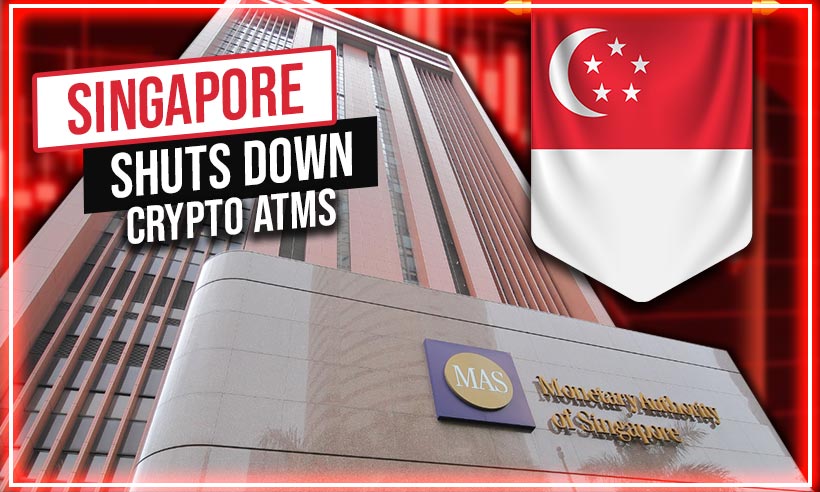
Singapore Crypto ATMs Shut Down Following MAS Guidelines

Singapore Crypto ATMs Shut Down Following MAS Guidelines

Cryptocurrency ATMs have shut down in Singapore following the guidelines by the country’s central bank, the Monetary Authority of Singapore (MAS).

According to fresh guidelines issued Monday, the MAS has banned crypto firms from advertising their services in public places, websites, and social networks in an effort to regulate advertising cryptocurrencies to the public.

To comply with the new regulations published by the MAS, two cryptocurrency ATM operators Daenerys & Co. and Deodi Pte have already shut down all of its crypto ATMs on Monday, which it said came as a surprise.

“To comply with the sudden announcement, we have ceased to offer buy or sell services via our five ATMs while seeking further clarification from the MAS,” said one crypto ATM operator.

Both Daenerys and Deodi are among the companies that have applied to the MAS for a license to offer digital payment token (DPT) services, commonly known as cryptocurrencies. About 170 firms applied for a license but about 100 have either withdrawn their applications or have been rejected by the central bank.

The central bank clarified that it ‘has observed that some DPT service providers have been actively promoting their services through online and physical advertisements or through the provision of physical automated teller machines (ATM) in public areas.

The MAS has specifically restricted ATMs that can convert cash into Bitcoin, Ether, and other digital currencies. According to the watchdog, the convenience offered by cash-to-crypto terminals could lead the public to buy cryptocurrencies ‘on impulse, without considering the risks.’

Singapore’s Central Bank Supportive of Global Crypto Economy: Ravi Menon

Singapore's global crypto economy

Singapore could become a global leader in the cryptocurrency economy, according to Ravi Menon, managing director of the Monetary Authority of Singapore (MAS). “We think the best approach is not to clamp down or ban these things,” said Ravi. Instead, MAS is for stronger regulations, so that firms can meet their requirements and address the multitude of risks that can operate.

MAS Supportive of Singapore’s Part in Global Crypto Economy

Appearing in an interview with Bloomberg.com in anticipation of next week’s Singapore FinTech Festival, the managing director of Singapore’s central bank (MAS), Ravi Menon endorsed building a well-regulated crypto hub in Singapore where it could extend beyond the financial sector.

“It could help create jobs, create value-add, and I think more than the financial sector, the other sectors of the economy will potentially gain.” Menon said.

According to him, the only way forward is a careful investment into the world of cryptocurrency for a prospective future, “the shape of which is not clear at this point.” At the same time, he advocated that the country must raise its safeguards to counter risks including illicit flows.

The Plan to Become Global Crypto Hub

Singapore’s status as a cryptocurrency and blockchain hub has attracted a string of crypto firms from Binance Holding, to Gemini to set up as a regional base.

In fact, over 170 companies have applied for a MAS license, to operate under its Payment Services Act. That number has now increased to about 400 after a law came into effect in January last year. Since then, only three crypto firms have received the licenses, while two were rejected. Meanwhile, 30 firms withdrew their application after engaging with the regulator.

Among those approved is the brokerage arm of DBS Group Holdings, Singapore’s largest bank who already set up a platform for trading digital tokens while offering tokenization services.

MAS Singapore Places Binance.com on the Investor Alert List

MAS Singapore Places Binance.com on the Investor Alert List

The Monetary Authority of Singapore (MAS), the Central Bank and Financial Regulator, places Binance.com on the Investor Alert List. As revealed, the placement took place on Thursday and mentions only www.binance.com on the list which provides a list of unregulated bodies, which have been wrongly perceived as being regulated or licensed by the regulators.

MAS Singapore Puts Binance.com on the Investor Alert List

A week ago, Binance exchange hired the former Chief Regulatory Officer of the Singapore Stock Exchange, as the CEO of Binance Singapore. Richard Teng has also operated at the MAS for 13 years as Director of Corporate Finance from the years 1994 to 2007.

In addition to this, it should be noted, that the Singapore website of Binance, Binance.sg, has not been added to this list yet as a spokesperson for Binance Singapore revealed that Binance.com and Binance.sg are two separate exchanges.

The spokesperson added:

“Binance.sg operates in Singapore with its own local executive and management team. Binance Singapore is backed by Vertex Venture Holdings and is solely focused on growing the Singapore cryptocurrency ecosystem and servicing users in Singapore.”

Additionally, he said that Binance Singapore does not offer any products or services via the Binance.com website.

Operations of Binance.sg in Singapore

Binance Singapore operates in Singapore through Binance Asia Services Pte. Ltd. and this body is currently on the list of bodies that have been granted an exemption from holding a license under the Payment Services Act for a particular period. 

The spokesperson revealed that the MAS is currently reviewing the licensing application of the entity, and said:

“Binance Singapore has applied for a license with the Monetary Authority of Singapore. We currently operate under the relevant exemption granted by the MAS and are fully committed to working closely with the MAS to comply with all required standards for license approval.”

MAS Singapore Shortlists 15 Firms to Build an In-House Retail CBDC

MAS Singapore CBDC

The Monetary Authority of Singapore (MAS) has recently shortlisted 15 Global CBDC Challenge participants in order to develop an in-house retail Central Bank Digital Currency. As revealed in the announcement made by the MAS, the finalists include six companies from Singapore, four companies from the United States, and one each from France, Australia, Singapore, Germany, and Barbados. However, only three winners are going to be shortlisted to deploy a retail CBDC in Singapore.

MAS Singapore Selects 15 Companies to Develop a Retail CBDC

Following the announcement made by the Monetary Authority of Singapore regarding cash prizes for digital currency ideas back on June 28, the challenge reportedly saw the participation of over 300 fintech firms spread across over 50 countries.

As for the finalists, they include, Criteo (France), Giesecke + Devrient advance52 GmbH (Germany), Bitt (Barbados), and Soramitsu (Switzerland).

Talking locally, the shortlisted Singaporean consortiums include HSBC Bank Limited and HSBC Holdings plc, Citibank N.A., Standard Chartered Bank and Xfers Pte. Ltd. 

The move to develop a retail CBDC for Singapore is going to be complemented with a cash prize of 50,000 Singapore dollars ($37k).

In addition to this, it should be noted that the announcement revealed that 15 finalists are going to be mentored by the MAS and:

“be given access to the APIX Digital Currency Sandbox for rapid prototyping of digital currency solutions.”

Another Move of Singapore in Favor of Crypto

Throughout the year 2021, Singaporean Authorities have been making moves in favor of crypto. Most recently, the MAS gave in-principle approval to the Australian crypto exchange Independent Reserve, allowing the company to operate as a regulated provider for Digital Payment Token Services.

Reportedly, Singapore hosts a long list of 170 crypto exchange applicants, including Binance and Gemini, which are waiting for approval to conduct business within its jurisdictions.

MAS Singapore Grants Approval to Crypto Exchange Under the Payment Services Act

MAS Singapore Crypto Exchange

The Monetary Authority of Singapore, MAS, has recently granted an in-principle approval under the Payment Services Act to crypto exchange Independent Reserve. As reported, it will be allowing the crypto exchange to operate as a regulated provider for Digital Payment Token services.

Crypto Exchange Acquires Singapore Nod on Digital Token Services

In accordance with the statement released from the company, it is one of the first virtual asset service providers to acquire an in-principle approval letter for a Major Payment Institution License in Singapore.

The Chief Executive Officer of Independent Reserve, Adrian Przelozny said in a statement:

“To be one of the first cryptocurrency exchanges to be notified by MAS of our in-principle licensing approval is a reflection of the robustness of the policies, procedures, and risk management systems that we have put in place to guide our day-to-day operations. It provides certainty for us as industry participants and security for our customers.”

Tharman Shanmugaratnam, the Senior Minister of Singapore and Chairman of the Monetary Authority of Singapore replied to a question raised in the parliament on July 26 that said:

“Several applicants were in the final stages of review for getting a license to operate as digital payment token service providers.”

More About the Independent Reserve

Since the outset of the Payment Services Act that was implied back in the month of January of the year 2020, around 170 applicants have applied to provide digital payment token services. 

In addition to this, Tharman said that 30 applicants have been withdrawn following the engagement with MAS while the two had been rejected already.

In response to queries, the regulator said that:

“Applicants will be subject to close scrutiny in the licensing process and ongoing supervision by MAS.”

The Independent Reserve was established back in the year 2013 and it embarked on its international expansion plans in late 2019.

Singapore Central Bank Launches Global Challenge for Retail CBDC Solutions

Global CBDC Challenge

The Monetary Authority of Singapore (MAS) has unveiled a Global CBDC Challenge calling on companies around the world to provide solutions for retail CBDCs innovations to improve payment services and promote financial inclusion.

MAS Launches Global Challenge for Retail CBDC Solutions

The Monetary Authority of Singapore (MAS) announced on June 28 seeking market-ready solutions that address 12 problem statements related to CBDC instruments, distribution, and infrastructure to promote the creation of innovative solutions that address payment inefficiencies and enhance financial inclusion.

The initiative has been launched in partnership with the International Monetary Fund, the World Bank, the Asian Development Bank, the United Nations Capital Development Fund, the United Nations High Commission for Refugees, the United Nations Development Programme, and the Organisation for Economic Co-operation and Development.

In the announcement release, Sopnendu Mohanty, MAS Chief FinTech Officer, said:

“Through the Global CBDC Challenge, MAS hopes to encourage innovator communities worldwide to develop and showcase solutions that can maximize the potential of CBDC to deliver efficiencies to payment services, improve financial inclusion, consistent with central banks’ core mandate of monetary stability.”

The MAS says that it seeks market-ready solutions that can address 12 problem statements centered on three key areas such as improving and expanding accessibility and utility of digital payments, mitigating risks associated with payment transfers, providing a viable infrastructure that is low-cost, efficient, and robust that facilitates trusted settlement of payment transactions among participants.

Cash Prizes and Mentorship Access

The competition will be supported by Amazon Web Services, Mastercard, payments platform Partior, blockchain software developer R3 and blockchain project Hyperledger and open to FinTech companies, financial institutions, and solution providers around the world.

Finalists of the challenge will have the chance to pitch their solutions to the global audience at the Demo Day that will be held at this year’s Singapore FinTech Festival in November 2021.

The deadline for submissions is July 23. Up to three winners will each receive S$50,000 (US$37,000) in cash prize money with up to 15 finalists will go on to receive mentorship and access to the APIX Digital Currency Sandbox.

STAE Along with Other Firms Granted Exemption in Regulatory Framework

STAE

Blockchain technology and the firms dealing in blockchain or cryptocurrency are a subject of doubt in different countries. It does not come under legal tender in many countries and huge restrictions have been imposed on them by regulators.

The regulations related to blockchain and the firms dealing with it are unclear in different firms. Recently, there have been some changes in the regulations related to blockchain in Singapore. According to the Payment Services Act of Singapore, STAE along with WeChat and Aliplay have been exempted under the regulations. 

Exemption period granted to select businesses by MAS

The Monetary Authority of Singapore (MAS) which is the central bank of Singapore has given certain exemptions. These exemptions are for the different firms and STAE is also included in them.

The major reason for providing this exemption is to make sure that there will not be an impediment in conducting business operations. The exemption that has been granted to STAE and other firms will allow them to conduct operations in specific areas. Those areas include Account Issuance Service, Cross-Border Money Transfer Service, Digital Payment Token Service and a lot more.

STAE working with legal team to get the official license 

This exemption by the MAS is a great relief for various firms otherwise there would have been great difficulties in their businesses. Meanwhile, STAE is working along with the legal team in order to get the official license. STAE is working on it so that it won’t face difficulties in conducting operations when its license will get expired.

Currently, STAE deals in stablecoins which are tied with USD or RMB otherwise backed by ETC or BTC. These stablecoins are also linked with different wallet providers. These will be later linked up with a custom messager application.

It has been assumed that if the firms will be able to get the license then there will be a first crypto version of WeChat. This will happen for the first time in the whole crypto industry.

You May Also Read.