Stripe Launches Fiat-to-Crypto Payment Service for Web3 Businesses

Stripe

According to a statement released on Thursday, the payments processor Stripe has launched an initiative to make Fiat-to-Crypto transactions easier for businesses in several nations.

Fiat-to-Crypto Payment Services by Stripe

Customers will be able to immediately buy cryptocurrencies in Web3 applications with the help of the product. It is a widget that can be customized and easily integrated into a decentralized exchange (DEX), non-fungible token (NFT) platform, wallet, or decentralized app (dapp). Solana is the foundation for 11 of the company’s original 16 initiatives. According to Stripe, it provides flexible on-ramping services and manages know-your-customer (KYC) payments, fraudulent, and compliance challenges.

According to a blog post by the business, it designed the Fiat-to-Crypto onramp to eliminate complications.

Easy Transfer of USDC Payments

Since last year, Stripe has increased the number of cryptocurrency firms with whom it has alliances. As a result, 67 more nations now enable cryptocurrency payouts, making it possible for corporations to transfer USDC payments to individuals and organizations worldwide.

The decentralized music discovery network Audius announced that it accepted Stripe’s payment solution. So, that users can use their credit cards to purchase their native AUDIO coin and tip their favorite musicians. Audius is one of the first companies to use Stripe’s new on-ramp. In July, the company made a first move toward permitting users to donate to musicians using virtual currencies by allowing them to do so using AUDIO they had won on the system.

Sui Network From Ex-Meta Employees Launches Its Testnet “Wave 1”

Sui Network Testnet Wave 1

Sui Network, a layer-1 blockchain established by ex-Meta (now Facebook) employees, has announced the opening of its testnet “Wave 1”, a location where the sustainability of the system can be thoroughly examined.

“Wave 1” For Validators and Full Nodes

According to a Twitter post from Sui Network, the testnet “Wave 1” would be used for verifiers and complete nodes to enhance decentralized coordination + incident reaction and designate a core set of functions expertise in installing, monitoring, and debugging.

In recent months, Sui has acquired a lot of traction and is considered a rival to the Aptos blockchain, developed by ex-Meta personnel. The programming language Move is utilized by both Aptos and Sui.

Mysten Labs Fundraising Round

The Sui Blockchain’s creator, Mysten Labs, earned $300 million in a fundraising round headed by the now-defunct FTX Ventures in September. During the fundraising round, Mysten Labs was also valued at $2 billion. The Sui blockchain’s creators introduced Mist units in October in an effort to enhance the network’s transaction infrastructure.

Developers can continue to utilize Sui’s developer network (devnet) to test and create decentralized applications (dapps).

Blockchain Company AltLayer Recruited Amrit Kumar as COO

AltLayer COO

AltLayer, an Ethereum-based layer 2 scalability blockchain, has announced that Amrit Kumar has been hired as its COO.

Amrit Kumar – the New AltLayer COO

According to a statement from the Singapore-based business, Kumar, 34, would be in charge of carrying out the organization’s worldwide operating model and advancing its goal of creating personalized services for Web3 apps and innovators.

Kumar co-founded Zilliqa Research, where he served as president and chief science officer before founding AltLayer. Layer 2 describes a collection of off-chain systems or unique blockchains constructed on top of layer 1s. The foundational network of a blockchain is known as a layer 1 network.

Development of Web3 Apps and Dapps

About 25 individuals work for AltLayer, which develops compensation blockchains for Web3 applications and decentralized applications (dapps). A dapp is a digital application that leverages blockchain technology to protect users’ data from the companies who created it. The next version of the internet, known as Web3, encourages decentralized protocols and seeks to lessen reliance on major tech firms.

Binance Launches Oracle Network to Run Web3 and BNB Chain Ecosystem

Binance Industry Map

Binance, the world’s largest cryptocurrency exchange by market cap, has announced the debut of Binance Oracle, a new data feed platform that enables blockchain smart contracts to communicate with actual data, beginning with its own internal blockchain service, BNB Chain.

Binance Oracle Network

To begin with, Binance Oracle will give BNB Chain users using decentralized apps (DApps) access to current data sources and sophisticated computations. Binance acknowledged that more than ten BNB Chain projects have already collaborated with the Binance Oracle network.

Other blockchains will eventually have access to the capability of connecting smart contracts with off-chain data. Gwendolyn Regina, investment director at BNB Chain, outlined the significance of the network by stating that it would be essential to use oracles to significantly expand the smart contract’s understanding of what is happening outside of the blockchain and to enable it to react to external events with predetermined actions.

Employing Five Components for Reliability

Using five robust components, including internal TSS (Threshold Signature Scheme) to verify individual data feeds and aggregating prices from many CEXs, Binance Oracle can reach the maximum level of reliability. It facilitates a choice of straightforward interfaces to on-chain DApps, as well as 24-hour data monitoring and prompt reaction, and provides the most current index price to the on-chain oracle, enabling a configurable timespan or price variance.

Binance further disclosed that the network employs an inbuilt Threshold Signature Scheme for every data feed and price accumulation using an algorithm, which, in its opinion, assures excellent dependability.

Binance Permanently Destroyed $547M of BNB Tokens

On October 13, Cryptoknomics reported that Binance permanently destroyed $547 million in Binance Coin (BNB), but markets remained calm. According to a statement from Binance, 2,065,152 tokens worth approximately $600 million, were destroyed. Additionally, the exchange disclosed that 4,833.25 BNB tokens were destroyed as part of its Pioneer Burn Program, which assists users who mistakenly lose their digital assets.

DeFi Privacy Protocol Railgun Introduced Railway Wallet Mobile App

The Railway Wallet mobile app, developed by Decentralized Finance (DeFi) privacy protocol Railgun, enables users to conduct DeFi actions on the Ethereum blockchain in private.

Secure Interaction of Users

Users may interact discreetly with decentralized exchanges (DEX), decentralized apps (dApps), and liquidity providers due to Railway Wallet, which safeguards users’ transaction histories and guarantees “untraceability” with applications like Etherscan. The mobile wallet is suitable for both Apple’s iOS and Android operating systems, making it the first zero-knowledge Ethereum Virtual Machine (EVM) server to run on mobile.

According to Alan Scott, a co-founder of Railgun, as the DeFi industry grows, programmers must develop privacy-focused programs. From a consumer protection perspective, Scott told the news sources,

“If the future of finance is going to be DeFi, there has to be a privacy infrastructure in place.”

Use of Privacy Protocol

In addition to employing Railgun’s open-source code, Railway Wallet will use security protocols readily accessible by the Ethereum blockchain’s primary network as a Layer 1 application. Security companies like Trail of Bits, Hacken, and ABDK Consulting have inspected the code in the lead-up to the on-chain wallet’s introduction, and the Zokyo Security Team has given it a 100 grade. In recent months, regulators have resisted various privacy protocols, claiming that these procedures could be used to hide undesirable money tracks.

User’s High Expectations For Privacy

While some regulators are worried that privacy services may facilitate illegal activity, Scott contends that consumers should have high expectations for privacy in DeFi settings, just as they would in other spheres of their lives.

Scott stated,

“Whenever I go to a restaurant, I may tell them about my nut allergy, but I don’t hand them the entirety of my medical records. And I think the same thing is quite applicable to finance.”

Railgun DAO and Digital Currency Group (DCG) agreed to a $10 million agreement in 2021 to develop a privacy protocol for the decentralized finance (DeFi) industry.

Binance Launching Red Alarm Tool to Help Users Detect Crypto Scams

A new tool called ‘Red Alarm’ to aid users in spotting cryptocurrency frauds has been launched on the smart contract-enabled blockchain created by crypto exchange Binance. DappBay, a decentralized application (DApp) hub with a new blockchain scanning technology that seeks to identify cryptocurrency projects that are likely to be scams, is being introduced by BNB Chain, according to a recent business blog post.

Binance Chain Ecosystem

‘DappBay’ is a DApp hub on the BNB Chain ecosystem that gives users the tools they need to move around more safely. Red Alarm, a simple-to-use contract risk scanning tool offered by DappBay, helps users protect their investments from potential threats by identifying prospective high-risk projects.

To help traders maximize their investments, DappBay also assesses recently established digital asset ventures based on market data. Based on market statistics, DappBay selects and ranks the top recently launched projects, such as Games, DeFi (decentralized finance), NFT (non-fungible token), etc. You may quickly locate the newest and most well-liked projects and take advantage of investment possibilities with the help of the “Fastest User Growth,” “Best Performing Tokens,” and “Trending” rankings.

According to Gwendolyn Regina, investment director at BNB Chain, the security tool’s goal is to assist traders in staying one step ahead of con artists and safeguarding their capital. The BNB Chain community can rate and shortlist the finest newly released projects, including Games, Defi, NFT, and others, using market data provided by DappBay. The Red Alarm function is of paramount importance, which alerts the community in real-time to potential risks linked with the projects and helps users keep one step ahead of scammers.

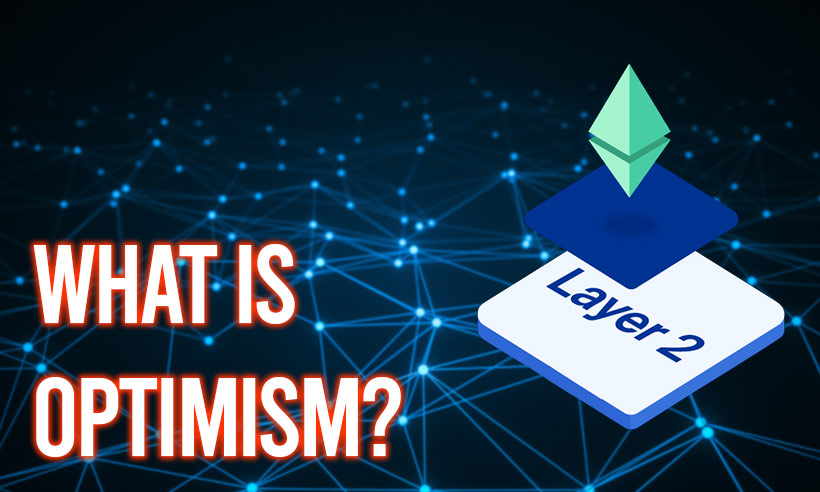
All You Need to Know About Optimism: Low Cost Layer 2 Blockchain Solution

Layer 2 Blockchain Solution

Optimism is the first Ethereum Layer 2 Blockchain Solution to develop an Optimistic network that is Ethereum Virtual Machine (EVM) compliant. It runs alongside Ethereum and can handle transactions at scale while inheriting Ethereum’s security. The word Optimistic Rollup comes from the manner transactions are handled. Transactions are assumed to be accurate by default, and no calculations are performed. To assure the legitimacy of the transactions, it uses a fraud-proof system. To know about Optimism in greater detail, continue reading.

Fraud Proof System Working

Verifiers (anyone running an Optimism network full node) can question the validity of transaction proposals given by sequencers. The rollup will do a check by conducting the transaction’s calculation on Ethereum. Before they are approved and transmitted to the Ethereum main net, transaction proposals can be disputed under the challenge time, set to one week for Optimism.

The verifier is rewarded, while the sequencer is penalized if the proposal is found to be fake. Sequencers must have a pool of bonded ERC-20 tokens to collect the payouts. The needed coin in the instance of Optimism is ETH. This aligns incentives so that verifiers are rewarded for catching bad actors, and sequencers for only submitting proper transaction proposals. The false proposal is withdrawn and replaced with the correct proposal. The false proposed outcome of the transaction is eliminated, but the transaction itself is not overturned.

Aside from its technological prowess, Optimism layer 2 is notable for the fact that a Public Benefit Corporation runs it with the objective of promoting the public goods protocols. Because the product isn’t fully decentralized yet, the team gives all earnings from running a centralized sequencer to scaling and supporting Ethereum-based public goods. In 2021, the team donated $1 million to similar programs.

Know All About How Optimism Works

The ultimate purpose of Optimism is to improve the sustainability of transactions on the widely used Ethereum network. However, by lowering costs and increasing speeds, demand for ETH will rise. Increased growth should be possible- thanks to the network’s vibrant ecosystem (which includes money markets, user-friendly wallets, exchanges, yield aggregators, and so on).

Let’s look at some of the technical aspects that make this possible.

Optimism’s sequencers perform calculations off-chain. They broadcast compressed transaction data into an Ethereum smart contract at regular checkpoints. Because computation consumes a lot of resources, it can be scaled by transferring it away from Ethereum. Every time the sequencer releases transaction data, there is a window in which anyone can perform their computation to see if the data is authentic. In other words, the verifier verifies the data. The smart contract subsequently validates the information. The verifier will receive a portion of the deposit as a reward for their efforts, while the remainder will be burned.

A new sequencer then checks the data registered on-chain. In the end, the system gives sequencers and verifiers a reason to work. This will also encourage Optimism layer 2 stakeholders to engage in the sequencer data verification. It’s worth noting that there’s a seven-day lockup period. Users can withdraw their cash back to the Ethereum network after this time has passed.

In a word, Optimism can use both on-chain and off-chain computational capabilities to run its Layer 2 scaling Layer 2 Blockchain Solution. It may also run a variety of Ethereum applications. Users benefit from faster, less expensive transactions, which helps the Ethereum ecosystem expand and prosper.

Everything You Need to Know About Optimism Tokenomics

The project’s native token is OP. OP token holders are a member of a bicameral system in which they form a body to vote on specific governance issues. OP tokens were airdropped to users and protocols who contributed to the Optimism layer 2 ecosystems, and they will be dispersed through the OP Governance Fund to future initiatives based on Optimism. The following are some of the existing OP usage cases:

Governance Overview of OP

The Optimism Collective is founded on the belief that a vibrant and valuable ecosystem requires robust public goods. The ecosystem’s economics is meant to generate value for stakeholders in the following three ways:

  • Token holders gain value through the productive re-deployment of sequencer revenue. Sequencer money is generally used to fund public goods, which adds value to the ecosystem and promotes block space demand.
  • Contributors and builders gain value directly from retroactive public goods funding and the markets it facilitates. Builders benefit from a symbiotic relationship; it’s preferable to develop in an ecosystem that includes well-funded tools, education, apps, and infrastructure.
  • Users and community members benefit from continual OP airdrops, project incentives made feasible by OP ecosystem funding, and the benefits provided by public goods.

Token Allocation

Allocation of User Airdrops: 19%

Members of the Optimism and Ethereum communities get a portion of the OP allotment in numerous waves from the Optimism Foundation.

1st Airdrop

The first user airdrop was distributed to 5% of the total supply of OP tokens. This airdrop is intended for persons who-

  • Act in a positive-sum manner.
  • Actively participate in their communities.

Future Airdrops (Numbers 2, 3, and so on)

A portion of the OP token supply will be retained in reserve for future user airdrops, amounting to 14% of the total supply. Because airdrops can be gamed, the Optimism Foundation will be in charge of calculating airdrop metrics as somewhat as possible. Airdrops are distributed to addresses that positively impact the Optimism community. Participating in future airdrops is the best method to increase your chances of receiving them.

Allocation of the Ecosystem Fund: 25%

The Ecosystem Fund is a financial incentive scheme aimed at promoting the growth of the Collective ecosystem. This allocation will be used to directly fund communities and businesses that are driving the Collective ecosystem’s progress (OPCOs).

The Ecosystem Fund’s contribution will be further divided into the following categories.

  • Fund for Governance (5.4 percent )
  • Partners Fund(5.4 percent )
  • Seed Fund (5.4 percent )
  • Unallocated funds (8.8 percent )

The Ecosystem Fund is meant to be a temporary Layer 2 Blockchain Solution that will be phased down once the OP in the fund is finished. We expect the Ecosystem Fund’s (proactive funding) function to be eventually superseded by private third-party investors who will be paid out through the Retroactive Public Goods Funding (opens new window) mechanism. The diverse funding systems ensure that airdrops continue to flow to users who contribute significantly to the ecosystem.

These contributions lead to ecosystem growth, which leads to increased demand for block space, which in turn leads to revenue, and is subsequently productively re-deployed into the ecosystem as new airdrops. Each fund may be viewed as a separate OP allocation experiment, allowing for rapid iteration and doubling down on what works to help the ecosystem expand even more.

Governance Fund

The first Governance Fund was allocated 5.4 percent of the total quantity of OP tokens. This fund will provide tokens to all initiatives that demonstrate Optimism usage.

Partners Fund

The Partner Fund will be allocated 5.4 percent of the total supply of OP tokens. The Optimism Foundation will wisely distribute this money to grow the Optimism ecosystem for the benefit of the entire Collective.

Seed Fund

The Seed Fund will get 5.4 percent of the OP token supply, which will fund early-stage enterprises emerging in and around the Optimism ecosystem.

Unspent Funds for Future Growth Initiatives

An 8.8% of the OP token supply will be set aside for future community growth initiatives.

Allocation of Retroactive Public Goods Funding

The Citizens’ House will first distribute 20% of Retroactive Public Goods Funding (RetroPGF). RetroPGF rounds are scheduled to take place every quarter to ensure that all OPCOs are adequately, correctly, and dependably compensated based on their influence on the Collective—a critical component of our vision (opens new window).

Allocation to Core Contributors: 19%

The Core Contributors allocation will be awarded to those who assisted in bringing Optimism and the Optimism Collective to life and continue to fund protocol development. A lockup term will apply to any tokens distributed as part of the Core Contributors allotment.

Sugar Xaddies’ Allocation: 17%

A lockup term will apply to any tokens awarded in the Sugar Xaddies allocation.

Token Distribution

A total amount of 4,294,967,296 OP tokens were available at genesis. The total supply of tokens will grow at 2% every year. As indicated above, 64 percent of the initial token supply (the whole quantity of OP not held for core contributors or sugar xaddies) will be released to the community. As a steward of the Optimism Collective, the Optimism Foundation will handle these distributions throughout time.

The Foundation will be given 30% of the initial token supply to distribute in the first year. Token holders will vote after the first year to establish the Foundation’s yearly OP distribution budget. It anticipates requesting the following annual contributions:

  • 2nd year: 15 percent of the initial token supply
  • 3rd year: 10% of the initial token supply
  • 4th year: 4 percent of the initial token supply

Conclusion

Optimism Layer 2 Blockchain Solution is here to stay, and it will be where the majority of Ethereum transactions occur in the future. Layer 2s have been criticized for adding to the user’s complexity by requiring them to take different procedures to get assets on and off the chain. Given the current state of affairs, such criticisms are justified, but they will be addressed over time by third-party tools that streamline the process or by the Layer 2 teams themselves. They are not rendered obsolete by ETH 2.0 but empowered to become more scalable and efficient.

Many existing dApps will be enticed to give Optimism a try because of its ease of deployment, and the low gas fees will attract users to transact on the chain as its ecosystem develops. They are actively supporting and expanding high-impact initiatives in the Ethereum ecosystem by providing funding in addition to building software.

Hopefully, this article will have helped you learn everything that you need to know about Optimism and the role that it can play in redefining Layer 2 Blockchain Solution.

Cardano Founder Features On London’s Most Popular Newspaper

Cardano Founder

Cardano founder Charles Hoskinson has been featured in Crypto A.M. Magazine, a subsidiary of City A.M., London’s most-read business newspaper, according to a recent tweet from the research and development company behind the network IOHK.

Hoskinson is featured on the cover of the online magazine alongside Binance co-founder Yi He and British MP Matt Hancock, who are also staunch supporters of cryptocurrencies. In the magazine, Hoskinson sums up his plans for the Cardano network for 2022, saying:

“2022 is the year of governance. This doesn’t mean we’ll stop working on building a better, faster, and cheaper blockchain, but each year has a theme.”

The developer names the long-anticipated Vasil hard fork as the key moment to watch out for this year. Hoskinson asserts that the upgrade expected at the end of July will boost the network’s capacity and improve Plutus, its smart contract programming language.

Vasil Testnet Upgrade Nearing Launch

The Vasil upgrade is slated to bring “significant performance and capability upgrades” to the blockchain, with IOHK describing the fork as the “biggest and best upgrade to date,” providing higher throughput, improved script performance for developers, and lower costs.

One of the most significant updates is aimed at improving the blockchains’ scalability for decentralized applications (DApps). The update will allow faster block creation as they can be transmitted without full validation.

If everything goes smoothly, the upgrade to the testnet will take place on July 3, with the mainnet upgrade scheduled for around the end of July.

Convex Finance Sets Up New Website Addresses After Website Hijack

Convex Finance

Convex Finance, a decentralized staking platform, set up new internet addresses (URLs) after an attack involving the prior address led users to a fraudulent website. The developers stated in a tweet that we had fixed the issue and an investigation is still on. Popular protocol Convex enables customers to profit from the stablecoin swap service Curve Finance. The Domain Name Service (DNS) converts user-typed website names into the standard numeric address coding used on the internet. By intercepting that procedure, it is possible to reroute people to other websites with potentially malicious purposes.

Five Vulnerable Wallets

Alexintosh.eth raised a potential exploit concern last night on Twitter, alleging that approvals for contracts were impersonating wallet addresses and tricking users into approving the wrong wallet operations. Convex then prompted users to “review approvals” as developers looked into a “possible front end issue” shortly after. Convex identified five wallets as being vulnerable to the susceptibility. According to developers, funds on confirmed contracts on Convex were unaffected. Token approvals or rights users give to decentralized apps (dApps) to access tokens in their crypto wallets are the basis of how crypto wallets operate.

Protocol’s Website Mimic

In a phishing assault, attackers may mimic a protocol’s website’s front end to trick users into approving the erroneous action, giving the attacker access to the wallet that has been compromised and enabling them to syphon tokens from that wallet. As alternatives for users, the creators setup “Convexfinance.fi” and “frax.convexfinance.fi.” According to a tweet from the site’s developers, users are advised to engage with the site using these URLs while the DNS hijack inquiry is ongoing.

Cardano’s IOG Launches Ethereum Virtual Machine Sidechain Alpha

IOG Ethereum virtual machine

Input Output Global (IOG) formerly known as “IOHK”, the company responsible for Cardano’s research and development, has launched a permissionless Ethereum Virtual Machine (EVM) sidechain Alpha on testnet.

IOG Launches EVM Sidechain Alpha on Testnet

On Sunday, IOG tweeted that the alpha version of this Ethereum Virtual Machine (EVM) sidechain had been released on the testnet. The initiative will enable developers to build different solidity-based applications on the Cardano network, as well as import their solidity apps from Ethereum to Cardano.

“We’re releasing the Ethereum Virtual Machine (EVM) sidechain alpha! (Now on testnet.) Build your Solidity-based applications on Cardano, a decentralized, permissionless, sustainable blockchain. The future is interoperable,” the IOG team wrote in its tweet.

As of yet, it is not known when the EVM sidechain on the mainnet will be officially launched for a full-fledged roll out.

A few days ago, IOG shared a tweet explaining how Solidity developers could “apply for access to the EVM sidechain alpha release.”

EVM Sidechain Was Discussed Back in April

Meanwhile, the move to roll out the EVM sidechain was first discussed in April, in a blog post titled “Interoperability is key to blockchain growth.” In the post, the EVM sidechain as well as five other Cardano sidechains were discussed.

“IOG is planning to release a new permissionless EVM sidechain this year. This sidechain will allow developers to write Solidity smart contracts on Cardano, create EVM compatible dApps, and ERC20-compatible tokens (and in time, their own sidechains) while gaining many of the benefits of Cardano,” an excerpt of the blog post reads.

IOG noted that the EVM sidechain has full compatibility with Ethereum upgrades and tools, Web3 wallets, and Ouroboros Byzantine Fault Tolerance consensus protocol including its ability to inherit security from the Cardano main chain.

Is Polygon (MATIC) Worth Hodling?

s Polygon (MATIC) Worth Hodling

Polygon is an open-source blockchain that supports the launch of Decentralized Applications (Dapps) on its platform. Its native token is MATIC.

At the time of writing, Polygon (MATIC) is ranked in the 17th position in the CoinMarketCap ranking of cryptocurrencies. Uniswap is the largest Decentralized exchange in the world presently. MATIC trades at $0.6442 at present with a 24 hours decrease in price by 7.39%.

Polygon (MATIC) has reduced by 55.5% in the past 30 days. MATIC 30 days low and high prices are $0.56 and $1.50 respectively.

Some of the reasons why MATIC remains a good hodl are:

  • Present data of sellers’ pressure.
  • The attraction of Non-Fungible Tokens projects to Polygon Blockchain.

Present data of sellers’ pressure

Technical analysis data on Polygon ( MATIC) shows that out of the 11 oscillator indicators analyzed, 1, 9, and 1 indicate sell, neutral, and buy signals respectively. Also, out of the 15 moving average indicators analyzed, 14,1, and 0 indicate sell, neutral and buy signals respectively. This means that 15, 10, and 1 indicators gave a sell, neutral, and buy signals respectively. The relative strength index of Polygon (MATIC) is 31.8. This means that it is close to it’s oversold/undervalued region of 30. If this happens, investors could see a bullish market reversal.

The attraction of Non-Fungible Tokens projects to Polygon Blockchain

In recent times, due to the recent explosion and gains that are associated with non-fungible tokens (NFTs), there has been an inflow of more investors to the market. One of the factors that had been a hindrance to its growth is the high gas fees associated with the Ethereum network. However, some of the market places for trading NFTs in the Decentralized market have now been adding trading on Polygon Blockchain as another option. This has attracted some of the projects and new ones to the Polygon ecosystem. With this rise, there will be more adoption of Polygon native token MATIC.

Conclusion

Polygon blockchain at present is competitive as an alternative to Ethereum blockchain. However, an inflow of more projects into it will attract more investors, which will directly increase the price of MATIC tokens.

Coinbase Launches Direct Access To ETH-Based Dapps For Some Users

Coinbase Glitch Users

Cryptocurrency exchange Coinbase Global will allow a “small set” of its app users to access Ethereum-based decentralized apps (dapps) directly from their app.

Select Users Can Now Directly Access Ethereum-Based Dapps on Coinbase

According to an official announcement, Coinbase’s dapp wallet and browser extension would give a few of its US-based users access to DeFi and NFT marketplaces directly from its app.

Users will be able to buy NFTs on decentralized marketplaces like OpenSea and trade on decentralized exchanges like Uniswap and Sushiswap, and lend and borrow on DeFi platforms like Compound and Curve without leaving the Coinbase app.

The new feature will be rolled out in the US on Android to a select number of users, with further plans to expand to all users soon.

“We want to enable everyone to seamlessly and safely participate in web3, and today’s launch is another step on that journey,” said Rishi Dean, Director of Product Management.

Secured With MPC Technology

The dapp wallet is operated with Multi-Party Computation (MPC) technology, which secures the privacy of senders and receivers while ensuring the accuracy of a transaction.

“This means if you lose access to your device, the key to your Dapp wallet is still safe and Coinbase can assist in recovery through our live support,” Dean added.

What to Expect if IOTA Trades Below $0.15

What-to-Expect-if-IOTA-Trades-Below-$0.

Most investors are happy with the recent pullback in the price of most cryptocurrencies. There is a possibility that IOTA trades below $0.15 in the near future. However, for IOTA (MIOTA), it could go either way after it has surged to $0.335 and gained 34.44% in the past 24 hours. At the time of writing, the 24 hours low and high prices of MIOTA were $0.237 and $0.3403. It holds the possibility of reaching a new bottom after attaining a 90-days low price of $0.2759 on May 12th, 2022.

Next, let’s explore the possible consequences if IOTA trades below $0.15 or nears that level. Here are a few:

  • A high re-bounce to trade around $0.45
  • A consolidation to determine the next move
  • A dip breakout to trade below $0.1.

A High Re-Bounce to Trade Around $0.45

A price-dip of IOTA trades below $0.15 is likely to occur soon. If this happens, the present re-bounce that had made it surge by over 34% in the past 24 hours would be a minimum pullback. The extreme buyers’ continuous pressure would give it a high uptrend to regain the recent losses.

A Consolidation to Determine the Next Move

At about $0.15, IOTA might experience consolidating prices for some days. The reason for this is that most investors and traders want a clear signal before deciding on their next move. MIOTA holders should expect a consolidation of the market to last for some time unless a major update or change occurs within the IOTA ecosystem.

A Dip Breakout to Trade Below $0.1

Sellers might wish to cash out from the market to minimize their losses. Consequently, this could trigger a selling pressure which might push the price of MIOTA below $0.1. CoinMarketCap states that more investors are likely to buy the dip at this cost, as it is almost getting close to its all-time low price of $0.07962.

Conclusion

It would be wise to invest with caution as the current market pullback could reverse the lead to a higher crypto winter than the one just experienced.

Chainlink : Enabling Smart Contracts to Interact With Real World Data

Chainlink Enabling Smart Contracts to Interact With Real World Data

In today’s world, blockchain oracles are frequently thought of as decentralised services with a single goal, i.e. to transfer data from off-chain sources into blockchains. It’s only a small step from forwarding data to computing, storing it, or manually transferring it. This finding supports a considerably broader interpretation of oracle functionality.

Smart contract service requirements are expanding, as are the diverse technologies that rely on oracle networks. In other words, an oracle may and will be a general-purpose, computer-enabled interface, bidirectional for off-chain and on-chain systems. Oracle’s mission in the blockchain ecosystem is to improve smart contract performance, functionality, and interoperability to introduce new trust models and transparency to various businesses.

This will be accomplished through expanding the usage of hybrid smart contracts, which combine the distinctive qualities of blockchains with the unique capabilities of off-chain systems like oracle networks to achieve far more reach and power than on-chain systems alone. Chainlink is useful in this situation.

What is Chainlink?

Chainlink is a decentralised oracle network that enables smart contracts to securely interact with real-world data and services outside of blockchain networks. Chainlink is not a monolithic network like a blockchain but rather an infrastructure and framework for building blockchain-agnostic oracle networks that augment the capabilities of blockchains and layer-2 protocols.

Each Chainlink oracle network is made up of numerous independent oracle nodes that gather data from a variety of sources, combine it into a single data point, and provide it on-chain for smart contracts to consume. The modular design of Chainlink enables highly adjustable oracle networks, which can be made up of node operators and data sources and use various network settings like update frequency, fee payment amounts, etc.

Professional DevOps infrastructure providers, top organisations, and premium data providers run Chainlink nodes, which enable smart contracts with access to cryptographically signed data for further security. Chainlink’s flexible design allows it to deliver any form of data or computation to any smart contract application running on any blockchain.

Steps Followed by Chainlink to Validate Data

Chainlink nodes translate the requesting contract data request using the Chainlink Core software solution, and this request is translated from an on-chain programming language to an off-chain programming language that can be easily understood by real-world sources.

The request is then sent to an external application programming interface (API) that collects data from the source of origin.

Chainlink Core translates the collected data into on-chain language and sends it to the Chainlink Aggregating Contract. Now things get interesting as the Chainlink aggregating contract can check data from various sources and reconcile data from multiple sources.

So, suppose five nodes deliver one answer from a weather sensor and two other nodes deliver a different answer. In that case, the Chainlink Aggregating Contract will know that those two nodes are faulty (or dishonest) and discard their answers. This process helps Chainlink nodes to validate data from a single source.

The Chainlink Aggregating Contract can repeat this validation process for multiple sources and then collect all the validated data and average it down into one piece of data. Under some circumstances, all the data cannot be averaged. I will not further discuss this mechanism deeply here for simplicity’s sake. Chainlink has created a way to reliably and efficiently provide accurate data to smart contracts on smart-contract enabled blockchains.

Use cases of Chainlink

Complete Decentralization

For high availability and manipulation resistance, use decentralized oracle networks made up of independent and Sybil-resistant nodes.

Nodes with Proven Security

Each piece of data is digitally authenticated by nodes and saved on-chain, it provides cryptographic confirmation of the oracle networks’ overall integrity.

High-quality Information

Access any API data source that is password-protected or authorized and is redundantly checked by several nodes to avoid failure from a single point.

Crypto-Economic Protection

Use provably safe nodes that are financially rewarded for providing accurate findings on-chain.

Security

Use cryptographic signatures, trusted execution environments, zero-knowledge proofs, and other security measures.

Open-source Community

Continuous contributions from node operators, developers, researchers, security auditors, and others will improve network security and speed development.

Blockchain-Independent

Connect to all major public and private blockchain environments using a single framework, which provides a standard abstraction level for cross-network communication.

Off-chain Processing

Hybrid smart contracts combine on-chain infrastructure with cost-effective and dependable off-chain compute to construct feature-rich decentralized applications.

Tokenomics of Chainlink

LINK is Chainlink’s native token based on Ethereum and follows the ERC-20 token standard. It can be purchased and traded for fiat money or other digital currencies.

Requesting Chainlink node operators are paid using LINK by contract holders. The Chainlink node operator determines prices based on the demand for the data they can give and the current market for that data. Chainlink node operators must deposit LINK with Chainlink to indicate their commitment to the network and incentivize good service.

When matching nodes with data requests, the Chainlink Reputation Contract considers the size of a node’s stake (among other things). As a result, nodes having a higher stake are more likely to be chosen to fulfill requests (and thus earn LINK tokens for their services). Furthermore, the Chainlink network penalizes faulty or dishonest nodes by charging their LINK stake.

Token Distribution

The LINK token had a sale on September 19, 2017, with a hard cap of $32 million. During its pre-sale, LINK was sold at $0.09 per token with a 20% bonus investors must have gotten depending on the timing of their purchase. LINK was sold at $0.11 per token in the subsequent public sale. A total of 300 million tokens were sold during both sales.

A total of one billion LINK tokens were initially distributed as follows:

The token sale investors received 35% of the total. Thirty-five percent was set aside for Node Operators and ecosystem awards, which would be dispersed to network participants as incentives. SmartContract.com, LINK’s parent business, received 30% of the funds.

The supply of LINK has been fixed. 35 percent of the total supply will be distributed to node operators as rewards, they are still liquid because of the lack of indication that any contract binds them. The contracted developer determines the benefits that nodes receive for retrieving and providing data.

Future of Chainlink

Chainlink 2.0, a multi-year effort to improve the present project’s capabilities, may be able to address some of these concerns. To facilitate services of hybrid smart contracts, the plan’s cornerstone is to build a platform of several interoperating decentralized oracle networks (DONs).

With applications that can continually run (executables) calling on adapters that retrieve off-chain data, this structure might enable persistent services. The goal is for dapps to communicate with various DONs, which will administer the off-chain computing layer for these smart contracts securely and cost-effectively, allowing for new applications of its services.

According to the roadmap, superlinear staking might be available on Chainlink as early as this year, according to co-founder Sergey Nazarov’s January 1 presentation. While the new staking model prioritizes security, it also aligns economic incentives based on (1) node reputation and (2) the size of node operators’ deposited stake, which serves as a security assurance for Chainlink service buyers.

Node operators that stake more have access to more transaction possibilities and greater rewards, similar to how staking works on proof-of-stake blockchains.

Furthermore, individuals or pools will be able to delegate or lend LINK to node operators as collateral, allowing them to share in the rewards. Staking and delegating tokens could decrease the danger of LINK supply dilution and realign some of the fee imbalances that now contribute to selling pressure, resulting in more LINK being locked up and helping to alleviate some of the difficulties we highlighted earlier.

Conclusion

However, the exact timeline for Chainlink 2.0 is unknown, making it challenging to price these future advancements, particularly in terms of growth. Chainlink already has a sizable market share of the total value secured across the crypto realm, making it doubtful that it will continue to grow at the same rate as the previous two years after the market went through the bearish environment in 2022.

Few changes that are proposed in the Chainlink 2.0 white paper appear to be conceptually dependent on future crypto project developments that may or may not eventually occur. Nonetheless, the addition of superlinear staking could mark a significant turning point in LINK’s tokenomics, which will be worth watching this year.

Near Protocol is Bullish Against the Market Trend

Near-Protocol-is-Bullish-Against-the-Market-Trend-

Near Protocol (NEAR) is bullish against the present bearish market that has plummeted the price of top cryptocurrencies like Bitcoin and Ethereum. At the time of writing, it increased by 6.99% in the past 24 hours and was trading at $11.05. In the past year, Near Protocol has gained 111%.

One could ask why Near Protocol is experiencing this present bullish trend against the trend of most coins and tokens in the market that are bearish?

Some of the factors that could be responsible are:

Over a 100% increase in its trading volume in the past 24 hours

In the past 24 hours, the trading volume of Near Protocol (NEAR) rose over 104%. In other words, it is evident that there are a lot of trading activities, and the number of buyers and investors is high. In response, the sellers raised their prices to maintain the positive trend. It then caused an increase of $0.74 NEAR price in the past 24 hours. If this buying pressure is maintained, Near Protocol might maintain this bullish gain for some time.

The recent launch of Nightshade on the Near Protocol

Near Protocol, with its native token NEAR, was launched as a layer one blockchain project to meet some challenges that inhibit the growth of Cryptocurrencies in the cloud computing areas. Correcting the low transaction speed and ensuring Blockchain interoperability might be one way to achieve this. With the recent launch of Nightshade on the Near Protocol, developers and decentralized application (DApps) creators can enjoy high scalability of about 100,000 transactions per second (TPS). Consequently, ‘NEAR’ token demand increased when various DApps began to integrate Near Protocol on their platforms.

Traders’ reaction to a critical key level

High trading volume always impacts the price positively. In a situation where both price and volume are positive, new psychological resistances are always surpassed. Traders are always very sensitive to those key levels, so they will apply a lot of buying pressure, making sure investors do not miss out on any bullish breakout on those levels.

Community sentiment

Due to a lack of knowledge about trading psychology, in a prominent bear market such as we are currently experiencing, many investors attempt to move towards any coins or tokens that are bullish. This sentiment in the community directly impacts the price of Cryptocurrency.

Conclusion

For these reasons, we saw the possible factors that might be responsible for the present trend of Near Protocol.

Synapse Network: Connecting Multiple Chains Together

Synapse-Network-Connecting-Multiple-Chains-Together

Synapse is a cross-chain liquidity network that works across all blockchains. It is a cross-chain communication protocol that enables assets, smart contract calls, etc. Blockchains can securely interact with one another thanks to Synapse, and developers can create real cross-chain applications like cross-chain DEXs, lending platforms, margin systems, derivatives markets, yield aggregators, and more.

The Synapse Bridge, which leverages AMMs deployed across 15+ EVM and non-EVM blockchains to allow users effortlessly move assets between all chains, is the first application built using this cross-chain protocol. Users can now utilize Synapse to transfer assets between the most popular EVM compatible blockchains. Out of all the interoperability options, Synapse presently provides the deepest liquidity.

How does Synapse Work?

Cross-chain multi-party computation (MPC) validators protect the Synapse network by using threshold signature techniques (TSS). The network has no leaders, and each validator maintains security by running the exact process when receiving on-chain events on the many chains that the MPC validator group monitors. 

The network reaches consensus and issues a transaction to the target chain once two-thirds of all validators have collectively signed the same transaction using their key.

They also receive SYN as a rebate for gas expenses on the Ethereum network, which can be a costly part of running a validator otherwise. Validators’ staked SYN balances are slashed if they participate in irresponsible or malicious behaviour that affects the network to maintain their honesty.

What is nUSD?

The nexus stablecoin liquidity pool on Ethereum, which includes DAI, USDC, and USDT, fully backs the nUSD, or “nexus” USD, a cross-chain bridge asset. The nUSD currency is used to facilitate asset trading between blockchains.

What is nETH?

nETH, or “nexus” ETH, is a cross-chain asset pegged to ETH and entirely backed by the ETH-only nexus ETH on Ethereum. nETH is a protocol that allows ETH to be quickly bridged to and from L2 networks like Arbitrum.

Bridge Fees

By default, the Synapse bridge charges. 0.05 percent every bridge transaction, with a chain-specific minimum cost based on average gas fees on that chain.

Tokenomics of Synapse

Synapse has its own SYN is used as a reward for liquidity providers, voting on community governance choices that affect smart contract upgrades or DAO treasury spending, and the Synapse network’s native token for transaction fees.

Uses of SYN Token

Governance

SYN is also Synapse Protocol’s governance token, allowing early adopters and future investors to have a say (and a share) in the protocol’s evolution.

Any SYN token holder with more than 50k tokens can submit a snapshot proposal to the Synapse DAO. As a result, SYN is used to gain community approval for protocol-level changes to smart contracts and actions paid for with DAO treasury funds. This includes a regular re-evaluation of the SYN emissions rate, as well as, if necessary, adjustments to the supply cap.

Protocol Fees

Protocol fees are divided between liquidity providers and the DAO treasury, from which they can be directed for community governance actions that promote SYN. This allows the treasury to collect non-SYN assets (mainly stables) while also allowing the protocol to generate demand to build the price floor required for flexible regulation of SYN emissions and supply.

Validator Economics

Validators, who provide the most critical job by safeguarding the network, are not the only integral protocol adopters who must be encouraged to benefit from the protocol. SYN may also be used as a subsidy to reimburse validators for gas spent on Ethereum to assist them to operate within the Synapse network.

Synapse Chain

Validators will be required to stake SYN when the protocol reaches its Archean, Proterozoic phases and the Synapse Chain is deployed, and validators will earn network fees. Because the Synapse Chain will be secured by Proof of Stake consensus, anyone can help secure the chain by delegating SYN to validators (and earn a portion of block rewards). SYN can be used to pay for internal network transactions and bridge to other chains.

Providing SYN with Liquidity

On Sushiswap, Synapse holders can give liquidity to SYN. SYN or SUSHI emissions are used to incentivize this. Third-party DEXes have also placed SYN on their platforms to incentivize holders to offer liquidity in exchange for a piece of the SYN trading volume.

This was the situation with Trader Joe’s on Avalanche (SYN/AVAX) in the past, and it continues to be the case with Solidly on Fantom (SYN/USDC and SYN/FTM) and IDEX on Polygon (SYN/ETH) in the present. Without Synapse Protocol’s approval, any DEX can list and create incentives for SYN (DYOR).

Furthermore, on February 23, 2022, Synapse used its voting power on Solidly to incentivize an SYN/USDC pool.

Token Supply

The maximum supply of SYN tokens is 250,000,000. Emissions of SYN to liquidity providers boost circulation supply. SYN emissions are currently around 296k per week (down close to 75 percent since the launch of Synapse in September 2021)

Upon the launch of the Synapse Protocol, SYN was distributed. Synapse took its current shape due to community governance and an airdrop to NRV holders: NRV holders were rewarded 2.5 SYN for every NRV they had at the time of the snapshot on 22-Sep-2021, whether as NRV, staked as xNRV, or in an NRV-BUSD or NRB-BNB LP.

This indicates that at the time of Synapse Protocol’s debut, all SYN holders were also NRV holders. Holders of unvested NRV were also given 2.5 unvested SYN. The Synapse DAO will decide how to deal with the unvested SYN through future governance activities.

 Conclusion

The stated purpose of Synapse is to attract a developer ecosystem to build on top of its cross-chain liquidity. Ecosystem developers can focus on developing unique use cases like cross-chain collateral, intelligent yield aggregation, and deeper, more efficient lending markets by solving the cross-chain liquidity problem natively.

Furthermore, ecosystem developers can concentrate on creating more elegant user experiences that allow users to engage smoothly between layer 1s while maintaining governance in a single location. Synapse offers actual value by solving the cross-chain liquidity problem and will be rewarded for doing so by native L1 dApps that want Synapse to route through them.

Theta Network Powering Video Platforms

Theta-Network-Powering-Video-Platform

In a global, peer-to-peer mesh network, Theta Network attempts to offer a more efficient way to transport content.

Individual users are encouraged to offer their idle computer and bandwidth resources as caching or relay nodes for video broadcasts using tokens on the Theta blockchain. This concept attempts to improve stream delivery quality and alleviate the “last-mile” delivery problem, a major bottleneck in traditional content delivery pipelines, particularly for high-resolution, high-bitrate 4k, 8k, and next-generation streams.

Most users will pull streams from peering caching nodes with adequate network density, allowing video platforms to dramatically reduce content delivery network (“CDN”) expenditures.

The Theta Network intends to empower video platforms to deepen viewer engagement, produce incremental income, and differentiate their content and viewing experience from their competitors by adding tokens as an end-user incentive mechanism.

Consensus Mechanism

A committee of 20–30 Enterprise Validator Nodes and a second layer of 1000s of community-run Guardian Nodes make up Theta’s unique multi-Byzantine Fault Tolerant (BFT) consensus system. Guardian Nodes seal blocks and work as a check on malicious or otherwise non-functional Validator Nodes.

Guardian Node counts quickly increased following Theta 2.0 in May 2020. Theta community members manage around 3,600 Guardian nodes in July 2021.

Components of Theta Network

Theta Network is a PoS blockchain network that is both quick and inexpensive, making it ideal for microtransactions. This could allow content providers to be paid in real-time for their work.

The network achieves consensus using a two-layer structure of nodes: the Enterprise Validator Node and the Enterprise Validator Node. Validator Nodes propose and produce new blocks in the chain, whereas Guardian Nodes seal blocks and check for malicious or otherwise non-functional Validator Nodes.

Enterprise Validator Node 

The validator committee comprises a small number of validator nodes in the network. These nodes have substantial computer resources that allow them to process transactions quickly and efficiently.

Guardian Node

On the Theta Network, the Guardian Node is the second tier of security. A Guardian Node downloads and evaluates the validator committee’s chain of blocks to reach a consensus.

Because there are so many of these nodes, transaction and network security are improved. Once both sets of nodes have accepted a transaction, it is complete.

Smart Contracts

Smart contracts are fully compatible with Theta Network, allowing developers to create DApps (Decentralized Applications) on the platform. A rich user experience would be ensured as a result of this.

To engage more people, video platforms would be able to construct smart contracts for loyalty programmes. In addition, video platforms would create smart contracts that would allow for real-time payment models like pay-per-use (a user would not need a monthly or weekly subscription).

Off-Chain Micropayment Support

Even though the Theta Network has a TPS of over 1,000 transactions, this is insufficient for the network’s prospective adoption. The network must be fast and inexpensive to facilitate modest payments.

Theta has created an off-chain “Resource Oriented Micropayment Pool” designed exclusively for video streaming for this purpose. Furthermore, because the technique is off-chain, the platform’s scalability would be significantly enhanced.

Edge Node

Theta Network’s Edge Node is a relatively new feature. A user, such as you or me, can provide surplus bandwidth or processing power to the Theta Network in exchange for TFUEL (the native token of Theta Network).

Tokenomics

With the following use-cases, Theta employs a two-token paradigm.

THETA is a utility token. Validator (block production) and Guardian (block finalization) nodes can stake THETA tokens in exchange for TFUEL (the second token in the Theta ecosystem).

THETA is the protocol’s governance token, which means it has a say in protocol choices, upgrades, etc.

TFUEL token utility TFUEL is the “gas” of the Theta protocol, and it is used to pay for transactions as well as the development and operation of smart contracts.

It’s also the micro-transactions currency, allowing users to pay relayers for films they’ve shared with them. The supply of Theta tokens is limited to one billion.

At the mainnet launch, each ERC20 Theta token holder received 1:1 native Theta tokens on the new blockchain. On the native blockchain, the supply of native Theta is similarly permanently fixed at 1 billion, implying that no new Theta tokens will ever be generated.

The main goal of limiting the quantity of Theta tokens is to make it prohibitively expensive for a bad actor to obtain enough tokens to pose a threat to the network. Because new Theta tokens will never be created, the only way to get more is to buy current tokens, making amassing a controlling quantity of Theta tokens more expensive over time.

In 2018, 300 million THETA were sold for $20 million in an ICO.

Token Distribution

Tokens sold in private sales accounted for 30% of the total token supply. From September 26 to December 27, 2017, it raised a total of $20.0 million at a price of $0.067 per token, accounting for 30% of the total token supply.

The team received 7.49 percent of the total tokens distributed (unlocked in January 2019).

Advisors were given 1.23 percent of the tokens distributed.

Partners were given 12.5 percent of the total tokens that were distributed.

12.5 percent of the total tokens released went to Network Seeding.

Labs Reserves is responsible for 36.28 percent of the total tokens issued.

Features of Theta Network

Theta Wallet

Theta Network features a wallet available on both the web and mobile platforms. You can keep your Theta Tokens in the wallet (TNT20 standard). The Android and iOS versions of the software are both available. With over 50 thousand downloads, the mobile application gets a 4.1 rating on Google Playstore.

The wallet may also be connected to hardware wallets such as Trezor and Ledger, which is a plus.

ThetaSwap

Theta Transfer, a Decentralized Exchange (DEX) on Theta Network that may be used to swap tokens in a decentralized environment, was just established. This is based on the Uniswap-invented Automated Market Maker concept.

TNT20 tokens are accepted on the exchange (standard tokens of Theta Network). From here, you can try Theta Swap. The exchange takes a trading fee of 0.3 percent of the transaction value, paid to the pool’s liquidity provider.

Edge Cast

Edge Cast is the first decentralized video streaming platform DApp that leverages smart contracts built on the Theta blockchain. Edge Cast is only available as part of the Edge Node application. Users may either stream their material or watch other users’ streams on the site.

Edge Cast provides a glimpse into the future of the Video Streaming Ecosystem.

Theta Mainnet Version 3.0

On June 30, 2021, Theta Mainnet 3.0 went live, bringing the staking and burning feature for TFUEL. The following are the critical characteristics of Mainnet 3.0. An Edge Node can bet its TFUEL to become an Elite Edge Node, earning higher benefits on the TFUEL they have staked. The TFUEL burning mechanism would regulate the token’s supply in the market and, as a result, the token’s value inflation.

Waves Price Prediction 2022-2026: Will the Price of WAVES Hit $70 by the end of 2022?

WAVES Technical Analysis

WAVES is the native token of the Waves multi-purpose blockchain which was launched in 2016. Waves blockchain is decentralized and open-sourced and can be used to build user-friendly applications with high scalability.

Applications in deal with sensitive data, personal finance, and decentralized applications that be built on the Waves blockchain due to its high security.

What is Waves (WAVES)?

Ukrainian-born Alexander Ivanov is the founder of Waves (WAVES). Waves blockchain uses the Proof-of-Stake consensus mechanism in its blockchain. In year 2020, the Ethereum version of Waves was launched.

Waves have remained competitive since its launched and had attracted smart contract that requires high speed and scalabilities like SIGN Art and Puzzle Swap.

Some of the top cryptocurrency exchanges for WAVES transactions include Binance, Kucoin, Bittrex, Kraken, Huobi Global, and Bitfinex.

Waves (WAVES) Price Analysis

Flashback: Fundamental Analysis of Waves

The adoption of the WAVES coin as one of the trusted cryptocurrencies for transactions in the Ukrainian-Russian war had led to its surge of 130.2% in the last 30 days according to CoinGecko. This is because Waves founder is a Ukrainian. If no peace deal is achieved soon, the price of WAVES could surpass the present all-time high of $62.32.

Also, the news of the Waves blockchain upgrade to Waves 2.0 in February has also increased the demand for WAVES. This is due to the expected launch of Metaverse games through the platform as it is presently compatible to Ethereum Virtual Machine.

Price Analysis of WAVES with Charts

https://www.tradingview.com/x/6ds8C5U7/

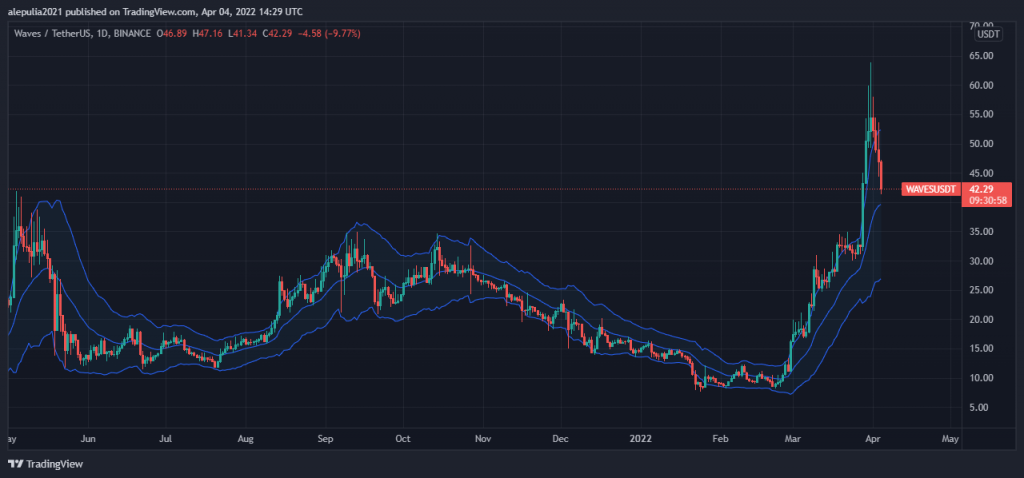
From the Waves 1Day chart above, it could be observed that the price of WAVES reached the top of the Keltner Channel curve and started reversing. This is due to reduced buyer pressure as short-term investors are cashing out their recent gains.

https://www.tradingview.com/x/UrnDLiO4/

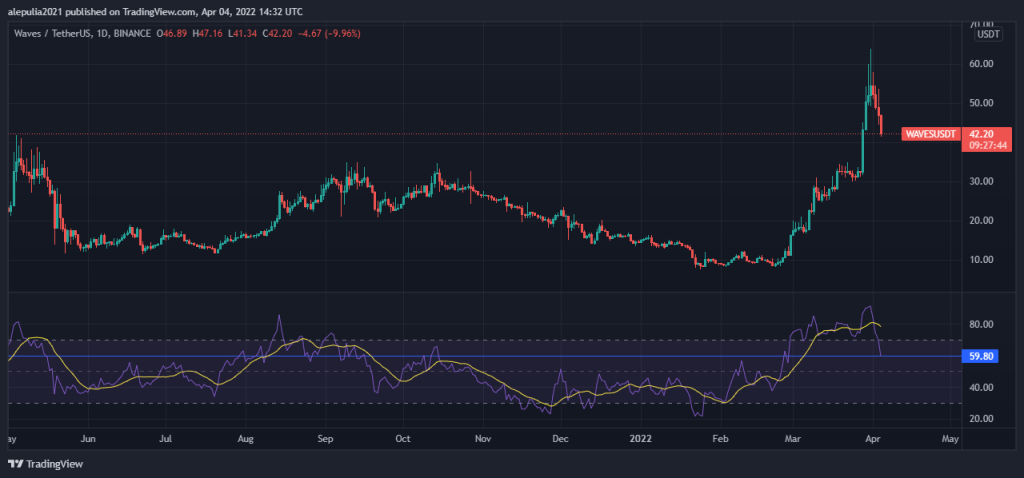
The Relative Strength Index (RSI) measures the relative momentum in the magnitude of recent price changes so as to deduce oversold or overbought assets. The RSI value of the 1Day chart is 59.80. This means that the recent trend is strong. However, it is important for investors to be mindful of price actions at major key levels, due to the positive news about the WAVES coin.

https://www.tradingview.com/x/Wq3DWbuZ/

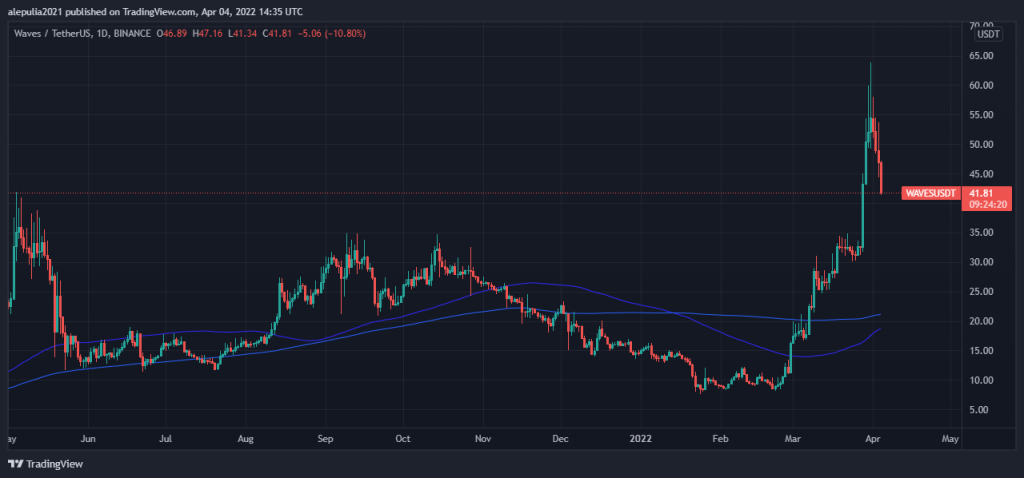
The 200-MA is above the 100-MA and the gap between them are not too close. Also, both moving averages are below the recently formed candlesticks. This means that the market is bullish in the long term.

Now, we shall consider the price predictions of WAVES for the next five years.

WAVES Price Prediction for 2022

The price of WAVES is expected to reach at least $70 by the end of 2022. This bullish price prediction is because a total cease-fire might not be attained soon in the political turmoil in Ukraine. If the forecast is true, we should expect the price of WAVES to pass its present all-time high value of $62.32 this year.

WAVES Price Prediction for 2023

WAVES is expected to begin the year 2023 with a bullish record. The relative strength index of WAVES is expected to be above 50. This is due to its recent upgrade and major developments that will lead to its diversification into the metaverse and gaming sector. If this is achieved, the price of WAVES might reach $100 by the end of 2023.

WAVES Price Prediction for 2024

WAVES might hold the support level around 200-MA which is the long-term moving average. Hence, buyers will then have their way to push its price to at least $180 by the end of 2024.

WAVES Price Prediction for 2025

The price of WAVES will be $300 by the end of the last quarter of 2025. This is due to more adoption of WAVES due to the inflow of more developers that uses the Waves smart contract as a result of its upgrade to Waves 2.0.

WAVES Price Prediction for 2026

The price of WAVES will be $420 by the end of the last quarter of 2026 as a result of increased market capitalization. This will be due to the positive outlook and forecast for top cryptocurrencies like Bitcoin and Ethereum since most of the markets move in the direction of the trend.

We shall now look at different media houses’ price predictions for Waves.

WAVES Price Prediction: Market Sentiments

Wallet Investor

According to Wallet Investor, the price of WAVES will reach $44.36 by next year and $93.88 in five years’ time. This is due to the results of the long-term forecast for the coin that gave over 105% returns in the next five years.

DigitalCoin

According to DigitalCoin, the price of WAVES will reach $58.75 in 2022 and $137.50 in 2028. The coin is expected to rise by over 235% in the next six years according to their long-term forecast analysis.

CoinQuora

According to CoinQuora, the price of WAVES will reach $40 in 2022 and $450 by the year 2026. The price of the coin is expected to give a return on investment of over 1100% in the next four years.

Our WAVES Price Prediction

By the end of 2022, 2023, 2024, 2025, and 2026 the price of WAVES might trade at least $70, $100, $180, $300, and $420 respectively.

Conclusion

From the fundamental analysis and the market sentiment around WAVES, we can deduce that all analyses are of the opinion that WAVES would be bullish in the future which will be rewarding for long-term investors.

Serum DEX: Backbone of Solana DeFi Ecosystem

Serum DEX: Backcbone of Solana's DeFi

The Serum is a protocol that delivers decentralized finance, exceptional speed and cheap transaction costs. It’s based on Solana and requires no permissions. Serum’s on-chain central limit order book allows ecosystem partners to exchange liquidity and enable market-based functionalities for institutional and retail customers.

In particular, Serum’s on-chain central limit order book and matching engine provide traders and composing projects liquidity and price-time-priority matching. The flexibility to determine their trades’ price, size, and direction is a feature of this exchange mechanism for users. Serum’s existing architecture has bootstrapped liquidity, and matching services benefit the composing projects.

Serum Features:

Serum core

Asset agnostic order book for matching any Solana-based trading product, including options, futures, borrow lending positions, and any other financial or non-financial instrument that can use Serum’s backend matching engine.

True Composability 

Serum allows many applications and participants to share middleware in a single location. Thanks to the AOB’s design, Serum’s architecture is better suited to modularity. Serum-based programmes will offer more flexibility while still adhering to basic design rules like composability.

Developer Services and Ecosystem

Developers have complete control and freedom with the decentralized on-chain order matching tool that provides infrastructure for trading applications. Permissioned marketplaces provide much more freedom and conformity.

Serum DEX, built on top of the Asset Agnostic Order book, gives the ecosystem a larger pool of pooled liquidity and a shared resource to support trading functionality.

Serum Token (SRM)

SRM is the Serum ecosystem’s utility and governance token. SRM is fully integrated with Serum and it takes advantage of buy/burn fees.

Solana Speeds and Costs

Solana’s ultra-low transaction fees of $0.00001 per transaction allow for sub-second trade and settlement.

Tokenomics 

The Project Serum ecosystem has two tokens: Serum ($SRM) and MegaSerum ($MSRM), which generate value from usefulness and governance.

The list of $SRM features:

  • Fees can be reduced by up to 50%.
  • Weekly “buy and burns” participation 
  • Specialized governance (such as future fees)

$MSRM, which can be redeemed for 1,000,000 $SRM, comes with additional features and benefits not found in $SRM. There are just 1,000 MSRM in supply. To run a node, you need at least one $MSRM. Holding $MSRM provides fees discount on trading upto 60%.

Demand Side Buy and Burn: A buyback-burn system, in which tokens are bought and burned at a proportion of platform fees, is a fundamental mechanism for boosting the value of $SRM. This mechanism receives 68 percent of the fees of the platform. 

Initial Token Distribution of Serum

On Aug. 7, 2020, the Initial Token Distribution was held with two exchanges (FTX and BitMex) selling 3 million SRM at around $0.11 per token (for a total of $660,000). Both IEOs needed KYC, and the total number of participants was limited to 1,800.

Pre-sales for 400 MegaSerum (equal to 400 million SRM, or 4% of total supply) were held before the IEOs, raising around $20 million. All pre-sales are locked up for the following 1-7 years after the sale.

Serum token distribution:

  • Team and Advisors account for 20% of the total supply.
  • Project Contributors account for 22%, while Locked Seed and Auction Purchasers account for 4%.
  • The Partner and Collaborator Fund was allocated 27% of the total supply.
  • The Ecosystem Incentive Fund was allocated 27% of the total supply.

Serum’s Token Supply Schedule

10% of all SRM tokens are unlocked at the start. The remaining 90% all follow the same unlock schedule: they are entirely locked for the first year, then open linearly over the next 6 years, at about 1/2190 every day.

All seed sales were also locked. The protocol uses 60% of the fees it generates to buy back and burn SRM tokens. These buys and burns are conducted approximately every week.

Governance

Governance is an essential aspect of the Serum ecosystem, which uses a staking-based governance mechanism to give SRM stakeholders a say in the future of the project developments. Stakeholders in the SRM are grouped into nodes, which have voting rights over fees, new markets, revenue usage, buy/burns, and ecosystem grants.

To pass a vote, more than 60% of the world’s total staked SRM must vote in favour (this parameter may be further changed via a proposal, within bounds). The serum also recently debuted its governance voting programme, a self-upgradable programme regulated by a multi-sig. This is the first step toward decentralizing, transparent, and secure governance for Serum.

Conclusion

Serum supports the whole Solana DeFi ecosystem through its large pool of liquidity. It is the best order book based decentralized exchange in crypto. The daily volume of assets traded on Serum is in millions. The total value locked in Serum is around 750 million dollars. These figures show that it is currently, Solana users’ go-to platform for buying and selling cryptocurrencies. 

As the Solana blockchain will attract more users in future, it will automatically benefit Serum. Few changes in tokenomics of Serum token can also help in driving its price upwards.

Venus Protocol and PancakeSwap Announce Integration with Coinbase Wallet

Coinbase Glitch Users

Coinbase Wallet has been a very useful software to users looking to buy and store ERC-20 tokens, collect rare digital art, browse DApps, shop at crypto accepted stores, etc. March observed the standalone application, Coinbase Wallet, welcoming both Venus Protocol and Binance Swap running on the Binance Smart Chain into the family. 

Integration of Venus Protocol

On March 24, 2022, Coinbase Wallet announced on Twitter the news of the newest member of the family, Venus Protocol. 

It is a fast, affordable, decentralized lending system. It is used to borrow funds using $XVS and other top 22 cryptocurrencies.

Embedding PancakeSwap

Earlier this month, on March 3rd, Coinbase Wallet integrated PancakeSwap. Later, PancakeSwap took to Twitter to share the setup guide and additional information concerning steps to set up a Coinbase wallet. 

An automated market maker [AMM], PancakeSwap allows users to seamlessly exchange tokens and earn CAKE. 

BitKeep Breaks Record of 5 Million Cross-Chain Swap Services

BitKeep Breaks Record of 5 Million Cross-Chain Swap Services

The leading decentralized multi-chain crypto wallet, BitKeep is committed to becoming a one-stop solution to a variety of services. These services include wallet, cross-chain transactions, BKSwap, DApps, DeFi, and NFTs. 

On March 21, 2022, BitKeep Global Inc. retweeted the announcement of BKSwap hitting a recorded number of 5 million transactions with a transaction amount of over $500 Billion.

What Is BitKeep?

BitKeep Wallet, a subsidiary of the parent company BitKeep Global was founded in Singapore in 2018. BitKeep is known to provide management services of digital assets to over six million users. 

The objective of BitKeep is to construct the world’s largest gateway to the decentralized world. The multi-chain crypto wallet boasts of its partnership with 30 mainnet including Polygon, Solana, ETH, Terra(Luna) and has succeeded in becoming their authorized wallets.

BitKeep Celebrates

Today, BitKeep retweeted the good news via a user named @kevin_bitkeep who claims that the concept of crypto wallets is beyond MetaMask, the crypto wallet utilized on the Ethereum Blockchain, as well. He believes that the future is cross-chain. 

Anchor Protocol: DeFi’s Leading Saving Product

ANC

In the past few years, DeFi applications have seen tremendous growth. At the start of the year 2021, the Total value locked (TVL) in DeFi applications was used to be around 18 billion dollars. Currently, TVL in DeFi applications is around 200 billion dollars, which is more than 10x of the TVL of January 2021. Total unique DeFi wallets are 4.3 million right now, more than 4x the unique DeFi wallets of January 2021. 

Various DeFi applications provide financial services like lending & borrowing, trading, prediction markets, yield farming, etc. Still, there are only a few million DeFi users, and the Anchor protocol of Terra Ecosystem wants to change it. Team of Anchor Protocol believes that a saving product is required for the mass adoption of DeFi applications. 

Anchor is a saving protocol that offers low-volatile yields on deposits of Terra Stablecoins. The Anchor interest rate is powered by staking rewards from Proof of Stake blockchains, and therefore more stable rates can be expected. Anchor Protocol makes a money market between a lender and a borrower. 

Lenders can earn stable yields by depositing their Stablecoins while borrowers can borrow stablecoins on their stakeable assets. According to the protocol-defined borrowing ratio, borrowers can lock their bonded assets (bAssets) as collateral and borrow stablecoins. Currently, Bonded Luna (bluna) and Bonded ETH(bETH) are the only two bonded assets that can be put as collateral for borrowing stablecoins. 

The stream of staking rewards comes from borrowers’ global pool of collateral. These staking rewards are converted into stablecoin, which are given to the lenders in stable yield. 

Tokenomics of Anchor

Anchor Protocol’s governance token is the Anchor Token (ANC). Users who have staked ANC tokens can propose new governance polls, which can be voted on by users who have staked ANC tokens. 

ANC token is designed to increase its value linearly with Anchor’s assets under management, allowing it to capture a piece of the protocol’s yield. Anchor provides protocol fees to ANC stakeholders proportionally to their stake, benefiting stakeholders as adoption of Anchor grows. ANC stakeholders are driven to suggest, discuss, and vote for proposals that improve the protocol.

ANC Value Accrual

The buying pressure increases proportionally as ANC tokens grow in lockstep with Anchor’s Assets Under Management. Protocol fees are used to buy ANC tokens from Terraswap, which are then paid to ANC stakers as staking rewards. 

Protocol Fees 

ANC captures protocol fees created by Anchor, with 10% of the value flowing into the yield reserve being used for the value accrual of ANC tokens. bAsset rewards, excess yield, and collateral liquidation costs are used to fund Anchor’s protocol fees.

basset rewards

A portion of the rewards from deposited bAsset collaterals is used to buy ANC, with the rest going into the yield reserve. If the yield reserve’s inventory reaches a sufficient amount, governance can modify the ratio of bAsset rewards utilised for ANC purchases.

Excess Yield

Deposit rates higher than the target deposit rate are stored in the yield reserve, with a portion of it utilised to purchase ANC. The ANC tokens that have been purchased are subsequently given to ANC stakers.

Collateral Liquidation Fees

When a loan is liquidated, 1% of the liquidated collateral value is sent to the yield reserve, with a portion going into ANC purchases. This cost is not included in the bid premiums.

Governance Fees

ANC token deposits of Anchor governance polls that have failed to attain the needed quorum are then allocated to ANC stakers as staking rewards.

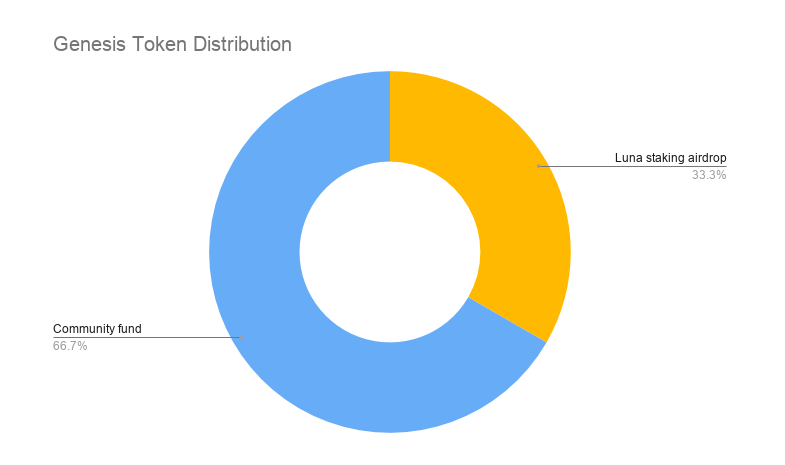
Genesis Token Distribution


At the start of the Anchor Protocol, 150 million ANC tokens were released.

Fifty million (33.3 percent) tokens were airdropped to LUNA stakers, with staked amounts snapshotted at block 2179600. 

One hundred million tokens (66.7 percent) were set aside for the Anchor Community Fund.

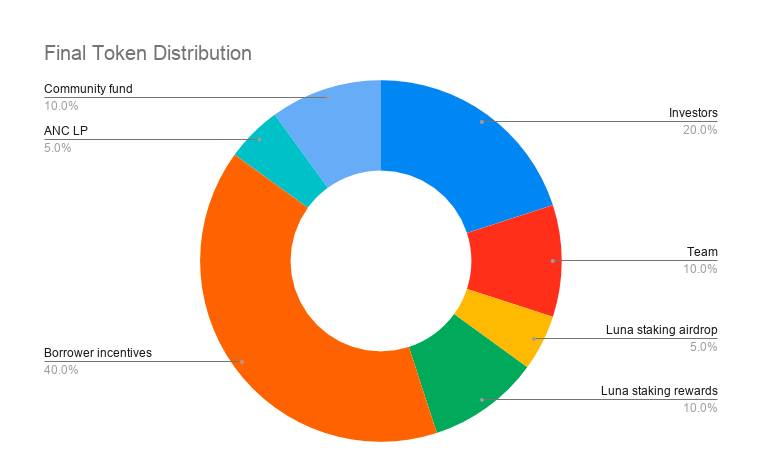
Final Token Distribution

Final Token Distribution

A total of 1,000,000,000 ANC tokens will be distributed over four years. No more new ANC tokens will be added to the supply once this quantity has been distributed.

Various methods to earn money with Anchor: 

  • Depositing UST is a simple way to earn money with Anchor. The protocol project itself as a savings product and provides a 20% annual percentage yield (APY) on deposit. 
  • Users can borrow UST by putting their bAssets, i.e. Bonded Luna (bluna) and Bonded ETH(bETH), up as collateral. 
  • Users can also buy and stake ANC to receive staking rewards and participate in governance. 
  • You can also earn rewards while at the same time providing liquidity to exchanges by staking your LP tokens (ANC-UST LP).

Conclusion

Anchor is the leading DeFi protocol of Terra Ecosystem. Currently, 13 billion dollars worth of assets is deposited in the protocol. Its goal is to become a stable saving solution for DeFi users, providing passive income. Anchor has an easy to use interface, which will be helpful in onboarding millions of users. It will play a vital role in the success of DeFi and Terra Ecosystem.

Related: All You Need To Know About Liquid Staking

Curve Protocol : Leading DEX for Stablecoins

Curve Protocol : Leading DEX for Stablecoins

USDC, USDT, BUSD, PAX, TrueUSD, and DAI are all examples of stablecoins that have recently gained popularity. They have an issue with price stability and liquidity (particularly decentralized stablecoins). When MakerDAO reduced its stability charge to 5.5 percent, many customers of Compound (which had an interest rate of 11 percent at the time) decided to stay because they had taken out a loan in DAI and changing DAI to USDC is a costly procedure. 

At the same time, many DeFi users are eager to lend their stablecoins in exchange for a 5% APR, which is far higher than what traditional banking gives. Users would be hesitant to provide the same money to trading firms that guarantee profits. Curve Finance addresses the issue of lack of liquidity while trading Stablecoins and high costs. 

Introduction

Curve Finance uses liquidity pools and bonding curves to enable high-efficiency stablecoin trading and low-risk rewards for liquidity providers.

When trading from one stablecoin to another on Curve, customers are not vulnerable to the price slippage on DEXs. Curve, unlike Uniswap, lends assets on Compound when they aren’t being traded and pays liquidity providers interest on those loans.

Curve was created as an alternative to trading stablecoins on general-purpose DEXes like Uniswap, which have algorithms that aren’t designed for such transactions. Curve’s debut resulted in increased liquidity and more competitive prices for stablecoins. As interest rates in money markets changed, DeFi lenders might quickly and efficiently switch from  USDT to USDC or USDC to DAI etc.

Curve is an Ethereum-based exchange liquidity pool. The Curve is built for incredibly efficient stablecoin trading and low-risk trading fees go to liquidity providers and veCRV holders. Curve currently offers over 40 distinct official liquidity pools, with the tricrypto2 (USDT / wBTC / WETH) and 3pool (DAI / USDC / USDT) being two of the most popular. However, it’s worth noting that pegged asset trading is still a big part of the market.

CRV Token

CRV is the Curve protocol’s governance token. It is primarily utilized to incentivize liquidity to the platform. The rise in capital benefits Curve users because it gives more trading liquidity and decreases slippage for end-users. Voting, staking, and raising rewards can be gained by using the CRV token. Users can participate in the community and can introduce or vote on proposals. 

Depositors can obtain 50% of all trading fees generated by the protocol by staking their CRV tokens. Liquidity Providers can use boosting to increase their CRV awards by up to 2.5x. To access all of these features, token owners must lock their CRV in Curve for vote-escrowed CRV (veCRV) in exchange. The longer the CRV is locked in Curve, the more veCRV you received.

For example, 1,000 CRV locked for a year produces 250 veCRV, but the exact amount locked for four years produces 1,000 veCRV. As a result, the longer the lock-up period, the greater the user’s voting power and incentives. This ensures that token holders are invested in the protocol’s long-term success.

Curve Token Distribution

The following groups received CRV tokens as part of the initial token distribution:

61% to pre-CRV liquidity providers with a one-year vesting period; 30% to shareholders (founders and investors) with a 2-4-year vesting period; 3% to team members with a two-year vesting period; and 5% to the community reserve. The remaining 57 % of the overall maximum supply will be given in stages to future liquidity providers as incentives.

Despite the original supply of 1.3 billion, the effective circulating quantity of CRV was zero at launch, due to vesting schedules. Based on this timeline, the inflation of released CRV is expected to be large in the next few years. Only 11.2 percent of the supply is in circulation as of March 10, but that number is expected to rise to 3.37 billion in five years.

How to Trade on Curve DEX?

Trading on Curve

Similar to most DeFi applications, you have to allow Curve protocol on your wallet to interact with your DAI or USDC balance before you can trade. Select the asset you’d want to convert (for example, USDC) and the amount (for example, 1,000) on the exchange; the exchange rate and quantity you’ll receive (including all slippage and costs) will be displayed. Curve’s value is in its ability to surprise you with its exchange rate. 

Fees

Currently, all pools have a 0.04 percent fee, 50% of which goes entirely to liquidity providers and 50% to veCRV holders. There is no charge for administration. DAO members have power to determine fees and pool specifications.

What are Liquidity Pools?

curve pools

Liquidity pools are a type of smart contract that contains a pool of tokens. If you were to make a pool of DAI and USDC, one DAI would equal one USDC. You would have the same number of tokens in the pool, say 1,000 (1,000 DAI and 1,000 USDC). If trader 1 arrives and exchanges 100 DAI for 100 USDC, the pool will have 1,100 DAI and 900 USDC, causing the price to shift.

How to Provide Liquidity to Curve Pools?

Curve’s liquidity pool is made up of cTokens, which are assets within the Compound protocol. This ensures that assets are always put to use. By supplying DAI or USDC to Compound or purchasing cTokens on 1inch, Paraswap, you can obtain cDAI or cUSDC. Curve will need your permission to engage with your cDAI or cUSDC balances before you can provide liquidity. Your available balances should appear on the Curve deposit page. You will supply coins at the current exchange Curve rate if you contribute all coins in a balanced proportion. You need to have all your assets in your wallet.

You can turn this feature off to provide one side of the market or a different ratio of assets, and Curve will automatically convert them into the correct number (with the same low slippage and fees as the Curve exchange). By choosing Deposit wrapped, you can deposit ordinary stablecoins DAI/USDC/USDT/TUSD/BUSD/sUSD, as well as its cTokens and yTokens.

Risks

Some of the significant concerns that Curve Finance faces in the short to medium term are as follows:

Growing Competition: As mentioned in the preceding section, one of Curve’s most significant threats is the increasing competition from other DEXs. Competitors like Uniswap are strengthening their protocols to compete even more effectively on both non-pegged trading pairs and stablecoins.

Relatively High Inflation: The released supply of CRVs is expected to expand by a factor of 2.7x during the next five years. Although those incentives are required to recruit team members and keep liquidity, they are significantly greater than Uniswap’s and Sushiswap’s expected inflation rates. This will inevitably dilute token holders’ holdings. However, this risk is partially alleviated by the increasing vote locking of CRV on Curve.

Conclusion

Curve is the leading protocol in terms of Total Value Locked(TVL). It is present on various blockchains like Ethereum, Avalanche, Polygon, Fantom etc. At the time of writing this article, the TVL on the Curve is worth 17.86 billion dollars. This deep liquidity allows low slippage for traders while swapping their assets on Curve.

Related: Osmosis DEX- Biggest Decentralized Exchange of the Cosmos Ecosystem

Audius Streaming Platform: Revolutionizing The Music Industry

Audius Streaming Platform: Revolutionizing The Music Industry

In the last two decades, technology has revolutionized music production and distribution. It is no longer necessary to hire a team of producers and audio engineers to make music. With low-cost software, anyone in their bedroom can get started. Similarly, music distribution no longer needs physical record factories and retail ties to get those records into stores; music platforms have made it possible for artists to quickly and easily release their songs.

The network of intermediaries and middlemen that arose in the early days of recorded music still exists, living on the backs of artists and curators. At the same time, the mechanics of value transfer and accrual are still largely obfuscated. 

Audius is the most direct-to-consumer alternative to traditional digital streaming platforms, providing direct access to Artists and Fans and ownership and interest in the network they (and you) are helping to build.

Audius is a digital streaming service that connects fans with artists and new music in real-time. They accomplish all of this by also being completely decentralized. Audius is owned and operated by a worldwide open-source community of artists, fans, and developers. Audius empowers musicians to share never-before-heard music and directly monetize streams. Audius allows developers to create their apps, giving them access to one of the unique audio libraries available.

Audius is a protocol and platform built on top of the blockchain and community-run nodes. It is open-source, openly available data and access, and is owned by the public. Artists (content creators), Fans (content consumers), and Service Providers are the three user demographics on Audius. 

Artists: They submit songs, make albums, and share content with their fans.

Fans: They can listen to music, make playlists, subscribe to and follow artists, and re-share material with their social media networks.

Service providers handle app traffic, stream music, and network security. 

Service providers provide many services, which are needed to run the Audius platform. They provide all of these services by staking $AUDIO tokens and registering their service.

  • Discovery node: These user-operated nodes index all the content and make it discoverable for the users of the platform.
  • Content node: These user-operated nodes are responsible for hosting the content.

How does Audius work?

On Audius, content is routed to two different types of nodes:

  • Content Nodes – To store and relay audio content streamed on Audius
  • Discovery Nodes – To index and hash data like user profiles, playlists and followers, following.

Uploading content to Audius as an artist is similar to uploading to Soundcloud. it’s what happens behind the scenes that set Audius apart from other music streaming platforms.

When an artist uploads a track to Audius:

  1. Content is uploaded to a Content Node.
  2. The data is transcoded, and a reference code is returned that can be used to identify the track.
  3. The data connected by the reference code is duplicated over the network to two more Content Nodes.
  4. The metadata is connected to the profile that submitted the music, and an on-chain transaction is broadcast indicating that the track exists on Audius.
  5. A Discovery Node picks up the transaction and indexes it.
  6. When the music appears on the Discovery Node, the client reports that it was successfully published, indicating complete upload.

A similar process is executed by other music streaming companies, effectively making them the true owner of all the content. If that corporation goes out of business, all of the data in its database goes with it. The data of the Audius network is maintained and controlled by third-party and decentralized node operators. It is not reliant on a single corporation to stay afloat. Users can also assist in protecting and powering the protocol by staking $AUDIO.  

AUDIO Token

Within the Audius protocol ecosystem, the Audius platform tokens (AUDIO) have three main functions: 

  • Security 
  • Feature Access 
  • Governance

AUDIO is used as security for a value-added service like running a node or engaging in governance. Stakeholders receive continuous issuance, governance weight, and access to exclusive features in exchange. In the future, AUDIO will manage a global fee pool derived from value transfers in the network. 

Offering a native token to align all actors generates a parallel incentive unique to web3, allowing our early adopters to share in the growth of Audius. The Audius community wants to ensure that AUDIO tokens are always going to the most valuable players. This is accomplished by continuous issuance, which uses on-chain data as a metric to better route distribution to active players rather than just those who stake the most AUDIO. This is how it works in practice.

SECURITY  

To safeguard the network, node operators stake AUDIO. The larger the stake by node operator, the higher the probability of their node getting used by artists and fans. Audius is totally run by volunteers, resulting in a permissionless network of node operators safeguarding content for the world’s most unstoppable streaming protocol.  

FEATURE ACCESS 

AUDIO is used as collateral to gain access to extra artist tooling. Artist tokens, badges, and profit multipliers are some of the first ideas that the community has come up with. Fans will be able to assign AUDIO to individual artists and curators in the future, allowing them to partake in their success on the platform.   

GOVERNANCE 

Any AUDIO staked in Audius is given governance weight which can be used to define the protocol’s future versions. Every aspect of Audius can be governed, starting with a single token representing one vote. Audius has always focused on operator incentives from the start, intending to allow even the most passive fans to have a say in product updates and feature enhancements. The Audius decision to give ongoing issuance distribution power to those who are consistently the most active on the platform, a strategy that has proven to be effective till now.   

Token Distribution

Audius launched its mainnet in October 2020, with 1 billion AUDIO tokens minted and approximately distributed as follows: 

Airdrop: 55MM AUDIO (5.50%) 

Foundation Treasury: 180MM AUDIO (18.00%) 

Team and Advisors: 405MM AUDIO (40.50%) 

Investors: 360MM AUDIO (36.00%) 

What Role does Staking Play?  

Audius is a decentralized platform based on Ethereum that stores and indexes all content, information, and data, rather than the Audius team. Node operators must submit collateral or stake as a commitment to service the protocol to ensure that this content can be trusted and maintained. This $AUDIO stake ensures that node operators have tokens at risk, which can be slashed or taken in the event of malicious or harmful activity.   

Anyone with the proper hardware requirements can join as a node operator in a completely permissionless manner by providing $AUDIO tokens as collateral. The more $AUDIO invested in the protocol, the more secure the network gets and the less vulnerable it is to attacks from the outside. Node operators can receive $AUDIO as a reward for serving the network through automatic on-chain issuance or the continuous generation of new tokens dispersed to value-added actors. In exchange for safeguarding the network, those node operators that stake more $AUDIO tokens will receive a more significant percentage of the issuance.  

Team, Media, and Community 

Audius has a formidable team of entrepreneurs, engineers, audiophiles, and blockchain experts on its side. Deadmau5, RAC, and 3LAU are among their advisory board members. This group also includes EA Games and Twitch co-founders. Binance, Coinbase Ventures, and seven other investors are among the investors. With over 133,000 Twitter followers and 33,970 Discord members, their media presence and community strength are major factors for their growth.  

Advantages: 

1) Audius is the only decentralized music streaming platform with a strong following. It has a mighty advisory board and major investors such as Binance and Coinbase Ventures. 

Disadvantages: 

1) Blockchain is utilized to solve existing problems, introducing new ones. In the instance of Audius, musicians can post copyrighted music without much interference from the company. Without blockchain, platforms like Bandcamp and Patreon solve this problem. 

2) The current supply of the native token ($AUDIO) is minimal, and the supply is set to increase every three months until July 2026. This puts selling pressure on the AUDIO tokens.

Avalanche Review: The Fastest Transaction Finality Platform

Avalanche Review: The Fastest Transaction Finality Platform

Avalanche is the world’s first decentralised smart contract platform with near-instant transaction finality, designed for the size of global banking. As Solidity works out-of-the-box, Ethereum developers can quickly build on Avalanche. 

People think that blockchains will be sluggish and non-scalable over time. The Avalanche consensus uses a revolutionary approach to the consensus to deliver strong safety guarantees, speedy finality, and high throughput without compromising decentralisation. The Avalanche Consensus Protocol is the consensus mechanism used by Avalanche.

Overview of Avalanche Platform

Exchange Chain (X-Chain), Platform Chain (P-Chain), and Contract Chain (C-Chain) are the three built-in blockchains of Avalanche. The Primary Network validates and secures all three blockchains. All members of all custom subnets must also be members of the Primary Network by staking at least 2,000 AVAX.

Exchange Chain (X-Chain)

X-Chain uses Avalanche Consensus Mechanism. X-Chain is a UTXO-based chain structured as a directed acyclic graph. The default asset chain for Avalanche’s native AVAX token allows new assets, including utility tokens, NFTs, and smart contract platforms, to be created and traded. The X-Chain is an instance of the Avalanche Virtual Machine (AVM).  

Contract Chain (C-Chain) 

The C-Chain is the principal chain that Avalanche users connect with for DeFi and NFT activities, and it hosts smart contracts. It is a linear chain that uses the Ethereum Virtual Machine (EVM), with the same tooling that most Ethereum developers are used to, but with the extra benefits of speed and low costs thanks to Avalanche’s Snowman Consensus implementation.

Platform Chain (P-Chain) 

Staking, governance, and validator coordination are all done using the P-Chain. Validators stake AVAX token on the Platform Chain. It allows for custom subnets and stores network metadata such as the active subnets and each subnet’s node list. The P-Chain and C-Chain are linear chain that implements the Snowman Consensus to correctly add/remove nodes from the validator set at a given time.

Subnets 

A subnet, also known as a subnetwork, is a dynamic group of validators who collaborate to reach a consensus on the state of a group of blockchains. Each blockchain is only validated by only one subnet. A subnet can validate many blockchains, and a node can belong to many subnets.

A subnet administers its members, and its constituent validators may be required to meet particular criteria.

Features of Subnets that can be used:

Compliance

Regulatory compliance is easy to handle with Avalanche’s subnet architecture. As previously stated, validators may be required to meet a set of standards by a subnet.

The following are some examples of requirements:

  • Validators are required to be located in a specific country.
  • Validators must pass KYC checks.
  • Validators are required to have a specific licence. 

Support for Private Blockchains

You can construct a subnet that only specific pre-defined validators can join, as well as a private subnet where only those validators can see the contents of the blockchains. Businesses can use these subnets who want to keep their information confidential.

Separation of Purposes

Some validators will refuse to validate specific blockchains in a heterogeneous network of blockchains because they have no interest in them. The subnet architecture allows validators to focus on the blockchains that are important to them. Validators will have less work to do as a result of this. 

Specific Requirements for Each Application

Validators may be required to have specific properties by various blockchain-based applications. Assume you have a programme that demands a lot of RAM or processing power. Validators may be required to meet particular hardware requirements by a Subnet to ensure that the application does not suffer from slow validators.

How does Avalanche Consensus Work?

Repeated sub-sampled voting is used in the Avalanche Consensus. When a validator decides whether to accept or reject a transaction, it asks a small, random subset of validators whether they believe the transaction should be approved or refused. If the queried validator thinks the transaction is invalid, has already rejected it, or prefers a different transaction, it will respond that it should be refused. Otherwise, it says it believes the transaction should be approved.

The validator prefers to accept the transaction if a sufficiently large share of the validator’s sampled response that it should be taken. 

If the transaction is questioned again in the future, it will respond that it believes the transaction should be accepted. Similarly, if a sufficiently significant number of validators respond that the transaction should be refused, the validator will choose to reject the transaction.

The validator repeats the sampling process until the majority of the validators polled respond in the same way (accept or refuse) for some rounds in a row. When there are no issues in a transaction, it is usually completed fast. When there are disputes, honest validators quickly cluster around them, creating a positive feedback loop that continues until all accurate validators prefer that transaction. As a result, non-conflicting transactions are accepted, and conflicting transactions are rejected. 

If any honest validator approves or rejects a transaction, all honest validators will accept or reject that transaction (with a high likelihood based on system parameters).

Snowman Consensus Protocol

The Snowman consensus system is based on the Avalanche consensus mechanism. However, transactions are ordered linearly. When dealing with smart contracts, this property comes in handy. The Snowman, unlike the Avalanche consensus protocol, makes blocks. The Avalanche consensus protocol powers Snowman. Both P-Chain and C-Chain implement the Snowman consensus protocol. 

Main Features of Avalanche 

Speed

It employs a unique consensus process devised by a group of Cornell computer scientists. Transactions get confirmed in less than one second.

Scalability

It outperforms many existing blockchains, with 4,500 transactions per second.

Security 

It ensures more security guarantees than the 51% criterion used by other blockchains.

Flexibility

Create custom blockchains and decentralized apps with nearly any logic in a matter of minutes.

Sustainability

Instead of proof-of-work, it uses a more energy-efficient proof-of-stake consensus algorithm.

Smart Contract Support 

Allows you to create Solidity smart contracts and use your Ethereum tools like Remix, Metamask, Truffle, etc.

Private and Public Blockchains 

Create your blockchains, either public or private.

Designed for the Financial Sector

Digital smart assets can be easily created and traded with complex, custom rules.

Tokenomics

The Avalanche network’s native token is AVAX, although developers can create their tokens on its custom blockchains. Like on the Ethereum network, fees on the  Avalanche are burned, gradually depleting the token supply.

Avalanche is a proof-of-stake platform that relies on validators to receive block rewards by staking AVAX. Validators can earn up to 11 percent annual percentage yield (APY) on staked AVAX, with an average annual return of roughly 9.75 percent. 

AVAX allows stakeholders of the network to:

  1. Make payments and provide a basic unit of account between the multiple subnetworks created on the Avalanche blockchain.
  2. Pay network fees.
  3. Secure the network and validate transactions through the Proof of Stake mechanism, also dubbed staking.

AVAX tokens are now in the supply of more than 245 million, with a maximum capped supply of 720 million. Three hundred sixty million AVAX tokens were minted in the genesis block, with the remaining 360 million tokens will be created over time. Unlike Bitcoin, whose fees go to miners, Avalanche fees are burnt, increasing the token supply scarcity. 

Token Distribution of AVAX
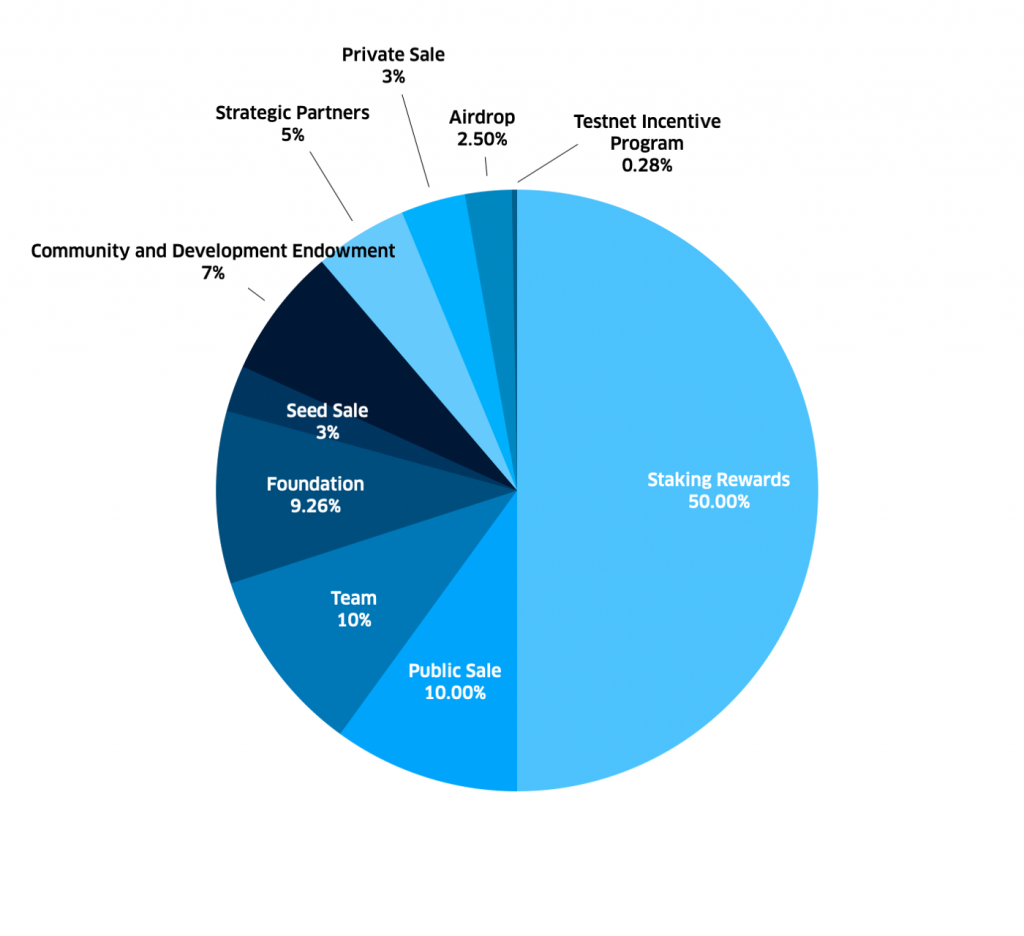
 

avax token distribution
Avalanche Foundation Incentives Program

Avalanche Foundation Announced $180M DeFi Incentive Program Titled ‘Avalanche Rush’. On 18 August 2021. The program’s aim was to encourage more applications and tokens to move to Avalanche’s decentralized finance (DeFi) platform. 

The program was a success, as after the announcement on18 august, the daily active address count was 4991 at that time, now after more than 6 months, the daily active address on  22 February stands at 99,601. So it is evident from the data that users have started using Avalanche Network.

In November, the Avalanche Foundation launched Blizzard, a 200 Million Dollars fund to support ecosystem development, which already saw over 320 projects building on the platform.

Analysis of Avalanche Platform
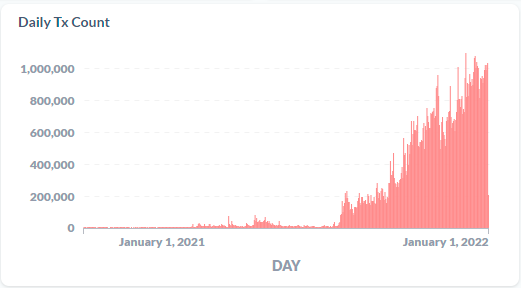
avax daily tx count

Source: stats.avax.network

On February 24, the daily transaction count on C- chain was 1,040,725, while at the start of January 1 2021, the daily transaction count was 1851. 
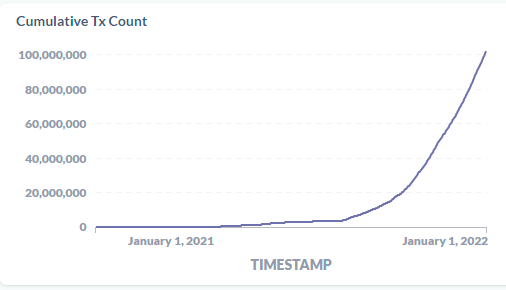
avax cumulative tx count

Source: stats.avax.network

From Avalanche’s Mainnet launch to up till now, a total of 101,971,171 transactions have been executed on Avalanche C-chain. More than 100 million transactions executed shows that People have actively used Avalanche.
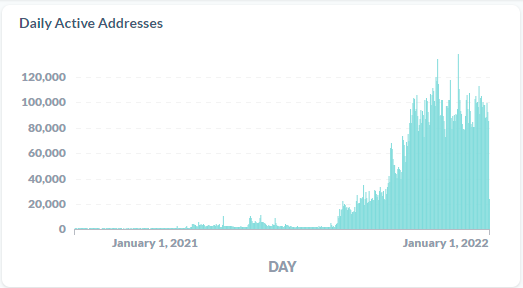
avax daily active addresses

Source: stats.avax.network

On February 24, daily active addresses were 84,986, while Daily active addresses on Ethereum on the same day were  513,537. Daily active addresses on Avalanche is still way below Ethereum’s active address, but since Avalanche is also newer in comparison to ethereum, the growth of daily active addresses on Avalanche is impressive.
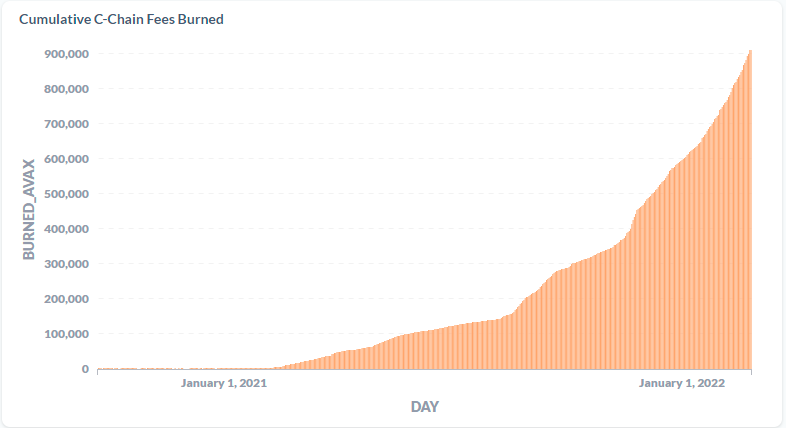
avax cumulative c chain fees burned

Source: stats.avax.network

All the transaction fees of the Avalanche network is burned, thus reducing the supply of AVAX token. Around 910,0756 AVAX tokens have been burned since the Avalanche mainnet launch on September 20 2020. According to the current AVAX token price of 75 dollars each, 682,556,700 million dollars worth of AVAX tokens have been burned.
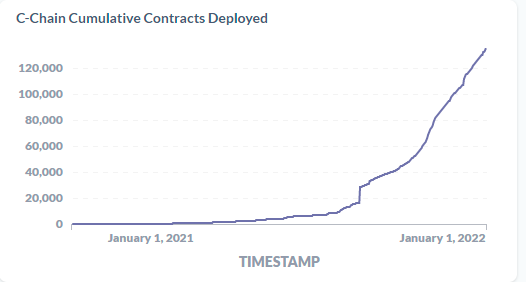
avax c chain smart contracts deployed

Source: stats.avax.network

Around 134,445 smart contracts have been deployed on the C-chain of Avalanche; thus, it shows that developers are actively working and deploying smart contracts for various applications.

Conclusion

The Avalanche platform and AVAX token have performed really well in the past year. The Avalanche platform saw a large increase in user count, developer count, smart contracts deployed, and transactions. AVAX token price increased by more than 3000% in the year 2021 and made an all-time high of 147 $ on 21 November 2021.

Avalanche aims to digitize all assets on the planet, connect them into its network, and act as a new interoperable finance core platform.  

Crypto and Blockchain Predictions for 2022

Crypto and Blockchain Predictions for 2022

The year 2021 has been a thrilling one for the cryptocurrency and blockchain industry. Last year, cryptocurrencies such as Bitcoin and Ethereum reached an all-time high. This has set the way for 2022 to continue scaling the crypto space’s development.

Below are the predictions for 2022 addressing potential trends and forecasts that may materialize soon.

Addressing Limitations of a Seamless Infrastructure

Even if competition among infrastructure providers is expected to heat up dramatically in 2021, critical challenges must still be addressed. Ethereum (ETH), for instance, is still the most popular blockchain for DApp (decentralized applications) creation, although it suffers from network congestion and expensive transaction costs.

These issues are addressed by Layer-2 solutions, however, gaining long-term traction remains difficult. The same applied to ‘Ethereum competitors,’ since they are still in their beginner phase. Addressing such limitations this year and beyond is required. 

Many individuals anticipate that the release of Ethereum 2.0 will assist to relieve some of these issues. Its sharding implementation will help solve issues such as network congestion, transaction fees, and low performance. These implementations may take time as they will occur in multiple stages. 

Other networks, such as Binance Smart Chain, Solana, and Avalanche, will continue to draw users and developers while Ethereum remains a bottleneck. It is important to note, however, that Layer-2 solutions will follow a similar route as Ethereum. 

It is just a matter of time before these become the less appealing alternatives to avoiding Ethereum’s transaction fees. Unless developers come up with creative alternatives, this will have an impact on any cross-chain bridges that use Layer-2 networks.
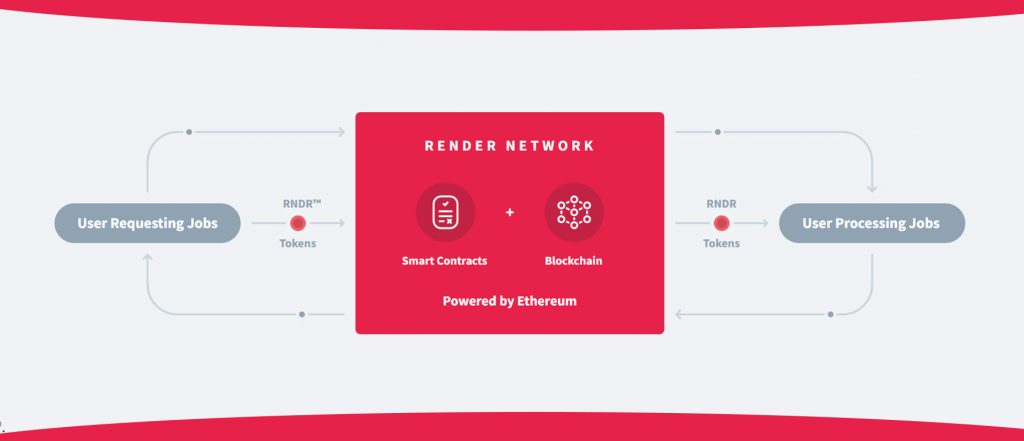
With Ethereum London upgrade, TVL on Layer-1 versus Layer-2, node distribution for leading blockchains, gas utilization are some of the advances 2022 has already witnessed in the blockchain field. Ethereum TVL leads the pack of BSC, Avalanche, and Solana. 

New solutions have been proposed to improve network usability while seeking to reduce gas prices as well. 2022 will observe upgrades in the Ethereum network and the popularization of competitors like Solana. 

Introduction of NFT into the Metaverse

Last year, NFT and Metaverse markets had become the center of attraction, eventually collaborating with DeFi and the gaming industry to form an ecosystem. The objective of the ecosystem was to help empower users and provide them control over trade and digital asset release. 

The present NFT market is observed to be divided into three categories – art, collectibles, and gaming. However, new efforts based on the NFT standards are introduced in the market. Furthermore, NFTs will now be able to assist Metaverse in numerous activities like avatars, virtual spaces, economic activities, and much more. 

Playing the role of being the main hub of NFT activity, the metaverse will assist 2022 in becoming a remarkable year for the introduction of game-changing solutions in user identification across a decentralized space. Additionally, deployment of numerous supporting systems for complete integration with decentralized financing (DeFi). 

To summarize, Metaverse might aid in an application scenario of NFT development, while NFTs drive the growth of Metaverse. In present times, Metaverse is known to be quite centric towards the gaming industry. However, metaverse has the potential to blur the line between activities of the real and virtual world.

Creating their own, walled-off Metaverse is a critical first step toward that aim. Connecting various virtual worlds will be a significant challenge, eventually resulting in a multi-Metaverse.

Another Metaverse development to keep an eye on is the involvement of DeFi and cross-chain bridges. Decentralized finance has shown to be efficient and reliable, providing a solid platform for economic Metaverse activity.

Furthermore, DeFi and NFTs work well together and apply to a wide range of Metaverse use cases. The Metaverse is synonymous with user empowerment. Allowing for a larger range of assets, goods, and services lays the door for greater financial inclusion.

Developer can make significant work on Metaverse’s cross-chain bridge. Present initiatives are centered on a single blockchain, resulting in an ‘ecological island’ dilemma. Developers can make significant work on the Metaverse’s cross-chain bridge. Present initiatives are centered on a single blockchain, resulting in an “ecological island” dilemma. 

Furthermore, most public chains suffer from infrastructure, which reduces the charisma of Metaverse initiatives that leverage their technology. Cross-chain bridges can address these issues while also improving efficiency for the Metaverse, NFTs, and decentralized finance.

Regulators Focus on Legal Frameworks for Metaverse

The regulation of the crypto sector is still a major concern throughout the world. The absence of a defined framework has the potential to hinder innovation, which should be avoided at all costs. Regulating has grown much more complex as a result of creative concepts like as DeFi (decentralized financing), NFTs (non-fungible tokens), the Metaverse, and so on.

Regulators and policymakers must concentrate on developing legal frameworks for the Metaverse. The innovation has received widespread interest. Clear boundaries outlining what can and cannot be done in the virtual world will aid in legitimizing these endeavors.

Experts in the crypto industry predict that things will improve dramatically. Reports also suggest that guidelines will soon be enacted. This may influence decentralized identifiers – enable verifiable, decentralized digital identity. 

Regulators will surely be interested in decentralized finance. However, safeguarding investors without jeopardizing innovation and decentralization is a significant challenge. Furthermore, present regulatory rules may not apply to the DeFi business. 

As a result, depending on how the Securities and Exchange Commission, Bank for International Settlements, or Financial Action Task Force handles the industry, new regulatory infrastructure may be required. Furthermore, the governance of DeFi protocols provides a novel regulatory challenge. Large token holders get more voting power, producing a degree of centralization.

So far, achieving decentralized governance has proven practically challenging; nevertheless, Decentralized Autonomous Organizations (DAOs) may provide relief. At last, there is the issue of integrating decentralized finance with KYC standards and user privacy. It will be necessary to find some level of regulatory compliance. Permissioned DeFi solutions, such as Aave Arc, offer an innovative answer to this challenge. 

Experts of the crypto field anticipate that both institutional and non-institutional DeFi users will be required to comply with rules sooner or later. On-chain KYC might be a solution, but developers may look at other alternatives this year.

Avoiding Blockchain Security Incidents

Numerous blockchain security issues occurred in 2021. Something needs to change in 2022 and beyond, from DeFi rug pulls to exchange hacks to smart contract vulnerabilities. Unfortunately, that is far easier said than done, especially given the irreversibility of blockchain transactions.

Furthermore, there is no actual “protection” for affected users, while insurance protocols may offer a remedy. In the wider blockchain space, code auditing must become the standard by 2022. 

Numerous auditing businesses, including CertiK, SlowMist, and others, have developed a foothold. Before smart contracts are deployed in a live environment, an audit can assist in the identification of any concerns. 

Auditing companies will help reduce additional hazards in the blockchain business as they become better financed. However, it is the responsibility of developers and coders to get their code evaluated, and not everyone will do so.

Insurance procedures may add an extra layer of security and safety. Today, several similar protocols exist in DeFi, with the majority of them focusing on mutual fund pools or financial derivatives.

Unfortunately, their expansion is hindered by expensive fees, KYC requirements, a lack of cross-chain assistance, and inefficient capital use. Nonetheless, according to the research, luring institutional participants would need improved and more effective insurance standards.

Another factor to consider is transactional privacy. Pseudonymity is provided by public blockchains, but not privacy or anonymity. Even private computing protocols, such as Manta, Oasis, and zkSync, trade decentralization in favor of computational capacity. 

As the blockchain and cryptocurrency ecosystems expand, so will the demand for transactional privacy, necessitating more and better privacy computing projects. 

To conclude, the introduction of required changes such as the above-mentioned are predicted to occur in 2022. Ongoing development to scale the growth of decentralized technology and make it mainstream is one avenue to not miss out on. 

Taking the perspective of industry in hand, it is critical to solve hurdles the infrastructure faces. Ingenious ideas like DeFi, NFTs, and Metaverse cannot succeed under the existing infrastructure. Inefficiencies and expensive fees need to be eliminated as well. 

Phishing Attack on OpenSea Triggers Trading Drop

Phishing Attack on OpenSea Triggers Trading Drop

According to DappRadar statistics, OpenSea trading activities plummeted by 37% to roughly $660 million. Additionally, the number of traders on the largest NFT platform decreased by over 20% to a little over 220,000.

OpenSea’s Trading Activities Drop

This major trading activity drop can be caused due to the effect of the recent heist on OpenSea. The attacker successfully imitated an OpenSea email inviting users to move their NFTs to a newer smart contract.

The fraudulent e-mail by the hacker caused 254 tokens to be stolen from OpenSea’s users. The attacker’s email smart contract duped the original holders into transferring their digital token to him for 0 ETH. Some of those assets have now been sold, resulting in a sizable profit for the culprit.

Around 17 traders signed the contract, which served as a blank cheque, granting the hacker access to all NFTs kept on their wallets. As per Devin Finzer, OpenSea’s chief executive, the attack resulted in a loss of $1.7 million. However, studies from independent research estimate the loss between $2 million and $3 million. 

As per the data from blockchain security provider PeckShield, the stolen NFTs included four Bored Apes, out of which three were sold on LooksRare, a competitor platform for a total value of US$667,000. 

One of the phishing attack victims, Timothy McKimmy alleged OpenSea of negligence due to which he lost a Bored Ape Yacht Club NFT. McKimmy wants the court to order reimbursement of $1 million. 

According to the global app store for decentralized applications, DappRadar observed a sizeable amount of decrease by 19 percent in traders using OpenSea. DappRadar claims that the trading activity on the rival platform, LooksRare dropped to 66% and the trading volume on BloctoBay increased by 215 percent.

OpenSea Disagrees With DappRadar’s Data

DappRadar’s data as observed in the last seven days reveals that OpeaSea’s trading volume fell by 65 percent and BloctoBay’s marketplace based on Flow blockchain had its trading volume surge by 215 percent.

OpenSea feels that the data of DappRadar is inaccurate in contrast to Dune Analytics. OpenSea directed its recent statement to DappRadar saying,

“It’s wildly irresponsible to draw conclusions in your headline without any technical backing or comparisons to other platforms. Furthermore, the data in the text of your story does not match the graphs in your story. For more accurate and complete data, please refer to Dune Analytics.”

On Monday, OpenSea stated that the hacker’s crypto wallet has not seen any movements since the phishing attack. There has been no transaction activity observed in 24 hours. According to Nadav Hollander, the marketplace’s chief technology officer, the event discloses a need for awareness amongst traders concerning security issues. 

Mintable Pledges to Return Stolen OpenSea’s NFTs

The new marketplace selling blockchain items, Mintable disclosed the recovery of three NFTs that were stolen in the recent OpenSea attack. The stolen NFTs were namely Azuki #1178, #4176, and #1180. 

Mintable has bought the three NFTs for 13.35 ETH each and wishes to return them to their previous holders. According to the press statement by Mintable, the NFTs were found on LooksRare. 

Perpetual Protocol: Go Long or Short With Upto 10x Leverage

Perpetual Protocol: Go Long or Short With Upto 10x Leverage

Perpetual Protocol is a decentralized protocol to trade perpetual contracts for every asset. It works by using a Virtual Automated Market Maker (vAMM). Traders can trade directly with vAMMs without the need for counterparties just like Uniswap.

The vAMMs offer guaranteed on-chain liquidity and predictable pricing based on product curves that are always the same. The vAMMs are also designed to be fully collateralized and market neutral.

Features of Perpetual Protocol

Users can go long or short on many assets, including BTC, ETH, DOT, SNX, YFI and more. You can trade with up to 10x leverage on these assets. Due to xDAI, low trading fees have to be paid. All trading is 100% on-chain and non-custodial.

How does it work?

The protocol’s primary goal is to build a universal trade protocol for perpetual contracts. Thanks to the revolutionary vAMM-based exchange, you can trade with strong liquidity and low slippage. In comparison to other Ethereum-based exchanges, Perpetual uses a scaling technique called xDai to boost trades’ speed and offer zero gas fees on all deals. As all trades on Perpetual Protocol are settled in USDC, the exchange’s collateral is also in USDC.

Perpetual Protocol employs a simplified approach that allows traders to profit from xDai scaling without setting up a wallet. You can deposit USDC via their trading platform using your existing wallet, and you are ready to trade. Your funds are controlled by your Metamask wallet or another compatible wallet at all times during the trading process. 

Perpetual Protocol token holders have no risk of impermanent loss while receiving fees and rewards on their staked PERP tokens. Since staked PERP tokens are not held in their vAMM or used for liquidity – they are safely stored in the smart contract vault rather than a liquidity pool and thus are not vulnerable to impermanent loss.

Tokenomics

Perpetual DAO issued the PERP token, which is Perpetual’s native protocol token.

PERP is an ERC-20 token. It is a utility token that facilitates and incentivizes the protocol’s decentralized governance. As a result, PERP token holders gain voting rights proportional to their holdings.

The incentive structure is designed in such a way to encourage participation in governance:

1. Staking and trading fee increases > 2. The PERP token’s value rises > 3. PERP token becoming more popular > 4. More people know about Protocol > 5. Trading volume increases > 6. Trading fees automatically increases> Return to step one

This loop is also fed by the Perpetual Protocol team’s marketing activities and initiatives like Transaction Mining.

Use Cases of PERP Token

Governance 

PERP token holders who have staked their tokens, can vote on or propose new ideas to improve Perpetual Protocol using their staked PERP tokens. Core protocol contributors lead crucial decisions before the on-chain governance voting platform became ready for PERP token holders. 

Staking

Holders of PERP tokens can stake their tokens in the Staking Pool. Stakers receive staking incentives in the form of PERP-denominated staking rewards and a portion of the network trading fees in quote assets (the remaining trading fee goes to the Insurance Fund). 

Exchange Backstop

The exchange’s insurance money could be drained in the worst-case scenario. In this case, PERP tokens could be sold at the market to make up for the shortfall.

Token Distribution

Balancer Liquidity Bootstrapping Pool (LBP)

Balancer LBP token launched: 7,500,000 PERP tokens (5.0%) allocated 

Seed investors ​ 

6,250,000 PERP tokens (4.2%) were allocated to Binance Labs. They invested in an early stage of protocol development in 2018. Tokens are vested quarterly after the launch of the V1 mainnet.

Strategic Investors ​ 

Strategic investors were allocated 22,500,000 PERP tokens (15%). Tokens are vested quarterly after the V1 mainnet launch.

Team & Advisors

 ​31,500,000 PERP tokens (21%) were allocated to the Team. They are responsible for the launch of the initial version of Perpetual Protocol and other beneficial initiatives. Tokens are vested, after 6 months of v1 mainnet launch, quarterly unlock begins. 

Ecosystem & Rewards 

82,250,000 PERP tokens (54.8%) were allocated to Ecosystem and rewards. These tokens will benefit traders, stakers, and community developers who participate in the Perpetual Protocol ecosystem.  Once the protocol converts to community governance, the Perpetual Protocol community will set the distribution of ecosystem incentives.

The total supply of PERP tokens is 150,000,000.

Two mechanisms can be used to inflate the token supply, both of which have a very low likelihood of happening:

1. The insurance money is depleted, and PERP is minted to make up the difference.

2. Governance may opt to manufacture extra tokens.

Insurance Fund

Two conditions can cause the Insurance Fund to lose money:

1. Losses Associated with the Liquidation Process.

2. Keepers on Perpetual Protocol, who is responsible for liquidating under-collateralized holdings, may fail to do so on time because market prices are volatile, and the Ethereum network is crowded, thus creating the risk of insolvency.

3. Funding Payment – Because vAMMs are always the counterparty in each trade, they must pay or receive financing payments on every position they maintain (as every trader does on the platform). Even though the vAMM’s funding payments and receipts should eventually balance out, the system may have a negative equity balance on shorter time horizons.

If any of the scenarios mentioned above occurs, Perpetual Protocol will first back up losses with capital from the Insurance Fund, which receives 50% of the system’s trading fees.

If somehow Insurance Fund left with no money, the Perpetual Protocol smart contract will mint fresh PERP and sell them at the market to keep the system afloat.

There Were Some Key Issues With Perpetual v1 

Long/short skew  

The dynamic adjustment of the k value of AMM was a design barrier in Perpetual Protocol v1. Thus, changing the quantity of liquidity on the exchange would create more difficult difficulties to solve.

Slow Execution

The xDai sidechain confirms transactions in up to 5 seconds while being multiple times quicker than Ethereum. Furthermore, node performance can be unstable, with transactions occasionally taking several minutes to confirm for unclear reasons.

While xDai has done admirably in general and is hard at work on other scaling solutions such as “Arbitrum on xDai,” existing Ethereum L2 solutions like Optimism perform far better now.

Perpetual Protocol V2 (New Update)

Due to many problems in Perpetual V1 which were stopping the protocol to scale. Perpetual protocol V 2, dubbed Curie, was launched on Optimism in November 2021.

Key benefits of Perpetual Protocol V2

  • Faster trade owing to L2 (expect more L2s and sidechains in the future!).
  • Uniswap v3 behind the hood provides better liquidity and lower spreads.
  • Leverage for market makers.
  • New user interface for trading on mobile and desktop.
  • Improved system stability and market response with dynamic liquidity.
  • Improved modularity, enabling integration with a variety of various DeFi protocols and tools.
  • Flexible position management with cross-margining.

Conclusion

The perpetual protocol allows for trading with upto 10x leverage. Perp protocol V1 is available on xDai and v2 on Optimism. They have planned to launch their protocol on different blockchains. They provide good liquidity and low slippage for traders, due to their vAMM model. 

The perpetual protocol is the second-largest perpetual DEX in terms of market cap. With the launch of the protocol on various blockchains, it can easily become the largest dex. As KYC is getting mandatory on centralized exchanges and centralized exchanges are also lowering the leverage, perpetual dexes will benefit from it and will gain more market share. It is in a good position to gain market share and acquire users at an exponential rate.

Overview of Cross-Chain Bridges

Overview of Cross Chain Bridges

A cross-chain bridge allows cryptocurrencies, smart contract instructions, and data transfer between blockchains. Although two blockchains may have different protocols, rules, and governance models. A bridge securely unites them through interoperating.

Users Can Use a Cross-Chain Bridge To:

  • Quickly and easily implement digital asset transactions.
  • Take advantage of low operational difficulty.
  • Take advantage of lower transfer fees on non-scalable blockchains. 

Here’s an example of how a bridge is used to transfer cross-chain assets: When a user wants to convert an ERC20 A token on Ethereum to a BEP20 A token on the BSC chain via AnySwap, the ERC20 A is locked on the source chain, and the bridge is notified to generate the BEP20 A on the BSC chain before transferring it to the user.

Issues addressed by Cross-Chain Bridges

Cross-chain bridges foster growth across chains (as evidenced by Fantom and Avalanche prices, which rose more than 12 percent and 18 percent in the first week of November) by providing multiple asset interoperability and increased security. Investors have to go through a lot of trouble if there isn’t a bridge.

Cross-chain bridges also address the following issues:

  • Reduced gas expenses and faster transaction speeds.
  • User assets can freely interact, providing a good user experience. 
  • Existing crypto assets’ productivity and utility have increased.
  • Better security and privacy.

In the following circumstances, cross-chain bridges are appropriate:

  • Token exchanges between Ethereum and a Layer 2 network, with assets interoperable between chains, faster and easier fund deposits, asset withdrawals, and exit times to reduce operational complexity.
  • Single chains support thin assets, while cross-chain bridges support larger assets.
  • Investors can use bridges to go faster when investing in new chains, but they must first examine its full mechanics and security.
  • Arbitrage trading on Optimism, Arbitrum, and Polygon, and others, throughout the Decentralized Exchanges.

Explanation of various cross-chain bridges:

Multichain

Multichain is the web3’s ultimate router. It is a system designed to allow arbitrary cross-chain transfers. On July 20th, 2020, Multichain, formerly known as Anyswap, was created to address the need for communication between distinct and diverse blockchains.

Multichain’s technology enables practically all blockchains to communicate with one another. There are no restrictions on Ethereum like chains (e.g. Binance Smart Chain), Layer 2 chains (e.g. Polygon), chains like Bitcoin (e.g. Litecoin), a network of parachains (e.g. Moonbeam in the PolkaDot system), or COSMOS chains (e.g. Terra). All of these have either been incorporated or are on their way to being integrated. Multichain is generally used as an interoperable layer because it supports all ECDSA and EdDSA encrypted chains. Multichain is currently supporting 33 different blockchains.

Multichain is the leader in the cross-chain category, with a rapidly expanding family of chains (currently 33) and daily volumes above $100 million. Its sustained daily volume of more than $100 million, Total Value Locked more than $5 billion, and its thousands of daily users are testament to its popularity, security and rich user experience.

Synapse

Synapse is a cross-chain layer protocol that enables frictionless blockchain interoperability. Synapse powers essential blockchain activities like asset transfers, swaps, and generalized messaging with cross-chain functionality. It allows new primitives based on its cross-chain architecture by providing decentralized, permissionless transactions between any L1, sidechain, or L2 ecosystem. Synapse supports EVM ecosystem blockchains.

Hop Protocol

Hop is a protocol for delivering tokens quickly and trustlessly among rollups and its shared layer-1 network. Although rollups can extend the Ethereum network, they create a segregated environment for their applications. 

Moving assets between rollups and the layer-1 network are sluggish and expensive, reducing the benefits of using the rollup for users. The Hop protocol allows assets to be transported straight from one rollup to the next, saving money and enabling cross-rollup application composability.

Wormhole

A wormhole is a message-passing mechanism that connects Ethereum, Solana, Terra, Binance Smart Chain, Polygon, Avalanche, and Oasis to many chains. Wormhole works by scanning a group of chains for messages sent by smart contracts running on those chains. Messages are then directed to destination chains, facilitating cross-chain message transfer.

Currently, two functionalities have been implemented on top of the general message-passing protocol:

  • A token bridge allows users to seamlessly transfer wrapped assets between supported chains.
  • ERC721 and SPL NFTs may be moved between Ethereum, Binance Smart Chain, Polygon, Avalanche, Oasis, and Solana using this NFT bridge.

RenVM

RenVM is a decentralized virtual machine protocol that does not require permission.

A secure network of virtual computers that enables cross-chain financing, exchanges, collateralization, and more for decentralized applications.

RenVM is one of the few scaleable interoperability options available. It’s also the sole technique that enables hidden computation across many inputs and participants. RenVM is a network (along with an SDK) that lets developers add cross-chain capabilities to their DeFi apps. RenVM supports Bitcoin, bitcoin cash, Ethereum, and Zcash.

Conclusion

Cross-chain bridges are used by thousands of users daily. Currently, there are many bridges in the ecosystem supporting transfer between various blockchains. These bridges need to work on their security as one major exploit in a bridge can cause billions of dollars of tokens to get stolen.

Everyone in the web3 world believes that there will be no single blockchain that can handle everything, thus we will be having a  multi-chain world. In this multi-chain world, cross-chain bridges will play a significant role. We will see billions of dollars in daily volume on these bridges in the coming years. 

Render Network: offering low-cost GPU-based rendering solutions 

Render Network: offering low-cost GPU-based rendering solutions 

Rendering, also known as image synthesis, uses computer software powered by GPU to create an image from a 2D or 3D model. The Render is the name given to the final image.   

A scene file containing objects in a rigorously specified language or data structure can have many models. The scene file contains the virtual scene’s geometry, viewpoint, texture, lighting, and shading information. The scene file’s data is then supplied to a rendering program, which processes it and outputs it as a digital image. The concept of ‘rendering’ is similar to an artist’s interpretation of a scene. 

Many problems are faced during rendering, and Render Network has created a decentralized system to solve these problems. 

Render Network is Solving These Problems

Scalability of the Network   

Traditional render technique makes scaling GPU rendering power very challenging. What can be rendered locally on a network or even in the cloud has its limitations. It’s hard to make efficient use of GPUs worldwide without a decentralized system to track and manage render jobs.   

The Network of Sleeping GPUs  

The most efficient rendering hardware, GPUs, are now standard on all phones and computers. However, there are numerous inefficiencies in the current system. When most users’ GPUs aren’t rendering their work, they’re sitting idle, and a lot of potential power remains unused at that time.

A More Effective Use of GPU Power   

In Proof-of-Work (PoW), mining GPUs are employed to solve arbitrary arithmetic functions to provide the base power and security for their crypto networks. They consume a significant amount of GPU power. However, PoW mining is inherently inefficient and wastes GPU power. Render envisions a future where our Network is fueled by the work that GPUs were created to do: bringing creative concepts to reality.   

Digital Rights Management

Artists do not have a widely accessible storage space to store their work. Artists can hold and access their designs and creations using the RNDR network’s blockchain and ledger-based storage system.

What is Render Network?

Working of Render Network

The Render Network is a service that connects people who want to render their projects with others who have spare GPUs, which can be used for rendering purposes. Owners link their GPUs to the Render Network so that OctaneRender can accept and execute rendering jobs. Users submit RNDR to the individual performing rendering, and OTOY would earn a tiny fraction of the RNDR as compensation for facilitating the transaction and maintaining the Render Network.   

After registering their idle GPUs on The Render Network, these GPU owners become ‘Node Operators’ and earn RNDR Tokens. They accomplish this by accepting jobs from ‘Creators’ or users who need rendering services. Users transmit their files to the Render Network, assigned to Operators. Render earns a small percentage of the RNDR paid out to maintain the network and enable the transaction.

Tokenomics of RNDR    

RNDR Tokens and RNDR Credits are used to power the RNDR Network.   

RNDR Token   

RNDR token is an ERC-20 utility token used to power the RNDR Network’s rendering operations. RNDR tokens, unlike RNDR Credits, can be bought and sold on exchanges, and Node Operators can earn them for work performed by them.  

RNDR Credits   

RNDR Credits are a simple way for new users or those inexperienced with Cryptocurrency to get started on the Network as they gain experience. RNDR Credits, unlike RNDR Tokens, can be acquired directly through the RNDR Portal on rndr.otoy.com using PayPal and Stripe.

When a user acquires RNDR Credits, those Credits are backed by RNDR Tokens purchased from an exchange by the RNDR Team. This means that node operators are compensated in RNDR Tokens for their labor when a creator pays for a job using RNDR Credits.

Since the public token sale in October 2017, 117,843,239 RNDR have been distributed out of a total of 536,870,912 RNDR.   

RNDR circulating supply: 156m   

RNDR total supply: 523 million   

Max Supply: 536m RNDR

Allocation of RNDR Tokens:   

25% of the stock has been sold.   

10% in the RNDR Reserve   

65% held in escrow* (to ensure supply and demand flow back to the Network)

Token Sale for RNDR   

The sale was split into two parts. The project began with a public sale on the Ethereum blockchain, which was followed by a private sale phase.  

The public sale took place in October 2017 

1 RNDR = $0.25 equivalent of the token in the public sale*   

Bonus for the public Sale: 20% Genesis Bonus (Dec 5, 2018)   

Vesting for the Public Sale: none   

*For the token sale, the ETH/RNDR exchange rate was 1150 RNDR for 1 ETH. This was calculated using a 30-day weighted average of the price of ETH at the start of the sale.   

The private sale took place from January 2018 to May 2018 

1 RNDR = $0.25 value of the token in the private sale*   

Bonuses for private sales range from 5% to 30%.   

Vesting: none for a private sale

How Creators & Node Operators Use Render Network 

The Render Network functions as an automated marketplace where content creators (referred to as ‘Creators’) can submit GPU-based rendering tasks to be executed by Render’s decentralized Network of GPU service providers (referred to as ‘Node Operators’). 

OctaneRender is OTOY’s GPU rendering software utilized in the Render Network.

Render users follow the steps listed below:   

Creating a job:  

Using OctaneRender or a supporting plugin/integration, creators must submit their work in ORBX file format and provide essential parameters, including graphic resolution, output format, and sample size. Creators can also choose whatever service tier they want based on the priority of their job and the on-chain performance benchmarks and reputation scores of Node Operators.

Uploading a job:   

When a task is posted through Render’s OctaneRender online interface, the Creator’s assets are divided into independent files, which are then encrypted and hashed. It allows the Render protocol to detect and prohibit malicious behaviour. Creator’s job specifications and payment terms are subsequently passed to a smart contract which broadcasts the relevant information throughout the Render Network.   

Assigning a job:  

Render’s MTP protocol automatically allocates relevant assignments to Node Operators, based on each market participant’s reputation scores and the Creators’ specifications. Render will automatically evaluate a Node Operator’s performance capabilities upon joining the Network and use this knowledge in its node benchmarking and assignment process.

Completing a job:   

Node Operators use OctaneRender to process each job provided to them. It allows them to provide Proof of Render work through their computational tasks. The contributions of Node Operators are linked to their OctaneRender identification, and task submission and rating are likewise made using OctaneRender.   

Authenticating deliverables:   

Creators may track the status of their Node Operators’ renders in real-time and identify any processing issues or bad behaviour before the project is finished. These previews are watermarked until a job is verified and a Creator pays for completed work. The outputs of Node Operators are also encrypted.

Making a Payment:   

During a rendering task, escrow holds all render payments, and the RNDR tokens are delivered to Node Operators whenever a Creator manually checks that their job has been performed correctly. Based on current GPU supply and demand levels, Render Network receives a small proportion of the total RNDR needed to complete the job for facilitating the transaction and running the Render Network. Render Network’s cut ranges from 0.5–5% of the total RNDR required to process the job. Creators can then instantly download or share their rendered assets on OctaneRender.

RNDR’s Pricing Structure 

RNDR's Pricing Structure

RNDR has a multi-tier pricing structure dependent on speed, security, and cost. OctaneBench is a unit of labour that is tied to one RNDR Token or RNDR Credit. OctaneBench is a tool developed by OTOY that combines the computational capacity of any number of graphics cards into a single score. When creating a job, creators choose a tier based on speed, cost, security, and node reputation preferences.

Tier 1 (Trusted): [NOT YET RELEASED] 

Tier 2 (Priority): Provides higher priority in the rendering queue, more power, and faster average speeds than Tier 3, allowing it to handle more extensive and more complex scenarios.

Tier 3 (Economy): This option offers the most cost-effective rendering solution. Priority in the queue and the required node power are not guaranteed. 

Team & Advisors

Jules Urbach is the founder & CEO of Los Angeles-based software company OTOY, Inc (develop OctaneRender, and the RNDR network) and its academy-award wining subsidiary, LightStage LLC, which aims to revolutionize 3D content capture, creation, and delivery. Charlie Wallace is the Chief Technology Officer of Render Network. There are a total of 10 members in the Render Network team.

RNDR advisors include:

J.J. Abrams, Chairman & CEO of Bad Robot Productions 

Brendan Eich, Brave Browser and BAT (Basic Attention Token). 

David Vorick, CEO and founder of Sia

Ari Emanuel, George Gilder, and Jennifer Zhu Scott are also advisors.

Conclusion

Render Network is solving major problems faced by creators during rendering. They have created a stable, reliable decentralized network for providing rendering services to users at a low cost. Octane Render makes the whole rendering process experience smooth for creators and node operators. 

As Metaverse will become a significant part of our daily lives, Render Network will be the key player in providing rendering services for different metaverse projects.