Top 5 Altcoins To Invest in February 2022

Bitcoin Financial Asset

The cryptocurrency market did not have a good start in 2022, with the entire market worth falling about more than 50% from its all-time highs in November. Many people are speculating on whether Bitcoin has finally reached the bottom. President Biden is expected to make some crypto actions soon, which could mean some major price impact on the crypto investors in the short term. Because of the ongoing uncertainty, February is an excellent month to stick with more established cryptos. Prices may fall further, but the fact that many are trading at considerably lower levels than past highs is another reason to pay attention to certain old favorites.

According to research published last year, Altcoins have been a significant driver of the burgeoning cryptocurrency sector, which briefly reached a $3 trillion capitalization in 2021, with Shiba Inu and others leading in value and popularity development.

Altcoins Made 2021 The Year For Them

Altcoins began to account for a larger percentage of the total crypto universe even during the wide crypto market sell-off, decreasing Bitcoin’s “dominance” in industry parlance. Many “Ethereum killers,” or competitors in the field of smart contract blockchains, such as Solana, with its SOL token, began to attract traders’ attention. In July, the price of so-called layer 2 tokens, such as Polygon’s MATIC, which aims to improve the efficiency of transactions on the Ethereum blockchain, roughly doubled. BrokerChooser, an international broker comparison website, in a report said: 

“And while Bitcoin is undoubtedly still the king of cryptocurrencies, there are thousands of other coins and tokens, some of which have enjoyed greater surges in popularity and price than Bitcoin in the last twelve months.”

Many Altcoins aren’t only cryptocurrencies; their technology can be applied to a variety of other applications. Blockchain technology paves the way for a wide range of applications in a variety of industries, including peer-to-peer financial platforms, automation, transaction trust, and increased credit availability. According to Clayton Gardner, co-founder, and co-CEO of Titan, a cryptocurrency investing platform, these use cases, which are unconnected to Bitcoin, are ‘finally being recognized and (are) reaching real adoption.’

Therefore, if you are thinking of putting your money in crypto and looking for some best alternatives to Bitcoin, then this article is for you. As with any investment, there are risks associated with these other Altcoins, as evidenced by the recent ‘Squid Game’ crypto fraud, which saw the token in question rise to roughly $2,860 before falling to nearly zero. This Cryptoknowmics article will help you with the top 5 Altcoins for February 2022. 

Top Altcoins For February 2022

The weaknesses of Bitcoin can be exploited by Altcoins. Ethereum, for example, enables a variety of blockchain infrastructure functions, such as automation and more general network interaction. XRP, an Altcoin, mines its currency in a far more straightforward manner than Bitcoin. In comparison to Bitcoin and Ethereum, Solana was built to deliver more scalable and secure software at a lesser cost. According to experts, the emergence of new Altcoins that address the constraints of existing cryptocurrencies and blockchains would affect Bitcoin demand. 

If you want to invest in crypto, you must do your research and understand the risks. You can read more about how to start trading crypto and how to select the right token. Read this article to know about the top Altcoins that are expected to explode this month. 

Note: Altcoins are not given in any particular order, and the price and market cap of all the tokens are as per the research done for the article.

Solana (SOL)

The token is trading at $117.02, with a global market cap of $37 billion. It is the 7th-largest cryptocurrency today in terms of market value, according to CoinMarketCap rankings. Solana is one of the most promising cryptocurrencies for 2022 growth. This competitor of Ethereum can execute more than 50,000 transactions per second. It is also known for providing smart contracts to crypto wallets. The market experienced a massive bull run in October 2021, thanks in large part to price increases in coins such as Bitcoin and Ether. SOL, on the other hand, outperformed them all, rising 41.89% in a month. Surprisingly, SOL’s gains did not end at the end of October, as they did for several other large-cap coins. Although Bitcoin and Ether took a breather at the start of November, SOL has been on another tear. 
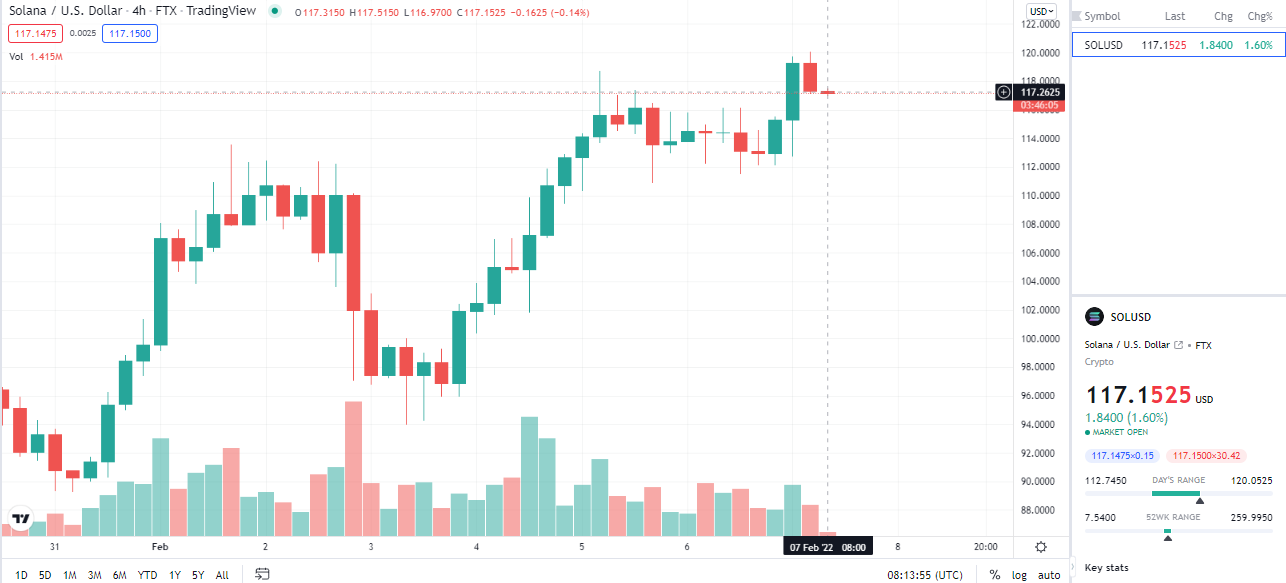
SOL Chart

The coin began trading in November at $198.93, and it quickly surpassed its previous high to reach a new zenith of $259.06 on November 6, 2021. With these results, there is little doubt that SOL will be the best performer among large-cap coins in November as well. If SOL’s performance last year is any indication, the token appears to be in good shape. However, when you consider the number of Solana integrations that are currently taking place, things get even better.

The majority of long-term crypto investors seek out initiatives that will be valuable in the long run. Solana’s creators are aware of this, and they’ve been forming alliances to ensure that the Solana blockchain remains operational in the long run.

Brave, the prominent privacy-focused and crypto-friendly browser revealed last year that it would connect with the Solana blockchain. As a result, the browser will be able to natively display DApps created on Solana. At the same time, Solana will encourage dApp creators and consumers to adopt Brave’s Token BAT.

The developers of Solana have also made significant investments in the gaming industry. Solana Ventures teamed up with prominent crypto exchange FTX and venture capital company Lightspeed Venture Partners to launch a $100 million ecosystem fund devoted to Web3 gaming in November 2021.

Polkadot (DOT)

The token is trading at $22.09, with a global market cap of $21 billion. The Polkadot Chain received a lot of attention and good news in October 2021. It has been on an upward trend (until the recent correction), since the news of its sale, with the first parachain of Polkadot going online on November 11, 2021. On November 4th, last year the asset reached a new ATH of $55. Polkadot led the entire market gain that week, with a price increase of around 24.8%.
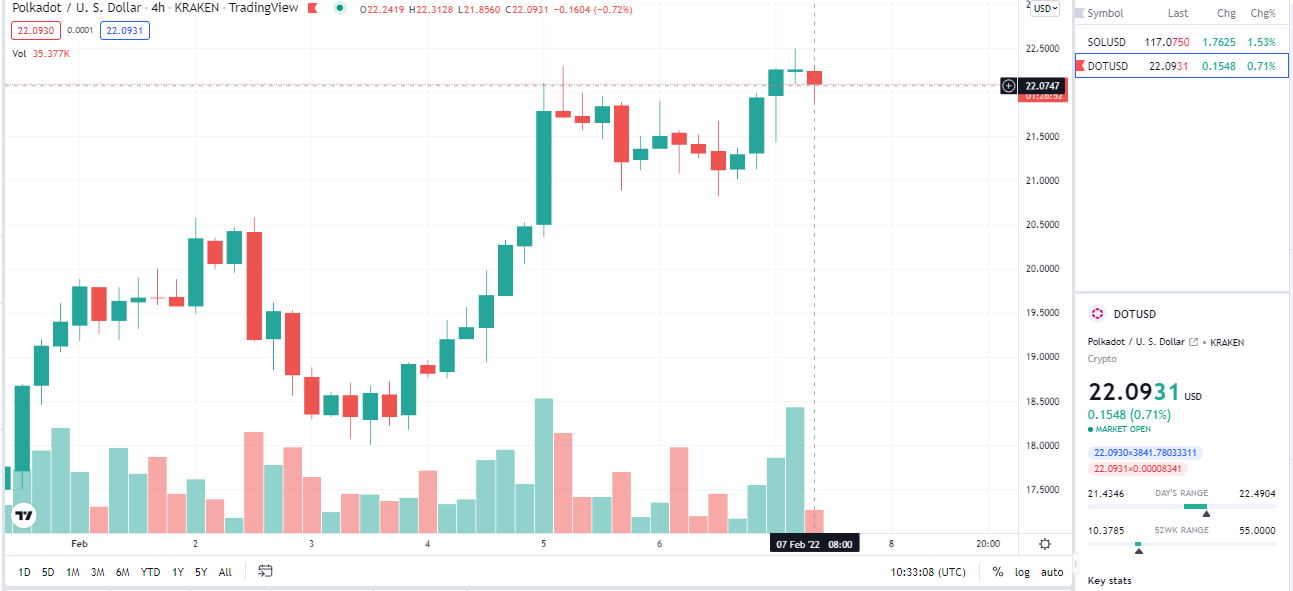
DOT Chart

The Polkadot blockchain benefited from the excitement, with Digital Finance Group, a crypto investment firm, allocating approximately 500,000 DOT to Acala, a DeFi platform built on the Polkadot blockchain, before its proposal for a parachain slot. Moonbeam and Acala Network had raised a total of $882 million to bid for a spot in Polkadot’s para-chain auction.

Foundry, a mining subsidiary of the DCG, has developed a staking business for exchanges, hedge funds, and other financial institutions that want to stake DOT. The crypto market was in the red when the parachain auction began, with Dot leading the way. This can be linked to the initial drops after the ATH due to the ‘sell news impact.’ The DFG group, a worldwide blockchain investment business with a $1 billion AUM, has stated that it has donated 300,000 DOT tokens to support the Astar Network’s para-chain proposal.

The DOT coin was launched in August 2020 and has shown incredible growth in a short period. Except for the drop in June and July, which is primarily attributable to the aftereffects of the May market meltdown and the asset trading in a very small range, the price has been quite constant. Since January, prices have increased by about 328%.

The token has seen significant gains over the last four months, reaching an all-time high of $55 in November.

Sandbox (SAND)

The token is trading at $4.59, with a market cap of $4 billion. The value of Sandbox, a metaverse currency, soared last year as a result of Facebook’s Meta rebranding. People can hang out in metaverses, which are virtual settings where they can do many of the same things they can in real life, spend money, work, and play. Metaverses, according to Cathie Wood of Ark Invest, will be worth trillions of dollars in the future, and she isn’t alone. The Sandbox is the market’s second-most valuable Metaverse coin, after Decentraland.
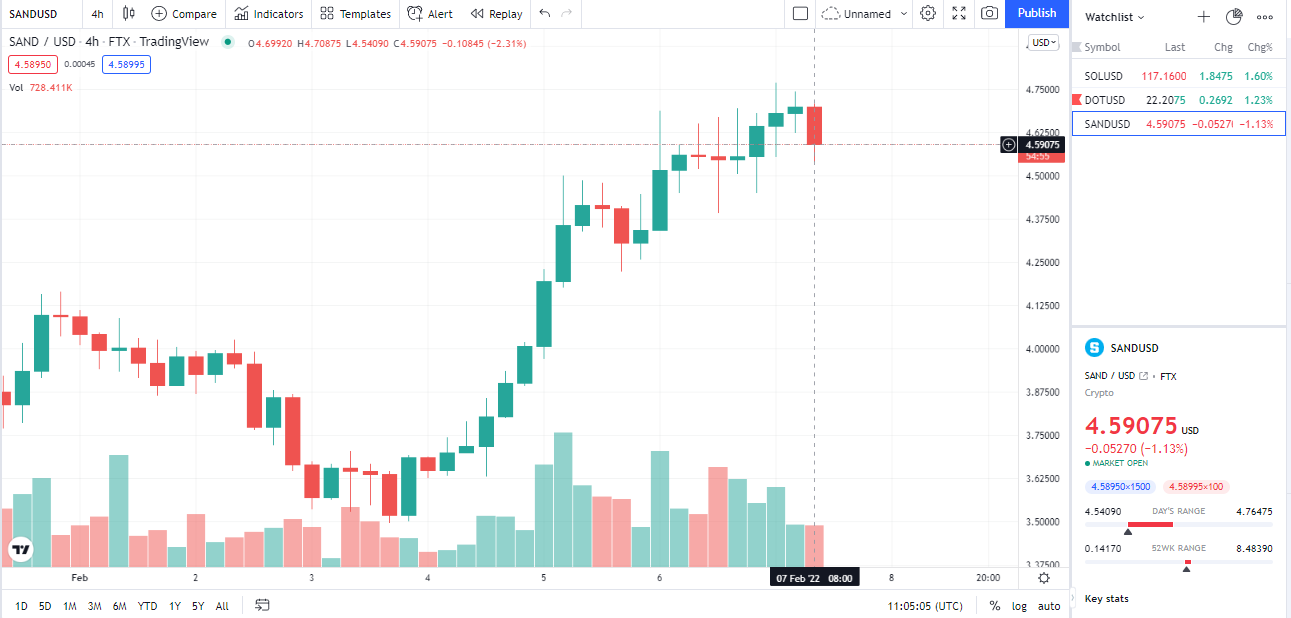
SAND Chart

Grayscale, a large digital asset management company, is now analyzing SAND and may add it to its portfolio, which is potentially bullish for The Sandbox. Furthermore, the project’s ecosystem is rapidly expanding, with land transactions, for example, fetching substantial sums regularly. Analysts believe The Sandbox will continue to do well this year and will rank among the best cryptocurrencies in 2022. The SAND price climbed by more than 16% last week as the team announced another LAND sale, which included over 550+ LANDs, eight ESTATE auctions, and Premium NFTs. The LAND sale is set for February 10th at 1 PM UTC, so mark your calendars if you want to buy some virtual land. Furthermore, The Sandbox has released a new LAND contract that addresses a flaw in the prior contract that was discovered on December 25th. Make sure to move LAND to the new contract if you have it. Keep in mind that The Sandbox will pay for your gas.

The Sandbox is one of the most anticipated ventures on the market, and their LAND economy is the most active cryptocurrency economy. Softbank was one of The Sandbox’s first significant backers, investing more than $93 million in the Metaverse game. As a result, SAND is one of the safest Metaverse investments, especially when used in conjunction with LAND.

Polygon (MATIC)

The token is trading at $1.78, with a global market cap of $13 billion. Matic is one of the many cryptocurrencies expected to become popular in 2022. It is a token with enormous potential to explode in 2022. Matic is powered by the Polygon network, which is quickly becoming one of the best Ethereum scaling solutions. The number of developers migrating to the polygon mainnet is rapidly increasing, which is why Matic is doing well. 
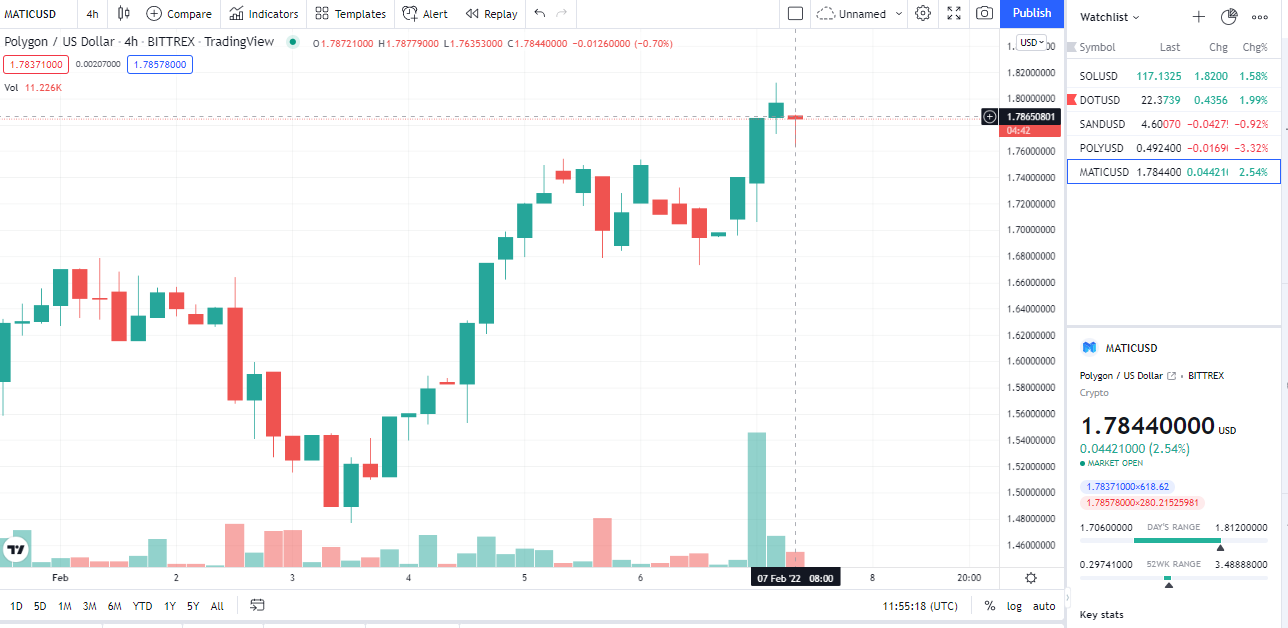
MATIC Chart

Matic is showing all of the signs of bullish growth that Polygon is. Matic will continue to expand in response to rising demand for more Polygon scaling solutions. The crypto coin is currently green, but it may turn bullish in the coming days. The token had several projects one after the other last year. 

Polygon Network announced the formation of a decentralized autonomous organization on August 19, 2021. (DAO). According to Polygon, the system intends to ‘deliver DeFi to the next million users’ by forming committees and facilitating conversations across projects such as Sushi, Aave, QuickSwap, and others. Polygon released its most recent user growth update on October 29. Polygon had ‘83.14% of the active addresses relative to Ethereum,’ according to the company’s data. Since October 1, Polygon has had more daily average users than Ethereum.

MATIC price is poised for a significant bullish reversal of the recent downtrend after Polygon’s trend channel was broken to the downside. Bulls were able to stop and turn the drop at $1.40, pushing the price back towards the 200-day Simple Moving Average (SMA) at $1.63, thanks to that correction. The Relative Strength Index (RSI) bounced over the oversold border with that move, causing a bullish knee-jerk reaction.

Decentraland (MANA)

The coin is trading at $3.27, with a global market cap of $5 billion. Another of the year’s top new crypto initiatives is Decentraland. Simply put, Decentraland is a blockchain-based virtual world in which users can create their characters and buy in-game property plots. As the metaverse concept spreads in 2022, altcoins like Decentraland are anticipated to gain more traction, potentially resulting in massive price rises.
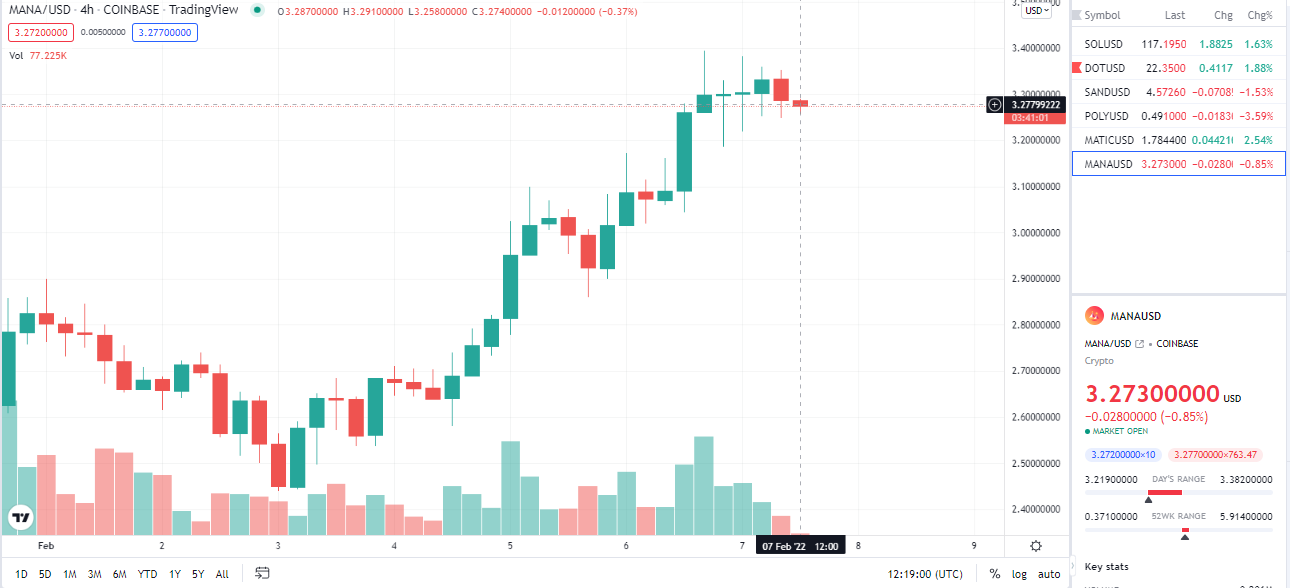
MANA Chart

The 20-EMA and the 50-SMA are both trending up on the 4-hour chart, and the RSI is in the overbought zone. Bulls have the upper hand in this situation. The moving averages are expected to provide support if the price drops below the current level. The news of Steve Aoki’s Australian Open metaverse party could be a catalyst for the MANA token to rise. The celebration took place this past weekend in the Decentraland metaverse and featured performances by a variety of performers. This is noteworthy since the Australian Open is one of the most popular yearly tennis tournaments, with hundreds of thousands of fans tuning in to watch. Decentraland now has a greater sense of legitimacy and reputability as a result of this.

The technical indicators for MANA reveal that the coin is performing well as well. The coin is currently trading above its 200-day moving average of $1.59, with the MACD line hovering near neutral. The RSI of 52 also indicates that it is now in the neutral zone. MANA is now trading at about $3.7 per coin as of this writing. According to WalletInvestor analysts, the token’s price might rise by about 140% in 2022, with MANA trading around $8 by the end of the year.

Conclusion

The most common motivation for trading altcoins is the potential for a faster return on investment in the near term. However, experts argue that Altcoin investors can utilize tokens to limit risk because some low-cost coins or projects do not require a huge investment. With widespread acceptance, cryptocurrency has indeed become mainstream. However, everyone wants to know how to choose the correct coin within their budget to build a strong portfolio. It is not necessary to have a large sum of money to open a crypto account. All you need is a small amount of knowledge and a little bit of luck.

Can Ethereum (ETH) Reach 10k in 2022?

Peter Brandt Ethereum

Ethereum has had a fantastic year in 2021. The price of Ethereum’s native cryptocurrency, ETH, has increased by more than 440%. The growth was phenomenal and the token ended well above $3500, thanks to a rally in the closing days of December. It hit $4,843 in mid-November, about seven times greater than it had been at the start of the year, indicating the coin’s continued rise in 2021. Since then, however, the coin has dived, sometimes trading below the $4000 level, underscoring the volatile nature of cryptocurrencies.

ETH is the second-largest cryptocurrency in terms of market value. With ETH up more than 440% since the start of 2021, investors see the network’s potential. The Ethereum network, in particular, is not yet complete; additional features and enhancements are still in the works, giving this cryptocurrency a lot of potentials. Will ETH’s meteoric rise continue? So, what does the Ethereum price forecast for 2022 look like? Is this a one-time blip? Is there a real chance that the coin will reclaim its previous highs or maybe reach as high as 10,000 by the year-end? Let’s take a look at the factors or what it will take for ETH to reach that milestone this year. 

Ethereum’s Blockchain Upgrades For 2022

Throughout 2021, the Ethereum blockchain was upgraded to Ethereum 2.0, a project that will continue into 2022. Coin burning was introduced as part of the London hard fork, or split, in August, and is meant to increase the value of the ETH coin by limiting supply as its use grows. On October 27, the Altair upgrade went live on the main network. The Ethereum Beacon Chain upgrade is a test of the transition to proof-of-stake (PoS) block mining. To complete the Ethereum 2.0 upgrade, the main Ethereum chain will combine with the Beacon Chain in 2022.

As the blockchain transitions from proof-of-work (PoW) mining to proof-of-stake (PoS) mining, the Arrow Glacier network update took effect on December 8, delaying the “difficulty bomb,” or an increase in mining difficulty, until June 2022. According to the Ethereum Cat Herders development blog, “the Ethereum clients’ team wished to avoid having to organize another pushback while working on the next large upgrade.”

Institutional Interests in ETH

Large growth in Ethereum blockchain use might push its token to $10,000 or higher. Ethereum has already established itself as the most popular blockchain for smart contracts. It’s not difficult to imagine the impending improvement drawing a large number of developers in the future year. Institutional investors have expressed interest in Ethereum this year, owing to the introduction of applications like decentralized finance (DeFi) and non-fungible tokens (NFTs).

According to CoinShares, Ethereum outflows totaled $39.2 million in the first week of 2022. JP Morgan is one of the organizations delving deeper into the bitcoin field. At its Crypto Economy Forum event, it gave free NFTs minted on the Ethereum-based Polygon network, which has since been listed on the OpenSea NFT marketplace. To promote its support of the Sibos conference, Bank of America just launched its first NFT.

Bad news for one or more of Ethereum’s main competitors could potentially help in this regard. A major security breach or prolonged unavailability for Cardano or Solana, for example, could entice developers to transfer to Ethereum.

Several projects are now competing with Ethereum, including Solana, Algorand, Polkadot, and Cardano. These technologies, while promising and now more scalable than Ethereum, are nonetheless lagging behind Ethereum in terms of growing the dApp ecosystem.

What Can Stop it From Happening?

Numerous obstacles could prevent Ethereum’s price from going above $10,000 next year. For one thing, the whole cryptocurrency environment must remain stable. Ethereum would very probably be dragged down by a broader sell-off.

The Ethereum 2.0 upgrade’s shard chain phase has already been pushed out from 2022 to 2023. Any further large delays in the upgrade could prevent Ethereum from considerably increasing in value in 2022.  Even if the update isn’t postponed, Ethereum may lose ground to competing blockchains. Smart contracts are supported by other blockchains as well, but with far faster transaction rates and reduced gas fees.

Here’s What The History Says

In all but two years since its introduction in 2015, Ethereum has achieved gains of more than 160%. From a historical perspective, this may appear to indicate that the cryptocurrency’s chances of reaching the target level are quite good. However, the larger a cryptocurrency becomes, the more difficult it is to grow at the same rate.

However, the components are in place for Ethereum to have another successful year. As new apps are built on the blockchain, billionaire Mark Cuban expects that it will be a huge winner in 2022. He may be correct. Even if he isn’t, Ethereum might provide investors with significant long-term profits. 

The Bottom Line

The prospects for Ethereum in 2022 are bright. Given that ETH increased by more than 430% in 2021, a 230%  growth to $10,000 next year is an easy conclusion. Furthermore, assuming Ethereum maintains its current trend, the price of the cryptocurrency might reach $20,000 by 2022.

While the cryptocurrency sector is expected to grow next year, volatility is expected to stay high. As a result, in 2022, the Ethereum price may undergo multiple significant drops. However, if the cryptocurrency industry continues to grow, the Ethereum price might hit $10,000 in 2022, according to our estimates.

Web3 Innovations Are Taking the Place of Middlemen

Web3 Middleware Protocols

Decentralized Finance (DeFi) has ushered in a new era for cryptocurrency, attracting a large number of newcomers. It lets users avoid paying high fees by lending their money out and earning interest on the assets they own. The surge in DeFi initiatives demonstrates how far the DeFi revolution may go in disrupting established lending methods and giving customers more power. Developers are extracting value from protocols, rather than enterprises extracting value from users, thanks to the DeFi revolution.

Cryptocurrencies and the broader blockchain ecosystem are helping to transform how we live our lives. Because of these new technologies, Web3 is being hailed as a permissionless and open innovation platform based on middleware blockchain protocols. They are displacing intermediary software-as-a-service (SaaS) firms and extracting more revenue as a result. Now, before going into further details, let us first understand what Web3 is. 

What is Web3?

Web3 is supposed to liberate the world from monopolistic control. Web3 refers to a blockchain-based decentralized online ecosystem. Platforms and apps built on Web3 will not be owned by a centralized gatekeeper, but rather by users who will earn ownership stakes by contributing to the development and maintenance of those services.

In 2014, Gavin Wood coined the term Web3 (originally Web 3.0). At the time, he had just finished working on Ethereum, the cryptocurrency that is second only to Bitcoin in terms of popularity and market size. Today, he is the CEO of the Web3 Foundation, which supports decentralized technology projects, as well as Parity Technologies, which is focused on developing blockchain infrastructure for Web3.

Now, a technology this advanced is taking the place of middlemen along with middleware protocols. Middleware protocols are not new. After all, Web2 is supported by middleware applications, the most important of which is HTTP. Middleware is what allows users in a computing environment to interact with one another and with applications. And, with Web3, there are a variety of protocols in this new internet’s middle layer stack to support applications.

Web3 and Middleware Protocols Together Make It Better

With the introduction of blockchain technology, the way we go about our daily lives is changing. The blockchain enables this by providing a secure and trusted peer-to-peer (P2P) network between users, whether it’s through financial transactions, purchasing art, purchasing property, or donating to a charity. Companies are no longer extracting value from users; instead, developers are extracting value from protocols.

And it works quite efficiently. Developers can stake the native token once for the equivalent network bandwidth for the lifetime of that stake on a middleware protocol. The longer applications are staked and used on the network, the closer the cost gets to zero. After a few months, the service is essentially free, and there are no monthly fees, as there are with SaaS fees.

Developers can always sell the native tokens of the middleware protocol they purchased on the secondary market or to another developer after unstacking their initial investment. They can also stake the software-as-a-service node to gain more protocol tokens in exchange for serving application requests.

Middleware Protocol that is Unique For Every Layer of the Stack

At a distinct layer of the stack, each application-specific middleware protocol provides a unique service. For example, the RPC layer is with Pocket Network, the indexing layer is with Graph, the cloud layer is with Akash, the video transcoding layer is with Livepeer and Arweave, and the storage layer is with Filecoin and Storj. The protocols are complementary since they exist in distinct areas of the decentralized Web3 developer stack. ERCgraph, Proxy Poster, LiFinance Bridge Aggregator Analytics, and Balancer Chat, for example, employed both Pocket and the Graph in their ETHOnline 2020/2021 hackathon projects. The protocols are synergistic since they are at distinct portions of the decentralized Web3 developer ops stack.

This is demonstrated by the fact that the Graph’s subgraph indexers must ping a base-layer Ethereum archive node, which can be costly to host and maintain. Indexers can save money by utilizing the RPC endpoints of a middleware protocol, which provide users with maximum uptime and no single points of failure. They must use Livepeer’s orchestrators to ping a base-layer Ethereum full node, which incurs monthly costs to run and maintain. Orchestrators, like indexers, can save money by utilizing a middleware protocol’s RPC endpoints. As a result, a two-sided marketplace emerges between customers and providers.

Conclusion

With the above-mentioned mutually beneficial relationship, better service attracts apps, more app usage creates more node money, and more node revenue draws additional nodes, increasing redundancy, and so on. Because Web3 middleware protocols will run on decentralized protocols — the building blocks of blockchain and crypto technology — we can expect a substantial convergence and symbiotic interaction between these three technologies and other disciplines.

The Significance of Blockchain in Web 3.0

How Web 3 Can Help India and Add Value to Their Financial Systems

The burgeoning blockchain world is a mix of traditional and blockchain-enabled methods of doing things. The fact that the blockchain world is part of a wider infrastructure does not mean that its consequences are insignificant. The Internet has had a huge impact on our culture, economics, and systems, and blockchain will be complementary to the kinds of changes that have already occurred, allowing for both centralized and decentralized government. Blockchain permits participants to implement agreements and transactions without having to be their own legal company by enabling so-called decentralized autonomous organizations (DAOs). And the growing popularity of blockchain has now contributed to the world of Web 3.0. This article discusses the importance of blockchain in Web 3.0. 

The pandemic has demonstrated the importance of the internet in times of disaster. However, when it comes to data security, the internet as we know it today is pretty confusing. Since its creation, the internet has expanded dramatically. Before the arrival of blockchain in Web 3.0, many new kinds of the internet emerged. The following points will give you a thorough understanding of how blockchain may propel Web 3.0 forward.

What is Web 3.0?

The next internet revolution is in the works, and it intends to give users more control over digital content. Web 3.0, which will be based on blockchain, aspires to eliminate any major intermediaries, such as centralized governing bodies or repositories.

Web 3.0, often known as the decentralized web, is the most recent generation of internet apps and services that are enabled by distributed ledger technology, the most common of which are blockchains. It focuses on decentralizing data instead of storing it centrally, with computers capable of interpreting information as intelligently as people.

Web 3.0 differs from Web 2.0 in that it focuses more on employing cutting-edge technology like machine learning and artificial intelligence to provide more tailored information for each user. Web 3.0 is also predicted to be more secure than its predecessors due to the system on which it is based. Web 3.0 tokens are cryptos associated with Web 3.0. 

Web 3.0, with the help of decentralized infrastructure, promises to give users more control over their digital content by removing the dependency on a single authority for transactions and approvals. This is encouraging for the creator economy, in which people may be paid for holding or donating digital material and value to the online community.

Apple’s Siri and Amazon’s Alexa are two examples of companies that have already implemented Web 3.0 AI technology. Voice-controlled AI is being used by both organizations to provide customers with real-time answers to their questions. Web 3.0 would make internet connection available to anybody, at any time. Amazon has also begun to integrate smart gadgets, which come under the Web 3.0 category, into its Alexa goods. A user can communicate with or control many devices using their phone or voice with smart gadgets. But cryptocurrency, such as Bitcoin, is the most talked-about Web 3.0 technology that is already in use. 

Web 3.0 Towards Decentralization

People nowadays use the internet as if it were a standalone computer. All data on the internet is centralized and managed through servers operated by designated trusted entities. Firewalls are required to protect data on these servers, and system administrators must address server and firewall administration concerns. In such situations, power and control are concentrated in centralized bodies. On the other hand, the drawbacks of concentrated power have been well-documented in the past, with numerous examples. The 2008 global financial crisis exposed the cracks in centralized control, paving the way for decentralization. Web 3.0’s decentralized architecture strives to address the difficulties that arise from centralized power and control. Web 3.0 addresses some of the most difficult challenges, such as user trust, openness, and privacy.

The Semantic Web was the core of the Web 3.0 definition, as defined by Tim Berners-Lee, the designer of the World Wide Web. Its main goal is to create an autonomous, open, and intelligent internet. Web 3.0 examples can demonstrate how data would be decentralized networked, as well as chances for machines and users to engage with data. Simultaneously, the third generation web’s major pillars would be the semantic web and artificial intelligence. 

Implementation of Blockchain in Web 3.0

The most essential component of Web 3.0 examples such as voice assistants Siri and Alexa shows how machine learning may generate a new range of internet services. The third generation of the internet would run on decentralized protocols, except for hints of incorporating machine learning and connecting machines through IoT. As a result, finding a possible convergence of blockchain in Web 3.0 is critical. Interoperability, automation through smart contracts, seamless integration, and censorship-resistant storage of P2P data files are all features of the third generation of online networks. As a result, blockchain will be a major driving force behind the future generation of the internet.

Blockchain is playing a critical role in altering traditional data storage and management methods. In layman’s terms, blockchain provides a one-of-a-kind collection of data or a global state layer that is managed collectively. The ability to construct a value settlement layer on the internet is provided by the unique state layer. The state layer enables effective P2P transactions without the use of middlemen by allowing files to be sent in a copy-protected way.

Because Web 3.0 networks will run on decentralized protocols — the building blocks of blockchain and crypto technology — we can expect a substantial convergence and symbiotic interaction between these three technologies (Web 1.0, Web 2.0, and Web 3.0) and other disciplines. 

Why Will Blockchain Benefit Web 3.0?

The makers of Web 3.0 are utilizing the greater security and privacy offered by blockchain to appeal to internet consumers. Because blockchain is a decentralized system, it does not have a single point of control that may be hacked. Individual websites and the internet as a whole would be substantially safer against threats under Web 3.0. Users would not have to be concerned about their data being lost or hacked. Web 3.0 and blockchain will work together to improve bitcoin trading and mining.

When you consider how blockchain affects data structures in the web’s backend, it’s clear that it’s the foundation for Web 3.0. Most importantly, it aided in the creation of a governance layer that runs on top of the existing internet. The governance layer can now allow two untrustworthy people to form an agreement and settle transactions over the internet. Surprisingly, blockchain’s capabilities in web 3.0 would mostly focus on introducing a backend revolution. Web 3.0 can be thought of as a collection of blockchain-based protocols aimed at transforming the internet’s backbone wiring from a technical standpoint.

However, Know That Web 3.0 Is Not Just About Blockchain

Web3 isn’t about decentralization or blockchain entirely. It’s about web democratization, which is sometimes overlooked by Web3 developers. Blockchain and decentralized architectures are tools for this democratization, and yes, Proof of Work blockchains, such as Bitcoin, consume a lot of energy and, depending on the energy source, have a lot of carbon emissions, which is terrible.

A massive computational capacity could address many of humanity’s issues. Instead of protecting a trustless ledger, those GPUs may be used to find a treatment for cancer or the optimal architecture for a fusion reactor or to train smarter AIs. However, PoW is merely one method of achieving consensus.

There are non-mining PoX consensus mechanisms such as PoS, PoA, PoH, and others that do not require supercomputers or power plants. These nodes can run on a modest PC or an IoT device and consume very little power. New blockchains, such as Solana or Polygon, have similar levels of usage as centralized systems.

Another common objection is that these decentralized systems aren’t truly decentralized. Most Ethereum users, for example, access it through Metamask or other centralized methods. Yes, it is correct. But why is this a problem in the first place? The aim isn’t a straight peer-to-peer link. The key is that you can change your provider at any time or run your node on the cloud, at home, or wherever else you desire.

A decentralized Uber, Airbnb, or Facebook does not necessitate a direct peer-to-peer network in which everyone runs their node. A nice example is a DAO that follows the same design as existing businesses. The service does not necessitate the use of blockchain or other mystical decentralized technologies. It’s the same old “web2 style” cloud infrastructure, but this time with a DAO present. That is precisely the point. Users have complete control over platform development, monetization, and other aspects.

The Bottom Line

While widespread adoption of Web 3.0 is still a big dream, we can see the beginnings of its potential. The internet is leveraging blockchain to advance towards the next development of the web, from bitcoin to smart devices. While some of these changes may appear perplexing to those outside the technology industry, there is no need to be concerned about all of them occurring at the same time. Because changes to the internet take time and money to implement, they are frequently gradual, giving the average user time to learn and adapt.

Top 10 Altcoins to Invest in August 2021

Top 10 Altcoins to Invest in August 2021

Cryptocurrencies have undoubtedly won the hearts of investors all over the world. Ever since Bitcoin was introduced in 2009, there has been a radical new way of making payments. Such has been the popularity of digital assets that it is hard to ignore these days. 

Moreover, cryptocurrencies have become one of the mainstream investment platforms today. And due to the rise of the economic crisis in several countries, digital assets have gained sudden acceptance that cannot be ignored. It is quite clear that cryptocurrencies are an important element in today’s digital economy. 

Notably, Bitcoin alone is not responsible for this. The rise of other cryptocurrencies or altcoins has brought down the global market dominance of Bitcoin. It started the year with a dominance of 70%, which has now come down to 46%. Therefore, Altcoins, coins apart from Bitcoin, have gained significant success over the past few months. Interestingly, altcoins like Ethereum, Cardano, Polkadot, Dogecoin, etc., have witnessed more than double-digit gains. 

Even tiny sums of cryptocurrency investment can yield significant returns if you get in at the right time and make the right decision, but that doesn’t mean there aren’t risks (if anything, the risks are bigger). Investing in cryptocurrencies has become a worldwide craze. As we approach the end of July, most cryptos remain much lower than their all-time highs (ATHs) set earlier in 2021. However, the prices of many digital assets, and especially altcoins, have recently stabilized. Investors should keep in mind that altcoins may not be suitable for all portfolios.

This article will look into the top 10 Altcoins that have exciting advancements planned for August, which could significantly boost their price.

Top 10 Altcoins for August

Altcoins are scalable, inexpensive, and offer a quick and easy way to make transactions. Despite their apparent similarities, most cryptocurrencies provide unique services and functionalities.

The value of altcoins has plummeted over the last few months. As a result, the market is speculating whether most digital currencies have any more room for growth. Some investors are searching for crypto exposure without having to buy altcoins through companies like Coinbase Global and Square. On the other hand, others are considering purchasing these during the fall in these digital assets as the market tries to get traction. This is perhaps the best moment to invest in these altcoins as the crypto market slowly and methodically recovers from the massive market-wide drop. So research the following tokens when you think of investing your money in the market. 

Note: Altcoins are not given in any particular order, and the price and market cap of all the tokens are as per the research done for the article.

Ethereum (ETH)

We cannot talk about potential altcoins without mentioning this token. Ethereum is the largest altcoin and is currently trading at $2488, with a global market cap of $291 billion. On August 4, Ethereum launched a long-awaited and contentious hard fork known as the London upgrade. A hard fork is a significant modification to the programming of a network that renders previous versions outdated.

Although Vitalik Buterin, Ethereum’s co-founder and developer, recently stated that the entire Eth2 rollout may not be completed until 2022. 

Regardless, the hard fork is crucial. The adjustments are intended to lower the amount of Ethereum on the market, enhance transaction times, and stabilize costs. Transaction prices on Ethereum vary depending on how busy the network is, and excessive fees have pushed some developers away from Ethereum in favor of alternative cryptocurrencies. The adjustments will lower the fees.

If we look at the market trend, Ethereum has recently outperformed Bitcoin in terms of market sentiment, surging past the $2,550 mark. Last month, the digital currency broke through its resistance levels of $2,500 and $2,550, trading at $2,700 before seeing a negative reversal. Ethereum’s latest trend is building a barrier near the $2,630 mark. The digital currency might soar to unprecedented heights if the consolidation breaks through and sets new price records.

Polkadot (DOT)

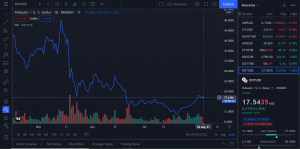
This token is known as the best alternative to Ethereum. The growth of Polkadot over the past year has been commendable. The crypto is trading at $17.51, with a global market cap of $17 billion. It was launched in 2020 and today DOT has become one of the most talked-about cryptos. It is even often considered as the “Ethereum Killer.” 

Polkadot functions and features tell us what it can achieve in the future, most Polkadot holders just hold and keep investing in the native token of Polkadot, DOT. Four months after its launch, DOT hit a market capitalization of $3.7 billion, trading around $4, and was ranked as the 7th largest crypto in the market. 

Polkadot, which owns one of the hottest blockchains around, has been called the “next-generation blockchain” by Web3 Foundation. Apart from this, Polkadot has been coming up with various projects that add up to the growth of the token.   

The DigitalArt4Climate initiative by the International Association for the Advancement of Innovative Approaches to Global Challenges (IAAI GLOCHA), an Austria-based organization accredited by the United Nations — aims to empower young artists and designers around the world by offering them special non-fungible tokens (NFTs) platform where they could present and sell their art to inspire environmental awareness. And this will be built on the Polkadot blockchain. 

Charu Sethi, chief marketing officer at Unique Network, said in an interview that sustainability has been the top priority for Unique Network and the reason they built on Polkadot is that the technology allowed for proof-of-stake validation, which leads to less energy consumption.

Furthermore, Bitcoin recently completed 3 transactions per second, while Ethereum processed 15 transactions per second. This demonstrates the scalability challenges that each of these cryptocurrencies is dealing with. Polkadot, on the other hand, wins in terms of scalability.

Polkadot’s parachains allow for speedier parallel processing of transactions. As a result, throughput improves. The first parachains, capable of processing 1 million transactions per second, are expected to launch later this year. Therefore, this is the right time to invest in the token. 

Chainlink (LINK)

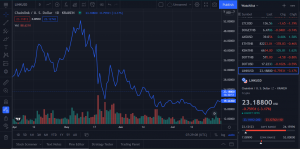
The token is trading at $23.12 and holds a market cap of $10 billion. Chainlink was one of the first networks that allowed off-chain data to be used in smart contracts. Chainlink is a key participant in the data processing area, with a large number of reliable partners. This token has shown good growth after the market-wide crypto correction. The month of August will be crucial for the token as it has several tokens lined up. Weather information provider AccuWeather announced Wednesday that it is launching a Chainlink node to make its weather APIs directly onto blockchain-based smart contracts, according to a release.

Kurt Fulepp, Global Chief Product Officer of AccuWeather, said, “As one of the initial weather-related data products to join Chainlink, we are thrilled to expand our reach in bringing value to the emerging blockchain-based market.” Apart from this, Kraken too recently embraced a Chalinlink node to “facilitate price predictions” on DeFi apps, and the digital asset investment firm Grayscale also, LINK, to its investment fund. 

Chainlink and NAOS Finance, a decentralized real-world asset lending protocol, announced a collaboration today to develop a Chainlink oracle solution for financial assets in the primary and secondary markets. Daniel Kochis, Head of Partnerships at Chainlink Labs said:

“We’re excited to support NAOS in providing their users with tamper-proof data feeds, bringing more access to real-world financial data previously unavailable in the DeFi ecosystem.” 

Therefore, one should try to keep this token in their portfolio this month. 

Theta (THETA)

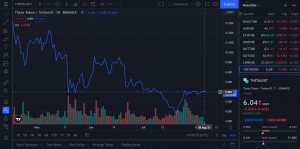
The token is currently trading at $6.04, with a market cap of $6 billion. This is the largest NFT token, hence you can expect a lot from this token. And with the NFT marketplace booming, this token has the most growth potential. Theta is planning to launch TDROP, a TNT-20 token that will be used to reward purchases on ThetaDrop NFT Marketplaces. This token will be launched on February 1, 2022, according to the release.

TDROP tokens can be “NFT liquidity mined” in addition to being earned through primary or secondary purchases on the ThetaDrop NFT Marketplace or through a third-party NFT dApp based on the NFT marketplace smart contract. TDROP will function as a governance token for ThetaDrop and the NFT marketplace, which is interesting. Holders of this token will be able to vote and create new ideas to be voted on in the future as a result of this development.

From July 20 to July 26, Theta’s price increased by about 95%. Following this exponential rise, the market has been consolidating and is currently targeting the $5.76 support level. The commencement of an uptrend will be signaled by a decisive 6-hour candlestick close over the $6.44 resistance level, propelling THETA by 17 percent to the supply barrier at $7.53. While this scenario is possible, there is a potential that Theta price will drop below $5.76 and retest $5.25 before rising.

Kava (KAVA)

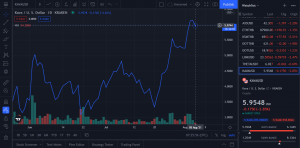
The token is trading at $5.9 and holds a market cap of $416 million. Kava is a software protocol that makes use of various cryptocurrencies to let people borrow and lend money without the need for a traditional financial intermediary. Kava is seen as one among a rising number of decentralized money (DeFi) projects along similar lines. Although most DeFi projects operate on Ethereum, Kava is built on Cosmos, which developers claim adds extra features.

Kava’s working protocol is what makes it interesting. Kava aims to become a de facto DeFi lending protocol, using its decentralized lending function and USDX stablecoin to provide additional sorts of crypto assets to its consumers. Kava coin (KAVA) is the Kava protocol’s local governance coin and shared asset. The coin holder is in charge of administering the agreement, voting on smart contract and operational parameter suggestions, securing the network, and acting as the lender of last resort.

Simplex and multi-asset DeFi platform Kava teamed together last month to create the first Fiat-to-DeFi ramp for Kava and other DeFi lending platforms on the Kava blockchain, serving millions of users globally. Therefore, with projects like these, the price of the token can reach heights. 

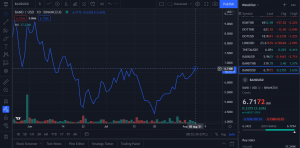
Band Protocol (BAND)

The token is trading at $6.72, with a market cap of $236 million. Band Protocol token has recently been in the news. Band Protocol is enhancing its interoperability within the Cosmos ecosystem. Cosmos’ adaptability is growing, as blockchains inside the ecosystem become “much more integrated and interoperable than ever before.” Newly generated chains can “exchange feeds of diverse types of data by employing an oracle and the Cosmos interoperability standard: Inter-Blockchain Communication protocol (IBC)” with this Band Protocol inclusion in Starport, the Cosmos blockchain creation tool.

While numerous chains have now been merged with the Band Protocol Oracle, it is the first to be adopted “as a standard within Starport, the most convenient way to establish a blockchain on Cosmos,” according to the study. Developers of decentralized applications (DApps) can now access decentralized and secure data from Band Protocol “while developing on Cosmos.” IBC was previously primarily utilized for asset transfers. 

The growth BAND is having this year is worth noticing. It started the year with a market cap of just $109 million, and now it stands at $236 million. Therefore, with the crypto market coming back from the correction, this is the right time to invest in the coin. 

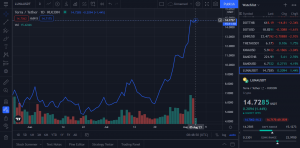
Terra (LUNA)

The coin is trading at $14.6 and holds a market cap of $6 billion. Terraform Labs, the company in charge of the Terra cryptocurrency project, has reaped the benefits of its growing popularity. Investors such as Arrington Capital, Lightspeed Venture Partners, and Pantera Capital have invested $150 million to assist Terra incubate numerous crypto businesses. 

Terraform Labs and its partners have developed apps that use the company’s blockchain technology to retain a permanent and shared record of the company’s cryptocurrency-related financial transactions.

Terra (LUNA), a blockchain platform that underpins the fiat-pegged TerraUSD (UST) stablecoin, is one such project that has managed to outperform Bitcoin since the beginning of August. The price of LUNA has risen 162% from a low of $5.53 on July 20 to an intraday high of $14.51 on August 3rd, according to data from TradingView, while its 24-hour trading volume has surged from $137 million to $774 million.

The addition of a wrapped version of Ether (ETH) to Anchor Protocol, which introduces Ether staking rewards to the Terra ecosystem, and the protocol’s tokenomics, which assist limit the circulating supply of LUNA and UST, are three reasons for the spike in interest.

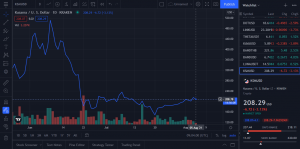
Kusama (KSM)

The price of the coin stands at $208 and has a market cap of $1 billion. Kusama is one of the most intriguing blockchain crypto technologies. Kusama has been a preferred location for development teams wishing to treat our new functionality, serving as a testbed for the conservative Polkadot blockchain. 

In the crypto realm, the Kusama blockchain has become a hub for some of the most popular DeFi protocols. Five DeFi projects are currently listed in its parachain auction, with more anticipated to join in the coming weeks.

In addition, Kusama is actively developing Unique Network, an NFT chain aimed at combating climate change. Market analysts believe that KSM will double in value by the end of the year due to its rising use case. KSM is expected to trade for $528.628, according to Wallet Investor. Therefore, don’t miss out on this token to get profitable returns this month. 

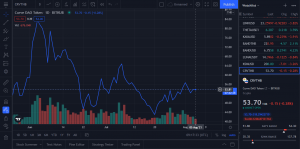
Curve DAO (CRV)

The price of the token stands at $53 and holds a market cap of $1.62. Curve DAO has gained considerable attention for following its remit as an AMM specifically for stablecoin trading. Now is the best time to buy the token. Curve Finance has established itself as a mainstay of the DeFi market due to its ability to provide stablecoin liquidity across the ecosystem while also giving token holders a less risky means of generating money.

Curve was created to address a fundamental issue in the Stablecoin community: a lack of dedicated services. Today’s stablecoins come in a variety of shapes and sizes. Curve focuses on national currency-pegged stablecoins. It creates a valuable market and framework that takes advantage of these coins’ unique properties. Curve serves as a link between centralized stablecoins like USDT and decentralized initiatives like DAI in this way. 

Curve assisted DeFi investors in overcoming some of Uniswap V1’s flaws. The creators incorporated various proprietary methods that allowed for efficient stablecoin trading, low-risk transactions, and passive benefits for liquidity providers. And this sums up the increasing popularity of the token. 

Ren (REN)

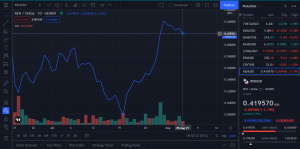
The token is trading at $0.42 and holds a market cap of $420 million. Ren is an open protocol for exchanging bitcoins between blockchains on different networks. The goal is to make it possible for various digital assets to participate in a decentralized multi-chain financial ecosystem. Users will subsequently be able to use smart contracts to access tokens from any blockchain. Ren intends to increase the interoperability of DeFi and hence its accessibility by reducing the barriers to liquidity between blockchains.

The token is up from the price of $0.3 at the beginning of the year. Its price reached as high as $0.44 and came down only after the correction in the crypto space. Therefore, growth like this cannot be ignored. Do not miss this token if you want profitable returns this month. The growth is steady, and the bulls will hit soon. 

Conclusion

This monthly Altcoins to watch column seeks to provide you with a taste of interesting cryptocurrencies and what’s going on in the cryptocurrency world. It concentrates on coins with a defined purpose and a team behind them, which we call “good-faith” currencies. However, it is a quickly evolving industry, and we have no idea how it will play out.

All of the coins listed are available on major cryptocurrency exchanges. However, before you buy, you should conduct your research. Your interests, risks, and financial status are all unique to you. And only you have the authority to choose which coins to add to your cryptocurrency collection.

The Onset of DeFi in the Gaming Industry

The Onset of DeFi in the Gaming Industry

The open, permissionless, seamless decentralized system built on blockchains like Bitcoin and Ethereum — we are talking about the DeFi universe here. The DeFi industry has been growing swiftly over the past few years and has piqued the interest of investors and technologists globally. The Binance Academy defines DeFi as the “movement that promotes the use of decentralized networks and open-source software to create multiple types of financial services and products.”

Currently, the total value locked in the DeFi industry is $66.08 billion. This number talks about the popularity and acceptance this space has received over the past year. The purpose of DeFi is to “develop and operate financial decentralized applications (dApps) on top of a transparent and trustless framework.” And it is not just the finance industry that has witnessed the potential of Decentralized Finance (DeFi). Interestingly, the gaming industry is reaching places with the amalgamation of DeFi into it. 

Blockchain Gaming Will Harvest the Rewards

One of the biggest benefactors of this DeFi development will undoubtedly be blockchain gaming — a space with great potential to introduce new forms of value for the already familiar and curious gaming world. At present, there are more than 2 billion gamers across the globe, and gaming remains one of the most immersive industries today. Moreover, due to the COVID-19 crawling its effects on every economy, millions of people have been confined to their homes and this has propelled the gaming industry. 

Having said that, it is quite clear that gaming itself is an emerging and popular industry. The more addictive a game is, the more money a gamer is ready to invest in it. And DeFi makes it better as it allows you to earn while playing the game. In addition, DeFi offers gamers a novel method of recompense through blockchain-based tokens and various other rewards powered by impressive arms of decentralized algorithms.

Blockchain or the DeFi gaming industry is new, and it is still finding its feet. However, the adoption of DeFi mechanisms in gaming protocols is increasing rapidly. It is widely being accepted not just in the crypto industry but throughout the world. And this is sure to propel further by the current success of the broader DeFi industry, which gives it a unique upper hand in appealing to gamers.

DeFi and Gaming: How the Two Co-Exists

The distinction between assets utilized solely in games and financial assets is eroding, allowing the emergence of a new asset class. People used to think of in-game assets as a digital currency with no actual value, but today they’re seen as legitimate financial assets. 

Both in-game players and investors will use these new, limited in-game assets as financial instruments. DeFi’s mechanics allow blockchain games to provide players with a variety of ways to make it worthwhile for them to play and receive rewards. This increased ubiquity of monetary rewards has piqued people’s interest. Collectible and trading games are among the most popular blockchain genres, thanks to the ability to purchase, sell, and exchange unique tokens and assets. With games increasingly generating and issuing their native tokens, developers may essentially build their economies and ecosystems and connect through them, in most cases across platforms.

The utility and value of these tokens and NFTs will ultimately determine their success, which is why an increasing number of blockchain games are employing DeFi principles to increase the liquidity of such tokens.

Another benefit of DeFi for gaming is the opportunity for players to make passive revenue by staking collectibles or other assets they’ve previously accumulated in the game to liquidity pools. One of the numerous ways DeFi’s mechanics reward gamers beyond the means of traditional, non-blockchain-based games is by agreeing to offer liquidity in the ecosystem.

Top Gaming Tokens

DeFi and blockchain technology have made it possible for game designers to assign a certain asset to a certain player. Players can use, sell, or trade their tokens for these products in any way they desire. The more time players spend playing a game, the more valuable the resources become. Given below are some top DeFi gaming tokens that have shown the most success rate this year. 

Axie Infinity (AXS)

Axie Infinity is a video game that allows players to collect, breed, raise battles, and trade token-based creatures known as Axies. Each Axie is a unique non-fungible token (NFT) with unique characteristics and abilities. These Axies can be pitted against one another in 3-vs-3 combat, with the winning side collecting more experience points, which can be used to improve an Axie’s stats or evolve their body parts. 

Axie Infinity Shards are the unique governance token for the Axie Infinity ecosystem (AXS). These will offer holders a say in how money in the Axie Community Treasury is spent and utilized to participate in critical governance decisions.

Players were able to stake their AXS to receive weekly incentives, which started in 2021. These prizes began largely to encourage user development and eventually decrease as Axie Infinity matured. Staking awards from AXS are held in escrow for a year when claimed, after which they can be vested. The token is currently trading at $43.66 at the time of writing. 

Enjin Coin (ENJ)

Enjin Coin is a project of Enjin, a corporation that offers a blockchain-based gaming environment with interconnected products. The Enjin Network is Enjin’s flagship product, a social gaming platform that allows users to build websites and clans, communicate, and run virtual item stores. Enjin allows game producers to use the Ethereum blockchain to tokenize in-game assets. It backs digital assets issued on its platform with Enjin Coin, an ERC-20 token, allowing them to be purchased, sold, and exchanged with real-world money.

Enjin Coin mints new, unique fungible, or non-fungible ERC-1155 tokens through a sequence of smart contracts to which game creators send ENJ. These tokens can be traded or exchanged for ENJ at any moment on the Enjin Marketplace. More ENJ gets taken from the ecosystem as more custom tokens are produced, making it scarcer. ENJ Token is currently trading at $1.44 at the time of writing. 

The Sandbox (SAND)

The Sandbox is a virtual environment on the Ethereum blockchain where users may create, control, and sell their game experiences using SAND, the platform’s utility token. With The Sandbox Game Maker, players may build digital assets as NFTs, publish them to the marketplace, sell and buy them, and then drag-and-drop them to create game experiences. 

The Sandbox intends to introduce blockchain into mainstream gaming by providing true ownership, digital scarcity, monetization capabilities, and interoperability to both crypto and non-crypto game players. In August 2020, the SAND token went on sale on the Binance Launchpad, the entire offering was sold in seven days. Holders of the SAND ERC-20 token can use it to participate in the platform’s governance and conduct all transactions inside the ecosystem. The token is currently trading at $0.6642. 

Conclusion

This DeFi-based gaming industry still has a long way to go. And it is not just blockchain and new technologies that are helping the gaming industry to grow. It is a two-way road. Gaming is proving to be one of the main fields of application in the blockchain industry. In fact, the gaming business has gained a new dimension with the introduction of play-to-earn. It piqued the interest of gamers and investors all over the world, who want to partake in the value of this massive sector thanks to blockchain’s decentralized benefits.

Everything You Need to Know About Cardano Mainnet Alonzo Launch

Everything You Need To Know About Cardano’s Mainnet Alonzo Launch

The upcoming months will be big for Cardano as it takes the first step towards smart contracts. Output Input One of the organizations behind the Cardano blockchain, Hong Kong, has announced the launch of a testnet for Cardano’s Alonzo update. Alonzo is the next phase in a series of Cardano blockchain update that will include new functionality such as smart contracts and the potential to create a decentralized finance ecosystem. The “Goguen” era of the network comes to an end with Alonzo.

Cardano will be developed in five stages, each of which is named after well-known poets or computer scientists. After the successful Alonzo update, Cardano will compete with other decentralized finance ecosystems including Ethereum, Binance, Polkadot, Solana, and others in the expansion of the industry.

Alonzo to Bring New Capabilities to Cardano

Alonzo mainnet deployment will take 90 days and will be divided into three phases: blue, white, and purple. Each phase will grow in size, adding more users as well as new functions and features. Cardano with smart contracts functionality is scheduled to be operational by the end of August 2021. The Alonzo announcement on Cardano’s development site mentioned that the upgrade will provide interesting new capabilities. It stated: 

“The ‘Alonzo’ hard fork will bring exciting and highly-anticipated new capabilities to Cardano through the integration of Plutus scripts onto the blockchain. These will allow for the implementation of smart contracts in Cardano, enabling the deployment of a wide range of new DeFi applications for the first time.” 

Alonzo is part of a series of Cardano blockchain updates that will add a smart-contract capability to the blockchain for the first time, allowing for the implementation of a wide range of decentralized finance applications. Input-Output Hong Kong’s founder, Charles Hoskinson, believes this will be the busiest time in the company’s history. He said:

“This is probably going to be the busiest 90 days in my company’s history and the ecosystem’s history. I’m not saying 90 days after this video, Alonzo will be on the Mainnet. What I’m saying is the most critical engineering path, integration path, coordination path, and community path are for the next 90 days.”

What to Expect from the Launch?

Cardano has reached a critical milestone with the implementation of smart contracts, which will ultimately make the blockchain a credible competitor to Ethereum. Since last summer, Ethereum’s decentralized financial (DeFi) ecosystem has grown significantly, based on a diverse set of decentralized applications (Dapps) that are all built on smart contracts.

Cardano will now have the same functionality. The Cardano developers, for example, have offered a Cardano-native Dapp that allows users to swap multiple tokens, similar to Ethereum’s “killer Dapps” like Uniswap.

The smart contract integration into Cardano’s network, codenamed Alonzo, has had a beneficial impact on the native token ADA, to say the least. In February, a 270% bump was given in preparation for the Mary hard fork in March. This successful upgrade added multi-asset native tokens to the Cardano blockchain, as well as the foundation for fungible and non-fungible token transactions (NFTs).

The impending Alonzo hard fork falls midway in the center of Cardano’s roadmap, signaling the conclusion of the Shelley era, with the Allegra hard fork at the end of 2020 and the start of the Goguen period.

As a result, Alonzo will usher in the Goguen period as the first hard fork. The most current update, dubbed Daedalus, was released on April 1. It allowed users to access their ADA tokens through a simple interface while also allowing them to hold all Cardano-native tokens.

A Comparison With Ethereum

DeFi Pulse estimates that the entire value locked in DeFi is currently near $53 billion. Meanwhile, Ethereum’s smart contracts are used by large platforms like MakerDAO, Compound, Aave, and many others. Cardano will be able to enter this multibillion-dollar sector as well with the debut of Alonzo.

Cardano’s latest upgrade, nicknamed Mary, introduced the option for users to generate unique tokens in early March, bringing the blockchain much closer to Ethereum. As a result, Cardano has evolved into a multi-asset network capable of supporting a wide range of cryptocurrencies.

Cardano, unlike Ethereum, does not use smart contracts for token transactions. This means that transfer fees on Cardano could be significantly lower than on Ethereum, which are still skyrocketing.

For example, according to Blockchair’s data, the average transaction cost on Ethereum recently hit a new all-time high of $43 on February 23. It’s sparked disputes over whether Ethereum is becoming too expensive to use, and rivals like Cardano are promising smart contracts and reduced transaction costs, so the fight is only going to get more heated.

Conclusion

So with Alonzo coming up, the month of August will be crucial for Cardano and its native crypto token ADA. Even though the crypto space is going through a major market-wide correction right now, the launch is expected to boost the price of the token to new heights. Cardano would be in a much better position now if smart contracts had been adopted at the start of the year. Cardano and Ethereum are now working on updates that are only a few months apart.

DApp Revuto Based on Cardano Raises $1.7M from A Private Sale  

DApp Revuto Cardano Blockchain

The all-in-one payment protocol Revuto (REVU), a dApp based on Cardano registers a million sign-ups for its testing program. Revuto is a payment protocol that utilizes the functionality of Cardano (ADA) smart contracts for retail use cases. 

Cardano Based dApp Revuto Raises Fund From Blockchain Investors

The team behind the Cardano-based Revuto dApp shared the details regarding the private funding round from blockchain investors and the plans of the team for a public sale of Revuto (REVU).

In accordance with the press release, the application has managed to raise $1,700,000 from major venture capital funds and angel investors in a week.

Discussing further the funding round, it was led by Black Dragon, a blockchain investment team that is backed by the community.

In addition to this, the representatives of the application revealed that due to the increase in demand for allocation, the private funding round was closed earlier than it was scheduled.

Josipa Majic, the CEO of Revuto, confirmed that the funds raised recently will be helping her team to catalyze the greater adoption of subscription payments based on blockchain. She said:

“We’re grateful to our private investors, including BlackDragon, for believing in Revuto’s team and tech, and for sharing our vision of making crypto spendable in everyday life. Having the right funding and investors that back our long-term vision is crucial, and thus we are delighted to achieve this milestone and are excited for what lies ahead.”

REVU Tokens to Save Subscribers

With Revuto, the subscribers will be paying for the services using the native token of Revuto, REVU. This will be allowing the users to personalize their subscriptions with a broad variety of vendors and spend only what they want to spend. 

Every user who uses Revuto can determine when and how they are going to pay for the subscriptions and most necessarily what they are paying for by using Revuto for those payments.

DappRadar Announced $5 million Raise in Series A Funding

DappRadar

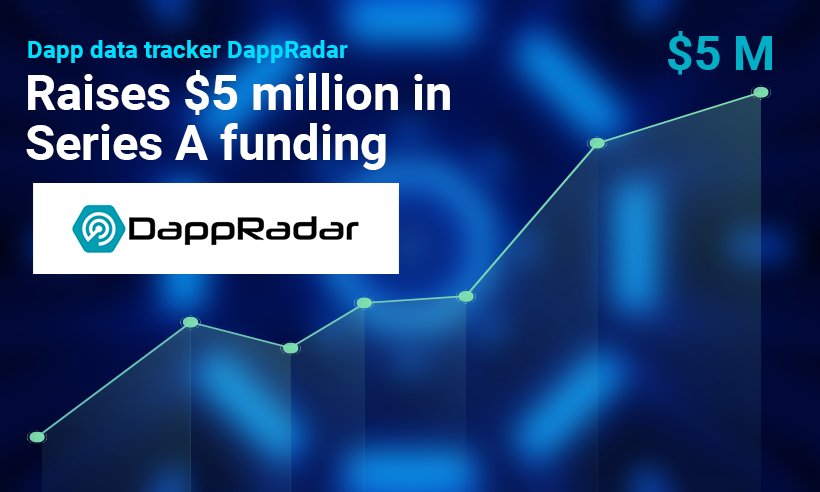
Lithuanian data tracking company DappRadar has announced the raise of $5 million in Series A funding. As the announcement says, the startup will make use of the funding to magnify its brand recognition. 

Dapp Data Tracker DappRadar is Maximizing Its Appreciation

Lead investors in this Series A round were Blockchain.com Ventures, Proses Ventures, and NordicNinja VC. According to the release, the startup will use its funding to launch new products like its Portfolio Tracker along with maximizing its recognition in the space. 

Popularly known to provide information and insights about the existing Dapps, i.e; Decentralized Applications, DappRadar acts as a Non-Fungible Token Platform and an international application store for decentralized finance (DeFi) platforms. This data app tracker can track the data of over 5,000 Dapps from more than 20 blockchains such as Ethereum and Flow. Where flow is the blockchain behind the leading NFT marketplace NBA TopShot.

Statistics read that DappRadar has raised $2.3 million in its 2019 seed round to increase the efficacy of its research and development. 

According to the firm, 

“The funds will be used primarily for research and development, to offer new functionality to help the business expand its service and reach the next stage in its growth.” 

The only seed funding DappRadar received during 2019, is the funding from Naspers Ventures, Blockchain.com Ventures, and Angel Invest Berlin.

 According to John Dantoni, 

“Funding for crypto data/analytics/information was lower this past quarter, this sector saw some notable deals recently.”

Apart from DappRadar’s $5 million raise, global crypto data aggregator Coin Metrics has received $15 million in funding from Goldman Sachs on 5th May 2021. 

Crypto exchange giant Coinbase also made moves to acquire data analytics firm Skew in late April while the blockchain analysis firm Chainalysis earned $100 million back in the previous month.