Top 5 AI Coins That You Should Know About

top 5 AI coins

The world of cryptocurrency has been rapidly evolving in recent years, with new technologies and developments emerging on a regular basis. One area that has the potential to revolutionize the industry is artificial intelligence (AI). In this article, we will explore how AI is being used in the cryptocurrency industry, what impact it may have in the future, and the top 5 AI coins that are currently underway in the industry.

What is the Importance of AI in Crypto?

Currently crypto has a lot of problems. They are frauds and scams and issues related to risk management and the security of blockchain. Let’s see how AI can help in solving these issues.

1)Frauds and Scams: Last year was devastating for crypto as we saw more than $3 billion in hacks and crypto stolen. AI can solve this problem by detecting any anomalies in transactions as it will be programmed in that way.

2)Risk Management: A lot of people lost huge amounts of money in crypto primarily due to poor risk management. AI can help people make better investment decisions as it works on facts and data, not on emotions.

3)Security: A lot of blockchains got hacked last year because of poor security. A lot of bugs went undetected by normal people. AI can help resolve this problem as it can find any bug in a blockchain in just a small time. This will make existing blockchains more secure and less prone to hacks.

Top 5 AI Ccoins

1)  SingularityNET (AGIX): SingularityNET is a blockchain-powered platform that allows anybody to easily create, share, and monetize AI services, thanks to its globally-accessible AI marketplace. Through the SingularityNET marketplace, users can browse, test, and purchase a huge variety of AI services using the platform’s native utility token — AGIX.

Currently, AGIX is trading at $0.1747 with a market cap of $205 million and a circulating supply of 1.17 billion as of 16th Jan 2023.

Unique Value Proposition: It is the first platform that makes it easy for developers to sell their AI tools and libraries and enables buyers to test any AI service provided on the marketplace to see if it meets their needs before making payment.

2) FETCH.AI (FET): Fetch.AI is an artificial intelligence (AI) lab building an open, permissionless, and decentralized machine learning network with a crypto economy.

Currently, FET is trading at $0.2347 with a market cap of $192 million and a circulating supply of 818 million as of 16th Jan 2023.

Unique Value Proposition: Fetch.ai’s utility token FET was designed to find, create, deploy and train digital twins and is an essential part of smart contracts and oracles on the platform. It democratizes access to AI technology with a permissionless network upon which anyone can connect and access secure datasets by using autonomous AI to execute tasks that leverage its global network of data.

3) OraiChain (ORAI): It is the world’s first intelligent and secure solution for emerging Web3, scalable Dapps, and decentralized AI.

Currently, ORAI is trading at $4.14 with a market cap of $8.4 million and a circulating supply of 2 million as of 16th Jan 2023.

Unique Value Proposition: It operates on an AI layer 1 protocol with high interoperability, which means other blockchain tokens can easily connect with OraiChain. It is focused to design and implement “proof of correctness” and “proof of execution” for any AI computation. This plays a fundamental role in developing AI Oracles for many smart contracts.

4) SingularityDAO (SDAO): It is the first decentralized, non-custodial, dynamically adjusted baskets of tokens (DynaSets) controlled by a team of traders aided by and eventually handing over majority control to highly advanced Artificial Intelligence.

Currently, SDAO is trading at $0.3234 with a market cap of $18.4 million and a circulating supply of 56.7 million as of 16th Jan 2023.

Unique Value Proposition: It is capable of using both long and short trading strategies. Also, applying leverage to those trades automatically rebalance holdings and take positions based on market conditions.

5) PlatON (LAT): It is a next-generation Internet infrastructure protocol based on the fundamental properties of blockchain and supported by the privacy-preserving computation network.

Currently, LAT is trading at $0.011 with a market cap of $36.7 million and a circulating supply of 3.28 billion as of 16th Jan 2023

Unique Value Proposition: “Computing interoperability” is its core feature. PlatON provides a public infrastructure in open-source architecture for global artificial intelligence, distributed application developers, data providers, and various organizations, communities, and individuals with computing needs.

Conclusion

So, these were the top 5 AI coins. AI is still in its nascent phase but so far it has shown many promising use cases in crypto which will help crypto to reach the masses. Also, AI can play a big role in making crypto more secure and user-friendly. It still has to go through a lot of developments but it can be the next biggest thing in the crypto world.

The Benefits Of Liquid Staking For Institutions And Corporations

Liquid Staking

Staking is a core component of decentralized finance (DeFi). It means that users typically get rewarded between 4% – 8% for locking up their coins. The current banking model no longer offers any real form of interest for deposits, so the benefits of this kind of staking are clear and obvious, as it rewards people for their contributions instead of taking from them.

But Liquid Staking takes it one step further. Liquid Staking was initially created by Ankr, a Web3 infrastructure firm that helps blockchain startups grow and expand together. Ankr further offers a seamless point of entry into Web3 and DeFi with a large suite of protocols.

While the benefits of DeFi are obvious from the perspective of traders, investors, and entrepreneurs, it can also be of huge advantage to institutions and corporations.

What Is Liquid Staking?

With regular staking, users earn rewards on their deposits. This works on proof-of-stake blockchains such as Ethereum, and cannot be done on proof-of-work blockchains such as Bitcoin. Most blockchains are now proof-of-stake or delegated-proof-of-stake, though there are many different models being tested out.

Liquid Staking goes a step further than regular staking. With Liquid Staking, you get the rewards from staking, but are given a derivative token in return. For instance, you get the rewards for staking MATIC and are then given an aMATICb derivative token. This derivative token can then be used for other purposes, such as crypto loans or trading.

Many people have still not grasped what Liquid Staking is or what its implications are. The existing financial industry is built on derivative trading, and this plays a part in the reluctance of corporations and institutions to take part. Though estimates vary, the derivatives market could be up to $1 Quadrillion. It’s about 10 times global GDP, though the figures are hotly contested.

Without a derivatives market, the existing financial infrastructure is not going to be interested in Web3. It takes away its flexibility and ability to innovate. Of course, many would argue that the derivatives market is itself the problem, but this is not 100% accurate. It enables fluidity and mobility of capital, which leads to increased affluence, though also the potential for troublemaking of various kinds.

The Many Advantages of Liquid Staking

The financial world runs on a fractional reserve system, enabling the multiplication of assets in a rapid manner. With Liquid Staking, institutions and corporations can leverage their crypto assets to the maximum potential. There will be a fee for Liquid Staking, typically around 10% or so. But this fee is small in comparison to what could be achieved.

The problem with the derivatives market stems from a lack of correct risk mitigation procedures. Moreover, there are systemic risks that are difficult to account for in any economic environment. Many Web3 advocates are against the derivative market and against large corporations and institutions in general.

But it’s hard to ignore the fact that Web3 is built through the contributions of large firms such as Binance, Ankr, and Polygon. The infrastructure needs to be put in place to migrate from Web2 (Google, Facebook) to Web3 (decentralized service providers like Ankr).

Another point that is missed is that more staked assets will strengthen the blockchain network. In other words, when larger organizations start taking part in Web3, they will heavily support and strengthen security protocols. So, the primary advantages of Liquid Staking include:

  • Increased flexibility of assets.
  • Increased room for diversification.
  • Maximization of profit potential.
  • Room for innovative investment in new markets through DeFi protocols.
  • Investment strengthens the proof-of-stake network, acting as a form of security.

These are significant advantages for both corporations and institutions. It is especially relevant in the highly unstable global economic environment. Like all markets, there are risks. But Liquid Staking allows you to use the token as a hedge against the core token. In other words, if you are worried about exposure to Ethereum, you can use the derivative to invest in a market that rises as Ethereum falls.

Bottom Line

It’s possible to engage in regular staking through a wallet or through an exchange provider. But liquid staking will require you to work with a liquidity staking platform or a decentralized service provider. You still retain full asset ownership, you are simply operating through a decentralized protocol. The staking of assets is just the click of a button, but it sounds a lot more complicated than it is.

Larger entities will want future assurances, but the core ethos of autonomous ownership will still remain the same. As always, the question comes down to risk mitigation procedures. Do not risk more than you can lose, and do research into what you are investing in.

Liquid Staking offers unparalleled advantages. It is a core aspect of Web3 and DeFi and intelligent investment can yield enormous profits. But regardless of whether you are an individual, entrepreneur, trader, business, corporation, or institution, no investment is foolproof.

Money can be made, and lost, in all markets.

DeFi Creates Golden Opportunities For Enterprises To Earn Additional Revenue Through Staking

DeFi Staking

DeFi is opening up new opportunities for corporations and retail alike to make additional income, at a time when businesses are strapped for cash. DeFi is a new financial ecosystem that is being developed on top of blockchain technology, allowing users to earn revenue by providing liquidity to the market.

The main idea behind DeFi is to make finance more accessible, transparent, and efficient for all parties involved in it. Many blockchains thrive on a Proof-of-Stake mechanism, where token holders participate in the blockchain by helping validate transactions, run nodes, and secure the network. Participating in the network’s activity often yields certain returns.

Enterprises Globally Will Take Full Advantage of DeFi Staking 

The benefits of staking are not limited just to the individual. It can also provide a lot of benefits to an enterprise. Staking is a process where an individual or company locks its crypto holdings for a specific period of time. Oftentimes staking will take place in order to secure the network, with some of the network gas fees going to stakes.

This process provides additional revenue for both parties involved in the transaction either way, which is why it will become so popular among enterprises. With large amounts of capital, enterprises could earn a considerable amount of interest.

Staking offers a much higher APY than a traditional savings account, sometimes over double digits. For example, Ankr currently offers 3.56% on ETH, 5.84% on MATIC and 14.78% on DOT. The company specifically offers staking opportunities for enterprise clients with a deeply liquid ecosystem including SushiSwap, UniSwap, Curve, PancakeSwap, and many more.

Staking is an excellent form of passive income in the DeFi space for anyone to take advantage of. And with the rise of liquid staking, these benefits are even more pronounced, where enterprises can receive staking returns and also use their derivative tokens for other yield-bearing purposes.

BitGo was the first to offer institutional services for digital assets ranging from custody to staking and lending. The company saw large demand, paving the way for future brands. Many enterprises hold hundreds of thousands of dollars, some millions, and are earning very little on that capital. Businesses could stake their non-working capital and earn double-digit APY on the money using DeFi. Compared to traditional investment vehicles, DeFi and staking are revolutionary.

The Potential Problem for DeFi Retail Investors

Proof-of-Stake networks are a new form of decentralized finance. They offer control over the network to those who stake their tokens.

In a Proof-of-Stake blockchain, control over the network is largely held by holders of staking tokens. Stakers often get to vote in decision-making and certain network activity. If enterprises do enjoy the opportunity of staking, they could end up with so much money staked that they have too much control over the network.

For example, many networks, especially DAOs, will take snapshots of token holders or stakers prior to a vote. Participators get votes equivalent to the number of their tokens supporting the network, giving the largest holders the most votes. Companies could take advantage of their size and capital and potentially be able to influence the industry.

Although it would be a good thing for a company’s bottom line, it’s certainly something for retail investors to watch out for as the space expands.

Alternative DeFi Opportunities 

DeFi is an entire ecosystem of decentralized financial apps, services, and products. Staking is the only way that enterprises can participate in the blockchain. DeFi includes loans, marketplaces, and even more.

In a decentralized exchange, token holders are rewarded for providing liquidity to the market. These can be exchanges like 1inch or PancakeSwap that rely on liquidity to process transactions more than a centralized exchange like Coinbase.

Similar to the traditional world, DeFi loans are slowly gaining popularity as well. These work with one person loaning the cryptocurrency in return for a specific interest rate from the platform. The borrower gets almost instant access to capital without the need for any paperwork or personal information at all. The borrower also still owns their cryptocurrency and can be saved from a liquidation event.

New opportunities are popping up in the DeFi and greater blockchain space for enterprises to take advantage of all the time. Even NFTs present amazing opportunities to businesses across all industries to brand, community build, or raise money.

The Wait for Regulation

Cryptocurrency regulation is a hot topic in the world of finance. Governments are trying to figure out how to regulate these digital currencies and what they should be classified as. The main reason for this is that cryptocurrencies are not backed by any government or central bank. This means that they are not regulated by any institution, which can lead to fraud and other illegal activities.

In order to regulate these currencies, governments need to decide what classification they should be given. They could be considered commodities, securities, or something else entirely. Enterprises specifically need to wait for regulation due to potential legal trouble. Large and especially public companies are under the watchful eye of government regulators, just waiting to file a lawsuit against them.

This is why very few companies have invested in or integrated cryptocurrencies into their models. Once they have clarity on exactly how they are allowed to invest and use cryptocurrencies enterprises will begin throwing money into DeFi.

With all the opportunities available in the DeFi and staking space, it’s only a matter of time before corporations, small businesses, and governments alike will explore the space- perhaps even together.

A Glance at the The Top 5 Altcoins of the Week

Top 5 Altcoins of the Week

Altcoins are seeing a decent uptrend recently. The market expects FED to take a slow and soft approach in its future policy decisions. The downfall in commodity prices might be an indication of inflation coming down. So, if you have been thinking of investing in Altcoins after a recent relief bounce, here is a list of the top 5 Altcoins of the week.

1. Filecoin (FIL)

Anyone can save and retrieve data online, thanks to the peer-to-peer Filecoin network. Files are consistently and constantly saved and retrieved for however long a user requests, thanks to built-in economic incentives.

The amount of storage space available and how much it costs to store and retrieve files are not under the authority of a single business or organization. Instead, anyone with internet access can participate in open marketplaces for storing and retrieving files, courtesy of the Filecoin storage network.

It carries out these transactions using its native coin (FIL). Similar to bitcoin and ether, the native crypto token of the Filecoin network is the Filecoin token (FIL). Holders of tokens can use FIL to interact with and conduct transactions on the Filecoin network. Users specifically pay miners in FIL to store, distribute, and retrieve their data.

Additionally, storage companies use FIL as collateral to offer a minimal degree of service assurance, which diminishes if an agreement with a customer falls through.

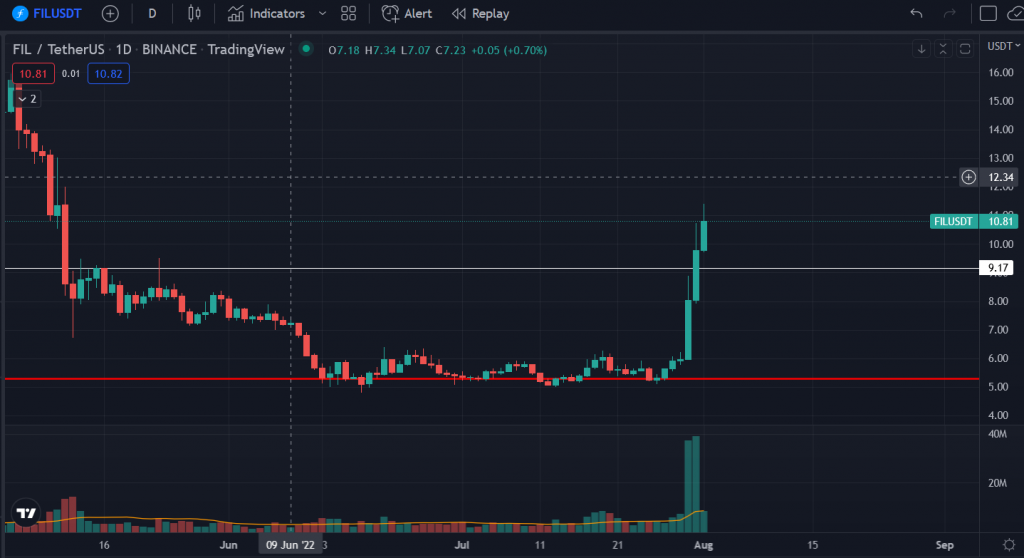
$FIL currently trades at $10.81 and has a market cap of $2.4 billion. $FIL token had an impressive prime pump in the last few days. Most bids for the $FIL token are coming from Asian exchanges. Filecoin is the market leader in the storage category of Web3.

Price chart of Fil

2. Oasis Network (Rose)

Oasis Network is a Layer 1 Proof-of-Stake (PoS) decentralized network. The Consensus Layer and the ParaTime Layer are its two main parts.

The Consensus Layer is a decentralized network of validator nodes that manages a scalable, high-throughput, secure proof-of-stake consensus. The ParaTime Layer hosts multiple parallel runtimes (ParaTimes), representing a replicated compute environment.

The Oasis Network offers secretive smart contracts, enabling DApps to leverage private information and opening up new use cases for blockchain technology. At the Consensus Layer of Oasis Network, the $ROSE token is used for transaction fees, staking, and delegation.

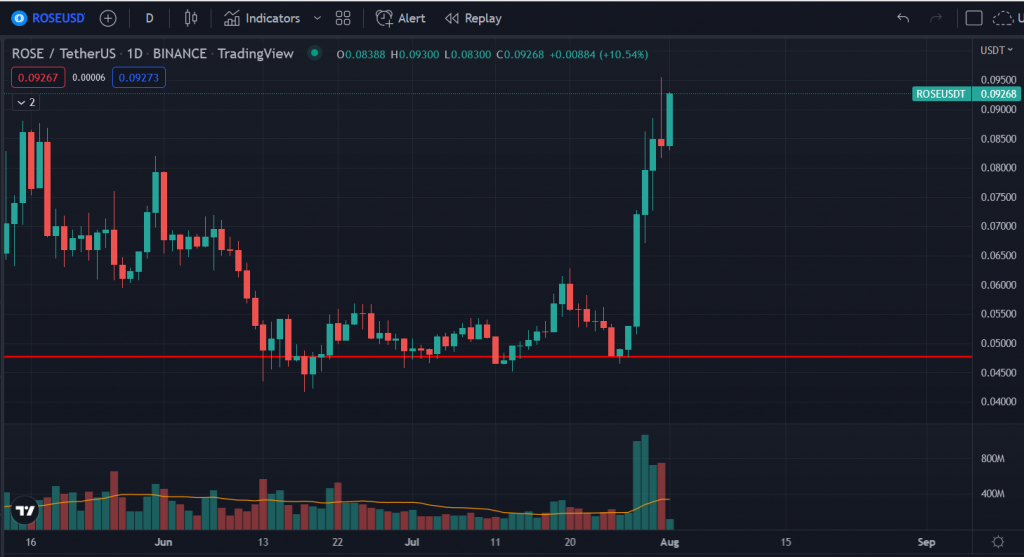
$ROSE currently trades at $0.092 and has a market cap of $434 million. $ROSE token price has jumped almost 2x in the past few days. On 28 July, Oasis announced its collaboration with Meta and introduced its platform to the world for evaluating the fairness of Meta’s goods while upholding individual privacy.

Market participants are excited about this partnership, and their interest is clear from the recent price action of the $ROSE token.

Price chart of Rose

3. dYdX

dYdX is a decentralized exchange that offers users access to essential financial products such as perpetual, margin and spot trading, lending, and borrowing. With the help of dYdX, traders can short-sell tokens, increase exposure by longing with leverage, or move swiftly by earning interest on deposited tokens. The platform also provides traders with off-chain order books with on-chain settlement.

dYdX combines the speed and usability of a centralized exchange with the security and transparency of a decentralized one by using StarkWare’s Layer 2 so that users can trust centralized exchanges when they trade this way. With the governance token dYdX, the dYdX Protocol community can now fully own and control the Layer 2 protocol.

By allowing shared control, dYdX synchronized incentives between traders, liquidity providers, and Layer 2 protocol partners. The dYdX platform offers robust governance, incentives, and a staking ecosystem, all intended to promote further decentralization and evolution of the dYdX Layer 2 protocol.

Alongside dYdX, two staking pools that support liquidity and security on the dYdX Layer 2 protocol were also created. Reward programs for trading, liquidity provision, and prior use of all dYdX protocols will aid in the dYdX Layer 2 protocol’s expansion and adoption.

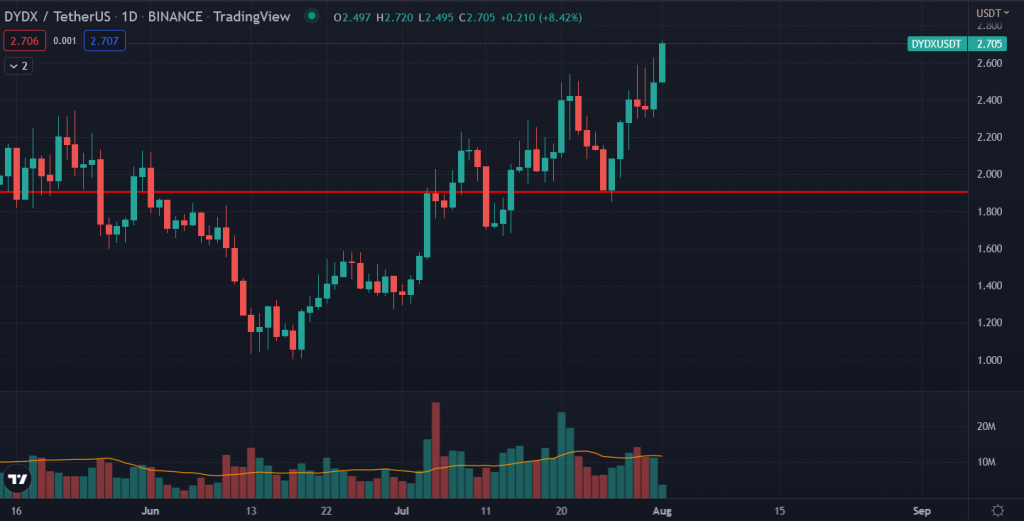
$dYdX currently trades at $2.70 and has a market cap of $292 million. $dYdX chart is forming a clear higher high and higher low market structure, and it appears ready for a pump.

pricechart of dydx

4. Synthetix (SNX)

Synthetix is a decentralized platform for issuing synthetic assets, a Layer 2 scaling solution built on Ethereum. The Synthetix Network Token ($SNX), which, when locked in the contract, authorizes the generation of synthetic assets, serves as security for these virtual assets (Synths).

Users can make conversions between Synths directly through the smart contract using this pooled collateral architecture, doing away with the requirement for counterparties. This approach resolves the liquidity and slippage problems that DEXs have. Synthetix supports fictitious fiat money, long and short cryptocurrency positions, and commodities.

Owners of SNX are encouraged to stake their tokens because integrators pay them a pro proportionate share of the fees made from activity on Synthetix (Kwenta, Lyra, Curve, dHEDGE, and many others). SNX token’s value derives from the privilege of participating in the network and capturing fees made from Synth exchanges. Having $SNX is not necessary to trade on the Synthetix network.

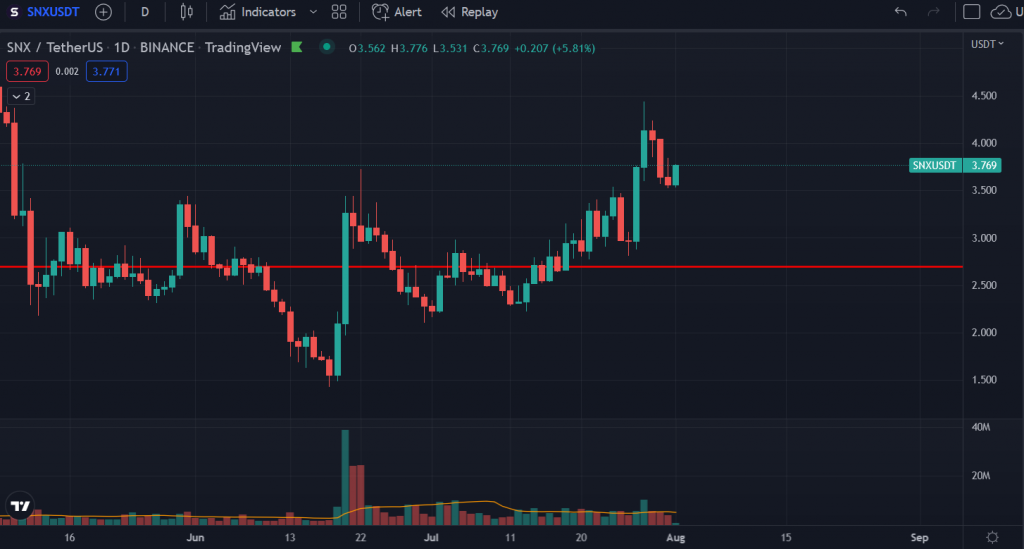
$SNX currently trades at $3.76 and has a market cap of $853 million. $SNX has been performing better even against Eth token pair. Their upcoming Synthetix V3 update and $SNX stakers receiving around $400 k from protocol usage is the reason behind this price action.

price chart of snx

5. Optimism (OP)

The primary function of Optimism is to batch transactions on the network. Optimism enables customers to take advantage of decreased gas rates on transactions carried out on the Optimism network through the Optimistic roll-up technology. The project’s native token is called $OP.

OP’s current use cases include the following:

  • Governance: OP token holders participate in a bicameral structure that allows them to vote on specific governance issues through a body they form.
  • Rewards and Ecosystem Funding: Users and protocols that support the Optimism ecosystem are airdropped OP tokens by the OP Governance Fund for future projects building on Optimism.

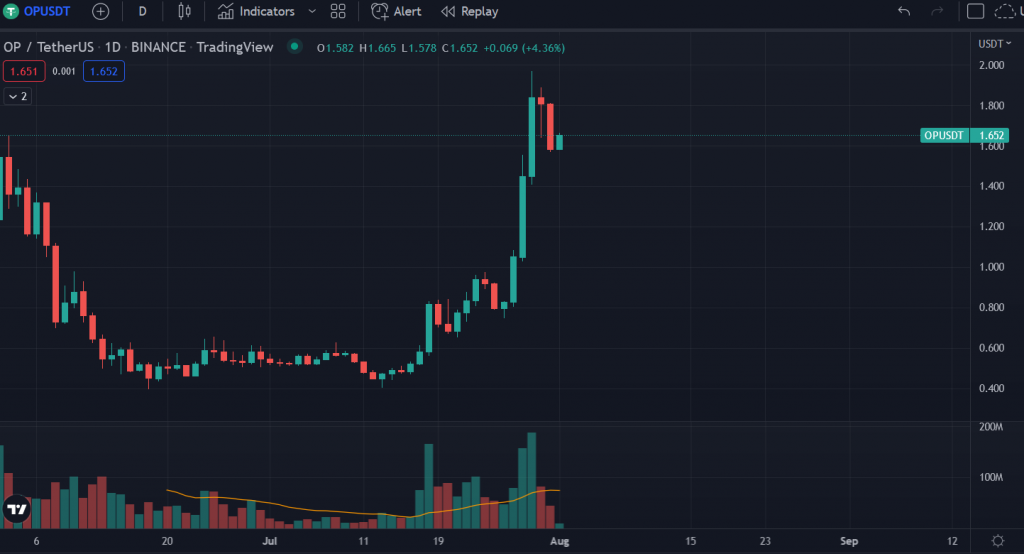
$OP currently trades at $1.652 and has a market cap of $347 million. $OP token was one of the best performers of the last week. Layer 2 narrative is picking up, and $OP is one of the top Layer 2 solutions, attracting investors and capital. TVL is continuously rising on Optimism, and DApps on Optimism are also seeing adoption.

price chart of op

Conclusion

If CPI data in August show that inflation is coming down, then this market rally is expected to continue. Should inflation data come out hot, the market could see another downtrend. Ethereum merge update will also take place in September. The success or failure of the launch will likewise determine the market’s direction. Do your research before investing in any project. This article is for educational purposes and does not intend to act as investment advice.

OSL Offers Security Tokens to Institutional Bankers in Hong Kong

Hong Kong OSL

One of the largest cryptocurrency exchanges in the world, OSL Digital Securities Limited (OSL), said on Tuesday that it has become the first Type 1 SFC-licensed digital asset broker to provide sales of security tokens to professional investors in Hong Kong via private security token offers (STOs).

According to the official announcement, OSL is the first licensed brokerage business in Hong Kong for digital assets to let international institutions buy new asset-backed digital tokens classified as securities. Animoca Brands, China Fortune Financial Group Limited, Monmonkey Group Asset Management Limited, and Head & Shoulders Financial Group are just a few of the institutional clients it has thus far.

Each digital token, according to OSL, represents a USD10,000 unit of a USD bond with a Bitcoin-linked coupon rate. The startup uses the Ethereum blockchain to create the tokens with a three-month tenor and a bonus coupon tied to Bitcoin performance. In this approach, investors may purchase digital assets with U.S. dollars, Bitcoin, and Ether, in addition to indirectly owning digital assets linked to conventional financial assets.

OSL CEO Wayne Trench discussed the situation saying,

“The OSL STO transaction is a viable model for security token issuance and distribution of digital tokens by regulated operators. We designed the issuance to demonstrate the immense value and ease of distribution of a security token issued on a public blockchain. Through the STO, OSL reaffirms its position as a pioneer in the Hong Kong digital asset market. Blockchain-based digital securities represent the future of the capital markets and financial products, and this is a key step in the adoption of this innovative and efficient technology.”

Tokenization Creating Investment Opportunity

Startups with limited regulatory and financial knowledge undoubtedly struggle to introduce such digital assets and run into regulatory hurdles. The Hong Kong Monetary Authority (HKMA) and the SFC jointly released a circular on January 28, 2018, allowing registered institutions and licensed businesses to offer digital asset investment services through collaborations with SFC-licensed virtual asset trading platforms for the first time.

Here Are The Top 5 DeFi Tokens of the Week

Top 5 DeFi Tokens

Blockchain provides a platform to build trustless, permissionless, and decentralized Dapps. These features are necessary for a Dapp to provide everyone equal and safe access to financial services. Various Defi protocols are providing people access to a large variety of financial services. So, if you have been thinking of investing in DeFi tokens, here is a list of the top 5 DeFi tokens of the week.

Top 5 DeFi tokens of the week

1. Maker DAO

A decentralized protocol called MakerDAO is working to stabilize the cryptocurrency market. The Maker Protocol uses the two-token mechanism. First is Dai, a stablecoin that gives collateral backing. A decentralized stablecoin, in the opinion of the Maker Foundation and the MakerDAO community, is necessary for any protocol or individual to experience the benefits of digital money.

The second is MKR, a governance token used by stakeholders to control Dai and maintain the system. Holders of the MKR token can vote on several governance-related issues, including the stability fee, debt ceiling, acceptable forms of collateral, the Dai Savings Rate, and more. Additionally, MKR is utilized in the Surplus Auction to pay stability fee payments and buy extra Dai from collateral auctions. As soon as the auction is over, the protocol immediately burns the MKR, reducing the supply.

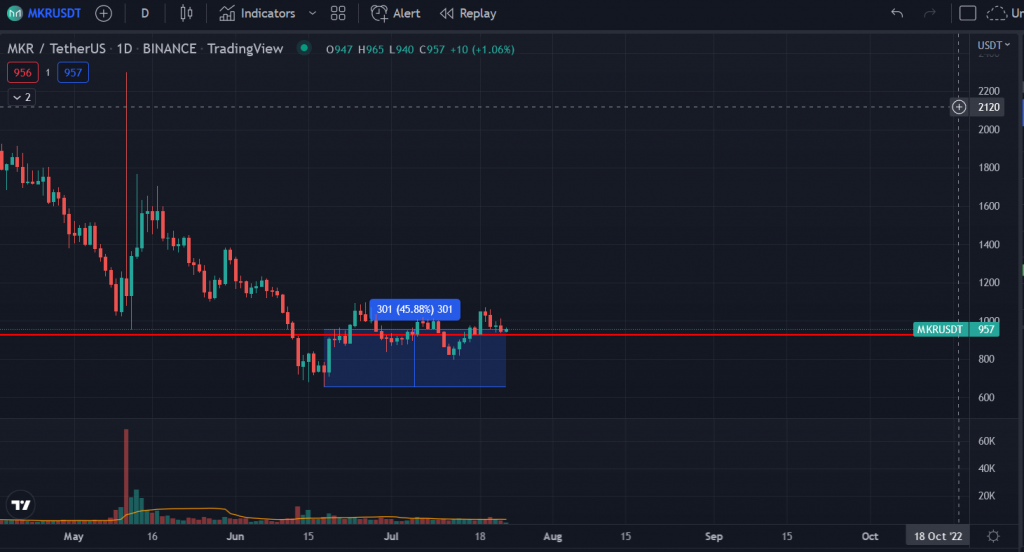
$MKR currently trades at $97 and has a market cap of $862 million. $MKR token price has jumped around 46% from its June low. The jump in price may be due to Maker DAO’s efforts to onboard Real World assets on its platform.

Top 5 DeFi Tokens

Recently, the MakerDAO community approved a proposal to incorporate a US bank into its collateral system. The maximum loan amount passed to the Huntingdon Valley Bank is $100 million. It can borrow the money in DAI by putting down security in an off-chain account.

2. Curve DAO

Curve uses the StableSwap invariant, which has substantially less slippage for stablecoin trades than many other well-known invariants, to produce exceptionally efficient stablecoin trades (e.g., constant-product).

Tokens that are stable representations of one another are referred to as stablecoins in this context. This encompasses, among other things, USD-pegged stablecoins (such as DAI and USDC), ETH, sETH (synthetic ETH), and other forms of wrapped BTC.

The StableSwap invariant is implemented by a curve pool, effectively a smart contract that includes the logic for exchanging stable tokens. All Curve pools enforce the StableSwap invariant. A Curve pool, also known as a plain pool, is the StableSwap invariant implemented with two or more tokens in its most basic form. Pools with lending capabilities, or lending pools, as well as meta pools, which are pools that permit the exchange of one or more tokens with the tokens of one or more underlying base pools, are examples of alternative and more complex pools.

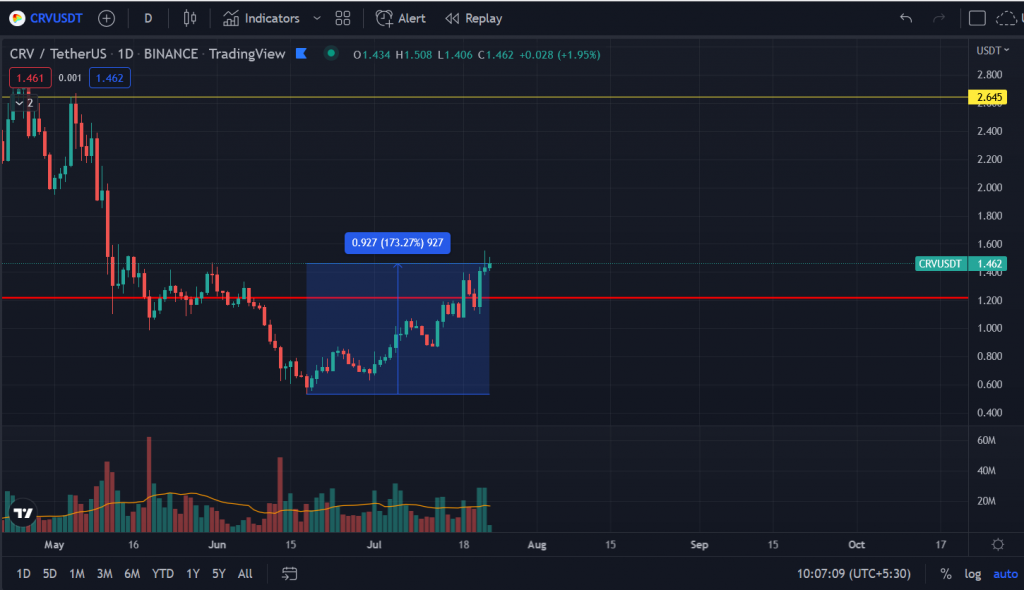
CRV currently trades at $1.462 and has a market cap of $568 million. CRV token saw a massive price jump of 173% in the last 1 month.

Recent bullish price action is due to Michael Egorov, the founder of Curve, acknowledging that they will be launching an over-collateralized stablecoin soon.

Top 5 DeFi Tokens

3. GMX

Low swap fees and trades with no price impact are supported by the decentralized spot and perpetual exchange known as GMX- a unique multi-asset pool that supports trading and generates fees for liquidity providers via market making, swap fees, and leverage trading. Chainlink oracles deliver average prices from top volume exchanges and provide dynamic pricing.

The GMX protocol makes money by deducting fees on trade opening and closing transactions and a “borrow fee” for each hour a leveraged position is open. When opening and closing a trade, a trading fee of 0.1 percent of your position size is charged.

You can stake $GMX tokens to receive the reward in the following three ways.

  • Escrowed GMX
  • Multiplier Points
  • AVAX / ETH Rewards

The Escrowed GMX (esGMX) that holders of Staked GMX are entitled to and receive as compensation can be used in one of the following two ways.

  • Staked for incentives akin to those from regular GMX
  • vested over a year to become regular GMX tokens

30% of protocol income goes to GMX stakers, the token utility drives up demand for GMX. As a result, 86 percent of the supply in circulation is currently staked. Because this staked GMX is yielding a 27.41% APR, there is a significant demand for the token.

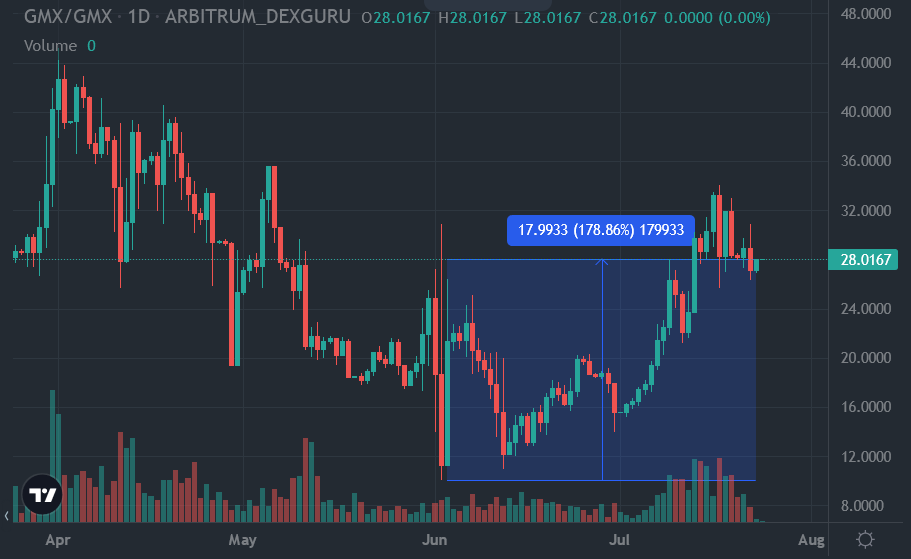
$GMX trades presently at $28 and has a market cap of $219 million. $GMX was one of the only tokens that performed better than $ETH during the massive market sell-off in the past few months. $GMX token has seen bullish price action and has jumped around 178% from its lows.

GMX

4. Compound

Compound is one of the top 5 DeFi tokens of the week. Users of Compound, an Ethereum-based lending platform, can borrow or lend money without getting authorization from a pool of assets. Instead of being decided by a single person, interest rates are decided by an algorithm depending on the percentage of assets lent out.

Users contribute assets to construct compound pools in exchange for ERC-20 “cTokens” that grant holders a fixed share of the entire pool. Holders of cTokens have the right to an expanding balance, meaning they continuously receive interest as the pool size grows and borrowers withdraw money and pay it back with interest.

The maximum amount that borrowers may withdraw is equal to their combined borrowing capacity, which is equal to the token balance multiplied by the collateral factor, which is a number between 0 and 1 that indicates the amount that may be borrowed.

A higher collateral component indicates a more robust form of collateral and often shows a more liquid asset with a higher market capitalization.

Third parties may buy the underlying collateral with a liquidation discount (currently 5%) to pay off the loan if the collateral’s value drops past the closing factor. To vote on and propose protocol modifications, COMP token is used.

Although it was explicitly stated that it was not intended to be marketed as an investment, token holders are widely assumed to eventually vote in a value capture mechanism, giving them some claim on the system’s cash flows.

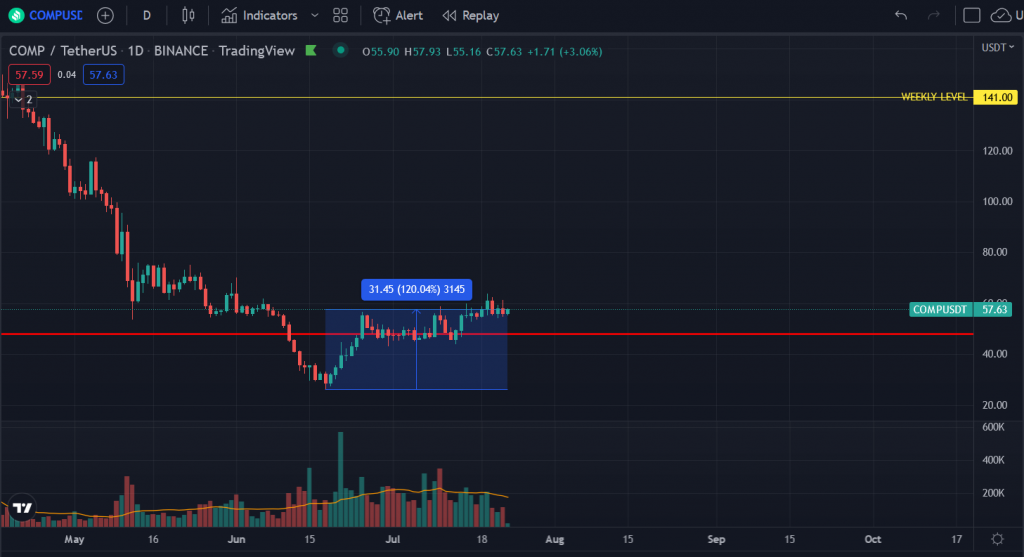
$COMP trades presently at $57.63 and has a market cap of $392 million. On 29 June, Compound labs released the source code for the upcoming Compound III multi-chain lending protocol. These new developments will bring various new features which will benefit borrowers.

COMP token has seen a price change of 120% from its lows. The price has been in range for the past few days, but we might see some bullish price action after Compound’s new version launch.

Top 5 DeFi Tokens

5. Loopring

Loopring seeks to provide an open source protocol for scalable, non-custodial exchanges that use order books by utilizing zero-knowledge proofs. LRC tokens are used for protocol pool staking, which receives 70% of the fee distribution. Anyone who wants their proportionate share of the fees may stake for at least 90 days.

Exchange owners must also stake for safety and reputation. For an exchange with data availability, there must be a minimum of 250,000 LRC, but an exchange without data availability requires a minimum of 1 million LRC.

When the exchange closes and reimburses user funds, funds can be withdrawn; otherwise, they will be reduced. To lower the maker/taker fees, exchanges might also stake more tokens.

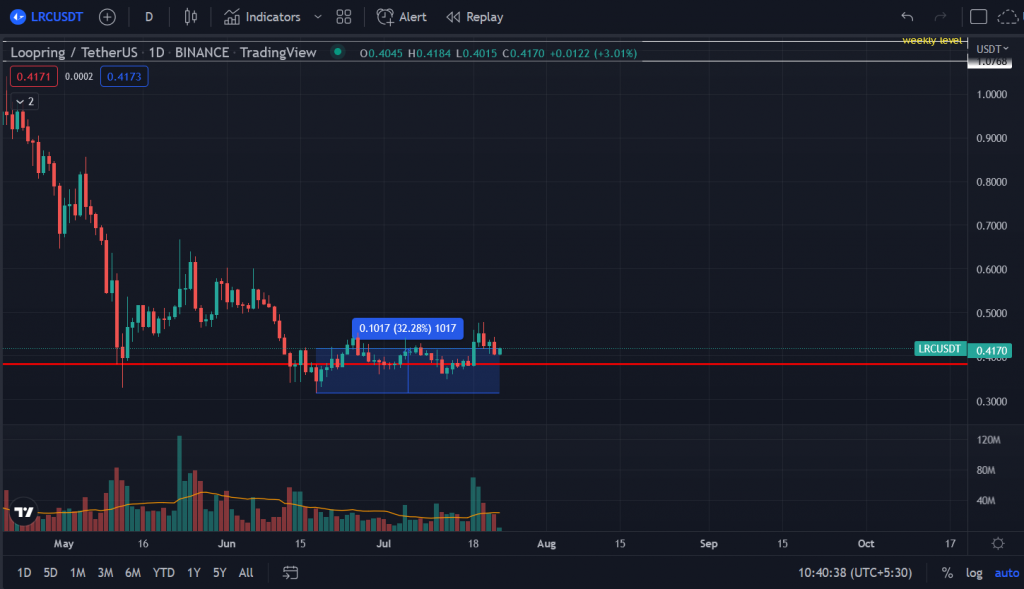
LRC trades presently at $0.41 and has a market cap of $519 million. Currently, the LRC price action seems to be neutral, but in the recent few days, the zk rollups narrative is seeing solid momentum, Loopring being a zk rollup DEX might attract investors.

Loopring

Conclusion

So, these were the top 5 DeFi tokens of this week. DeFi protocols provide various financial services, and anybody can use them worldwide. Still, the user experience of these DeFi applications is terrible. A user needs to know multiple aspects of DeFi & blockchain before they can use DeFi protocols to their full extent. Do your research before investing in any project. This article is for educational purposes and shouldn’t be misconstrued as investment advice.

How Vechain and its Traceability Solution Can Prevent Counterfeiting

Vechain Traceability

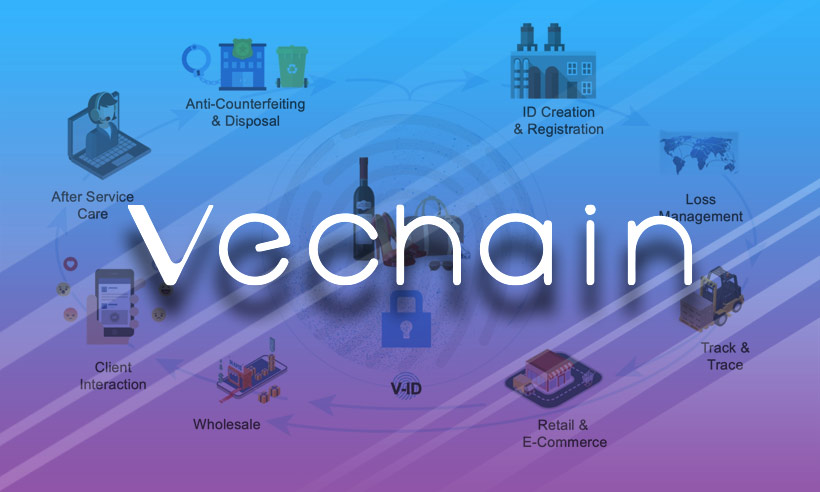
One of the most significant issues the supply and manufacturing industry faces is counterfeiting. It is estimated that the value of illicit goods is around half a trillion dollars annually, a huge problem affecting companies producing original products. Years ago, this was a relatively small-time business, but it has since grown to become a significant issue for many companies.

The counterfeiting industry is a complex business with devastating effects on the individuals and companies it affects. According to the World Health Organization, around 30% of the drugs in circulation are fake, and 1 in 10 medical products in developing countries is counterfeit, responsible for about a million deaths annually.

Despite the fight against counterfeiters, it’s still not always possible to tell if a product is real or fake. Retailers must have the necessary tools and resources to combat this issue. Unfortunately, the various technologies used to combat counterfeits have failed. It is why blockchain technology could be a viable solution to help prevent fraud. This article discusses the various advantages of blockchain-based technology VeChain and its traceability solution that can help businesses prevent counterfeiting.

What is VeChain (VET)?

As one of the first blockchains built specifically for enterprise-level clients, VeChain aims to improve the efficiency of the supply chain. The project’s developers are focused on using distributed ledger technology to improve the efficiency of the business process. Its robust features allow users to enhance their supply chain management and business processes.

Due to the complexity of the logistics industry’s data collection systems, the lack of transparency and transmission of this information is a significant issue that has been affecting the operations of the sector. This issue is caused by the lack of unity between the various data sources within the supply chain.

Through VeChain, businesses can track various data sources such as temperature, transportation status, and quality. It is crucial as it allows them to improve efficiency and reduce overhead. Through a distributed business ecosystem, VeChain eliminates the need for third parties and helps them improve their accountability.

VeChain Traceability

The Vechain network is a multi-faceted system that allows users to collect and analyze data. It includes various tools that are connected to the blockchain.

Toolchain

The toolchain is a fundamental component of the Vechain blockchain, allowing users to improve efficiency. However, it can also be very challenging to connect all the various components of the blockchain.

This toolchain is a part of Vechain’s platform that aims to connect the Internet of Things (IoT) and the blockchain. It facilitates the transfer of data between the various devices and the blockchain. It is also a framework that integrates various components of the IoT and blockchain ecosystem. It is a vital part of the solution for monitoring and tracking the activities of multiple devices.

IoT Device

The Internet of Things (IoT) is a central component of the Vechain blockchain and its traceability solution. It allows users to collect and manage data related to various factors such as temperature, location, and precipitation.

The Internet of Things (IoT) devices are placed on the products under transfer or in packaging. These are then used to monitor the condition of the products. Each product has one of these devices, and the vehicle transporting them has one.

The Internet of Things (IoT) devices attached to a vehicle or product have the necessary conditions to ensure that the goods or services are delivered to their intended destination. They can also collect data about the conditions of the road and the time spent at a particular stop. After gathering all the necessary details, the device can then be able to provide the user with a better understanding of the surrounding area.

The Blockchain Core

The blockchain core is the central hub of the VeChain network. It acts as the intermediary between the various activities within the network. Once the data collected by the IoT devices is sent to the blockchain, it can be easily accessed by buyers and sellers.

The information collected by the IoT devices during the transit process can be used by the parties involved to compensate for the damages caused by the conditions. It eliminates the need for manual handling and helps protect the quality of the goods.

VeChain Traceability: A Viable Solution to Counterfeiting

Businesses can use a blockchain-based distributed ledger to fight counterfeiting through the Internet of Things and VeChain. This platform can help companies and consumers track the origin, ownership, and location of their products and raw materials. It can also give them the necessary transparency to improve their supply chains because both the blockchain and the IoT provide a secure and unalterable way to store and manage information.

This technology can significantly improve the fight against counterfeiting by allowing authorities to track and monitor the movement of products in the supply chain. It can also prevent fraudulent activities by sharing real-time information with the government and other stakeholders.

How Does VeChain Detect and Prevent Counterfeiting?

Through VeChain, suppliers and manufacturers can easily track and confirm the provenance of their products. Businesses can use these smart tags in various forms, such as security labels and digital tags. Each of these can be equipped with a unique digital or QR code.

Besides security labels, companies can also use smart tags on various types of surfaces, such as ceramic or metallic. The related marks or smart tags are automatically recognized when a batch of products is entered into the blockchain network.

Before businesses can add a product or service to the blockchain, it should be thoroughly checked to ensure that it is genuine and verified. With the unique mark or barcode already on the platform, manufacturers and suppliers can easily track the entire process of their products, from their manufacturing to their sales.

A product’s entire journey can be captured with smart tags, making it incredibly hard to try and replicate. Also, since the data collected by these tags are not visible on the blockchain, it can be easily separated from counterfeit goods. Businesses can also use it to confirm the authenticity of a product by looking up its origin.

When a product is recalled or is brought back for repairs due to warranty terms, or when the manufacturer discovers that the parts or the entire product are not original, companies can use the smart tag to confirm the authenticity of the goods.

Conclusion

Vechain is one of the most popular blockchain networks and has many use cases. However, despite the popularity of VeChain, the lack of traceability in the supply chain led to many counterfeiting incidents. However, the creation of a new supply chain management system can now help prevent counterfeiting in the process. This new technology is used in various industries, such as food, transportation, and the environment. Vechain is working to ensure that it provides the necessary tools and resources to improve the efficiency of these industries.

3 Ingenious Ways to Make Money From Cryptocurrencies

Make Money From Cryptocurrencies

Digital currencies are providing lucrative opportunities to retail and institutional investors. Today, the crypto industry has close to 19,000 assets with a cumulative market cap of $825B. The crypto ecosystem is, however, in its earliest development stages since it is a fairly new concept. Many individuals are uncertain about how they can make money with virtual currencies. Investors across the world are taking advantage of common mechanisms like mining, day trading, and holding to maximize profits. The following article, therefore, intends to examine which of the three strategies is more suitable for investors to make money from cryptocurrencies.

How to Make Money From Cryptocurrencies

Crypto Mining

Crypto mining is an income-generating opportunity that rewards miners for validating transactions on a blockchain. Under this mechanism, a group of decentralized computers is responsible for maintaining the public ledger. The process encourages miners to participate in solving complex algorithmic equations. As such, miners with significant computational power have a higher chance of solving the equations.

From there, the winning miner is able to update the ledger by adding new blocks to a chain. Performing this activity allows miners to earn a predetermined amount of digital currencies. Bitcoin, for instance, provides miners with a certain amount of BTCs which decreases after every four years.

During its initial stages, the mining reward for Bitcoin was 50 BTCs. Going by the asset’s current price, the amount is equivalent to $890k. Today, the block reward is currently at 6.25 BTCs which is equal to $112k.

There are several downsides that make mining an inappropriate investment strategy. For one, investors need to have access to sufficient mining energy since the process requires intensive amounts of power. What’s more, the mechanism requires powerful equipment which can be somewhat costly. Such disadvantages make crypto mining a costly venture to undertake.

Day Trading

Day trading is one of the most popular ways to make money from cryptocurrencies. It represents an investment strategy where users trade digital assets every day. The mechanism enables investors to make profits by entering and exiting the market. Strategies that fall under the day trading mechanism include:

Scalping

Scalping functions as a short-term investment strategy where users place different types of trades to generate an income. Here, traders take advantage of small gains to accumulate sufficient profits. In some cases, investors may automate their trading with bots to obtain profits within the shortest time possible.

Arbitrage

Crypto arbitrage involves the act of buying a digital asset from one exchange and selling it to another trading platform. Essentially, arbitrage relies on the discrepancies of one asset across various exchanges. Hence, investors can buy cryptocurrencies at a cheaper price and sell them to another exchange at a higher price.

Range Trading

Range trading entails the use of support and resistance levels to determine an appropriate trading range. An asset’s support level represents a value that is below its current price while the resistance level reflects a price that’s above the current price. Basically, traders sell digital assets once they reach a resistance level and buy them when they hit a support level.

Generally, day trading needs in-depth technical analysis to make the right trading decisions. The strategy heavily relies on constant market research, analyzing chart patterns, and price trends. This requirement could pose a challenge to new traders who want to maximize profits.

Holding

The third investment strategy is holding, a common practice where investors buy and store digital currencies. Holding serves as a less risky mechanism that requires little or no commitment compared to day trading. More importantly, this exercise helps investors to bypass the effects of crypto volatility.

When users hold digital coins, they genuinely believe that the asset in question will become profitable in the future. There are multiple factors that may make an asset favorable for holding. In most cases, users may select an asset based on their use cases and acceptance rate.

Like day trading and mining, holding cryptocurrencies has its own downsides which may affect an investor’s earnings. Investors may develop Fear, Uncertainty, and Doubt amid their holding journey. As a result, investors end up making little profit as they can sell their holdings at a lower price.

The other demerit is that holders will not spend their crypto as a payment medium. Holding discourages the use of virtual coins, thus limiting it to a reserve asset that cannot be used to make payments. This downside could affect the mainstream adoption goal since there is no diversification.

Bottomline

Millions of users are joining the digital asset economy with a profit-oriented goal. Crypto mining and day trading have complex procedures and requirements that may be challenging to new investors. The mining exercise is expensive since users will need adequate power and mining equipment.

On the other hand, day trading requires intensive market research and technical analysis to generate an income. Holding poses minimal risks to investors as they are simply storing their holdings for future profits.

While the three strategies may seem promising, it is upon the individual investor to embrace due diligence on the most appropriate path to follow to make money from cryptocurrencies.

Cardano vs Bitcoin l Which Is a More Decentralized Crypto Network?

Cardano vs Bitcoin

In February 2020, Cardano co-founder and IOHK CEO Charles Hoskinson made a bold claim. He stated that Cardano (ADA) would one day become the most decentralized cryptocurrency in the world. Hoskinson believed that upgrades to the Cardano network could make it between 50 and 100 times more decentralized than Bitcoin (BTC).

Hoskinson’s assertions are not surprising; Cardano has been a hot topic for a while now. Analysts view it as one of the few digital assets capable of challenging Bitcoin’s dominance of the crypto space. Would greater decentralization make Cardano more attractive to crypto users? And would it increase ADA’s value and influence in the cryptoverse?

To answer these questions let’s do a Cardano vs Bitcoin comparison with regard to their decentralization. But we first need to understand decentralization and why it is essential in crypto.

What Is Decentralization?

Simply put, decentralization means moving control and decision-making from a central entity to a distributed network. Decentralization brings inclusivity, transparency, security, and greater control of information or assets. It also provides a trustless environment, improves data reconciliation, reduces points of weakness in a system, and optimizes the distribution of resources. In a nutshell, the more decentralized a crypto network is, the better it is.

Is Cardano More Decentralized Than Bitcoin?

Many industry observers have echoed Charles Hoskinson’s assertion that Cardano will be more decentralized than BTC. Below, we will take a look at Cardano vs Bitcoin to understand why they believe this to be so:

Completely Decentralized Block Production

As far as block production is concerned, Cardano and Bitcoin are vastly different. The Bitcoin blockchain is primarily controlled by the ten biggest BTC mining pools. These mining pools account for approximately 85 percent of all block production on the network.

In contrast to Bitcoin, Cardano is not controlled by a handful of groups. Instead, the network’s entire community, comprising of 2,200 stake pool operators, is exclusively responsible for 100 percent of all block production.

Spreading block production across a large number of people or pools increases the security of a blockchain or crypto because it lessens the possibility of a 51 percent attack on the network.

Stake Saturation Point

Decentralization on Cardano is further enhanced by a mechanism known as the stake pool saturation point. On the Cardano network, each stake pool is only allowed to be a specific size. Once that size limit is reached, staking rewards become fixed, making the pools less lucrative. This is the stake pool saturation point.

For decentralization to be truly effective, the number of stake pools or mining pools must be as high as possible. The saturation point for stake pools is meant to make sure that transactions on the Cardano network are not controlled by a small number of large stake pools but rather by a large number of smaller ones.

Governance

While some blockchain systems have integrated formal governance processes, including voting for proposals or electing leaders, bitcoin has nothing of the sort. Bitcoin does not rely on on-chain mechanisms to handle governance issues. Instead, it uses off-chain dynamics and interactions of its users, especially a tiny niche of developers and miners.

On the other hand, Cardano is working on an $80 million fund dubbed Project Catalyst, which is an attempt to make its community more involved in the governance of the network. Project Catalyst is wholly funded by the Cardano community and aims to turn their ideas and proposals into innovative and impactful real-world projects.

Decentralization Timeframes

Another pointer to Cardano’s eventually being more decentralized than Bitcoin is the roadmaps, or lack thereof, highlighting the networks’ plans. The Cardano roadmap divides the future of the network into several important phases or eras, with decentralization and access at the heart of each one.

For example, Cardano users in the Goguen era should be able to build decentralized applications (DApps) and create fully functional smart contracts, even if they don’t have a technical background. The Basho era is expected to improve the scalability and interoperability of the Cardano network.

Finally, the Voltaire era will introduce a voting system where Cardano users will be able to leverage their stake and vote to shape the future of the network. Also, a treasury system will be set up where a small portion of all transaction fees will be pooled to pay for changes that the community votes on.

On the other hand, Bitcoin has yet to share such detailed plans for its future. Upgrades on the network are made on a need basis. This implies that, unless it is felt along the way that the network might need a bit more decentralization, it will most probably stay the same.

Conclusion

Cardano vs Bitcoin comparison signifies that both crypto networks have strong decentralization points. But Cardano already has an advantage over Bitcoin because it does better on some decentralization measures.

And looking at their plans, Cardano has a much clearer roadmap for decentralization. Because of this, it may very well become the more decentralized of the two blockchains in the future.

What Does it Entail to Become a Blockchain Lawyer?

Blockchain Lawyer

Blockchain technology has only been around for a little over ten years. But today, the technology is used for everything, from storing virtual money and documenting transactions to providing digital identification.

The way individuals and corporations do business online is changing because of blockchain technology. But even though the technology opens up new areas, it also has a lot of unknowns. This is why federal agencies such as the Commodities Futures Trading Commission (CFTC), the Internal Revenue Service (IRS), and the Securities and Exchange Commission (SEC) have stepped in to regulate the blockchain space.

What Opportunities are Available in Blockchain Law?

Organizations that work with blockchain platforms, cryptocurrency traders, and cryptocurrency investors need to be careful and get legal help before doing anything that could lead to civil or criminal prosecution.

It is for the above reason that a new field in the legal space is slowly taking shape. Blockchain lawyers are legal practitioners who provide counsel to clients who deploy blockchain-based business solutions, create or use cryptocurrencies, or integrate distributed ledger-based technologies in their processes.

The crypto space is filled with opportunities for lawyers to promote best practices and ensure that trailblazing and disruptive blockchain projects operate within existing legal frameworks. The following are areas where attorneys can lend their expertise to the blockchain and crypto community:

Consulting

Lawyers working in blockchain will have many clients, from big companies to small startups and even individuals who want to make money from crypto. These potential clients are usually blank slates as far as the legal requirements of the crypto space are concerned, and it is the lawyer’s job to help them make a legal road map for corporate governance and other issues. Here, the blockchain lawyer helps them decide where to incorporate, what kind of legal structure would work best for their business, and whether to make an initial coin offering (ICO) or not.

Policy Formulation

The necessity for policy formulation is greatest with regard to newly developing technology such as blockchain. It is common knowledge that governments are typically the slowest to adopt new technologies. However, it is still possible to provide this service to organizations primarily focused on developing legal structures.

Legislative Tracking

Given the ever-evolving nature of blockchain, there is usually some new legislation or policy connected to its regulation being issued somewhere in the world at any given time. The widespread legal ambiguity that currently hangs over blockchain technology means maintaining an up-to-date review of these legislations is critical.

Compliance

Some countries might require organizations to get licenses before engaging in blockchain or crypto activities. The legal status of a token might also determine whether or not a project needs a license. For instance, in some jurisdictions, if a token is deemed a utility, it would not require a license to operate. However, the issuing organization would need a license if the token is considered a security.

Blockchain lawyers would come in handy in ensuring crypto projects avoid statutory and regulatory violations through compliance with the legal requirements of different jurisdictions.

Litigation

It is estimated that there has been a four-fold increase in legal suits involving blockchain technology and its applications in the last four years. Blockchain lawyers can represent companies and individuals in investigations and inquiries involving regulatory bodies. They can also provide defense representation for civil or criminal cases that may arise from allegations of fraud, money laundering, tax evasion, and assorted cyber crimes.

What Do You Need to Become a Blockchain Lawyer?

The path to becoming a blockchain lawyer is not the easiest. It would be best if you are both legally and technologically savvy.

  • Like any other legal field, you should have a certified law degree from a recognized institution.
  • Have a very sound knowledge of blockchain technology. An in-depth understanding of blockchain tech will enable you to become a better lawyer. The technical level will give you the edge and expertise needed to analyze any legal issue related to the technology.
  • Know what smart contracts are. As a blockchain lawyer, you will help your clients create and utilize smart contracts and represent them in regulatory matters concerning the same. To successfully draft smart contracts, you must also have basic skills such as drafting commercial contracts and understanding compliance procedures.
  • Keep yourself updated with significant developments and policies not only in your home jurisdiction but globally as well. This will give you an insight into how fast and dynamic the legal tech space changes. Also, make sure to develop a habit of reading any case law and any new development related to blockchain.
  • Get yourself skilled enough to freelance. In this way, you can even escrow yourself to jurisdictions where blockchain-related legal issues already exist. This will help you gain practical knowledge, which will help you frame yourself as a better blockchain lawyer.
  • Pursue internship and network with people from the crypto space, even through social media. Practical experience will always give you an edge.
  • You should have in-depth knowledge about token issuing and trading to support your client’s token operations with legal documentation that will keep their activities above board.
  • Also, know how to use blockchain technology and its constituent applications without legal ramifications.

Conclusion

Like any other practice, blockchain law requires you to understand what is happening in that space in order to advise clients appropriately. Take courses and read books that will enhance your knowledge about the legal, business, and technical aspects of blockchain.

Your resilience toward law and technology will help you become a blockchain lawyer.

Here Are The Top 5 Altcoins of the Week

Top 5 Altcoins of the Week

Altcoins like Solana, BNB, and Avax saw a massive price jump in the bull run. There are various altcoins protocols that continue to build their system so that they are able to serve billions of users when web3 reaches mass adoption. If you’ve been looking for the best altcoins to put your money in, you’ve landed at the right place. Here is a list of the top 5 altcoins of the week.

Top 5 Altcoins of the Week

1. Polygon

Polygon is a decentralized Ethereum scaling platform. It enables developers to create user-friendly, scalable decentralized applications (dApps) with cheap transaction fees without compromising security. Matic is the native token of the polygon ecosystem. It is used for transactions. By staking, it is also used to protect the network.

Polygon offers several scaling options such as:

Polygon PoS

By using side-chains for transaction processing, Polygon PoS is a system that provides transaction speeds and cost savings that were never possible before. A decentralized network of Proof-of-Stake (PoS) validators and the dependable Plasma bridging architecture are both used by POS to assure asset security.

Polygon Hermez

Polygon Hermez is a layer 2 zk-rollup that addresses the scalability issue by condensing mass transfer procedures into a single transaction.

Polygon Avail

Multiple execution contexts can employ Polygon Avail for data ordering and availability, enabling modular chain architecture.

Polygon Edge

A flexible framework for creating public or private blockchain networks compatible with Ethereum.

Polygon Nightfall

The hybrid Optimistic-ZK rollup developed by Nightfall makes it possible for businesses on Web3 to conduct private, effective, decentralized business transactions.

Polygon Miden

A STARK-based, Zero-Knowledge rollup, Polygon Miden supports any smart contract. It is still in the development stage.

Polygon Zero

To create a ZK Layer 2 that is more scalable and decentralized, Polygon Zero makes use of Plonky2’s speed. It provides consumers with access to better throughput and lower prices by providing rollup and validium modes.

Helium

Despite being a new blockchain for the physical world, Helium as emerged as one of the top 5 altcoins of the week. It is the foundation of a decentralized, open wireless network. It is based on a brand-new consensus method and a novel form of work called Proof of Coverage (based on HoneyBadger BFT).

Data for long-range, low-power IoT devices is routed through the Helium Network using the LongFi protocol. The primary function of Helium, the native token of the Helium blockchain, is to reward Helium Hotspot operators for their contributions to the network’s development and security.

It is also used to serve as the basis for Data Credits, which are created by burning Helium tokens. All network transaction costs are paid using these DCs.

Five methods exist for Hotspots to generate tokens. These are:

Network Data Transfer: Hotspots receive compensation for the total data they transfer from connected devices.

Witnesses: Hotspots track and file reports.

Proof-of-Coverage: Hotspots confirm the wireless coverage of their peers as proof of service.

Consensus Group:  Hotspots verify transactions and publish new blocks, according to the consensus group. Based on a reputation score that varies in response to Proof-of-Coverage participation, the chance of engaging in this consensus process is calculated.

Challenges: Messages are encrypted and sent to a target set of Hotspots across the Internet, which presents challenges. Proof-of-Coverage makes use of these difficulties to confirm wireless coverage.

The People’s Network, the largest and fastest-growing LoRaWAN network in the world, is already being developed by hundreds of developers.

LongFi, a potent fusion of LoRaWAN and blockchain technology, can be configured to function on thousands of currently available solutions, sensors, devices, and gateways.

AAVE

Users can engage in Aave, a decentralized non-custodial liquidity system, as depositors or borrowers. Borrowers have the option of borrowing in an overcollateralized (perpetually) or undercollateralized (one-block liquidity) method, while depositors offer liquidity to the market in exchange for passive income. The native token of the AAVE ecosystem serves as the basis for the Aave Protocol’s governance and security.

Aave Tokenomics intends to establish a Shelling Point where the protocol’s safety, growth, and sustainability take precedence over the interests of individual stakeholders. Aave Companies is proposing to the DAO the launch of the native, decentralized, collateral-backed stablecoin GHO, pegged to USD.

If the proposal is approved, adding GHO would increase the competition for stablecoin borrowing on the Aave Protocol, provide stablecoin users more options, and bring in more money for the Aave DAO by sending all interest payments on GHO borrows to the DAO.

Immutable X

Immutable X is the first layer two scaling solution for non-fungible tokens (NFTs) on Ethereum, offering direct trade, astronomical scalability, and zero gas fees for minting and trading, all without compromising users or assets security.

Created using StarkWare’s potent STARK prover and rollup technology, Immutable X is the most cutting-edge NFT scaling solution yet designed. The Immutable X protocol’s native ERC20 utility token, the IMX token, can pay fees, carry out governance tasks, or stake in the system. Users can earn the IMX token by engaging in pro-network activities like trading.

Members currently have direct voting rights based on the number of tokens they own. However, the community will heavily influence many of IMX’s economic policies and future governance procedures, even though no public information is available regarding a specific proposal process.

At this point, the IMX team still exercises the majority of influence over governance. The community holds some on-chain governance skills, but they do not apply off-chain.

Filecoin

Filecoin is one of the top 5 altcoins of the week. Filecoin can store and retrieve data on the Internet using Filecoin’s peer-to-peer network. Files are constantly saved and retrieved for however long a user requests, thanks to built-in economic incentives.

The amount of storage space available and how much it costs to store and retrieve files are not under the authority of a single business or organization. Instead, anyone with internet access can participate in open marketplaces for storing and retrieving files, thanks to the Filecoin storage network.

Similar to bitcoin and ether, the native crypto token of the Filecoin network is the Filecoin token (FIL). Holders of tokens can use FIL to interact with and conduct transactions on the Filecoin network. Users specifically pay miners in FIL to store, distribute, and retrieve their data.

Conclusion

So, these were the top 5 altcoins of the week. Ethereum is the only altcoin that has gained massive popularity among non-coiners and has been able to gather the trust of the institutions. There are various altcoins in areas of Defi, and Infrastructure, which are generating value for their token holders.

I believe this pattern will continue and more altcoins projects will find their product-market fit and distribute the value generated to their token holders also. Do your research before investing in any project. This article is for educational purposes only and shouldn’t be misconstrued as investment advice.

Beginners Guide to Cardano’s Non-Interactive Proof-of-work

Cardano's Non-interactive Proof-of-work

One of the most prominent blockchain technologies of 2021, Cardano is a cryptocurrency with the fifth-largest market cap. It has also created a native coin called ADA, performing well in the crypto markets. As a network, Cardano uses a sidechain system that involves running two blockchains. The first one is called the Cardano settlement layer (CSL), which acts as the central hub for the ADA. It also serves as the payment gateway for the various settlements within the network, which is very secure and easy to implement.

The second layer of the Cardano network is called the Cardano computational layer(CCL). It focuses on smart contract technology. However, it also developed a new technology called NIPoPoW to ensure that the sidechain and mainchain are working efficiently. This guide will look into how these technologies work and their contribution to Cardano Settlement Layer and Cardano computation layer. However, let us first dive into how sidechains work to understand Cardano’s non-interactive proof-of-work.

What are Sidechains?

A sidechain is a system that allows two blockchains to interact seamlessly. Investors can use it to transfer their assets from one blockchain to another. This move will enable them to maintain their value and avoid experiencing volatility.

The transaction does not change between one chain and the other. Instead, the token amount is burnt off from the sending chain, and the same amount is created from the second chain. Although the name of the coin is still used for Cardano, it can benefit from the platform’s features.

The Cardano network uses the sidechain capability to connect to the various components of the ADA business. The first layer, the CSL, is where all the ADA transactions happen. The second layer, the CCL, will introduce new contract capabilities that allow users to quickly transfer Ada from the CSL to the network’s other components without value loss.

If there is a transfer between the mainchain and the sidechain, the sidechain gets the proof of work done and this is where Cardano’s non-interactive proof-of-work comes in.

Cardano’s Non-Interactive Proof-of-work

IOHK, a group of Cardano developers, has introduced a non-interactive proof of work system that helps interlink sidechains. The system, known as NIPoPoWs, verifies a specific event on-chain without requiring the user to download all the details from the source block. Generally, these systems help prove that a particular block happened without requiring the user to download all the data from the genesis block.

The main advantage of the blockchain and the sidechain is that they need to work together to ensure that the transactions are efficient. However, this would require the miners in the sidechain to prove that the transactions happened in the CSL.

During a transaction, NIPoPoWs take data from the genesis block of a chain. Notably, NIPoPoWs compress data that is usually mega into quickly sent data. Once the receiving party gets the NIPoPoWs, they will prove that they have created money.

Every block in a blockchain is enormous. However, according to developers, to complete a block, its hash has to start with ten zeros. In rare cases, a block can begin with 15 hashes, turning into a superblock. A superblock is rare, but showing the proof of a successful block is enough for the work that has been done since the genesis block.

A smart contract is similar to a regular contract in that it involves a procedure that consists in hosting it. The goal of the CCL is to provide a variety of smart contracts to the Defi world. The NIPoPoWs can also be used to benefit the ADA.
Suppose an individual may want to transfer their ADA from the Cardano Settlement Layer (CSL) to the Cardano Computation Layer(CCL) using a smart contract. This move will only require a single step, and the contract will receive the transfer benefit.

How NIPoPoWs Work

The creation of NIPoPoWs was a way to reduce the complexity of transferring parties. Initially, the concept was known as PoPoW. Still, developers eventually changed it to an interactive one because it involved the sender and the receiver completing various steps to prove a transaction.

Since the burn transaction is required to complete before it can create a new transaction, it would involve creating a new transaction that would then collect the data from the previous one. Doing so would result in double transactions. Because the transactions are non-interactive, it eliminates the need for the users to complete them to send the required proof. However, this doesn’t mean the users don’t perform the transactions. Just one transaction will be enough to send the required proof.

Notably, mobile wallets would be very useful for the creation and adaptation of NIPoPoWs. These allow users to create a small amount of data they can handle in every transaction. The advantage of this method is that the data does not grow very fast.

Due to the nature of the NIPoPoWs technology, sidechains have become very easy to create in Cardano. These sidechains have various features such as scalability, interoperability, and upgradability.

Final Word

Due to the complexity of the Cardano network, the sidechains concept has been in development for a long time. To create a more efficient and transparent transaction between the mainchain and the sidechain, IOHK developed NIPoPoWs. These are designed to help create a more secure and fast transaction between the mainchain and the sidechain.

Through Cardano’s non-interactive proof-of-work, a transaction can be shown that happened without giving all the details about it, which speeds up the process and increases the efficiency of financial transactions. This technology could be used by various banks and financial institutions globally.

How to Take Advantage of Crypto Prices When They Hit a Resistance Level

Crypto Prices Resistance Level

Blockchain technologies have ushered in a new era of digital assets that keep growing in popularity. Cryptocurrencies are the new hot topic with enthusiasts and investors from all over the world partaking in owning and trading cryptos. In trading these digital assets, technical indicators come in handy and prove to be effective strategies for making profits. Such indicators include the resistance level. When applied and executed effectively, huge profits can be minted in the crypto realm.

Moreover, newbies can leverage extensions like the Fibonacci that predict future resistance levels such as reaching 100% or 200% levels and then reacting. The resistance level is an essential indicator that sellers take advantage of and enter the market, and on various occasions, can change the price movement. As such, the resistance level is an indicator that points out where most sellers will enter the market.

What is the Resistance Level?

In crypto trading, the resistance level acts as the ceiling of the crypto market. It indicates that the price of a crypto asset is overvalued, as such, most traders exit their trades and take a profit. It’s basically a concentration of sell pressure that forces price levels to act as a barrier. In simpler terms, the resistance level is achieved when crypto prices increase in value fostered by seller interests. As a result, a resistance zone is forged where the crypto price halts and begins reacting.

Moreso, these resistance levels can be used as exit points and in some cases entry points. The cause of this is that when prices are at the resistance level, they either bounce back away from the resistance level or go against it. If the latter happens, another resistance level is formed, and the initial one becomes a support level.

Considering technical analysis strategies secure large profits and most crypto trades leverage resistance levels in doing so. The common belief is that the price will not break past the resistance. In the likelihood that it does, pro traders can predict the trend direction and take advantage. One major advantage of this indicator is that traders can mitigate losses in the event of a break past the resistance level. Alternatively, huge profits can be made if applied correctly.

Benefits of using the Resistance Level

There are various benefits of using resistance levels in trading cryptocurrencies. As such, this indicator is a significant tool in making profits and mitigating losses, proving to be an exceptional trading instrument. However, it’s important to note false breakouts. It implies to resistance levels becoming a support level once the price breaks past the resistance level. It’s vital to identify optimal resistance levels even during minor breakouts, that in turn assists in putting short-sell orders correctly. Some of the benefits of using the resistance level include:

  • Better Trading Strategy

Considering that the cryptocurrency market is among the most volatile, applying the resistance level technical indicator assists in predicting price surges. Newbies might suffer huge losses based on the market’s volatility. Once identified, the resistance level can assist in formulating an effective and profitable trading strategy. Traders can use these levels in generating a trading plan. Moreover, you can come up with strategies to counteract the volatile market and make huge gains.

  • Predicting the Market Trend

When knowing the market trend, it is easier to understand the price movement and the resistance level makes this possible. It’s a critical tool in crypto trading as it provides insights into the market trends at the time. As such, traders can use this to their advantage. It implies either using the levels to gain profits from the trend movements or mitigating losses. In simpler terms, it helps in knowing if it’s safe to trade crypto.

  • Displays Exit and Entry Points

Even without being a professional crypto trader, using the resistance levels predicts the entry points and exit points that you can use in securing profits. It implies knowing when to take profit or enter a trade. Using the resistance levels allows you to identify and take advantage of these exit and entry points. As such, they stem a trader’s decision in entering the market by giving insight into the crypto asset’s price trends.

  • Risk Management

A resistance level is an essential risk management tool. Leveraging the resistance level is an important risk management enhancement tool that allows the prediction of price movements across the market. For example, traders can initiate stop-buy orders above a resistance level. As such, in case of an upsurge rally where the prices break past the level, traders can control their losses.

Conclusion

Resistance levels provide traders with a more technical insight into the crypto market. Leveraging this indicator proves to be both lucrative and informative. As such, it helps identify false breakouts that might trigger huge losses. Most traders around the globe attest to the resistance level effectiveness in determining the prices of crypto assets.

NFT Domains: The New Dot Com Frenzy

NFT Domains

Websites have become a doorway for individuals to utilize and engage with the Internet as the world has become a global village. The “dot com” extension has been commonly used since the first website was hosted in the early 1990s. This resulted in the well-known “dot com bubble” a few years ago. However, with the introduction of blockchain technology and its offshoots, the Domain Name System is being supplanted by the NFT domain system.

According to reports, the NFT domain name “win.crypto” was sold for $100,000. One of the most successful NFT domain registrars, Unstoppable Domains, said in February of this year that it had over 2 million registered domains.

This demonstrates that NFT domains are quickly becoming the standard, replacing the dated domain name system.

The Inner Workings of NFT Domains

Before you can understand how NFT domains work, you need to know what a non-fungible token, or NFT, is. NFT is a unique, digitally protected object. Digital art is often produced with NFTs. If an artist makes an NFT for a GIF or a video, for instance, they can sell it along with the rights that go with it. So, in many situations, an NFT is like a title deed for a digital object.

Blockchain technology underpins NFT. Information about an object is stored in a chain of blocks that are linked together, and this information is stored in a decentralized way in a peer-to-peer network.

An NFT domain uses the same technology. The blockchain has information about the website’s or domain’s owner as well as its content. Like cryptocurrencies or NFTs, the NFT domain is kept in a wallet. This means that you don’t need the Internet or any other third-party providers. NFT domains are also used to make it easier for people to trade cryptocurrencies.

NFT domain endings are different from domain endings (top-level domains) in that they are not officially released by ICANN. Instead, each provider releases and manages their own NFT domain endings. These can be various “Web3” players, like Unstoppable Domains, which focuses on NFT domains.

Since ICANN doesn’t release NFT domains, they aren’t listed in the root directory of the Domain Name System (DNS). So, you can’t get to them with all browsers, or you have to use a plugin. Another issue is that ICANN could, in theory, approve the same top-level domains for the official Domain Name System in the future.

But Why All the Hype?

DNS servers throughout the world function like phone books, converting website domain names into machine-readable IP addresses. ICANN, the Internet Corporation for Assigned Names and Numbers, is a non-profit organization that administers everything, including the creation of new TLDs and the oversight of SLD registrations.

As blockchain technology gained popularity, developers sought ways to decentralize internet names, which led to the creation of NFT domains. By registering new TLDs on the blockchain, crypto domains can sidestep ICANN and open the door to millions of new domains.

The first thing that everyone who buys an NFT domain usually does is connect it to a cryptocurrency wallet in order to receive cash. “Domain resolution” enables human-readable NFT domains to automatically send payments to the relevant currency addresses in a wallet, such as Bitcoin to its BTC address, Ether to its ETH address, and so on. Developers also employ NFT domains to connect to decentralized Web 3.0 apps, the number of which has expanded dramatically in recent years. You may also build your own website or application on top of it. You may also alter or delete your website content since your crypto domain name is stored on a blockchain as an NFT and published on IPFS, InterPlanetary File System, a decentralized storage system.

Finally, you may create, buy, or sell NFT domains. In fact, prominent blockchain domain names have a robust resale market.

Closing Note – Should You Buy an NFT Domain?

Blockchain technology promises to decentralize the Internet and put individuals in control of their internet domains. The more the adoption of Web3, the greater the demand for an NFT domain. Given the numerous benefits and applications of NFT domain names, it is just a matter of time until people abandon regular domains. Indeed, the NFT domain represents the true future of DNS.

Therefore, the best time to get an NFT domain name would be now.

Some Strategies Adopted by Users to Bypass Government Crypto Ban

Strategies to Bypass Crypto Ban

The ban placed on cryptocurrencies in some jurisdictions has made crypto users adopt strategies to bypass the sanctions. This is due to the benefits they had enjoyed or read that crypto offers. Some of the strategies to bypass the crypto ban include the following.

1. Use of Virtual Private Network (VPN)

Virtual Private Network (VPN) is used for anonymous online browsing. This is attained by routing the encrypted activities of the users. Other users will not be able to know or have access to the users’ information. VPN allows its users to pick the country of their choice while browsing. Since some VPNs are free to use, a crypto user can easily access their exchange account or private wallets with them. Through this, the government will not be able to receive information concerning them. Using VPNs is one of the most effective strategies to bypass crypto ban.

2. Peer-to-Peer Transactions

Most top Cryptocurrency exchanges like Binance, Mexc, Kucoin, LBank, Crypto.com, Gate.io, and others have established peer-to-peer transactions. This is known in the crypto space as P2P trades. P2P allows users in a given country to trade on their cryptocurrency assets and the local fiat. The exchange acts as an escrow service provider in settling transactions and disputes that might arise. Users can now receive funds in exchange for their cryptocurrencies as a normal bank deposit.

3. Purchase of Personal Goods

At present, there is a rise in the adoption of cryptocurrencies around the world. Statistics have shown that there are over 15,000 merchants that accept Bitcoin as a medium of exchange. In this list are top Fortune 500 companies like Overstock, AT&T, Microsoft, Amazon, and others. Cryptocurrency users can pay with coins and tokens and then receive the imported goods to their address.

The purchased goods can be used personally or sold to receive cash. This gives them the opportunity to save or earn extra income from their crypto than buying the goods from their local market.

4. Relocation to Countries That Allow Crypto Trade

This is one of the strategies used by big crypto investors to bypass crypto ban imposed by governments. Some cryptocurrencies have given their investors huge returns. Irrespective of the present market downtrend, Shiba Inu (SHIB) investors have received a return on investment (ROI) of 95878 times in the past 21 months. This means that each $1 investment has a present return of $95878 according to CoinMarketCap.

An investor with an initial investment of $10 on SHIB will be worth $958780 presently. It will be risky for such an investor to attempt using the bank to withdraw since the account could be frozen. Hence, migration to crypto-friendly countries will enable them to withdraw and then send it to their local account.

5. Sell to Friends Abroad in Exchange for Fiat

To save the cost of getting travel documents, visa, and flight ticket, trusted friends abroad can be used as proxies to sell in exchange for fiat. Caution should be taken when using this option. The friend is trusted to avoid defrauding of the user.

Also, the jurisdiction of the friend should be considered. This is because some jurisdictions tax cryptocurrencies. The friend might be required to pay tax on such withdrawal since it will be taken as earnings. It is, therefore, necessary to check before adopting this strategy.

6. Use of Local Exchanges

Irrespective of the ban in some countries, some local cryptocurrency exchanges still trade on them. Their users are required to get verified before trading with them. Also, some of the local exchanges have international offices. Once the international office has confirmed the receipt of the crypto deposit, they inform their local office to transfer the local currency equivalent.

7. Payment for International Purchase

Some countries are experiencing an inadequate supply of the United States Dollar that is needed to meet their import demands. This has made local importers look for other means of sourcing fiat to meet their international business transactions. With the help of local crypto users who are willing to sell their coins, they can buy from them at a moderate price and then send them to their foreign business partner.

Conclusion

Cryptocurrency has come to stay since its transactions are mostly anonymous. With the strategies mentioned above, can try to bypass the crypto ban. However, considering the massive potential of cryptocurrencies, it’d be wise for governments across the world to legalize them. Hence, the government could partner with both local and international bodies in making laws and policies that would make its use safe.

Can the Upcoming Ethereum Merge Rekindle the Crypto Market Bullrun?

Ethereum Merge Crypto Bullrun

Ethereum, the second-largest cryptocurrency by market cap, is set to release a major software update soon. The update was initially referred to as Eth2 or Ethereum 2.0, though the foundation has changed its name to Ethereum Merge. According to co-founder Vitalik Buterin, the decentralized digital currency will transition from its proof-of-work phase to its main network in August. Some experts believe that there is potential for Ethereum to undergo a massive surge in price. Despite the recent highs of around $4,800, the price of Ethereum has remained relatively stable at about $2,000. However, Ethereum bulls are hopeful that the incoming merge will take the price higher than the coin’s ATH value and user in a crypto bullrun.

Still Below the $2K Position

A few weeks ago, the value of Bitcoin fell so low that it failed to reach its $30,000 mark, causing the price of Ether to plummet. Due to this, the ETH price dropped below the $2k mark. The price of Ether fell below the 50 neutral regions at the time of writing. The Money Flow and Relative Strength Index were also below 50. Delving into the oversold territory, the latter indicator was 38.16 at press time. The market capitalization of the Ether token was at $150 billion at press time. The value represents a drop of more than 50% from the previous year’s record high of $438.13 billion. Meanwhile, its price has dropped by 12% over the past 24 hours to $1,073.57.

What the Ethereum Merge Could Mean to a Potential Crypto Bullrun

The completion of the merger between the two major cryptocurrencies could cause a significant change in the price of Ethereum. Miners will no longer be able to operate, which could cause them to stop validating transactions. For operators of nodes actively running software on the Ethereum 2.0 network, the estimated annual return on their 32 ETH deposits is between 6% and 7%. It is not enough for some miners.

The upcoming upgrade to the Ethereum blockchain is expected to decrease the supply of new ETH. It could increase interest in cryptocurrency as more people are ready to stake it. According to Christine Kim, a research analyst at Galaxy Digital, the decrease in supply is a positive for investors as it shows that the blockchain is a haven asset.

ETH Staking

Investors are eager to see the merger of the two platforms happen. Reportedly, there is over $31.5 billion worth of Ethereum in the new staking mechanism, which is ready to validate recent transactions once the green light is given.

Many believe that investors will sell Ethereum’s hard fork assets to the markets once the merger is completed. However, this is not likely to happen due to the various factors involved in the transaction. These include securing the network and ensuring that the consensus is strong. Another reason this is unlikely to happen is that developers will release the ETH in phases, which means that it will not immediately flood into the markets.

ETH Supply

According to a report by Glassnode, the amount of ETH staked in the Beacon chain smart contract during the first six months of this year has reached almost 12 million. There were also 398,000 unique validators. Meanwhile, the amount of ETH currently in the circulating supply is around 10%. The value of these assets is about $23.3 billion.

Other sources claim that the amount of ETH in the supply is higher, such as the Ethereum Launchpad. It shows that over 13 million ETH is staked, around 11% of the total supply. This increase in the number of assets being validated is a vote of confidence in the ecosystem despite the current bear market.

Effect on the Crypto Market

According to market research firm Messari, the crypto industry will likely split into different segments by 2022. It projects that various segments of the industry will continue to gain popularity. Despite the various predictions about the upcoming merger between Bitcoin and Ethereum, the two are still not on the same page. According to market analyst Noelle Acheson, more funds will flock to the decentralized digital currency after the deal.

Ether Price Predictions for 2022

Let’s look at the various predictions for the rest of 2022. In addition, bear in mind that price forecasts for cryptocurrencies are often wrong. They can also change at any time. Also, the algorithm used to make these predictions is not always reliable.

According to TradingBeasts, the price of Ethereum will increase to $1,856 in August before it starts to drift back down again. It projects that the coin will reach $1,808.54 by the end of the year. Despite being more positive in the short term, DigitalcoinPrice is still cautious about the year’s outlook. It projects that the bitcoin price will be around $2,541.50 in June, but it will fall to about $2,300 in July.

According to LongForecast, it is a bit bearish on the outlook for the price of Ether in 2022. It projects that the cryptocurrency will fall to around $1,612 in September before recovering to about $1,234 in November. It then predicts that the price will fall once more to about $1,037.

These various predictions for the next couple of years seem to be too pessimistic for a post-merger ETH. It’s also possible that the price will not be able to go higher.

Should You Change Your Investment Strategy?

While it’s not necessary to rush into any investment, it’s essential to keep in mind that cryptocurrencies experience high price volatilities. Moreover, there are other factors that could affect the market such as the increasing number of regulations and the development of new technologies.

Although it’s tempting to get into crypto, financial experts advise you to keep only 5% of your portfolio in virtual currencies. They also suggest you pay off debts and put aside an emergency fund. Even though it’s a promising asset class, experts say that investors should avoid investing more than they can afford to lose.

Despite the various factors that could affect its price, Ethereum is still considered a safe bet. Even before the proposed merger between Bitcoin and Ethereum takes place, analysts believe its return to all-time highs could be possible. Thus, the Ethereum merge could indeed kick off a crypto bullrun.

What are the Common DeFi Marketplaces for Beginners?

Common DeFi Marketplaces for Beginners

The decentralized finance movement is one of the fastest-growing areas of crypto. DeFi is an open and efficient global financial system that uses a more modern framework than today’s traditional market. Despite the initial excitement about decentralized finance, the concept is still in its infancy. As the evolution of digital assets continues, new features and applications will allow users to experience the various features of this industry seamlessly. This guide is an excellent and detailed resource for anyone interested in learning more about DeFi as a beginner and offers a glimpse of some of the most common DeFi marketplaces for beginners.

What is DeFi?

DeFi is a decentralized financial ecosystem that uses blockchain technology to create a new type of financial instrument. Unlike other cryptocurrencies, it doesn’t rely on centralized control. Besides payments, we now have various tools that allow us to perform multiple tasks without a central entity or individual. These include lending and borrowing, decentralized exchanges, and financial banking.

What are DeFi Marketplaces?

DeFi is a decentralized marketplace that does not involve an intermediary. It allows users to download software and get linked to other users simultaneously. This concept is similar to blockchain, where a user can get connected to other people using the software at a given moment. Defi marketplaces allow people to trade digital currencies without needing a central exchange.

5 Most Common DeFi Marketplaces for Beginners

1. Magic Eden

Magic Eden is a new marketplace that enables creative artists to sell and buy non-fungible tokens (NFTs). However, in a very short span, it has cemented its place as one of the most popular and common DeFi marketplaces for beginners. It eliminates the complexity of the process and provides a simple and affordable way for everyone to participate in this growing industry. Due to the rising number of NFTs, many artists are struggling to find a way to market their collections on other platforms. With Magic Eden, they can easily reach out to their potential customers and make their projects more affordable.

Through the Magic Eden platform, users can easily buy and sell NFTs without paying transaction fees. Also, since there are no listing fees, it’s easier for regular and new users to participate in the industry. To purchase SOL tokens, create a Solana-compatible wallet and connect it to the Magic Eden platform. You can then browse through the various collections on the platform.

Besides buying and selling SOL tokens, Magic Eden also allows users to mint their collections. Unlike other platforms, creators don’t need multiple technical processes to launch their digital assets. They can sign a form and fill out all the necessary information. Another easy way to get started is by using the Mint Authority, a self-service minting tool designed to make the process easier for artists.

2. Uniswap

In 2014, Uniswap was the first decentralized exchange (DEX) to allow users to trade Ethereum-related tokens directly through a web wallet. It became a popular alternative to traditional trading methods due to its ease of use and the lack of deposits and withdrawals. Despite the numerous clones and competitors that have emerged, it is still in the first place.

With Uniswap, users can easily trade Ethereum-related tokens with a few clicks. Its decentralized platform allows users to perform on-chain transactions without going through the usual steps of getting involved with third parties, such as custody, verification, and phishing. Its liquidity pools are also relatively stable, which means that the price of transactions on the platform doesn’t change much.

Through its automated market maker, Uniswap can create unique markets for different assets. It allows users to quote the prices of their transactions on the platform according to predefined rules. Liquidity providers can also supply the capital to the exchange by making collateral available for both the USDC and DAI markets. It ensures that the exchange’s Constant Product AMM is maintained.

3. Opensea

OpenSea is a decentralized exchange allowing users to buy and sell various non-fungible tokens. The platform’s developers initially established it to serve the CryptoKitties community, but it has since expanded to include other digital assets. OpenSea is a blockchain-based platform that supports multiple wallets, such as TrustWallet, MetaMask, and Coinbase. It also supports various blockchains, such as those belonging to the likes of MATIC and KLAY. There are also over 200 payment options on the platform, including stablecoins such as USDC.

OpenSea allows users to buy and sell unique digital assets. Its smart contracts are designed to protect the rights of the creator of the digital assets. They also enable users to make transactions directly on the blockchain. Although the platform facilitates the NFT transfers, users still make transactions through the MetaMask wallet, a Web3 wallet supported by OpenSea. OpenSea uses the Ethereum blockchain to confirm that NFT collectors have the rights to the assets they’re listing on the platform. It also introduced the use of the Polygon blockchain for low-cost trading.

4. Particl

Although it’s relatively new, Particl has established itself as one of the most common DeFi marketplaces for beginners. It is a decentralized marketplace that aims to provide users with the best possible privacy. Its platform utilizes its cryptocurrency to ensure no data is collected about its users. It eliminates the need for third parties and allows users to enjoy the full benefits of the platform without having to worry about their transactions being monitored. Particl is built by experienced online merchants looking to put power back in the merchant’s hands.

Unlike other marketplaces, the buyers and sellers do not have to be intermediaries to resolve potential disputes. Instead, they are handled through a mutually assured destruction theory, which means that they can reciprocally distribute the power of the buyer. It adds a layer of protection to the marketplace from potential corruption. Unlike other decentralized platforms, Particl is entirely decentralized. Its users connect to peer-to-peer networks instead of relying on a central server. This move ensures that all transactions are conducted anonymously and securely. It is the only payment option people will need to consider when making transactions on the platform. Particl is atomic swap compatible, making it easier to get your hands on some.

5. Curve Finance

Curve is an exchange similar to UniSwap, but for stablecoins. Because stablecoins are its focus, this platform offers traders incredibly low slippage, and liquidity providers experience minimal impermanent losses. You can easily trade between these pairs with a wide variety of support, including DAI, USDC, sUSD, and TUSD, as well as BTC pairs. When it comes to stable assets or currencies, the prices of these assets are typically the best in the market.

Through the use of Curve, stablecoins can trade directly between one another. It does so by minimizing the fees and ensuring the trade goes smoothly.

Compared to other forms of financial transactions, trading on the Curve is relatively low-risk. However, it is essential to note that the supply of liquidity on the platform is different from the one on an exchange. Unlike other assets, LPs on the Curve cannot directly purchase and sell assets on the exchange.

Wrapping Up

So, that was a wrap of some of the most common DeFi marketplaces for beginners. The lack of third-party involvement in the transaction is one of the main factors affecting interest in decentralized markets. The lack of data provision and the anonymity of transactions are some of the factors that prevent people from using these platforms. Despite the low acceptance of decentralized markets, they are still gaining popularity among investors and users. Developers of decentralization and blockchains can help build censorship-resistant platforms, allowing people to make transactions with various digital assets.

All You Need to Know About Optimism: Low Cost Layer 2 Blockchain Solution

Layer 2 Blockchain Solution

Optimism is the first Ethereum Layer 2 Blockchain Solution to develop an Optimistic network that is Ethereum Virtual Machine (EVM) compliant. It runs alongside Ethereum and can handle transactions at scale while inheriting Ethereum’s security. The word Optimistic Rollup comes from the manner transactions are handled. Transactions are assumed to be accurate by default, and no calculations are performed. To assure the legitimacy of the transactions, it uses a fraud-proof system. To know about Optimism in greater detail, continue reading.

Fraud Proof System Working

Verifiers (anyone running an Optimism network full node) can question the validity of transaction proposals given by sequencers. The rollup will do a check by conducting the transaction’s calculation on Ethereum. Before they are approved and transmitted to the Ethereum main net, transaction proposals can be disputed under the challenge time, set to one week for Optimism.

The verifier is rewarded, while the sequencer is penalized if the proposal is found to be fake. Sequencers must have a pool of bonded ERC-20 tokens to collect the payouts. The needed coin in the instance of Optimism is ETH. This aligns incentives so that verifiers are rewarded for catching bad actors, and sequencers for only submitting proper transaction proposals. The false proposal is withdrawn and replaced with the correct proposal. The false proposed outcome of the transaction is eliminated, but the transaction itself is not overturned.

Aside from its technological prowess, Optimism layer 2 is notable for the fact that a Public Benefit Corporation runs it with the objective of promoting the public goods protocols. Because the product isn’t fully decentralized yet, the team gives all earnings from running a centralized sequencer to scaling and supporting Ethereum-based public goods. In 2021, the team donated $1 million to similar programs.

Know All About How Optimism Works

The ultimate purpose of Optimism is to improve the sustainability of transactions on the widely used Ethereum network. However, by lowering costs and increasing speeds, demand for ETH will rise. Increased growth should be possible- thanks to the network’s vibrant ecosystem (which includes money markets, user-friendly wallets, exchanges, yield aggregators, and so on).

Let’s look at some of the technical aspects that make this possible.

Optimism’s sequencers perform calculations off-chain. They broadcast compressed transaction data into an Ethereum smart contract at regular checkpoints. Because computation consumes a lot of resources, it can be scaled by transferring it away from Ethereum. Every time the sequencer releases transaction data, there is a window in which anyone can perform their computation to see if the data is authentic. In other words, the verifier verifies the data. The smart contract subsequently validates the information. The verifier will receive a portion of the deposit as a reward for their efforts, while the remainder will be burned.

A new sequencer then checks the data registered on-chain. In the end, the system gives sequencers and verifiers a reason to work. This will also encourage Optimism layer 2 stakeholders to engage in the sequencer data verification. It’s worth noting that there’s a seven-day lockup period. Users can withdraw their cash back to the Ethereum network after this time has passed.

In a word, Optimism can use both on-chain and off-chain computational capabilities to run its Layer 2 scaling Layer 2 Blockchain Solution. It may also run a variety of Ethereum applications. Users benefit from faster, less expensive transactions, which helps the Ethereum ecosystem expand and prosper.

Everything You Need to Know About Optimism Tokenomics

The project’s native token is OP. OP token holders are a member of a bicameral system in which they form a body to vote on specific governance issues. OP tokens were airdropped to users and protocols who contributed to the Optimism layer 2 ecosystems, and they will be dispersed through the OP Governance Fund to future initiatives based on Optimism. The following are some of the existing OP usage cases:

Governance Overview of OP

The Optimism Collective is founded on the belief that a vibrant and valuable ecosystem requires robust public goods. The ecosystem’s economics is meant to generate value for stakeholders in the following three ways:

  • Token holders gain value through the productive re-deployment of sequencer revenue. Sequencer money is generally used to fund public goods, which adds value to the ecosystem and promotes block space demand.
  • Contributors and builders gain value directly from retroactive public goods funding and the markets it facilitates. Builders benefit from a symbiotic relationship; it’s preferable to develop in an ecosystem that includes well-funded tools, education, apps, and infrastructure.
  • Users and community members benefit from continual OP airdrops, project incentives made feasible by OP ecosystem funding, and the benefits provided by public goods.

Token Allocation

Allocation of User Airdrops: 19%

Members of the Optimism and Ethereum communities get a portion of the OP allotment in numerous waves from the Optimism Foundation.

1st Airdrop

The first user airdrop was distributed to 5% of the total supply of OP tokens. This airdrop is intended for persons who-

  • Act in a positive-sum manner.
  • Actively participate in their communities.

Future Airdrops (Numbers 2, 3, and so on)

A portion of the OP token supply will be retained in reserve for future user airdrops, amounting to 14% of the total supply. Because airdrops can be gamed, the Optimism Foundation will be in charge of calculating airdrop metrics as somewhat as possible. Airdrops are distributed to addresses that positively impact the Optimism community. Participating in future airdrops is the best method to increase your chances of receiving them.

Allocation of the Ecosystem Fund: 25%

The Ecosystem Fund is a financial incentive scheme aimed at promoting the growth of the Collective ecosystem. This allocation will be used to directly fund communities and businesses that are driving the Collective ecosystem’s progress (OPCOs).

The Ecosystem Fund’s contribution will be further divided into the following categories.

  • Fund for Governance (5.4 percent )
  • Partners Fund(5.4 percent )
  • Seed Fund (5.4 percent )
  • Unallocated funds (8.8 percent )

The Ecosystem Fund is meant to be a temporary Layer 2 Blockchain Solution that will be phased down once the OP in the fund is finished. We expect the Ecosystem Fund’s (proactive funding) function to be eventually superseded by private third-party investors who will be paid out through the Retroactive Public Goods Funding (opens new window) mechanism. The diverse funding systems ensure that airdrops continue to flow to users who contribute significantly to the ecosystem.

These contributions lead to ecosystem growth, which leads to increased demand for block space, which in turn leads to revenue, and is subsequently productively re-deployed into the ecosystem as new airdrops. Each fund may be viewed as a separate OP allocation experiment, allowing for rapid iteration and doubling down on what works to help the ecosystem expand even more.

Governance Fund

The first Governance Fund was allocated 5.4 percent of the total quantity of OP tokens. This fund will provide tokens to all initiatives that demonstrate Optimism usage.

Partners Fund

The Partner Fund will be allocated 5.4 percent of the total supply of OP tokens. The Optimism Foundation will wisely distribute this money to grow the Optimism ecosystem for the benefit of the entire Collective.

Seed Fund

The Seed Fund will get 5.4 percent of the OP token supply, which will fund early-stage enterprises emerging in and around the Optimism ecosystem.

Unspent Funds for Future Growth Initiatives

An 8.8% of the OP token supply will be set aside for future community growth initiatives.

Allocation of Retroactive Public Goods Funding

The Citizens’ House will first distribute 20% of Retroactive Public Goods Funding (RetroPGF). RetroPGF rounds are scheduled to take place every quarter to ensure that all OPCOs are adequately, correctly, and dependably compensated based on their influence on the Collective—a critical component of our vision (opens new window).

Allocation to Core Contributors: 19%

The Core Contributors allocation will be awarded to those who assisted in bringing Optimism and the Optimism Collective to life and continue to fund protocol development. A lockup term will apply to any tokens distributed as part of the Core Contributors allotment.

Sugar Xaddies’ Allocation: 17%

A lockup term will apply to any tokens awarded in the Sugar Xaddies allocation.

Token Distribution

A total amount of 4,294,967,296 OP tokens were available at genesis. The total supply of tokens will grow at 2% every year. As indicated above, 64 percent of the initial token supply (the whole quantity of OP not held for core contributors or sugar xaddies) will be released to the community. As a steward of the Optimism Collective, the Optimism Foundation will handle these distributions throughout time.

The Foundation will be given 30% of the initial token supply to distribute in the first year. Token holders will vote after the first year to establish the Foundation’s yearly OP distribution budget. It anticipates requesting the following annual contributions:

  • 2nd year: 15 percent of the initial token supply
  • 3rd year: 10% of the initial token supply
  • 4th year: 4 percent of the initial token supply

Conclusion

Optimism Layer 2 Blockchain Solution is here to stay, and it will be where the majority of Ethereum transactions occur in the future. Layer 2s have been criticized for adding to the user’s complexity by requiring them to take different procedures to get assets on and off the chain. Given the current state of affairs, such criticisms are justified, but they will be addressed over time by third-party tools that streamline the process or by the Layer 2 teams themselves. They are not rendered obsolete by ETH 2.0 but empowered to become more scalable and efficient.

Many existing dApps will be enticed to give Optimism a try because of its ease of deployment, and the low gas fees will attract users to transact on the chain as its ecosystem develops. They are actively supporting and expanding high-impact initiatives in the Ethereum ecosystem by providing funding in addition to building software.

Hopefully, this article will have helped you learn everything that you need to know about Optimism and the role that it can play in redefining Layer 2 Blockchain Solution.

Here’s the Significance of Total Value Locked (TVL) in Cryptocurrencies

Significance of TVL in Cryptocurrencies

Even though it has flaws, the crypto industry has grown like never before, especially in decentralized finance (DeFi) and non-fungible tokens (NFTs). And, because the cryptosphere is constantly changing, savvy investors are always looking for indicators that can help them determine how profitable various crypto products are. Trading volume, market capitalization, and total value locked (TVL) are some of the indicators used to gauge the performance of the crypto market. TVL has become especially popular among DeFi investors when assessing the overall fiat value of assets deposited in a single project or across all DeFi protocols. But before we get into the significance of TVL in cryptocurrencies, let’s take a moment to discuss what it is.

What Does Total Value Locked Mean?

TVL is simply defined as the total value of digital assets locked or staked in the smart contract of a DeFi protocol. It is a measure of the total funds that can be transacted, lent, or borrowed through a particular DeFi platform. TVL also demonstrates to market observers and potential investors the level of interest, activity, and value currently present in the DeFi protocol.

TVL is determined by taking the number of crypto tokens that have been staked in a particular DeFi project and multiplying that number by the token’s current dollar value. On platforms that allow investors to stake more than one cryptocurrency, the total value locked of each crypto is calculated separately and then added together to arrive at the platform’s TVL.

DeFi protocols are broadly divided into three main types: decentralized exchanges; lending and borrowing platforms; and yield optimization applications. Because of this, each kind of DeFi has its own way of defining TVL based on its core nature. For example, decentralized exchanges let users trade within a liquidity pool that holds the pairs of cryptocurrencies they want to buy or sell. For these platforms, TVL is measured as the total value held in all the crypto-pair pools within the protocol. When it comes to lending and borrowing platforms, TVL is calculated as the total value held in their lending and borrowing pools.

Lastly, regarding yield optimization protocols, which are basically automated asset managers that use complex algorithms to optimize investments across multiple lending and borrowing platforms, TVL is indicated as the total amount investors have lent to the yield optimization application.

Leading Protocols by TVL

According to the crypto analytics firm DefiLlama, the overall TVL of all DeFi platforms at the start of 2020 was about $630 million. In the first quarter of 2022, this number had grown to more than $172 billion. More than 50 percent of that growth was in MakerDAO, which, along with Curve and Aave, is among the most important DeFi protocols.

Curve controls 9.7 percent of the market and has a TVL of $17 billion. It is followed by Lido, which has a TVL of $15.4 billion; Anchor, which has a TVL of $12.6 billion; and MakerDAO, which has a TVL of $11.5 billion. At this time, Ethereum is the most valuable network in terms of DeFi TVL, and it is responsible for more than half of the total volume of global DeFi transactions. The network comprises almost 500 DeFi projects and has about 64% of the market share overall.

BNB Smart Chain has the second-highest TVL with a 7.7 percent market share. It is followed by Avalanche, with a market share of 4.5 percent, and Solana, with a market share of 3.68 percent.

So, What is the Significance of TVL in the World of Cryptocurrencies?

DeFi platforms are powered by their own tokens, which can be deposited as collateral for loans or as liquidity in trading pools. TVL is vital because it is the best way to see how a token affects the profits and usability of a DeFi platform for investors, traders, and regular users.

When a DeFi project’s TVL goes up, its token’s popularity, liquidity, usability, and value usually go up as well. A higher TVL means that more capital is staked on a DeFi platform in the form of crypto tokens. This means that traders and investors get better returns from their digital assets. On the other hand, a low TVL means fewer funds will be available, meaning investors will get lower returns on their investments.

The level of TVL also signifies the number of active users on a DeFi platform and shows how popular a project is. Many crypto analysts believe that TVL is an excellent way to judge the strength of a cryptocurrency and the project it underpins. To know how a DeFi project will do in the future, you need to look at its market cap. But if you want to see how a project is going right now, the best way to do that is to look at the TVL.

Final Thoughts

While TVL is a valuable valuation metric, it can sometimes misrepresent the robustness of a DeFi protocol. Such misrepresentation can be caused by the fact that DeFi platforms are typically dominated by whales whose behaviors and financial activities disproportionately affect protocol measurements. TVL cannot show which users control which assets or percentages of a crypto’s total value. As a result, potential investors may get a false sense of a project’s health and activity, since one whale might be able to affect its value significantly. Also, whales are often encouraged to exaggerate the activity of a crypto project in order to attract new investors.

Nevertheless, the significance of TVL in cryptocurrencies shouldn’t be underestimated and it should be paired with other criteria when deciding whether to invest in a platform.

Here Are The Top 5 DeFi Tokens of the Week

Top 5 DeFi Tokens

The Total value locked (TVL) in DeFi protocols is currently 72 billion dollars worth of assets. At the peak of the bull run, TVL was around 230 billion dollars. DeFi protocols have worked frictionless and smooth during the previous quarter’s downtrend. So, if you have been thinking of investing in DeFi tokens, here is a list of the top 5 DeFi tokens of the week. These protocols are performing well during this bear market also.

Top 5 DeFi Tokens of the Week

1. ThorChain

Based on Tendermint and Cosmos SDK, ThorChain is a decentralized cross-chain liquidity system. It merely decides how to move assets in response to user activities; it does not peg or wrap items. As a leaderless vault manager, THORChain makes sure that each step of the process is byzantine-fault tolerant.

The main goal of THORChain is to provide cross-chain liquidity while preventing centralization and capture. Only the assets stored in THORChain’s vaults are secured, and the security of those assets is backed by financial assurances. The THORChain ecosystem is powered by the token RUNE, which also offers the financial incentives needed to keep the network safe. The four crucial roles for RUNE are:

  • Liquidity (as a settlement asset)
  • Security (as a Sybil-resistant mechanism, and a means for driving economic behavior)
  • Governance (signaling priority on-chain)
  • Incentives (paying out rewards, charging fees, subsidizing gas)

RUNE is used for network transaction fees. Both a fixed network price and a dynamic slip-based fee are applied to all swaps.

2. Uniswap

On the Ethereum blockchain, cryptocurrencies can be exchanged using the Uniswap protocol. In order to promote censorship resistance, security, and self-custody, the protocol is built as a collection of persistent, non-upgradable smart contracts. It is also intended to operate without the use of any trusted intermediaries who might arbitrarily impose access restrictions.

The Uniswap protocol currently exists in three versions. Both V1 and V2 are open source and GPL-licensed. Concentrated liquidity—liquidity that is distributed within a specific price range—is the key concept of Uniswap v3. In previous iterations, liquidity was dispersed uniformly between 0 and infinity throughout the price curve.

The Uniswap community treasury, the Uniswap protocol governance, and the protocol fee switch are all controlled by the ERC-20 token UNI on the Ethereum network (0.05 percent of the fee would be collected by UNI token holders if activated).

3. Aave

Users can engage in Aave, a decentralized non-custodial liquidity system, as depositors or borrowers. Borrowers have the option of borrowing in an overcollateralized (perpetually) or undercollateralized (one-block liquidity) method, while depositors offer liquidity to the market in exchange for passive income. The amount you can borrow up to depends on the value you have deposited and the liquidity that is readily available. For instance, if there isn’t enough liquidity or if your health prevents it, you can’t borrow an asset.

Transacting with the protocol necessitates fees for using the Ethereum Blockchain, which is based on the network’s health and the intricacy of the transactions. Gas expenses have been reduced for all necessary functions with Aave V3. Across the board, gas prices have decreased by about 20–25%.

4. Synthetix

Built on Ethereum and Optimistic (a layer two scaling solution built on Ethereum), Synthetix is a DeFi platform for issuing synthetic assets. The Synthetix Network Token (SNX), which when locked in the contract authorizes the generation of synthetic assets, serves as security for these virtual assets (Synths).

Users can make conversions between Synths directly through the smart contract using this pooled collateral architecture, doing away with the requirement for counterparties. The liquidity and slippage problems that DEXs have are resolved by this approach. Currently, Synthetix supports fictitious fiat money, long and short cryptocurrency positions, and commodities.

On top of the Synthetix architecture, numerous protocols have developed. Kwenta, which provides spot exchanges and perpetual futures, Lyra, which provides options trading, Curve, which provides cross-asset swaps, and dHEDGE, which enables investors to pool their funds and provides a decentralized hedge fund service.

Owners of SNX are encouraged to stake their tokens because integrators pay them a proportionate share of the fees made from activity on Synthetix (Kwenta, Lyra, Curve, dHEDGE, and many others). The value of the SNX token is derived from the privilege to participate in the network and capture fees made from Synth exchanges. Having SNX is not necessary in order to trade on the Synthetix network.

5. Lido DAO

A group called Lido DAO creates liquid staking services for Ethereum. Lido enables users to gain staking benefits without maintaining staking infrastructure or locking assets. Users can stake ether in Lido smart contracts and obtain tokenized staked ether in the form of stETH.

The tokens are subsequently staked by the DAO-controlled smart contracts with the DAO’s chosen node operators. The DAO is in charge of the money that users deposit; node operators never have access to the money directly.

The stETH token can be transferred at any moment and is not subject to the restrictions associated with a lack of liquidity, unlike staked ether. The entire amount of staked ether will be multiplied by rewards and deducted from any slashing fines to determine the balance of the stETH token.

The project’s native token is LDO. Various use cases of the LDO token are:

  • Governance: Users can vote on ideas to determine important factors including fee structures, node operators, and oracle assignments.
  • Value Accrual: The DAO, a slashing insurance fund, and node operators each receive 10% of the earnings from staking. The Lido DAO gains value by obtaining 5% of all real-time staking payouts.
  • Liquidity Incentive: In exchange for LDO rewards, users can lend liquidity to the liquid-staking tokens.

Conclusion

So, these were the top 5 DeFi tokens of this week. These protocols are leaders in their service category of DeFi. However, these protocols need to make some changes in tokenomics to better serve the token holders. Also, token holders need to participate actively in governance. If these protocols will keep on innovating, it will not be easy to replace them. Network effects and strong development teams are the reason for the success of these protocols.

The Top Five Algorithmic Stablecoins Explained in Detail

Top Five Algorithmic Stablecoins

The key factor behind a stablecoin’s rising appeal in the cryptocurrency community is the practice of pegging it to an underlying asset. Stablecoins that use algorithms that don’t have any collateral or low collateral associated with them are called algorithmic stablecoins. The term “non-collateralized” stablecoins is used to describe them as a result. Algorithmic Stablecoins are designed to increase market price stability without the need for a central authority and are decentralized. This is frequently accomplished by pre-programming the supply to match the demand for the asset. If you’ve been planning to invest in algorithmic stablecoins, this guide on the top five algorithmic stablecoins could come in handy for you. So. let’s take a look at the top 5 algorithmic stablecoins in the market.

1. FRAX

The first stablecoin protocol using a fractional algorithm is Frax. It is one of the best algorithmic stablecoins. Frax is now implemented on Ethereum and 12 other chains and is open-source, permissionless, and on-chain. The aim of the Frax protocol is to replace digital assets with a fixed supply, like BTC, with a highly scalable, decentralized, algorithmic currency. Two stablecoins, FRAX and FPI, are part of the Frax ecosystem (pegged to the Consumer Price Index). To provide a new scalable, trustless, stable on-chain currency, Frax is the first stablecoin protocol to implement design ideas from completely collateralized (such as Maker Protocol) and fully algorithmic stablecoins. Since FRAX is tied 1:1 to USD, it aims to maintain a value of 1 FRAX = 1 USD$.

A stablecoin named FRAX and a governance token called FXS are implemented under the Frax protocol. FRAX can be backed by collateral and an algorithm- thanks to the two token scheme (burning and redeeming of FXS). When FXS and collateral are deposited into the Frax protocol contract, FRAX is created. The amount of collateral that must be placed to mint 1 FRAX is determined by the collateralization ratio. The ratio between collateral and the algorithm that makes the $1 FRAX value is determined by the Frax collateralization ratio.

Neutrino USD

In 2019, the Neutrino protocol was used to generate the algorithmic USD-pegged stablecoin known as Neutrino USD (USDN). The WAVES coin serves as USDN’s collateral. Smart contracts control all aspects of USDN operations, including issuance, staking, and reward payments. Given that WAVES backs every USDN token, arbitration bots can offset any deviations from the 1:1 peg.

Like other stablecoins, USDN enables cryptocurrency users to conduct transactions or exchange money between different applications (including exchanges) in a stable currency as opposed to historically volatile crypto-assets (such as WAVES or BTC). By securing WAVES in the contracts of the Neutrino Protocol, users can produce USDN. The opposite result would occur if USDN were sent back to Neutrino (i.e., destroy USDN to unlock the WAVES supply). The Ethereum ERC-20 blockchain supports the USDN assets that have been Waves-ported to the Ethereum network. The Waves blockchain’s smart contract locks the exchange gateway.

USDD

The TRON DAO Reserve has released the cryptocurrency USDD, which has steady pricing and a range of applications. The USDD’s stability, security, and value as a legitimate settlement currency are all enhanced by the assured over-collateralization using a variety of popular cryptocurrencies. USDD took a few weeks to come in a list of top five algorithmic stablecoins.

By allowing USDD to be used for electronic payments, the USDD protocol is dedicated to satisfying consumer demand for robust digital currency. To do this, a robust, decentralized, and tamper-proof USDD-USD system will be established by pegging the USDD protocol to the USD, the most extensively used fiat currency in the world. The protocol manages how currencies work and close the gap between digital assets and real-world uses. Whether a stablecoin protocol has enough asset value to support it determines its level of security.
The TRON DAO Reserve has added high-liquidity digital assets, including BTC, USDT, and TRX, for over-collateralization in the protocol based on the TRX burning mechanism provided by the USDD protocol. Given that the present minimum collateral ratio is set at 130 percent, the total amount of collateralized assets will always be much greater than the total value of USDD in circulation. The ratio will be able to dynamically change to preserve stability based on changing reserve asset values and market conditions, thanks to the responsive monetary policy instruments. For complete transparency, all collateral assets are kept in open on-chain accounts and posted on the TRON DAO Reserve website.

MIM

The Magic Internet Money token is a stablecoin tied to the USD, which is backed by tokens that pay interest! MIM must continue to be tied to the USD since it is a stablecoin. To keep things simple, arbitrage is used as the mechanic. Users with debt in MIM might see that the currency is trading below 1 USD on some markets and opt to purchase some MIM at a bargain to pay off some of their debt. This MIM acquisition will result in a price increase compared to their volume.

Users who own components (legal collateral) may elect to establish a position and sell the MIM they borrowed to use it elsewhere after noticing that it is trading on the market above 1 USD. With their volume, this transaction will result in a price reduction. Users who own other cryptocurrencies, whether stablecoins or not, may notice that MIM is trading in two of the marketplaces at different prices and decide to buy MIM in one of the markets where the price is below 1 US dollar and sell the MIM in another market where the price is at 1 USD or higher.

The majority of Market to Market arbitrage is typically carried out by automated bots that continuously scan pools for opportunities to profit from these pricing disparities. Price pegs may be quickly corrected as a result, which is advantageous. If algorithmic stablecoins regulation comes into effect, these algorithmic stablecoins might need to change their approach.

Fei USD

The objective of the Fei Protocol is to create the decentralized, $1-pegged stablecoin FEI scalably. The FEI peg mechanism is simple on a high level. The Fei Protocol algorithmically controls a reserve of tokens (Protocol controlled value) to enable direct FEI redemption at $1. FEI can be created and redeemed for $1 in security. On secondary markets, arbitrageurs guarantee a tight peg. Depending on the state of the market, DAI, ETH, and LUSD are among the assets that can be created or redeemed.

Protocol Controlled Value, or PCV, is the name for the protocol reserves. With the following objectives, the PCV is used in a mix of liquid and illiquid strategies:

They are maintaining the peg giving FEI and Tribe DAO goods utility and liquidity maximizing yields in agriculture. Tribe benefits from protocol productivity while also acting as a governance tool.

Tribe guarantees reserve deficits, and if PCV ever falls below 100% collateralization, an on-chain recovery mechanism would issue a new TRIBE to repurchase FEI debt. When there is a surplus, the protocol uses FEI to purchase TRIBE back off the market at a portion of the excess.

Wrapping Up

So, here was a list of the top five algorithmic stabelcoins. Please remember that there are risks in algorithmic stablecoins. Do your research before using algorithmic stablecoins. This article is for educational purposes only and shouldn’t be misconstrued as investment advice.

8 KOLs Whose Opinions Matter in the Crypto Space

KOLs in the Crypto Space

Cryptocurrencies are rapidly becoming very popular, with the Bitcoin millionaires list growing longer. Crypto is deemed the currency of the future. Its decentralized nature in control and processing makes it very attractive, increasing the number of individuals engaging in the industry. Many crypto leaders use various social media platforms, such as Twitter and YouTube and crypto websites and blogs, to share their insights. While focusing not only on the number of followers but also on the use of different social media platforms to promote the blockchain industry, several notable individuals are making an impact. Some are not KOLs per se but are respected and looked up to in the crypto space.

Top 8 KOLs in the Crypto Space

1. Roger Ver

Roger Ver, a pioneer Bitcoin promoter, is an early adopter of blockchain technology, investing large sums of money in different crypto startups, including Kraken, Ripple, Bitcoin, and Purse.io. He’s one of the first entrepreneurs to start accepting crypto as a form of payment. With approximately 748,400 followers, his feed is a beneficial source of news and information on crypto, including issues regarding Bitcoin and Bitcoin Cash, ethical considerations, and crypto investment insights.

2. Andreas M. Antonopoulos

Andreas Antonopoulos is another bigwig in the crypto space. The Greek-British tech entrepreneur has been a vocal figure advocating for Bitcoin and blockchain. An author of books explaining Bitcoin and the blockchain industry, Andreas leads quite a successful crypto campaign. Andreas has written various books, including Mastering Ethereum and The Internet of Money and Mastering Bitcoin: Unlocking Digital Currencies.

Besides a Twitter account surpassing 732,300 followers, he runs a popular YouTube channel to post videos about Bitcoin, blockchain, and cryptocurrency. These videos deeply analyze the crypto industry, hence a valuable tool for rookies and experienced persons. Andreas also shares interviews, Q-and-As, and live streams. He offers workshops, two crypto-focused podcasts, and other resources that’ll help bolster crypto understanding.

3. Tim Draper

Tim Draper, a venture capitalist and founder of Draper Fisher Jurvetson, is one of the most famous Bitcoin investors. Tim Draper is near the top of Bitcoin holders charts due to his massive net worth and large BTC investments. He has a massive following of over 230,000 on Twitter, where the venture capitalist shares valuable insights on crypto. Tim Draper’s crypto knowledge has led him to be a trusted source of BTC information. He has, on multiple occasions, predicted BTC prices, with his most recent forecast noting that BTC has a massive chance of hitting $250k by the end year.

4. Charlie Lee

The former Coinbase director, Charles Lee, is another crypto bigwig with massive followership of over 1 million on Twitter. As the founder of Litecoin, Charles Lee often tweets updates about LTC and Litecoin foundation news. Lee also often shares comic strips and memes about issues going on in the crypto space. Lee recently joined BTCS Inc, a very reliable source of crypto information, as a member of the Board of Directors.

5. Anthony Pompliano

Anthony is one of the most well-known KOLs in the crypto space who is active across several platforms, not just on his 1.6M following Twitter page. He is a pioneer Bitcoin supporter, founder, and partner at a hedge fund specializing in blockchain technology and digital assets. Anthony runs a YouTube channel where he posts videos, podcasts, discussions, and interviews, exploring the crypto, business, finance, and tech worlds. He owns Substack newsletter, The Pomp Letter: a daily newsletter sharing his analysis on several industries, including finance and tech.

6. Erik Voorhees

Voorhees, the founder of a BTC wallet Coinapult and a crypto exchange, ShapeShift, has tremendous experience in BTC and crypto. His experience in crypto has earned him respect within the crypto community. He actively shares insights on Twitter with his 597,300 followers and on Medium, where he documents articles on Bitcoin and ShapeShift.

7. Tone Vays

Vays is a blockchain and financial advisor running Instagram and Youtube channels, including a website that advocates economic freedom through crypto tech. His YouTube channel features various videos tackling Bitcoin and Bitcoin trading, Bitcoin law, and Bitcoin news as an independent content creator. Vays has accumulated a large following of approximately 280,300 followers. Using his Twitter page, Vays gives updates and predictions on Bitcoin. He also shares life lessons especially linked to crypto and BTC.

8. Ivan on Tech – @IvanOnTech

Ivan Liljeqvist, a Sweden-based content creator, specializing in blockchain technology, is active on several online platforms, such as Instagram and Facebook. On Twitter, he has 382,900 followers, with whom he often shares humorous takes on crypto and updates on Bitcoin and Ethereum. On his Youtube channel, Ivan uploads videos on crypto-related interviews, debates, analyses, and live talks.

Final Thoughts

As the crypto industry rapidly grows, so will its use cases, investors, supporters, and even detractors. Based on a Goldman Sachs survey, 51% of respondents from both developed and developing countries admitted that a lack of knowledge of digital assets is a significant barrier to entry. Whether a long-time crypto advocate or a novice, it is crucial to gain updated knowledge on crypto and blockchain technology to stay ahead of the game. Hopefully, the list of KOLs shared in this blog will help you stay updated on the crypto space.

When Will the Current Crypto Bear Market Come to an End ?

Crypto Bear Market End

The main trigger of the 2021 bull run was the third Bitcoin halving event in May 2020. After two years of mass dump and bear market, the post-crypto bull cycle attracted a lot more attention internationally in 2021. However, the sentiments have now changed, and as per retail investors, the bear market or the crypto winter is here. Moreover, there are no definite indicators that can help in finding out when the crypto bear market will finally come to an end.

Every few years, the cryptocurrency and virtual asset sector enters an extended bear market. Bitcoin and Ethereum drop by double digits, while some other assets are completely wiped out. That is what we are again seeing in 2022. Assuming that the cryptocurrency sector will continue to be as cyclical as it has in the past, investors must wonder how long this crypto bear market will last.

Here’s a Glance at the Bear Markets Conditions

Over the past 3 months, with inflation spiking and recession issues spreading, Bitcoin has dropped from an excess of $48,000 to roughly $18,000. The current Bitcoin price is a long way off from the latest all-time high it hit in November 2021, when it went over $68,000. But even with the recent decline in price, Bitcoin is still more than twice as valuable as it was just a couple of years ago. For Bitcoin, these kinds of ups and downs are nothing new. A few top traders assume we’re in for another painful, extended period of low prices.

So, When Will This Crypto Bear Market End?

The crypto market is simply too unpredictable. We don’t know if prices have hit a bottom yet or if the cycle will continue as it has in the past. However, if you’re a long-term investor trying to make a small bet on this nascent sector, this could be your chance to accumulate your best position.

Importantly, when a crypto bear market comes to an end, it can result in a longer period of credible growth in terms of crypto prices, as seen in the case of the last crypto winter in 2020. In other words, even the most intense crypto winter in history came to an end in less than two years. Based on this trend, the ongoing bear market could be over earlier than the end of 2023, possibly a lot sooner.

Does Crypto Mining Pose Double Taxation Risks?

Crypto Mining Double Taxation

Increased crypto adoption has directly resulted in more demand for digital assets. Cryptocurrency mining has, in turn, been on the up over the years. Crypto legislation has been trying to catch up in light of its increased popularity and therein lies the issue. While crypto mining has been associated with tax evasion, is double taxation on crypto mining a possibility? Read on to find out.

Double Taxation and How It Occurs

Double taxation refers to a taxing principle where taxes are paid twice on the same income source. Its occurrence may be legal, and it does occur for some actors. A taxing authority may impose taxes twice during the same taxing period, on the same income source, for the same purpose, and within the same jurisdiction. Such an occurrence raises illegality concerns.

The Susceptibility of Crypto Mining to Double Taxation

Crypto mining may incur several possibilities of double taxation. They include the following.

1. Income Tax on Mining and Capital Tax

Crypto mining activities generate returns to the miner through mining rewards. In most jurisdictions, the rewards represent a taxable income and are subject to an income tax. Tax obligations don’t end there on paying the income tax as per the rates stated by the jurisdiction a miner is based in. The miner is obligated to pay a capital or wealth tax. It is especially applicable in instances where the mining process is done by a registered venture. Such a tax is levied on a venture’s assets, such as the mined coins. Individuals carrying out crypto mining activities would be exempted from paying a wealth tax in many countries. There is, however, a personal wealth tax in practice in some OECD nations.

2. Income Tax from Mining and Sales Tax from Transacting

Income tax from crypto mining is an obligation that every miner must do. The crypto receipts are expected to be spent at some point in time, either directly as payment for goods or when exchanged for fiat money. When such a transaction occurs, the crypto will attract a sales tax. The taxes on the sale of most goods and services come in the form of value-added tax (VAT), where some are exempt by the taxman. While VAT rates on cryptos are yet to be set, they are eligible to attract use tax at the exchange point. It presents another instance of crypto mining attracting double taxation.

3. Taxation at Corporate and Personal Levels

As has been observed in the first point, double taxation increases when a venture rather than a person does activities. When an incorporated crypto mining firm does the mining activities, double taxation in the form of corporate taxes and personal taxes becomes unavoidable. The first incidence is between the firm and its employees. The firm has to pay a corporate income tax on its financial receipts from mining activities. At the same time, its workers are obliged to pay an income tax on the salaries the corporation pays them.

The second is income taxes between the firm and its shareholders. One tax is paid on the corporate level as corporate income tax, while the second is by shareholders as income tax in dividends issued. The third is as capital taxes on the firm as well as shareholders. The corporate is obliged to pay the wealth or capital gains taxes on its mining receipts holdings. Similarly, the shareholders are required to pay capital gains taxes on their holdings from the corporation’s mining activities.

4. Taxation by Different Taxing Authorities in Different Jurisdictions

Cryptocurrencies differ from traditional fiat currency in the sense that they’re accepted internationally across many national borders. It is possible for one to have a mining outfit in one nation and transfer their mining receipts to another. Such a situation raises the risk of double taxation. Since crypto legislation is still being drafted, Double Taxation Treaties between nations don’t exist for the asset. Income and wealth taxes will be levied by both the country of residence and the country where it arises.

Take Away

Crypto mining activities come with risks of double taxation levies, both to individual miners and to mining outfits registered as corporations. However, the occurrence of double taxation is legal rather than illegal form. The nature of taxation is such that income taxes, sales taxes, and capital and wealth taxes will be charged on the same taxable income by the same authority. Instances of taxation at different levels also constitute double taxation. Corporate taxes and individual taxes on both employee incomes as well as shareholders’ holdings within the venture are common. However, the occurrences are not endemic to crypto mining alone and do occur in every other sector.

A Glance at the Significance of Launching Blockchain Nodes in Space

Launching Blockchain Nodes in Space

Since the inception of cryptocurrencies, security has been a major issue for the crypto community. There have been many attempts to ensure the security of cryptocurrencies and its users and taking blockchain nodes to space might be a game-changer. Launching blockchain nodes in space provides an untouchable data center in space with a higher level of security because the data center cannot be accessed on Earth.

Early this year, SpaceChain managed to successfully launch the mission of its blockchain-enabled payload into space onboard a SpaceX Falcon 9 rocket. The payload was incorporated with the space node created for Velas Network AG. It was installed onto a satellite that also managed the launch mission. It became a stepping stone for SpaceChain towards their goal of having a decentralized network of blockchain nodes. The nodes will operate from satellites in orbit while serving fintech and business applications.

What are Blockchain Nodes?

BlockchaiN, a distributed ledger technology (DLT), allows data to be stored globally on thousands of servers. It allows any network user to see all the entries that appear at any time, which makes it nearly impossible to gain control of the network. A blockchain node is the communication endpoint, which allows any user or application that wants to interact with the blockchain to do so through nodes.

Although nodes are also a point of communication redistribution, it’s important to note that every node on the blockchain network does not carry out the same functionality. A node maintains the transaction records of the blockchain, whereas others are not required to keep records. Other functionalities of blockchain nodes include: accepting or rejecting transactions, managing the transactions and their validity, storing the cryptographically linked blocks, and acting as a point of communication.

Pros of Launching Blockchain Nodes in Space

While including all these functions of nodes, blockchain nodes are revolutionizing the network by being set up in space. The milestone comes with many benefits for the entire blockchain community, such as the following.

1. Mitigation of Security Threats

Over the years, there has been a tough spot when it comes to blockchain and security threats. Many of these threats happen because blockchain nodes can be easily hacked while they remain in stagnant locations worldwide. What if that could change?

The launch and execution of multisig transactions in space projects requires everyone’s continuous efforts in ensuring blockchain networks are secure and immutable. It happens when a blockchain-based satellite network in space operates blockchain nodes. Having blockchain nodes in space makes it more difficult for third parties, like hackers, to disrupt communications through blockchain systems, which is better than less secure land-based networks.

2. Providing Location Data

Incorporating the use of blockchain nodes with satellites could provide location data. Integrating the use of mobile devices’ GPS systems could complement another layer of security. That’s because it would integrate location data that could prevent data falsification through secure timestamps. Anyone with a mobile phone can process data and transmit GPS signals. Putting that in mind, a huge chunk of low-power devices worldwide can receive data directly from satellites orbiting the Earth, eliminating middlemen who stand in between to facilitate communication with Satellite dishes.

4. Boosting Blockchain Worldwide Adoption

To complement the previous point, launching blockchain nodes in space could boost blockchain mass adoption. That’s because the data from blockchain nodes could reach anyone worldwide without a hassle. That means that within no time, blockchain could potentially grasp everyone.

5. Protection from Natural Disasters

Fourthly, it prevents blockchain nodes from natural calamities which tend to disrupt and destroy the system. In particular, some places where large portions of Bitcoin and other cryptocurrency miners are clustered in China experience large floods, which destroy mining equipment. It results in noticeable drops in cryptocurrency hash rates. Natural mishaps like flooding exemplify the vulnerability of centralized, land-based infrastructure. It also displays how space-based alternatives, like blockchain nodes in space, could provide a layer of extra security.

6. Cost Efficiency

Many earthly data centers take security very seriously, that’s why they carefully control access and employ several armed guards. Launching blockchain nodes in space can mitigate the costs of employing security and access can be more carefully controlled because they are out in space.

Conclusion

At the first glance, launching blockchain nodes in space is a concept that seems to put security first. However, it necessitates a comprehensive end-to-end cyber-security assessment to ensure appropriate security measures have been implemented. They are cost-efficient and promote the adoption of blockchain universally. However, more research has to be carried out to identify other benefits that blockchain nodes have on security.

Gold Tokenized NFTs: How Do They Differ from Gold Backed Stablecoins?

Gold Tokenized NFTs

The idea of tokenization refers to attaching the value of an asset in the physical world to a Non-fungible Token (NFT) within a digital ecosystem. Gold tokenized NFTs and stablecoins carry the corresponding value in underlying gold assets stored in a vault in the real world. However, there are fundamental differences between the two classes of crypto assets. The following are notable disparities:

The Creation of Gold Tokenized NFTs and Stablecoins

The main difference between the two crypto entities is how they become part of the blockchain. NFTs depend on the creative process of a creator who designs unique features of a project that includes either art, audio-visual content, or popular text. The owner mints NFT by converting the new project into digital form to make it equally valuable on an NFT marketplace such as OPenSea. The asset then changes hands from one owner’s wallet to another depending on how tradable it proves to be on the blockchain.

Stablecoins acquisition occurs through purchase over centralized or decentralized exchange (DEX) systems that support different coins. Gold-backed stablecoins such as Tether Gold (AUXT) have a hedge against unpredictable price shifts of normal cryptocurrencies. The hedge comes from the coins being gold derivatives whose blockchain market behavior simulates the physical asset’s price movements.

Liquidity Between Gold Backed Stablecoins and NFTs

The gold tokenized NFTs have a high liquidity level from their tokenization. The asset’s value implies that gold of equal value is available in a secure vault to back its value in the digital arena. At any moment of ownership, the owner can request the backing gold asset be availed upon which the NFT ceases to exist on the platform. The liquidity of NFTs allows the user to own the physical asset outside of the blockchain wallet by providing provenance of ownership.

On the other hand, gold-backed cryptocurrency presents difficult liquidity to track and implement upon request by the asset holder. The issuer holds the proof of liquidity of the coins; thus, it is almost impossible to track down. Many issuing firms do not have gold supplies to collateralize the entire stablecoin amount available fully. However, the only time when liquidity is necessary is when holders need compensation in gold of equal value if assets get lost.

Price Regulation Between Gold-Backed Stablecoins and NFTs

The gold tokenized NFTs have their market value tied to the gold standard exchanges. However, there are different blockchain elements that the owner leverages to prop up the price of their assets for better trading returns. The rarity rank and scarcity of a collateralized NFT asset within a valuable project increases its price by a reasonable margin. Therefore, the NFT’s market value will move with changing user perception, making its underlying physical asset value shift in a controlled manner.

Gold standard cryptocurrency prices depend on the stablecoin futures market values. The gold backing provides non-volatility under unstable markets. The issuer determines the initial coin value while the market movements define the futures value margins of the gold-backed crypto assets. The issuer decides how much value of gold should correspond to one coin, and you must buy or sell at the set rates.

Provenance Between Gold-Backed Stablecoins and NFTs

The NFT minting process involves allocating a unique digital certificate indicating the asset’s proof of ownership and originality. Tokenizing the asset to the gold standard ensures that it shares a unique serial number with the corresponding gold asset tied to its value. The verifiable transfer history of the NFT means that it is traceable to the creator. The provenance element allows creators to earn royalties for future asset resale, with its rarity rank determining the royalty percentages earned.

Stablecoins sold on crypto exchanges do not hold digital certificates that tie them to a unique owner on the blockchain. The coins bought are fungible and therefore, similar to the rest and do not present unique features that tell them apart from the rest. Therefore, the gold-backed stablecoins do not rely on a particular gold asset but instead on any corresponding value of gold assets.

Security Concerns for Gold-Backed NFTs vs Stablecoins

NFTs attract several security concerns that arise from copyright violations by creators who mint art or assets they do not own. The copyright holder can revoke the digital certificate indicating provenance and render the asset useless. The stablecoins encounter exposure to all blockchain security concerns, such as scams and price manipulation attempts.

Author’s Take

The non-fungible nature of NFTs makes them valuable assets that the owner can earn from depending on their demand on marketplaces like OpenSea. The creator sets the initial market value before other market conditions such as scarcity contribute to price readjustments. Stablecoins offered by exchanges such as CoinBase become part of the user’s wallet and undergo trades as derivatives using futures contracts. The two classes of assets depend on the gold standard to become non-volatile in a highly volatile cryptocurrency ecosystem.

What Makes Cryptocurrencies A Good Hedge Against Inflation

Cryptocurrencies Inflation

An inflation hedge is an asset or investment that maintains or increases its value over time while protecting against decreased purchasing power and its adverse effects. Inflation in fiat-based economies is imminent, hence, the need for buffers against the adverse effects of inflation. Store of value investments such as Gold, stocks, real estate, bonds, or precious metals has been considered tools and investments that have worked as hedges for a long time. Cryptocurrencies have currently been embraced by the U.S. Securities and Exchange Commission as investable assets. Store of value assets and good inflation hedges, known as hard assets, should be capable of holding purchasing power over time. Fundamental properties linked with hard assets are scarcity, accessibility, and durability.

Crypto As a Store-Of-Value

Utility and scarcity are critical prerequisites to value, both of which are inherent in cryptocurrencies. The utility is the purpose of these cryptocurrencies and the problem they seek to address or improve processes. Scarcity refers to the number of digital coins or tokens in circulation. Regarding utility, one can use bitcoin as a store of value, ether to implement a pre-programmed code through smart contracts, and litecoin for payment of goods and services. Use cases and increased adoption are growing, indicating an interest in replacing current systems.

Fiat currencies decrease in value over time due to money creation by central banks, but cryptos resist this devaluation because of their fixed supply. For instance, Bitcoin has a fixed supply of 21 million units. Cryptos derive their value from their use as mediums of exchange and stores of value. For an asset to be a store of value, it must have intrinsic value derived from a practical utility. The cryptos’ utility as stores of value is dependent on their utility as a medium of exchange. Cryptos will, therefore, have to be effective facilitators of transactions. Ubiquity will be necessary to increase their value; this is termed the network effect. The more acceptable the currency, the more flexible it facilitates transactions, stabilizing its value.

For cryptos to efficiently behave as a store of value, the market needs to be dominated by long-term investors who can withstand volatility and price drops and lend support and stability to the asset.

According to Goldman Sachs publishing research, common frameworks, metrics, and classifications used across market participants should be developed, deeming cryptos a “store of value” to compete with gold. Cryptocurrencies will then trade as inflation hedges other than risk assets.

Cryptocurrencies As an Inflation Hedge

Cryptos are gaining wider adoption, gradually trading more like stores of value owing to their limited supply. Bitcoin, for example, is deemed even scarcer than gold as its upper supply limit is fixed, whereas gold continues to be mined physically, thereby gradually increasing supply every year. According to the CEO and founder of Parallax Digital Robert Breedlove, BTC’s endgame is to one day become a risk-free asset and a safer store of value. Fidelity Digital Asset Manager stated that cryptos are unique in that some perform as a payment technology and as forms of money.

Looking into the query “Can Cryptocurrencies prevent inflation?”  Limited supply and decentralization are the two primary considerations as they bring scarcity and resilience power to cryptocurrencies, making them effective hedges against inflation.

Scarcity

Each coin’s nuanced approach as to what constitutes scarcity should be considered. The scarcity of a particular cryptocurrency such as bitcoin, ether, or litecoin may affect price action, especially when considering bitcoin’s halving event and the Ethereum protocol’s ‘ice age.’ All Cryptocurrencies are unique in their ways. However, there are outlined limitations to the supply of digital currency units in almost all cases. Bitcoin and Ether control supply differently. Ethereum’s reward structure has five units of ether created every 15 to 17 seconds. There is about 99 million ether in circulation with no finite supply since the use of the network itself causes ethers to be destroyed naturally.

Bitcoin’s supply (BTC) is algorithmically capped to 21 million coins. Like gold, it is scarce and has a low correlation to other assets. This supply cap raises the demand for the asset increasing its prices. Bitcoin’s pre-set limit means no excess supply, keeping inflation in check. The coin’s annual rate of mining dips by every four years. Bitcoin’s annual production is expected to be approximately half of gold’s and will continue dipping, making it scarcer than gold.

Decentralization

Decentralization eliminates control by a centralized authority.  The Bitcoin network is resistant to external attacks seeking to change its monetary policy. These attacks might jeopardize the sought-after scarcity of the digital coin. In terms of decentralization, no other currency compares to Bitcoin. Anyone can run a Bitcoin node to verify transaction history and relay transactions. Cryptocurrencies cannot be double-spent in cases of extensive decentralization. It’s because of high decentralization that Bitcoin prevents centralized control of info, while also distributing the process of decision making. Basically, all Bitcoin holders can participate in decision-making.

Wrapping Up

Limited supply and decentralization propel cryptocurrencies to unique positions as assets that can keep inflation at bay. However, if you’re planning to invest in crypto, make sure to form a good understanding of the market for maximum returns.

Five Traditional Hedge Funds That Are Investing In Cryptocurrencies

Traditional Hedge Funds Cryptocurrencies

A recent study indicates that traditional hedge funds have started gaining interest in the world of cryptocurrencies. However, they’re keeping their investments low, notwithstanding the current crypto surge sweeping the market. Intertrust Group, a Netherlands-based fund administrator, in its survey of 100 hedge funds, found that hedge funds are aiming to scale their crypto exposure significantly. Chief financial officers worldwide predicted that 7.2% of their assets would be held in cryptocurrencies in the next five years. In order of priority, the primary reasons for interest in the crypto space given by traditional hedge funds were: general diversification, exposure to a new value-creation ecosystem, and hedge against inflation.

Strategies by Traditional Funds Investing in Cryptocurrencies

Traditional hedge funds investing in cryptocurrencies use fundamental trading, passive approach, and arbitrage as investment strategies. They also use Bitcoin and other cryptos for staking, lending, and borrowing. An increased number of players and liquidity is evolving the crypto derivatives market. Different exchanges provide highly sophisticated products that allow crypto hedge funds to capitalize on mispricing and arbitrage opportunities.

In bull markets, managers compound returns by increasing leverage and taking more extensive exposure to their underlying positions. Hedge funds invest in digital assets through derivatives trading (futures/options) and traditional value strategies – direct/spot investment or passive funds/trusts or ETPs.

Barriers Faced By Traditional Hedge Funds Investing In Cryptocurrencies

Traditional hedge funds face specific barriers while investing in cryptocurrencies, with regulatory uncertainty being the most significant barrier. According to Joe McCarney, the global blockchain assurance leader at EY, the regulatory framework is a substantial hurdle to broader-scale adoption for many investment managers. Other significant barriers include Client reaction or high reputational risk, crypto-assets being outside the scope of their current investment mandates, and lack of sufficient knowledge on digital assets to invest in them. Intertrust’s report also listed custodianship of digital assets, mode of storage, and protection as a primary focus of hedge funds as they move forward with crypto allocations.

Notable Traditional Hedge Funds Investing In Cryptocurrencies

Pantera Capital

Pantera, founded in 2003 by Dan Morehead, a well-known Bitcoin bull, is one of the oldest digital asset investment firms, initially focused on traditional investments geared toward investing in macro trends before switching in 2013. Pantera has several high-profile institutional backers in the conventional space, including Benchmark, Fortress Investment Group, and Ribbit Capital. With the growth and potential of digital assets, Pantera switched focus towards blockchain and cryptocurrency. It invests in venture equity and crypto tokens, with approximately 75% of its investment from institutional investors. As of November 2021, Pantera Capital managed $6.4 billion in blockchain assets.

Andreesen Horowitz (a16z)

Andreessen Horowitz is a Silicon Valley-based venture capital firm with over $10 billion in management across multiple funds that invest in various asset classes from seed to growth stages. A16z’s arrival into the cryptocurrency space was a massive deal in the industry. It is the first time an established investment institution has explicitly advanced into investing specifically in digital assets. Alternate to utilizing active trading methods, a16z employs a more fundamental long-term approach to its investments.

Polychain Capital

Polychain capital was established in 2016 by Olaf Carlson-Wee. It is probably the most significant digital asset fund globally, managing over $1 billion in assets. Polychain invests in digital currencies and early-stage start-ups focused on blockchain technology and cryptocurrencies. With the ability to attract funds from respected venture capitalists in traditional finance, such as Union Square Ventures, Bain, Founders Fund, and Sequoia Capital, Polychain has established itself as a prominent cryptocurrency fund. Polychain centers on troubled projects with solid fundamentals to get ahead of the market.

Digital Currency Group (DGC)

DGC is a well-established fund with over 130 investments in various projects. Barry Silbert founded it in 2015, a renowned pioneer in cryptocurrency start-ups such as Coinbase, Bitpay, and Ripple. The reach of DCG is massive, fronted by its subsidiary, Grayscale, which has an absolute duty to invest in digital currencies. As of 2019, Greyscale announced that it had accumulated an AUM of over $2.7 billion, surpassing its nearest rivals.

The majority of its client base are institutional investors, a positive indication of the increasing interest of institutional players in the cryptocurrency industry. Grayscale is the first-ever publicly traded bitcoin investment vehicle called the Bitcoin Investment Trust. DGC became famous after it acquired CoinDesk, the most significant global cryptocurrency, and blockchain-related media publications company.

Blockchain Capital

Blockchain Capital seeks to help entrepreneurs build world-class companies and projects based on blockchain technology. The firm issues capital, domain expertise, partnerships, recruiting, and strategy. Blockchain Capital is an active venture investor that has financed 75+companies and projects since its conception. Conceived in 2013 by Bart Stephens, Bradford Stephens, and Brock Pierce, Blockchain Capital represents one of the oldest investment funds in cryptocurrency.

Blockchain Capital is a multi-stage investor investing in publicly traded cryptocurrencies and has equity in early crypto and blockchain projects, financing over 80 companies since its inception.

Author’s thoughts

Elimination of the barriers to crypto investment would allow fund managers to start or speed up their investment in the digital asset space or possibly change their approach and become more involved. There are several traditional hedge funds that are now investing in cryptocurrencies. While putting your money in such crypto hedge funds could be rewarding, it is important to note that hedge funds are high-risk assets. This is because instead of long-term, steady growth, hedge funds are usually looking for quick short-term gains. However, if you decide to invest in one of the traditional hedge funds dealing in cryptocurrencies, make sure that you fully understand the risks that you will be taking.

Top Global Universities with Blockchain and Cryptocurrency Departments

Universities blockchain cryptocurrency

Blockchain technology and cryptocurrency have been amongst the hottest topics in the technology space in recent times. This is due to the number of opportunities that they offer. According to LinkedIn studies, blockchain jobs have grown by over 98% in 2022. Cryptocurrency-related jobs have grown over 395% within the same time. Studies by Indeed.com show that cryptocurrency and blockchain jobs saw a rise of 118% between September 2020 and July 2021. This shows that there is a need to train the number the individuals that will be occupying those positions. This is one of the reasons why some top universities around the world started offering courses on blockchain technology and cryptocurrency. Therefore, some of the top global universities have put in place blockchain and cryptocurrency departments. Let’s take a look at some of these universities.

University of Oxford

The Oxford University was one of the first universities to have established blockchain and cryptocurrency departments to tap into the potential of this evolving technology. University of Oxford Blockchain Center was established in 2018. It is headed by renowned academician, Professor Bill Roscue. Prof. Bill’s blockchain research group has been able to provide the solution to challenges associated with threats encountered while using quantum computers in handling blockchain activities.

The research center was established to provide solutions to the needs of business executives in various disciplines that wish to integrate blockchain activities into their systems. The courses offered cover the business, legal, economic, and technology aspects of blockchain technology.

University of California, Berkeley

The University of California Berkeley Blockchain course was started in July 2018. The Team Lead is Rustie Lin. The initial sign-ups for the Blockchain certification were from individuals who have majors in Computer Science, Mathematics, Business, Economics, Philosophy, Law, and other STEM courses. The program also targets individuals who have an interest in crypto trading, blockchain development, research and cryptocurrency Analyst, consultant, and more. Since its start with about 70 students, numerous students had been trained since then. This has added to the number of trained workforce in the industry.

University College London

University College London is the first university in the United Kingdom to start courses on blockchain technology. It is among the first group of top universities around the world that saw the need of creating a Blockchain department. The University of London Centre for Blockchain Technology was established in 2015. It was created to provide solutions to the risk associated with Decentralized Ledger Technology (DLT).

For graduate students doing their Masters, the University College London offers courses on Emerging Digital Technologies and Financial Technologies. Its undergraduate courses are in the areas of cryptocurrency technology, blockchain technology, monetary system, and financial system. The department is coordinated by over 20 associates. The executive program of the University College London runs for 10 weeks.

Massachusetts Institute of Technology

Massachusetts Institute of Technology Blockchain Technology courses was started around 2018. It has Professor Gary Genslar as one of its coordinators. The program was targeted at business executives and individuals who want to gain knowledge of blockchain, how it works, how blockchain can be used in cryptography, and the creation of cryptocurrencies. Other areas of interest at MIT include democratic groups in cryptocurrency and blockchain technology and the use of blockchain for business innovation.

National University of Singapore

The National University of Singapore Blockchain Technology Department was started in 2017. It is presently led by an Adjunct Associate Professor, Neo Kok Beng. The research center offers courses for undergraduate and postgraduate certificates in blockchain technology. Students are taught through live sessions onsite, recorded video sessions, mentorship, and lecture notes. Participants are equipped with blockchain innovative business knowledge that could be applied in the real estate sector, fintech establishments, media platforms, logistics, finance, and other areas. The university offers courses in areas like blockchain, cryptocurrencies, cryptocurrencies development, use of blockchain on exchanges, coding, smart contracts, and lots more.

University of Zurich

The University of Zurich Center for Advanced Studies in Blockchain Technology started activities in 2017. It became a Competence Center for the training of students and experts in 2019 when it started admitting students. The Blockchain Center is coordinated by Academia from various departments in the University which include Informatics, Business, and Law. There are over 20 experienced researchers in the Universe of Zurich Center for Advanced Studies in Blockchain Technology. Some of them include Prof. Abraham Bernstein who is an expert in Informatics, Prof. Helmut Dietl who is an expert in Business Administration, and Prof. Thorsten Hens, an expert in Banking and Finance.

Teachings are done in English. The course structures are in the areas of blockchain technology, blockchain business and economics, and blockchain regulations and law. The University of Zurich is ranked in the first position in blockchain technology education in Europe and in the top four universities for blockchain technology and cryptocurrency in the world.

Wrapping Up

There are over 50 universities around the world that offer courses on blockchain technology and cryptocurrency. However, it is important for a scholar to understand the essence of why they wish to enroll. This will give them the ability to make proper decisions on the universities to attend.

Factors Responsible for the Recent Increase in Blockchain Activities in Dubai

Blockchain Activities Dubai

Dubai is becoming a cryptocurrency and blockchain hub in recent times. Not many would have imagined that the city would attract such a massive wave of crypto and blockchain activities in the last two years. According to Chainanalysis report of June 2021, Dubai is now the third-largest cryptocurrency hub in the Middle East, after Turkey and Lebanon, hosting a plethora of crypto and blockchain activities. However, this has been caused by some factors. Some of the factors include:

  • Increase in the number of cryptocurrency exchanges in the city
  • Increase in the number of investors
  • Steady blockchain roadmaps
  • Possibility of creation of Central Bank Digital Currency
  • Increase in the number of crypto start-ups
  • Increase in the number of cryptocurrency dinners and meetups
  • Zero tax on crypto earnings

Increase in the Number of Cryptocurrency Exchanges

LBank is one of the oldest cryptocurrency exchanges that has its headquarters in Dubai. It was founded in 2015 and is presently ranked on the 21st position in CoinMarketCap ranking of cryptocurrencies. It conducts over $1.792 billion transactions in the past 24 hours. Ever since then, other cryptocurrency exchanges like Binance, Bybit, FTX, Crypto.com, Kraken have also established regional headquarters in Dubai.

Binance in December 2021 signed a Memorandum of Understanding (MoU) with the Dubai World Trade Center Authority (DWTCA) to operate a virtual asset hub. By March 2022, the exchange received the license to operate in Dubai. Binance CEO Changpeng Zhao believes that Dubai is the Wall Street of Crypto. The likes of FTX, Kraken, and Crypto.com exchanges also gained licenses from the Dubai authority to operate Virtual asset trades.

Increase in the Number of Investors

The agreement signed by Dubai Airport Free Zone Authority with the Securities and Commodity Authority has opened the city to investors. This is due to the listing of Bitcoin Fund on the Dubai NASDAQ trading platform. This has given investors who wish to trade the largest Cryptocurrency Bitcoin on a legal platform with no restrictions to do so. A study by International Market Research firm, Toluna in 2021 shows that 78% of UAE residents want to increase their investment in crypto and that 25% of all investable assets in UAE are targeted at cryptocurrency projects. Also, the Global Financial Center Index (GFCI) in its report in July 2021, ranked Dubai as the eighth-most investment-prone location in the world. This is its best ranking that was enhanced by investment attracted from the blockchain industry.

Steady Blockchain Roadmaps

Ever since the UAE government launched the “Smart City Project” in 2013, the government had been consistent with the implementation of its blockchain roadmaps. It consist of three stages which are blockchain 1.0, 2.0, and 3.0, which have to do with different sectors. This was followed by the establishment of the Global Blockchain Committee in Dubai in 2016. This committee consists of 30 members. Then in 2018, it established a Blockchain Court in partnership with Binance exchange. Also, in 2020, the Dubai government and mainstream industries are working tirelessly to ensure that the City becomes the”Blockchain Development Capital of the World.” This led to the release of the Dubai Blockchain Strategy 2020.

Possibility of Creation of Central Bank Digital Currency

Irrespective of the position in some quarters that cryptocurrencies should be banned, the UAE government has shown its indifference by stating that it would launch its own Central Bank Digital Currency (CBDC) called Govcoins. This is in pursuit of its 2023 to 2026 strategy to ensure that the Central Bank of the United Arab Emirates (CBUAE) enters into the top 10 central banks in the world. KIKLABB free trade zone in Mina Rashid, Dubai is the first government entity in UAE that accepted cryptocurrencies for obtaining licences and visas in the Dubai Free Zone. In pursuit of this goal, blockchain activities are gearing up in Dubai since different sectors such as finance, tourism, education, and the government will need to adopt blockchain technology to attain the goal.

Increase in the Number of Blockchain Startups

According to Tracxn, there are about 120 blockchain startups in Dubai. This number is expected to rise to about 1000 by the end of the year 2022, according to a publication by Thenationnews. In another development, over 900 applications have been received by the Dubai CV VC agency on blockchain startups that want to receive licenses in Dubai. They are expected to invest at least $125,000 in the economy so as to help the UAE government in achieving its digital goals.

Increase in the Number of Meetups and Dinners

Some cryptocurrency exchanges and blockchain establishments are working to enhance the cryptocurrency history of Dubai by organizing crypto and blockchain get-togethers. For example, in a LinkedIn post, LBank noted that it organizes a crypto dinner once every two weeks so that different players in the industry could meet and discuss on how to enhance the sector.

Zero Tax on Crypto Earnings

Presently, some countries are making laws that would make crypto users, investors, and traders pay heavy taxes on their crypto earnings. This has endangered the growth of Cryptocurrency in those locations. However, Dubai has zero percent tax on personal income for legal residents. This has led to the migration of some cryptocurrency and blockchain companies to Dubai. India’s largest cryptocurrency exchange WazirX has plans to relocate due to the 30% tax on cryptocurrency earnings required for Indian cryptocurreny earners.

Conclusion

Blockchain has come to stay and Dubai has shown that it is highly committed to seeing many successes in the industry in the future. Its steady roadmap could attract more investors as there is a migration of both investors and blockchain and cryptocurrency organizations from regions of higher tax returns on crypto earnings to regions with low or no tax. Therefore, it’s no wonder that the number of blockchain activities in Dubai is on a steady rise.