The Evolution of Shiba INU: Is It Still a Meme Coin?

Shiba Inu Meme Coin

Shiba Inu (SHIB) is a meme coin above all else. However, since its start, it has expanded to create an exchange, ShibaSwap, and is currently looking to offer added utility with the Shiba Inu metaverse. SHIB holders, in particular, may mint land plots in SHIB: The Metaverse. At first, the project only accepted payments in ether (ETH), but that has changed so that there won’t be a massive sell-off of SHIB on exchanges and trading platforms.

People can mint four different types of plots that are worth between 0.2 ETH and 1 ETH. On the Shib.io platform, users can pay the same amount in ETH or SHIB to get access to these land plots. It is important to note that SHIB: The Metaverse will be developed on Shibarium, an upcoming layer 2 scaling mechanism for SHIB. In the next few months, Shibarium will get a public test net and then go through a public beta testing phase. Once Shibarium is up and running on the main network, all SHIB will move there. The new system will also have low transaction fees, which will be “near zero.”

Shiba INU: From a Meme Coin to Metaverse

The SHIB protocol’s creators are optimistic about the future of blockchain technology. They also see a brutally obvious path ahead of them. As interest in the metaverse and non-fungible tokens (NFTs) continues to grow, the Shiba Inu community is searching for a way to bring Shibas into the digital economy. Shiba Games is simply a response, a gaming company founded by SHIB developers to build a portfolio of goods centered on the community’s favorite dog breed.

However, what crypto and Shiba enthusiasts are looking forward to is the project’s metaverse plans. According to the Shiba Inu project’s creators, the metaverse will have 100,595 plots of land that will be minted by users. Landowners may earn passive revenue from their plots while also collecting in-game resources and earning incentives. Furthermore, the creators intend to add a method of earning and provide participants with a personal space where they may construct and manage their projects.

Because certain lands are locked as key locations for traveling within the metaverse, not all of them are available to mint or purchase. Those areas will stay private and function as common grounds, acting as conduits connecting different sections of the metaverse.

SHIB: The Metaverse is divided into four districts:

  • Growth District
  • Defense District
  • Technology District
  • Currencies District

Users can explore land plots ranging from Tier 1 to Tier 4 in these districts. Tier 1 is the “rarest” and contains the fewest accessible lands. In addition, they are the most costly to mint, requiring 1 ETH or the equivalent in SHIB.

SHIBA Memecoin Gets Utility

SHIB’s virtual world applications extend beyond simply serving as a means to “mint” land in this metaverse. By utilizing SHIB, customers may brand plots of land with images and trademarks. The ecosystem will destroy SHIB tokens if the images are modified.

Users can also use SHIB to name or rename land plots. SHIB is also used to lease HUBS, which are the most valuable property plots in the metaverse. As the next rounds of development progress, application cases will emerge for LEASH and BONE currencies as well.

The metaverse hopes to provide innovative tools for fostering community and full immersion in the virtual world. These tools will be backed by solid partnerships and a wealth of introductory resources.

SHIBA Games

Shytoshi Kusama, Shiba Inu’s pseudonymous founder, already disclosed the specifics of Shiba Games’ launch in an anonymous blog post. In this blog, Kusama unveiled a variety of new games.

It was revealed that William Volk had been appointed as the lead designer for the first Shiba Games game. Triple-A video game developer Activision Blizzard (NASDAQ: ATVI), known for games like Call of Duty and World of Warcraft, has collaborated heavily with Volk in the past. Volk will serve as the game studio’s central figure for the time being. Volk, being a mobile app developer, is perfectly equipped for the task of creating a freemium NFT game.

At the same time, Kusama Studio announced a partnership with another triple-A developer to work together on a new flagship game. Kusama has yet to reveal the name of the studio with which they’ve signed a non-disclosure agreement; they say the contract isn’t yet complete, but a confidentiality agreement is in place.

In the broader scale of things, this is only the beginning of the protocol’s journey toward a SHIB metaverse.

Closing Note

Shiba Inu’s once-ubiquitous meme icon popularity has been dwindling for some time. Each new stage of the project’s development is like pulling a rabbit out of a hat. For potential future use in web3, it is developing functionalities such as a decentralized exchange, payment tokens, and a Metaverse.

The media began reporting on the lucrative possibilities of blockchain gaming as early as 2021. DappRadar estimates that 1.4 million Unique Address Wallets access blockchain games. The increasing value of other metaverse-related tokens suggests that this growth in activity may soon spread to metaverse chains as well.

With such public support, it’s hardly a wonder that Shiba Inu has evolved rapidly from a meme coin to much more than that and its future does seem bright.

Here Are The Top 5 DeFi Tokens of the Week

Top 5 DeFi Tokens

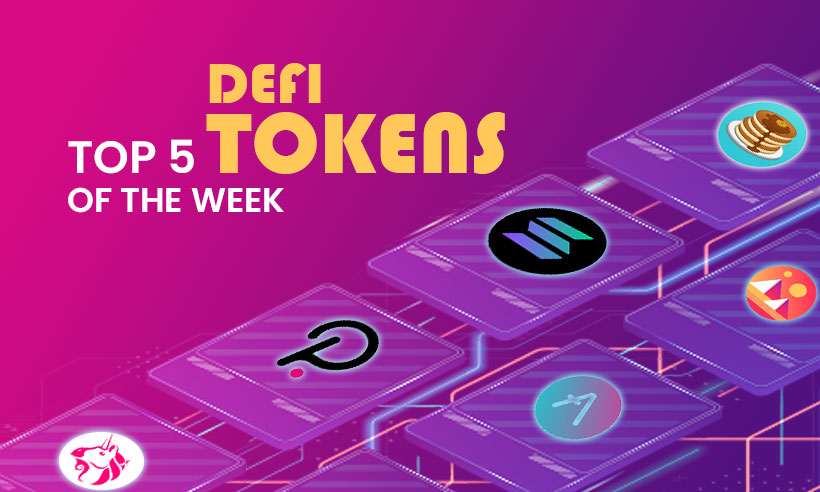
The Total value locked (TVL) in DeFi protocols is currently 72 billion dollars worth of assets. At the peak of the bull run, TVL was around 230 billion dollars. DeFi protocols have worked frictionless and smooth during the previous quarter’s downtrend. So, if you have been thinking of investing in DeFi tokens, here is a list of the top 5 DeFi tokens of the week. These protocols are performing well during this bear market also.

Top 5 DeFi Tokens of the Week

1. ThorChain

Based on Tendermint and Cosmos SDK, ThorChain is a decentralized cross-chain liquidity system. It merely decides how to move assets in response to user activities; it does not peg or wrap items. As a leaderless vault manager, THORChain makes sure that each step of the process is byzantine-fault tolerant.
The main goal of THORChain is to provide cross-chain liquidity while preventing centralization and capture. Only the assets stored in THORChain’s vaults are secured, and the security of those assets is backed by financial assurances. The THORChain ecosystem is powered by the token RUNE, which also offers the financial incentives needed to keep the network safe. The four crucial roles for RUNE are:
  • Liquidity (as a settlement asset)
  • Security (as a Sybil-resistant mechanism, and a means for driving economic behavior)
  • Governance (signaling priority on-chain)
  • Incentives (paying out rewards, charging fees, subsidizing gas)

RUNE is used for network transaction fees. Both a fixed network price and a dynamic slip-based fee are applied to all swaps.

2. Uniswap

On the Ethereum blockchain, cryptocurrencies can be exchanged using the Uniswap protocol. In order to promote censorship resistance, security, and self-custody, the protocol is built as a collection of persistent, non-upgradable smart contracts. It is also intended to operate without the use of any trusted intermediaries who might arbitrarily impose access restrictions.

The Uniswap protocol currently exists in three versions. Both V1 and V2 are open source and GPL-licensed. Concentrated liquidity—liquidity that is distributed within a specific price range—is the key concept of Uniswap v3. In previous iterations, liquidity was dispersed uniformly between 0 and infinity throughout the price curve.

The Uniswap community treasury, the Uniswap protocol governance, and the protocol fee switch are all controlled by the ERC-20 token UNI on the Ethereum network (0.05 percent of the fee would be collected by UNI token holders if activated).

3. Aave

Users can engage in Aave, a decentralized non-custodial liquidity system, as depositors or borrowers. Borrowers have the option of borrowing in an overcollateralized (perpetually) or undercollateralized (one-block liquidity) method, while depositors offer liquidity to the market in exchange for passive income. The amount you can borrow up to depends on the value you have deposited and the liquidity that is readily available. For instance, if there isn’t enough liquidity or if your health prevents it, you can’t borrow an asset.

Transacting with the protocol necessitates fees for using the Ethereum Blockchain, which is based on the network’s health and the intricacy of the transactions. Gas expenses have been reduced for all necessary functions with Aave V3. Across the board, gas prices have decreased by about 20–25%.

4. Synthetix

Built on Ethereum and Optimistic (a layer two scaling solution built on Ethereum), Synthetix is a DeFi platform for issuing synthetic assets. The Synthetix Network Token (SNX), which when locked in the contract authorizes the generation of synthetic assets, serves as security for these virtual assets (Synths).

Users can make conversions between Synths directly through the smart contract using this pooled collateral architecture, doing away with the requirement for counterparties. The liquidity and slippage problems that DEXs have are resolved by this approach. Currently, Synthetix supports fictitious fiat money, long and short cryptocurrency positions, and commodities.

On top of the Synthetix architecture, numerous protocols have developed. Kwenta, which provides spot exchanges and perpetual futures, Lyra, which provides options trading, Curve, which provides cross-asset swaps, and dHEDGE, which enables investors to pool their funds and provides a decentralized hedge fund service.

Owners of SNX are encouraged to stake their tokens because integrators pay them a proportionate share of the fees made from activity on Synthetix (Kwenta, Lyra, Curve, dHEDGE, and many others). The value of the SNX token is derived from the privilege to participate in the network and capture fees made from Synth exchanges. Having SNX is not necessary in order to trade on the Synthetix network.

5. Lido DAO

A group called Lido DAO creates liquid staking services for Ethereum. Lido enables users to gain staking benefits without maintaining staking infrastructure or locking assets. Users can stake ether in Lido smart contracts and obtain tokenized staked ether in the form of stETH.

The tokens are subsequently staked by the DAO-controlled smart contracts with the DAO’s chosen node operators. The DAO is in charge of the money that users deposit; node operators never have access to the money directly.

The stETH token can be transferred at any moment and is not subject to the restrictions associated with a lack of liquidity, unlike staked ether. The entire amount of staked ether will be multiplied by rewards and deducted from any slashing fines to determine the balance of the stETH token.

The project’s native token is LDO. Various use cases of the LDO token are:

  • Governance: Users can vote on ideas to determine important factors including fee structures, node operators, and oracle assignments.
  • Value Accrual: The DAO, a slashing insurance fund, and node operators each receive 10% of the earnings from staking. The Lido DAO gains value by obtaining 5% of all real-time staking payouts.
  • Liquidity Incentive: In exchange for LDO rewards, users can lend liquidity to the liquid-staking tokens.

Conclusion

So, these were the top 5 DeFi tokens of this week. These protocols are leaders in their service category of DeFi. However, these protocols need to make some changes in tokenomics to better serve the token holders. Also, token holders need to participate actively in governance. If these protocols will keep on innovating, it will not be easy to replace them. Network effects and strong development teams are the reason for the success of these protocols.

Bitcoin: Why is it The Best Bet Against Inflation?

Bitcoin inflation

Inflation has begun to rise again. For the past few months, India’s annual inflation rate has been climbing, as has been the case in many other nations. As a result, more individuals are looking for measures to safeguard their assets against inflation, and cryptocurrencies like bitcoin appear to be a great hedge. It is argued that money printing by the central bank would lead to inflation or the devaluation of money over time. In comparison, Bitcoin has a set limit of 21 million coins that may ever be minted. Because of its limited supply, bitcoin is resistant to inflation. Let’s take a closer look.

Inflation – A Basic Overview

Simply put, inflation is the rising cost of goods and services. In other words, rising prices reduce people’s purchasing power. Therefore, formerly lower-priced goods and services now demand more fiat cash to be acquired. A chocolate bar that cost $10 two years ago now $20. The culprit is inflation. Inflation can be caused by a variety of macroeconomic and microeconomic variables. Most observers feel that persistent inflation occurs when the amount of fiat money in circulation increases in a way that does not correlate to the country’s economic progress.

To keep inflation under control, most countries have a national central bank. It regulates the supply of fiat money in circulation and establishes credit limits for the benefit of the national economy. However, these measures have failed time and again, and as such, necessitated the creation of an inflation hedge. In a perfect world, an inflation hedge should rise in value as fiat currency depreciates. Gold and real estate have traditionally been popular assets for inflation protection. During periods of inflation, these assets frequently retained or even increased in value. Investing in these sorts of assets helps protect your funds against the devaluation caused by inflation.

However, investors’ interest in gold has been steadily declining. It’s still a terrific long-term investment, but the returns aren’t as great as they previously were. Furthermore, moving and storing it is a bother. This is where Bitcoin steps in.

How Does Bitcoin Combat Inflation?

Bitcoin is a superior inflation hedge than gold or other traditional assets for three major reasons, which are as follows.

1. Bitcoin isn’t tied to any currency or economy.

Bitcoin isn’t tied to a currency or economic system, like gold. Neither corporations nor stakeholders control it. It’s a global asset class reflecting global demand. Rising inflation forces investors to take on greater risk to offset falling asset prices. A 3% dividend yield, for example, might be utilized to supplement retirement income. But if the inflation rate is 6%, it’s not good enough. Long-term S&P 500 returns are between 7% and 8% per year, marginally above the existing inflation rate. Bitcoin may be a better investment than equities since it bypasses many of the political and economic risks. Bitcoin and other cryptocurrencies are good for diversifying away from domestic sources.

2. Bitcoin is limited.

An algorithm caps Bitcoins (BTC) to 21 million. 19 million BTC exist in 2022. Within 12 years of Bitcoin’s existence, 90% of the cryptocurrency’s mineable supply is in circulation. Pre-set Bitcoin circulation limits ensure there is no surplus supply, which helps control inflation. In addition, the mining reward also halves every four years. Bitcoin’s yearly production rate is roughly half of gold’s and is likely to drop, making it more precious and difficult to obtain.

3. Bitcoin makes value preservation easy.

Bitcoin is durable, interchangeable, safe, and limited, like gold. Bitcoin, unlike gold, can be transported, transferred, and decentralized. Most of the world’s gold is held by sovereign governments, including the US, China, Germany, and others. Bitcoin can be stored and secured more easily than gold. Those who feel gold is a precious commodity may say the two are identical. However, Bitcoin’s underlying blockchain technology has real-world utility. As a currency, Bitcoin has limited practical utility in industrialized countries with stale fiat currencies. However, in economies prone to hyperinflation and political turmoil, Bitcoin is a superior means of exchange.

Closing Note

Investing in Bitcoin as an inflation hedge is a smart move, but you should monitor regulatory developments closely. The above factors further reinstate that it’s a better bet to invest in Bitcoin than gold, real estate, or other traditional assets. As a result of its limited supply and decentralization, Bitcoin has a unique position as an asset that can withstand inflation.

Web 3.0 And The Potential it Holds for India

Web 3.0 India

Web 3.0 is the buzzword in the world of technology these days. With the future versions of our modern-day internet and all the opportunities of a new era that is expected to arrive, the Web3 frenzy has reached its peak. A more decentralized approach to network ownership is at the heart of Web3, the anticipated next step in the internet’s evolution. It is also expected to be more intuitive in terms of tracking usage patterns and tailoring the online experience to fit user needs.

Web 2.0 is still bearing fruit, and we are all benefiting from it. Meanwhile, Tim Berners-Lee believes that the Semantic Web will cause a fundamental upheaval across the world, including in India. Web 3.0 in India will have a significant impact on the efficiency and effectiveness of existing work processes. Thus, let us investigate if India is prepared to embrace the next internet revolution and progress beyond Web 2.0 in the near future and how it will benefit from this.

Web 3.0 and India

Web 3.0 would be a game-changer for India in every industry in the near future. Web 2.0 revolves around search engines, whereas Web 3.0 revolves around finding engines. India can alter its revenue return by utilizing the potential of the semantic web, which the entire world is looking forward to experiencing. People in India are concerned about Web 3.0 since the digital gap has been a persistent issue for a long time. There are also a number of problems in terms of technological, social, and cultural aspects when considering India on Web3.

India has a low domain penetration, which is calculated by dividing the number of domains held by a nation by the number of internet users. Domain penetration in India is approximately 0.6 percent, while it is 43 percent in the United States. However, in terms of the overall population rate, the United States is third after India. Nonetheless, India’s domain penetration is substantially lower than that of the United States. It is related to a variety of factors, including proper internet usage, per capita income, and many more.

Web 3.0 for Entrepreneurial Aspirations

In India, aspiring entrepreneurs are excited about exploiting Web 3.0 to capitalize on the potential prospects provided by the semantic web. Numerous venture capitalists are interested in spending millions of dollars in Indian enterprises that have begun to embrace, leverage, and invest in semantic web to promote India’s status as a leader in Web 3.0. This is all because they believe that India is well-positioned to gain from Web 3.0’s increased efficiency and revenue transparency. With the appropriate legislation and regulations in place, Web3 in India can improve people’s lives while also producing more employment and chances for a vibrant economy. The Indian government must enforce a well-planned agenda in order for India to be ready for the next digital revolution following Web 2.0.

India is regarded as having one of the world’s largest communities of start-ups, developers, and inventors. Despite being a developing country, India has one of the world’s fastest-growing internet consumer marketplaces. With the democratizing effects of digital technology, Web 3.0 in India has the ability to transform the country into an inclusive digital society.

Web 3.0 is equipped to recognize and address the numerous inefficiencies of Web 2.0 in an efficient and effective manner. Telangana, one of India’s state governments, has authorized Web 2.0 and Web 3.0 blockchain start-ups under the India Blockchain Accelerator Program. The major goal is to help early-stage Web 2.0 and Web 3.0 start-ups handle a variety of real-world difficulties. Investors believe that India is poised to lead the rest of the globe in the successful establishment of a blockchain and cryptocurrency ecosystem with Web 3.0 in India.

Conclusion

Web 3.0 has the potential to become one of the most significant technological advances of the coming decade. It will alter the ways in which we engage with one another, both online and in real life. By utilizing the capabilities offered by the semantic web, India has the potential to improve its revenue return significantly. This is something that people all across the globe are looking forward to. As everything plays out, it is evident that India is on track to become a big participant.

What’s fueling Ethereum’s Intrinsic Value?

Ethereum is one of the most useful cryptocurrencies in the market. In terms of market capitalization, it’s second only to that of Bitcoin. As a result, it’s highly regarded as a financial tool by many people. Ethereum is also home to a slew of cutting-edge technologies, like NFT and dApps. However, how can Ethereum come to have its own intrinsic value?

What is the Definition of Intrinsic Value?

To begin discussing the intrinsic value of Ethereum, it is necessary to first define the word “intrinsic value.” In layman’s terms, intrinsic value is the true value of any asset. The inherent worth of any asset should not be confused with its market price. This is because market prices may be either under or overvalued.

When it comes to digital currencies, the intrinsic value may be defined in a variety of ways. Any digital currency’s inherent worth is defined by its scarcity, real-world applications, and broad technological usage. This simply indicates that the more a digital currency’s utility, the greater its inherent worth.

As Ethereum’s utility in real-world activities rises, so does its value, and it has received a lot of attention in the cryptocurrency market.

The use of smart contracts is the most notable element that improves the utility of the Ethereum blockchain and network.

These smart contracts are regarded as Ethereum’s first and most essential utility feature. This is due to the fact that smart contracts serve as a backbone for various real-world network applications, such as the creation of NFTs, dApps, and DeFi. Smart contracts allow blockchain transactions to be performed automatically without the need for legal or financial third-party intervention.

By modifying the way transactions are handled through governance, digital ID, supplier chains, and market structure, Eth smart contracts have shown significant promise for transforming the financial community.

With thousands of decentralized applications and use cases, Ethereum became the uncontested champion in the Decentralized Application field.

So, what gives Ethereum intrinsic value?

In addition to smart contracts, there are additional aspects that contribute to the overall value of Ethereum. Here are a few observations:

Improved Connection

Ethereum has shown enormous potential in terms of bridging the financial and technology worlds. Because Ethereum is the greatest backer of DeFi, it will play a critical role in reshaping the macroeconomic environment.

Because Ethereum strives to facilitate the transformation of the financial ecosystem, it provides an unconstrained and open-source platform. This will open the door for mass engagement and connections, increasing the network’s value.

With a solid supporter base, an efficient development team, and tremendous popularity, the Ethereum ecosystem is undoubtedly developing, and this growth will result in an increase in the value of the currency, Ether.

Transactional Speed

The rapid networking speed of Ethereum is one of its distinctive features. New blocks are validated every 10 to 15 seconds, and transactions take 5 minutes or less. This is substantially faster than Bitcoin’s blockchain, which takes 10 minutes to validate a block and around 40 minutes to complete a transaction.

Protocol Improvement

Ethereum is currently based on the PoW protocol, which necessitates the usage of miners. The primary job of these miners is network surveillance and the permission of new blocks, for which they are compensated.

Nonetheless, Eth is preparing to switch from the current PoW protocol to the more cost-effective PoS protocol. The upcoming Eth 2.0 is expected to entirely operate on the beacon chain rather than the Ethereum Classic blockchain that is currently in use. This will improve network speed, scalability, and efficiency.

Unlike Eth 1.0, which requires miners, ETH 2.0 primarily requires validators. In an effort to prevent selfishness, these validators are required to have a stake in the network. There are three key stages to the transition: Phase 0, the ‘Merge,’ and then the shard chains.

Disinflationary Supply

Because there are only 21 million Bitcoins in circulation, it is usually seen as a store of value and an inflation hedge. Unlike bitcoin, Ethereum has an endless supply of Ether but limits the quantity issued each year through the mining process. This eliminates the perceived scarcity that may have contributed to bitcoin’s increased worth. The supply of Ether grows using a disinflationary process that will be modified as the network matures.

The way blocks are constructed changed fundamentally with Ethereum’s new paradigm. Instead of paying miners for building blocks, validators will be compensated with a transaction fee for each transaction and smart contract that they validate. The more the amount of Ether that is staked, the higher the value will be since there will be less Ether available for purchase. Plus, Proof of stake reduces mining expenses like electricity and hardware, suggesting that miners will sell and stake less Ether, implying that deflation may come into play in new ways.

Eth 2.0’s Impact on Ethereum’s Intrinsic Value

The year 2022 is expected to be a turning point for Ether, according to cryptocurrency analysts. The value of the currency has increased dramatically in recent years, attracting a large number of investors. In addition, Ether’s steady rise has also prompted a number of newcomers to join the crypto revolution via trading.

Enhanced scalability and increased performance are only two of the new upgrade’s many promising benefits. However, the success of this will be contingent on the planned improvement.

Until the upgrade is done and tested, the Ether price will likely fluctuate, affecting its value.

Can the Lightning Network Do to Bitcoin What Sidechains Are Doing to Ethereum?

Bitcoin Legal Tender

With the impending switch from proof-of-work to a more energy-efficient proof-of-stake model, Ethereum will be able to reduce its impact on the environment significantly. This move is known as ‘The Merge,’ and it will be implemented soon. ETH 2.0 will also solve some of the scalability issues, primarily by implementing sharding techniques. However, in order to attain higher degrees of scalability, layer 2 scaling methods are required.

Layer 2 solutions aim to increase Ethereum’s scalability by building on top of it rather than from within the blockchain itself. Separate blockchains, known as sidechains, run concurrently with Ethereum Mainnet but independently. For the most part, sidechains do not rely on the security of the main blockchain, and they have their own consensus process in place.

As a result of a separate chain existing in parallel to the main chain, a lot of the workload can be migrated to the sidechain, resulting in significantly faster transaction speeds.

But What’s All This Got to Do With Bitcoin?

Simply said, sidechains are also a boon for Bitcoin, which has been plagued and critiqued due to its scalability issues. However, due to a slight difference in the terminology, people often get confused. The layer 2 scaling solution is commonly referred to as the Lightning Network when it comes to Bitcoin.

The lightning network adds a second layer to the Bitcoin blockchain to enable off-chain transactions. The second layer consists of multiple payment channels established between parties or Bitcoin (BTC) users. A lightning network channel lets two people send and receive money. Layer two enhances the scalability of blockchain applications by managing transactions outside of the blockchain mainnet (layer one) while still benefiting from the mainnet’s powerful decentralized security paradigm.

The lack of scalability is a significant barrier to the widespread adoption of cryptocurrencies. When properly scaled, a blockchain network may process millions to billions of transactions per second (TPS). In this context, the lightning network charges low fees by transacting and settling off-chain, enabling new use cases such as instant micropayments, which can solve the traditional “can you buy coffee with cryptocurrency” predicament by significantly reducing processing times and lowering the costs (energy costs) affiliated with the Bitcoin blockchain.

In short, the lightning network helps Bitcoin with-

  • Increased Speed
  • Reduced fees
  • Overall Scalability boost

While the intent is admirable, the lightning network is still failing to address the issue and has even brought new problems such as low routing prices and malicious attacks. There is a small fee to set up and terminate a payment channel, for example. Additional fees are paid to nodes that verify transactions in addition to these minor charges.

The question now is, why would a node want to validate a transaction with such a low routing fee? The reasonable explanation is that miners do not usually validate smaller transactions since they get lower fees for doing so. As a result, traders are required to pay a routing fee, and their transactions may take a long time to be verified. In terms of destructive attacks, a bad actor may set up several payment channels and then shut them all at once. Those channels must then be authenticated, causing traffic load by getting in the way of genuine transactions. During periods of high traffic, the attacker may be able to take money away before legitimate parties become aware of the problem.

The beauty of the Lightning Network, however, is that these updated bitcoin transactions do not have to be broadcasted to the blockchain; thus, they do not use block space or require miner fees. However, the updated transaction still have value since they can be included in the Bitcoin blockchain.

It’s also possible for users to swap between networks, using Lightning Network for smaller transactions and the Bitcoin network for major ones. Last but not the least, the Lightning Network’s transactions are private, taking place outside of the blockchain and only capturing the aggregated outcomes of the transaction.

As the number of nodes and channels on the Bitcoin network rises, so does the network’s ability to process more bitcoin transactions. The Lightning Network may be the key to solving the scalability problem in Bitcoin in the future. More individuals are using both Bitcoin and the Lightning Network because they operate so well together. If you’re already using Bitcoin, the Lightning Network is a no-brainer for making fast, low-cost payments. As more individuals utilize Lightning Network and Bitcoin, both will be recognized on conventional exchanges and accepted as traditional means of payment.

Closing Note

The Lightning Network, which was launched in 2018, is quickly transforming the face of Bitcoin. Developers worked extensively to sustain and promote the network and build a user-friendly platform. A smartphone is all it takes to connect to the Lightning Network, allowing anybody to send and receive payments with limitless options. While the Lightning Network is currently a work in progress, it has the potential to benefit both the Bitcoin network and its users.

Should You Use a DEX in 2022?

DEX

One of the core ideals of the cryptocurrency sector is the decentralization movement. The idea of moving away from centralized systems is becoming the new norm. The ‘Not your keys, Not your coin’ revolution gave birth to the notion of decentralized exchanges (DEX) for cryptocurrency trading. Because DEXes provides the user complete control, they have spawned a booming market.

But there’s more to it than meets the eye. Given the multiple risks associated with centralized exchanges, DEXes may be enticing to many. When you encounter the words’ exchange hack,’ what do you think of? For many crypto users, it’s either curiosity about which exchange was compromised or panic if they use or have funds on it. These stories, however, are rather regular in the sector, and a few attacks are practically expected every year.

These attacks are not confined to small exchanges; several of the industry’s largest exchanges, such as Binance, have experienced security breaches at some point. These can have disastrous consequences since millions of dollars in company funds have been lost as a result. They do, however, highlight a critical problem in the centralized exchange currency system.

With all the issues that are associated with centralized exchanges, cryptocurrency users are leaning more towards decentralized exchanges these days.

So, what exactly is a decentralized exchange, and how does it differ from its centralized counterparts?

A decentralized exchange, in its most basic form, provides a new type of pair-matching service, enabling traders to place orders and trade currencies without the need for an intermediate entity to manage the funds.

This decentralized dynamic system enables rapid transactions, often at a significantly lower cost than what is available on centralized crypto exchanges, due to its reliance on self-executing smart contracts.

Centralized exchanges require clients to make deposits and then issue an IOU (which stands for “I owe you” and refers to a document acknowledging a debt owed by one party to another) that is freely traded on the exchange. These IOUs are converted to cryptocurrency and handed to the beneficial owner when a client requests a withdrawal.

Furthermore, centralized cryptocurrency exchanges hold the crypto assets of their clients, which may include both the buyer and seller and control the private keys necessary to access the funds.

Why Should You Use a Decentralized Exchange (DEX)?

To begin with, the option to retain your private keys is seen as a critical feature for privacy-conscious users who want complete control over their crypto assets. In the centralized exchange architecture, one entity manages users’ private keys and facilitates transactions. A decentralized exchange, on the other hand, allows users to trade cryptocurrencies on a distributed ledger while preserving control over their own private keys and money.

Second, decentralized exchanges have substantially lower, and in many cases nil, fees than centralized exchanges. Decentralized exchanges may substantially reduce prices because of an innovation known as Automated Market Makers (AMM).

When employing AMMs, the traditional order book is substituted with liquidity pools that are pre-funded for both crypto assets in a trading pair. The liquidity is supplied by a network of users, who can earn passive income on their deposits through trading fees based on their share in the liquidity pool.

A crypto custodial service is now a standard feature of every central exchange. This implies they manage the crypto assets of their users, and because large amounts of cryptocurrency are housed in one spot, centralized exchanges are vulnerable to attacks. Decentralized exchanges are not appealing targets for such attacks since they do not retain funds.

A DEX distributes custody throughout the whole user base, making attacks significantly more costly, less lucrative, and far more difficult. Because the funds are totally managed by the individual users, the lack of an intermediary also suggests that most DEXs have little counterparty risk because the funds are fully controlled by the individual users, giving the individual crypto traders complete independence and authority.

Problem with DEXes!

While decentralized exchanges have some advantages, they also have a few drawbacks.

Cryptocurrency exchanges are an important source of liquidity for the global cryptocurrency market, facilitating daily trades worth tens of billions of dollars. If you’ve purchased cryptocurrencies in the past, you’ve almost certainly done it using exchanges such as WazirX and Binance. This is because these platforms are easily accessible, easy to use, and has the option to use fiat currencies to purchase crypto assets. That’s not the case with DEXes since they are all crypto-crypto platforms. So, first, you need to purchase a cryptocurrency, say Bitcoin, and transfer it to the DEX to be able to start investing.

Furthermore, DEXs may look fairly complicated to an inexperienced eye. Also, a user must properly handle his or her private keys and funds, which is often inconvenient and costly for many users. As a result, there may be an intellectual barrier to entry when it comes to DEXes.

Another significant disadvantage of decentralized exchanges is the limited trading capabilities. How? The DEX risks of slower transaction settlement speed might make trading on DEXs more difficult. Furthermore, decentralized exchanges with an emphasis on easy buying and selling orders have just recently gained popularity. Additionally, users can’t find complex trading functionalities like stop losses and margin trading on the majority of decentralized exchanges.

But that doesn’t mean nobody is using these decentralized platforms. In November last year, the trading volume on DEXes went as high as $205 billion. Furthermore, there are more than 15 different DEXes that exist today. This goes to show the immense progress that has been made in this regard.

Closing Note

The market for DEXes is fairly new, and most of the problems that exist currently stem from this very fact. The crypto industry is constantly evolving, and the same can be said for DEXes. So to answer the question of whether or not you should use Decentralised exchanges currently depends on your technical knowledge. If you can work your way with the technicalities, then trading DEXes is definitely a great option for you or any privacy enthusiast.

Why You Should Stop Holding And Start Staking

Why-you-should-stop-Holding-and-Start-Staking.

From “Just Bitcoin,” the cryptocurrency sector has grown into a trillion-dollar industry. There are tens of thousands of different types of decentralized apps and a variety of investment opportunities. Nevertheless, one thing that has remained the same over time is the idea of “Hodling.”

To date, crypto investors all over the world have held on to their crypto assets for longer periods of time in order to mitigate short-term volatility risks and benefit from substantial returns. But what if there was a way to keep holding cryptocurrencies for the same period of time and still generate passive income from them without having to trade them or undertake any kind of risks?

Enter Staking

Staking cryptocurrency is similar to depositing money in a bank in that an investor locks up their assets and gets incentives, or “interest.” in exchange. Crypto staking is a way to contribute to a blockchain network’s consensus mechanism by “locking up” some of your cryptocurrency for a certain amount of time. In return, those who stake earn rewards, which usually come in the form of more coins or tokens.

Before we get into why staking is a slightly better way to invest in the cryptomarkets over simply holding, let’s get to know staking a bit better.

Staking is only feasible through the proof-of-stake consensus mechanism, which is a method used by some blockchains to select honest participants and validate new blocks of data uploaded to the network.

By requiring these network users – known as validators or “stakers” – to buy and lock a fixed quantity of tokens, it makes it unappealing for these validators to act dishonestly in the network. If the blockchain was manipulated, the native token’s price would certainly collapse, and the perpetrator(s) would lose money.

The stake is, therefore, the validator’s “skin in the game” to guarantee they act honestly and in the best interests of the network. In return for their dedication, validators get rewards in the native cryptocurrency. The more they have at stake, the more likely they are to come up with a new block and then get the rewards. Simply said, the more at stake you have, the more likely you are to play by the rules, in addition to enjoying regular incentives.

The stake doesn’t have to be just one person’s coins. To encourage more people to engage in staking, validators often operate a staking pool and gather funds from a group of token holders via delegation (acting on behalf of others). Every holder can participate in staking by delegating their coins to stake pool operators who validate blockchain transactions.

To keep validators in check, they can be penalized for minor errors, like going offline for lengthy stretches of time or even kicked out of the consensus process and have their funds removed. This is called “slashing,” and it has happened on a few blockchains, such as Polkadot and Ethereum, but it is quite rare.

By now, you might be wondering why you would choose this over good old holding. The answer is ‘Proof of Stake.’

The shift toward POS

If you are slightly familiar with the concept of mining, staking is basically mining without all the energy-hungry hardware. The validators are the minors; they receive crypto incentives. Meanwhile, stakers help by locking in their funds, and both parties share the block rewards.

In other words, rather than exchanging electricity for cryptocurrencies, the PoS method seeks to tackle the heavy energy demand by basically substituting staking for computational power, with the network determining an individual’s mining capability. This means that energy usage should be drastically reduced because miners can no longer rely on vast farms of single-purpose equipment to get an edge.

So, is Proof-of-Stake the key to scaling cryptocurrencies and revolutionizing how we perceive money? Yes. All signs point to the rising need for a scalable, secure, and efficient crypto infrastructure, which Proof-of-Stake provides. Ethereum, the second-largest blockchain network, is already on its way toward switching to the proof of stake consensus mechanism.

Proof-of-Stake cryptocurrencies would allow for faster transactions, thus encouraging more companies to accept cryptocurrency payments. So, yeah, you might be able to buy coffee with cryptocurrency!

More crucially, staking will expand access to blockchain networks and accelerate broad adoption. Even institutional investors may be motivated to buy cryptocurrency now that it has long-term viability and improved possibilities of mainstream adoption.

This is also why staking is currently a better alternative to simply holding your cryptocurrencies.

Closing note

Several POS-based chains have emerged in recent years, each with its own incentives. However, it is critical to note that staking is not a completely risk-free process, and no investment must be made without doing thorough research. Ultimately, this is all a part of a relatively new industry, and every move must be made carefully.

Nonetheless, staking is a great way to make holding much more profitable for both newcomers and professionals alike, in a less risky way. More so because the industry has touted it to be the future.

The Theory of Burning – Why is it crucial?

The-Theory-of-Burning-–-Why-is-it-crucial.

If you follow cryptocurrencies, you’ve probably heard of coin burning. It is a method of reducing the supply of a coin. Coin burning became popular around 2017 and has been duplicated almost endlessly since then. It is now a common trend in the cryptocurrency industry.

The phrase “coin burning” conjures up ideas of an investor setting fire to real money. Of course, this is not physically feasible because digital currencies are only present in virtual form. Token burning is when a coin’s creators remove a particular amount of tokens from circulation. Burning tokens has several purposes, the most common of which is to minimize the market’s inflationary pressures.

It is like a public company repurchasing stock. Such companies use the cash available to acquire common equity shares, reducing the total outstanding shares. This strategy increases earnings per share by boosting the value of outstanding shares. The net profit to share ratio increases.

Big blockchains like Bitcoin and Ethereum don’t employ this methodology. On the other hand, altcoins and smaller tokens commonly burn to regulate the circulating supply, further drawing in investment.

But how do cryptocurrencies get burnt?

Token burning has many variations, but the ultimate goal is to reduce the total number of available tokens. While you can’t burn Cryptocurrency, you can make it unusable. Token signatures are visible to all nodes but are permanently frozen, saved in an irretrievable public wallet called an “eater address.” Blockchains publish the status of these currencies.

Projects burn tokens in various ways, depending on their goals. Some will utilize a one-time burn mechanism to remove unsold tokens from circulation after their ICO (Initial Coin Offering). Others choose to burn coins at set intervals and volumes. Binance, for example, burns tokens quarterly to ensure its native BNB coins preserve their value.

Ripple burns tokens with every transaction. The transaction fee is not refunded to any central authority when parties use XRP. Instead, they’re sent to an eater’s address once a transaction clears.

Stablecoins like Tether (USDT) produce tokens when money is deposited and burn them when withdrawn. Regardless of the technique used, the outcome is the same: burned crypto tokens become useless and are, therefore, removed from the market.

What else?

Proof-of-Burn consensus (PoB) is a famous mechanism that evolved from token burning. It focuses on users burning their tokens to acquire mining rights.

While Proof-of-Work (PoW) remains the most plausible approach, partly because of Bitcoin’s support, PoW consumes a significant amount of resources and can be extremely expensive. PoB solves this problem by restricting the amount of blocks miners may verify to the number of coins they’ve burnt. On the surface, it forms a virtual mining field that may expand in size as more burning of tokens happens.

Is the price impacted?

There is no guarantee that the token’s value will rise immediately after a burn occurs. Other information regarding the crypto token might sometimes overshadow its importance. Alternatively, investors may be aware that a token burn is imminent and “price it in” at an early stage. If you’d like to increase the value of an asset over the long run, burning tokens may be beneficial.

Those staking tokens in a Proof-of-Stake protocol can also gain by burning them. Taking large quantities of tokens out of circulation may increase the value of stake rewards.

Some programs incorporate burning events regularly. An essential part of the goal here is to convince investors that there is no inflation or over-dilution in the future supply of the token. As a result, the token’s appeal as a “store of value” can be reinforced.

Burning is an effective strategy for rebalancing an economy in general. On the other hand, it may not work with all Cryptocurrencies because some are best suited to serve as a medium of exchange, while others are better suited to serve as a store of value.

Can Bitcoin Outperform the Internet in Growth?

Bitcoin

If you’re reading this, you’ve undoubtedly heard of bitcoin, as have hundreds of millions of other people. You may have heard recently that a single bitcoin is worth tens of thousands of dollars. You could possibly be one of the millions of individuals with active bitcoin wallets in 2022.

There is a good chance that you are familiar with the internet, whether or not you belong to one of the aforementioned categories. Few things in human history have altered our way of life as drastically as the internet. The internet is one of humanity’s greatest achievements, whether in communications, entertainment, business, or even international relations. While bitcoin is undoubtedly gaining popularity, could it possibly exceed the internet in terms of growth?

How Quickly Is Bitcoin Growing?

Last year, an on-chain analyst named Willy Woo unveiled a set of tweets that got the crypto community buzzing. The tweets included a graph depicting the history of bitcoin use, as well as estimates for the next several years. According to the graph, there were 135 million active bitcoin addresses, which is the same number of individuals using the internet in 1997.

However, bitcoin use has grown rapidly in recent years, and analysts predict that if it continues to develop at this rate, it will have a billion users by 2025. In comparison, the internet did not reach a billion users until 2005, eight years after it reached 135 million.

A billion bitcoin users is an audacious ambition, but is it one that can be achieved? First, the billion-user target must be specified more clearly. If a billion users mean a billion active wallet addresses, it is doable; however, the amount of bitcoin in each wallet will be minimal. It should be remembered that bitcoins are not infinite.

There will only ever be 21 million bitcoins in existence at any given moment. As of May 2022, there are roughly less than 2 million bitcoins left to mine, and demand for bitcoin is more than ever before, thanks to its all-time highs and increasing media attention. If the remaining bitcoin were distributed equitably, each wallet would have a very small fraction of a bitcoin.

Can Bitcoin Grow Fast Enough?

Bitcoin’s ability to reach a billion wallet addresses, particularly in the next three years, is dependent on institutional backing. In the case of the internet, its rise was aided mostly by necessity rather than organic growth. By the turn of the century, nearly every aspect of life was linked to the internet; companies began interacting via email, major announcements were posted on official websites, and email addresses became essential for accessing certain services.

Simply said, it has become nearly impossible to function in modern life without access to the internet. While many people used the internet because they liked it, institutional backing drove its rise. Unfortunately, Bitcoin does not currently have that degree of support (even though, over the past few years, several major corporations have stepped in). As of now, most people set up bitcoin or cryptocurrency wallets with the intention of profiting from the market or because they believe in the concept of decentralized currency.

This, however, is just a minor portion of the global populous. And although one may argue that decentralized currencies have the capacity to redefine the world in the same way that the internet has, a billion individuals are unlikely to feel the same amount of compulsion. There’s a good reason why email addresses outnumber Facebook profiles: the former has been rendered mandatory, whilst the latter, despite its widespread use, has not.

The same is true for bitcoin; if institutional support improves to the point where bitcoin is a payment option for most day-to-day purchases, is almost universally accepted, and is firmly established in modern society, bitcoin has the potential to outperform the internet in terms of growth. It’s not a matter of how but when.

Possible Ways to Reverse the Present Cryptocurrency Market Trend

Possible-Ways-to-Reverse-the-Present-Cryptocurrency-Market-Trend

With the present dip in the Cryptocurrency market, there is a need for intervention before the total collapse of some crypto assets could be reached.

Terra (LUNA) will be a major discussion in the history of cryptocurrencies, but there is a need for the reversal of the present decline, so as to encourage future investors and also increase the trust of different governments that cryptocurrencies could be scams.

Some of the possible ways for the market trend to reverse are:

  • Bitcoin and Ethereum whales to hodl
  • Launch of a new sector in cryptocurrency
  • Projects to do a buyback

Bitcoin and Ethereum whales to hodl

The role of the Bitcoin market in the cryptocurrency market cannot be overemphasized. This is due to its dominance in the market. At the time of writing, according to CoinMarketCap, Bitcoin dominance is 44.9% while Ethereum dominance is 19.5%. This shows that the two top cryptocurrencies in terms of market capitalization are controlling about 64.4% percent of the entire cryptocurrency market. Hence, activities within the Bitcoin and Ethereum blockchains could plunge the entire market into crisis. Hence, if Bitcoin and Ethereum whales could hodl for a longer duration and stop transfers to centralized Cryptocurrency exchanges, this present trend could reverse.

Launch of a new sector in cryptocurrency

One of the reasons why the Cryptocurrency market grew in the past two years was due to the launch of other new areas in the market. Some of them are the Decentralized Finance, Metaverse, Non Fungible Tokens, and the present move to earn tokens. These sectors attracted a lot of investors due to the high yield opportunities they gave to their investors, especially the early ones. This shows that a possible new idea that has not to be harnessed in the market previously could push more funds into the market from the mainstream investors.

Projects to do a buyback

Periodical buybacks by teams handling different Cryptocurrency projects could reverse the present market downtrend. This is because of the buying pressure that funds provided by them would add to the market, therefore, increasing the price of the crypto assets.

Conclusion

In conclusion, a possible reversal is possible if the major players in the Cryptocurrency space want it soon.

How Cryptocurrencies Can Revamp Global Trade and Commerce

How-Cryptocurrencies-can-Revamp-Global-Trade-and-Commerce

The globe has been connected in terms of trade and commerce for a long time, and with the advent of the internet, this appears to be becoming more visible. Besides the import and export of raw commodities, average folks may now shop online at companies all over the world, further compressing the global economic domain.

The introduction and rise in popularity of cryptocurrencies over the last decade have also had massive ramifications for global trade and business, some of which may endanger the current system as we know it.

Cryptocurrency in Global Trade

Every nation on the planet has some form of natural resource or another, as well as commodities. At the same time, no nation on the planet possesses every natural resource or product required to function, necessitating global commerce. When two countries trade, the resources or items in issue must be paid for, and this is done via fiat currency.

For a long period of time, fiat currency was the only way for countries to pay for foreign exchange. Then cryptocurrency came along. The use of centralized money, however, comes with a disadvantage endemic to centralized systems: the potential of sanctions from powerful players.

Consider Venezuela, which has been sanctioned by the US for several years. The country has endured hyperinflation as a result of these limitations, and its inhabitants have suffered economically. However, in recent years, the country has resorted to using cryptocurrencies to pay for imports from other countries in order to avoid the sanctions that have been imposed.

The nation also enhanced its usage of cryptocurrencies to enable commerce with nations like Turkey and Iran.

Similarly, North Korea has been suspected of utilizing a state-sanctioned hacking squad to steal cryptocurrencies in order to fund its nuclear weapons program. Prior to cryptocurrencies, it would have been practically impossible to get around sanctions imposed by countries such as the United States, but that period looks to be coming to an end. Venezuela even went so far as to develop its own national cryptocurrency, the petro, in order to retain economic autonomy.

If countries like Venezuela and North Korea are successful in circumventing sanctions by adopting cryptocurrency, the ramifications might be catastrophic.

What it means

It is no secret that the United States is a world power, and one of the reasons for this is the US dollar’s strength and the country’s capacity to sanction other countries. Cryptocurrencies pose a threat to this since they effectively take away the United States’ economic authority and give it to no one in particular.

What would happen if cryptocurrencies became extensively utilized and no country was terrified of being sanctioned by the US? In 2019, the Kennedy School of Harvard University performed a simulation in which the usage of the digital yuan allowed North Korea to test its nuclear missile programs with Chinese assistance.

The simulation depicts a scenario in which other countries may defy the US at will due to the effective circumvention of US sanctions attributable to cryptocurrencies. According to all indicators, the usage of cryptocurrencies will alter global trade by opening up the market in ways never seen before.

Countries and businesses will be able to trade more freely with one another, including with international giants like the United States. This autonomy and power that cryptocurrencies may provide nations will make it essentially irreplaceable and invaluable in the global arena, ensuring its adoption by countries across the globe for decades to come. We can expect to see the full impact of this in both international diplomacy and global trade and commerce.

But are bypassing sanctions the only advantage when using cryptocurrencies on an international level? Not at all. Here are just some of the benefits when cryptocurrencies are involved.

Cryptocurrencies may improve cross-border payment efficiency

Cross-border payments are settled within one to five business days. Human interaction is often necessary to verify sender and recipient information, for example, for AML and CTF purposes. Thus, the speed of payment is typically controlled by how closely the sending and receiving institutions’ work hours overlap and if they use the same communications protocols.

For digital currencies that rely on decentralized ledgers, money might be transmitted and received in a matter of seconds and at any time of day. It’s possible that future regulatory compliance requirements for digital currency service providers and foreign exchange regulations would slow down the speed of transactions.

Cryptocurrencies may provide an alternate source of credit information for trade finance

The $1.7 trillion global trade financing gap disproportionately affects SMEs that lack solid financial records with banks. To underwrite import and export loans, public ledgers of digital currencies can be employed. At the same time, strict privacy standards would need to be implemented.

Cryptocurrencies may help with de-risking

De-risking hinders nations with high AML and CTF risks from participating in global commerce and increases transaction costs for buyers and sellers. While digital currencies may not help minimize AML and CTF issues, they may help re-connect consumers and merchants from such nations with a global customer base.

Closing thoughts

The entry of cryptocurrencies into global trade and commerce will undoubtedly be interesting to watch. However, if we hope to see this happen, regulations will undoubtedly play a significant part. As cryptocurrencies gain traction, it may only be a matter of time until they take center stage.

Binance is Now Brasileierão’s Cryptocurrency Sponsor

Binance Brasileierão

According to a tweet by Binance, the Brasileiro Assa, Brasileiro Female Neoenergia, Brasileiro Female A-2, and Brasileiro Female A-3, 4 premier football events run by Confederação Brasileira de Futebol, have announced Binance as their new official cryptocurrency sponsor. 

Brasileierão Announces Binance as Its Cryptocurrency Sponsor

As part of a 3-year agreement, Binance and NFT will work together to establish the Binance brand as synonymous with these competitions and produce Fan Tokens — cryptos that give interaction and rewards. Inside the digital and internet ecosystem, the sector is continually changing. 

In this environment, having these competitions (Brasileiro Assa, Women’s Brasileiro Neoenergia, Women’s Brasileiro A-2, and Women’s Brasileiro A-3, affiliated with Binance, a worldwide behemoth in this field) is associated with Binance is a remarkable and creative step. 

Lorenzo Perales, who is in charge of marketing and sales for the CBF, says that this partnership is important because it will help them learn more about Brazilian football fans and help them feel more connected to these competitions.

Binance Demonstrates Interest in the Sport Sector

Sport is a key catalyst for social integration. Changpeng Zhao believes that his company’s cooperation with the Brazilian Football Federation (CBF) is critical to the company’s goal of increasing cryptocurrency acceptance and making a good difference in the lives of its customers, the cryptocurrency and blockchain ecosystem, and Brazilian society.

After announcing that it has signed a Memorandum of Understanding to demonstrate its interest in acquiring Simpaul Investimentos, a Brazilian exchange licensed by the Central Bank of Brazil and the Commission of Mobiliary Values, Binance has been working on expanding its presence in Brazil. However, the transaction must be approved by regulatory authorities, notably Brazil’s Central Bank, to be completed successfully.

Brazil’s Santos Futebol Clube and Paulista Sicredi have already received a cryptocurrency sponsor from a Brazilian corporation. Binance also promotes international sports by financing the AFCON, Africa’s greatest football tournament, European football teams Porto and Lazio, and collaborating with Alpine, an F-1 team.

CZ Highlights the Benefits of Cryptocurrency Over Fiat  

CZ Bitcoin

On his Twitter feed, the CEO Of Binance, Changpeng Zhao, highlighted the characteristics of fiat money while stating it missed one fundamental property that differentiates it from cryptocurrency; freedom to invest and transact. The features the crypto entrepreneur listed are divisibility, limited supply, acceptability, uniformity, durability, and portability. 

Users who responded to the tweet agreed with CZ highlighting the benefits of cryptos such as Bitcoin and BNB over the fiat currency. 

https://twitter.com/cz_binance/status/1521757826678460416?s=19

Fiat Money And Cryptocurrency 

Right from the inception of digital currency as a means of payment and exchange, there have been numerous concerns about how crypto is a greater choice than fiat currency. Even as the globe progresses towards a cashless future, very few people understand how different cryptos are from fiat money.

Fiat Money is a currency issued by a state and controlled by a central authority like the central bank. An actual product does not necessarily back such currencies. Instead, it is dependent on the performance of the economy. 

However, a cryptocurrency is digital or virtual money that may be used to trade. Because they are virtual transactions, they rely on encryption technology to process, protect, and validate them.

Advantage Of Crypto Over Fiat

In contrast to fiat currencies, cryptos are not regulated by a central authority, such as a government or a central bank. They are entered into a blockchain that cannot be edited or manipulated. 

Furthermore, due to the low transaction costs, cryptocurrencies have become a popular method of transmitting money across international boundaries. Also, cryptocurrency transactions allow for fast payment compared to the conventional currency, which would take days before it is processed. This particular property has won several users over to the crypto community. 

Another feature that has made cryptocurrencies popular is that users do not have to reveal their identities to conduct transactions. However, recent regulation in certain states is fighting to remove the anonymity the crypto community has enjoyed over the years. This move is due to the increased rate of fraudulent activities in the industry.

Although the fiat currency is still in use, crypto is the future of the new digital economy, and numerous financial institutions have already started adding it to their portfolio. 

Blockchain Social media and Free Speech

Blockchain-Social-media-and-Free-Speech.

Many of us have learned to self-moderate our online conversations, being cautious about what we say, post, and do. Our tweets, postings, and comments cross boundaries, languages, and cultures. Now that social media mishap are constantly in the news; many people wonder who has the final power to regulate what we may publish online.

As a result, censorship in online communities has become a hot subject, hotly argued by both pro-censorship and anti-censorship groups.

The global blockchain community can help shape this narrative as proponents of decentralized technology. We explore whether blockchain can truly alter online communications and the ramifications of unlimited freedom of speech via decentralized platforms.

Big Tech on Censorship

Major social media platforms have historically moderated and removed comments that violate their conditions. Comments that directly hurt or seek to injure other members of a platform’s community are deleted.

But what happens when a social media platform eliminates content to promote a different agenda?

We have witnessed that social media companies have used their censoring abilities to weigh in on political disputes and other topics generally protected by free speech laws. Should censorship be applied on public social media platforms, especially since these online groups have so much power and influence globally?

In the United States, an Executive Order issued by the White House in May 2020 said that “Twitter, Facebook, Instagram, and YouTube wield enormous, if not unprecedented, power to shape how public events are interpreted; to censor, delete, or disappear information; and to control what people see or do not see.”

While this argument is heightened in the United States because of the widespread use of social media, it is a global issue.

As a result, critics frequently accuse conventional social media platforms of spying on users, mining data, and avoiding income sharing with key players.

According to many, the issue stems from centralization’s inherent biases, which means centralized social media platforms can only be as objective as the firm that controls them. So, could blockchain change online communication and social media?

Can Blockchain Protect Freedom of Speech?

Due to its decentralized structure, blockchain technology is not susceptible to the same centralized control as traditional social media platforms. Instead, decentralized social media and content platforms aim to give people more control over their data.

For example, the blockchain-based platform Mastodon allows users to run a personal server utilizing their own hardware and domain name. The user controls these servers and sets the rules and directions for discussion.

While Mastodon has a free API environment where independent developers may design and maintain reader applications, it claims to only show communities that actively moderate. However, community founders, not Mastodon, establish moderating preferences.

Some decentralized systems employ blockchain-based currencies to provide a rewarding aspect. Steemit users, for example, can be rewarded with STEEM tokens by other users for creating popular content or posting thoughtful comments, which have secondary market value.

Users may reward content providers for writing articles that fulfill the interests of the larger community, similar to how ‘likes’ work on other platforms, but with a monetary incentive and without a centralized authority.

Other systems, like the open-source Ethereum-based Minds network, award users with tokens depending on their participation and time spent on the platform and reward the most active users.

Another platform, Minds, has also hinted that they are considering a voting-based system where users may vote to remove information, which would make it one of the first genuinely decentralized social media networks.

Decentralized Communications: Serious Considerations

To achieve a truly egalitarian society that respects human liberty, libertarianism often argues that we must accept the good with the bad.

Many net neutrality proponents say that unwanted internet material is a sad consequence of safeguarding our rights to freedom of speech, even if some individuals choose to misuse it.

Regardless, decentralized societies require inclusive social media networks to thrive. Unmoderated online communities often evolve into places where most web users don’t want to go, and it isn’t easy to have a completely free online platform without certain users feeling ostracized or targeted.

This raises some challenging ethical issues. If material on a social networking platform becomes harmful or disparaging to an individual or group of individuals, they can opt-out or start their own inclusive online community.

Others might advocate for the complete elimination of the more problematic online communities and censorship of contentious individuals, claiming that they represent a risk of inflicting harm and asking platform owners to delete linked accounts and material on users’ behalf — in other words, active censorship. This can lead to overzealous moderation in online communities.

There may be a better approach through blockchain — a distributed and community-led moderation process that does not rely on censorship from a centralized curator holding unlimited authority but on meticulous moderation via a democratic process enabled by each and every user via decentralized technology. A community might therefore pick its own course and enable decent actors to participate.

In principle, decentralized social media systems may return control to users by letting them govern and regulate their own online communities and choose what information they create and consume based on community consensus rather than centralized approval.

How do you feel about social media, blockchain, and censorship? Is a decentralized system better? What about the risks of distributing false information? Inversely, a decentralized platform can allow more voices to be heard, allowing major media channels to not always dominate the narrative.

Blockchain and Climate Change: The Transition from ‘Villain’ to Unsung Hero

Blockchain and Climate Change: The Transition from ‘Villain’ to Unsung Hero

Blockchain is rising to prominence as the world looks to digital technology to speed up responses to challenges such as climate change.

One of the primary uses of blockchain technology is to validate and track complex multi-step transactions. Although it is best recognized for its function in Bitcoin, blockchain technology is being used in a variety of applications, from monitoring the environmental impact of products to real-time pollution monitoring.

There are two main points to consider. Even if we know what to do to slow or stop climate change, we don’t know how to achieve it. We confront a climate-governance crisis at the same time. The 2015 Paris Agreement marked a historic turning point for global climate action. 

The pace of climate change has slowed a bit, but it is still expected to rise over the previously agreed-upon thresholds. It’s time to come up with fresh ideas and push nations who aren’t following the Paris Agreement to account. Things get a lot simpler when blockchain is included in the arsenal of tools used to address climate change. How, then, can this be done?

Going Green with Smart Contracts

Until recently, the inability of blockchains to interact effectively with real-world data, particularly environmental data, impeded the creation of green smart contracts. Recent years have seen the development of ‘oracles’ — entities that can shepherd facts about the world into blockchains. In recent times, these oracles are broadcasting agricultural data sets straight onto blockchains, allowing smart-contract developers to construct applications around crop yields and more. As additional environmental data sets — such as weather patterns or IoT sensor readings – are put into blockchains, developers are starting to construct an array of eco-friendly smart contract apps. These are three instances.

  1. Regenerative Farming

Smart contracts can help everyday people battle climate change by facilitating regenerative agricultural initiatives. These include attempts to encourage communities worldwide to minimize their carbon footprints by conserving and growing trees.

Automated payments for land stewardship can be made feasible via smart contracts that interact with real-world data. Examples include the Green World Campaign’s smart contracts, which use satellite data to automatically compensate people who effectively regenerate land by increasing tree cover, improving soil, and other ways. Payouts are made when oracles use satellite data to activate smart contracts on a blockchain, ensuring that individuals on the ground are compensated appropriately.

  1. Conscious Consumption

Smart contracts can also empower eco-friendly people and groups. In the case of reforestation, an individual may be rewarded in the form of tokenized carbon credits, which could be sold to charities, crowdfunding campaigns, or even enterprises trying to demonstrate their green impact. Because tokenized carbon credits can only be issued if satellites or IoT devices report considerable reforestation to a smart contract, these organizations can verify that their funds have truly had an impact.

Smart contracts can also provide eco-friendly consumers with greater alternatives for energy use. Using smart contracts, decentralized energy networks like the Brooklyn Microgrid Project are allowing users to create and trade solar power with their neighbors through a blockchain-based exchange. Solar energy trading between neighbors can cut energy transit costs and greenhouse gas emissions.

While many consumers are already adjusting their own consumption patterns, a social transition will likely involve linking financial incentives with more sustainable buying decisions. Using smart contracts and real-world data, users may automatically receive incentives or punishments depending on their consumption patterns, triggering behavioral changes that education alone would not have achieved. Another project working on such initiatives is NetObjex is placing IoT sensors in hotels to track guests’ water and energy usage. Using oracles, smart contracts may automatically compute and compensate visitors depending on their consumption stats.

  1. Using Crop Insurance to Mitigate Risk

Global climate change is already affecting weather patterns. Agriculture is particularly vulnerable to changes in weather patterns, such as droughts and winds, because it is largely uninsured and unregulated. The traditional insurance firms have failed to adequately cover small-time farmers in emerging nations, despite the fact that 75% of agricultural risks remain uninsured. As a result, most have highly uncertain circumstances. Bad weather may cause farmers to lose money, causing families to be relocated and crops to be destroyed. Agricultural producers will be hit hard if the effects of climate change continue to escalate.

Fortunately, smart contracts that use oracles to adjust to changing weather conditions can help mitigate risk for those with limited resources. For example, Arbol and Etherisc provide smart contract-based crop insurance to farmers worldwide. For example, farmers may utilize smart contracts to specify requirements for contract execution (such as a specific quantity of rainfall) and then use oracles to track weather patterns. The farmer is paid automatically if the oracle network reports a given measure has been reached. A farmer may now safeguard their financial future with only a smartphone and smart contracts that can connect to meteorological data through oracles.

  1. Enforcing Climate Commitments

Using smart contracts, blockchains could minimize the risk of moving backward, by pressuring states to make their obligations to climate action with a fund. If a state fails to meet its carbon offset promises, its deposit may be seized and redistributed to those who have. Commitments are more easily enforced when they are staked on the blockchain.

Closing Thoughts!

Similar to how the internet today is far more than just emails and databases, blockchain technology is much more than just decentralized money. This new era of smart contracts powered by blockchains and oracles can offer totally new forms of incentives for sustainable human consumption. As climate change continues to be a heated topic of discussion, we must emphasize that the environmental effect of this budding ecosystem will be determined by more than just one project’s consensus mechanism.

Chris Larsen’s Bitcoin Greenification Plan is Impractical

Chris-Larsen's-Bitcoin-Greenification-Plan-is-Impractical

Chris Larsen is one of the co-founders of the embattled crypto-payments company Ripple. He has reportedly committed $5 million of his own money to a public campaign to make bitcoin (BTC) greener. In collaboration with Greenpeace and other organizations, he is supporting a series of advertisements spanning the month of April, urging bitcoiners to “Change the Code, Not the Climate.” According to Bloomberg, the idea is to pressure the Bitcoin community to switch from power-intensive proof-of-work mining to a proof-of-stake mechanism that requires far less energy.

Larsen’s approach appears to be intriguing at first look. The environmental effect of proof-of-work mining is probably Bitcoin’s most significant disadvantage. It is also a persistent impediment to the general public’s understanding of cryptocurrency. For example, rhetoric about environmental damage has contributed to widespread and sometimes misguided animosity toward non-fungible tokens (NFT) in the art world.

However, industry experts and onlookers have reacted with skepticism and distrust to Larsen’s efforts. This is due, in part, to the fact that as noble as Larsen’s intention appears to be, the campaign’s proposals are exceedingly risky, totally unrealistic, and maybe even absurd. More importantly, Larsen’s motivations for the idea are highly dubious. He has spent the last decade as a co-founder of Ripple, arguably competing with Bitcoin.

Environmental protection group and founder of Ripple launch 'code change from climate change' campaign to urge Bitcoin to reduce energy - GIGAZINE

Risks Involved

The first issue with Larsen’s plan is that moving Bitcoin to proof-of-stake security would be extremely risky. The change would be so significant that it would almost certainly be impossible to achieve via a traditional “hard fork.” This happens when certain members of the Bitcoin network move to an incompatible software version. Hard forks have previously been utilized to create modified versions of Bitcoin, most notably in the 2017 Bitcoin Cash split.

However, Bitcoin Cash and related forks only tweaked technical parameters originally set in the proof-of-work mechanism, such as block size. Rather than modifying current parameters, a proof-of-stake-based Bitcoin would almost certainly need a complete redesign. This is because a proof-of-stake system runs on a completely new security architecture. This would entail a considerably more complex operation of moving existing wallet balances to a new network called “Bitcoin.”

Ethereum’s move from proof-of-work to proof-of-stake exemplifies this. Ethereum 2.0  will be a phased transition to a new system. Rather than a direct continuation of the present Ethereum chain. For years, a “Beacon Chain” for the new system has been operating alongside Ethereum 1.0. The merger of the two has been carefully handled by a strong core group of Ethereum companies and developers.

There’s a little probability that a similarly unified and powerful organization will emerge to handle such a transition for Bitcoin. One cause is widespread skepticism about proof-of-stake security. Many people in the Bitcoin ecosystem have interests and agendas that might diverge dramatically if large network modifications are proposed. Bitcoin miners, for example, who have invested millions of dollars on specialized chips known as ASICs (application-specific integrated circuits) for proof-of-work mining are extremely unlikely to support a proof-of-stake transition.

Reactions from Bitcoiners

These facts help explain why Larsen’s plan has come with not just dissent but also vehement and frequently quite personal condemnation from bitcoiners. Like Twitter and Facebook, Bitcoin is heavily reliant on “network effects.” It becomes more helpful as more people use it. While Larsen’s idea has little chance of convincing every bitcoiner to transition to a new proof-of-stake system, it may convince some of them. This may result in a “hard split” in the community, if not in the network itself.

This division has the potential to damage Bitcoin. Furthermore, Larsen’s history appears to have fueled uncharitable conjecture about the campaign’s real objectives. Ripple has often claimed over the past decade that the XRP currency established by its co-founders is a superior system to Bitcoin. The company has sold over $1.3 billion of the token to the public despite relatively little progress in its ambition to develop an interbank transfer system.

Conclusion

This has resulted in a big, continuing struggle with the U.S. Securities and Exchange Commission and many bitcoiners harboring enduring hostility toward Larsen and the whole Ripple organization. This, in many regards, is intrinsically and deeply antagonistic to Bitcoin.

Market Analysis of Bitcoin Shows Bulls Are in Control

Market-Analysis-Signals-Bullish-Trend

Bitcoin Market


After ranging for 3 months and touching the $45,000 level resistance four times, Bitcoin gave a relief bounce. Bitcoin has finally come out of the range and broke the $45,000 level with a bullish candle close. During this range, the market was impacted by a lot of macro factors such as the Russia-Ukraine War, financial sanctions on Russia, which resulted in a high rise in prices of commodities and the FED also approved a 0.25 percentage point hike rate. After all of these factors played out, which were bad for the economy, Bitcoin stayed within the range and always showed strong price movement upwards after some relief in the market. Such strength shown by Bitcoin during such bad times is impressive.

I have analyzed some charts below which are composed of On-chain data, Derivatives data and it will be interesting to see whether these charts are showing signs of bullishness or bearishness in the market. Insights gathered from these charts will be helpful to know the upcoming trend in the market. Please remember that this article aims to help you understand the current market scenario. Never invest more than you can afford to lose, and always do your own research before investing. 


Exchange Netflow

Exchange Netflow

For the past 2 months, Exchange Netflow has been mostly negative, despite the market being highly volatile amid the Russia-Ukraine war. It means more Bitcoins are going out of exchanges during these times despite such bearish macro conditions. This shows that people are confident in Bitcoin’s value and are moving their Bitcoin into their wallets. This data also shows that there is low selling pressure on exchanges for Bitcoin. It is positive for the overall health of the market.


Bitcoin Spot & Futures Demand

Spot Futures Demand

There has been no major change in the number of Bitcoin holders. The number of Bitcoin holders in January and in March is almost the same, while Bitcoin Futures have risen in the past few days as Bitcoin was moving up towards resistance at the $45,000 level. Bearish sentiment in the worldwide market has not frightened the Bitcoin holders as there is no major change in the number of Bitcoin holders, which is quite bullish for the market in terms of people’s conviction towards Bitcoin irrespective of its current price value.

Open Interest

Open Interest

Open Interest has continually increased for the past 2 months and currently, 14.494 billion dollars worth of derivative positions are opened. A continuous increase in Open Interest is usually an invitation to volatility in the market. Bitcoin has finally broken out of this range, this might attract more open interest positions being opened. It’s possible that we will see major liquidations in the coming weeks if volatility in the market increases.

Put/Call Ratio

Put Call Ratio

Before talking about this chart, it is important for you to know what is “put” and “call”. A “put” or put option is a right to sell an asset at a predetermined price. A “call” or call option is a right to buy an asset at a predetermined price. As you can see, more call positions are opened right now in comparison to Puts, it shows the bullish sentiment of the market toward Bitcoin.  

Short Term Holder Realized Price

sth


The Short-Term Holder Realized Price can act as a major resistance for Bitcoin, trading at $45.9k. As this metric is the average price paid for Bitcoin by investors who purchased after the October ATH. If short-term holders did not feel confident about Bitcoin, they might sell their positions which can result in a major fall in Bitcoin price. If Bitcoin holds above the $46,000-$47,000 level easily without much problem, then Short-Term Holders might not feel any panic to sell their bags, and it will not result in high selling pressure. 

All the data simply tells us that market conditions are positive and bulls are in control right now. After three months of ranging, we might see the market in uptrend soon, considering no major negative change takes place in the macro-environment. However, if we go upwards, high volatility is expected to shake out the weak hands. As the market does not give gains easily to market participants. 

Bitcoin is still more then 30% below its all-time high, and the Russia-Ukraine war is still going on. Any major negative news can result in a major downfall in Bitcoin price. So, it is time to be cautiously bullish, not highly bullish. But if there is no such news, seeing the current bullish sentiment, we might see many green candles on the Bitcoin chart in the month of April

Rollups are the Layer 2 Scaling Solution for Ethereum

Rollups will Solve Ethereum's Scalability Problem

User activity on Ethereum has seen slow growth due to Ethereum’s high gas fees. Users prefer to use Solana, Avalanche, Fantom as gas fees on all of these chains cost less than a dollar. Ethereum has less throughput also in comparison to other Layer 1 blockchains.

On Ethereum, only 10-12 transactions get executed per second, while on other Layer 1 blockchains have the capacity of thousands of transactions per second. High Gas fees and less throughput are the two critical reasons for the slow growth of Ethereum ecosystem usage in 2021, while at the same time Layer 1 blockchains saw a major rise both in terms of users and price.  

Various scaling solutions can help in boosting the growth of Ethereum’s ecosystem such as State Channels, Plasma, Sidechains, and Rollups. Rollups have shown the most potential as a scaling solution out of all of these. Rollups can solve significant problems for Ethereum users, which is high gas fees and less throughput.

Rollups enable transactions at low cost and have a high throughput capacity without compromising the security as settlement of all the transactions executed on rollups happens on Ethereum. Ethereum can act as a settlement layer of the Ethereum ecosystem while rollups are used as an execution layer.

What are Rollups?

Rollups offload computation (and state storage) from the blockchain while keeping some data for each transaction on the blockchain. They employ various advanced compression techniques to increase efficiency and, wherever possible, substitute data with computation.

The result is a system whose scalability is still constrained by the underlying blockchain’s data bandwidth but is better than the current system. Where an Ethereum base-layer ERC20 token transfer costs 45000 gas, an ERC20 token transfer in a rollup takes up 16 bytes of on-chain space and costs under 300 gas.

The fact that data is stored on the blockchain is crucial because putting information “on IPFS” does not work because IPFS does not provide consensus on whether or not any given piece of data is available; the data must go on a blockchain. 

Anyone can locally conduct all of the operations in the rollup if they desire, allowing them to identify fraud, commence withdrawals, or personally start manufacturing transaction batches after putting data on-chain and gaining consensus on that fact. There are no data availability issues, so a malicious or offline operator can do significantly less harm (for example, they couldn’t cause a one-week delay), allowing for a considerably bigger design space for those who have the permission to publish batches and make rollups much easier to reason about. 

The lack of data availability issues means that there is no longer any need to map assets to owners, which leads to the key reason why the Ethereum community is so enthusiastic about rollups over previous forms of layer 2 scaling. Rollups are fully general-purpose, and one can even run an EVM inside a rollup, allowing existing Ethereum applications to migrate to rollups with little to no new code.

Optimistic Rollups

Optimistic rollups run parallel to the main Ethereum chain. They can increase scalability because they don’t execute any calculation by default. Instead, they suggest a new state to Mainnet or “notarise” the transaction.

Transactions are written to the Ethereum blockchain as calldata, further optimizing them by lowering the gas cost. Because processing is the sluggish, expensive component of utilizing Ethereum, optimistic rollups can boost scalability by up to 10-100x, depending on the transaction. With the advent of shard chains, this figure will rise even further, as more data will be available if a transaction is challenged. The two most widely used optimistic rollups are Optimism and Arbitrum.

ZK Rollups

ZK-rollups (zero-knowledge rollups) combine hundreds of off-chain transfers to provide cryptographic proof. These proofs can be in the form of SNARKs (succinct non-interactive argument of knowledge) or STARKs (scalable transparent argument of knowledge).

Validity proofs, such as SNARKs and STARKs, are posted to layer 1 for settlement. The ZK-rollup smart contract maintains the status of all transfers on layer 2, and this state can only be altered with validity proof. This means that instead of complete transaction data, ZK-rollups require validity evidence. Validating a block using a ZK-rollup is faster and less expensive because less data is provided.

When moving your assets from layer 2 to layer 1 blockchain, there are no delays with a ZK-rollup because the funds have already been validated by a validity proof acknowledged by the ZK-rollup contract. ZK-rollups can be optimized to minimize transaction size further because they are on layer 2. 

An account is represented by an index rather than an address, reducing a transaction from 32 to 4 bytes. Transactions are also written as calldata to Ethereum, which saves gas. Currently, ZK sync and Starkware are the leading ZK rollups.


The Top NFT Marketplaces to Buy or Sell NFTs

Marketplaces to trade NFTs

If you want to be a part of the NFT space, then you should visit NFT marketplaces where you can trade NFTs ranging from music to art to assets of the virtual world. There are dozens of marketplaces and some marketplaces cater to specific sectors.

What things should you look for in an NFT marketplace before picking which one to utilize and which are the top NFT marketplaces? This article covers top NFT marketplaces in detail.

OpenSea

OpenSea is the biggest decentralized peer-to-peer marketplace for buying, selling, and trading rare digital assets, such as gaming assets, collectibles, and art which runs on the Ethereum blockchain. In reality, OpenSea bills itself as the world’s largest marketplace for digital assets, claiming to have the best pricing on new NFTs and a wide choice of available NFTs in over 200 categories.

Digital art, decentralized domain names, trading cards, virtual worlds, digital collectibles, sports NFTs, utility NFTs, you name it, all of these items can be traded on OpenSea. Cryptopunks, Axie Infinity, Gods Unchained, CryptoKitties, SuperRare, and other popular NFT projects use it as their primary platform.

Rarible

Rarible is a non-profit marketplace for selling single works of art and collections. Sports, gaming, media corporations, and artists launching collections of work are attracted to Rarible due to its decentralized nature. It is a community-owned platform that encourages decentralization. It has its token, RARI, and the platform’s users get to vote on any platform changes and participate in governance. For example, Adobe has worked with Rarible to secure artists’ work and develop unique NFTs.

Rarible uses Flow, Tezos, and Ethereum. You may choose which token to use when you mint your NFT, and you can share your search options with OpenSea. The topic of which blockchain to use is intriguing. The most popular blockchain for NFT minting is Ethereum, although it has a significant carbon footprint and hefty gas prices. Tezos has modest gas expenses (about $0.50). However, it’s aimed towards artists releasing compilations. Flow uses lazy minting, which means creators pay almost no fees, and it’s a proof-of-stake blockchain, meaning it has a much lighter carbon footprint than Ethereum.

Nifty Gateway

Nifty Gateway has helped some of the most well-known digital artists, including Beeple and singer/musician Grimes, sell their music. It’s a cryptocurrency exchange-backed art curation platform (controlled by the Winklevoss twins). The NFTs, sometimes known as Nifties, are Ethereum-based. Nifty Gateway hosts any NFTs purchased, which means the NFTs aren’t held in your wallet but rather on Nifty Gateway’s servers.

NFT collectors may not like this feature, who like more flexibility while investing in art. Purchases on Nifty Gateway can also be done in fiat currency(e.g., US dollars) without the need of purchasing cryptocurrency. 

Super Rare

The Super Rare platform gives more of a gallery feel to the NFT space. It’s an NFT marketplace that prioritizes artistic intent and credibility above meme-friendly art. You won’t find any celebrity NFTs in SuperRare. It is said to accept only 1% of all applicants, which may sound snobbish, but if you are selected, you will be included in a catalogue of well-curated and intriguing artworks.

SuperRare has the atmosphere of a high-end gallery, which is heightened by a rule that allows its artists to mint one of their originals — no Editions here. This indicates that the pieces are more scarce and so rare, as the term implies. It is one of the top NFT marketplaces for serious art and artists, which is incredibly uncommon in the NFT space.

Top Shot 

The NBA and the Women’s National Basketball Association have teamed with NBA Top Shot, a fan-driven marketplace, to sell collectible moments and art based on the world’s most famous NBA sport and women’s basketball league. Go to the fastest-growing marketplace instead of going to Amazon for your next sports present.

Firstly, you need to create an account with the NBA’s Top Shot to purchase an NFT. Top Shot is a closed marketplace that only allows you to buy and sell things on their site, and it was built on the Flow Blockchain by Dapper Labs. Some memorabilia can be purchased for as little as a few dollars.

Magic Eden

Magic Eden is a Solana blockchain-based decentralized application. The blockchain allows users to generate and manage non-fungible tokens. NFTs can be used for various things, such as digital collectibles, game assets, and more. 

The following are some of the desirable characteristics of Magic Eden: 

Launchpad: This capability is exclusive to Magic Eden and allows users to construct NFTs in minutes without using any other software. The platform now only accepts a small number of projects; however, this is likely to change. 

Future Launches: Rather than wasting time looking for your favourite creator’s next NFT drop, Magic Eden provides a curated list of upcoming launches so you can stay informed. 

Collections: Popular Collections displays the most recent NFT projects on the Solana blockchain. It allows you to browse quickly, learn about, and invest in the most recent projects.


Could Algorand be the Future of Blockchain?

algorand WadzPay

What is the future of blockchain and cryptocurrency? That’s one of the most common questions on the minds of many crypto investors or enthusiasts. While many believe Bitcoin will become the world’s reserve currency, others predict privacy coins like Zcash will take over. But there may be another contender who could be one of the biggest blockchain technology breakthroughs. That is Algorand, an innovative platform based on proof-of-stake algorithm and security deposits.

Could Algorand be the Future of Blockchain?

A Review of Smart Contracts

What is a smart contract, really? It is a computer program that controls financial assets or property and executes exactly as programmed. It’s to digitally facilitate, verify or enforce negotiation or performance of an agreement. So, there is no need for a third party (like a bank).

Essentially, the intention is to replace trust in humans with trust in code. But what does that actually mean for you and me in practice? How will smart contracts change everything for blockchain technology? How do we decide which ones are best for our own needs—whatever they may be? Let’s take a closer look at some potential use cases of blockchains when it comes to smart contracts. ​

One of the most useful applications of smart contracts in decentralized file storage. For example, suppose someone wants to store data on IPFS but can only commit small amounts of money at a time due to constraints set by their employer or university.

A simple algorithmic script running on the blockchain allows them to store that piece of data on IPFS without actually owning any cryptocurrency while still gaining credit for other contributions made during their workday. In this way, everyone involved gets access to decentralized storage without needing any cryptocurrency​ themself!

How does Algorand Work?

Algorand is a new blockchain architecture that focuses on solving several problems that exist in existing blockchain models. The primary goal is to achieve security guarantees like those run by classical Byzantine fault-tolerant (BFT) consensus algorithms. However, unlike PBFT and Tendermint, Algorand requires just 16 nodes to agree on every block. Furthermore, it does not rely on third-party services to run its network. This implies that no single party may withhold service, disrupt processes, or manipulate results without majority consent.

Simply put, there’s no way for a bad actor to take advantage of their position and tamper with data. Furthermore, each node validates all transactions locally and must decide on each one independently before acting.

Even if an attacker temporarily controlled several of Algorand’s sixteen consensus participants, he would have minimal leverage. His ability to perform future transactions would be limited. He wouldn’t have access to information about prior transactions until they were recorded into blocks. Therefore, he would be unable to predict their effect on his reputation score reliably or otherwise corrupt them.

The Problem with Bitcoin, Ethereum, and Other Cryptocurrencies

The problem with cryptocurrencies is that they don’t scale. For example, Bitcoin currently carries out 7 transactions per second, while Ethereum can only handle 15. This means that you can’t support a truly global economy with either cryptocurrency as a foundation, not even on a regional level.

Many other cryptos are attempting to fix scaling problems. However, few have gained enough popularity for their use cases even to matter yet. And if the use of cryptocurrencies isn’t widespread, how will businesses or governments fully use them? Or do we want them to make full use of them? Besides, all of these cryptocurrencies run off some form of blockchain technology. So there must be something better than blockchain technology for us to get true scalability and better usability.

The Problems Algorand Identifies From Other Blockchains

There are two core problems concomitant with today’s blockchain applications: scalability and security. Scalability is a matter of size related to how many transactions per second an application can handle. On the other hand, security is a big deal for financial institutions and companies who don’t want careless sharing or compromise in sensitive data. Traditionally, having multiple computers confirm every transaction addresses these issues.

The idea is to create redundancy by dividing those transactions among several devices rather than one mega computer. Then, if something goes wrong on one device (or gets hacked), others pick up where that device left off. That strategy has some pretty serious limitations, though. First, because everyone needs to process every transaction, scalability remains on a tight leash no matter how many computers you add-in. Another issue is that only one group can process all those transactions. It’s not very private when everyone knows exactly what everyone else is doing.

And finally, there’s latency or lag time. As more people join a network, it takes longer for your transaction to appear as part of that network. This is because each computer must first verify everything before adding its approval on top of everything else. That makes your wait times longer than they need to be.

How Will Algorand Succeed Where Other Blockchains Have Failed?

Could Algorand be the Future of Blockchain?

Fortunately for us, Algorand claims they’ve figured out how to solve these issues without requiring massive increases in scale by developing what they call proof-of-stake weighted voting technology. It’s complex stuff, but essentially their approach adds speed, privacy, and robustness while enabling better output. So how might we see Algorand benefit our daily lives?: Well, for starters, we could feel less guilty about spending our money frivolously—after all, isn’t cryptocurrency supposed to speed things up?

When you think about it from a business perspective, many industries will benefit from faster transactions, too. Think money transfers, trade settlement, and retail payment systems such as Paypal/Venmo/Square Cash/Google Wallet/Apple Pay. But, of course, there are still challenges ahead. First and foremost is merchants’ and consumers’ adoption. That’ll come down to user experience improvements and good marketing efforts over current offerings.

Ultimately, I believe Algorand has a good shot of succeeding. They seem smart, trustworthy, and respectful of regulatory efforts. Also, credible investors like Union Square Ventures and Softbank Capital back them.

Cosmos Deep-Dive: The Internet of Blockchains

Cosmos Deep-Dive

Cosmos is a permissionless decentralized network of interoperable and independent blockchains that exchange tokens and information. Cosmos was established in order to overcome some of the problems that modern blockchains have. Scalability, governance, and usability are among these concerns.

Blockchains can be separated into three conceptual layers from architecture: 

Application layer: It updates the state of blockchain based on the execution of transactions. 

Networking Layer: It is in charge of ensuring that transactions and consensus-related messages are propagated. 

Consensus Layer: It allows nodes to agree on the system’s present state.

The Cosmos is a decentralized network of autonomous, scalable, and interoperable blockchains powered by the Tendermint Core Byzantine Fault-Tolerant (BFT) consensus algorithm. Cosmos is all about the multi-chain world, seamlessly communicating data and tokens between numerous sovereign blockchains. This establishes a collaborative ecosystem because no project or blockchain in the ecosystem exists to compete with others; instead, Cosmos connects them all. 

Features of Cosmos:

  • Tendermint Core
  • Cosmos SDK
  • IBC

Tendermint Core

Tendermint BFT combines a blockchain’s networking layer and consensus layer into a generic engine, allowing developers to focus on the development of the application layer rather than the complicated underlying protocol. Tendermint saves hundreds of hours of development time as a result. Tendermint is also the name of the byzantine fault-tolerant consensus method employed by the Tendermint BFT engine.

The Application Blockchain Interface connects the application layer of blockchains with the Tendermint BFT engine through a socket. Any programming language of your choice can be used to wrap the protocol, allowing developers to use whatever language best suits their needs.

Cosmos SDK

The Cosmos-SDK is an open-source framework for creating multi-asset public Proof-of-Stake (PoS) and Proof-of-Authority (PoA) blockchains, such as the Cosmos Hub. Application-specific blockchains are blockchains that have been created using the Cosmos SDK. The Cosmos SDK’s purpose is to simplify developers to build unique blockchains from the ground up that can natively interact with existing blockchains.

IBC

It’s a protocol that enables different blockchains to communicate with one another. Considering the legalities and constraints that needed to be met to make this communication process a reality was hard. IBC makes it easy to transfer tokens and other data in a trusted and frictionless manner. It opens up a world of possibilities allowing for interoperability and value transfer, without facing the scaling issues which can be seen today in many blockchains.

How does IBC work?

The logic behind IBC is very simple. Let us suppose, there is an account on chain X, and it wants to send 20 tokens (for eg. ATOM) to chain Y. 

Tracking

Chain Y receives the headers of chain X continuously and vice versa. This allows every chain to have the track record of the validator set of every other blockchain. For this purpose, each chain runs a light-client of the other.

Proof Relay

Proof that 20 ATOM tokens are bonded is sent from chain X to chain Y.

Validation 

The proof sent to chain Y is verified against chain X’s header and if the proof is found valid, then 20 ATOM vouchers are created on chain Y.

Keep in mind that, ATOM tokens created on chain Y are not real, because real ATOM tokens still exist on chain X. Tokens present on chain Y are just a representation of ATOM on chain X, along with proof that these ATOM tokens are frozen on chain X. A similar process is followed to unlock the tokens when they return to their origin chain. 

Tokenomics

Use Cases of ATOM Token

ATOM can be used in three ways: as a spam-prevention system, staking tokens, and voting method in governance. 

ATOM is used to pay fees as a spam prevention method. Similar to Ethereum’s idea of gas, the fee might be proportionate to the amount of computation required by the transaction. Taking fees is necessary so that malicious actors don’t misuse the blockchain.

ATOM can be staked to obtain tokens as rewards. The quantity of ATOM staked determines the Cosmos Hub’s economic security. The more collateralized ATOM there are, the more skin is at stake and the cost of attacking the network rises. As a result, the more ATOM are staked, the better will be the economic security,

Governance: ATOM holders can also govern the Cosmos Hub by voting on proposals with their staked ATOM.

Initial Token Distribution of Cosmos(ATOM)

The Interchain Foundation held multiple private investment rounds, and a public fundraising event on April 6, 2017. 

According to the Interchain Foundation, private Contributors, Public Contributors, All in Bits Inc (AiB), and the Interchain Foundation were the recipients of these newly created ATOMs. 

In exchange for a $1,329,472.3 donation, strategic and early adopters received 7.1 percent of the first supply or 16,856,718.97 ATOMs. In exchange for $300,000, the seed contributors received 5% of the initial supply or 11,809,947.91 ATOMs. Public Contributors paid in BTC or ETH received 67.9% of the initial supply, or 160,293,050 ATOMs, in exchange for $16,029,305.06 in BTC or ETH. 

To develop the open-source IP utilized in Cosmos Network, All in Bits Inc (Tendermint Inc.) earned 10% of the first supply or 23,619,895.81 ATOMs. ICF earned a ten percent share of the initial supply, or $23,619,895.81, to continue its Web 3.0 R&D. At genesis, 984 accounts received a total of 236,198,958.12 ATOMs.

Investors, Partners, and the Team

Team

Jae Kwon is the co-creator of Cosmos and the founder and CEO of Tendermint. He has a background in distributed systems, computer science, and blockchain software architecture. Jae has worked on a bitcoin exchange and other open-source initiatives.

Ethan Buchman – The Tendermint and Cosmos projects’ co-founder. He graduated from the University of Guelph with a BSc in Physical Science and a MASc in Engineering Systems and Computing (Canada). He also owns CoinCulture CryptoConsulting, which provides non-technical and technical audiences with in-depth courses on blockchain technology. Kwon and Buchman later wrote the Cosmos white paper, and the software was released in 2019.

Investors

The ATOM cryptocurrency had a two-week initial coin offering (ICO) in 2017, and the project raised approximately $17 million. Tendermint Inc. raised $9 million in a Series A investment round in 2019 to continue the project’s development. 

Strategic partners: Binance Smart Chain. Band Protocol. Terra Protocol.

Roadmap of Cosmos

Theta Upgrade (expected April 2022) includes Cosmos <> Ethereum Gravity Bridge, which will enable transfers of ATOM, ETH, ERC-20, and various other tokens on the Cosmos Hub between Ethereum- and Cosmos-compatible chains

Rho Upgrade (due in Q2 2022): Tendermint v0.35 Interchain accounts. After this upgrade, users will be able to maintain accounts across several blockchains. Its goal is to provide locking and unlocking mechanisms for IBC-enabled blockchains. Custody providers would be able to service any IBC-connected blockchain using the Hub’s common interface. Simple management of NFT identifiers, their owners, and associated data, such as URIs, content, and provenance, is possible with the NFT module. Collectables, custody, provenance, and marketplaces are all extensions to this adaptable basic module.

Interchain Security v2 Cosmos solution to shared security via cross-chain validation and interchain accounts is included in the Lambda Upgrade (scheduled in Q2 2022). Allows for the creation of a parent chain. Cosmos Hub, for example, maybe in charge of creating blocks for a young chain. For misconduct, validators of a baby chain will have their ATOM ownership in the Cosmos Hub halved. Issuance of Tokens Aims to deliver ERC20 capabilities by allowing token creation directly on the Hub.

All You Need To Know About Liquid Staking

All You Need To Know About Liquid Staking

Staking your cryptocurrency has a lot of advantages. You can not only earn a passive income, but you can also contribute to the security of blockchain networks by using the Proof of Stake process. However, staking isn’t the same on every platform. The types of supported tokens, staking periods, and staking methods vary depending on who you stake with. Nowadays, liquid staking is becoming more popular.

What Is Liquid Staking? 

If you’ve staked before, you may have been required to keep your staked crypto assets locked up for some time. This is why the widely used Proof of Stake (PoS) consensus mechanism works so effectively over hundreds of blockchains. It vastly improves the Proof of Work technique as it is very energy efficient and provides rewards quickly. 

If your cryptocurrency is frozen in the staking process, you won’t be able to transfer, sell, or use it until the staking period has ended. The unlocking time of staked tokens varies based on the token and platform you’re using, but they might range from days to weeks and even months. This isn’t a significant issue in staking, but it does deter some users because they won’t be able to touch their tokens for an extended period. 

Furthermore, you may be charged a penalty if you un-stake before the end of the staking period. Un-staking typically takes weeks, so you’ll have to wait a long time for your funds to become available. This is where liquid staking becomes a viable option. This strategy, also known as soft staking, allows you to access your funds while they are staked. The funds remain in escrow, but unlike PoS staking, they are not frozen and inaccessible. 

This is accomplished by giving you a tokenized representation of the cryptocurrencies that have been staked. You can buy, sell, and use them in the same way your original cryptocurrencies are used. Furthermore, liquid staking does not require a lengthy un-staking procedure. This makes the entire process a lot easier. In a nutshell, liquid staking combines the best of both worlds: a passive revenue stream and easy access to your staked cryptocurrencies.

How does Liquid Staking on Ethereum work?

In the face of the limits of both self-staking and exchange staking, liquid staking emerges as a novel way to avoid the problems of illiquidity, complexity, and centralization. Instead of locking up a user’s stake: it allows users to stake any amount of Ethereum and effectively allow transactions without unstaking it. 

This is accomplished by issuing a tokenized version of the staked funds – a derivative form — that can be transferred, saved, spent, and traded just like any other token. A user would deposit their Ethereum into a third-party app such as Lido. 

of Users that stake their ETH into the Ethereum deposit contract in order to secure the Ethereum network. They cannot unstake their ETH until transactions are enabled after ETH merge upgrade. No date has been announced yet for this phase of the upgrade, users may potentially have to wait for months to get back their staked ETH. Here, liquid staking solved this problem.

Applications such as Lido would deposit users’ ETH into the Ethereum deposit contract on their behalf (using their own validators) and mint a representative ETH token in exchange (e.g. stETH). 

Users will keep their ETH liquidity by transferring it wherever they want while still receiving Ethereum staking rewards using this representational token. Lido, for example, allows users to stake any amount of Ethereum in exchange for stETH, which can be used for lending, collateral, and other purposes, while still collecting daily staking rewards. A user’s balance will increase once each day as their staked ETH creates staking incentives, allowing them to receive the value of their staking rewards. Users can unstake at any time through the use of stETH-ETH liquidity pools.

This representative ETH will be refunded to the third-party issuer once Ethereum transactions are enabled in a future upgrade. The issuer will then refund the customer a sum of ETH equal to their original investment and any incentives they earned while safeguarding the network. Users can also unstake their ETH tokens by exchanging them on the open market. 

Different options for liquid staking services

  • Another outstanding crypto exchange that enables liquid staking is Crypto.com. On Crypto.com, you may need a liquid stake in a wide variety of cryptocurrencies, including Bitcoin, Ethereum, Litecoin, and Ripple. You can also stake some stablecoins, such as Tether and USD Coins. These all have different reward rates and minimum holdings, which you can find on Crypto.com’s Earn page. 
  • KuCoin is a well-known cryptocurrency exchange that lets you liquidate your holdings. Soft staking is what KuCoin calls it, and it was first used in 2019. Hundreds of thousands of KuCoin users began liquid staking in a matter of days. It is one of the mostly used Liquid staking platforms available. You can stake various coins on KuCoin, including Algorand, Ethereum, Cosmos, and Tezos, all of which have different fees and reward rates.

Solana Review: High-Speed Layer 1 Blockchain

Solana Review: High-Speed Layer 1 Blockchain

A centralized database on a standard gigabit network can execute 710,000 transactions per second when transactions are no more than 176 bytes size on average. Without compromising decentralization, it is challenging for a blockchain to have such a high-speed transaction capacity.

Solana has accomplished an impressive transaction per second capacity without compromising decentralization much. It is an open-source project that is a new permissionless and high-performance blockchain. The Solana Foundation manages the open-source project, situated in Geneva, Switzerland. It is the high-speed layer one blockchain, with a max capacity of 65,000 transactions per second. It has a transaction finality of around 13 seconds.

How does Solana work?

Proof of Stake (PoS) and Proof of History (PoH) are used by Solana Network to process its transactions efficiently with high speed. PoH is a simple method for validating all the transactions without communicating with other nodes. PoS is also used for validating transactions, for this, you have to stake your token.

PoH is based on a simple method. It assigns a leader position randomly to a particular node after every new block creation. Any node which is the leader node must generate the whole proof of history statement. After being given the responsibility, the leader node coordinates with other nodes to construct a proof of history statement.

The leader node also pushes the currently executed transactions, and then it publishes the transactions with verifiers in their final nodes. Verifiers repeat the process again to verify transactions. Verifiers also make copies of transactions and make them public. There is only one leader node in each Solana network at a time. The verifier node performs intelligently and has the same capabilities as a leader node; however, the verifier node can subsequently be elected as a leader through proof of stake elections.

Compared to Bitcoin and Ethereum blockchain networks, a combination of PoH and PoS works well for Solana, allowing it to process data at a cheap cost.

Solana’s high-speed blockchain is built using eight major technologies mentioned below:

  • Proof of History: a clock before consensus.
  • Tower Byzantine Fault Tolerance: a PoH-optimized version of PBFT.
  • Turbine: a block propagation protocol.
  • Gulfstream: a Mempool-less transaction forwarding protocol.
  • Sealevel: the world’s first parallel smart contracts run-time.
  • Pipelining: a transaction processing unit for validation.
  • Cloudbreak: a horizontally-scaled accounts database.
  • Archivers: Provide distributed ledger storage.

Key characteristics of Solana: 

Proof of History: For authorizing and restricting entries on its ledger, Bitcoin and Ethereum’s blockchain networks use a Proof of Work technique (proof of work means that every node on the blockchain network must reach consensus before every new entry). Proof of Work (PoW) is a complicated method that slows down the speed of transactions. 

To address the drawbacks of the PoW system, Proof of History (PoH) was developed. Proof of history simply means that a new block can be added to the blockchain network without the need for mutual consent of other nodes. Every node in Solana has its clock and makes choices without consulting the others. Proof of History improves transaction speed while simultaneously ensuring an efficient blockchain network and recording all transactions.   

 Tower Byzantine Fault Tolerance: The BFT system functions as a safety net for the whole Solana ecosystem. It ensures that a single node failure does not disrupt the entire operation of the system. This approach enables the nodes to work even in case of multiple failures.

Gulfstream: Gulfstream is a system that eliminates memepool requirements. Memepool can be viewed as a holding area where all unprocessed transactions await their turn. Solana’s network can handle a memory pool with a capacity of 1,00,00 transactions.  

Validators are present in every blockchain ecosystem (validators select transactions and add them to the blockchain network). Solana’s network sends the transactions to its validators even before a new transaction is added. Validators empty the memepool region simultaneously, ensuring no ‘unconfirmed transactions’ in the Solana ecosystem.

Sealevel: Solana allows for the simultaneous execution of numerous smart contracts. Solana becomes a time-saving and cost-effective blockchain network as a result of this. Sea level is the technology that allows Solana to run many smart contracts simultaneously.

Cloudbreak: Solana uses a horizontal scaling method, which allows the blockchain to expand its scalability. Cloudbreak manages a database that can read and write transaction input data. It is also in charge of bridging the gap between hardware and software. 

Pipeline: Most tasks in Solana’s ecosystem are separated for processing transactions quickly. Solana distributes the input data throughout the various hardware components of the network. It is a procedure that quickly checks the information blocks using various devices.

Turbine: Solana splits various blockchain nodes into smaller packets. It helps in increasing the transaction speed of the network. Smaller data packets can be evaluated more quickly, which aids Solana in addressing bandwidth difficulties.

Two main ways which make Solana more valuable: Staking and MEV.

Staking

If you own SOL, you can stake SOL tokens directly to one of the validators of Solana Network using a wallet like Phantom. Validators are compensated for safeguarding the network through minor transaction fees and inflation rewards. The protocol mints SOL tokens (maximum cap is 504.2 million SOL) and rewards tokens to validators. The higher the Validator’s stake, the more frequently they become a leader node, and the more money they make in the form of SOL tokens. Validators offer stakers yield to attract more stake. For example, Currently, you can stake SOL and earn at least a 5.93% yield annually. 

How does staking make SOL more valuable?

There’s a theory that in Proof of Stake networks, the value constructed on top of the chain must be smaller than the value staked in the network, otherwise, validators may attack the network in order to seize the value built on top. So theoretically, the more value at stake, the more secure the network is because validators are more motivated to operate benevolently. As a result, everyone in the network is motivated to ensure that the staked value is greater than the value created by dapps built on Solana.

The only thing that ensures that your protocol stays safe is if the price of SOL is high. These protocols deployed on Solana can effectively pay for security by purchasing and staking additional SOL. If the project includes a treasury, as Audius does or as Saber and Star Atlas, the DAO might state, It appears that the DAO’s value will exceed the value of our staked tokens. Thus we should invest 10% of our treasury to buy and staking more tokens to make the Solana network more secure.

Staked SOL tokens will need to rise as more valuable protocols are developed on top of Solana. While this is technically correct, there is a range of possibilities. If given a chance, most validators would not act maliciously. What matters is that this concept is genuine enough that it provides a Schelling Point for everyone in the SOL ecosystem. It is simple, attract more developers, who will draw more users, and everyone will agree that staked value must rise in tandem.

MEV

MEV is another opportunity for SOL holders and market participants to gain value. Miners’ ability to produce value by arranging transactions within a block is called Miner-Extractable Value (MEV). Users submit transactions, which are then placed in a global “mempool” from which miners choose which transactions should be included in the upcoming block, and miners can order any way they want within the block, frequently based on gas pricing. On Ethereum, gas is divided into the base fee and tip fee, with those that need their transactions, validated first, usually paying more tips to move up the block.

Miners can order blocks so that they can take advantage of front-running deals or extract value in other ways, while third-party bots can also grab MEV by manipulating transaction fees. Users may face increased transaction charges or more slippage due to this (the price goes up if a bot front-runs your trade). It is also quite clear that Proof of History reduces the chance of MEV on Solana. Because each transaction has its unique timestamp, validators can’t reorder them arbitrarily.

Tokenomics

SOL is the Solana blockchain’s native token. It relies on a delegated Proof-of-Stake consensus method, which rewards token holders for validating transactions. All transaction costs are paid in SOL and burned as part of Solana’s security mechanism, lowering total supply. This deflationary supply strategy encourages more token holders to invest, resulting in greater network security.

It is used for the following purposes:

Staking: In exchange for powering and supporting the network, Solana holders who stake their tokens receive SOL tokens as a reward.   

Transaction Fees: Users pay for simple transactions and smart-contract executions on the network using the SOL token.

Governance: SOL is also a governance token. Token holders can vote on governance proposals submitted by the Solana community members.

Token supply distribution 

  • 16.23% of the total token supply was allocated to Seed Sale. 
  • 12.92% of the total token supply was allocated to the Founding Sale. 
  • 5.18% of the total token supply was allocated to Validator Sale. 
  • 1.88% of the total token supply was allocated to Strategic Sale. 
  • CoinList Auction Sale was allocated 1.64% of the total token supply.
  • The team was allocated 12.79% of the total token supply. 
  • Foundation was allocated 10.46% of the total token supply. 
  • 38.89% of the total token supply is reserved for the community.

Conclusion

Solana has a theoretical throughput of 65,000 transactions a second with very low fees. It is the high-speed layer one blockchain. In comparison to other blockchains, Solana has a considerable advantage. Solana has attracted a vast number of developers. The reasons may be that it supports the Rust programming language, which is very well known to developers from the web2 world, so it is easy for them to switch to developing on Solana. 

Many users have started using Solana due to its low fees and fantastic user experience. Solana has played an essential role in the growth of the web3 ecosystem. Solana is best suited for building Decentralized Exchanges and games due to its high throughput capability.

Avalanche Review: The Fastest Transaction Finality Platform

Avalanche Review: The Fastest Transaction Finality Platform

Avalanche is the world’s first decentralised smart contract platform with near-instant transaction finality, designed for the size of global banking. As Solidity works out-of-the-box, Ethereum developers can quickly build on Avalanche. 

People think that blockchains will be sluggish and non-scalable over time. The Avalanche consensus uses a revolutionary approach to the consensus to deliver strong safety guarantees, speedy finality, and high throughput without compromising decentralisation. The Avalanche Consensus Protocol is the consensus mechanism used by Avalanche.

Overview of Avalanche Platform

Exchange Chain (X-Chain), Platform Chain (P-Chain), and Contract Chain (C-Chain) are the three built-in blockchains of Avalanche. The Primary Network validates and secures all three blockchains. All members of all custom subnets must also be members of the Primary Network by staking at least 2,000 AVAX.

Exchange Chain (X-Chain)

X-Chain uses Avalanche Consensus Mechanism. X-Chain is a UTXO-based chain structured as a directed acyclic graph. The default asset chain for Avalanche’s native AVAX token allows new assets, including utility tokens, NFTs, and smart contract platforms, to be created and traded. The X-Chain is an instance of the Avalanche Virtual Machine (AVM).  

Contract Chain (C-Chain) 

The C-Chain is the principal chain that Avalanche users connect with for DeFi and NFT activities, and it hosts smart contracts. It is a linear chain that uses the Ethereum Virtual Machine (EVM), with the same tooling that most Ethereum developers are used to, but with the extra benefits of speed and low costs thanks to Avalanche’s Snowman Consensus implementation.

Platform Chain (P-Chain) 

Staking, governance, and validator coordination are all done using the P-Chain. Validators stake AVAX token on the Platform Chain. It allows for custom subnets and stores network metadata such as the active subnets and each subnet’s node list. The P-Chain and C-Chain are linear chain that implements the Snowman Consensus to correctly add/remove nodes from the validator set at a given time.

Subnets 

A subnet, also known as a subnetwork, is a dynamic group of validators who collaborate to reach a consensus on the state of a group of blockchains. Each blockchain is only validated by only one subnet. A subnet can validate many blockchains, and a node can belong to many subnets.

A subnet administers its members, and its constituent validators may be required to meet particular criteria.

Features of Subnets that can be used:

Compliance

Regulatory compliance is easy to handle with Avalanche’s subnet architecture. As previously stated, validators may be required to meet a set of standards by a subnet.

The following are some examples of requirements:

  • Validators are required to be located in a specific country.
  • Validators must pass KYC checks.
  • Validators are required to have a specific licence. 

Support for Private Blockchains

You can construct a subnet that only specific pre-defined validators can join, as well as a private subnet where only those validators can see the contents of the blockchains. Businesses can use these subnets who want to keep their information confidential.

Separation of Purposes

Some validators will refuse to validate specific blockchains in a heterogeneous network of blockchains because they have no interest in them. The subnet architecture allows validators to focus on the blockchains that are important to them. Validators will have less work to do as a result of this. 

Specific Requirements for Each Application

Validators may be required to have specific properties by various blockchain-based applications. Assume you have a programme that demands a lot of RAM or processing power. Validators may be required to meet particular hardware requirements by a Subnet to ensure that the application does not suffer from slow validators.

How does Avalanche Consensus Work?

Repeated sub-sampled voting is used in the Avalanche Consensus. When a validator decides whether to accept or reject a transaction, it asks a small, random subset of validators whether they believe the transaction should be approved or refused. If the queried validator thinks the transaction is invalid, has already rejected it, or prefers a different transaction, it will respond that it should be refused. Otherwise, it says it believes the transaction should be approved.

The validator prefers to accept the transaction if a sufficiently large share of the validator’s sampled response that it should be taken. 

If the transaction is questioned again in the future, it will respond that it believes the transaction should be accepted. Similarly, if a sufficiently significant number of validators respond that the transaction should be refused, the validator will choose to reject the transaction.

The validator repeats the sampling process until the majority of the validators polled respond in the same way (accept or refuse) for some rounds in a row. When there are no issues in a transaction, it is usually completed fast. When there are disputes, honest validators quickly cluster around them, creating a positive feedback loop that continues until all accurate validators prefer that transaction. As a result, non-conflicting transactions are accepted, and conflicting transactions are rejected. 

If any honest validator approves or rejects a transaction, all honest validators will accept or reject that transaction (with a high likelihood based on system parameters).

Snowman Consensus Protocol

The Snowman consensus system is based on the Avalanche consensus mechanism. However, transactions are ordered linearly. When dealing with smart contracts, this property comes in handy. The Snowman, unlike the Avalanche consensus protocol, makes blocks. The Avalanche consensus protocol powers Snowman. Both P-Chain and C-Chain implement the Snowman consensus protocol. 

Main Features of Avalanche 

Speed

It employs a unique consensus process devised by a group of Cornell computer scientists. Transactions get confirmed in less than one second.

Scalability

It outperforms many existing blockchains, with 4,500 transactions per second.

Security 

It ensures more security guarantees than the 51% criterion used by other blockchains.

Flexibility

Create custom blockchains and decentralized apps with nearly any logic in a matter of minutes.

Sustainability

Instead of proof-of-work, it uses a more energy-efficient proof-of-stake consensus algorithm.

Smart Contract Support 

Allows you to create Solidity smart contracts and use your Ethereum tools like Remix, Metamask, Truffle, etc.

Private and Public Blockchains 

Create your blockchains, either public or private.

Designed for the Financial Sector

Digital smart assets can be easily created and traded with complex, custom rules.

Tokenomics

The Avalanche network’s native token is AVAX, although developers can create their tokens on its custom blockchains. Like on the Ethereum network, fees on the  Avalanche are burned, gradually depleting the token supply.

Avalanche is a proof-of-stake platform that relies on validators to receive block rewards by staking AVAX. Validators can earn up to 11 percent annual percentage yield (APY) on staked AVAX, with an average annual return of roughly 9.75 percent. 

AVAX allows stakeholders of the network to:

  1. Make payments and provide a basic unit of account between the multiple subnetworks created on the Avalanche blockchain.
  2. Pay network fees.
  3. Secure the network and validate transactions through the Proof of Stake mechanism, also dubbed staking.

AVAX tokens are now in the supply of more than 245 million, with a maximum capped supply of 720 million. Three hundred sixty million AVAX tokens were minted in the genesis block, with the remaining 360 million tokens will be created over time. Unlike Bitcoin, whose fees go to miners, Avalanche fees are burnt, increasing the token supply scarcity. 

Token Distribution of AVAX


avax token distribution
Avalanche Foundation Incentives Program

Avalanche Foundation Announced $180M DeFi Incentive Program Titled ‘Avalanche Rush’. On 18 August 2021. The program’s aim was to encourage more applications and tokens to move to Avalanche’s decentralized finance (DeFi) platform. 

The program was a success, as after the announcement on18 august, the daily active address count was 4991 at that time, now after more than 6 months, the daily active address on  22 February stands at 99,601. So it is evident from the data that users have started using Avalanche Network.

In November, the Avalanche Foundation launched Blizzard, a 200 Million Dollars fund to support ecosystem development, which already saw over 320 projects building on the platform.

Analysis of Avalanche Platform

avax daily tx count

Source: stats.avax.network

On February 24, the daily transaction count on C- chain was 1,040,725, while at the start of January 1 2021, the daily transaction count was 1851. 

avax cumulative tx count

Source: stats.avax.network

From Avalanche’s Mainnet launch to up till now, a total of 101,971,171 transactions have been executed on Avalanche C-chain. More than 100 million transactions executed shows that People have actively used Avalanche.

avax daily active addresses

Source: stats.avax.network

On February 24, daily active addresses were 84,986, while Daily active addresses on Ethereum on the same day were  513,537. Daily active addresses on Avalanche is still way below Ethereum’s active address, but since Avalanche is also newer in comparison to ethereum, the growth of daily active addresses on Avalanche is impressive.

avax cumulative c chain fees burned

Source: stats.avax.network

All the transaction fees of the Avalanche network is burned, thus reducing the supply of AVAX token. Around 910,0756 AVAX tokens have been burned since the Avalanche mainnet launch on September 20 2020. According to the current AVAX token price of 75 dollars each, 682,556,700 million dollars worth of AVAX tokens have been burned.

avax c chain smart contracts deployed

Source: stats.avax.network

Around 134,445 smart contracts have been deployed on the C-chain of Avalanche; thus, it shows that developers are actively working and deploying smart contracts for various applications.

Conclusion

The Avalanche platform and AVAX token have performed really well in the past year. The Avalanche platform saw a large increase in user count, developer count, smart contracts deployed, and transactions. AVAX token price increased by more than 3000% in the year 2021 and made an all-time high of 147 $ on 21 November 2021.

Avalanche aims to digitize all assets on the planet, connect them into its network, and act as a new interoperable finance core platform.  

Overview of Cross-Chain Bridges

Overview of Cross Chain Bridges

A cross-chain bridge allows cryptocurrencies, smart contract instructions, and data transfer between blockchains. Although two blockchains may have different protocols, rules, and governance models. A bridge securely unites them through interoperating.

Users Can Use a Cross-Chain Bridge To:

  • Quickly and easily implement digital asset transactions.
  • Take advantage of low operational difficulty.
  • Take advantage of lower transfer fees on non-scalable blockchains. 

Here’s an example of how a bridge is used to transfer cross-chain assets: When a user wants to convert an ERC20 A token on Ethereum to a BEP20 A token on the BSC chain via AnySwap, the ERC20 A is locked on the source chain, and the bridge is notified to generate the BEP20 A on the BSC chain before transferring it to the user.

Issues addressed by Cross-Chain Bridges

Cross-chain bridges foster growth across chains (as evidenced by Fantom and Avalanche prices, which rose more than 12 percent and 18 percent in the first week of November) by providing multiple asset interoperability and increased security. Investors have to go through a lot of trouble if there isn’t a bridge.

Cross-chain bridges also address the following issues:

  • Reduced gas expenses and faster transaction speeds.
  • User assets can freely interact, providing a good user experience. 
  • Existing crypto assets’ productivity and utility have increased.
  • Better security and privacy.

In the following circumstances, cross-chain bridges are appropriate:

  • Token exchanges between Ethereum and a Layer 2 network, with assets interoperable between chains, faster and easier fund deposits, asset withdrawals, and exit times to reduce operational complexity.
  • Single chains support thin assets, while cross-chain bridges support larger assets.
  • Investors can use bridges to go faster when investing in new chains, but they must first examine its full mechanics and security.
  • Arbitrage trading on Optimism, Arbitrum, and Polygon, and others, throughout the Decentralized Exchanges.

Explanation of various cross-chain bridges:

Multichain

Multichain is the web3’s ultimate router. It is a system designed to allow arbitrary cross-chain transfers. On July 20th, 2020, Multichain, formerly known as Anyswap, was created to address the need for communication between distinct and diverse blockchains.

Multichain’s technology enables practically all blockchains to communicate with one another. There are no restrictions on Ethereum like chains (e.g. Binance Smart Chain), Layer 2 chains (e.g. Polygon), chains like Bitcoin (e.g. Litecoin), a network of parachains (e.g. Moonbeam in the PolkaDot system), or COSMOS chains (e.g. Terra). All of these have either been incorporated or are on their way to being integrated. Multichain is generally used as an interoperable layer because it supports all ECDSA and EdDSA encrypted chains. Multichain is currently supporting 33 different blockchains.

Multichain is the leader in the cross-chain category, with a rapidly expanding family of chains (currently 33) and daily volumes above $100 million. Its sustained daily volume of more than $100 million, Total Value Locked more than $5 billion, and its thousands of daily users are testament to its popularity, security and rich user experience.

Synapse

Synapse is a cross-chain layer protocol that enables frictionless blockchain interoperability. Synapse powers essential blockchain activities like asset transfers, swaps, and generalized messaging with cross-chain functionality. It allows new primitives based on its cross-chain architecture by providing decentralized, permissionless transactions between any L1, sidechain, or L2 ecosystem. Synapse supports EVM ecosystem blockchains.

Hop Protocol

Hop is a protocol for delivering tokens quickly and trustlessly among rollups and its shared layer-1 network. Although rollups can extend the Ethereum network, they create a segregated environment for their applications. 

Moving assets between rollups and the layer-1 network are sluggish and expensive, reducing the benefits of using the rollup for users. The Hop protocol allows assets to be transported straight from one rollup to the next, saving money and enabling cross-rollup application composability.

Wormhole

A wormhole is a message-passing mechanism that connects Ethereum, Solana, Terra, Binance Smart Chain, Polygon, Avalanche, and Oasis to many chains. Wormhole works by scanning a group of chains for messages sent by smart contracts running on those chains. Messages are then directed to destination chains, facilitating cross-chain message transfer.

Currently, two functionalities have been implemented on top of the general message-passing protocol:

  • A token bridge allows users to seamlessly transfer wrapped assets between supported chains.
  • ERC721 and SPL NFTs may be moved between Ethereum, Binance Smart Chain, Polygon, Avalanche, Oasis, and Solana using this NFT bridge.

RenVM

RenVM is a decentralized virtual machine protocol that does not require permission.

A secure network of virtual computers that enables cross-chain financing, exchanges, collateralization, and more for decentralized applications.

RenVM is one of the few scaleable interoperability options available. It’s also the sole technique that enables hidden computation across many inputs and participants. RenVM is a network (along with an SDK) that lets developers add cross-chain capabilities to their DeFi apps. RenVM supports Bitcoin, bitcoin cash, Ethereum, and Zcash.

Conclusion

Cross-chain bridges are used by thousands of users daily. Currently, there are many bridges in the ecosystem supporting transfer between various blockchains. These bridges need to work on their security as one major exploit in a bridge can cause billions of dollars of tokens to get stolen.

Everyone in the web3 world believes that there will be no single blockchain that can handle everything, thus we will be having a  multi-chain world. In this multi-chain world, cross-chain bridges will play a significant role. We will see billions of dollars in daily volume on these bridges in the coming years. 

The Blockchain Gaming is The Future

Blockchain Gaming is The Future

The start of the next monetization revolution in gaming is just around the corner: blockchain gaming. Other names for the blockchain gaming industry include GameFi and play-to-earn, which refer to the new monetization strategies that have emerged in this era of gaming. Non-fungible tokens (NFTs) or other tokenized assets are commonly used in blockchain gaming and traded for cryptocurrencies on blockchain-facilitated exchanges. 

As a result, sales of tokenized assets and subsequent royalty proceeds represent the key monetization strategy. In this new business model, game creators and players have aligned motivations because both gains as the game’s tokenized assets increase in value.

The idea is that gamers should own the content they earn, or at the very least, have more ownership in the digital environments in which they spend a considerable amount of their time and money.

Problems Currently Faced by Traditional Gaming

Players don’t truly own anything

Last year, gamers spent more than $50 billion on in-game items such as clothes, weapons, and power-ups. These purchases usually improve a player’s performance and enjoyment of the game. They have no other use, and you can’t sell, lend, or collateralize them. They now fall into entertainment spending rather than a serious investment.

Interoperability across games is limited

For the most part, today’s games are still walled gardens. They are separate planets with their own set of things and experiences. Game makers should have complete creative authority over their work. 

Lack of business model optionality

Free-to-play (or ‘freemium’) games account for 80% of overall digital gaming income. Most successful paid games, such as CS: GO, are based on skins. This trend has benefited players—paying $0.99 for a mobile game is almost unheard of, but it has limited the design area available to some developers. As new economic models for game producers arise (such as commissions on secondary NFT purchases), new forms of gameplay will emerge.

Properties of NFTs Which Gives a Boost to Blockchain Gaming  

NFTs are a significant value proposition in different blockchain games and operate as a primary primitive for blockchain assets. NFTs in blockchain games bring a variety of advantages to games, including asset ownership, asset programmability, new incentivization, and innovation options.   

Ownership of Assets   

The game creator controls and owns in-game assets rented out to players in legacy games. In contrast, players in blockchain games retain actual ownership of their digital assets, whether in-game currency or more specific investments such as skins account names, in-game land, or other assets.

The programmability of Assets   

NFTs can be programmed to have varied attributes or be constructed with in-game utility because they are essentially software on blockchain networks. NFTs can be programmed with various unique use cases, such as single-use, unlocking content, or awarded to users that achieve a certain status.

Incentivization and Innovation   

Game developers are already amongst the most knowledgeable when it comes to incentives. NFTs offer an additional layer of economic incentives by enabling players to earn yield-generating assets and build a more robust gaming economy via in-game currencies and NFT marketplaces.   

Some of the Popular Blockchain Games  

Axie Infinity  

Axie Infinity is an NFT-based online video game inspired by Pokemon Go. It was the first metaverse project to introduce a play-to-earn gaming model. Axie Infinity is present on the Ethereum blockchain and has two cryptocurrency tokens associated with it, i.e., AXS, a governance token that holders of tokens can use to vote on governance proposals to decide the future of the game. Beyond that, AXS holders can stake their tokens to earn more AXS tokens.  

Smooth Love Potion (SLP) is the second cryptocurrency token linked to Axie Infinity. Players here raise, breed, and combat their Axies (digital creatures), earning Smooth Love Potion tokens for each victory in-game.

Axies and digital land are NFTs that players may purchase and sell in the game, while SLP tokens can be sold on exchanges.

The Sandbox

The Sandbox is a decentralized community-owned virtual world where creators can create their avatars. Sandbox and Roblox are frequently compared by analysts owing to their comparable gameplay. The main distinction with Sandbox is that players have complete control over their virtual assets. 

The Sandbox has an ERC 20 token called SAND. It is used as both a utility and a governance token. To buy and sell NFTs like LAND and assets in the Sandbox’s marketplace, you will need SAND. In addition, the SAND token is used for participating in governance functions.

Decentraland 

Decentraland is a virtual environment where users can buy land, develop it, monetize it, and immerse themselves in other users’ applications and content. The community owns the Decentraland project in a decentralized manner. It is powered by Ethereum’s blockchain. 

In Decentraland, gambling casinos draw a large crowd on special event nights. Players can win prizes by participating in events. The native token of Decentraland is called MANA. It is a cryptocurrency that may be used to buy and sell LAND and assets on the MANA marketplace.

Splinterlands 

Splinterlands is a blockchain-based digital collectable card game inspired by games like Magic the Gathering and Hearthstone. Players build a huge collection of cards with different properties and compete against other players in skill-based battles. Players can buy or sell their digital assets on the marketplace, just like they play in traditional card games such as Pokémon, Magic the Gathering, and Yu-Gi-Oh. Unlike conventional trading games, Splinterlands makes it relatively simple for users to buy and sell items. 

Splinterlands’ native token is SPS. Owners of SPS tokens have the power to shape the game’s and ecosystem’s future. Owners of SPS tokens may also propose changes to the tournament calendar, fighting parameters, or DEC inflation pools.

Thetan Arena  

Thetan Arena is a Blockchain-based e-sports game. Coins can be earned by forming a team and competing against other teams. The gameplay in Thetan Arena is built to win battles by using a combination of your abilities and teamwork. Players can choose from various game types, including MOBA and Battle Royale, which have regular upgrades and lucrative rewards. 

In contrast to Axie Infinity, players are not required to pay a fee or have any non-fungible tokens (NFTs) before playing. THG is the native token. THG token holders can take part in governance functions.     

Difficulties Faced by Blockchain Gaming   

The most significant barrier to the junction of blockchain gaming is scalability, which is a well-known issue. 

While still in its early phases, the trend indicates a general lack of long-term viability for blockchain-based gaming. During network congestion, gas costs on Ethereum can be prohibitively expensive, and several formerly promising gaming dapps have faded into oblivion after launch.

For the time being, centralized games and gaming platforms have distinct benefits versus blockchain-based games. Attractive hybrid solutions like Ethereum-based Gods Unchained, on the other hand, may offer some insight into how centralized and decentralized models can be blended.

The current scope of games built on a blockchain network is another issue caused by scalability limits. Many games are simple adaptations of popular mobile games or collectible-focused games due to slow network speeds and a lack of developer engagement.

This isn’t a long-term issue as initiatives like Decentraland, which focuses on developing three-dimensional worlds and games, are beginning to turn toward more ambitious aims. 

The scalability issue will ultimately determine which platforms will have the most interactive games produced and which will shift to a more non-fungible asset-focused paradigm. Regardless, scalability issues are now impeding the long-term viability of the vast majority of blockchain games.

Conclusion

Blockchain gaming will create various forms of monetization for developers and users. Players will be able to truly own their assets, and they will also be able to use their assets in different games. NFTs will play a key role in boosting the blockchain gaming ecosystem.

Currently, there are many problems associated with blockchain gaming. Scalability is the major problem that makes it difficult for blockchain gaming to reach the masses. The user experience of blockchain games is also poor in comparison to traditional games. There are many problems that are slowing the growth of the blockchain gaming ecosystem. It will take some time to solve these problems, but once they are solved, the growth of blockchain games will be exponential.

How to Earn USDC with a Savings Account

Hop Protocol USDC

USD Coin is a stablecoin with a value that is equivalent to the United States dollar. It is operated on the Ethereum blockchain as well as others such as Solana and Stellar. The purpose of stablecoins is to provide a cryptocurrency investment that maintains its stability at all times. No wonder, most investors want to buy them as a safe way to store cryptocurrency for trading in the future. However, instead of holding the coins somewhere in a private digital wallet, you can invest in a savings account to earn USDC.

Sounds interesting, right? If this is something you would like to try, we will tell you how to earn USD Coin through a reliable platform that offers up to 10% APR or more.

How to Find a Good Platform to Earn USDC

With cryptocurrency savings accounts becoming popular, many platforms are coming up to offer interest on various digital coins including USDC. Finding a good platform can be quite a challenge if you are a rookie in cryptocurrency, but with the information shared below, you will know how to earn USD Coin.

  •       Check the reputation – What is the crypto savings platform known for? Peruse the web, particularly review websites and social media, to learn more about the most talked about platforms. If a particular platform has a good reputation, there are high chances you will have a great experience.
  •       Security – A platform without modern crypto security is a time bomb even if it promises you to earn USDC. Ensure there is enough security, which you can verify by looking at the website and customer reviews.
  •       Interest rates – Since the goal is to earn on USDC, you need a platform with the highest annual percentage rates (APR). You should understand this clearly before making the next moves.

Opening a Savings Account to Earn USDC

You can only earn interest on USDC when you open an account with your preferred platform. The procedure is always available on the website and involves clicking through some steps. For instance, YouHodler allows you to earn USDC once you have opened an account on their website and transferred the coins you want to save.

Although the interest rate is given in APR, many platforms give you full control of your USDC, which means you can withdraw or add as you wish. Most importantly, the earnings on this passive venture start immediately. So, what are you waiting for? Start to earn USDC with a savings account from a reliable platform today.

Get Paid Regularly

When you start to earn USDC, the payments are made regularly like weekly or monthly. Different platforms have varying terms, and it is up to you to choose how you want to get paid. If you are careful when choosing, you will get a perfect platform that pays good rates conveniently.

You can withdraw your interest as fiat money such as USD, EUR, or any other. Better still, you can receive the interest as crypto coins to your digital wallet and expand your savings for more interest. Since there is guaranteed asset security on most reputable platforms, there is nothing to be scared of. After all, this is a good way to earn on USDC and grow your digital investments. 

That said, you now know how to earn USD Coin with a savings account. What is remaining is for you to start investing after choosing a reliable platform. Good luck!


Bitcoin Illicit Involvement – a Real Menace or Agenda of Naysayers ?

Bitcoin

Bitcoin has been a revelation ever since its inception. Ever since the seeds of it were sown back in 2009, the tree has continued to grow. It has taken the people who lost faith in fiat currency under its wings and provided them with a shade by virtue of extensive security and anonymity.

As with everything in life, we’ve to take the good with the bad which is true for bitcoin too. Bitcoin possesses a dark side too which has been a bump in the road of bitcoin growth. Time and time again, bitcoin has been used by the financial Mephistopheles who have taken no prisoners in using the top cryptocurrency in diabolical deeds. The sheer monstrosity of crimes committed via bitcoin has been due to the added layer of anonymity. While it is impossible to remain totally anonymous, there is only an iota of a chance to trace whether a bitcoin is being used for monotonous purposes or malevolent ones.

The most prominent ways in which bitcoin is facilitated to wreak havoc and shake the tree to its foundation are money laundering, bitcoin mixers and Ponzi schemes. While Bitcoin ATMs can be utilized too, the damage done by the above mentioned is much more severe and leaves bitcoin bludgeoned.

Money Laundering

Bitcoin has contributed quite significantly to money laundering. So much so that if Jordan Belfort, widely known as the Wolf of Wall Street, the main motivational man and the name on every money laundering aspirant’s lips in the ’90s makes a comeback in the business, I’m pretty sure bitcoin would be the way to go for him.

The lack of KYC measures, one thing in which the traditional banks lead the race has poured in a lot of nefarious criminals for notorious activities.

The “local bitcoin” exchange plays the hero for these villains. Over here, fiat currency can be deposited for buying or selling bitcoin. The traditional bitcoin transaction fees are 1,2%, whereas the exchange charges a substantial 15% per transaction. However, that is not a turn off as its customers deposit a considerable chunk of their ill-gotten gains on this platform, put it through the wringer, wash away the blemish, rinse off the sins, and bring out bitcoin like they’re straight out of a shrine, all holy, almost godly.

Since the birth of bitcoin, it has been estimated that more than $2.5 billion worth of bitcoin has been utilized to launder and carry out evil deeds.

Bitcoin Mixers

The criminals then tumble down to tumblers, as the next most desired way to carry out their tasks. The tumblers take a shot in the dark and allegedly clean the tarnished bitcoin by rebounding it between a plethora of addresses, before the amalgamation of the full amount in a tip-top form. As they don’t come for free, and the standard fees can range from 1-3%, it makes them a wee-bit tedious, but they are worth their weight in gold in the eyes of the criminals.

Initially, a bitcoin wallet is created on standard internet, and two or more wallets are put up on the darknet. Bitcoin is transferred from a clearnet wallet to a hidden Tor wallet on the darknet, and the exchange can be done plenty of times. These transactions are termed as “hops” and add layers of ambiguity with every hop that is carried out. Once the bitcoin has been loaded in the darknet wallet, it’s time to turn to a tumbler which spins up the bitcoin bundle. There are multiple mixing services claiming to be Jack of tumbler trade and charges fees according to the level of anonymity they throw into the “mix”.

The bitcoin burst out of the dark wallet to multiple random Tor wallets at different interval times. Ergo, the ability to trace down the bitcoin in profound ways turns vague and gets a tad-bit obliterated.

Once the stains are washed down, bitcoin is blended together once again in Clearnet wallet, and then can be used in exchange for other altcoins or even fiat currency.

Why Unregulated Exchanges are Enamouring?

The unregulated exchanges are another breeding ground for bitcoin crimes. These exchanges lack a solid KYC or AML system, which makes it vulnerable and very easy to deceive.

The large loopholes persisting are then exploited by these criminals, and even mixing isn’t a necessity for their ecstasy as chunks of bitcoin can be deposited on an exchange and be traded for various altcoins. With each exchange, a hop like coating on the coin is conceived which then conveniently helps in eluding the exchanges.

The user then switches to another platform to withdraw their coin for another one as they can have multiple anonymous accounts as there’s no KYC barrier to beat. Even conversion to fiat at times is viable.

Blowing Things out of Proposition to Land a Blow on Bitcoin?

Its safe to assume that there’s more to it than meets the eye, while what might appear on top as a scathing attack, it is far from it. The arguments in favour, outweigh the arguments against. The question that pops up is just how badly is bitcoin contributing to the illicit business.

Well, honestly not that much, according to an elliptic study, around $829 million of Bitcoin has been involved in illicit activities as of 2019. While this might be witnessed as a whooping number, interestingly, it is just 0.5% of all bitcoin transactions. The technology on which bitcoin runs, Blockchain maintains an immaculate record of each transaction. The numbers clearly suggest that while there is an underlying problem, the crypto critics tend to blow things out of proportion to suit their agenda.

The mixing services might appear as a mammoth problem, but they are too big of a risk to take, even for criminals who usually don’t shy away from putting everything at stake. Researchers have analyzed these mixers and reached a conclusion that no matter how the promises go, even the most prominent mixers have a genuine scarcity of security and privacy.

According to a Clain’s blog, the mixing can never deliver what they promise simple cause as soon as they make a jump to a large scale money laundering attempt, the burst of flow out of the blue is instantly alerting. The binance exchange scam resulted in 7074 bitcoin getting stolen from it and the scammers are still trying to cash them out. While they are taking baby steps in trading bitcoin, by sending bitcoins in a pack of ten, the researchers have found where the transactions are occurring from.

The illegal exchanges that are used to evade don’t fair out well, atleast in the long term. The popping issue for them is that with while they mostly do start out by offering fiat, for unregulated exchanges, this gets curtailed very soon and that puts a crack on the faith criminal initially show.

Bank’s Accusation- a Classic Case of a Pot Calling a Kettle Black?

The banks make a mockery of themselves when they point fingers at bitcoin. A humongous number of banks have been involved in money laundering cases and drug trafficking, but being the darling of many governments, they get away with murder. Fiat currency still remains the undisputed kings when it comes to crime and out triumphs bitcoin by a landslide. Major banks such as HSBC has paid a massive $1.98 billion for its involvement in Mexican drug cartel’s related money laundering case.

 Bloomberg.

All in all, Bitcoin while not completely stainless, still stacks up better against the banks which are absolutely in no position to raise fingers against the top cryptocurrency. However, there’s still work to be done in order to erase the stains on Bitcoin once and for all.

You May Also Read.

Lawsuit filed against Overstock’s Former CEO John Murphy 

John Murphy has issued a lawsuit against Overstock, an online retailer, over former CEO  Patrick Bryne’s sudden exit from the company and then his notorious offloading of shares worth $90 million. The lawsuit is to determine the potential violations of the duty of the directors at Overstock, and the role they played in aiding Bryne’s deeds. According to Law360, Murphy is looking for records under Section 220 of Delaware General Corporation Law. 

“This action seeks corporate books and records to investigate Byrne’s and the board’s role in what appears to be a scheme to cause a so-called ‘short squeeze,’ resulting in Byrne’s sudden resignation from the company and sale of over $90 million of his stock.”

Peter Bryne decided to draw the curtains on his role as CEO of Overstock in August 2019. It came ten days later when he gave a fishy statement regarding his  role in aiding the So-called ” deep state ” Bryne exclaimed :

“Starting in 2015 I (operating under the belief that I was helping legitimate law enforcement efforts) assisted in what is now known as the ‘Clinton Investigation’ and the ‘Russian Investigation’ (in fact, I am the notorious ‘missing Chapter 1’ of the Russian investigation).

He followed his exit by publishing a filing on September 18, 2019, that he had sold off his stake in Overstock, a 90 percent share which was in totality 13 percent of the stock of the online retailers. 

A while later, Bryne provided an update with his blog stating he is in Indonesia, a country where the US jurisdiction can’t intervene cause the United States doesn’t have an extradition treaty with the country.  

Directors of Overstock Has Blood on There Hands Too

Murphy also claimed that the diabolical deeds of Overstock’s ex CEO only happened as the directors assisted the culprit in his illegal action which led to a $90 million fraud, hit the image of the company real hard and led to a stock collapse.

You May Also Read.