
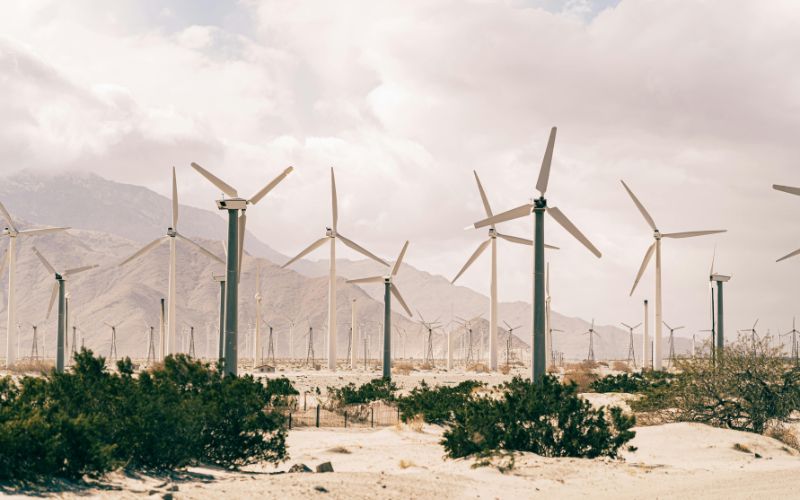
Combining Bitcoin’s security and decentralization with environmentally friendly mining practices.
The blockchain-energy consumption discourse is one of the most pertinent issues facing the innovative technology. Bitcoin, in particular, uses the proof-of-work (PoW) consensus mechanism to validate transactions and add blocks to the chain. This process requires miners to consume substantial amounts of energy to solve complex algorithmic problems. Once solved, a block is added to the blockchain, the transaction is validated, and the winning miner collects a reward of its native coin.
With Bitcoin’s price exponentially rising in value over the last decade, the competition for this reward has also increased. Hence, more energy is required to solve the problem. The issue, however, is not Bitcoin’s energy consumption but the fact that most mining facilities turn to fossil fuels to power their machines.
Here are the shocking numbers behind Bitcoin’s energy consumption and digital carbon footprint.
- The average annualized Bitcoin greenhouse gas emissions from mining stand at 95.56 million tonnes of CO₂ equivalent (MtCO₂e). If Bitcoin were a country, it would have been the 61st most polluting country, compared to industrialized countries such as Israel, Belgium, Romania, and Kenya.
- Bitcoin mining uses 203.27 TWh per year in electricity, beating gold mining (131TWh per year), and total TV and fridges electricity consumption in the US (164 TWh per year).
This conundrum will always be a persistent challenge for Bitcoin and PoW chains, as environmentalists argue that the increasing energy consumption and greenhouse gas pollution is detrimental to the planet’s health in comparison to the benefits that the cryptocurrency offers.
In response, new-age blockchains have been developed with more eco-friendly consensus mechanisms, greatly reducing energy consumption and pollution by over 99% compared to PoW chains. The best example is Ethereum, which migrated from the PoW mechanism to the Proof-of-Stake (PoS), which uses a fraction of the energy needed by PoW chains.
However, there are issues with the proof-of-stake mechanisms too.
Limitations of Proof of Stake
Unlike PoW blockchains, PoS blockchains, such as Ethereum, require little energy to secure the blockchain. Simply, “stakers” or validators on PoS blockchains deposit tokens as collateral to a smart contract for the opportunity to successfully approve transactions. To environmental conservationists and climate experts, the low energy consumption and minimal pollution make PoS blockchains more sustainable and better for the environment than PoW blockchains.
Nonetheless, PoS blockchains have several problems. First, they drift away from the ethos of blockchain itself, as staking makes chains more centralized despite them being faster. Additionally, PoS blockchains are less secure than PoW blockchains.
The biggest criticism of PoS lies in the compounding effect, whereby the more coins you have, the better the probability of gaining rewards from staking your coins. Therefore, the system favours the rich, locking out the smaller players and making them richer.
Blockchain is meant for everyone. Not only the rich.
The question that arises is whether there are better mechanisms that can combine the advantages and benefits of PoW and PoS chains, while remaining eco-friendly and secure.
One protocol has been built for this by combining the security properties of Bitcoin while remaining environmentally sustainable. The motto driving the creation of Fedrok is that the tension between energy consumption and decentralization, and how “green” mining should be, doesn’t have to mean “centralized.”
Inside the Next Generation of Green Blockchains
Layer 1 blockchains are increasingly trying to become eco-friendly without sacrificing decentralization through sustainability, introducing hybrid models like Proof of Green, hybrid mining, and real-world carbon linkage. Fedrok proposes a hybrid mining mechanism, whereby its blockchain mining and consensus processes are anchored to the Bitcoin network.
Its Proof of Green consensus mechanism leverages Bitcoin’s hash power, enhancing security while significantly improving environmental sustainability. To ensure it remains eco-friendly, Fedrok focuses on two key mechanisms:
- The blockchain rewards blockchain activities (mining) that are powered by renewable energy sources.
- Maps the carbon credit footprint to transform ‘high-emission’ blockchains into environmentally friendly entities.
How Proof of Green works
At the core of Fedrok is the Proof of Green consensus mechanism, which uses “combined mining” to make Bitcoin mining greener. This allows users to mine Bitcoin using renewable sources of energy and, in turn, are rewarded using the FDK token. The mechanism decouples mining from block generation, rewarding environmentally friendly mining over traditional mining.
Node validators are selected based on verifiable environmental behaviour. This ensures that the validators do not solely compete for the rewards but also find greener ways to compute and produce blocks. Each Fedrok node maintains its native blockchain data and hash-linked validation data from the Bitcoin chain, enabling transparent verification.
The platform combines decentralized consensus, third-party carbon auditing, and smart contract infrastructure to build a sustainable mining model that is eco-friendly and carbon-neutral.
Stabilizing the Global Carbon Credit Market
Apart from making Bitcoin mining greener, the Fedrok tokenomics model also addresses inefficiencies in the global carbon-credit ecosystem. Today, the global carbon credit market is highly fractionalized, lacks transparency, and is inefficient. The carbon credits are priced and valued differently across different jurisdictions and, at times, are not transferable or interoperable from one country to the next. This creates friction and limits global scalability and liquidity, making it difficult to implement a standardized global carbon credit market.
Fedrok proposes a way to standardize real-world carbon markets, governed by a decentralized governance structure. The decentralized autonomous organization (DAO) is designed to include major stakeholders in the carbon credits markets, such as regulators, governments, and accredited auditors. This structure allows Fedrok to integrate with existing carbon credit systems while solving persistent challenges around valuation, standardization, interoperability, and traceability.
By leveraging its FDK token, Fedrok creates a standardized, interoperable framework for the global carbon credits market. Each FDK is directly linked to verified reductions in carbon emissions, ensuring environmental integrity and aligning economic incentives with real-world impact.
Its goal is to entice players to join the carbon credits market through incentivization, building a global standard, utility, and liquidity step by step.
Future of Green Mining
There is no question that crypto mining has to become greener and the architecture of it reimagined for the future of the planet. This future is green mining. Blockchain’s core practices have to balance rewards with sustainability, decentralization, and economic inclusivity. Hybrid models like Fedrok’s Proof of Green may offer a way to balance Bitcoin-level security with greater sustainability.
By transforming mining from a purely competitive race for BTC rewards into an eco-friendly, conscious ecosystem, participants will be able to operate their mining facilities more sustainably.
In addition, tying token rewards to renewable energy verification and carbon credits, and by creating decentralized systems for tracking and standardizing these credits globally, green mining could redefine blockchain’s relationship with the planet, improving blockchain’s environmental impact through transparent verification and renewable integration.