Kvants Studio Is Turning Plain-English Ideas Into AI Trading Strategies

Kvants Studio

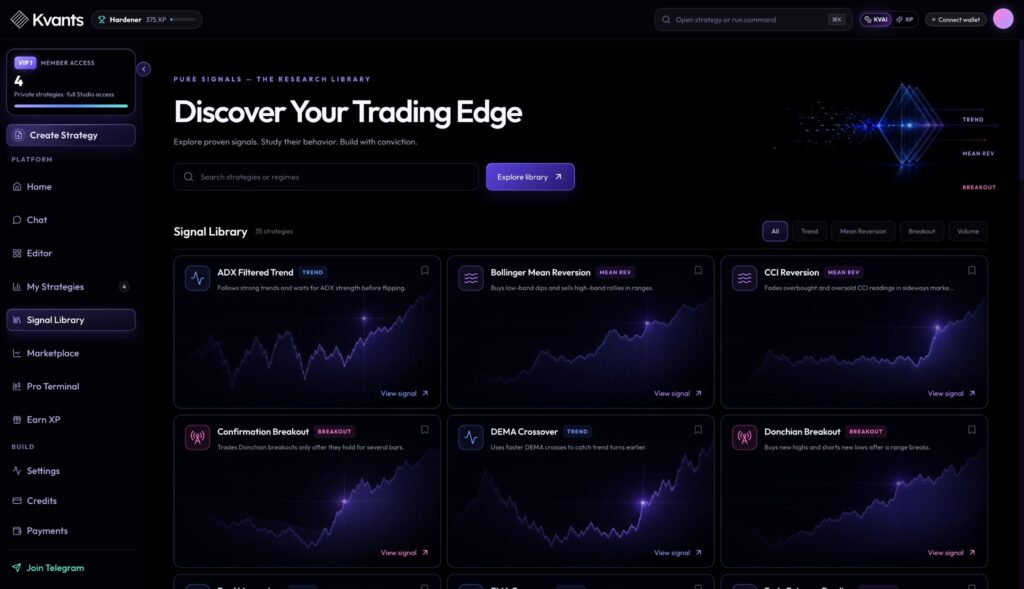
Building an AI trading strategy no longer has to begin with code. Kvants Studio is an AI trading strategy builder from Kvants that lets traders create strategies in plain English, edit the rules, backtest them and export compatible strategies as Pine Script or JSON. This makes the work portable across external trading tools instead of keeping it inside one platform.

The promise of AI trading tools is speed, but speed matters only when the output remains understandable. Kvants Studio focuses on the path from natural-language idea to systematic trading strategy, with validation and trader control built into the workflow.

How does Kvants Studio turn plain English into a trading strategy?

Turning plain English into an AI trading strategy means translating a trader’s written idea into structured rules, indicators, and conditions through a simple conversation with AI. Traders can then refine, expand, or adjust the strategy simply by describing the changes they want in natural language. This significantly lowers the technical barrier to systematic trading, but it does not create an edge on its own. Every strategy is still only as strong as its assumptions, components, and the quality of its testing.

Kvants Studio goes beyond simply using leading LLMs such as GPT-5.6 SOL and Claude Fable 5.1 to generate trading strategies. It combines the reasoning capabilities of these models with a curated, in-house library of trading signals and strategy component, bringing together the flexibility of generative AI with purpose-built quantitative harness.

The entire strategy-building process remains conversational. Traders can ask the AI to change thresholds, replace indicators, add or remove conditions, modify entry and exit logic, or rebuild a strategy from scratch using natural language. This keeps traders in control of how their strategies evolve rather than treating the AI’s first response as the finished strategy.
trading edge

How are AI trading strategies validated before execution?

AI trading strategies are validated in Kvants Studio using an event-driven backtesting engine with historical data, modelled fees and slippage. The engine enforces anti-lookahead protection, while every compiled strategy requires a stop-loss. These controls reduce common testing errors, although backtests cannot guarantee future performance.

Users can then run out-of-sample and walk-forward tests, parameter sweeps and stress windows covering recent episodes such as the April 2025 tariff shock, the record crypto-liquidation cascade of October 2025 and the Strait of Hormuz oil-market disruption of early 2026. A configurable risk gate reviews deployment rules including leverage, costs and risk controls and explains why a setup does not pass.

“Generating an AI strategy is easy now; generating one worth running is not. Our AI handles assembly of multiple signals so our users can create a clear edge. The trader brings the judgement, the components bring institutional accountability, and the testing is designed to expose a weak idea before real capital is at risk,” said Devashish Bhuyan, CEO of Kvants AI.

What does AI strategy automation change for traders?

With Kvants Studio, AI strategy automation can apply predefined trading rules consistently, helping reduce behavioural errors such as widening a stop, exiting too early, or skipping a planned trade. Kvants Studio cannot turn a weak trading idea into a strong one by automation alone; its practical value lies in helping traders structure their logic, assumptions, and validation process before execution.

After validation, Kvants Studio allows users to paper trade a strategy before considering exporting its Pine Script. Strategies created in Kvants Studio can also be exported in compatible formats such as TradingView Pine Script or structured JSON, helping traders keep their strategy logic portable across supported workflows.

Kvants Studio ultimately shortens the path from a trading idea to structured quantitative approach. The value of Kvants Studio depends on whether each strategy remains transparent, testable, and understandable, giving traders the ability to evaluate the underlying logic before putting capital at risk.

What is Kvants Studio?

Kvants Studio is an AI trading strategy builder for creating, editing and backtesting strategies, with compatible exports available as Pine Script or JSON for use in external trading tools.

Kvants Studio is intended for research and simulation and does not provide investment advice. Trading involves risk, and historical or simulated performance does not guarantee future results.


Bitcoin Logs Second-Best Weekly Gain Since Early 2021

An upward-trending price chart illustration representing Bitcoin's second-best weekly performance since early 2021

Bitcoin closed out a standout week with its second-strongest weekly gain since early 2021, according to CoinDesk reporting published on 24 August 2026. The advance lifted the wider cryptocurrency market broadly, with multiple major digital assets posting meaningful gains alongside the world’s largest cryptocurrency by market capitalisation.

Key Takeaways

  • Bitcoin recorded its second-best weekly performance since early 2021, a benchmark that underscores the scale of the move relative to more than four years of price history.
  • The rally was broad-based, with the wider crypto market advancing in tandem with Bitcoin rather than the gains being confined to a single asset.
  • The comparison point — early 2021 — is significant: that period marked the opening phase of a historic bull run that carried Bitcoin to what was then a new all-time high above $60,000.

Main Details

Bitcoin’s weekly performance placed it among its best seven-day stretches in over four years, a notable achievement given the asset has experienced multiple significant drawdowns and recoveries across that span. Weekly performance rankings of this magnitude are typically driven by a combination of factors including macroeconomic shifts, changes in institutional demand, regulatory developments, or a reversal of prior selling pressure — though the specific catalysts for this particular week have not been independently confirmed from the single source available.

The broader crypto market moved higher alongside Bitcoin, a pattern that historically signals genuine risk appetite returning to the sector rather than speculative rotation into a single token. When Bitcoin leads and altcoins follow with comparable momentum, market participants often interpret this as a more durable shift in sentiment compared with isolated single-asset spikes.

For context, Bitcoin entered 2021 already in the midst of a powerful uptrend, ultimately reaching an all-time high of approximately $69,000 in November of that year. The weekly gains recorded during that early-2021 phase were among the most dramatic in the asset’s history, making any comparison to that benchmark a meaningful signal about the intensity of the current move.

Evidence and Source Information

This report is based on a single primary source: a CoinDesk markets article published on 24 August 2026. No additional independent sources were available at the time of writing to corroborate specific percentage figures, volume data or the precise ranking methodology used to determine “second-best week since early 2021.” Readers should treat granular statistics as sourced exclusively from CoinDesk until further verification is available. The article has been flagged for human editorial review prior to publication.

CoinDesk is a long-established and widely cited cryptocurrency media outlet with a dedicated markets data team, lending reasonable credibility to the headline claim, though independent confirmation remains best practice for performance rankings of this nature.

Market, Regulatory or Industry Context

Bitcoin’s price history since early 2021 has been marked by sharp cycles. After reaching its then-record high in November 2021, the asset entered a prolonged bear market through 2022, shedding more than 75% of its value at the trough. A recovery phase followed through 2023 and into 2024, aided in part by the approval of spot Bitcoin exchange-traded funds (ETFs) in the United States in January 2024 — a development that opened the asset to a broader pool of institutional and retail investors through regulated vehicles.

Against that backdrop, a weekly performance that ranks second only to the early-2021 bull-market surge would represent a significant acceleration in momentum. Such moves can attract renewed media attention, fresh capital inflows and increased on-chain activity, though they can also precede periods of consolidation or profit-taking. This article does not constitute investment advice, and past performance is not indicative of future results.

Regulatory conditions for cryptocurrency have also evolved considerably since 2021, with clearer frameworks emerging in several major jurisdictions. A more defined regulatory environment can influence how institutional participants respond to price rallies, potentially affecting the durability of any given move.

What Happens Next

Market observers will be watching whether Bitcoin can sustain momentum above key technical levels in the days following this weekly close, and whether trading volumes confirm the strength of the move. Analysts will also assess whether Ethereum and other major altcoins continue to track Bitcoin’s gains or begin to diverge. On-chain metrics — including exchange inflows and outflows, active addresses and miner behaviour — will provide additional data points about the conviction behind the rally. CryptoKnowmics will continue to monitor developments and update coverage as verified information becomes available.

Term Finance Loses $8.5M After Attacker Exploits Governance Voting Power

Abstract illustration of a digital vault dissolving against a dark blockchain network background, representing a DeFi governance exploit

Term Finance, an Ethereum-based decentralized lending protocol, suffered an approximately $8.5 million loss after an attacker reportedly purchased sufficient governance voting power to push through a malicious proposal, according to a CoinDesk report published on August 24, 2026. The incident underscores a critical and increasingly exploited vulnerability in decentralized finance: governance systems designed to give communities control can themselves become attack vectors.

Key Takeaways

  • An attacker allegedly acquired governance voting power in Term Finance and used it to drain approximately $8.5 million from the Ethereum-based lending protocol.
  • The incident highlights a growing attack surface in DeFi: governance mechanisms themselves, rather than smart contract code bugs, can be weaponized to authorize malicious actions.
  • Term Finance users and liquidity providers face potential losses; the full scope of the exploit, any protocol pause, and recovery efforts had not been independently confirmed at time of writing.

Main Details

According to the CoinDesk report, the attacker did not exploit a conventional smart contract vulnerability such as a reentrancy bug or oracle manipulation. Instead, the attacker allegedly acquired enough of Term Finance’s governance token to accumulate the voting power needed to pass a proposal that authorized the withdrawal of protocol funds. This class of attack — sometimes called a governance takeover or governance exploit — bypasses code-level security audits entirely, because the malicious action is technically approved through the protocol’s own decision-making process.

The reported loss stands at approximately $8.5 million. At the time of publication, CryptoKnowmics had not independently verified this figure against on-chain data or an official statement from the Term Finance team. Readers should treat the amount as alleged until confirmed by a second authoritative source.

Term Finance operates as a fixed-rate lending marketplace on Ethereum, allowing borrowers and lenders to agree on loan terms through an auction mechanism. Unlike variable-rate lending pools, the protocol’s fixed-rate model is designed to offer more predictable returns for liquidity providers — a feature that may have attracted significant capital and, consequently, made it a high-value target.

Evidence and Source Information

The primary source for this report is CoinDesk, a widely cited and editorially independent cryptocurrency news outlet. The article was published on August 24, 2026. No official post-mortem, on-chain forensic analysis, or statement from the Term Finance team had been supplied or independently located at the time of writing. CryptoKnowmics will update this article as additional verified information becomes available.

Governance exploits of this nature typically leave a clear on-chain trail: token acquisition transactions, proposal submission, voting records, and the execution transaction are all publicly visible on the Ethereum blockchain. Independent blockchain analytics firms and security researchers often publish detailed breakdowns within hours of such incidents. Readers seeking real-time on-chain data can monitor Ethereum block explorers and the Term Finance governance forum for official updates.

Market, Regulatory or Industry Context

Governance attacks are not new to Ethereum’s DeFi ecosystem, but they have grown more sophisticated. One of the most prominent precedents was the 2023 Tornado Cash governance attack, in which an attacker submitted a malicious proposal disguised as a legitimate one and gained control of the protocol’s governance contract. In that case, the attacker briefly held administrative control before the community mobilized a counter-proposal.

The Term Finance incident, if confirmed, would represent a significant financial loss by DeFi standards and adds to a long record of protocol losses attributed to governance vulnerabilities. According to blockchain security researchers, governance attacks are particularly difficult to defend against because they exploit features — token-weighted voting, proposal execution — that are intentional design choices rather than bugs.

Regulatory scrutiny of DeFi protocols has intensified in recent years, with authorities in multiple jurisdictions examining whether decentralized governance structures provide adequate investor protections. An exploit of this scale may draw renewed attention from regulators who argue that token-based governance creates accountability gaps. For more on the evolving regulatory landscape for cryptocurrency, see our dedicated coverage.

From a market perspective, governance token prices for affected protocols typically experience sharp declines in the hours following a confirmed exploit, as liquidity providers withdraw funds and confidence erodes. Whether Term Finance’s governance token has been affected could not be confirmed at the time of writing.

What Happens Next

Several developments are likely to follow in the coming hours and days. The Term Finance team is expected to publish an official incident report or post-mortem detailing the attack vector, the funds affected, and any steps taken to pause or secure the protocol. On-chain security firms will likely publish independent analyses tracing the attacker’s wallet activity and any attempts to launder or bridge the stolen funds.

If the protocol holds a community treasury or has relationships with centralized exchanges, there may be efforts to freeze or recover a portion of the stolen assets — a step that has proven partially effective in some previous DeFi exploits. Affected liquidity providers should monitor the protocol’s official communication channels, including its governance forum and social media accounts, for guidance on any compensation or recovery process.

The broader DeFi community is likely to revisit governance security practices in response, including time-lock delays on proposal execution, higher quorum thresholds, and multi-signature safeguards that require human approval before on-chain execution of high-impact proposals. For ongoing cryptocurrency news and updates, including any developments in this story, follow CryptoKnowmics.

Bitcoin and Ethereum ETFs Added $23B in AUM Last Week, But Only $2.6B Was Fresh Capital

Bar chart illustration comparing Bitcoin and Ethereum ETF total AUM growth against net new inflows for the week

Bitcoin and Ethereum spot exchange-traded funds recorded a combined $23 billion increase in assets under management during the week ending 24 August 2026, but only $2.6 billion of that growth represented net new money flowing into the products, according to data reported by Decrypt. The headline figure is striking, but the underlying breakdown reveals that price appreciation — not a surge in investor demand — was the dominant force behind the week’s gains.

Key Takeaways

  • Combined Bitcoin and Ethereum ETF AUM rose approximately $23 billion in a single week, with net inflows of only $2.6 billion.
  • Roughly $20.4 billion of the AUM increase was attributable to rising prices of the underlying assets, not new capital.
  • Separating price-driven AUM growth from genuine net inflows is essential for accurately reading institutional and retail appetite for crypto ETF products.

Main Details

Assets under management for a fund can grow in two distinct ways: investors can deposit new money (net inflows), or the assets the fund already holds can increase in value. Last week’s $23 billion AUM expansion was overwhelmingly the result of the second mechanism. With net inflows of $2.6 billion, price appreciation accounted for an estimated $20.4 billion — or roughly 89 percent — of the total AUM increase.

This dynamic is not unusual in crypto ETF markets, where the underlying assets can move several percentage points in a single session. A strong Bitcoin or Ethereum price rally will automatically lift the dollar value of every share held inside an ETF, inflating AUM figures without a single new dollar entering the fund. Conversely, a sharp price decline can erase weeks of inflow progress from an AUM perspective even when investors are still buying.

The $2.6 billion in genuine net inflows is nonetheless a meaningful figure in absolute terms. For context, the U.S. spot Bitcoin ETF market — led by products from BlackRock, Fidelity, and others — has attracted tens of billions in cumulative net inflows since the Securities and Exchange Commission approved the first wave of funds in January 2024. Weekly net-inflow readings in the low billions have been a recurring feature of the market during periods of positive price momentum.

Ethereum spot ETFs, which received SEC approval in mid-2024, have generally attracted smaller absolute inflow volumes than their Bitcoin counterparts, though they have shown consistent participation from investors seeking regulated exposure to the second-largest cryptocurrency by market capitalisation.

Evidence and Source Information

The figures cited in this article originate from a Decrypt report published on 24 August 2026, which drew on ETF flow and AUM data for the relevant week. CryptoKnowmics has not independently verified the underlying data against primary sources such as SEC filings, Bloomberg ETF analytics, or SoSoValue flow trackers. Readers and editors should treat the specific dollar amounts as reported figures pending independent confirmation. The core analytical point — that AUM growth substantially exceeded net inflows — is consistent with how ETF mechanics work and is not disputed.

Market, Regulatory or Industry Context

The approval of spot Bitcoin ETFs in the United States in January 2024 marked a structural shift in how institutional and retail investors access cryptocurrency markets. Rather than holding digital assets directly or using futures-based products, investors can now buy and sell regulated fund shares through standard brokerage accounts. This has lowered the barrier to entry significantly and brought a new class of buyers — including registered investment advisers and wealth management platforms — into the market.

The distinction between AUM growth and net inflows has become a recurring topic among ETF analysts precisely because crypto’s volatility makes the two metrics diverge sharply. During the 2024 post-approval rally, Bitcoin ETF AUM figures regularly made headlines, but analysts consistently cautioned that price-driven AUM expansion is not the same as durable demand. The same caution applies here.

From a regulatory standpoint, the growth of crypto ETF AUM increases the systemic relevance of these products and may attract closer scrutiny from the SEC and other regulators over time. Larger AUM also means that ETF rebalancing activity — when fund managers buy or sell underlying assets — can itself influence spot market prices, a feedback loop that market structure researchers have begun to examine. For more on the regulatory landscape shaping these products, see CryptoKnowmics’ cryptocurrency regulation coverage.

What Happens Next

Analysts and investors will watch whether net inflows sustain their current pace or whether last week’s $2.6 billion reading was a one-off driven by a specific price catalyst. Sustained weekly net inflows above $2 billion would signal broadening institutional participation; a reversion toward lower figures would suggest that much of the recent AUM growth remains price-dependent and therefore fragile.

On the product side, asset managers continue to file for additional crypto ETF structures — including those covering altcoins and multi-asset baskets — which could eventually diversify the inflow picture beyond Bitcoin and Ethereum. Regulatory decisions on those pending applications will be a key variable in the months ahead.

For ongoing Bitcoin market updates and Ethereum news, follow CryptoKnowmics’ dedicated coverage hubs.

Strategy Raises $334M Selling Stock While Holding Off on Bitcoin Purchases

Michael Saylor’s Strategy — the business intelligence firm widely known for its aggressive Bitcoin accumulation strategy — raised approximately $334 million through equity sales last week, yet did not deploy any of those funds toward purchasing additional Bitcoin. The move marks a notable pause in the company’s well-documented pattern of using capital raises to expand its cryptocurrency holdings.

According to filings and reports covering the period, Strategy sold shares of its common stock, MSTR, through its at-the-market offering programs. Despite generating a substantial sum from those transactions, the company made no corresponding announcement of new Bitcoin acquisitions during the same timeframe — a departure from the cadence investors and market observers have come to expect.

A Break From the Usual Playbook

Strategy has built its corporate identity around a Bitcoin treasury strategy, consistently converting proceeds from stock and debt offerings into the leading cryptocurrency. The firm currently holds one of the largest corporate Bitcoin reserves in the world, accumulated over several years of repeated capital raises followed by near-immediate purchases.

The absence of a Bitcoin buy announcement following this latest round of equity sales drew attention across the crypto and financial media. Cointelegraph’s coverage of the development highlighted that the $334 million raised sat unused for Bitcoin acquisition, at least within the reporting window — an unusual occurrence for a company that has made Bitcoin buying a near-routine corporate activity.

It is worth noting that Strategy has not publicly stated it is abandoning or pausing its Bitcoin strategy. The company has not issued any guidance indicating a change in its long-term treasury policy. The lack of a purchase during this specific period may simply reflect timing, market conditions, or internal capital allocation decisions that have not been publicly disclosed.

How Strategy Raises Capital

Strategy uses at-the-market, or ATM, equity offering programs to sell newly issued shares directly into the open market over time. This mechanism allows the company to raise funds incrementally without the fixed pricing and underwriting process associated with traditional secondary offerings. The flexibility of ATM programs means the company can sell shares when market conditions are favorable and hold proceeds until it decides to deploy them.

In addition to equity offerings, Strategy has previously used convertible notes and other debt instruments to fund Bitcoin purchases. The combination of these tools has allowed the firm to accumulate its substantial Bitcoin position over time, making it one of the most closely watched corporate holders of the asset globally.

Market and Investor Implications

For investors who track Strategy specifically because of its Bitcoin exposure, any gap between a capital raise and a subsequent Bitcoin purchase can raise questions about the company’s near-term intentions. MSTR shares have historically traded at a premium to the net asset value of the company’s Bitcoin holdings, partly because investors anticipate continued accumulation.

If the company were to signal a sustained pause in Bitcoin buying, it could affect how the market prices that premium. However, based on available information, there is no indication that Strategy has altered its overarching treasury philosophy. The $334 million raised through stock sales remains available for deployment, and the company retains full discretion over when and how to use those funds.

Observers also note that Bitcoin’s price environment and broader macroeconomic conditions can influence the timing of large corporate purchases. Companies of Strategy’s profile are often sensitive to entry points, liquidity conditions, and the potential market impact of announcing a large buy.

Context Within the Broader Corporate Bitcoin Trend

Strategy’s approach to Bitcoin as a treasury reserve asset has inspired a number of other publicly traded companies to explore similar strategies. The firm’s ability to raise hundreds of millions of dollars through equity markets — and the market’s continued appetite for MSTR shares — reflects ongoing institutional and retail interest in gaining Bitcoin exposure through publicly traded vehicles.

The latest capital raise, even without an accompanying Bitcoin purchase, demonstrates that Strategy retains strong access to equity markets. Whether the proceeds will eventually flow into Bitcoin, be used for operational purposes, or serve some other function remains to be seen based on future company disclosures.

As of the time of reporting, Strategy had not issued a public statement clarifying the intended use of the $334 million raised, and no new Bitcoin acquisition had been announced. Market participants are likely to watch closely for any subsequent filings or announcements that shed light on the company’s next move.

A Four-Layer Trust Stack for Low-Friction Crypto Platforms

mazco the four layer trust stack

Maczo says its observed Player Win Rate increased by 70% in the period after the platform expanded Provably Fair verification and removed routine document-based KYC from its standard player journey.

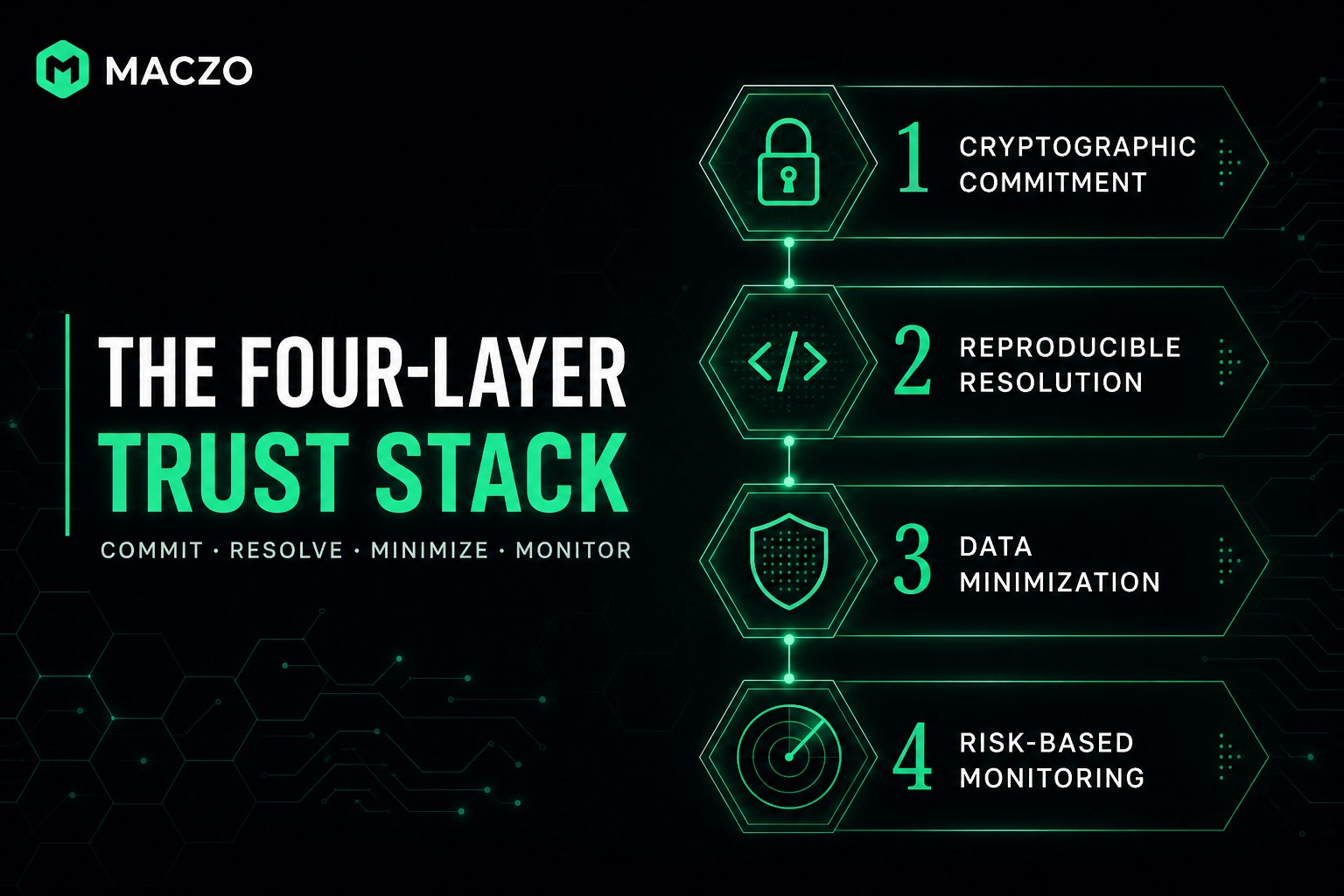
The headline combines two visible product changes, but the more useful analysis is architectural. A credible low-friction crypto platform needs several layers of trust to work together. Removing one identity step is not enough, and publishing one seed hash is not enough.

The 70% figure is reported by Maczo and refers to a relative increase in observed Player Win Rate. The company has not disclosed the baseline, game scope, measurement window, sample size or calculation method, so the result should be read as an internal observation rather than a benchmark or promise.

mazco prove the game

Layer One: Cryptographic Commitment


The first layer prevents an input from being changed after the platform has seen the player’s action.

Maczo’s Provably Fair model commits to a secret server seed by publishing its hash before play. A client seed controlled by the player and a nonce that increases with each round are then included in a deterministic calculation.

When the server seed is later revealed, the player can hash it and compare the result with the original commitment. A different seed creates a different hash, making substitution detectable.

This proves that the platform remained bound to the committed value. It does not yet prove that the final game result was calculated correctly.

Layer Two: Reproducible Resolution

The second layer maps the cryptographic output to the visible result.

A wheel can use published weights to select a segment. Dice can convert output into a bounded roll. Mines must choose distinct positions. A card game must generate a deterministic shuffle without duplicating cards.

Maczo’s open-source game code provides contextual evidence for these resolvers. Reviewers can inspect the calculation, run test vectors and compare a reproduced result with the outcome shown by the platform.

This is the difference between proving a seed and proving a game. The shared cryptographic engine establishes deterministic data; the resolver shows what that data means under a specific rule set.

protect the user

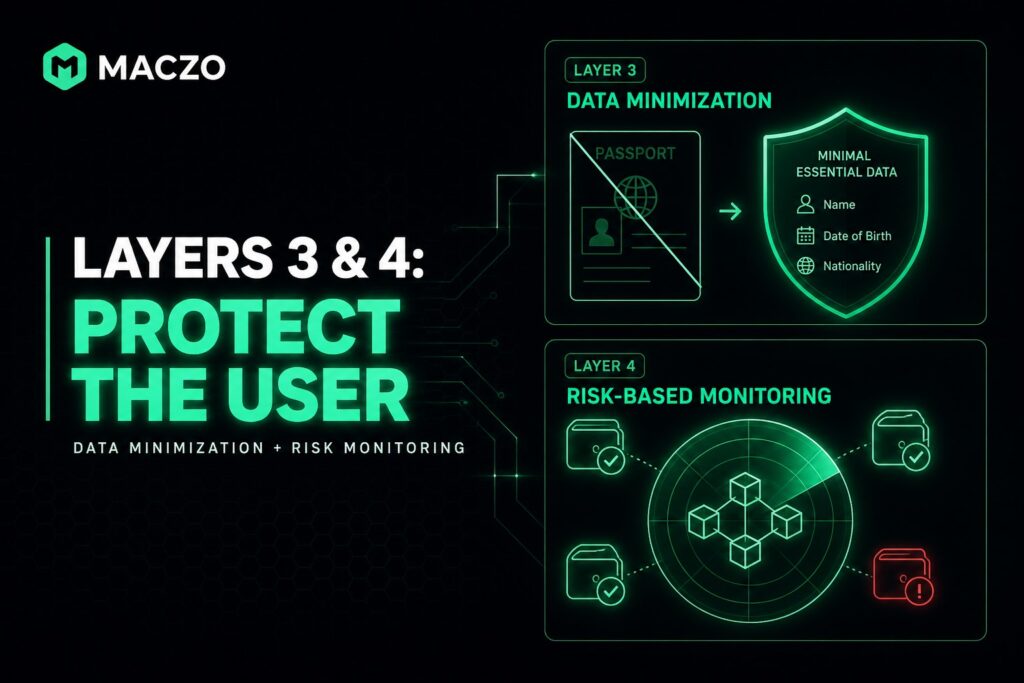
Layer Three: Data Minimization

The third layer concerns what the platform knows about the user.

Routine identity documents contain durable information such as a legal name, date of birth, face image and document number. Collecting these records creates storage, access, vendor and retention obligations.

Maczo says standard play and withdrawals do not require document-based KYC. This reduces onboarding friction and the volume of sensitive information held by the platform.

Data minimization should not be confused with collecting nothing. Accurate account information, age and jurisdiction eligibility, wallet control and account security remain important. The principle is to collect information in proportion to a defined purpose.

Layer Four: Risk-Based Monitoring

The fourth layer protects the platform from abuse without returning every ordinary user to a universal document flow.

The Maczo AML framework describes blockchain analytics, sanctions screening, behavioral signals and continuous monitoring. Activity connected to prohibited or criminal sources may be limited or rejected, and withdrawals are restricted to wallets controlled by the account owner.

This layer is essential to the no-KYC claim. Without targeted controls, lower friction could simply move risk elsewhere. With them, the platform can focus attention on observable warning signs.

How the Trust Layers Relate to the Win Rate Update

Each layer addresses a different reason for abandonment or distrust.

Commitment shows that an input was locked. Resolution shows that the outcome followed the rules. Data minimization reduces the privacy cost of starting. Risk monitoring explains how the platform maintains controls without routine documents.

Improving all four can create a more coherent journey. Users face less friction before participation and receive more evidence after it. The platform can communicate a permanent product advantage instead of relying only on a temporary incentive.

The four layers create a coherent trust model, but they do not mechanically raise the probability of winning. Maczo’s reported 70% increase in observed Player Win Rate occurred during the same period and may also reflect game mix, player choices, sample composition and normal variance.

What a Stronger Public Report Would Include


The next update should publish the starting and ending Player Win Rate, game scope, comparison periods, sample size and calculation method. Verification-tool usage, such as how many users changed a client seed or reproduced a completed round, should be reported as a separate transparency measure.

Those details would allow readers to evaluate the Player Win Rate observation without confusing product transparency with a change in game odds.

For crypto platforms, the main lesson is structural. Privacy, compliance and fairness should not be treated as isolated checkboxes. They form a trust stack.

Maczo’s update puts attention on all four layers. The strongest conclusion is not that transparency guarantees better results, but that verification, data minimization and risk controls can become visible parts of the product rather than documents users read only when something goes wrong.

BitMart Exchange Shuts Down After Nine Years, BMX Token Plunges

5 Blockchain Projects

BitMart, a cryptocurrency exchange that has operated for nearly a decade, has announced it will cease operations, joining a growing list of trading platforms that have exited the market in recent years. The closure marks a significant moment for the broader crypto industry, which continues to see consolidation among exchanges facing mounting competitive and regulatory pressures.

The announcement sent shockwaves through the market for BitMart’s native token, BMX, which collapsed by approximately 58% following the news. The sharp decline reflects the immediate impact that exchange shutdowns tend to have on associated tokens, as users and investors rush to exit positions ahead of any withdrawal deadlines.

What Led to BitMart’s Closure

BitMart was founded roughly nine years ago and grew into a mid-tier exchange serving users across multiple regions. While the platform managed to survive several turbulent periods in the crypto market — including the 2022 bear market and a high-profile security breach in 2021 — it ultimately could not sustain operations long-term. According to Decrypt’s coverage of the BitMart shutdown, the exchange is the latest in a series of platforms to wind down amid a challenging environment for crypto trading venues.

The specific reasons behind the decision to shut down have not been fully detailed in public statements, but the closure fits a broader pattern of smaller and mid-sized exchanges struggling to compete with larger, better-capitalized platforms that dominate trading volumes globally.

Impact on Users and the BMX Token

For users who hold funds on BitMart, the priority now shifts to withdrawing assets before the platform formally closes. Exchange shutdowns of this nature typically come with a withdrawal window, during which customers are urged to move their funds to external wallets or alternative platforms. Users who fail to act within the designated timeframe risk complications in recovering their assets.

The BMX token, which served as BitMart’s native utility and exchange token, bore the brunt of market reaction. A 58% single-day drop is a severe correction by any measure and underscores how closely exchange tokens are tied to the perceived health and longevity of the platforms that issue them. Holders of BMX now face significant losses, and the token’s future utility is effectively in question given the exchange’s impending closure.

A Broader Trend of Exchange Consolidation

BitMart’s exit is not an isolated event. The cryptocurrency news landscape has been marked by a steady stream of exchange closures and consolidations over the past several years. Platforms that once competed vigorously for market share have found it increasingly difficult to maintain liquidity, comply with evolving regulatory frameworks, and retain users in a market where a handful of dominant exchanges capture the vast majority of trading activity.

Regulatory scrutiny has intensified globally, with authorities in the United States, Europe, and Asia tightening requirements around licensing, anti-money laundering compliance, and user protection. Smaller exchanges often lack the legal and compliance infrastructure to meet these demands cost-effectively, making closure or acquisition a more practical outcome than continued independent operation.

The competitive landscape has also shifted dramatically. The rise of decentralized exchanges and the dominance of major centralized platforms have squeezed the middle tier of the market, leaving exchanges like BitMart with fewer viable paths to sustainable growth.

What This Means for the Industry

The shutdown of a nine-year-old exchange is a reminder that longevity in the crypto space does not guarantee survival. BitMart weathered multiple market cycles and a notable security incident, yet still found itself unable to continue. For users, the episode reinforces the importance of not leaving large amounts of funds on any single exchange for extended periods — a principle often cited by security-conscious members of the crypto community.

For the industry as a whole, continued consolidation may ultimately produce a more stable ecosystem dominated by well-regulated, well-capitalized platforms. However, it also raises concerns about reduced competition, fewer choices for users, and the potential for increased market concentration among a small number of major players.

As BitMart prepares to wind down, affected users are encouraged to act promptly to secure their funds and explore alternative trading platforms that meet their needs.

India Orders GitHub to Remove Jack Dorsey’s Bitchat App as Protests Escalate

India Orders GitHub to Remove Jack Dorsey’s Bitchat App as Protests Escalate

Indian government authorities have issued a directive to Microsoft-owned code hosting platform GitHub, demanding the removal of the repository for Bitchat — an encrypted, Bitcoin-linked messaging application developed by Twitter co-founder Jack Dorsey — as the country grapples with a period of significant civil unrest.

The takedown order represents a notable escalation in how governments are responding to decentralized communication tools that operate outside traditional regulatory frameworks. Bitchat, which leverages Bitcoin’s infrastructure and is designed to function as a censorship-resistant messaging platform, has drawn attention from authorities who appear concerned about its potential use during the ongoing protests.

What Is Bitchat?

Bitchat is an open-source messaging application created by Jack Dorsey, the entrepreneur best known for co-founding Twitter and payments company Square, now rebranded as Block. The app is built with a strong emphasis on privacy and decentralization, drawing on Bitcoin-related technology to enable communication that is difficult to intercept or shut down through conventional means.

Because the application’s source code is hosted publicly on GitHub, a platform widely used by developers around the world, the Indian government’s order targets the repository itself — effectively attempting to restrict access to the underlying code rather than simply blocking a centralized app or service.

Government Action Amid Civil Unrest

The directive comes during a period of heightened tensions within India, where protests have been taking place. The precise nature and scale of the unrest, as well as the full legal basis cited by Indian authorities for the takedown request, were still developing at the time of reporting.

Governments have historically sought to restrict access to communication platforms during periods of civil unrest, citing concerns ranging from public order to national security. India has previously ordered internet shutdowns and app restrictions in various regions during times of social or political tension. However, targeting an open-source code repository on a global developer platform marks a distinct approach, raising questions about the enforceability and broader implications of such orders.

Implications for Open-Source and Decentralized Tools

The move highlights a growing tension between governments seeking to control information flows and the decentralized, open-source nature of many cryptocurrency-adjacent projects. Because Bitchat’s code is open source, copies of the repository could theoretically be forked and mirrored elsewhere, complicating any effort to fully suppress access to the software.

It remains unclear at this stage whether GitHub has complied with the order, partially complied, or is contesting it. GitHub, like other major technology platforms, periodically receives government requests to remove content and typically publishes transparency reports detailing such requests. The company has previously pushed back on certain government demands, though it has also complied with legally binding orders in various jurisdictions.

Jack Dorsey has long been a vocal advocate for Bitcoin and decentralized technologies, and Bitchat fits within his broader vision of building communication infrastructure that operates independently of centralized corporate or government control. Dorsey has not publicly commented on the Indian government’s action, according to available reports at the time of writing.

A Broader Pattern of Crypto-Adjacent Censorship

This incident adds to a growing list of cases in which governments have moved against tools that blend cryptocurrency technology with communication or financial privacy. Authorities in multiple countries have scrutinized or restricted apps and protocols that make it difficult to monitor or intercept user activity.

For the cryptocurrency and open-source developer communities, the Indian government’s order is likely to reignite debates about the limits of state authority over decentralized software, the responsibilities of platforms like GitHub as intermediaries, and the resilience of open-source projects against censorship attempts.

The situation remains fluid. Key details — including the specific legal mechanism used to issue the order, GitHub’s response, and the current status of the Bitchat repository — had not been fully confirmed at the time of publication. Further developments are expected as the story continues to unfold.

Bitcoin ETFs Record $225M in Outflows, Ending Seven-Day Inflow Streak

bitcoin casinos

Bitcoin ETFs Record $225M in Outflows, Ending Seven-Day Inflow Streak

A seven-day run of consecutive inflows into U.S. spot Bitcoin exchange-traded funds came to an abrupt halt, with the products collectively shedding approximately $225 million in a single trading session. The reversal coincided with a broader pullback across risk assets, which analysts linked in part to escalating geopolitical tensions involving Iran.

A Streak Interrupted

Spot Bitcoin ETFs had been on a notable winning streak, drawing fresh capital for seven consecutive days before the outflow day broke the pattern. The products, which were approved by U.S. regulators in January 2024 and quickly became some of the most closely watched vehicles in the digital asset space, had attracted significant institutional and retail attention during that inflow period. The sudden shift underscores how sensitive these products remain to macroeconomic and geopolitical developments, even as they have matured as financial instruments.

The $225 million in net outflows represents a meaningful single-day withdrawal, though it remains to be seen whether this marks the beginning of a sustained trend or a temporary pause. Market observers noted that the broader context — including nervousness across equities and other risk-sensitive assets — played a significant role in the day’s flows.

Geopolitical Tensions Weigh on Sentiment

Reports pointing to heightened tensions involving Iran were cited as a contributing factor to the market unease that appeared to drive investors toward the exits. When geopolitical uncertainty spikes, risk assets across the board — including cryptocurrencies — often experience selling pressure as investors seek safer havens or simply reduce exposure to volatile holdings.

Bitcoin itself saw price movement in line with the broader risk-off sentiment, though the precise extent of any price decline and its direct correlation to the ETF outflows continues to develop. It is worth noting that ETF flow data and spot price movements do not always move in perfect lockstep, and multiple factors influence both simultaneously.

Context Within the Broader ETF Landscape

Since their launch, U.S. spot Bitcoin ETFs have experienced periods of both strong inflows and notable outflows, reflecting the inherently cyclical nature of investor sentiment in the cryptocurrency market. The seven-day inflow streak that preceded this reversal had been viewed by some market participants as a sign of renewed confidence, making the abrupt shift all the more notable.

Products from major asset managers have dominated the flow data since the ETFs launched, with a handful of funds accounting for the bulk of both inflows and outflows on any given day. It remains unclear at this stage which specific funds bore the brunt of the $225 million in redemptions, and a more granular breakdown of individual fund performance may emerge as additional data becomes available.

What Comes Next Remains Uncertain

Whether the outflow day represents a brief interruption or a more prolonged shift in sentiment is difficult to determine at this point. Geopolitical situations can evolve rapidly, and market reactions to such events are notoriously difficult to predict. Analysts and investors will likely be watching subsequent days of ETF flow data closely to gauge whether institutional appetite for Bitcoin exposure through regulated products remains intact.

The episode serves as a reminder that despite the growing mainstream acceptance of Bitcoin ETFs as investment vehicles, they are not immune to the same forces that move traditional financial markets. Macro events, risk appetite, and global news cycles all continue to shape how capital flows in and out of these products on a day-to-day basis.

As the situation involving Iran and broader market conditions continues to develop, further updates to ETF flow data will provide a clearer picture of how investors are responding over a longer time horizon.

Poolin, Once Bitcoin’s Largest Mining Pool, Files for Chapter 11 Bankruptcy Protection

bitcoin as payment

Poolin, Once Bitcoin’s Largest Mining Pool, Files for Chapter 11 Bankruptcy Protection

Poolin, a Bitcoin mining pool that at its peak held the distinction of being the largest by hashrate contribution on the Bitcoin network, has filed for Chapter 11 bankruptcy protection, according to multiple reports published this week. The filing marks a striking reversal of fortune for a company that was once considered a cornerstone of Bitcoin’s mining infrastructure.

From Industry Leader to Bankruptcy Filing

Poolin’s trajectory from dominant mining pool to bankruptcy applicant reflects the turbulent conditions that have repeatedly shaken the cryptocurrency mining sector in recent years. At its height, the pool attracted miners from around the world and processed a significant portion of all Bitcoin blocks, giving it an outsized influence over the network’s day-to-day operations.

The Chapter 11 filing, which allows a company to restructure its debts while continuing to operate under court supervision, signals that Poolin is seeking an organized path through its financial difficulties rather than an outright liquidation. Details surrounding the full scope of the company’s liabilities and the specific creditors involved are still emerging, and the outcome of the restructuring process remains uncertain at this stage.

A History Marked by Earlier Troubles

Poolin’s financial difficulties did not emerge overnight. The company had previously faced significant controversy when it suspended withdrawals for users of its wallet service, a move that drew sharp criticism from the mining community and raised early questions about the firm’s financial health. That episode left many miners and investors wary, and it appears the company was unable to fully recover its standing or stabilize its operations in the period that followed.

The broader Bitcoin mining industry has endured a series of challenging cycles, including sharp drops in Bitcoin’s market price, rising energy costs, and the periodic halving events that reduce the block reward paid to miners. These structural pressures have forced numerous mining companies and pools to scale back, restructure, or shut down entirely over the past several years. Poolin’s situation appears to be another chapter in that ongoing consolidation.

What Chapter 11 Means for Stakeholders

Under Chapter 11 bankruptcy proceedings in the United States, a debtor company is typically given the opportunity to propose a reorganization plan that outlines how it intends to repay creditors over time. The process can take months or even years to resolve, and there is no guarantee that a reorganization plan will be approved or successfully executed.

For miners who directed their hashrate to Poolin and for any users who still hold balances with the platform, the bankruptcy filing introduces a layer of uncertainty regarding how claims will be handled. It is not yet clear how the proceedings will affect ongoing mining operations, if any remain active, or what priority different classes of creditors will receive under any proposed restructuring plan.

Broader Implications for the Mining Sector

Poolin’s bankruptcy adds to a growing list of high-profile casualties within the Bitcoin mining and broader crypto infrastructure space. The collapse of companies that were once considered industry leaders serves as a reminder of the operational and financial risks inherent in cryptocurrency mining, a business that requires substantial capital investment in hardware and energy while remaining highly sensitive to fluctuations in Bitcoin’s price and network difficulty.

The mining pool landscape has shifted considerably since Poolin’s peak years. Competing pools have absorbed market share, and the industry has seen increasing consolidation among larger, better-capitalized operators. Whether Poolin’s restructuring effort will allow it to reclaim any meaningful position in the market, or whether the bankruptcy ultimately leads to a wind-down of its operations, remains to be seen.

Reporting on the specifics of the filing, including the list of creditors, total debt obligations, and any proposed reorganization terms, is still developing. Further details are expected to emerge as court documents become publicly available.

Sources

AI-assisted, reviewed by the editorial team.

Brazilian Dairy Farmers Turn to Blockchain, Tokenizing Cows to Unlock Agricultural Loans

5 Blockchain Projects

Brazilian Dairy Farmers Turn to Blockchain, Tokenizing Cows to Unlock Agricultural Loans

In an unexpected intersection of agricultural tradition and digital innovation, dairy farmers in Brazil have begun tokenizing their livestock on blockchain networks to access loans that conventional banking channels had placed out of reach. The approach, which converts ownership stakes in individual dairy cows into digital tokens, is reportedly gaining traction as a practical financing solution in the country’s rural communities.

A Novel Workaround to Lending Restrictions

Brazilian farmers have long faced constraints when seeking agricultural credit through established financial institutions. Regulatory caps and conservative lending criteria at traditional banks have historically limited how much financing rural producers can obtain, leaving many operations underfunded during critical periods of growth or seasonal demand.

By representing their cattle as tokenized assets on a blockchain, farmers have found a mechanism to use livestock as collateral in a format that digital lending platforms can recognize and process. Each token corresponds to a real dairy cow, with the animal’s productive value — including its milk output — underpinning the financial instrument. This structure allows lenders operating outside the conventional banking framework to extend credit against those assets without being subject to the same regulatory lending ceilings.

How the Process Works

The tokenization process involves recording ownership and relevant data about individual animals on a distributed ledger. Once a cow is represented as a digital token, that token can be pledged as collateral to secure a loan through platforms designed to handle blockchain-based assets. Borrowers retain practical custody of their animals and continue farming operations while the token serves its financial function in the background.

According to reporting from both CoinDesk and Decrypt, the model is described as functional and already in use among participating farmers, suggesting it has moved beyond the conceptual stage into real-world application. The full scale of adoption and the total value of loans facilitated through this method remain unclear, and details about the specific platforms or protocols involved are still emerging.

Broader Context: Real-World Asset Tokenization

The Brazilian livestock case fits within a wider global trend of tokenizing real-world assets — a category that has attracted significant attention from both blockchain developers and institutional investors in recent years. Proponents of the approach argue that placing physical assets on-chain can improve liquidity, transparency, and accessibility for asset classes that have traditionally been illiquid or difficult to use as financial collateral.

Agricultural assets, however, present unique challenges compared to more commonly tokenized items such as real estate or commodities. Livestock are living animals subject to health risks, mortality, and fluctuating productivity, all of which introduce variables that digital token structures must somehow account for. How the Brazilian model addresses these risks — through insurance, oracles that verify animal health data, or other mechanisms — has not been fully detailed in available reporting.

Implications for Rural Finance

If the model proves durable, it could have meaningful implications for agricultural communities in Brazil and potentially elsewhere in Latin America, where access to formal credit has historically been uneven. Small and medium-scale farmers who lack the documentation or credit history required by conventional lenders may find blockchain-based collateralization a more accessible path to financing.

At the same time, questions remain about the regulatory environment surrounding such arrangements. Brazilian financial authorities have been actively developing frameworks for digital assets, but whether tokenized livestock loans fall clearly within existing rules or occupy a legal gray area is not yet established based on currently available information.

The development also raises practical questions about what happens in the event of an animal’s death or illness, how disputes between borrowers and lenders would be resolved, and whether the model can scale without introducing new risks for participants.

A Grassroots Experiment in Decentralized Finance

What makes the Brazilian case particularly notable is that it appears to have emerged from practical necessity rather than from a top-down fintech initiative. Farmers facing real financing gaps sought out a solution, and blockchain technology provided the infrastructure to make it work — at least in its early stages.

Whether this represents a sustainable long-term financing model or an early-stage experiment that will require significant refinement remains to be seen. Observers of both the agricultural finance sector and the broader real-world asset tokenization space will likely be watching closely as more details emerge.

BitMEX Hit With Proposed Class-Action Lawsuit Alleging Theft and Insider Trading as Exchange Prepares to Close

Cryptocurrency and Sports Betting

BitMEX Hit With Proposed Class-Action Lawsuit Alleging Theft and Insider Trading as Exchange Prepares to Close

BitMEX, the cryptocurrency derivatives exchange that was once among the most powerful trading platforms in the industry, is confronting a new wave of legal pressure. A proposed class-action lawsuit has been filed against the exchange, alleging theft and insider trading — and the timing could hardly be more consequential, as BitMEX has separately announced it will cease operations entirely in September.

Lawsuit Targets BitMEX Over Alleged Misconduct

According to reporting from CoinDesk, the proposed class-action suit levels serious accusations at BitMEX, including allegations of theft and insider trading. The lawsuit, which has not yet been certified as a class action, represents a significant legal challenge for the platform at a moment when it is already winding down its business. Details surrounding the specific plaintiffs and the full scope of alleged damages are still developing, and the outcome of any class-action certification remains uncertain.

Insider trading allegations in the crypto space typically involve claims that individuals with privileged access to non-public information used that knowledge to gain an unfair advantage over ordinary traders. If proven, such conduct would represent a serious breach of trust for a platform that once processed billions of dollars in daily trading volume. BitMEX has not yet publicly responded in detail to the specific claims outlined in the lawsuit, and the legal proceedings are at an early stage.

BitMEX Announces September Shutdown

Separately, Bitcoin Magazine reported that BitMEX has confirmed it will shut down its crypto derivatives exchange in September. The closure marks a dramatic fall for a platform that, during the bull markets of 2017 and 2019, was considered a cornerstone of institutional and retail crypto derivatives trading. At its peak, BitMEX’s perpetual swap contracts were widely regarded as some of the most liquid instruments in the digital asset space.

The decision to close comes after years of mounting regulatory and legal difficulties. BitMEX and its founders previously faced charges from U.S. federal prosecutors related to violations of the Bank Secrecy Act, with several executives ultimately pleading guilty or reaching settlements. The exchange has operated under a cloud of legal scrutiny for much of the past several years, and the September shutdown appears to represent the final chapter for the platform.

A Turbulent History

Founded in 2014 by Arthur Hayes, Ben Delo, and Samuel Reed, BitMEX grew rapidly to become one of the most influential venues for leveraged crypto trading. The platform introduced products and trading mechanics that were widely copied across the industry. However, its trajectory shifted sharply in October 2020 when the U.S. Department of Justice and the Commodity Futures Trading Commission filed charges against the exchange and its leadership, alleging that BitMEX had operated an unregistered trading platform and failed to implement adequate anti-money laundering controls.

The legal fallout from those charges reshaped the exchange’s leadership and forced significant operational changes. Despite attempts to restructure and remain competitive, BitMEX struggled to recapture its former market position as better-regulated competitors expanded their offerings and attracted users seeking greater legal certainty.

What Comes Next

For users still holding funds or open positions on BitMEX, the combination of an impending shutdown and active litigation introduces a layer of uncertainty. It remains unclear how the proposed class-action lawsuit will proceed, whether it will be certified, or how any potential claims might be handled given the exchange’s closure timeline. Users with concerns about their accounts are advised to consult the platform’s official communications and, where appropriate, seek independent legal guidance.

The broader crypto industry will likely watch the BitMEX situation closely. The exchange’s rise and fall has already served as a cautionary tale about the risks of operating in regulatory gray areas, and the new lawsuit adds another dimension to that story. Whether the class-action allegations will result in any recovery for affected traders is a question that courts will ultimately need to answer — a process that could take years to resolve even after the exchange itself goes dark.

As of publication, BitMEX had not issued a detailed public statement addressing the specific claims in the proposed class-action filing. This story will be updated as further information becomes available.

Goldman Sachs CEO Backs Crypto Clarity Act, Breaking Ranks With Wall Street Peers

a-ADS

Goldman Sachs CEO Backs Crypto Clarity Act, Breaking Ranks With Wall Street Peers

Goldman Sachs CEO David Solomon has publicly expressed support for the Crypto Clarity Act, a piece of proposed legislation aimed at establishing clearer regulatory boundaries for digital assets in the United States. The move places the storied investment bank at odds with a number of its Wall Street peers, who have taken more cautious or opposing stances on the bill.

Solomon’s endorsement signals a meaningful shift in how at least one corner of traditional finance is approaching the question of cryptocurrency oversight. While much of Wall Street has remained hesitant or noncommittal on specific crypto legislation, Goldman Sachs appears willing to stake out a more defined position in favor of regulatory clarity for the sector.

What Is the Crypto Clarity Act?

The Crypto Clarity Act is a legislative proposal designed to draw clearer lines between which digital assets fall under the jurisdiction of the Securities and Exchange Commission (SEC) and which are overseen by the Commodity Futures Trading Commission (CFTC). The longstanding ambiguity between these two regulatory bodies has been a persistent source of uncertainty for crypto businesses operating in the United States, with companies often unsure whether their tokens or platforms are subject to securities law or commodities rules.

Proponents of the bill argue that resolving this jurisdictional question is essential for allowing the digital asset industry to grow and innovate within a predictable legal framework. Critics, however, have raised concerns about whether the legislation adequately protects consumers or gives too much leeway to crypto firms seeking to avoid stricter securities oversight.

Goldman’s Position and the Wall Street Divide

Solomon’s backing of the Crypto Clarity Act is notable not just because of Goldman Sachs’s stature in global finance, but because it highlights a growing divide within the traditional financial sector over how to engage with digital assets and their regulation. Several other major financial institutions have not aligned themselves with the bill, reflecting broader disagreements about the pace and shape of crypto regulation in Washington.

Goldman Sachs has been expanding its involvement in digital asset markets in recent years, offering crypto-related products and services to institutional clients. The firm’s public support for the Clarity Act could be interpreted as part of a broader strategy to help shape the regulatory environment in which those services operate, though the full implications of the bank’s position remain to be seen as the legislative process continues.

It is worth noting that the Crypto Clarity Act is still working its way through the legislative process, and its ultimate fate in Congress remains uncertain. The bill’s passage would require navigating a complex political landscape, including debates over investor protections, the appropriate role of federal agencies, and the broader question of how the United States positions itself relative to other jurisdictions that have moved more quickly to establish crypto regulatory frameworks.

Industry Reaction and Broader Context

The crypto industry has long called for greater regulatory clarity, arguing that the current patchwork of rules and enforcement actions has created an environment that is difficult to navigate and has pushed some businesses and talent overseas. Support from a firm of Goldman Sachs’s profile could lend additional credibility to those arguments in Washington, though it is unlikely to resolve the underlying policy debates on its own.

At the same time, consumer advocates and some lawmakers have cautioned that any regulatory framework for digital assets must include robust protections for retail investors, who have suffered significant losses during past crypto market downturns. How the Crypto Clarity Act addresses those concerns will likely be a central point of debate as it moves forward.

The split between Goldman Sachs and other Wall Street institutions over the bill underscores the fact that even within traditional finance, there is no consensus on the best path forward for crypto regulation. As the legislative process unfolds, the positions of major financial players are likely to continue evolving, and the outcome remains far from certain.

BlackRock, Coinbase, and Strategy Join $15 Million Consortium to Shield Bitcoin from Quantum Computing Threats

bitcoin as payment

BlackRock, Coinbase, and Strategy Join $15 Million Consortium to Shield Bitcoin from Quantum Computing Threats

A coalition of nine prominent firms in the digital asset industry, including investment giant BlackRock, publicly traded crypto exchange Coinbase, and Bitcoin-focused company Strategy, have announced the formation of the Bitcoin Security Consortium. The group has pledged a combined $15 million toward research and development efforts aimed at protecting the Bitcoin network from potential vulnerabilities posed by advances in quantum computing.

The announcement marks one of the most significant coordinated industry efforts to date focused specifically on Bitcoin’s long-term cryptographic resilience. While quantum computers capable of breaking current encryption standards do not yet exist in a practical, large-scale form, experts in the field have long warned that the timeline for such capabilities is shortening, and that preparation must begin well in advance of any real-world threat materializing.

Why Quantum Computing Poses a Concern for Bitcoin

Bitcoin’s security relies heavily on elliptic curve cryptography, which protects private keys and transaction signatures. Sufficiently powerful quantum computers, using algorithms such as Shor’s algorithm, could theoretically break this cryptographic foundation, potentially allowing bad actors to forge transactions or compromise wallets. The concern is not immediate, but the irreversible and decentralized nature of Bitcoin means that any protocol-level changes to address such threats require extensive research, community consensus, and careful implementation over a long period of time.

This is precisely the challenge the newly formed consortium aims to address proactively. By pooling resources now, the participating organizations say they hope to fund the groundwork for post-quantum cryptographic standards that could eventually be integrated into the Bitcoin protocol.

Who Is Involved

Beyond the three headline names, the consortium includes six additional firms, though the full list of all nine participants and the specific breakdown of financial contributions had not been fully detailed in early reports at the time of publication. BlackRock, the world’s largest asset manager and operator of one of the most widely held Bitcoin exchange-traded funds, brings significant institutional weight to the effort. Coinbase, a major U.S.-regulated cryptocurrency exchange, contributes deep technical infrastructure expertise. Strategy, formerly known as MicroStrategy and one of the largest corporate holders of Bitcoin, adds a perspective rooted in long-term Bitcoin treasury management.

The involvement of these firms signals a growing recognition among large institutional players that Bitcoin’s security infrastructure requires ongoing investment and forward planning, not just passive reliance on its existing cryptographic design.

What the $15 Million Will Fund

According to reports, the $15 million commitment is intended to support security research and development specifically focused on making Bitcoin resistant to quantum attacks. This could encompass funding academic research, supporting open-source development, and contributing to the broader conversation within the Bitcoin developer community about what post-quantum upgrades might look like in practice.

It is worth noting that any changes to Bitcoin’s core protocol would ultimately require broad consensus among developers, miners, node operators, and the wider community — a process that is deliberately slow and deliberate by design. The consortium’s funding does not, by itself, determine the direction Bitcoin development will take, but it could meaningfully accelerate the research phase that precedes any such decisions.

A Growing Industry Priority

The formation of the Bitcoin Security Consortium comes amid broader momentum across the technology sector around post-quantum cryptography. The U.S. National Institute of Standards and Technology finalized its first set of post-quantum cryptographic standards in 2024, a milestone that has prompted renewed urgency across industries that rely on public-key cryptography — including financial services and digital assets.

For Bitcoin specifically, the challenge is compounded by the network’s decentralized governance model, which means there is no central authority to mandate or rapidly deploy security upgrades. Advocates for quantum preparedness argue that this makes early, well-funded research even more critical, as the path from identifying a solution to deploying it across the global Bitcoin network is inherently lengthy.

Details about the consortium’s governance structure, research partners, and specific project timelines were still emerging at the time of reporting. Further disclosures from the participating organizations are expected in the coming weeks.

Robinhood CEO Vlad Tenev’s X Account Hacked to Promote Fake ‘Vladhood’ Memecoin

Robinhood Layoffs

Robinhood CEO Vlad Tenev’s X Account Hacked to Promote Fake ‘Vladhood’ Memecoin

Vlad Tenev, the chief executive of popular trading platform Robinhood, had his account on X — formerly Twitter — compromised by hackers who used the platform to promote a fraudulent memecoin dubbed “Vladhood,” according to multiple reports published on July 23, 2026.

The incident follows a broader pattern of high-profile social media accounts being seized by bad actors seeking to exploit the trust and reach of well-known figures in finance and technology to push dubious crypto tokens. The attack on Tenev’s account occurred amid what observers have described as an ongoing memecoin frenzy in the cryptocurrency market.

What Happened

Attackers gained unauthorized access to Tenev’s verified X account and posted content promoting the so-called “Vladhood” token, apparently attempting to drive traffic and purchases to the fraudulent asset. The posts were designed to appear as though they came directly from the Robinhood CEO himself, lending a false sense of legitimacy to the scheme.

The full scope of how many users may have interacted with the posts, or whether any individuals suffered financial losses as a result, remained unclear at the time of reporting. Details surrounding how the account was compromised — whether through phishing, a SIM-swap attack, or another method — had not been officially confirmed as of publication.

A Growing Trend

The hack of Tenev’s account is far from an isolated incident. Over the past several years, cybercriminals have repeatedly targeted the social media profiles of prominent executives, politicians, and celebrities to run cryptocurrency scams. These schemes typically follow a recognizable playbook: gain access to a trusted account, post urgent or enticing messages about a new token or giveaway, and attempt to extract funds from followers before the fraud is detected and the posts are removed.

The timing of this particular attack — during a period of heightened enthusiasm around memecoins — is notable. Memecoins, which are cryptocurrencies often inspired by internet culture or public figures rather than underlying utility, have seen surges of speculative interest in recent years. That environment can make followers more susceptible to impulsive decisions when they believe a recognizable name is endorsing a new token.

Robinhood’s Position in Crypto

The attack carries additional irony given Robinhood’s own expanding role in the cryptocurrency space. The platform has grown its crypto offerings significantly and Tenev has been a visible spokesperson for the company’s ambitions in digital assets. Using his identity to promote a scam token directly undermines the kind of consumer trust that legitimate platforms work to build.

Robinhood had not issued a formal public statement detailing the company’s response to the breach at the time this article was written. It is also unclear whether Tenev personally addressed the hack beyond the account being apparently restored to his control.

What Users Should Know

Security researchers and industry observers consistently warn that no social media post alone — regardless of who appears to be sending it — should be treated as a reliable endorsement of any cryptocurrency or financial product. Verified checkmarks and follower counts do not guarantee that an account has not been compromised.

Users who believe they may have interacted with the fraudulent posts or sent funds to any wallet addresses promoted during the hack are encouraged to report the incident to relevant authorities and to the platform itself. Recovering funds lost in such scams is typically extremely difficult, if not impossible, due to the irreversible nature of most cryptocurrency transactions.

The investigation into the breach is ongoing, and further details about the perpetrators or the extent of the damage may emerge in the coming days. This story will be updated as more information becomes available.

The Great Migration: Why 70% of EU Crypto Assets Are Heading to Self-Custody

crypto assets

The landscape of European crypto changed forever this month. Following the hard enforcement of the EU’s Markets in Crypto-Assets (MiCA) regulation on July 1, 2026, we’ve seen a massive shift in how investors manage their digital wealth. Binance co-CEO Richard Teng recently revealed that approximately 70% of user assets withdrawn from the platform following service restrictions were moved directly into self-custody wallets.

This “Great Migration” away from centralized exchanges (CEXs) marks a significant moment in the maturity of the European crypto market. While platforms scrambled to secure their “EU passports” under the new MiCA framework, the users themselves voted with their wallets—choosing the sovereignty of their own private keys over the convenience of a third-party service.

What triggered this massive move to self-custody?

The catalyst was the July 1, 2026, deadline, which served as a “hard cutoff” for any Crypto-Asset Service Provider (CASP) failing to secure a MiCA license. As platforms like Binance were forced to scale back services or wind down operations in specific member states to ensure compliance, users were faced with a choice: transfer to another licensed exchange or take control of their own funds.

Data suggests that the majority of users opted for the latter. This movement reflects a growing “sovereignty-first” sentiment among European traders who are becoming increasingly wary of exchange-based custody risks after years of global industry volatility.

Does MiCA regulation actually make centralized platforms safer?

The irony of this shift is that MiCA was designed, in part, to increase consumer protection by holding exchanges to rigorous standards—such as asset segregation, minimum capital reserves, and strict operational transparency.

However, as Richard Teng pointed out, this transition has prompted a deeper conversation about the goals of regulation. While licensed platforms now offer a “bank-like” safety net, users shifting to self-custody lose those regulatory protections. Once assets move to a personal wallet, they are no longer subject to the oversight (or the protections) of the MiCA framework. For these users, the “regulatory risk” of an exchange failing is simply being replaced by the “operational risk” of managing their own private keys.

Are centralized exchanges losing their dominance in Europe?

Not necessarily, but they are certainly facing a more competitive and expensive environment. With only about 250 firms out of the previous 1,200+ active providers successfully obtaining full authorization, the European market has undergone a drastic “culling.”

The remaining licensed players, such as Revolut or OKX, are now in a prime position to absorb the 30% of assets that didn’t move to self-custody. But for the 70% who went “off-grid,” the message is clear: European crypto users are prioritizing the fundamental ethos of decentralization over the added convenience of regulated custodial services.

The “New Normal” for European crypto users

If you are still holding assets on a platform, here is what you need to know in the post-MiCA era:

  • Verify Compliance: Before depositing, check if your exchange appears on the ESMA (European Securities and Markets Authority) register of authorized CASPs.
  • Understand Your Custody: Recognize whether your platform is holding your keys or if you are using a non-custodial solution.
  • Stay Informed: Keep an eye on your platform’s communication—if they are winding down services, they are legally required to provide a clear, orderly process for you to retrieve your funds.

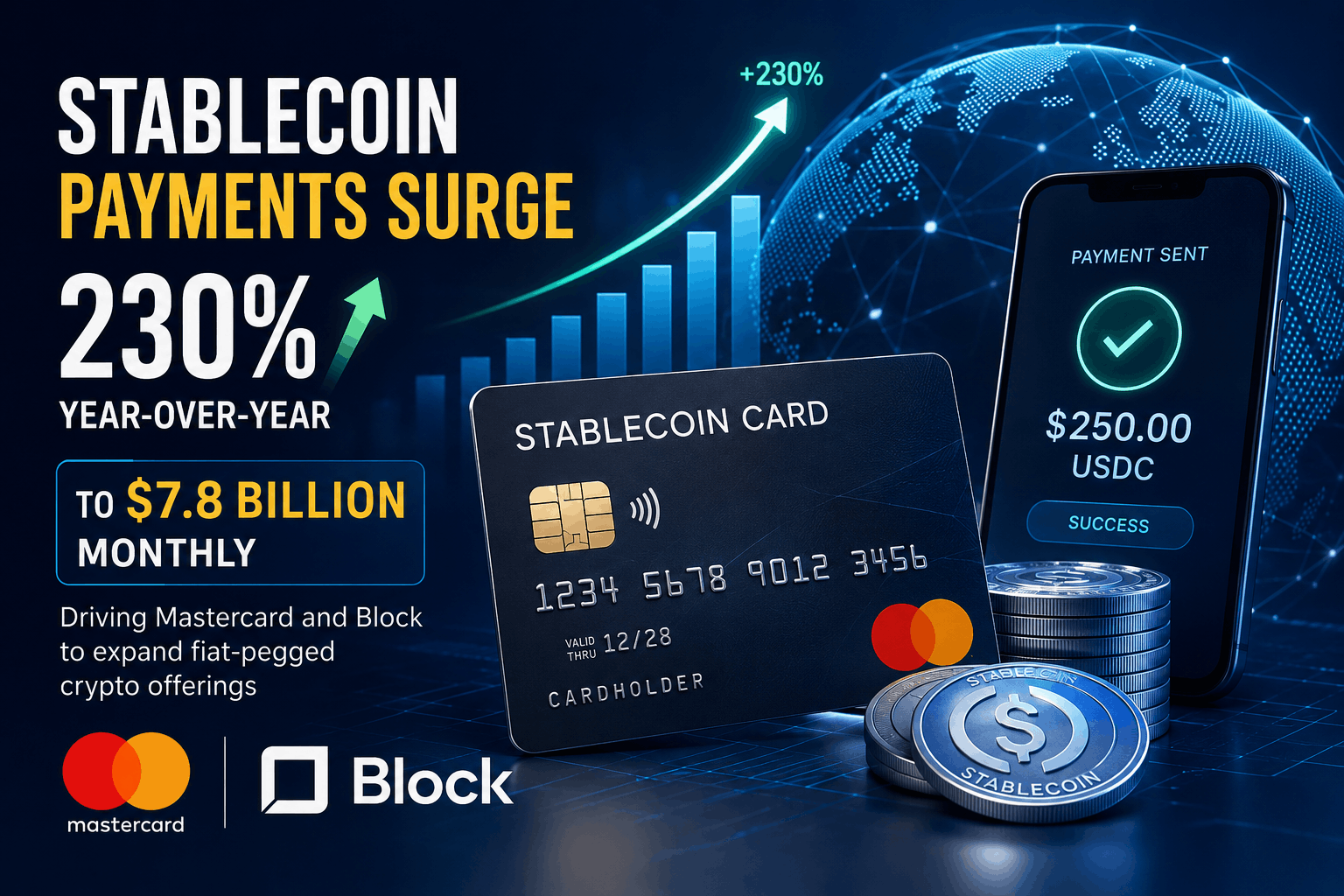
Stablecoin Integration Accelerates as Card Payments Surge 230% to $7.8 Billion Monthly

The global payments industry is witnessing a major transformation as stablecoin-linked card payments continue to gain momentum. According to recent industry data, stablecoin-powered transactions surged nearly 230% year-over-year, reaching an impressive $7.8 billion in monthly payment volume. The rapid growth is driving major financial technology companies, including Mastercard and Block, to aggressively expand their fiat-pegged digital asset offerings.

Stablecoins Are Becoming Mainstream

Stablecoins, digital currencies pegged to traditional fiat currencies such as the U.S. dollar, are increasingly being adopted for real-world payments. Unlike volatile cryptocurrencies like Bitcoin or Ethereum, stablecoins offer price stability, making them more practical for everyday transactions.

The rise in stablecoin card payments highlights a growing shift toward blockchain-powered financial infrastructure. Consumers and businesses are now using stablecoins for online shopping, cross-border transactions, remittances, and merchant payments due to their faster settlement times and lower transaction fees.

Industry experts believe the latest growth figures signal that stablecoins are moving beyond speculative trading and becoming a mainstream payment solution.

Mastercard Expands Stablecoin Payment Solutions

Mastercard has been actively strengthening its crypto and stablecoin ecosystem. The payments giant continues to partner with crypto exchanges, wallet providers, and fintech firms to enable stablecoin spending through traditional payment cards.

Mastercard’s strategy focuses on bridging the gap between traditional finance and blockchain technology. By integrating stablecoins into its payment network, the company aims to simplify crypto adoption for consumers while maintaining regulatory compliance and transaction security.

The company has also explored tokenized settlements and blockchain-based payment rails, signaling its long-term commitment to digital asset innovation.

Block Pushes Deeper Into Digital Payments

Meanwhile, Block, the fintech company led by crypto advocate Jack Dorsey, is also increasing its focus on stablecoin infrastructure. Block has invested heavily in Bitcoin and decentralized payment technologies over the past few years, and stablecoins are now becoming an important part of its broader financial strategy.

The company’s growing involvement reflects increasing demand for faster and cheaper digital payment systems, especially in emerging markets where access to traditional banking remains limited.

Analysts believe fintech companies are positioning themselves early to capture market share in the next generation of internet-native payments.

Why Stablecoin Payments Are Growing Rapidly

Several key factors are driving the explosive growth of stablecoin-linked card payments:

Faster Cross-Border Transactions

Stablecoins allow users to send payments globally within minutes, avoiding the delays associated with traditional banking systems.

Lower Transaction Costs

Blockchain-based transfers often reduce fees compared to conventional card processing and international remittance services.

Increased Merchant Adoption

More merchants are beginning to accept stablecoin payments as crypto infrastructure becomes easier to integrate.

Regulatory Clarity

Governments and regulators worldwide are gradually developing clearer frameworks for stablecoin operations, boosting institutional confidence.

Growing Consumer Interest

As crypto adoption expands globally, users are looking for practical ways to spend digital assets in daily life.

Competition Intensifies Among Payment Giants

The rapid rise of stablecoin transactions is creating fierce competition among payment providers, fintech firms, and crypto companies. Traditional financial institutions are increasingly recognizing that blockchain-based payment systems could reshape the future of commerce.

Major firms are now racing to launch crypto-friendly cards, stablecoin wallets, and blockchain settlement services to stay competitive in the evolving financial ecosystem.

The trend also reflects a broader movement toward tokenized finance, where digital assets and blockchain infrastructure play a central role in global payments.

Future Outlook for Stablecoin Integration

The future of stablecoin payments appears increasingly promising as both institutional adoption and consumer demand continue to rise. Analysts predict stablecoin transaction volumes could grow substantially over the next few years as regulatory frameworks mature and payment infrastructure improves.

Companies like Mastercard and Block are expected to remain key players in driving adoption, potentially paving the way for wider integration of digital currencies into mainstream finance.

As blockchain technology continues to evolve, stablecoins may soon become a standard component of global payment systems, transforming how money moves across borders and digital platforms.

Bitcoin Surges Past $82K as SOL and DOGE Rally Amid Michael Burry Stock Crash Warning

Bitcoin Crosses $82,000 as Crypto Market Gains Momentum

The cryptocurrency market witnessed a strong rally as Bitcoin briefly surged above the $82,000 mark, boosting investor confidence across major digital assets. Altcoins including Solana (SOL) and Dogecoin (DOGE) also recorded notable gains during the market upswing.

The sudden momentum in crypto prices came at a time when renowned investor Michael Burry issued a warning about a possible stock market crash. His comments sparked fresh discussions among investors seeking alternative assets and hedges against traditional market volatility.

Bitcoin’s rapid move above $82K highlighted growing institutional interest and renewed bullish sentiment in the crypto sector. Analysts believe increased trading activity and expectations of further adoption are supporting the current rally.

Meanwhile, Solana continued to attract attention due to its expanding ecosystem and strong network activity, while Dogecoin experienced renewed buying pressure from retail traders.

Market experts suggest that uncertainty in global financial markets may continue driving interest toward cryptocurrencies in the short term. However, investors are still advised to remain cautious because crypto markets remain highly volatile.

As traders monitor both traditional financial markets and digital assets, Bitcoin’s performance near the $82,000 level could play a major role in determining the next market direction.

XRP Price Analysis 2026: Is Ripple Set for a Breakout?

Introduction

XRP, the native cryptocurrency of Ripple Labs, continues to be one of the most talked-about digital assets in the crypto market. Known for its fast transaction speed and low fees, XRP has gained strong attention from investors and institutions alike. In this article, we provide a detailed XRP price analysis, including technical trends, market sentiment, and future predictions for 2026.

Current XRP Price Overview

As of 2026, XRP has shown moderate volatility, reacting to both global crypto trends and regulatory developments. The coin remains highly sensitive to:

  • SEC vs Ripple case updates
  • Adoption by financial institutions
  • Overall crypto market sentiment (Bitcoin influence)

XRP often follows Bitcoin’s movement but also shows independent spikes due to Ripple-specific news.

Technical Analysis of XRP

1. Support and Resistance Levels

  • Key Support: $0.45 – $0.50
  • Major Resistance: $0.70 – $0.85

If XRP breaks above the resistance zone, it could trigger a bullish rally. On the downside, falling below support may lead to further corrections.

2. Moving Averages

  • XRP trading above the 50-day moving average signals short-term bullish momentum
  • Crossing the 200-day moving average can indicate a long-term uptrend

3. RSI (Relative Strength Index)

  • RSI between 40–60 indicates consolidation
  • Above 70 suggests overbought conditions
  • Below 30 indicates oversold levels (buying opportunity)

Fundamental Analysis

1. Ripple’s Global Partnerships

Ripple continues to expand its network with banks and financial institutions, boosting XRP’s real-world utility.

2. Regulatory Developments

The ongoing regulatory clarity around XRP plays a crucial role. Positive outcomes can significantly impact price growth.

3. Cross-Border Payments Demand

With increasing demand for faster and cheaper international transactions, XRP remains a strong contender in this space.

XRP Price Prediction 2026

Based on current trends and expert analysis:

  • Short-term (3–6 months): $0.55 – $0.75
  • Mid-term (1 year): $0.80 – $1.20
  • Long-term (2–3 years): $1.50 – $3.00 (if adoption increases)

Note: Crypto markets are highly volatile. Always do your own research before investing.

Is XRP a Good Investment?

XRP can be a promising investment due to:

✔ Strong use case in banking
✔ Fast and low-cost transactions
✔ Growing institutional adoption

However, risks include:

✖ Regulatory uncertainty
✖ Market volatility
✖ Competition from other blockchains

Conclusion

XRP remains a key player in the cryptocurrency ecosystem with strong fundamentals and growing adoption. While short-term price movements may fluctuate, the long-term outlook looks promising if regulatory clarity improves and Ripple continues expanding globally.

Why is the Shiba Inu (SHIB) burn rate surging 812% today?

Shiba Inu

The “SHIB Army” has something to bark about this week. According to the latest on-chain data for May 2026, the Shiba Inu (SHIB) burn rate has just skyrocketed by a staggering 812%. In a massive effort to reduce the circulating supply, millions of SHIB tokens were sent to “dead wallets” in a matter of hours, creating a significant supply shock that has the market on high alert.

This sudden spike in burning activity isn’t just a random event; it’s happening right as the SHIB price starts flashing major bullish signals on the technical charts. Historically, when the community ramps up the burn rate while the price is consolidating, it often acts as a precursor to a volatile move upward. As of today, analysts are watching closely to see if this 812% jump is the spark needed to ignite a full-scale 2026 SHIB rally.

How does an 812% burn rate jump impact the SHIB price?

In the world of meme coins, it’s all about supply and demand. By burning tokens, the community is permanently removing SHIB from the market, making the remaining tokens more scarce.

  • The Supply Shock: When over 800% more tokens are burned than the previous day, it creates immediate “buy pressure” even if new buyers haven’t entered the market yet.
  • The Sentiment Boost: Beyond the math, these burns act as a massive confidence booster for holders. It shows that the ecosystem is active and committed to the long-term deflationary roadmap.

Currently, SHIB is testing a critical resistance level. If the burn rate continues to climb throughout the weekend, we could see a “short squeeze” where traders betting against the coin are forced to buy back in, fueling the rally further.

Is the Shiba Inu price signaling a major breakout in 2026?

The charts are starting to look very “dog-friendly.” Technical analysts have pointed out that SHIB is currently forming a bullish pennant on the daily time frame—a pattern that often leads to a massive vertical move.

With the RSI (Relative Strength Index) sitting comfortably in the “growth” zone and the burn rate providing the fundamental fuel, the consensus is that SHIB is eyeing a move toward the $0.000045 level. If it can clear that hurdle with high volume, the “zero-killing” season might officially be back in session for 2026.

What role is Shibarium playing in this latest burn surge?

We can’t talk about SHIB burns without mentioning Shibarium, the network’s Layer-2 scaling solution. In 2026, Shibarium has become a well-oiled machine, with a portion of every transaction fee automatically contributing to the SHIB burn mechanism.

The recent 812% surge is largely attributed to a massive increase in on-chain activity on Shibarium. New decentralized apps (dApps) and a surge in NFT trading on the L2 have led to more transactions, which in turn leads to more “auto-burns.” It’s a self-sustaining cycle: more utility leads to more burns, which leads to a healthier price floor.

What should SHIB investors watch for next?

While the 812% surge is impressive, the key is consistency. To maintain this momentum, the SHIB Army will be looking for:

  1. Follow-through Volume: We need to see exchange volume match the on-chain burn activity.
  2. Bitcoin Stability: As Michael Saylor noted earlier this year, Bitcoin’s health is the tide that lifts all boats. If BTC stays stable, SHIB has the “green light” to run.

Whale Activity: Keep an eye on “whale” movements. If large holders start moving SHIB to exchanges, it might signal a local top. If they continue to move it off exchanges, the rally likely has more room to breathe.

The Future of Cryptocurrency in India (2026 & Beyond)

📌 Introduction

Cryptocurrency in India has evolved significantly over the past few years. From uncertainty and regulatory confusion to structured monitoring and taxation, the country is slowly building its stance on digital assets.

While cryptocurrency is not legal tender in India, it is legal to buy, sell, and hold as a digital asset. This balanced approach reflects the government’s intention to allow innovation while maintaining financial stability.

So, what does the future hold for crypto in India? Let’s explore.

📊 Current Status of Cryptocurrency in India

India currently follows a “regulated but not fully legalized” approach toward crypto.

Key Highlights:

  • Cryptocurrency is classified as a Virtual Digital Asset (VDA)
  • Buying, selling, and holding crypto is legal
  • Crypto cannot be used as official currency
  • Exchanges must follow strict KYC and AML regulations

This shows that India is not banning crypto—but carefully controlling it.

💰 Crypto Taxation in India

India has implemented one of the strictest crypto tax regimes globally.

Tax Rules:

  • 30% tax on crypto profits
  • 1% TDS on every transaction
  • No offset of losses allowed
  • GST applies to exchange services

These measures aim to track transactions and discourage excessive speculation.

📈 Key Trends Shaping the Future of Crypto in India

1. Stronger Regulations on the Way

India is expected to introduce clearer crypto laws, including licensing systems and asset classification.

2. Global Alignment (G20 Influence)

India is working with global frameworks like the Crypto-Asset Reporting Framework (CARF) to ensure transparency and compliance.

3. Rise of Digital Rupee (CBDC)

The Reserve Bank of India (RBI) is promoting the Digital Rupee, a government-backed digital currency.

  • Safer and regulated alternative
  • Likely to dominate digital payments
  • May coexist with private cryptocurrencies

4. Institutional Adoption Growing

Crypto is no longer just for retail investors.

  • Banks exploring blockchain
  • Tokenization of assets (stocks, bonds)
  • Increased institutional participation

5. Increased Monitoring & Compliance

Authorities are strengthening tracking systems to ensure tax compliance and prevent misuse.

⚠️ Challenges for Crypto in India

❌ Regulatory Uncertainty

A complete crypto law is still missing, creating confusion.

❌ High Tax Burden

Heavy taxation discourages traders and investors.

❌ Government Skepticism

RBI continues to raise concerns about financial risks and volatility.

🌟 Opportunities in the Indian Crypto Market

Despite challenges, India has massive growth potential:

  • Over 100 million crypto users (estimated)
  • Rapidly growing Web3 ecosystem
  • Strong developer and startup base
  • Youth-driven adoption

India could become a global leader in blockchain innovation.

🔮 Future Predictions (2026–2030)

  • Introduction of a comprehensive crypto regulation bill
  • Possible reduction in crypto taxes
  • Growth of CBDC + crypto hybrid ecosystem
  • Rise of India as a Web3 and blockchain hub
  • Increased institutional and enterprise adoption

🧠 Conclusion

The future of cryptocurrency in India is not about extreme decisions like banning or fully legalizing—it’s about balanced regulation.

India is building a system where:

  • Innovation continues
  • Risks are minimized
  • Investors are protected

If policies become clearer and more supportive, India has the potential to become a major force in the global crypto economy.

Michael Saylor’s $1 Million Bitcoin Roadmap: Is a 7-Figure BTC Actually Possible?

Michael Saylor Bitcoin

If you thought the race to $100,000 was the “end game,” Michael Saylor has some news for you. The MicroStrategy founder, who has basically become the human personification of a “Buy” button, just outlined a vision where Bitcoin (BTC) doesn’t just grow—it scales to a staggering $1,000,000 per coin.

While the 2026 market has seen its fair share of ups and downs, Saylor remains unfazed. In his latest strategy breakdown, he argues that there are “a million possibilities” for how the global economy could shift, but only “one solution” for preserving wealth: Bitcoin. By treating BTC as “digital capital” rather than just a currency, Saylor believes the path to seven figures isn’t just a dream; it’s a mathematical certainty driven by the slow collapse of traditional fiat systems.

What is Michael Saylor’s strategy for Bitcoin reaching $1,000,000?

Saylor’s roadmap to a $1 million BTC isn’t about retail hype or “memecoin” energy. It’s built on the cold, hard logic of institutional absorption. His strategy focuses on three main pillars:

  1. Normalization of “Digital Capital”: Saylor argues that Bitcoin is the first “perfect” property. Unlike real estate or gold, it’s weightless, infinitely portable, and impossible to seize. As more corporations realize this, they will swap their depreciating cash for BTC.
  2. The ETF “On-Ramp”: With the massive success of Spot ETFs in 2025 and 2026, the gate is now wide open. This allows trillions of dollars from pension funds and sovereign wealth funds to flow into the market without the technical hurdles of self-custody.
  3. Global Reserve Status: Saylor predicts a future where nations—not just companies—will hold Bitcoin on their balance sheets to protect their citizens from inflation.

Why does Saylor call Bitcoin the “One Solution” for global wealth?

The “One Solution” concept refers to the inherent flaws in “Analog Money.” According to Saylor, every other asset class is leaking value. Real estate has maintenance costs and taxes; gold is expensive to ship and store; and fiat currency is being printed into oblivion.

In Saylor’s view, Bitcoin is the only asset that is thermodynamically sound. > “Bitcoin is the first engineered monetary system,” Saylor noted. “It is the only solution to the problem of $400 trillion in global capital looking for a safe place to hide. When that capital realizes it is melting in banks, it will flow into the only dry land available: the 21 million coins of the Bitcoin network.”

How long will it take for Bitcoin to hit the $1 million milestone?

While $1 million sounds like a sci-fi number, the math is simpler than you think. To reach a $1,000,000 price tag, Bitcoin would need a market cap of roughly $21 trillion.

$$\text{Target Price} = \$1,000,000 \times 21,000,000 \text{ (Max Supply)} = \$21 \text{ Trillion}$$

For comparison, the total value of global real estate is estimated at over $300 trillion, and gold sits around $14 trillion. If Bitcoin captures even 7% of the global real estate market’s value, the $1 million target is met. Saylor suggests this “Great Migration” of capital will likely play out over the next decade, with the 2026-2030 window being the most aggressive phase of institutional adoption.

What are the biggest risks to the $1 million Bitcoin prediction?

As a journalist, I’ve got to play devil’s advocate for a second. While Saylor’s logic is airtight if you accept his premises, there are “black swan” events to consider. Regulation remains the biggest “if” in the room. While the 2026 political climate in many regions has become more crypto-friendly, a sudden global crackdown on “self-custody” or a shift in the U.S. tax code regarding “digital property” could slow the momentum.

However, in Saylor’s world, these are just “temporary potholes” on a highway leading to a seven-figure destination.

US-Iran War Impact on Crypto Markets: Volatility, Bitcoin Swings & Trading Opportunities Explained

The escalating tensions between the United States and Iran are sending shockwaves across global financial markets—and the crypto sector is no exception. As geopolitical uncertainty rises, crypto trading has emerged as one of the fastest-reacting markets, highlighting both its strengths and risks.

Recent developments, including a U.S. naval blockade in the Strait of Hormuz and rising oil prices above $100 per barrel, have intensified global economic fears. These disruptions are not just affecting traditional markets but are also playing a significant role in shaping crypto price movements and investor sentiment.

🚨 Crypto Becomes First Responder to Global Crises

Unlike stock markets, which operate on fixed hours, crypto markets run 24/7. This means they are the first to react to sudden geopolitical events. During the early stages of the US-Iran conflict, crypto platforms handled massive trading volumes while traditional markets were closed.

Bitcoin and other cryptocurrencies experienced immediate volatility. Prices dropped sharply after initial war headlines, reflecting panic selling. However, they quickly rebounded, showcasing the market’s resilience. This pattern highlights how crypto acts as both a risk asset and a liquidity outlet during uncertain times.

📉 Volatility Spikes Across Crypto Markets

War-driven uncertainty has increased volatility across major cryptocurrencies like Bitcoin and Ethereum. Traders are reacting to macroeconomic signals such as oil price surges, inflation fears, and global liquidity concerns.

When oil prices rise due to supply disruptions, inflation expectations also increase. This often leads central banks to delay interest rate cuts, reducing liquidity in financial markets. As a result, crypto—often seen as a high-risk asset—faces short-term selling pressure.

At the same time, some analysts argue that Bitcoin is gradually evolving into a “digital gold” alternative. In certain phases of the conflict, Bitcoin has even outperformed traditional assets, indicating growing investor trust during crisis periods.

💰 Trading Opportunities Amid Chaos

Despite the risks, the US-Iran conflict is creating unique trading opportunities in crypto markets. High volatility allows traders to capitalize on rapid price swings through futures, options, and leveraged trading.

Decentralized exchanges and perpetual trading platforms have seen spikes in volume, with traders using crypto as a proxy to speculate on global events like oil prices and geopolitical outcomes.

Stablecoins and tokenized assets like gold-backed tokens are also gaining traction, as investors seek safer alternatives within the crypto ecosystem.

⚠️ Risks to Watch

However, the situation is far from stable. Continued escalation could lead to:

  • Increased market liquidations
  • Regulatory scrutiny due to sanctions evasion concerns
  • Higher correlation with traditional risk assets

Additionally, sudden news developments can trigger sharp price swings within minutes, making crypto trading highly unpredictable during wartime.

🔮 Conclusion

The US-Iran conflict underscores crypto’s growing role in global finance. It is no longer an isolated asset class—it reacts instantly to geopolitical shocks and macroeconomic trends.

While the war introduces significant volatility, it also reinforces crypto’s position as a real-time, borderless financial system. For traders and investors, the key lies in managing risk while leveraging the opportunities that arise in such uncertain times.

Why is XRP losing momentum on Binance right now?

XRP Network

If your XRP price alerts have been suspiciously quiet lately, there’s a technical reason for the silence. Recent on-chain and exchange data shows that XRP trading activity on Binance—the world’s largest crypto exchange—has plummeted to its lowest level since early 2025.

As of April 2026, the massive “wall of volume” that usually follows Ripple news has thinned out. This drop in activity suggests a significant cooling of interest from retail traders who typically drive the token’s daily volatility. When the biggest stage in crypto (Binance) sees a drop-off like this, it’s usually a sign that the market is entering a “wait-and-see” phase, leaving XRP stuck in a low-momentum consolidation zone.

Does low trading volume mean an XRP price crash is coming?

In the world of crypto, low volume is a double-edged sword. It doesn’t automatically mean a crash, but it does mean the “engine” is running out of fuel. For XRP, this 2025-2026 low in Binance activity indicates a lack of conviction from both buyers and sellers.

  • The Bearish Take: Without active buyers, even a small sell order can have a disproportionate impact on the price, potentially sliding XRP toward its next major support level at $0.55.
  • The Bullish Take: Low volume often precedes a “volatility squeeze.” If the “XRP Army” is simply exhausted and holding (HODLing) rather than trading, the market becomes “thin.” This means that when the next big catalyst hits, the price could jump significantly higher with very little resistance.

Are whales moving away from XRP in 2026?

While retail activity on Binance is hitting yearly lows, the story on the XRP Ledger (XRPL) tells a slightly different tale. On-chain data suggests that “Whale” addresses (wallets holding 1 million to 10 million XRP) haven’t actually stopped accumulating; they’ve just stopped trading on centralized exchanges.

We are seeing a massive shift toward self-custody and decentralized finance (DeFi). Many long-term holders are moving their XRP off Binance to participate in automated market maker (AMM) pools or to stake their assets in 2026’s newer liquidity protocols. So, while the “Binance lights” are dimming, the underlying network activity is likely just migrating to more private, decentralized venues.

What are the key XRP price levels to watch this week?

With momentum currently stalled, technical analysts are laser-focused on two specific numbers:

  1. $0.62 (The Resistance): XRP needs to break back above this level with a significant volume spike to prove that the Binance lull is over.
  2. $0.58 (The Floor): This is the immediate support. If Binance volume stays low and we slip below $0.58, the “momentum loss” could turn into a slow bleed toward the $0.50 psychological mark.

The Bottom Line: XRP isn’t “dead,” but it is currently in a deep sleep on centralized exchanges. The drop to a 2025-2026 low in Binance trading activity is a clear signal that the speculative retail hype has cooled off. Whether this is the “calm before the storm” or a sign of a long summer of sideways trading depends entirely on the next wave of institutional news.

Saylor Says the Bitcoin 4-Year Cycle is Dead: Why the “Halving Hype” is Officially Over

Michael Saylor Bitcoin

If you’ve been waiting for the “scheduled” crypto winter of 2026, you might be waiting a long time. Michael Saylor, the founder of MicroStrategy and Bitcoin’s most vocal bull, has officially declared that the legendary Bitcoin 4-year cycle is dead. Speaking at a major industry summit this week, Saylor argued that the predictable patterns of the past—where Bitcoin would moon after a halving and then crash for two years—no longer apply. In 2026, the entry of Wall Street giants and the massive success of Spot ETFs have fundamentally changed the math. According to Saylor, Bitcoin has “graduated” from a speculative retail asset into a mature, institutional global reserve, meaning the days of $80\%$ drawdowns are likely behind us.

Why does Michael Saylor think the Bitcoin cycle is dead in 2026?

For over a decade, the “Halving” was the North Star for crypto investors. Every four years, the supply of new Bitcoin was cut in half, leading to a massive supply shock. But Saylor argues that we have reached a “point of no return.”

He points to the massive, consistent buying pressure from institutional treasuries and sovereign wealth funds. In the past, the market was dominated by retail traders who would panic-sell at the first sign of red. Today, the majority of the “circulating” supply is locked in the vaults of companies like MicroStrategy, Fidelity, and BlackRock. These institutions don’t trade on “cycle hype”—they buy for a 10-to-20-year horizon, effectively “breaking” the cyclical volatility that used to define the market.

How do Spot ETFs change the Bitcoin price pattern?

The “death” of the cycle is largely thanks to the ETF effect. In 2026, the net inflows into Bitcoin ETFs have outpaced the daily production of Bitcoin by a ratio of 10 to 1.

When the market used to rely on a halving to create a supply shock, the ETFs are now creating a permanent supply shock every single trading day. This constant “bid” under the market acts like a shock absorber. Instead of the wild parabolic spikes followed by crashes, Saylor predicts we are moving toward a “high-frequency growth” model—where Bitcoin climbs steadily with much smaller, healthier corrections.

Is it still worth tracking the Bitcoin halving in 2026?

While the halving still happens on a technical level, its “psychological” power is fading. In 2026, the percentage of new BTC being minted is so small compared to the total supply that the “cut in half” doesn’t move the needle like it did in 2012 or 2016.

“The halving is now a technical footnote, not a market driver,” Saylor noted during his keynote. “If you are waiting for a ‘post-halving crash’ to get in, you are going to be priced out forever. The volatility is being replaced by institutional stability.”

What does the “Death of the Cycle” mean for your portfolio?

If Saylor is right, the strategy for 2026 and beyond changes completely. The old advice was “buy the bottom, sell the top.” But if there is no “top” and no “bottom,” the strategy shifts to Time in the Market > Timing the Market.

However, not everyone agrees. Some analysts warn that while institutional money brings stability, it also brings a new kind of risk: correlation. If the traditional stock market hits a recession in late 2026, Bitcoin might finally show its teeth as a “risk-on” asset, regardless of what the 4-year cycle says.

The Bottom Line: Michael Saylor is betting that Bitcoin has finally reached its “escape velocity.” By declaring the cycle dead, he is telling the world that the “cheap Bitcoin” era is officially closed for business.

Bitcoin at Risk? Shrinking Liquidity Could Trigger BTC Market Trouble

Bitcoin Price Faces Pressure as Global Liquidity Signals Turn Bearish

Bitcoin (BTC), the world’s leading cryptocurrency, may be heading into a challenging phase as concerns grow over tightening global liquidity—often described as the “oil” that keeps financial markets running smoothly.

Liquidity refers to the availability of capital in the financial system. When liquidity is high, investors have more money to deploy into assets like stocks and cryptocurrencies. However, recent macroeconomic signals suggest that this vital fuel may be running low, raising concerns about Bitcoin’s near-term outlook.

Why Liquidity Matters for Bitcoin

Over the past decade, Bitcoin has shown a strong correlation with global liquidity trends. Periods of aggressive monetary easing—such as low interest rates and quantitative easing—have historically driven BTC prices higher. Conversely, tightening financial conditions often lead to reduced risk appetite, impacting speculative assets like cryptocurrencies.

With central banks maintaining higher interest rates for longer and reducing balance sheets, liquidity is gradually being withdrawn from the system. This shift could limit the flow of capital into Bitcoin and other digital assets.

Macro Headwinds Building Up

Several factors are contributing to the current liquidity squeeze:

  • High Interest Rates: Central banks continue to keep rates elevated to control inflation.
  • Quantitative Tightening (QT): Reduction in central bank asset holdings is draining liquidity.
  • Strong Dollar Pressure: A stronger U.S. dollar typically weighs on global risk assets, including BTC.

These macroeconomic headwinds suggest that Bitcoin may struggle to sustain bullish momentum in the short term.

Bitcoin Price Outlook

While Bitcoin has demonstrated resilience in previous cycles, analysts warn that reduced liquidity could increase volatility and downside risks. If capital inflows weaken, BTC may face resistance at key levels and could experience corrections.

However, it’s not all bearish. Long-term fundamentals—such as institutional adoption, limited supply, and growing use cases—continue to support Bitcoin’s broader bullish narrative.

Investor Takeaway

Investors should closely monitor liquidity indicators, including central bank policies, bond yields, and money supply trends. These factors can provide critical insights into Bitcoin’s future price movements.

In the current environment, cautious positioning and risk management are essential. While Bitcoin remains a high-potential asset, macroeconomic conditions could dictate its performance in the coming months.

The Death Hoax That Rocked Solana: Why Everyone Thought Jonathan the Tortoise Was Gone

Solana Username3

If you were scrolling through Crypto Twitter today, you might have seen a wave of “RIP” posts that sent a specific corner of the Solana ecosystem into an absolute meltdown. Rumors began swirling that Jonathan the Tortoise, the world’s oldest living land animal at 194 years old, had finally passed away.

But before you shed a tear for the St. Helena legend, here is the good news: Jonathan is alive and well. The rumors turned out to be a classic “death hoax” designed to shake up the price of a popular Solana meme coin inspired by the tortoise. While the “JONATHAN” token saw a massive spike in volume as traders tried to “buy the news” (or sell the tragedy), official reports from his home on St. Helena Island confirm that the big guy is still munching on his favorite greens and enjoying the 2026 sunshine.

Did Jonathan the Tortoise die? The truth behind the 194-year-old legend.

No, Jonathan is not dead. In fact, for a creature born in 1832, he’s doing remarkably well. The hoax seems to have started from a spoofed news account that gained traction on social media, claiming that the Governor of St. Helena had made a formal announcement.

Local officials were quick to debunk the claim, stating that Jonathan is in stable health and continues to be the island’s most famous resident. In the wild world of 2026 meme coins, “death hoaxes” have unfortunately become a common (and pretty dark) tactic used by “pump and dump” groups to create artificial volatility.

How did the Solana meme coin react to the Jonathan death hoax?

The reaction was exactly as chaotic as you’d expect from the Solana network. The “JONATHAN” token, which had been trading sideways for weeks, saw a sudden 400% surge in volume within thirty minutes of the rumor hitting the “X” (formerly Twitter) feed.

Traders jumped in, expecting a massive “tribute pump.” However, as soon as the debunking tweets started rolling in from reputable journalists, the price did a complete U-turn, leaving “top buyers” underwater. This “V-shape” recovery—and subsequent crash—is a textbook example of why trading on unverified social media news is a high-stakes gamble.

Why are animal-themed meme coins so volatile in 2026?

We’ve moved past the era of just “Dog” and “Frog” coins. In 2026, meme coin culture has shifted toward “Real-Life Legends.” Whether it’s a famous zoo animal or a 194-year-old tortoise, these tokens trade on emotional sentiment rather than financial utility.

Because these coins have no underlying revenue or “roadmap,” their value is tied 100% to social media attention. When a story as big as the “death of the world’s oldest animal” hits, it triggers algorithmic trading bots that scan for keywords. These bots buy in milliseconds, pushing the price up before a human can even check if the news is real.

“The Jonathan hoax shows the dark side of the meme coin ‘attention economy,'” says one crypto analyst. “When a 194-year-old tortoise’s life becomes a ‘trading signal,’ you know the market has reached peak absurdity.”

What is the lesson for Solana traders after the Jonathan hoax?

If there is one takeaway from today’s drama, it’s this: Verify before you buy. The Solana ecosystem is faster than ever in 2026, but that speed is a double-edged sword. If you’re trading tokens based on the health or status of real-world figures or animals, you are playing a game of “information arbitrage” where the first person to find the truth wins. Jonathan might be 194 years old, but his “meme” is just getting started—thankfully, with the tortoise himself still very much in the picture.

Fidelity’s $140 Million Ethereum Move: Why Wall Street is Doubling Down on ETH Right Now

Ethereum Foundation Report

If you were looking for a sign that the big banks aren’t scared of a little market turbulence, here it is. Fidelity Investments, one of the largest asset managers on the planet, just dropped a cool $140 million to increase its Ethereum (ETH) holdings.

This isn’t just a casual trade; it’s a massive signal of confidence. As of late March 2026, while retail traders have been debating the “flippening” and worrying about gas fees, Fidelity has been quietly stacking. This latest purchase brings their total Ethereum exposure to new heights, proving that for the “smart money,” Ethereum isn’t just a speculative play—it’s a core pillar of the future financial system.

Why is Fidelity buying $140 million worth of Ethereum in 2026?

The timing of this move is what has everyone talking. Fidelity isn’t just chasing green candles; they are looking at the underlying plumbing of the global economy. Analysts suggest three main reasons for this nine-figure bet:

  1. Institutional Yield Hunting: With Ethereum’s transition to a fully mature Proof-of-Stake model, the ability to earn “staking rewards” has become the institutional version of a dividend. Fidelity is likely eyeing that 3.5% to 4.5% annual yield as a way to outperform traditional bonds.
  2. The “Tokenization” Wave: In 2026, everything from real estate to corporate bonds is moving onto the blockchain. Since Ethereum is the primary settlement layer for these assets, Fidelity is essentially buying “shares” in the internet’s new financial backbone.
  3. Spot ETH ETF Demand: With their own Ethereum ETF seeing consistent inflows, Fidelity needs to maintain a massive liquid reserve of the underlying asset to meet client demand without causing massive price slippage.

How will Fidelity’s massive ETH purchase affect the Ethereum price?

When a whale the size of Fidelity moves, the ripples are felt everywhere. This $140 million purchase acts as a “supply vacuum.” By taking that much ETH off the open market and moving it into institutional custody, the “sell-side” liquidity thins out significantly.

“We are seeing a classic supply-demand squeeze,” says one senior crypto analyst. “Fidelity is effectively setting a ‘floor’ for the price. Every time they buy these dips, it becomes harder for bears to push ETH back below the $3,800 support level.”

If other institutions follow Fidelity’s lead—which they usually do—we could be looking at a scenario where Ethereum challenges its all-time highs much sooner than the technical charts originally predicted.

Is Ethereum finally escaping Bitcoin’s shadow in 2026?

For years, ETH was just “the silver to Bitcoin’s gold.” But in 2026, that narrative is shifting. Fidelity’s move highlights a growing trend where institutions view Ethereum as a technology play rather than just a currency play.

While Bitcoin remains the ultimate “Store of Value,” Ethereum is being treated as “Digital Oil”—the essential fuel required to run the decentralized apps (dApps) and smart contracts that now power parts of the global supply chain. Fidelity’s doubling down suggests they believe Ethereum’s utility is finally becoming more valuable than Bitcoin’s scarcity.

Court Tightens Grip on Crypto: Developer’s Legal Shield Rejected

A recent court ruling has sent ripples through the crypto and fintech industries, as a U.S. court denied a developer’s attempt to exempt software from money transmitter regulations. The decision reinforces the growing scrutiny over digital asset tools and their role in financial transactions.

Key Ruling Highlights

The court ruled that software developers cannot automatically claim immunity from money transmitter laws simply because they create or distribute code. If the software is used to facilitate financial transactions—especially involving cryptocurrencies—it may fall under existing regulatory frameworks.

This decision challenges a common argument within the blockchain community: that code is merely a tool and not subject to financial regulation. The court emphasized that when software actively enables the transfer of funds, legal accountability may apply.

Impact on Crypto Developers

For developers working in decentralized finance (DeFi), wallets, or payment platforms, this ruling could have far-reaching consequences:

  • Increased regulatory oversight on crypto tools
  • Potential licensing requirements for developers
  • Legal risks tied to facilitating transactions
  • Greater compliance expectations

The ruling suggests that regulators and courts are moving toward holding developers accountable when their products are directly involved in moving money.

Legal vs. Technological Debate

The case highlights an ongoing debate between innovation and regulation. Many developers argue that software should be protected under free speech principles, as code can be considered expressive.

However, regulators counter that when software functions as a financial intermediary, it must comply with laws designed to prevent fraud, money laundering, and illicit transactions.

Industry Reaction

The crypto community has expressed mixed reactions. Some see the ruling as necessary for consumer protection and market stability, while others fear it could stifle innovation and push developers toward more restrictive jurisdictions.

Legal experts suggest this case may set a precedent for future enforcement actions against developers and platforms operating in gray regulatory areas.

What This Means Going Forward

This ruling could reshape how software related to financial transactions is developed and deployed. Companies and independent developers may need to:

  • Conduct legal reviews before launching products
  • Implement compliance measures early in development
  • Consider jurisdictional risks
  • Stay updated with evolving financial regulations

As governments worldwide tighten oversight on digital assets, the boundary between technology and financial services continues to blur.

Impact of the Current US–Israel–Iran War on Cryptocurrency: Market Volatility, Bitcoin Trends & Future Outlook (2026)

🌍 Introduction

The ongoing geopolitical conflict involving the United States, Israel, and Iran has created shockwaves across global financial markets. From rising oil prices to falling stock indices, every asset class is being affected — including cryptocurrency.

In 2026, crypto is no longer isolated; it reacts instantly to global events. This war has become a real-time stress test for digital assets like Bitcoin and Ethereum.

📉 Immediate Crypto Market Reaction: Panic & Volatility

When the war escalated with airstrikes, the crypto market reacted within minutes.

  • Bitcoin dropped sharply before stabilizing
  • Altcoins saw even steeper declines
  • Massive liquidations occurred in leveraged trading

Reports show Bitcoin initially fell below key levels and then quickly recovered, highlighting extreme volatility driven by war news 

👉 Crypto markets are open 24/7, so they are the first to absorb global panic.

💰 Surge in Crypto Usage During Crisis

One of the most important trends is increased real-world use of crypto in war zones.

  • Crypto outflows from Iranian exchanges surged over 700% after strikes began
  • Citizens used crypto to move money out of the country
  • It helped bypass banking restrictions and capital controls

This shows that Bitcoin is acting as a “financial escape tool” during crisis situations 

🛢️ Oil Prices & Inflation Impact Crypto

The war has threatened the Strait of Hormuz, a key oil route, pushing global oil prices higher.

  • Rising oil prices increase inflation fears
  • Investors move away from risky assets like crypto
  • Global markets, including India, have already seen sharp declines due to war tensions  

👉 Result: Short-term bearish pressure on crypto markets

📊 Bitcoin’s Changing Role: Risk Asset or Safe Haven?

Traditionally, crypto behaves like a risky asset — but this is changing.

  • Initial reaction: price drop (risk-off behavior)
  • Later phase: stabilization and recovery
  • Institutional investors are buying dips instead of exiting  

👉 This suggests Bitcoin is evolving into a hybrid asset — part risk, part safe haven.

⚖️ Government Regulations & Sanctions Pressure

War increases financial surveillance globally.

  • Governments may tighten crypto regulations
  • Crypto could be monitored to prevent sanction evasion
  • Exchanges may face stricter compliance rules

👉 This creates uncertainty but also pushes decentralization forward.

🔐 Cyber Warfare & Crypto Security Risks

Modern conflicts include cyber attacks.

  • Crypto exchanges may become hacking targets
  • Increase in phishing scams and fake donation campaigns
  • Blockchain networks face stress during global instability

👉 Security becomes a top priority for investors during war.

📈  Long-Term Impact: Bullishhh for Crypto Adoption

Despite short-term fear, war often strengthens crypto’s value proposition:

  • Decentralized → Not controlled by governments
  • Borderless → Works during sanctions and restrictions
  • Accessible → Helps people in crisis

👉 Over time, such conflicts increase trust and adoption of crypto globally.

🧠 Conclusion

The US–Israel–Iran war is proving that cryptocurrency is deeply connected to global events. While the market faces short-term volatility and fear, the long-term outlook remains strong due to rising adoption and real-world utility.