Top 10 Altcoins to Watch This Quarter

Top 10 Altcoins

TL;DR – Top Altcoins This Quarter

  • Altcoins continue to offer higher growth potential compared to Bitcoin during expansion phases.
  • Ethereum and Layer-2 networks remain strong due to developer activity and scaling demand.
  • Infrastructure and interoperability projects show consistent real-world adoption.
  • AI, gaming, and decentralized compute narratives support selective altcoin growth.
  • Diversification and fundamentals matter more than hype this quarter.

Top Altcoins to Watch This Quarter – Quick Answer

The top altcoins to watch this quarter include Ethereum, Solana, Chainlink, Polygon, Arbitrum, Optimism,
Avalanche, Cosmos, NEAR Protocol, and Render. These projects stand out due to strong development activity,
real-world use cases, growing adoption, and healthy on-chain metrics. While market volatility remains,
fundamentals suggest selective opportunities rather than broad speculation.

Introduction: Why Altcoins Matter This Quarter

Bitcoin usually steals the spotlight, but altcoins often deliver the real plot twists. Every market cycle proves one thing: while Bitcoin sets the tone, altcoins decide the tempo.

This quarter looks especially interesting. Network upgrades, growing institutional interest, and real-world adoption continue to separate strong projects from noisy hype. In this guide, we focus on altcoins to watch based on fundamentals, ecosystem growth, and on-chain activity — not rumors or social media noise.

A small warning with a smile: this is crypto, not a bedtime story. Volatility will show up uninvited.

How We Selected These Altcoins

Before diving into the list, here’s the logic behind it:

  • Active development and strong communities
  • Clear use cases with growing adoption
  • Transparent teams and credible roadmaps
  • Healthy on-chain and network metrics

We relied on trusted sources such as CoinMarketCap, CoinDesk, Messari, Glassnode, and official project documentation. No crystal balls. Just data and logic.

1. Ethereum (ETH): The Backbone of Smart Contracts

Ethereum remains the undisputed leader among smart contract platforms. Despite competition, developers still build here first.

Recent network upgrades improved scalability and reduced fees, while staking continues to lock up supply. According to the Ethereum Foundation, more than 25% of ETH supply is now staked, which supports long-term value.

Ethereum earns its place among the best altcoin picks thanks to its massive ecosystem and Layer-2 growth.

  1. Solana (SOL): Speed Still Sells

Solana focuses on high-speed transactions and low fees. After surviving past network issues, it returned stronger with improved stability.

Data from Messari shows rising developer activity and increasing DeFi and NFT usage on Solana. Big brands experimenting with Solana-based apps add credibility.

If speed and scalability matter, Solana stays on the list of altcoins to watch.

3. Chainlink (LINK): Powering Real-World Data

Blockchains need reliable data. Chainlink supplies it.

Chainlink’s oracle network connects smart contracts with real-world information such as prices, weather data, and payment systems. According to Chainlink Labs, partnerships continue expanding across DeFi, gaming, and enterprise solutions.

LINK remains one of the best altcoin picks for long-term infrastructure exposure.

4. Polygon (MATIC): Scaling Ethereum Without the Headache

Polygon helps Ethereum scale. Simple idea. Big impact.

Its ecosystem supports thousands of decentralized applications. Polygon Labs reports consistent growth in enterprise partnerships, including major brands exploring blockchain-based solutions.

As Ethereum adoption grows, Polygon benefits alongside it. That logic earns MATIC a solid position among upcoming crypto projects.

5. Arbitrum (ARB): Layer-2 With Serious Momentum

Arbitrum emerged as a leading Layer-2 solution by offering faster transactions and lower costs.

According to L2Beat, Arbitrum consistently ranks at the top for total value locked among Layer-2 networks. Developer adoption remains strong, which usually signals long-term viability.

ARB fits well into any list of altcoins to watch this quarter.

Want to Understand These Altcoins Better?

If you want to go beyond price speculation, explore our beginner-friendly and advanced crypto guides.


6. Optimism (OP): Governance Meets Scalability

Optimism combines Layer-2 scaling with an evolving governance model.

The Optimism Collective supports public goods funding, which attracts developers interested in sustainable ecosystems. Optimism Foundation data shows steady growth in users and transactions.

OP stands out as one of the best altcoin picks for those watching Ethereum scaling solutions.

7. Avalanche (AVAX): Custom Blockchains Done Right

Avalanche allows developers to launch custom blockchains, known as subnets.

This flexibility attracts gaming, enterprise, and DeFi projects. Avalanche Foundation reports growing subnet adoption across multiple sectors.

AVAX earns attention as one of the more flexible upcoming crypto projects.

8. Cosmos (ATOM): The Internet of Blockchains

Cosmos focuses on interoperability. It helps blockchains talk to each other — a skill many still lack.

The Inter-Blockchain Communication protocol (IBC) continues expanding. According to Cosmos Hub documentation, dozens of blockchains now rely on IBC.

ATOM deserves its place among altcoins to watch for its long-term vision.

9. Near Protocol (NEAR): Developer-Friendly by Design

NEAR prioritizes usability and developer experience.

Its sharding technology improves scalability, while user-friendly wallet features reduce onboarding friction. Electric Capital reports show consistent developer growth on NEAR.

NEAR fits investors looking for practical innovation rather than hype.

10. Render (RNDR): Decentralized GPU Power

Render targets a niche with growing demand: decentralized rendering and GPU computing.

With AI and metaverse applications expanding, distributed GPU networks gain relevance. Render Network highlights increasing adoption among digital creators.

RNDR stands out among upcoming crypto projects with a clear real-world use case.

Key Risks to Keep in Mind

Even the best altcoin picks face risks:

    • Regulatory uncertainty
    • Network competition
    • Market-wide volatility

Diversification and research remain your best defense. Crypto rewards patience more than impulse.

Continue Exploring Smart Crypto Picks

Serious investors focus on education, tools, and risk management. Explore more expert insights below.


Final Thoughts: Choosing Altcoins With Logic, Not Hype

This quarter offers strong opportunities across infrastructure, Layer-2 solutions, and real-world applications.

These altcoins to watch stand out due to active development, real adoption, and transparent ecosystems. While no list guarantees profits, logic and data usually outperform hype and guesswork.

Crypto markets move fast, but fundamentals still matter. Sometimes, the boring projects end up being the most exciting.

Trusted Sources & References

Frequently Asked Questions

What are the top altcoins to watch this quarter?

Ethereum, Solana, Chainlink, Polygon, Arbitrum, Optimism, Avalanche, Cosmos, NEAR, and Render lead due to strong fundamentals.

Are altcoins riskier than Bitcoin?

Yes, altcoins carry higher volatility, but they also offer higher growth potential when backed by real adoption.

How were these altcoins selected?

Selection is based on development activity, on-chain data, adoption metrics, and credible project documentation.

Is this financial advice?

No. This article provides educational insights, not investment recommendations.

Should beginners invest in altcoins?

Beginners should start small, focus on education, and avoid hype-driven decisions.

Top Telegram Games 2025: The Ultimate Telegram Games List to Earn Crypto

Top Telegram Games

The growing popularity of in-app mini-games has changed the gaming world like few trends did in the past. Gaining coin mid streaming out. The Popular Telegram Games have changed the instant messaging apps to be Play-to-Earn(P2E) ecosystems. Tapping hundreds of millions of active players to skills to add simple addictive coin earning games out. This guide focuses on the Games and mechinal viral top hits games Playing to Out of the Maxims to U assessments Crypto Earn the games.

What Are Telegram Games Bots and Why Are They All the Rage?

These bots are short games that you access via a Telegram Games Bot. These bots are lightweight games that integrate mini apps that run directly as games in the Telegram messenger. They utilize Telegram’s Mini App platform which requires no additional downloads outside the base app.

The integration of cryptocurrency rewards firmly explains the rising popularity of top games in Telegram. They employ blockchain technology, particularly, The Open Network (TON) blockchain, to enable players to gain in-game money or “shares” that can be converted to cryptocurrency (HMSTR, NOT or TAPS) that can be earned via airdrops or Token Generation Events (TGE).

The main advantages of this model include:

The players engagement: A user can start playing instantly from any device, anytime that they can access Telegram.

Ease of use: Game mechanics are often “tap-to-earn” which entails simple repetitive clicks, making them easy for anyone to pick up.

Rewards: Unlike the traditional in-game awards, the future potential of airdrops gives a higher positive incentive.

Massive user engagement: The community-focused design of Telegram with built-in group chats and channels facilitates engagement and growth of the games.

The Best Play-to-Earn Apps on TON & Ultimate Telegram Game List

The Best Telegram Games are currently TON Blockchain projects. They are fast, easy, and enjoy community support and engagement. Below are the Telegram games list and recommended games.

The Strategy Tapper: Hamster Kombat

Competitors are not as advanced as Hamster Kombat, who has since Telegram Games Bots set the standard.

Your role as Mechanic: CEO of a digital crypto exchange spawned your hamster. Tap the digital hamster on screen to earn Hamster Coins. To win the game, money management on hamster exchanges is essential.

Earning Strategy: To succeed, purchase and upgrade cards of the business operational “mechanics” to pursue passive earning profit branches. This hourly profit becomes critical more so than total coins tapped.

Notable Features: massive planned airdrop of the HMSTR token to gamers, Daily Combo Challenges, Daily Cipher Missions, airdrop of millions of coins.

The First Tap-to-Earn Game: Notcoin

Notcoin is the first game to set the tap-to-earn standard and spawned a genre. As an achievement, Notcoin managed to exchange its in-game currency to NOT token, currently on exchanges like Binance.

Mechanics: Users earn by tapping a coin until their energy is depleted.

Earning Strategy: Focus on unlocking both the Energy Limit and the Multitap features first. Once you secure the Silver League tier, you will be able to unlock the Auto-Tap Bot, which will continue to earn currency for you while you are not playing.

Evolution: Notcoin was the first to integrate tapping for earning, and now it has transformed into an explore-to-earn model, giving users additional earning opportunities by interacting in the ecosystem and participating in the newly launched Web3 projects.

Top Telegram Tapping Games: TapSwap & YesCoins

Following Notcoin’s model, TapSwap and YesCoins now also feature large player bases and have excelled their offerings in simple, rewarding tap and swipe actions.

TapSwap: Features an extensive upgrade system and a city-building component called Tappy Town, where users construct and upgrade buildings to passively earn and gain higher ranks. Users earn a currency called Shares which will later be exchanged for TAPS tokens.

YesCoins: Offers a distinct, retro, pixel art design with swipe-to-earn gameplay alongside a mechanic that allows idle earning through a character to assist.

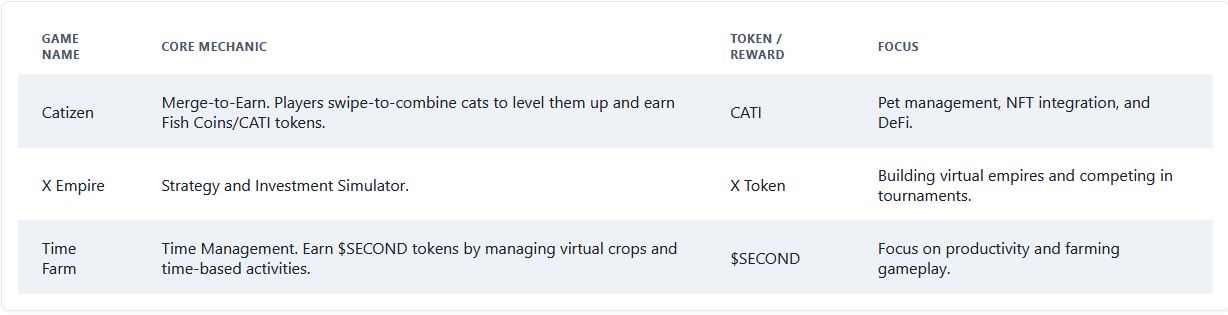
Catizen, X Empire, & Other Emerging Telegram Crypto Games

The ecosystem is constantly expanding with new concepts that go beyond simple tapping:

telegram games

Maximizing Earning Potential: Earning Without Investment in Telegram Games

The Most Notable Feature of Top Telegram Games Is Earning Cryptocurrency While Not Having to Pay Nothing to Get Started to Play Telegram Games at No Cost.

Methods to Use to Succeed with No Cost to Play

Most Useful to Earn

Passive Income Investments (Not Tapping): Tapping in the beginning is crucial, but for the longevity of your earnings in hamster Kombat and TapSwap, your passive Profit per Hour is What Determines Your Success.

The Largest Time Limited Rewards: Most Games Feature Large Time Limited Rewards, Like in Hamster Kombat the Daily Combo, That Gives Millions of Coins for Completing a Certain Set of Actions.

Boosters Should Be Used: Timed in Advance When You Have the Time to Play the Game Because Most Games Feature 3 Free Booster’s like Turbo Mode, and Full Energy, Daily.

Referrals Should Be Used: Share Your Referral Link to Earn Bonus Coins for You and the Person You Your Game Without Paying Searching You Earn Progress to Don’t Cost Significant.

Getting Started: How to Play Telegram Mini Games Safely

Graduating to your first P2E experience with Top Telegram Games is quick, but you should start with the right security measures in place.

Step-by-step:

Install Telegram: If you do not already use Telegram, sign up and install the most up to date version.

Find the Official Bot: Verify the bot’s username and search for the official Telegram Games Bot. Once you find the channel you should check for verification by tie notating that there are multiple announcements as well as millions of channel followers.

Start the Game: Once you find the correct channel, click the start button and make sure to press the joystick icon to enter the mini-game.

Connect a TON Wallet: After a while the game will instruct you to acquire a cryptocurrency wallet that works with TON, such as Tonkeeper. This is important to do early to make sure you receive your airdrop.

Focus on Upgrades: Tap a bunch, but make sure to invest your coins on upgrades that improve your passive hourly profit first.

Crucial Safety Tips: Never Share Your Seed Phrase: Don’t ever give out, keep, enter, or should I say the use, of your wallet’s 12/24-word recovery phrase. All game bots require nothing other than your wallet’s public address.

Impersonators Attempting to Scam Individuals, Ultimately Attempting to Produce Scam Channels Within Gaming Scenarios, Hence Reassure Yourself Gone Reputation Source Within Channel and Stayed Within Game.

Involvement Within This Game Along This Grind: Always Reminder Without Any Value On Investment, But Rewarded On Activity, So Till Participate Within Game Do Not Send Actual Cryptocurrency As P2E Games Are Always Free.

Conclusion: The Future of Top Telegram Games and the Web3 Ecosystem

There Are These Top Telegram Games, Which Are Top Games Within Telegram Along Side Their P2E Economy, They Are Breaking The New The Top Games Within Finance. P2E.

In Additional Factors That Are Very Simple, Within A Tap They Provide Mini Apps, They Provide Access To Millions. With The First To Participate, Notcoin, With The Future High Airdrop Expectations In The Future Games With Hamster Kombat Pair, TapSwap The Ecosystem In P2E. Within The Games, They Are Very Complex. So To Expect In P2E Within Telegram, With Games They Will Become DeFi More Integrated Within Games To Expect A Lot

3. Frequently Asked Questions (FAQ)

Q1. Which Telegram games offer the best crypto earning potential?

The best potential often lies with the largest, most established games that have confirmed airdrops, such as Hamster Kombat and TapSwap. Their immense user bases and strong ties to the TON ecosystem suggest significant future token utility and value.

Q2. Do I have to pay money to play Telegram games?

No. All the Top Telegram Games and the main crypto-earning titles operate on a free-to-play, tap-to-earn model. While some offer premium features or ways to speed up progress, you can enjoy and earn from these Telegram games free of charge.

Q3. What is a “Telegram Games Bot”?

A Telegram Games Bot is an automated account within Telegram that serves as the access point for the mini-game. When you interact with the bot (e.g., @hamster_kombat_bot), it launches the game’s interface directly within the messenger app.

Q4. How do I get my crypto from these games?

The crypto earnings are distributed via a Token Generation Event (TGE), also known as an airdrop. You must connect a compatible crypto wallet (like Tonkeeper) to the game. When the TGE happens, the project will calculate your accumulated in-game shares/coins and airdrop the equivalent tradable token directly to your connected wallet.

Q5. Are Telegram crypto games safe to play?

Yes, the major games on the Telegram games list are generally safe, but you must be vigilant. Only interact with official game bots, and never share your crypto wallet’s private keys or seed phrase with anyone or any bot. The security risk lies in connecting with scam/impersonator bots, not the official, well-known platforms.

This Comprehensive Guide on How to Trade Memecoins

how to trade memeecoins

Memecoins–cryptocurrencies created from internet jokes, viral trends and pop culture–are among the highest risk/reward crypto assets on the market. While lacking some of the practical applications found on platforms like Ethereum or Solana, tokens like Dogecoin, Shiba Inu and even some of Solana’s newer tokens have proven they possess enormous potential to experience explosive gains.

Learning how to trade memecoins successfully involves more than simply applying fundamental analysis; it requires mastery of technical timing, social sentiment analysis and effective risk management strategies. This guide presents essential steps and memecoin trading strategies tailored to 2025’s volatile markets.

Phase I: Prep Work–Setting Up Decentralized Exchange Trading

Memecoins tend to debut first on Decentralized Exchanges (DEXs), before spreading their wings onto major Centralized Exchanges (CEXs). Therefore, being prepared to trade on-chain is key to being successful with memecoins.

1. Selecting the Appropriate Blockchain and Wallet

The memecoin market can be divided up according to blockchain:

Ethereum (ETH): Home to more established tokens such as SHIB and PEPE with higher transaction fees (gas). You will require an EVM-compatible wallet such as MetaMask in order to access this cryptocurrency platform.

Solana (SOL): Solana is currently the recommended chain for viral memecoins (e.g. BONK and WIF). With fast transaction speeds and minimal fees required to trade rapidly at low costs. You will require a dedicated wallet like Phantom or Solflare when trading Solana memecoins.

2. Fund Your Trading Wallet

Once your trading wallet has been selected, fund it with either Ethereum (ETH) or SOL as gas/transaction fees cover, along with either USDC/USDT stablecoins or the base currency (ETH/SOL) used for trades.

3. Master Decentralized Exchanges (DEXs)

You should understand how to navigate DEXs such as Unswap for Ethereum or Raydium/Jupiter for Solana.

Slippage: Your slippage threshold should represent the maximum percentage change in price that you are willing to tolerate when trading new and volatile coins, so set this figure higher (5-10% or more) to ensure your trade goes through successfully.

Contract Address: As a safety step, always confirm the token’s contract address from a reliable source (such as Twitter of the project or crypto data sites ) before trading it. Scammers often create fake tokens with similar names.

Phase 2: Execution – Spotting and Trading the Hottest Tokens

Memecoin gains are driven by community enthusiasm and viral momentum. Successful trading requires diligence in monitoring trends early. Specialized tools may help.

1. Sentiment and Social Media Analysis

A memecoin’s lifecycle starts on social media platforms such as X (Twitter) and Telegram.

Follow KOLs: Keep tabs on key opinion leaders and influential wallets known to identify new product launches.

Monitor Community Activity: Look out for high levels of social engagement, organic enthusiasm, and rapidly expanding communities – but be wary of bots or coordinated shilling.

Meme Potential: The ideal coins have a clear, easily understood meme or narrative which resonates globally.

2. On-Chain Data Tracking Experienced traders use analytics tools (like Dexscreener or Birdeye ) to back up social hype with concrete information:

Liquidity Pool (LP): Always make sure the liquidity pool is locked; otherwise developers could quickly withdraw all funds in one “rug pull”.

Holder Distribution: When considering coins that involve one wallet (known as “whale wallet” or “dev wallet”) holding over 5–10% of supply, such as those offered by Whalecoins and Devcoins, be wary. Such concentration can pose a high risk of price manipulation via price management memecoins and management memecoins threats.

Volume: An indicator of genuine enthusiasm and momentum is rapidly rising trading volume.

3. Memecoin Trading Strategies for Entry

To avoid being bamboozled into buying tokens after they experience an enormous surge, consider these time and price techniques instead.

Launch Snipe: Acquiring fractions of seconds after coin launches (requiring bots and being extremely risky for beginners).

Accumulation Zone: Acquiring assets after their initial crash and subsequent dump, when their prices have stabilized and new holders can start quietly amassing assets ahead of another pump-and-dump cycle.

Support/Resistance Flip: Purchasing when an old resistance level retest is successfully flipped into support level.

Phase 3: Risk Managing Memecoins and Exit Strategy

One of the key aspects of how to trade memecoins is knowing when and how to sell. Without an exit strategy in place, profits quickly turn into losses.

1) Allocate Small, Speculative Capital

When allocating small speculative capital, always remember the primary rule: only invest capital you are prepared to lose completely. Treat memecoin trading as pure speculation and allocate a small proportion (1%-5%) of your overall crypto portfolio towards memecoin trading.

2. Set Up Stop Losses on CEXs (Centralized Exchanges) or Mental Stop-Losses on DEXs

Centralized Exchanges (CEXs): Make sure that if the price of an asset drops below a predetermined point, an automatic stop loss order should be placed to sell your position immediately thereby limiting losses and protecting against possible overexposure to losses.

3. Grayscale Exit Strategy (Taking Profits) Instead of waiting until an all-time high (ATH), implement a phased selling plan:


1x or 2x: Withdraw your initial capital immediately. As soon as your principal is protected, the rest of the trade becomes risk-free. 3x to 5x: Close out a portion (e.g. 25%) of your remaining position.

10x or higher: Sell another chunk and allow a small “moonbag” to ride the pump, protecting your overall profits. With this strategy you are more likely to capture gains while avoiding FOMO or greed, both emotional traps that often plague memecoin investors.

The Risks: Why Most Memecoins Fail

Trading hot tokens carries high rewards but comes with significant risks:

Extreme Volatility: Prices can suddenly decline by as much as 80% within minutes, sending shockwaves through markets worldwide.

Rug Pulls: Developers have been draining away liquidity pools, rendering tokens worthless.

Honey Pots: Smart contracts that permit purchasing but prohibit selling.

Memecoin Value Is Unreal: Memecoin value often derives solely from social sentiment analysis; there is no technology or real-world use case to support its existence.

By employing dedicated memecoin trading strategies and adhering to effective risk management protocols, your chances of successfully navigating this high-stakes environment increase considerably.

Conclusion: Navigating the Memecoin Market of 2025

2025 memecoin trading has never been more complex, particularly with the rise of Solana memecoin trading and automated tools. Success at memecoin trading depends on meticulous preparation, quick decision-making based on on-chain and social data analysis, disciplined profit-taking practices, and most of all treating tokens like lottery tickets — fun but risky investments with an eye towards protecting capital reserves.

Frequently Asked Questions (FAQ)

Q1: What is the most common mistake when trading memecoins? A: The most common mistake is failing to take profits and falling victim to the Fear of Missing Out (FOMO), leading traders to buy at the peak and sell during the inevitable crash. Setting a clear exit strategy is crucial.

Q2: Should I use a Centralized Exchange (CEX) or a Decentralized Exchange (DEX)? A:

  • DEX (e.g., Raydium, Uniswap): Necessary for getting into a coin immediately after launch (trading hottest tokens), as they list first here. Higher risk/reward.
  • CEX (e.g., Kraken, Binance): Better for established memecoins (like DOGE, SHIB) due to higher liquidity, lower fixed fees, and easier risk management via automated stop-loss orders.

Q3: How do I spot a potential “rug pull?” A: Check for two major red flags: 1) The liquidity pool (LP) is unlocked or not publicly verifiable; 2) A small number of private wallets (the developers/insiders) hold an overly large, centralized percentage of the total token supply.

Q4: What is slippage and why is it high for memecoins? A: Slippage is the difference between the expected price and the actual execution price. It is set high for memecoins because they have low liquidity and extreme volatility, meaning your trade could drastically move the price, requiring a higher tolerance for execution.

Q5: Which is the best Solana wallet for memecoin trading? A: Phantom Wallet is generally considered the best Solana wallet due to its intuitive interface, seamless integration with major Solana DEXs (Jupiter, Raydium), and built-in swapping functionality, making Solana memecoin trading fast and efficient.

The Ultimate Guide to the Best Solana Wallets (2025)

Best Solana Wallets of 2022

The Solana blockchain is reputed for its very low fees and extremely fast transaction speeds making it an ideal platform for the Web3 activities. In order to participate fully in this ecosystem, you will need a non-custodial wallet which allows you to keep your private keys to sign the transactions yourself. This is an in-depth review of the Best Solana wallets, which analyzes the top contenders in different categories.

Best Picks Software Wallets for Solana Ecosystem Integration

Software wallets are also deemed hot wallets, as the most convenient to use are those which are connected to the internet and take the form of apps as software or extensions in browsers.

1. Phantom Wallet Ecosystem Favorite

Highly regarded as the Solana wallet, it is also the most popular among newer users.

Features: Phantom displays a sleek, minimal design and has a commendable NFT gallery. Its simplicity is in the interface that is made use of to execute complex tasks like staking and swapping as well as the management of the various NFTs. Offers seamless dApp marketplace integration such as in Magic Eden and Raydium, a DEX.

Security and Accessibility: Phantom is a non-custodial wallet and hence available as both a mobile app and a browser extension. It has secure private key storage and also allows users to integrate a hardware wallet, such as a Ledger, which is an added security measure.

2. Solflare Wallet: The Advanced Staking Powerhouse

Solflare was one of the first wallets made for the Solana Network and is still one of the best wallets for people wanting to earn passive income.


Key Features: Among the wallets on the Solana Network, Solflare is one of the best for staking as it provides the most advanced features to control for and track which validators, and for how long, users track and manage reward.

Versatility: Supports all SPL tokens and NFTs and is also availably across more platforms than most of its competitors (browser extension, web app, mobile app).

3. Backpack: The Next-Gen xNFT and NFT Hub

Backpack is a newer, cutting-edge wallet made by the team behind the ‘Mad Lads’ NFT collection.

Key Features: xNFTs (executables NFTs) are essentially tokenized dapps (decentralized applications) and are its most popular feature among advanced Solana users and NFT collectors.

Maximum Security: Hardware Wallet Integration for HODLers

For long-term holders and users with a lot of value to store, hardware wallets are the best. HODLers need to keep your private keys physically offline and are the best protection against online malware and hacks.

Ledger (Nano S Plus, Nano X, Stax)

For the best security on Solana, Ledger wallet devices are most recommended.

Key Features: They store private keys on a Secure Element (SE) chip. Although Ledger saves the keys, the software wallet such as Phantom or Solflare facilitates the management and viewing of your assets. This combination gives the flexibility of both security and convenience.

Tangem Wallet

Tangem provides an innovative card-based solution for cold storage.

Key Features: It has no seed phrase and is a hardware wallet that employs NFC smart cards with highly secure chip (EAL6+ certified). This is a good choice for users that would be beginners. It can be overwhelming to manage a 12 or 24-word seed phrase. You simply tap the card to your phone to perform the transaction.

SafePal

SafePal is reasonably priced. They have the backing of Binance and with that comes decent, air-gapped security.

Key Features: It is a multi-chain wallet and buffer. The SafePal S1 air-gapped technology (no Bluetooth, Wi-Fi, or USB) allows for an isolated signing of transactions. You can only sign transactions with a QR code and it isn’t connected to the internet. It is secured with the Solana wallet and it is a fully functional device.

Notable Features: Passive Income Generation – Staking.

An exceptional feature of the Solana network is the Proof-of-Stake consensus mechanism. It allows users to earn rewards through token delegation to a validator. The optimal Solana wallets ensure that this process is safe and convenient.

How to Stake Solana Using a Non-Custodial Wallet:

Wallet Funding: Before starting, make sure your non-custodial wallet (i.e. Phantom or Solflare) has enough SOL to stake (and a small amount to cover transaction costs).

Staking Interface: Go to the wallet app to access the staking option.

Validator Selection: Select a trustworthy validator for your SOL delegation. Top validators have high uptime and good commission rates.

Delegation: Specify the amount of SOL to stake to finalize the transaction. After a warm-up period (usually one epoch, or 2-3 days) rewards will start to accrue.

Non-Custodial Wallets: Wallets like Phantom, or Solflare maintain that your SOL is in your custody, while staking it, you only override the ability to control it. You only give them the rights to stake the SOL assigned for your control.

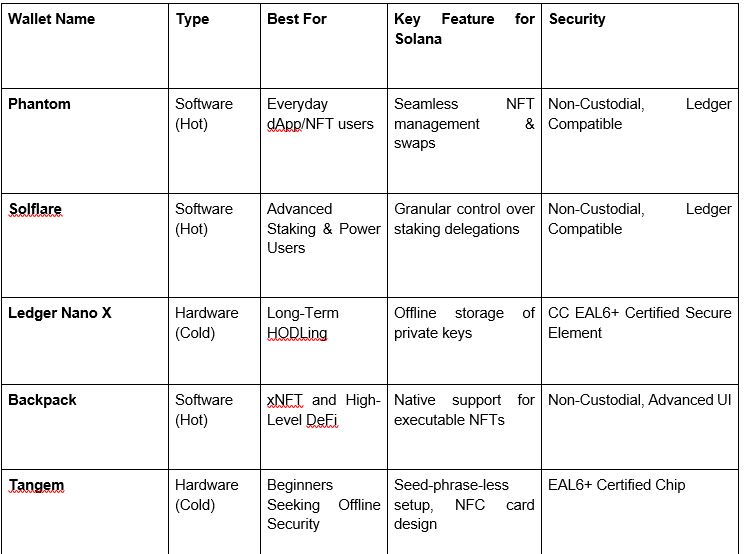
Final Wallet Comparison Summary

wallet comparison

Conclusion: Choosing your most suitable Solana Wallets

Selecting the most suitable wallets from the list of best Solana wallets boils down to your primary use case. For a DeFi user and NFT collector, Phantom is the most user friendly and compatible option. For additional security, pairing a piece of hardware such as Ledger or Tangem with a software wallet like Phantom is the best option. For focused stakers, Solflare provides the autonomy necessary to maximize Solana staking reward. Be sure to keep your 12 or 24 word seed phrase stored offline and confidential.

Frequently Asked Questions (FAQ)

Q1: What is the most secure way to store SOL?

A: The most secure way to store SOL is by using a hardware wallet (cold storage) like Ledger or Tangem. This ensures your private keys are never connected to the internet, making them immune to online hacking and malware.

Q2: Can I use MetaMask for Solana?

A: No, MetaMask does not natively support the Solana blockchain or the SPL token standard. You need a wallet specifically built for the Solana network, such as Phantom or Solflare.

Q3: What is an SPL token?

A: SPL stands for Solana Program Library. SPL tokens are the native token standard on the Solana blockchain, similar to how ERC-20 tokens are used on Ethereum. All major Solana wallets fully support the SPL standard.

Q4: Do I lose my SOL when I stake it?

A: No. When you stake SOL using a non-custodial wallet, your tokens are only delegated to a validator; they are not sent to them. You retain full control and ownership of your staked SOL at all times.

Q5: What is a seed phrase and why is it important?

A: The seed phrase (or recovery phrase) is a list of 12 or 24 words that serves as the master key to your entire wallet. If you lose your device or wallet app, this phrase is the only way to recover your funds. Never share it with anyone.

OKX Review 2025: Fees, Security & Trading Features Explored

OKX Manchester City

The cryptocurrency landscape continues its rapid evolution, making the choice of a trading platform more critical than ever. As we navigate the complexities of decentralized finance and global regulation, an in-depth OKX review 2025 is essential for both seasoned traders and new investors. OKX, a heavyweight in the crypto exchange arena, has positioned itself not just as a trading platform but as a comprehensive gateway to the Web3 ecosystem. This article provides a detailed analysis of the platform’s performance, features, security, and standing in the competitive 2025 market.

OKX Trading Fees and Structure 2025

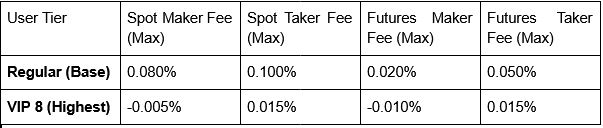
One of the most competitive aspects of the OKX review 2025 is the exchange’s fee structure. OKX employs a tiered maker-taker model which heavily favors high-volume and VIP traders but still offers attractive rates for regular users compared to many competitors.

kucoin trading


  • Maker Fees: By providing liquidity (placing limit orders), high-volume VIP users can even earn a negative maker fee, meaning they are paid to trade.
  • Taker Fees: These are the fees charged when an order is executed immediately against an existing order on the book. OKX’s taker fees remain among the lowest for perpetual and futures trading.
  • Deposits & Withdrawals: Cryptocurrency deposits are typically free. Withdrawal fees are dynamic and based on the prevailing blockchain network congestion. Fiat withdrawals, depending on the method (e.g., bank transfer), may incur external processing fees.

In short, for active traders, the fee structure highlighted in the OKX review 2025 offers a substantial cost advantage, making it a compelling choice for frequent market participation.

OKX Security Features and Regulation

Security and regulatory compliance have become paramount in 2025, especially following high-profile industry events. OKX has responded by doubling down on transparency and protective measures.

Proof of Reserves (PoR) and Cold Storage

OKX is a leader in user fund transparency, consistently publishing its Proof of Reserves (PoR). This cryptographic audit allows users to verify that the exchange holds 100% of the funds backing their deposits. Furthermore, a substantial majority of user assets (often over 95%) are held in cold storage, multi-signature wallets that are offline and thus immune to typical cyberattacks.

Regulatory Landscape

Historically, OKX has navigated a complex global regulatory environment. However, in 2025, the exchange has made significant strides in compliance, acquiring licenses and official registrations in several key jurisdictions. This move towards formal regulation across Europe and parts of Asia underscores a commitment to operating within a legitimate global framework, which is a major positive factor in the overall OKX review 2025. Users should, however, always confirm local jurisdictional restrictions, as the platform is often unavailable to residents of certain countries like the United States.

User-Side Security

Standard security protocols are robust, including mandatory Two-Factor Authentication (2FA), anti-phishing codes, and withdrawal address whitelisting.

OKX Features for Beginners and Pro Traders

OKX’s platform is designed to serve a vast spectrum of users, from first-time Bitcoin buyers to high-frequency derivatives traders.

Tools for Advanced Trading

Pro traders will find a comprehensive suite of advanced products, including:

  • Futures and Perpetual Swaps: Highly liquid markets with leverage up to 100x.
  • Options Trading: Catering to sophisticated risk management and hedging strategies.
  • Margin Trading: Allowing users to trade with borrowed funds to amplify positions.
  • API Trading: For institutional and algorithmic trading strategies.

Tools for Beginners

Beginners are supported with an intuitive “Lite” interface and a dedicated “Learn” section offering tutorials and market analysis. Crucially, the platform offers a demo trading account where new users can practice with virtual funds before committing real capital.

How to Use OKX Trading Bots and Copy Trading

The automation features of OKX are a major draw in the OKX review 2025, bridging the gap between passive investing and active trading.

Trading Bots

OKX offers over 10 types of automated trading bots, allowing users to execute strategies 24/7 without constant manual oversight. Popular bots include:

  • Spot Grid: Buys low and sells high within a predetermined price range.
  • Futures Grid: Extends the grid strategy to leveraged contracts.
  • Recurring Buy: A dollar-cost averaging (DCA) strategy on autopilot.

Copy Trading

For novices, Copy Trading is a powerful feature that allows them to automatically mirror the trades of high-performing, verified professional traders on the platform. This provides a way to participate in active trading strategies while leveraging the expertise of top performers, all for a small performance fee.

OKX Web3 Wallet and Ecosystem

OKX is strategically positioning itself as a Web3 hub, integrating decentralized functionality directly into the exchange environment.

The non-custodial OKX Web3 Wallet is a multi-chain wallet that exists within the OKX application but gives users full control over their private keys. This integration provides seamless access to the wider decentralized web:

  • DeFi: Interacting with decentralized protocols for lending, borrowing, and yield farming.
  • NFT Marketplace: Discovering, buying, and selling Non-Fungible Tokens (NFTs) across various blockchains.
  • DApp Exploration: Connecting to a wide array of decentralized applications.

This focus on blending centralized exchange services with decentralized utility is a clear differentiator for OKX in 2025.

OKX vs Binance vs Bybit 2025: Competitor Comparison

No OKX review 2025 is complete without a look at the competition. The global crypto exchange market remains highly concentrated, with Binance and Bybit as OKX’s primary rivals.

  • Binance: Remains the market leader in sheer trading volume and number of altcoins. However, it often faces more intense regulatory scrutiny in various global regions.
  • Bybit: Known for its strong focus on derivatives and advanced trading tools, Bybit offers a very similar, trader-centric experience to OKX, often with a slightly more intuitive user interface for futures trading.

OKX’s competitive edge in 2025 lies in its lower fee structure for high-volume traders, its industry-leading Proof-of-Reserves transparency, and its tightly integrated Web3 ecosystem, which positions it well for the next phase of crypto adoption.

Conclusion: Final Verdict on OKX in 2025

The OKX review 2025 reveals a powerhouse exchange that has effectively balanced institutional-grade security with an accessible, feature-rich user experience. Its ultra-competitive fees, robust commitment to Proof-of-Reserves, and comprehensive suite of trading tools—including advanced bots and copy trading—make it a top-tier choice. The platform’s seamless integration of a Web3 wallet for DeFi and NFTs ensures it’s future-proofed for the decentralized evolution.

While regulatory restrictions in certain jurisdictions remain a drawback, for the international crypto user looking for low-cost, high-utility, and transparent trading, OKX is undoubtedly one of the best exchanges available in 2025.

Frequently Asked Questions (FAQ)

Q1: Is OKX safe to use in 2025?

A: Yes, OKX is considered a safe, top-tier exchange in 2025. It prioritizes security with over 95% of user assets in cold storage and regularly publishes audited Proof-of-Reserves (PoR), allowing users to verify fund backing.

Q2: Are OKX fees lower than Binance or Bybit in 2025?

A: For most regular users, OKX’s spot and futures fees are highly competitive, often slightly lower than major rivals. For very high-volume traders (VIP tiers), OKX offers some of the lowest, even negative maker fees, in the industry.

Q3: Can US residents trade on OKX?

A: No, due to regulatory restrictions, the main OKX platform is generally not available to residents of the United States. Users should always confirm if the exchange is regulated in their specific jurisdiction.

Q4: What is the OKX Web3 Wallet?

A: The OKX Web3 Wallet is a non-custodial wallet integrated within the exchange platform, giving users full control over their private keys. It allows seamless interaction with the broader decentralized ecosystem, including DeFi, NFTs, and DApps, without transferring assets off the OKX application.

Q5: Does OKX offer copy trading?

A: Yes, OKX offers a popular copy trading feature, allowing less experienced users to automatically mirror the real-time trades of verified, successful professional traders on the platform.

From Code to Crypto Wins: A Developer’s Journey with Fairspin

fairspin

In crypto, proof is currency and promises mean little. That’s why Stan, a 32-year-old software developer and long-time blockchain enthusiast, approached online gaming with caution. Casinos, in his mind, were built on chance, not code. Yet when he discovered Fairspin casino, curiosity took over. What began as an experiment to test transparency and tokenization turned into a year-long journey where missions, rewards, and blockchain mechanics reshaped how Stan played and valued the game itself.

Fairspin Casino – Where Crypto Meets Gaming

Q: Stan, let’s start from the basics. Who are you outside of gaming?
A:
I work as a software developer. My days revolve around code and solving technical puzzles. Crypto has been part of my life for years, mostly as an investment and research area. I’m not someone who jumps into things lightly, so when it comes to gambling, I look at it more as structured entertainment than mindless spins.

Q: How did you first hear about Fairspin and what made you sign up?
A:
A colleague mentioned Fairspin about a year ago. What intrigued me wasn’t the “casino” part but the blockchain integration. I’d seen many platforms claim fairness, but Fairspin had actual on-chain proof. That was different. I decided to give it a try because transparency was something I could verify myself.

Q: What was your very first impression when you landed on the platform?
A:
What stood out right away was that the casino didn’t feel like a black box. I’m used to platforms where you just have to trust the numbers you see on the screen. At Fairspin, every bet and game result is recorded on an immutable digital ledger that can be easily checked. My first try was just a $20 bet that doubled to $40, and the way it was confirmed on the spot wasn’t about the cash – it gave me the proof I needed and made me trust the platform.

Wins, Losses, and Staying Grounded

Q: Do you remember your very first win at Fairspin?
A:
Yes, it was modest – maybe not the jackpot story people expect. Just $20. But that small win mattered more than any big payout, because it proved the system worked exactly as promised. I saw the transaction, confirmed it on the blockchain, and that trust gave me more confidence to keep playing.

Q: Losses happen too. How did you handle your first losing session?
A:
Honestly, that was the point where I knew discipline mattered. I don’t chase losses. I track my bankroll carefully and stick to a budget. Losing sessions are part of the game. At one point, I lost around $100. However, I saw 10% pop back as rakeback, plus there were tokens from missions waiting.

That kind of flipped my mindset. Even when you don’t hit a win, you are still moving forward. And that’s the whole idea of the 10-level loyalty system: every bet counts, unlocking bigger cashback, higher staking limits, and perks that keep the experience rewarding beyond the outcome of a single game.

Token Trail: Missions and Rewards

Q: Which missions stood out to you the most?
 A: I’m more interested in missions where the outcome depends on what I do, not on pure chance. For example, reaching a required total in bets or completing a set number of deposits over time – those are goals I can plan for. Once, the goal was 1,000 USDT in a week. I managed it in four days and unlocked my reward tokens, which felt less like gambling and more like achieving a milestone. That sense of progress is what keeps me coming back.

Q: How do you personally use Fairspin’s TFS tokens?
A:
As someone familiar with crypto, I quickly realized the real value of TFS tokens. They may look like a “soft currency,” but in practice they work as a versatile asset I can use across the platform. That flexibility made the whole system click for me.

Part of my tokens goes into staking. Fairspin offers three plans: for 8 hours, 1 day, and 3 days – so it is not like the tokens are locked forever. I can check results fast.

Sometimes I’ve staked around 5,000 TFS for just a couple of days, and it felt like passive income running in the background. What makes it even better is that it’s risk-free – the deposit always comes back – and I like knowing I’m literally sharing the casino’s profits.

The rest of my tokens I spend in the Fairspin Store. That’s the fun part: I’ve mostly used them for free spins and bonus funds, but once swapped for something tangible – a smartwatch. Putting it on my wrist was surreal – it felt like the tokens had crossed a line into real life.

Trust, Finance, and Advice for Others

Q: Transparency is a big buzzword. How important is it for you personally?
A:
Very. I don’t trust marketing slogans, just verifiable data. The fact that I can check everything via Trueplay Explorer myself means I don’t need to rely on someone’s word. It’s rare in this industry.

Q: Do you follow bankroll management rules?
A:
I set limits before I start and stick to them. For me, it’s about keeping play under control – once the budget is set, I don’t go past it. That way, Fairspin casino stays enjoyable without becoming stressful.

Q: What advice would you give to newcomers at Fairspin?
A:
Don’t think of it as a “get rich quick” place. See it as a platform where transparency and tokenization give you more control than anywhere else. Use missions to stay engaged, manage your bankroll wisely, and explore how Fairspin’s TFS tokens work. If you do that, you’ll see there’s a lot more fun here than just chasing wins.

Final Thoughts

Q: If someone asked you, “Why Fairspin?”, what would your answer be?
A:
Because the platform combines gaming with tech in a way that makes sense. The blockchain side means I can see what’s happening. And then there’s the token ecosystem on top of it: staking, missions, the Fairspin Store, even loyalty levels. It’s not just one-off wins – the platform keeps rewarding you in different ways. That’s why I say: your first $20 bet could become more than just a win – it could be the start of your crypto story.

Use Cases of Stablecoins in Payments and Transfers

Waller Stablecoins CBDC

The primary driver of stablecoin adoption is their effectiveness in payments and money transfers, where they offer significant advantages over traditional systems.

Cross-Border Payments and Remittances

One of the most compelling use cases of stablecoins is in international transactions. Traditional cross-border payments often involve multiple intermediaries, high fees, and slow settlement times that can take days. Stablecoins bypass this legacy infrastructure. They enable individuals and businesses to send value globally in a matter of minutes or even seconds, with significantly lower fees. For migrant workers sending money home, these digital remittances offer a cheaper and faster alternative to services like Western Union or MoneyGram.

E-commerce and Retail Payments

For merchants and consumers, stablecoins offer a reliable medium of exchange for online shopping and retail. They provide a frictionless payment experience, eliminating the high fees and chargeback risks associated with credit cards. As more businesses, from tech startups to e-commerce giants like Shopify, integrate crypto payment gateways, paying with a stablecoin becomes as simple as scanning a QR code. This is particularly beneficial for global merchants who can accept a stable currency from customers worldwide without worrying about volatile exchange rates.

Business-to-Business (B2B) Payments

The efficiency of stablecoins is also revolutionizing B2B payments. Companies can use stablecoins to pay international suppliers or manage payroll for a global remote workforce. The near-instant settlement and low transaction costs help businesses streamline their operations and improve cash flow. This allows for a new level of efficiency in corporate treasury management and international trade.

Use Cases of Stablecoins in Finance

Beyond payments, stablecoins are the backbone of the rapidly expanding decentralized finance (DeFi) ecosystem and are gaining traction in institutional finance.

DeFi and Crypto Lending Platforms

Stablecoins are the lifeblood of DeFi. They provide a stable medium for crypto lending platforms, allowing users to earn a yield on their assets without exposure to volatility. They also facilitate collateralized crypto loans and are a key component of decentralized exchanges (DEXs) and liquidity pools. By providing a stable anchor, they enable complex financial protocols to function reliably on the blockchain.

Institutional and Treasury Management

In 2025, major financial institutions and corporations are increasingly using stablecoins for their treasury operations. They serve as a form of tokenized cash management, allowing companies to hold and move value on-chain 24/7 without being subject to the limitations of traditional banking hours. This provides a high degree of operational efficiency and opens up opportunities for new financial products and services.

The Future and Regulatory Landscape

The future of stablecoins in payments and transfers looks promising, but it’s intertwined with regulatory developments. The increasing adoption has caught the attention of governments and central banks worldwide. As a result, many jurisdictions are developing specific frameworks for stablecoin regulation. This includes defining reserve requirements, ensuring consumer protection, and implementing measures to combat illicit activities. While regulation may introduce some friction, it is seen by many in the industry as a necessary step for gaining institutional trust and driving mainstream adoption.

FAQs

Q1: How are stablecoins more stable than Bitcoin?

A1: Unlike Bitcoin, which has a floating market price determined solely by supply and demand, stablecoins are designed to maintain a constant value. The most popular ones are fiat-backed, meaning each stablecoin in circulation is supported by an equivalent amount of fiat currency (like the US dollar) held in a reserve. This backing gives them their price stability.

Q2: Are stablecoins legal for payments everywhere?

A2: The legality and acceptance of stablecoins vary by country. In some regions, they are fully embraced and regulated, while in others, their use is restricted or in a legal gray area. As of 2025, regulatory frameworks are rapidly evolving, so it’s essential to check the local regulations of your jurisdiction.

Q3: Can anyone use a stablecoin for international payments?

A3: Yes. One of the main benefits is their accessibility. All you need is a crypto wallet and an internet connection. This makes them particularly useful for the unbanked or underbanked, who may not have access to traditional banking services but can still participate in the global financial system.

Solana and $GGs Top 2 Cryptos to Buy; Solana Holders Dive into Based Eggman Top Crypto Presale on Base

based eggman Solana

The world of cryptocurrency presales is evolving quickly, with new token presales driving interest across gaming, culture, and decentralized finance. Many investors are exploring these opportunities to secure early positions.

Solana continues to remain a key blockchain with its speed and scalability, while Based Eggman ($GGs) is emerging as one of the best crypto presales to buy right now. Together, they highlight the balance between established networks and fresh presale crypto tokens that attract both gamers and traders.

In this space, understanding presale cryptocurrency projects like $GGs is essential for anyone tracking the top crypto presales in 2025.

Based Eggman banner


Based Eggman ($GGs): Gaming Meets Web3 Culture

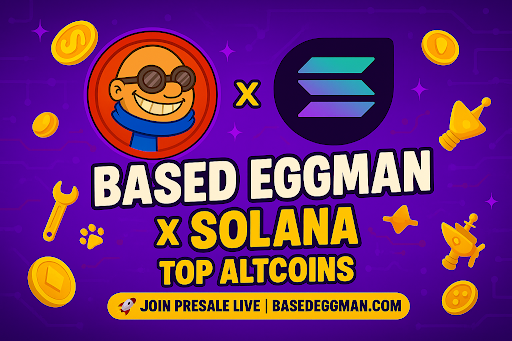
Based Eggman ($GGs) is gaining recognition as a presale crypto that blends memes with Web3 infrastructure. Built on Base, Coinbase’s Layer 2 network, it integrates gaming, streaming, and trading into one connected ecosystem. This approach sets it apart from many crypto coins on presale today.

The project is designed as a cultural hub where every game played, meme shared, and $GGs earned contribute to community activity. Unlike other presale crypto tokens that focus only on speculation, $GGs links digital culture with tangible engagement. Its ecosystem already expands beyond Base to include connections with Solana, BSC, and Ethereum.

This combination of entertainment, on-chain functionality, and community-driven activity makes Based Eggman ($GGs) one of the most notable entries in the current crypto presale list.

Solana: A Blockchain Powerhouse in 2025

Solana remains one of the most important crypto presale projects’ host networks, offering unmatched scalability and speed. Known for its ability to handle thousands of transactions per second at low cost, Solana provides an efficient environment for both developers and traders.

At present, Solana trades around $198, showing a slight 1.9% decline over the past week.

Despite this dip, its market capitalization holds strong at $109.69 billion. Its long-term role is reinforced by its appeal as one of the top blockchains for decentralized applications.

Low fees and an active DeFi pipeline keep Solana relevant, even when compared to newer presale cryptocurrency options. It remains a foundation in discussions about top presale crypto projects while continuing to support a diverse ecosystem of developers and creators.

Based Eggman banner

Based Eggman ($GGs): A Meme Token With Utility

$GGs is the native token of the Based Eggman ecosystem, designed to go beyond typical meme coin status. It acts as liquidity for the platform, a payment option for gaming, and a tool for minting and gas fees.

In gaming culture, “GGs” is shorthand for “Good Games,” symbolizing recognition and fair play. This cultural tie gives the token a familiar identity among gamers while expanding its use in Web3.

The presale data shows the early traction: over 974,823 $GGs tokens have been sold, raising 6,228 USDT in Stage One. With a presale price of $0.006389, Based Eggman demonstrates a structured tokenomics model that encourages both gamers and traders to join.

By positioning itself at the center of crypto gaming on Base, Based Eggman brings both humor and utility together. This dual role strengthens its place in the growing conversation around new crypto presales and highlights why it belongs on the radar of those reviewing cryptocurrency presales in 2025.

More Information on Based Eggman Presale Here:  

Website: https://basedeggman.com/

X (Twitter): https://x.com/Based_Eggman

Telegram: https://t.me/basedeggman

Is a $10 Price for Dogecoin a Realistic Dream?

Dogecoin Co-Creator Billy Markus Reveals His DOGE Holdings

The Dogecoin (DOGE) community has long held the ambitious goal of seeing the token reach a price of $10. However, a recent analysis by AMBCrypto suggests that this dream may be more of a fantasy than a realistic target. The report highlights that for Dogecoin to achieve such a price point, its market capitalization would need to surge to an astronomical $1.5 trillion, a value three times greater than the current market cap of Ethereum. This would require an unprecedented surge in on-chain activity, utility, and institutional adoption, which the analysis deems unlikely under current circumstances.

Sentimental Value vs. Fundamental Growth

The article points out that memecoin price rallies are predominantly driven by community sentiment and social media buzz rather than strong network fundamentals. Unlike top-tier blockchains that offer significant utility and are actively used for various decentralized applications, Dogecoin’s ecosystem currently lacks this robust utility and adoption. While a more modest price target of $1 is considered a more realistic possibility for the current market cycle, the journey to $10 remains highly speculative. The findings conclude that a significant shift in the network’s fundamentals and a massive influx of new users and capital would be necessary to even begin to make the $10 price dream a reality.

Bybit Review 2025: Is It the Best Exchange for You?

bybit review 2025

Bybit has rapidly grown from a derivatives-focused platform to a comprehensive cryptocurrency exchange, solidifying its position as a major player in the crypto space. In 2025, Bybit offers a vast array of products and services that cater to a diverse range of users, from seasoned traders to beginners looking to earn passive income. This Bybit review 2025 will delve into the platform’s key features, fees, security, and overall user experience to help you determine if it’s the right choice for your crypto journey.

Key Features of Bybit in 2025

Bybit has evolved into an all-in-one platform, providing more than just derivatives trading. The following are some of its standout offerings:

  • Derivatives Trading: This is Bybit’s original strength. It offers a wide selection of inverse perpetual contracts, inverse futures contracts, and linear perpetual contracts with leverage up to 100x. The platform’s high-performance matching engine can handle up to 100,000 transactions per second, ensuring fast execution and minimal slippage.
  • Spot Trading: Bybit’s spot market allows you to buy and sell cryptocurrencies at current market prices with competitive fees. It supports a wide variety of trading pairs, including major cryptocurrencies and popular altcoins.
  • Copy Trading: This feature allows users to automatically replicate the trades of expert traders, known as “Master Traders.” It’s an excellent tool for beginners who want to benefit from the strategies of seasoned professionals. The platform provides detailed metrics on Master Traders, including their ROI and win rate.
  • Bybit Earn: For those who want to generate passive income, Bybit offers a suite of Bybit Earn products. These include flexible savings, staking, and liquidity mining, allowing you to put your crypto assets to work and earn yields.
  • Trading Bots: Bybit provides automated trading strategies with features like spot grid bots, DCA bots, and futures grid bots. You can create your own bots or copy those used by other traders.
  • NFT Marketplace & Bybit Web3: Bybit has a dedicated NFT marketplace where users can buy and sell non-fungible tokens. In 2025, Bybit has also focused on its Web3 platform, which makes on-chain trading and DeFi activities more accessible to users.

Fees, Deposits, and Withdrawals

Bybit’s fee structure is competitive, with different rates for spot and derivatives trading.

  • Trading Fees: The maker/taker fee structure is tiered, offering lower fees for higher-volume traders.
    • Spot Trading: The regular maker and taker fees are typically 0.1%.
    • Derivatives Trading: Taker fees are around 0.06%, while maker fees are a low 0.01%, incentivizing market-making activity.
  • Funding Fees: These fees are exchanged between traders every 8 hours to ensure the contract price stays close to the spot price. Bybit itself does not profit from these fees.
  • Deposits & Withdrawals: Bybit supports both crypto and fiat deposits. Crypto deposits are generally processed instantly. Withdrawals are processed three times per day at specific times to enhance security. While some instant withdrawal options may be available, processing can take up to an hour depending on network traffic.

Security and Safety: A Key Consideration in 2025

Security is a paramount concern for any crypto exchange. In early 2025, Bybit experienced a significant security breach, resulting in the theft of a large amount of Ethereum. The attack, attributed to the Lazarus Group, exploited vulnerabilities in the platform’s infrastructure.

However, in the aftermath of this incident, Bybit took swift action to address the security concerns and restore user trust:

  • Rapid Response: The exchange quickly moved to reassure users, covering all user losses and securing emergency loans.
  • Enhanced Security: Bybit overhauled its security protocols, focusing on a zero-trust architecture and strengthening its transaction approval processes.
  • Proof of Reserves: The platform has committed to providing proof of reserves to demonstrate that user funds are securely held.
  • Regulation: Bybit operates in a complex regulatory environment but has actively sought to comply with regulations in various jurisdictions. It has obtained licenses in places like Dubai and Cyprus, though it remains restricted in countries such as the U.S. and the U.K.

Pros and Cons of Using Bybit

Pros

  • Diverse Product Suite: Bybit offers a comprehensive range of products, including spot, derivatives, copy trading, and passive income-generating tools.
  • Competitive Fees: The tiered fee structure and low maker fees are attractive for active traders.
  • Advanced Trading Tools: Integration with TradingView, trading bots, and advanced order types cater to experienced users.
  • Strong Performance: The high-speed trading engine ensures minimal latency and slippage.
  • Robust Mobile App: The mobile application is highly rated and offers a seamless trading experience on the go.

Cons

  • Security Breach History: The major hack in early 2025 is a significant concern, although the platform has since taken measures to recover and improve security.
  • Regulatory Restrictions: The platform is not available in several key markets, including the U.S. and the U.K.
  • Learning Curve: The extensive features and advanced tools can be overwhelming for absolute beginners.

Conclusion: Is Bybit the Best Exchange in 2025?

Bybit has evolved into a formidable all-in-one crypto platform. While the security incident in early 2025 was a major setback, its quick and transparent response has demonstrated resilience. For experienced traders seeking a platform with high leverage, advanced tools, and a diverse range of products, Bybit remains a top contender. Beginners, however, should be aware of the learning curve and the platform’s history. Overall, for those outside restricted regions, Bybit in 2025 is a strong, feature-rich choice for serious cryptocurrency trading.

Frequently Asked Question

Q1: Is Bybit a safe exchange to use in 2025?

A1: While Bybit has established itself with strong security measures like cold storage for a majority of user funds and two-factor authentication, it’s crucial to note a significant security breach occurred in early 2025. Following the incident, the exchange covered user losses and implemented a comprehensive security overhaul, including a zero-trust architecture and enhanced transaction processes. Bybit also provides a proof-of-reserves to show user funds are backed 1:1. However, investors should be aware of this history and always practice good security habits.

Q2: What is the main difference between spot and derivatives trading on Bybit?

A2: Spot trading on Bybit involves buying or selling cryptocurrencies at the current market price, with the user owning the actual asset. This is generally considered lower-risk, as your potential loss is limited to your initial investment. Derivatives trading, on the other hand, involves trading contracts that track the price of an asset. This allows for the use of leverage, which can amplify both potential profits and losses up to 100x. Derivatives trading is generally more suitable for experienced traders due to the higher risk of liquidation.

Q3: How does Bybit’s copy trading feature work, and is it good for beginners?

A3: Bybit’s copy trading feature allows users (known as “Followers”) to automatically replicate the trades of experienced users (known as “Master Traders”). The platform provides detailed performance metrics for Master Traders, such as their return on investment (ROI) and win rate, allowing Followers to make an informed choice. It is a good feature for beginners who want to learn from experienced traders and earn passive income, as it allows them to participate in the market without needing to execute every trade themselves.

Q4: How do Bybit’s fees compare to other major exchanges?

A4: Bybit’s fees are highly competitive, especially for derivatives and futures trading. The platform uses a tiered maker/taker fee structure, where users who add liquidity to the order book (makers) pay a lower fee than those who remove liquidity (takers). Spot trading fees for non-VIP users are typically 0.1% for both makers and takers, while derivatives fees are even lower. Bybit also does not charge for deposits, though network fees may apply.

Best Cardano Wallets for 2025: Securely Manage Your ADA

ADA Technical Analysis: Double Bottom Breakout Can Reach $2, Is It the Best Buy of 2022?

Choosing the right wallet to store and manage your Cardano (ADA) is crucial for security and ease of use. The Cardano ecosystem offers a variety of wallets, each with its own features and benefits. This updated guide for 2025 highlights some of the best Cardano wallets available, catering to different user needs, from beginners to experienced stakers.

Understanding Cardano Wallets: Custodial vs. Non-Custodial

custodial wallet

Similar to other cryptocurrencies, Cardano wallets can be broadly categorized into custodial and non-custodial:

  • Custodial Wallets: Typically offered by cryptocurrency exchanges, where the exchange holds the private keys to your ADA. While convenient for trading, they offer less control over your assets.
  • Non-Custodial Wallets: These wallets give you full control over your private keys, providing greater security and ownership. They are generally preferred for long-term holding and participating in staking.

For Cardano, many users prefer non-custodial wallets to participate in staking and have full control over their ADA.

Key Features to Look for in a Cardano Wallet

When selecting a Cardano wallet, consider these important features:

  • Security: Robust security measures, including private key encryption and options for hardware wallet integration.
  • Staking Support: The ability to easily delegate your ADA to staking pools to earn rewards. You can learn more about this in our guide on crypto staking.
  • User Interface: An intuitive and user-friendly design, especially for beginners.
  • Supported Platforms: Compatibility with your preferred devices (desktop, mobile, web, hardware).
  • Support for Native Assets: The ability to manage other native assets on the Cardano blockchain, beyond just ADA.

Top Cardano Wallets for 2025

Based on their security, features, and user reviews, here are some of the best Cardano wallets for 2025:

  1. Daedalus (Desktop): The official full-node wallet for Cardano, developed by IOHK (now Input Output Global). Daedalus downloads the entire Cardano blockchain, offering maximum security and full control. It supports staking and managing native assets. While powerful, it requires more storage space and can take longer to sync.
  2. Yoroi (Browser Extension & Mobile): A lightweight and user-friendly wallet developed by Emurgo, the commercial arm of Cardano. Yoroi does not require downloading the entire blockchain, making it quicker to set up and use. It’s available as a browser extension and a mobile app, supporting staking and managing native assets.
  3. Nami (Browser Extension): A popular browser-based wallet known for its simplicity and integration with Cardano dApps. Nami allows you to send, receive, and delegate ADA for staking directly from your browser. It also supports managing native assets and interacting with the growing Cardano DeFi ecosystem.
  4. Flint Wallet (Browser Extension & Mobile): A lightweight wallet focused on user experience and supporting the Cardano ecosystem, including staking and interacting with dApps. Flint is available as a browser extension and a mobile app, aiming for a seamless experience across devices.
  5. Lace (Desktop – Beta): A new light wallet from IOG, currently in beta. Lace aims to be an all-in-one portal for Cardano, supporting ADA and native assets, staking, and interaction with Cardano dApps and DeFi. Its user-friendly interface is a key focus.
  6. Hardware Wallets (Ledger Nano S Plus / Nano X, Trezor Model T): For the highest level of security, hardware wallets like Ledger and Trezor allow you to store your Cardano private keys offline. They integrate with software wallets like Yoroi and AdaLite to manage your ADA and participate in staking while keeping your keys secure. You can learn more about the security benefits in our article on cold wallets.
  7. AdaLite (Web Wallet): A web-based light wallet that allows you to access your Cardano without downloading the entire blockchain. AdaLite supports connecting with hardware wallets and offers staking functionality. It’s a convenient option for those who prefer not to install desktop software.

Choosing the Best Cardano Wallet for You

The best Cardano wallet for you will depend on your priorities:

  • Maximum Security: Hardware wallets (Ledger, Trezor) paired with a software interface.
  • Full Node & Control: Daedalus (desktop).
  • Lightweight & User-Friendly: Yoroi (browser/mobile), Nami (browser), Flint (browser/mobile), Lace (beta desktop), AdaLite (web).
  • DeFi Interaction: Nami, Flint, and Lace are particularly popular for engaging with Cardano dApps.

Securing Your Cardano Wallet

Regardless of the wallet you choose, always prioritize security:

  • Store Your Seed Phrase Securely: This is crucial for recovering your wallet. Write it down and keep it offline.
  • Enable Spending Passwords: Most Cardano wallets allow you to set a spending password for transactions.
  • Be Cautious of Phishing: Only use official wallet websites and browser extensions.
Conclusion: Selecting Your Cardano Wallet in 2025

The Cardano ecosystem offers a range of excellent wallets for 2025, catering to various needs for security, usability, and participation in staking and DeFi. Whether you prefer the full-node security of Daedalus, the lightweight convenience of Yoroi or Nami, the hardware security of Ledger or Trezor, or the emerging features of Lace, there’s a Cardano wallet to suit your requirements for securely managing your ADA.

Frequently Asked Questions (FAQ):

Q1: What is the most secure Cardano wallet for 2025?

A1: For the highest level of security for your Cardano (ADA) in 2025, using a hardware wallet like the Ledger Nano S Plus or Ledger Nano X, or the Trezor Model T, is generally recommended. These wallets store your private keys offline, protecting them from online threats. You can then use a software interface like Yoroi or AdaLite to interact with your ADA and participate in staking.

Q2: Which Cardano wallets are best for staking in 2025?

A2: Several Cardano wallets offer excellent support for staking in 2025. Daedalus, Yoroi, Nami, Flint, and AdaLite all allow you to easily delegate your ADA to staking pools to earn rewards. The best choice depends on your preference for a full-node wallet (Daedalus) versus a light wallet (Yoroi, Nami, Flint, AdaLite) and whether you prefer a desktop, browser extension, or mobile interface.

Q3: Are there any user-friendly Cardano wallets for beginners in 2025?

A3: Yes, several Cardano wallets are designed with beginners in mind for 2025. Yoroi (browser extension and mobile) and Nami (browser extension) are often praised for their intuitive interfaces and ease of use, while still offering staking functionality. Flint Wallet is another lightweight option focused on a smooth user experience. These wallets make it relatively simple for newcomers to manage their ADA and participate in the Cardano ecosystem.

How to Recover Stolen Cryptocurrency: An Updated Guide for 2025

Recover Stolen Cryptocurrency

The unfortunate reality of the cryptocurrency space is the prevalence of scams, hacks, and theft. If you’ve found yourself a victim, understanding the steps you can take to potentially recover your stolen cryptocurrency is crucial. While the decentralized and often anonymous nature of crypto makes recovery challenging, immediate and informed action can significantly improve your chances. This updated guide for 2025 outlines the essential steps and strategies to pursue if your digital assets have been stolen.

Act Immediately: Time is of the Essence in Crypto Recovery

The moment you realize your cryptocurrency has been stolen, swift action is paramount. Due to the irreversible nature of many blockchain transactions, delays can drastically reduce the possibility of recovery. Your initial steps should focus on documenting the incident and alerting the relevant authorities and platforms.

Step 1: Document Everything Related to the Cryptocurrency Theft

Meticulous record-keeping is crucial for any potential recovery efforts. Immediately gather and document the following information:

  • Transaction Details: Record the exact date, time, amounts, and transaction IDs (hashes) of the unauthorized transfers. This information is publicly available on the blockchain explorer for the specific cryptocurrency involved (e.g., Etherscan for Ethereum, Blockchair for Bitcoin).
  • Wallet Addresses: Note down the addresses your cryptocurrency was sent from and the recipient address(es) where the stolen funds went.
  • Platform Information: If the theft occurred through a specific exchange, wallet provider, or platform, document all relevant account details, including usernames, email addresses, and any communication you’ve had with their support.
  • Communication Records: Save any emails, messages, or screenshots related to the incident, including any suspicious communications that may have led to the theft (e.g., phishing attempts).
  • Timeline of Events: Create a detailed timeline of when you noticed the theft and any actions you’ve taken since.

Step 2: Report the Cryptocurrency Theft to the Relevant Authorities

Reporting the crime is a vital step, even if the chances of immediate recovery by law enforcement seem slim. Your report contributes to the overall tracking of cybercrime and can potentially aid in larger investigations.
  • Local Law Enforcement: File a police report with your local police department. While they may not have specific expertise in cryptocurrency theft, having an official record of the crime is essential for insurance claims or future legal proceedings.
  • Cybercrime Units: If your local police department has a dedicated cybercrime unit, ensure your report is directed to them. They may have a better understanding of digital asset theft.
  • Internet Crime Complaint Center (IC3): In many countries, there are national cybercrime reporting agencies (e.g., IC3 in the United States). File a report with these specialized agencies as they often track trends and patterns in online crime.

Step 3: Notify the Affected Cryptocurrency Exchanges and Platforms

If your cryptocurrency was held on an exchange or if the theft involved a specific platform, notify them immediately.

  • Cryptocurrency Exchanges: If your account was compromised or if the stolen funds were initially held on an exchange, contact their support team immediately. Provide them with all the documented details, including transaction IDs and recipient addresses. They may be able to freeze the receiving account if the funds are still within their platform (though this is often unlikely with experienced thieves).
  • Wallet Providers: If you used a custodial wallet service, inform them of the theft. They may have security logs or information that could be helpful.
  • Blockchain Analytics Companies: Consider contacting blockchain analytics firms. These companies specialize in tracking cryptocurrency transactions and identifying the flow of funds. While they can’t directly recover your assets, their analysis can provide valuable information for law enforcement or legal action. Some well-known firms include Chainalysis and Elliptic.

Step 4: Explore Potential Recovery Methods (Limited but Worth Pursuing)

Directly recovering stolen cryptocurrency is often difficult, but there are avenues to explore:

  • Legal Action: If you can identify the perpetrator (which is often a significant challenge), you may be able to pursue legal action to recover your funds. This can be a lengthy and expensive process with no guarantee of success.
  • Insurance Policies: If you had cryptocurrency insurance, review your policy to see if it covers theft. Promptly file a claim with all the necessary documentation.
  • Coordinated Community Efforts: In some instances, particularly with large-scale scams, affected communities may organize and pool resources to track down perpetrators or pursue legal action collectively. Stay informed through relevant online forums and social media groups (with caution, as recovery scams are also prevalent).
  • Bug Bounties and White Hat Hackers: In rare cases, if the theft involved a hack of a platform, bug bounty programs or ethical hackers might be able to identify vulnerabilities or track the stolen funds. However, this is not a direct recovery method for individual users.

Step 5: Be Wary of Recovery Scams

Unfortunately, the aftermath of cryptocurrency theft often attracts scammers who prey on victims’ desperation. Be extremely cautious of anyone offering guaranteed recovery services for a fee. These are almost always scams and will result in further financial loss. Never share your private keys or recovery phrases with anyone. Legitimate recovery efforts typically involve law enforcement or legal channels, not unsolicited offers online.

Prevention is the Best Defense: Strengthening Your Crypto Security in 2025

While this guide focuses on recovery, the most effective way to protect your cryptocurrency is to implement robust security measures proactively:

  • Use Strong, Unique Passwords: Employ complex passwords for all your crypto-related accounts and never reuse passwords.
  • Enable Two-Factor Authentication (2FA): Activate 2FA on all platforms that support it. Use authenticator apps rather than SMS-based 2FA for enhanced security.
  • Utilize Hardware Wallets: For significant holdings, store your cryptocurrency in a hardware wallet, which keeps your private keys offline and protected from online threats.
  • Be Vigilant Against Phishing: Carefully scrutinize emails, messages, and websites for any signs of phishing attempts. Never click on suspicious links or enter your credentials on unverified sites.
  • Educate Yourself: Stay informed about the latest cryptocurrency scams and security best practices.
  • Use Reputable Platforms: Choose well-established and reputable cryptocurrency exchanges and wallet providers with a strong security track record.
  • Consider Multi-Signature Wallets: For shared accounts or high-value holdings, multi-signature wallets require multiple private keys to authorize transactions, adding an extra layer of security. 1

Conclusion: Navigating the Difficult Path of Cryptocurrency Recovery in 2025

Recovering stolen cryptocurrency remains a challenging endeavor. While there’s no guaranteed method, taking immediate, documented action and reporting the incident to the appropriate authorities are crucial first steps. Be cautious of recovery scams and prioritize strengthening your security practices to prevent future losses. The evolving landscape of cryptocurrency security and regulation may bring new recovery mechanisms in the future, but for now, vigilance and proactive security remain your strongest defenses.

Major Altcoins Like SUI and BlockDAG Set to Hit New Highs

Market Dynamics

As the crypto market continues its bullish trajectory, SUI and BlockDAG are showing bullish momentum. BlockDAG has become a central talking point this week by raising an extraordinary $4 million in presale contributions, primarily driven by substantial engagement from crypto whales. Sui Network’s crypto token SUI is also enjoying a meteoric rise. It is benefiting from the recent integration of USDC, a major stablecoin. Investors are looking for the next big gains, and both SUI and BlockDAG are poised to deliver, with analysts predicting new all-time highs.

New Highs

SUI Crypto Token Surge Exceeds Expectations

Sui Network is known to be one of the biggest competitors to Solana and is becoming popular in decentralized finance (DeFi). Over the past month, its native token, SUI, experienced a price jump of over 60%, bringing its value to approximately $1.60. Thanks to a notable rise in daily trading volume the market capitalization of SUI reached $4.2 billion. Analysts indicate that the SUI/USDT trading pair successfully overcame key resistance levels, highlighting the token’s bullish momentum.


The SUI coin price trajectory has been impressive so far, and the growth has been fueled by heightened institutional interest and a renewed sense of trust among investors. With the total value locked (TVL) climbing over a billion, confidence in the token’s long-term potential is evident. A Sui Network spokesperson commented, “This increase in our TVL reflects the crypto community’s confidence in our network.” Sui’s innovative parallel transaction processing system and horizontal scaling capabilities are key to its scalability improvements.


Moreover, Sui’s object-based storage model optimizes state management, reducing transaction times and offering lower latency, benefiting decentralized applications and DeFi platforms. The network’s ongoing collaborations and partnerships in the crypto world continue to bolster its position in the market.


Additionally, Sui Network continues to forge meaningful partnerships in the cryptocurrency market. For example, Grayscale has recently launched a trust dedicated to SUI. This institutional backing has provided additional liquidity, making SUI a safer and more appealing bet for large-scale investors.

BlockDAG’s $4M Pre-Sale Increase in 24 Hours Sparks Excitement

Following the successful launch of a testnet, BlockDAG is currently dominating the cryptocurrency conversation with its extraordinary presale success. This altcoin employs innovative Directed Acyclic Graph (DAG) technology, allowing for faster and more scalable transactions than traditional blockchains. Unlike conventional blockchain protocols, DAG structures don’t suffer from the same bottlenecks, allowing them to process thousands of transactions per second. The crypto project showcases impressive scalability and user-friendly features. The $1 million giveaway made the coin even more popular, with 50 chances to win a staggering $20,000 in BDAG coins.


As each new batch of BDAG coins is acquired quickly, the project is experiencing rapid turnover, increasing the value of the coin. Early buyers have already witnessed significant growth in returns and the intense activity of crypto whales is a strong indicator of the high demand for the project. With $89 million raised in a few months and over 140,000 unique holders reached, the current presale batch is coming to a close. It’s no wonder that BlockDAG is on the verge of hitting new highs in the market.

Institutional Interest and Market Dynamics

One main driver behind the bullish momentum for both SUI and BlockDAG is the influx of institutional capital. Large financial entities are increasingly viewing cryptocurrencies, particularly altcoins with strong technological fundamentals, as viable long-term investments.


The broader market dynamics also play a role. With regulatory clarity improving in key markets like the U.S. and Europe, the entire crypto ecosystem is becoming more appealing to retail and institutional investors. In particular, altcoins are benefiting from this optimism, as they offer speculative gains and technological advancements that could push adoption across multiple sectors, including finance, gaming, and DeFi.

Price Predictions and Future Outlook

SUI’s immediate price target of $2.25 seems well within reach. Analysts point to technically solid indicators, such as SUI breaking past key resistance levels and holding support at $1.70, as reasons for optimism. Should SUI maintain its upward trajectory, it’s likely to surpass its all-time high of $2.18, set earlier in 2024.


BlockDAG, on the other hand, is expected to climb significantly as well, particularly with its current presale generating substantial interest. Some analysts predict that the altcoin could experience explosive growth similar to what Solana experienced in 2021, driven by the need for faster and more scalable blockchain solutions.
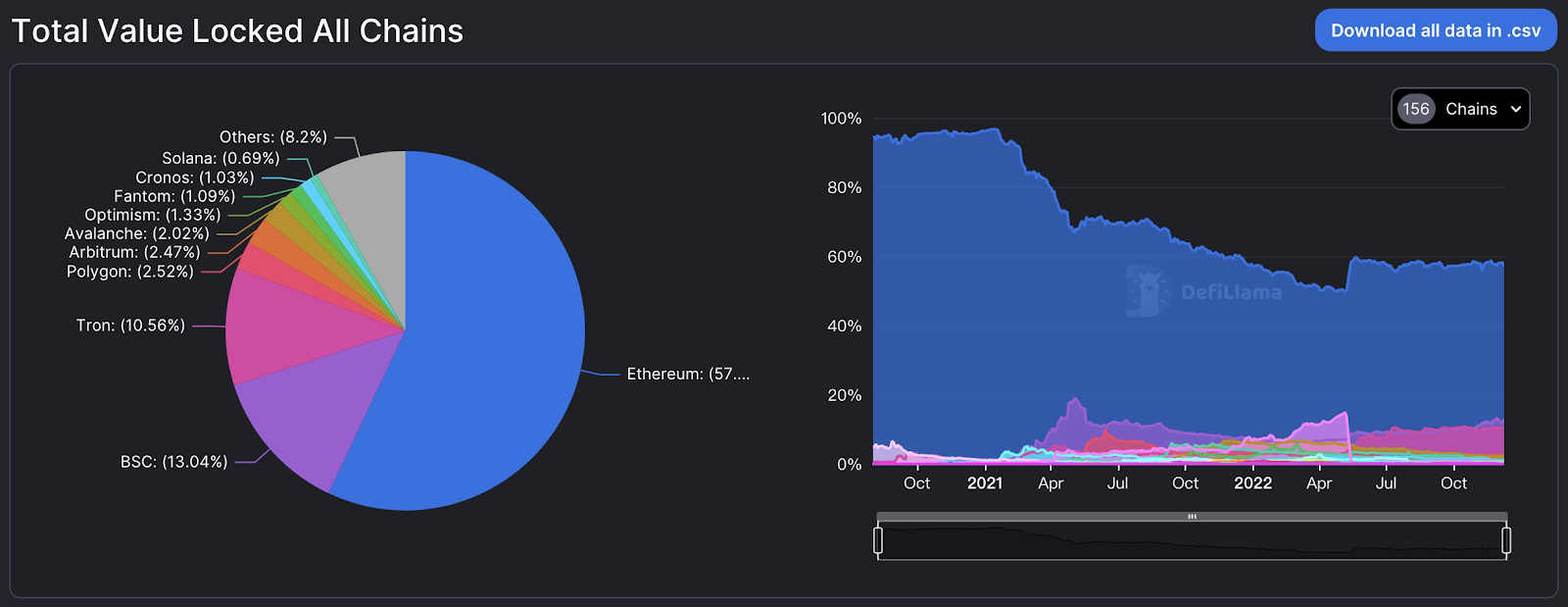
 

Both altcoins have great potential as they already benefit from strategic partnerships and increased media attention. The overall sentiment in the crypto market remains positive, and with institutional players continuing to pump capital into these projects, new all-time highs could be just around the corner.

How To Trade Cryptocurrencies Like SUI and BlockDAG Online

Trade Cryptocurrencies

As cryptocurrencies continue to gain momentum, many investors are eager to know the best way to enter these markets. Choosing a good crypto trading platform is the first step. While there are many options, OANDA is rapidly establishing itself as a leading option for buying and trading digital assets securely.


One of OANDA’s key advantages is its partnership with Paxos. Paxos is a regulated financial institution, which adds a layer of security for traders. Through this partnership, users can trade major cryptocurrencies seamlessly, utilizing OANDA’s advanced trading tools, like stop-loss and take-profit, to manage the volatility in the crypto market.


The platform is also known for its low fees, charging just 0.25% per transaction, with no hidden spreads. Moreover, OANDA allows users to trade cryptocurrency CFDs (Contracts for Difference), which enables them to benefit from both rising and falling markets without owning the underlying asset​.

The Time To Watch SUI and BlockDAG is Now

October 2024 is shaping up to be a pivotal month for altcoins like SUI and BlockDAG. Both have shown remarkable growth, backed by advanced technology and rising institutional interest. Investors looking for opportunities in the crypto space should keep a close eye on these two altcoins as they continue to ride the wave of bullish momentum. Key contenders among the hottest crypto projects, SUI and BlockDAG are two names you won’t want to overlook in the coming months.

Disclaimer: The views and opinions expressed in this article are for informational purposes only and do not constitute financial, investment, or other advice. Investing in or trading crypto assets comes with a risk of financial loss.

Bitcoin Could Reach $90,000: Analyst Predicts Bullish Surge

facts about bitcoin

Crypto analyst RLinda has made a bullish prediction for Bitcoin, suggesting the flagship cryptocurrency could soon reach a new all-time high of $90,000. In a recent post on TradingView, she outlined both fundamental and technical reasons supporting this potential price growth.

Fundamental Factors

RLinda highlighted several fundamental factors that could drive Bitcoin’s price upwards. One significant catalyst is the anticipated launch of Spot Ethereum ETFs, which she believes will positively impact the overall cryptocurrency market. Additionally, RLinda pointed out that former President Donald Trump’s increasing chances of re-election could boost market sentiment, as he has previously expressed support for cryptocurrencies.

Furthermore, she noted that high-ranking US politicians are reconsidering their stance on Bitcoin, and the US Securities and Exchange Commission (SEC) is gradually softening its position on cryptocurrencies. Recent statements from SEC Commissioner Hester Peirce about the inclusion of staking plans for Spot Ethereum ETFs illustrate this shift.

Technical Analysis

From a technical perspective, RLinda observed that Bitcoin is forming a classic bullish flag pattern on its daily chart. She indicated a high probability of Bitcoin retesting the strong resistance levels at $71,700 and potentially surpassing its current all-time high of $73,794. RLinda emphasized that breaking these resistance levels could set the stage for Bitcoin to challenge the global resistance at $73,800.

Key resistance levels to watch are $67,250 and $71,750, while support levels to maintain are $63,800 and $59,300. RLinda also highlighted a favorable price range for Bitcoin, suggesting that breaking the $67,250 resistance level could lead to further growth towards $71,700 and beyond.

Cup-and-Handle Pattern

RLinda’s analysis also identified a cup-and-handle pattern forming on Bitcoin’s weekly chart. She stated that this bullish pattern is in its final stage before potentially realizing a significant price surge to $90,000. As of now, Bitcoin is trading around $67,300, reflecting a nearly 1% increase in the last 24 hours, according to CoinMarketCap.

With both fundamental and technical factors aligning, RLinda’s bullish outlook suggests exciting times ahead for Bitcoin investors.

Disclaimer: The views and opinions expressed in this article are for informational purposes only and do not constitute financial, investment, or other advice. Investing in or trading crypto assets comes with a risk of financial loss.

Missed the Early Bitcoin Train? These Projects Could Be Your Next Big Win

next big crypto projects

The crypto market is going absolutely nuts right now. 2024 has been the best year yet for cryptocurrencies and it’s only getting started. Bitcoin hitting over $73,000 is something no one could have predicted in their wildest dreams. Then we got our first Bitcoin ETF that drew billions of dollars into the space already.

We have seen such market growth a few years back, and if there’s anything we’ve learned over the years, it’s that the blockchain industry needs practical, utility-based projects to achieve lasting impact and widespread adoption.

These projects offer solutions that improve people’s lives. Not just ones that could net you a hundred times your investment like Dogecoin did for many people this week. Taking the next step into tomorrow, here are three projects fueled with utility that could take center stage in 2024.

1) Filecoin ($FIL)

Traditional cloud storage models rely on centralized servers owned by tech giants like Amazon, Google, and Microsoft. Filecoin takes these models and flips them upside down, creating a decentralized peer-to-peer storage network that promises increased security and lower costs by eliminating the middleman.

  • Users: Pay FIL tokens to securely store their files on the network, selecting from a competitive marketplace of storage providers.
  • Storage Providers: Earn FIL by offering reliable storage space and proving their commitment to maintaining file integrity over time.

Why Filecoin is a Must-Watch Utility Project

  • Real-world use case: The amount of data being created every day is exponential, so naturally we need new solutions for storing it all more efficiently.
  • Resilience & Censorship Resistance: With traditional cloud models prone to single points of failure (being hacked or taken offline), decentralization makes Filecoin much harder to censor or manipulate.
  • Economic Empowerment: Anyone with unused hard drive space can become a storage provider on Filecoin and get paid in FIL tokens.
  • Market-Driven Pricing: Competitive and transparent markets can lead to lower costs for consumers as the technology matures.
FIL, the native token of the Filecoin network, powers all transactions, serves as a reward for storage providers, and grants users governance rights in the system’s evolution. As the need for reliable and affordable data storage continues to skyrocket, Filecoin stands as a pioneering solution with the potential to transform the digital landscape.
2 ) Diamante (DIAM)

Diamante is a blockchain & AI ecosystem that’s rooted in reality, with practical applications across many sectors, including finance, trade, metaverse, gaming, payments and more. The DIAM token that fuels this network is an important part of the ecosystem, and it can also be used as a stand-alone asset that has lots of utility. Here are some of Diamante’s offerings:

  • PayCircle: A super app  to conduct seamless transactions and make payments in Fiat, and trade cryptocurrencies, and accounting solutions—powered by the Diamante Net blockchain.
  • CreditCircle: Lets users secure a line of credit against their cryptocurrencies without having to sell them.
  • DiamCircle: A platform to build decentralized apps and digital asset management exchange solutions on its foundational network, Diamante Net.
  • DIAM Wallet: A wallet for managing DIAM tokens, participating in governance, and carrying out transactions securely.
  • Diamante Net: The a layer 1, hybrid blockchain network behind all of Diamante’s products. It offers speed and scalability, while also allowing public and private elements to coexist depending on user needs.
  • MudraCircle: Provides central banks and regulators with comprehensive CBDC solutions around the world.
  • MetaCircle: Helps users create, launch, and manage products or experiences in the Metaverse (a virtual universe).

Why Diamante is a Must-Watch Utility Project

  • Real-World Focus: Diamante solves actual problems in finance, banking, and asset management (and even the Metaverse).
  • Security & Efficiency: Built-in redundancy systems ensure smooth operation between different chains, and multi-layer authentication keeps everything safe.
  • Flexible Coin: DIAM lets users access the Diamante ecosystem and utilize dApps, such as PayCircle, to conduct transactions or unlock credit lines through dApps like CreditCircle.
  • Social and Sustainability Impact: Diamante aims to make finance more inclusive, and it’ll even use a portion of its transaction fees to fund green initiatives or social programs.

Diamante represents an ambitious endeavor to build a blockchain ecosystem with a strong focus on utility. With Diamante’s network and applications expanding, DIAM is poised to make a big impact on the future of AI-curated rewards & cashback.

3) Green Bitcoin ($GBTC)

Green Bitcoin has completely torn up the rulebook when it comes to how cryptocurrencies are supposed to work, and the result is fascinating. “Gamified Green Staking” gives users a chance to win big, and there are even opportunities for a token bonus. All you have to do is take part in an engaging prediction challenge that tests your market insight based on Bitcoin’s price action.

  • Gamified Staking: Users stake GBTC tokens and predict what Bitcoin will do. If you’re accurate in your predictions, you could earn significant rewards.
  • Passive Staking: It is for people who don’t want to get too involved. Green Bitcoin offers passive staking and has some impressive yields of up to 127% annually.

Why Green Bitcoin is a Must-Watch Utility Project

  • Innovative Earning Model: The prediction-based gamification element puts it in a class of its own when it comes to earning money within the crypto community.
  • Accessibility: When you combine market analysis with just a pinch of intuition, anyone can play this game. It evens out the field so everyone has a chance at winning.
  • Flexibility: Both active predictors and passive investors can find something they love about Green Bitcoin. There are rewarding mechanisms scattered throughout the ecosystem for all user types.
  • Community Engagement: Ongoing contests and potential for big rewards make this cryptocurrency platform particularly lively, as well as active among users.

With all of these unique features, it’s hard not to keep an eye on Green Bitcoin. As the platform continues to grow, there may be no limit on how high GBTC can go when it comes to changing how people interact with cryptocurrency.

The Future Belongs to Utility

It’s impossible to predict which projects will succeed and which will crash and burn in such an unpredictable space like cryptocurrency. However, there are three projects that stand out from the rest right now: Filecoin, DIAM, and Green Bitcoin. They might not become the next Bitcoin, Ethereum, and Dogecoin, but for sure, they all offer solutions to real-world problems when it comes to data storage, transparency in transactions, easy trading, customized reward programs, and market predictions.

So who knows? Maybe one of these projects could go on to change the world.

Disclaimer:The views and opinions expressed in this article are for informational purposes only and do not constitute financial, investment, or other advice. Investing in or trading crypto assets comes with a risk of financial loss.

The Case for Starknet’s STRK Recovery and Growth

StarkNet Token

The initial dip in Starknet’s STRK token price post-launch has stirred a whirlwind of market reactions. However, a closer look at the fundamentals suggests an impending rebound. Here’s why the STRK price could potentially recover and surpass the $2 mark in the coming week.

Agree or disagree with this analysis? Express your opinion on BetFolio’s prediction market.

BetFolio’s prediction market.

Strong Technical Foundation

Starknet operates on cutting-edge zero-knowledge proof technology, enhancing Ethereum’s scalability significantly. This technical foundation is vital for long-term success and can attract more developers and projects, increasing the demand for STRK.

Community and Developer Support

Despite the initial sell-off, Starknet boasts a strong community and developer support, with over 100,000 wallets claiming STRK. This community can drive recovery through increased adoption and use cases.

Market Corrections and Price Dynamics

Similar to other tokens experiencing initial drops post-launch, STRK’s price dynamics could follow a correction pattern seen with other cryptocurrencies, where initial sell-offs are followed by strong recoveries as early volatility settles.

Derivative Market Analysis

Analysis of derivative markets for the STRK token shows a higher long/short ratio across all time frames, indicating a net bullish sentiment despite the sell off.

Derivative Market Analysis

Open Interest weights funding rates are also positive. A positive open interest weighted funding rate typically indicates that the majority of the market participants are holding long positions and are willing to pay a premium to maintain these positions.

funding rate

Allocation for Ecosystem Development

A significant portion of the STRK supply is allocated for community airdrops, grants, and donations. This strategic allocation can foster a robust ecosystem around Starknet, driving up the utility and value of STRK in the medium to long term.

Anticipation of Unlock Schedules

While the token unlock schedule has been a point of criticism, it can also create predictable market dynamics. Investors might see upcoming unlocks as opportunities for increased liquidity and potential price stabilization.

Overall Market Sentiments

Crypto markets are influenced by broader market sentiments and external factors. Positive shifts in these areas, attributed to anticipated Ethereum ETF approval and cuts in interest rates, could lead to increased investor confidence, contributing to a price recovery for STRK.

Strategic Partnerships and Announcements

Any new partnerships, integrations, or announcements related to Starknet’s development and adoption can act as catalysts for price recovery, especially if they highlight new utilities or increased demand for STRK.

In conclusion, while the immediate aftermath of the STRK token issuance faced criticism and price volatility, several factors could contribute to its recovery. The underlying technology, community support, strategic allocations, and potential for positive market dynamics all suggest a favorable outlook for STRK in the near term.

Have Crypto, Will Travel: How to Buy Airline Tickets with Bitcoin

buy air tickets using crypto

You’ve heard of booking flights with airline miles, but what about doing the same, only with cryptocurrency?

Bitcoin has exploded in popularity in recent years, with some people using it to buy everything from a small cup of coffee to a trip around the world. Here’s how it works.

Bitcoin Is Becoming One’s Ticket to the World

bitcoin cash air ticket

Not everyone has jumped on the Bitcoin bandwagon quite yet, but according to a recent survey from Only Wanderlust, 22 percent of flyers have expressed interest in using crypto to book fights or pay for other travel expenses like hotels and rental cars. The majority of those travelers (70 percent) then said that they would prefer to use Bitcoin for their purchase as opposed to other cryptocurrencies.

At the moment, Bitcoin is being used most in luxury travel, with customers booking private jets and other high-class, high-cost items and experiences, but some traditional and low-cost airlines and travel agencies are getting in on the trend as well. A few airlines (both luxury and otherwise) already accept Bitcoin as a payment option, and others allow payment with crypto in a more indirect way.

Sound complicated? Don’t worry, it’s as easy as clicking a mouse!

Option 1: One-Step Booking with Your Bitcoin Wallet

While not all airlines have this capability, some airlines and booking sites allow customers to pay directly with their crypto wallet. Here are a few of the most notable:

  • airBaltic
    AirBaltic is currently one of the only airlines that accept Bitcoin payments directly through their website. As per  their FAQ section, the airline accepts several cryptocurrencies via BitPay.
  • Vueling
    According to multiple reports, Vueling will start accepting payment via crypto sometime during the second half of 2023, allowing customers to book cheap flights from one European city to another using Bitcoin. Although this low-cost airline won’t get you the transportation-galore of having built seat entertainment screen with an option to play games or watch movies in-flight, you can spent the extra money on your destination.
  • CheapAir
    As it proudly proclaims on its website, CheapAir was the first flight booking site to begin accepting crypto as a payment method. While it is not technically an airline itself, this service allows you to research, compare, and book flights with numerous airlines all from one website.
  • Alternative Airlines
    No, we’re not talking about airlines that use alternative methods of transportation, like flying cars or magic carpets. We’re talking about Alternative Airlines, a booking site that lets you book flights from over 600 different airlines using Bitcoin. While the name may sound a bit odd, nearly 15,000 reviews and an “Excellent” rating on Trustpilot make this appear to be a trustworthy choice.

Option 2: Give Yourself the Gift of Flight with Gift Cards

vueling btc

Let’s face it: while Bitcoin is popular among some groups of people, it is still relatively new to the public and not every business wants to commit to accepting it as a payment option quite yet. That would involve a lot of setup and a lot of integrating new services and platforms… and no one’s got time for that! So, sometimes it is just easier to pay for flights with crypto in a more roundabout way, rather than staying on the ground only wishing your occasional aviation sim hobby could “come alive” to take you outside the virtual space.

One of the easiest ways to do that is via a service like Bitrefill, which, according to a couple of sources, gives you 400 gift card options for airlines that can fly you to nearly 1000 different locations around the world. These gift cards aren’t just for low-cost or lesser-known airlines either: even Delta Airlines gift cards can be bought with Bitcoin via services like this one.

And, if there’s not a gift card for the specific airline you want to use, you can always buy a Mastercard gift card with crypto, which is good anywhere Mastercard is accepted (which is pretty much everywhere).

Once you’ve exchanged your Bitcoin for a gift card, it’s as simple as selecting the “pay with gift card” option (or equivalent) on the airline’s website. If you have a Mastercard gift card, you would instead carry out the transaction the same way you would with a regular credit card.

Option 3: Use a Crypto Debit Card (Yes, That’s a Thing Now!)

Many people already pay with flights with their debit card, which draws money from their bank account to make the purchase. But did you know that you can do that same thing with Bitcoin?

Some crypto wallets like Bitpay give you a crypto debit card, which can be used much in the same way as a regular debit card. In fact, you can even use it to book flights by selecting the “credit or debit card” option at checkout on any airline website that accepts Mastercard (in the case of Bitpay’s debit card). This includes all of the big players in the airline industry, such as Delta, United Airlines, JetBlue, British Airways, American Airlines, Southwest Airlines, and more.

So, as you can see, even if an airline doesn’t list cryptocurrency as a payment method on their checkout page, it is still possible (and relatively easy) to pay for your travel adventures with Bitcoin.

Why Ethereum and Other Deflationary Tokens Are Bad For Utility Protocols

ethereum Deflationary Tokens

Deflationary tokens are those whose supply decreases over time. According to Gresham’s law “bad money drives out good money.” So, if there are two forms of commodity money in circulation, which are accepted by law as having similar face value, the more valuable commodity will gradually disappear from circulation.
Good money is something that can’t be debased like Gold, silver, and Bitcoin. On the other hand, bad money can be easily debased or can be created very easily. E.g. – Nickel, Fiat, etc.

This is the reason people spend their fiat currency while they save their gold and Bitcoin. In the long run, gold and Bitcoin will grow in value because they have lower inflation and it’s impossible to create new ones out of thin air like fiat currency.

Why People Start Advertising Bitcoin as Hard Money or a Store of Value from a Peer-to-Peer Transaction Token

Bitcoin was created to become a peer-to-peer payment network. But the tokenomics of BTC makes it a bad substitute for payments. No one will spend Bitcoin for buying goods and services when they know that the stuff they will buy will go down in value whereas the value of BTC will go up (10000 BTC for 2 pizzas). In the next 9 years, 99% of the BTC will be mined and the only way for the miners to make money will be through transaction fees. Miners help secure the network. If there will be less incentive for miners they will unplug from the network, thereby, making it less secure.

That’s the reason early Bitcoin adopters like Andreas Antonopoulos preach about using Bitcoin for payment so that there will be enough incentives for miners through network transaction fees to continue operating. Now the aim of the BTC is to become the most censorship-resistant hard money that ever existed and its tokenomics and decentralization favor that thesis. In the future, the coin which is the most decentralized and has a predictable monetary principle will become the next global reserve currency and we know that Bitcoin is, by far, the most decentralized.

Does Usability Make Something a Better Asset?

People argue that ETH has more real use cases than BTC and thus, it’s a better form of money. It is true that ETH has more real use cases but this alone doesn’t make something better money.
Let’s compare gold and silver to understand what makes gold better money.
Usability – Around 90% of the silver mined annually is used for industrial use while only 10% of
the gold is used for industrial use. So usability doesn’t make better money.
Cost of Production – It takes around $10 to mine 1 ounce of silver while it takes somewhere between $800-$1000 to mine 1 ounce
of gold. So clearly the cost to produce something is what makes it more valuable. That’s the reason fiat is worthless as it costs nothing to create it. The only reason fiat has value is because of people’s trust. The labor people do to earn fiat is what gives it value.

Why Deflationary ETH is Bad, Just Like Other Deflationary Tokens

ETH is used as a unit of account in its ecosystem and by far it’s the best layer 1 protocol. But no one likes to spend anything which they know will go up in value in the long run. A lot of people bought NFTs using their ETH and now their Nfts are down 95% while ETH is down by only 70%. If they would have simply held on to their ETH, they would have been in a much better position.

All these things will lead to less usability of ETH as a unit of account because people will know that their ETH will be more valuable over the long run and Gresham’s Law, which we discussed earlier, will come into play here. After some time ETH will only be used as a store of value but people will also realize that there is better money than ETH and they will flock to BTC. This will start the demise of ETH and they will be left with only two solutions. Either to have some inflation of about (3-4) % or to be obsolete and I assume they will choose the earlier one. It’s better late than never.

Conclusion

ETH was created in the first place to be a global settlement layer but to attract more people to invest in ETH they made changes to their tokenomics to become a better asset. Now it will be better for them to become the oil or silver of crypto than to become the gold of crypto. If they will choose the path on which they are going, they might end up becoming the nickel or copper of crypto. ETH has contributed a lot to this crypto ecosystem than any other crypto but it will have to clear its path if it wants to be the leader in smart contracts

MEXC Opinion: The Crypto Market Still Needs Periods to Rebound

Andrew Weiner MEXC’s Vice President states that in recent months, we have witnessed many large institutions going bankrupt, which made BTC fluctuate around $16,000 for several weeks. Although the ongoing flow of funds in the market clearly represents that it has no sign of a rebound. A true recovery requires a blend of the macroeconomy and industry breakthroughs.

Fed Chair Jerome Powell, during the eighth and final meeting of 2022 on November 30, implied that the Federal Reserve is likely to increase interest rates by another 50 basis points. The previous Fed rate hikes were for 75 basis points.

Going through the data from the U.S. Department of Labor shows that the unemployment rate was significantly higher than the 3.5 percent that had been normal without showing any significant indicators of tightness before the pandemic.

Andrew believes that millions of jobs were empty due to the pandemic’s eve. A significant and continuing labor supply shortage has been created due to the pandemic, a gap that seems unlikely to close anytime soon fully.

congressional budget office

Source: Congressional Budget Office

Import prices for fuel and non-fuel have declined recently in a few months, and so do the indicators of prices paid by manufacturers too. From early 2022, the core goods inflation has decreased by almost three percentage points.

Adding further, Andrew mentioned the possibility of recession as per the indicators and statistics. As a result, market predictions for a 50bp increase in December increased from 66% to 77%, reflecting its dovish character.

Bitcoin (BTC) surged about 1% over the news to $16,982. On the other hand, US stocks soared, driven by the Nasdaq Composite, which was up as high as 4% after the neural tone of Powell during the speech. Over the Fed Chief’s comments, other important indexes showed a moment upward. The S&P 500 ended up more than 3%, while the Dow Jones Industrial Average increased by 737 points. BTC was a little decoupled from US stocks.

The Federal Reserve’s interest rate hike had the least impact on the price drop of the cryptocurrency market.

The Federal Reserve’s interest rate hike has a decreasing impact on the price fall of the cryptocurrency market.

From January 25 to 26, 2022, it was noticed that the Federal Reserve officially started to discuss the matter of interest rate hikes. The major hurdle is fixing the economic problems caused by the increase in US dollar liquidity starting in 2020. From the very first rate hike announced on March 26, it can be seen that the BTC prices have gradually increased, totally unaffected by the rate hikes.

BTC prices


Moving further Andrew also comments that when talking about the stocks, surprisingly, going through the historical data from the US stock market, even with very low-interest rates, selloffs continue to happen as we saw in the 1950s and again since 2004. Recessions followed rate hikes.

During the rate hikes, on average, the correction in the S&P 500 is nearly around 15%. Contrarily, during the recession  (even if it coincides with a cycle of rate increases), the average fall in stocks is almost double (blue circles and bars).

Nasdaq Economic Research

Source: Nasdaq Economic Research

If we see economic instability is usually brought on by inflation.  US stocks frequently have space to fall after the quantitative easing(QE), as the market assumes that Fed has begun to remove liquidity as a result of the weak economy.

Andrew’s views are that now we need to worry a bit about a recession after rate hikes. Can Bitcoin detach from US equities and leave the independent market, given the decreasing relationship between Bitcoin and the macroeconomy?

One more point to observe is the stablecoin cap. The cryptocurrency market has been unstable for weeks and is still volatile. Even though there has been a slight increase in the daily trend, the overall preference is still one of a bear market. For the market reversal signal, it needs to see the growing stablecoin market capitalization, which indicates that new funds are entering the market. As per the data taken from DefilIama, the overall market cap of stablecoins is nearly 140 billion, only half of its peak, with a downside. Currently, we can hardly see any sign of the money signals needed for a market reversal yet.

DefiLlama

Source: DefiLlama

A predictive indicator for predicting market flows is TVL. The market’s total TVL is around 42 billion, according to DefiLlama.

TVL

Source: DefiLlama

The overall weekly rise for TVL was 1.5%; on the other hand, last week, it grew by $0.63b. The TVL of Ethereum grew by 3.72% among them, and straight after three weeks of decline, Solana surged 6.97% for the week but only contributed 0.72% to TVL. Layer2’s public chain Arbitrum rose by 2.25%, polygon rose by 0.94%, and avalanche rose by 3.18%, but BSC and Optimism fell by 4.02% and 1.16%, respectively, last week. Roughly flat TVL claims there has been no market capitalization and no signs of activity.

tvl defilama

Source: DefiLlama

In addition to the lack of financing, there still are risks from FTX’s aftermath. As most of the liquidity in the crypto market is with major big market makers, including  Alameda, Wintermute, Amber Group, Genesis, etc. Market liquidity collapsed after Alameda announced the suspension of trading. The worst part is, following the FTX collapse, Amber Group, Wintermute, and Genesis also declared that their capital was trapped on FTX. Retail investors also ran into a panic to avoid risks. The market liquidity crunch situation was made worse by the presence of several factors.

In dozens of projects, Alameda has invested millions of dollars. Alameda also acts as a market maker to supply liquidity for these projects. As a result, market liquidity eventually collapsed.  The loss of FTX largely eliminated 1/8 of the market’s liquidity.

Grayscale and Genesis both belonged to DCG. Genesis loses $1 billion, Grayscale’s GBTC no longer has any subscribers, and it is no longer competitive due to the negative premium. We will see a further fall in the market if Grayscale’s locked BTC is redeemed. DCG is expected to face the issue of insolvency, which would further the market’s uncertainty.

So when will the market reversal be seen? The annualized return on US Treasury bonds has surged to 4.7%. However, DeFi’s is only approximately 2%. The two yields might flip, which would prevent the market from turning around by pushing money out of the cryptocurrency market.

Until the U.S. inflation subsides, the financial market will be more positive. However, cryptocurrency markets usually recover before traditional finance markets do. While the cycle for US stocks normally lasts 12–15 years, it is often only 3–4 years for Bitcoin. Once we see a stabilization in the macro economy, there will be a high possibility of a turning point.

Deleveraging is another crucial component. High leverage is closely related to the bull market’s prosperity. If we take an example, 3AC is famous for its highly leveraged bets, borrowing a lot of funds from various companies and investing in different projects. Its assets under management reached $10 billion in March 2022, and it included tokens such as Avalanche, Solana, Polkadot, and Terra in its investment portfolio. After its collapse, the BTC fell by more than 30%.

When compared with conventional finance, the crypto sector is often more leveraged.  The process of deleveraging is relatively more severe and acute in the setting of restricting global funds.

However, the actual reversal point will happen after deleveraging. After a long period of volatility at the bottom, it will lead to a rebound.

The evolution of a bull market is inseparable from the birth of new assets and scenarios. To build a strong public chain, performance support is needed for the implementation of new scenarios. Stronger public chain performance support is required for the implementation of new scenarios. With the arrival of new public chains, increased Layer 2 maturity, and improved infrastructure, the market will have the potential for a successful start.

Andrew’s final conclusion is that, at last, technological advancement is required for the growth of the bull market.

The Benefits Of Liquid Staking For Institutions And Corporations

Liquid Staking

Staking is a core component of decentralized finance (DeFi). It means that users typically get rewarded between 4% – 8% for locking up their coins. The current banking model no longer offers any real form of interest for deposits, so the benefits of this kind of staking are clear and obvious, as it rewards people for their contributions instead of taking from them.

But Liquid Staking takes it one step further. Liquid Staking was initially created by Ankr, a Web3 infrastructure firm that helps blockchain startups grow and expand together. Ankr further offers a seamless point of entry into Web3 and DeFi with a large suite of protocols.

While the benefits of DeFi are obvious from the perspective of traders, investors, and entrepreneurs, it can also be of huge advantage to institutions and corporations.

What Is Liquid Staking?

With regular staking, users earn rewards on their deposits. This works on proof-of-stake blockchains such as Ethereum, and cannot be done on proof-of-work blockchains such as Bitcoin. Most blockchains are now proof-of-stake or delegated-proof-of-stake, though there are many different models being tested out.

Liquid Staking goes a step further than regular staking. With Liquid Staking, you get the rewards from staking, but are given a derivative token in return. For instance, you get the rewards for staking MATIC and are then given an aMATICb derivative token. This derivative token can then be used for other purposes, such as crypto loans or trading.

Many people have still not grasped what Liquid Staking is or what its implications are. The existing financial industry is built on derivative trading, and this plays a part in the reluctance of corporations and institutions to take part. Though estimates vary, the derivatives market could be up to $1 Quadrillion. It’s about 10 times global GDP, though the figures are hotly contested.

Without a derivatives market, the existing financial infrastructure is not going to be interested in Web3. It takes away its flexibility and ability to innovate. Of course, many would argue that the derivatives market is itself the problem, but this is not 100% accurate. It enables fluidity and mobility of capital, which leads to increased affluence, though also the potential for troublemaking of various kinds.

The Many Advantages of Liquid Staking

The financial world runs on a fractional reserve system, enabling the multiplication of assets in a rapid manner. With Liquid Staking, institutions and corporations can leverage their crypto assets to the maximum potential. There will be a fee for Liquid Staking, typically around 10% or so. But this fee is small in comparison to what could be achieved.

The problem with the derivatives market stems from a lack of correct risk mitigation procedures. Moreover, there are systemic risks that are difficult to account for in any economic environment. Many Web3 advocates are against the derivative market and against large corporations and institutions in general.

But it’s hard to ignore the fact that Web3 is built through the contributions of large firms such as Binance, Ankr, and Polygon. The infrastructure needs to be put in place to migrate from Web2 (Google, Facebook) to Web3 (decentralized service providers like Ankr).

Another point that is missed is that more staked assets will strengthen the blockchain network. In other words, when larger organizations start taking part in Web3, they will heavily support and strengthen security protocols. So, the primary advantages of Liquid Staking include:

  • Increased flexibility of assets.
  • Increased room for diversification.
  • Maximization of profit potential.
  • Room for innovative investment in new markets through DeFi protocols.
  • Investment strengthens the proof-of-stake network, acting as a form of security.

These are significant advantages for both corporations and institutions. It is especially relevant in the highly unstable global economic environment. Like all markets, there are risks. But Liquid Staking allows you to use the token as a hedge against the core token. In other words, if you are worried about exposure to Ethereum, you can use the derivative to invest in a market that rises as Ethereum falls.

Bottom Line

It’s possible to engage in regular staking through a wallet or through an exchange provider. But liquid staking will require you to work with a liquidity staking platform or a decentralized service provider. You still retain full asset ownership, you are simply operating through a decentralized protocol. The staking of assets is just the click of a button, but it sounds a lot more complicated than it is.

Larger entities will want future assurances, but the core ethos of autonomous ownership will still remain the same. As always, the question comes down to risk mitigation procedures. Do not risk more than you can lose, and do research into what you are investing in.

Liquid Staking offers unparalleled advantages. It is a core aspect of Web3 and DeFi and intelligent investment can yield enormous profits. But regardless of whether you are an individual, entrepreneur, trader, business, corporation, or institution, no investment is foolproof.

Money can be made, and lost, in all markets.

DeFi Creates Golden Opportunities For Enterprises To Earn Additional Revenue Through Staking

DeFi Staking

DeFi is opening up new opportunities for corporations and retail alike to make additional income, at a time when businesses are strapped for cash. DeFi is a new financial ecosystem that is being developed on top of blockchain technology, allowing users to earn revenue by providing liquidity to the market.

The main idea behind DeFi is to make finance more accessible, transparent, and efficient for all parties involved in it. Many blockchains thrive on a Proof-of-Stake mechanism, where token holders participate in the blockchain by helping validate transactions, run nodes, and secure the network. Participating in the network’s activity often yields certain returns.

Enterprises Globally Will Take Full Advantage of DeFi Staking 

The benefits of staking are not limited just to the individual. It can also provide a lot of benefits to an enterprise. Staking is a process where an individual or company locks its crypto holdings for a specific period of time. Oftentimes staking will take place in order to secure the network, with some of the network gas fees going to stakes.

This process provides additional revenue for both parties involved in the transaction either way, which is why it will become so popular among enterprises. With large amounts of capital, enterprises could earn a considerable amount of interest.

Staking offers a much higher APY than a traditional savings account, sometimes over double digits. For example, Ankr currently offers 3.56% on ETH, 5.84% on MATIC and 14.78% on DOT. The company specifically offers staking opportunities for enterprise clients with a deeply liquid ecosystem including SushiSwap, UniSwap, Curve, PancakeSwap, and many more.

Staking is an excellent form of passive income in the DeFi space for anyone to take advantage of. And with the rise of liquid staking, these benefits are even more pronounced, where enterprises can receive staking returns and also use their derivative tokens for other yield-bearing purposes.

BitGo was the first to offer institutional services for digital assets ranging from custody to staking and lending. The company saw large demand, paving the way for future brands. Many enterprises hold hundreds of thousands of dollars, some millions, and are earning very little on that capital. Businesses could stake their non-working capital and earn double-digit APY on the money using DeFi. Compared to traditional investment vehicles, DeFi and staking are revolutionary.

The Potential Problem for DeFi Retail Investors

Proof-of-Stake networks are a new form of decentralized finance. They offer control over the network to those who stake their tokens.

In a Proof-of-Stake blockchain, control over the network is largely held by holders of staking tokens. Stakers often get to vote in decision-making and certain network activity. If enterprises do enjoy the opportunity of staking, they could end up with so much money staked that they have too much control over the network.

For example, many networks, especially DAOs, will take snapshots of token holders or stakers prior to a vote. Participators get votes equivalent to the number of their tokens supporting the network, giving the largest holders the most votes. Companies could take advantage of their size and capital and potentially be able to influence the industry.

Although it would be a good thing for a company’s bottom line, it’s certainly something for retail investors to watch out for as the space expands.

Alternative DeFi Opportunities 

DeFi is an entire ecosystem of decentralized financial apps, services, and products. Staking is the only way that enterprises can participate in the blockchain. DeFi includes loans, marketplaces, and even more.

In a decentralized exchange, token holders are rewarded for providing liquidity to the market. These can be exchanges like 1inch or PancakeSwap that rely on liquidity to process transactions more than a centralized exchange like Coinbase.

Similar to the traditional world, DeFi loans are slowly gaining popularity as well. These work with one person loaning the cryptocurrency in return for a specific interest rate from the platform. The borrower gets almost instant access to capital without the need for any paperwork or personal information at all. The borrower also still owns their cryptocurrency and can be saved from a liquidation event.

New opportunities are popping up in the DeFi and greater blockchain space for enterprises to take advantage of all the time. Even NFTs present amazing opportunities to businesses across all industries to brand, community build, or raise money.

The Wait for Regulation

Cryptocurrency regulation is a hot topic in the world of finance. Governments are trying to figure out how to regulate these digital currencies and what they should be classified as. The main reason for this is that cryptocurrencies are not backed by any government or central bank. This means that they are not regulated by any institution, which can lead to fraud and other illegal activities.

In order to regulate these currencies, governments need to decide what classification they should be given. They could be considered commodities, securities, or something else entirely. Enterprises specifically need to wait for regulation due to potential legal trouble. Large and especially public companies are under the watchful eye of government regulators, just waiting to file a lawsuit against them.

This is why very few companies have invested in or integrated cryptocurrencies into their models. Once they have clarity on exactly how they are allowed to invest and use cryptocurrencies enterprises will begin throwing money into DeFi.

With all the opportunities available in the DeFi and staking space, it’s only a matter of time before corporations, small businesses, and governments alike will explore the space- perhaps even together.

Is Crypto Staking Viable In A Crypto Winter?

Crypto Staking Crypto Winter

It took a while but the crypto winter that crypto natives were scared of when digital assets reached all-time highs in 2021 is now here. When a coin shilled by Kim Kardashian got dumped so quickly that its holders sued her, people got the first signal that the market was on the edge. However, if that crypto winter memo wasn’t received then, it certainly happened when giants like Celsius, Babel finance, and Three Arrows all got sizable chinks in their armor. The rapidly falling price of Bitcoin is also a sure signal that things could get worse. If you’re a spot trader, these trends are rather worrying.  

Crypto World in a Turmoil

Sadly, it’s not only crypto prices that are taking a beating. Right now, many cornerstone Web3 startups are illiquid, and others have simply been hacked into oblivion. The long and short of it is that things are not looking too good in the crypto-verse. 

Of course, this raises an even more important question. What does one do in a crypto winter? For many, the solution is to cut their losses and lock their wounds. For others, the solution is to go even more in and wait for a crypto summer, as it were.

But there might be another solution. A solution that’s halfway between selling all your crypto to avoid going into more losses and buying coins that may or may not appreciate.

Crypto Staking: The Hero We Need During the Crypto Winter

Staking your coins is probably the least adventurous thing you can do in a bull market. Staking your coins during a bull market is tantamount to taking out a huge ad in a national daily and announcing that you aren’t interested in record profits for a while. 

Even in normal market conditions, staking isn’t something investors find attractive. That’s because most of them prefer to have their financial destinies in their hands, and staking takes away that power. By staking coins for a while, they are also taking a huge risk. If the market suffers a shock and the value of the coins suffer a huge drop, the loss in value may outweigh whatever interest they earn on them. 

Given these conditions, it’s not difficult to see why crypto staking is not popular among institutions and traders. But all these conditions are only valid in a bull market. In a bear market, the promise of profits gets so slim that it changes everything. In that sort of market, even the so-called meager returns from staking may prove to be better than any other financial adventure. 

Therefore, when everything else fails, crypto staking can be the most viable solution during a crypto winter.

The Crypto World Can’t Wait for the ‘Ethereum Merge’

Ethereum Merge

After almost six years of waiting, the Ethereum merge is finally set to take place in September this year. There will be two stages for Ethereum merge to be public in the crypto market- the first stage, Bellatrix, happening on September 6 and the final stage, Paris, happening between September 10 and September 20. If all goes according to plan, the Merge will take place around Sept. 15. The change would shift Ethereum to a more energy-efficient infrastructure, addressing the widespread criticism that crypto’s climate impact outweighs its possible benefits. As a result of the Ethereum merge, the blockchain will become 99.5 percent more energy efficient after shedding its power-hungry proof-of-work consensus mechanism. The merge is also believed to reduce processing times, lower transaction fees, and help the blockchain scale in the future.

What is Ethereum Merge?

At basic level, the merge (sometimes called Ethereum 2.0, Eth 2, or ETH 2.0) is an upgrade to the Ethereum blockchain that will reduce its environmental impact, increase security in the network, and enable Ethereum developers to introduce new features and increase the scalability of the chain. But if you are looking for a technical definition, mostly lifted from Ethereum.org: The Merge is an upgrade to the Ethereum platform that will merge the Ethereum Mainnet with the Beacon Chain, marking a transition from proof-of-work to proof-of-stake.

If you’re not much aware of the crypto space, let me make this clear to you in the simplest terms. Computers consuming tons of electricity to power Ethereum are out, and they’re replaced by computers that consume dramatically less electricity. By Doing this, according to Ethereum Foundation, Ethereum’s energy consumption will be reduced by 99.95%. All that talk about NFTs not being green will be obsolete.

Is The Merge risky?

The Merge is a major upgrade of an extremely complex system. It could go wrong. Ethereum could run slowly for a while or even halt completely. There could be other unforeseen errors or issues. Chances of any of this happening are small, given all the testing that went into this event, but they are not zero.

The Merge also changes how the entire Ethereum network is secured. In a proof-of-work system, it’s hard to cheat the system because it would require a lot of computational power to do so. In a proof-of-stake system, cheating the system would require amassing a huge amount of ETH. Ethereum’s developers claim proof-of-stake is secure, and it has been used in several other major blockchains, including Cardano and Solana, but there’s a degree of risk involved.

Will Ethereum Gas Become Cheaper?

Gas fees are the cost of conducting a transaction on Ethereum, and they can skyrocket during busy periods (like when an NFT project is minting), potentially adding hundreds of dollars to transaction costs.

Some of the common misconceptions about The Merge are ideas that all of Ethereum’s problems – mainly, high gas fees and network speed – will get solved by The Merge. This isn’t true. The Merge is a multi-stage process, and this part only paves the way for optimizations down the road. Specifically, gas will not become cheaper following the Merge. Likewise, transaction speed will “mostly remain the same” after the Merge, according to Ethereum Foundation.

What Do You Need to do Ahead of The Merge?

If you own some Ethereum or an ERC-20 token (those are cryptocurrencies that run on Ethereum’s platform), be it in a software wallet, hardware wallet, or an exchange, you don’t need to do anything. If all goes well, the transition will just happen and Ethereum should keep ticking as before, without any downtime.

Not only this but the ETH management has also created a bug bounty for crypto investors to identify any critical bug issue in the Ethereum 2.0 version by offering a reward of up to $250k, so it’s definitely worth trying your skills.


Is Moonshot a Good Investment? Learn How to Trade on MSHOT Crypto

Moonshot Cryptocurrency

Cryptocurrency is no longer an alien term. Gone are the days when crypto was considered a fraudulent Ponzi scheme promising to double your money over the night. Based on a Blockchain-supported decentralized distributed digital ledger, cryptocurrency is now used as a mainstream means of trading, investing, and buying merchandise worldwide.

The wave of cryptocurrency, which set off in 2009 with Bitcoin, does not seem to stop anytime soon. Moonshot is one of such crypto tokens that has emerged in this spate of cryptocurrencies. The crypto enthusiasts who find it difficult to start investing in Moonshot no longer be confused after reading this blog.

In this guide, we will explore:

  • What is Moonshot cryptocurrency?
  • Where can you buy Moonshot cryptocurrency?
  • How to trade on Moonshot?

What is Moonshot?

what is moonshot

Being a fully community-driven cryptocurrency,  Moonshot, as it claims on its official website, is a deflationary, self-regenerating automated liquidity offering protocol. As the term, deflationary suggests the total supply of Moonshot cryptocurrency decreases over time. Moonshot was launched with a total supply of 1 quadrillion tokens, of which over 300 billion tokens have been burned forever. MOONSHOT is the native cryptocurrency token of the protocol.

Automatic Pay Out

Moonshot’s holders get fixed rewards in the form of payouts and non-fungible tokens (NFTs) like animated series, gamification assets, arcade-style games for competitive playing, and a lottery for buying and holding crypto assets. It pays out rewards to those who hold Moonshot tokens through an automatic self-regenerating liquidity offering protocol. For every transaction executed on Moonshot, 4% of the transaction value is to be rewarded to the holder, and 6% additional is added to the liquidity pool on every transaction, which helps in decreasing volatility and increasing the price floor. The net worth of every individual increases with the increase in the number of transactions in the network.

Buy-and-Hold Investment Strategy

While traditional cryptocurrencies are based on a high-volume trading strategy, Moonshot works on a buy-and-hold investment strategy. Based on the Binance smart chain, it was developed as a fixed reward token for long-term investors. The user stays longer with Moonshot and gets more rewards. Moonshot started functioning in the first quarter of 2021 when its whitepaper was published.

Charges

A transaction fee of 10% is charged for buying, selling, or a transfer from wallet to wallet. From each wallet holding, Moonshot receives 40% of the transaction cost (4% of the entire transaction value), while the PancakeSwap liquidity pool receives the remaining 60 percent of the transaction charge (6 percent of the overall transaction value). PancakeSwap is a decentralized exchange (DEX) where users can exchange BEP-20 tokens.

How Do I Buy Moonshot Cryptocurrency?

how to buy moonshot

Being listed on several popular cryptocurrency exchanges, Moonshot can’t be purchased directly with fiat money. In order to purchase Moonshot tokens, the first step is to buy an altcoin from a crypto exchange that supports fiat-to-crypto transactions. Now you will have to transfer that altcoin to a crypto exchange on which Moonshot works.

You can start your investment journey with Moonshot through the below steps:

  • Create an account in a reputed fiat-to-crypto exchange and get verified your credentials.
  • Once your account is set up, select your preferred payment method and fiat currency like USD, Euros, or Pounds to add funds to your wallet.
  • After adding funds, go to the Trade section of the crypto exchange to buy any of the cryptocurrencies of your choice.
  • The next step is to open an account in a crypto exchange that supports Moonshot tokens like Trustwallet or BitMart and complete the verification process.
  • Now transfer the major cryptocurrency you bought initially to this account that supports Moonshot.
  • Start buying Moonshot using the major cryptocurrency. You can get Moonshot in the exchange of your major cryptocurrency.
  • Confirm the transaction and start trading Moonshot.

Tools for Trading Moonshot Crypto

Since trading Moonshot is quite different from other cryptocurrencies, it needs special tools and techniques to make your investment grow. Use the following tools to start trading on Moonshot:

Pick Right Crypto Exchange

A perfect crypto exchange can make your investment grow exponentially. You need to pick the best crypto exchange to trade your Moonshot assets. A crypto exchange with a good reputation, huge trading volume, and decent user base will be suitable for your investment. Ensure that the crypto exchange you select must be available 24/7 and charge lower transaction fees.

Secure Your Moonshot Assets With A Hardware Wallet

Online hot wallets provided by crypto exchanges are prone to security breaches that can wipe out all your earnings and holdings. To ensure the protection of your Moonshot crypto assets you can use an offline wallet that comes in the form of a hardware device like a small chip or pen drive. A hardware wallet works as offline cold storage to store your private key to your Moonshot tokens.

Use Encrypted Secure Internet Connection

Since cryptocurrency works on a decentralized network, it has no central authority to be held responsible for any hack and theft. You are solely responsible to secure your crypto assets.  Trading crypto on the public internet certainly has risks of being stolen or hacked. To protect your digital assets from online hackers, you need to use an encrypted VPN connection.

Save Tax on Crypto Capital Gains

In many countries earnings from cryptocurrencies have been taxed by the government. It may not affect small investors, but it would be hard to keep track of capital gains for high-volume crypto traders and investors. To avoid tax evasion and potential regulatory scrutiny you may outsource a professional crypto tax expert or use an online resource like CryptoTrader.Tax to automate your crypto tax return by integrating it with your cryptocurrency transactions.

Conclusion

Unlike major crypto tokens, Moonshot cryptocurrency works on the principle of buy and hold and give fixed reward to its holders in the form of layouts and non-fungible tokens (NFTs) like animated series, game, lottery, etc. It cannot be bought directly on a crypto exchange using fit money. A user can purchase Moonshot in the exchange for another crypto asset on a crypto exchange that supports Moonshot. Although buying Moonshot is quite complicated in comparison to other major cryptocurrencies, you can start trading Moonshot using the above steps.

Beginners Guide About SafeMoon Cryptocurrency I How to Buy It?

SafeMoon cryptocurrency

Although the first two quarters of 2022 have been very bad for the crypto market, people’s interest in crypto still remains at an all-time high. The crypto industry is still in its infancy and is evolving constantly with advanced and innovative technologies. Many cryptocurrencies including BNB, BTC, ETH USDT, and SafeMoon hit multiple new all-time high prices in 2021.

SafeMoon captured the headlines when it registered an exponential growth of 23,225% from March 2021 to April 2021. It reached its all-time high price of $0.000014 on April 20. However, since then it has lost 99% of its value, raising several questions among investors about its authenticity and performance. If you are cynical about investing in SafeMoon cryptocurrency, this article will help you out.

Let’s dive into everything you need to know: what is SafeMoon and how to buy and sell it.

What is SafeMoon?

What is SafeMoon?

Launched in March 2021 SafeMoon is a cryptocurrency built on the Binance Smart Chain blockchain. It is used as a medium of exchange for fiat currency, digital assets, and making a purchase. A member of the group of tokens known as the meme coin, SafeMoon had a market cap of only about $88.4 million in July 2022. It is developed to reward its long-term investors and holders.

John Karony, CEO of SafeMoon is a former analyst for the United States Department of Defense. The token has more than 2.9 million active users. Registering phenomenal growth, the decentralized finance (DeFi) token notched its all-time high price of $0.000014 in April 2021 soon after its launch.

SafeMoon was launched with the aim to resolve two major issues crippling the crypto market:

  • Premature selling
  • Extreme volatility

It charges sellers a painful fee of 10% on transactions, half of which is redistributed to incentivize buyers and holders, and the other half is used in a liquidity pool to maintain price stability. The high selling charges are intended to thwart panic selling during market volatility.  It was aimed to encourage long-term investment among buyers but due to its instability, it failed drastically in doing so. SafeMoon regularly reduces the number of coins in circulation to reduce supply and increase the price.

How to Buy SafeMoon?

How to Buy SafeMoon?

Since it is different from normal crypto coins, you cannot buy it directly from a crypto exchange for fiat currency. You need to create a wallet on  Binance Smart Chain or any other exchange that supports SafeMoon. You need to buy BNB (Binance Coin) and convert it into SmartChain to acquire SafeMoon. You can buy a BNB token in the exchange for fiat currency or any other token such as BTC, ETH, BNB, etc. on the exchange on a decentralized exchange (DEX) such as SafeMoon Swap or PancakeSwap. You can also create an account in MetaMask or Trust Wallet to start buying SafeMoon. Start buying SafeMoon through the below steps:

  • Create a wallet address for the Binance Smart Chain through MetaMask or Trust Wallet.
  • Buy Binance tokens (BNB) through the MoonPay widget on the SafeMoon wallet.
  • Select Smart Chain (BNB) in the top slot and SafeMoon in the bottom slot and click the swap button.

Where to Buy SafeMoon?

You can buy SafeMoon by swapping other tokens for it on the following decentralized exchanges (DEXs):

  • PancakeSwap
  • BitMart
  • io
  • WhiteBit

Out of these DEXs, PancakeSwap is the most popular and primary platform for purchasing SafeMoon.

Pros and Cons of SafeMoon Cryptocurrency

Following are the pros and cons of SafeMoon:

Pros

 Huge Brand Awareness 

Since its launch, SafeMoon has successfully created hype around its token on social media. It has also been endorsed by high-profile celebrities like Dave Portnoy, gaining massive popularity among crypto lovers.

 Passive income

SafeMoon incentivizes its long-term investors and penalizes the selling. With an aim to discourage selling and bring price stability it charges a fee of 10% on selling. Half of which goes to the liquidity pool and another half is distributed to the investors. As such SafeMoon investors make money even when someone sells their holdings.

 Manual Token Burning

SafeMoon claims to burn the tokens manually instead of continuous burn to remove the token from circulation. A dedicated team of SafeMoon is engaged in burning coins regularly to reduce the supply and maintain the token’s price value. Manual token burning brings transparency to the system and is profitable for long-term investors

Cons

Highly Volatility

Most of the meme altcoins are highly volatile due to the lack of liquidity and underlying value, and SafeMoon is no exception. The recent performance of SafeMoon shows that it is an extremely volatile currency. Since its launch, it has gone up 20,000% and lost 99% of its value.

 No Utility

Another major downside of SafeMoon is that it is not acceptable as a means of payment. Since it is not available on most of the major centralized exchanges it has limited support for major fiat currencies.

 Centralized Ownership

SafeMoon has been criticized for being an excessively centralized cryptocurrency because more than 50% of the coin’s liquidity is owned by its CEO and insiders who have generated tremendous amounts of income. Several times it has been accused of being a Ponzi scheme, of which there is no proof.

Final Words

Safemoon has gained huge popularity among crypto investors in a short span due to some of its distinctive features such as passive income from liquidity pool, and manual coin burn. However, it has also been criticized as a highly volatile cryptocurrency with centralized ownership. Before investing in the fairly high-risk digital currency, SafeMoon, for the long term do some due diligence and be prepared to bear short-term losses.

Can I Trade Crypto on Kucoin? Is KuCoin Legal to Trade in the US?

New York Lawsuit KuCoin

Thanks to the advent of blockchain technology, the decentralized digital assets termed cryptocurrency, are swiftly replacing the traditional financial market dominated by fiat currency. It has allured the people towards it due to its astounding potential to generate profit, without any restrictions of centralized regulatory authority. With advanced features and tools, several cryptocurrency exchanges have made trading easy for beginners and advanced crypto traders.

One such emerging crypto exchange is KuCoin, which has caught the eyeballs recently and has also raised some questions regarding its authenticity and features. Continue reading this article to learn what KuCoin is, how to trade on KuCoin, whether it is legal in the U.S., and what are its trading features.

kucoin exchange

What is KuCoin?

Launched in 2017 by Michael and Eric KuCoin is a cryptocurrency exchange, initially based in China, but moved to Hong Kong and then Seychelles. It operates in over 200 countries and has over 20 million investors. Owing to its advanced trading features and unique interface, KuCoin has become an attractive choice for beginner and advanced crypto traders. With over 700 cryptocurrencies, it supports a wide variety of big as well as small-cap cryptocurrencies which have a higher potential to grow.

In November 2018, KuCoin received A round of funding of $20 million (USD) from IDG Capital and Matrix Partners. In 2021 It was named one of the Best Crypto Exchanges by Forbes Advisor. KCS is the native token of KuCoin. It has a circulating supply of 80,118,638 KCS.

what is kucoin

How to Trade Crypto on KuCoin?

You need to open an account on KuCoin using your phone or desktop. Enter all your personal information to sign up on KuCoin and verify the account with the code received in your email. Complete KYC verification by uploading required documents to get withdrawal benefits and advanced trading features.

Once your account is verified, start training on KuCoin through the below steps:

  • Visit KuCoin.com and click Spot Trading under the Trade tab section
  • Find the trading pair your want to trade from the list shown
  • Place an order by entering your 6-digit Trading Password
  • After you choose the order type, enter your order details such as price and amount, then click the Buy/Sell tap


After the order has been placed you can see it in the Open Orders section and later it will be moved to Order History and Trade History sections once the order is executed.

Is Verification Necessary to Trade on KuCoin?

A user can start buying, selling, and trading cryptocurrencies without completing verification. However, they will not be liable to get benefits of discounts on transactions and withdrawals. You will also not have access to advanced trading features and rewards, as such, it is recommended to have a verified account to start trading on KuCoin.

Features of KuCoin

KuCoin has been working to make it an attractive choice for all types of investors and traders by lowering fees, strengthening security, and diversifying trading features. Some of its key features are as below:

Low Fees

KuCoin has a reputation for lower transaction and trading fees in the crypto market. It does not charge any fee on deposits. However, it has a certain amount of fee on withdrawals based on currency and amount along with a minimum withdrawal limit. It takes 0.0005 BTC for withdrawing your bitcoin asset. For bitcoin, the minimum withdrawal limit is 0.0008 BTC.

The lowest and highest fee for spot or futures trading is 0.1% and 0.16% respectively of the transaction executed. It also gives a discount of 20% on trading fees for using KCS to pay fees.

Security & Privacy

After witnessing a major security breach in 2020, losing cryptocurrencies worth $285 million, KuCoin has taken a series of steps to beef up its security. KuCoin provided an extra layer of security to its users with a two-factor authentication feature.

It operates on standard transfer encryption protocol to make sure users’ privacy is not breached. To strengthen its security, it uses a private network powered by Amazon Web Services Cloud to store hackproof micro-wallets.

Here’s How C-Stores Can Push for Mass Crypto Adoption

C-Stores Mass Crypto Adoption

Cryptocurrencies have been around for some time, and while they are growing more mainstream, there is a lingering sense that a larger portion of society still considers them to be nothing more than oddities. Crypto is money, and the aim of money is to facilitate trade and investment. But money becomes less valuable if it can only be used within a small circle or if its reach is minimal.

Digital currencies such as Bitcoin (BTC)and Ether (ETH) have gone beyond the point of mass awareness; most people have heard about them. But the magic phrase being whispered around the corridors of crypto right now is “mass adoption.” The widespread use of virtual money for everyday payments is the next frontier that crypto needs to conquer.

What is Mass Crypto Adoption?

Mass crypto adoption means that governments worldwide have created enabling environments for it to flourish, that the man in the street has become aware of crypto’s utility, and that businesses have taken note and are monetizing the opportunity.

Several things are required for mass adoption to become a reality in crypto. First, there needs to be awareness. Thankfully, the initial coin offering (ICO) craze of a couple of years ago ensured that many people got to know about digital assets in general and cryptocurrencies in particular.

The second thing needed for mass crypto adoption to become a reality is institutional adoption to pave the way for political and regulatory acceptance.

Finally, crypto requires a seamless end-to-end experience for individuals and corporate entities to transact without having to go through the ordeal of converting digital money into acceptable fiat at the point of exchange.

This last phase will require a combination of flawless user experiences, accessible technologies, and merchant acceptance. This is where c-stores, or convenience stores, can come in to play a major role in mass crypto adoption.

C-Stores Ideally Placed to Push Mass Crypto Adoption

Convenience stores are essential to daily living in much of the developed world. For instance, at least 93 percent of Americans live within 10 minutes of the nearest c-store, which could be anything from a 7-Eleven to a local “mom-and-pop” station.

In February, Crypto.com released the results of a survey that found only 4 percent of merchants around the world accepted cryptocurrencies as payment. However, nearly 60 percent were interested in accepting payments within the following year.

In comparison, about 40 percent of customers worldwide are already paying with cryptocurrency, while another 60 percent indicated they would like to settle their bills using virtual cash within the next 12 months. The report also showed that c-stores were tied with luxury goods sellers as the industries most likely to use cryptocurrencies.

There is tremendous untapped potential for crypto acceptance within the c-store space. And with such a wide footprint, many believe c-stores could be the key to unlocking mass crypto adoption.

Convenience stores are widespread, accessible, and easy to navigate. They supply customers with services that are both necessary and repetitive. By accepting crypto, these establishments can broaden their business models while exposing a wider variety of individuals to the potential advantages of digital currencies.

Bitcoin ATMs

Most c-stores are good locations for ATMs, and one of the newest advancements in the crypto industry is the Bitcoin ATM (BTM). This machine resembles conventional cash-based ATMs in design. It is often contained in a kiosk equipped with a pin pad and screen and positioned in a high-traffic area. The primary distinction is that people can buy BTC and other major cryptocurrencies directly from the machine.

According to Coin ATM Radar, there are now more than 38,000 BTMs worldwide. That’s a lot of machines, but it’s still not enough considering there are more than 150,000 convenience stores and about 40,000 grocery stores in the United States alone. If even half of these retailers put up BTMs or coin conversion kiosks at their establishments, they would exponentially increase the visibility and usability of crypto.

Major C-Store Chains Now Accepting Crypto Payments

In May 2021, Sheetz became the first c-store chain to accept in-store crypto payments. The Altoona-based company, which operates about 625 convenience stores across the United States, partnered with payment technology provider Flexa to enable customers to pay for goods inside the store or to fill up their tanks at the forecourt using a host of digital currencies.

In Australia, On The Run (OTR), another major c-store chain, now allows customers to pay for the fuel at more than 170 locations. OTR’s parent company, the Peregrine Corporation, also accepts crypto at a number of its other subsidiaries, including Oporto, Subway, and Smokemart.

The list of retailers accepting digital currencies is much longer than most people know and includes major stores such as Lowe’s, Whole Foods, Regal Cinema, and Petco.

Conclusion

C-stores are innumerable, close to consumers, and are more personable than faceless corporations, thus engendering more trust. And just like it says in their names, they are incredibly convenient. This set of characteristics means that consumers would probably be more amenable to using crypto if c-stores continued championing them.

Conversely, for convenience stores to more readily take up crypto, there needs to be better regulation of the space and greater technological advancements to make crypto more accessible and user-friendly. C-Stores need to stay convenient, therefore, the introduction of crypto should not in any way complicate the transaction processes in these outlets, which would, thereby, increase the chances of mass crypto adoption.

Indian Crypto Tax Crushes Trade Volumes on Indian Exchanges

Indian Crypto Tax

On February 1st 2022, the government of India announced that it would impose a tax of 30% on income from cryptocurrencies from the new financial year 2022-23 (April 1, 2022 to March 31, 2023) and a 1% TDS on all crypto transactions starting July 1st, 2022. The move in a way quelled the uncertainty surrounding the fate of cryptocurrencies in India, and suggested that it may not be banned as feared earlier. But, by then, cryptocurrencies had already entered the bear market territory. The crash was worsened by the recent collapse of algorithmic stable coin TerraUSD and the Indian crypto tax only worsened the already plummeting market.

The Ramifications of the Ill-Planned Indian Crypto Tax

Twenty-two months ago, Bitcoin was trading at its highest level, but after falling 70% from its record highs in November, the cryptocurrency is now trading at its lowest level in 18 months. The crypto market is notoriously volatile and is down from a peak of $2.9 trillion, Overall the crypto market capitalization has fallen to $914 billion. Globally, crypto exchanges are trimming their costs and laying off hundreds of employees as trading volumes take a major hit.

While the government of India disregarded the demand to lower the TDS rate to between 0.01%-0.05%, the Central Board of Direct Taxes came out with long-awaited clarifications over the applicability of tax deducted at the source. Section 194S was inserted in the Income Tax Act through Finance Act 2022. This mandates that 1% TDS be deducted from the value of digital assets like cryptocurrencies.

The Central Board of Direct Taxes on 22nd June 2022 clarified that in a peer-to-peer (direct buyer to seller) transaction of virtual digital assets, the buyer—the person paying the consideration—would be required to deduct 1% tax under section 194S of the Income-tax Act. Finance Act 2022 inserted a new section 194S in the Income-tax Act, 1961, with effect from 1st July 2022. The new section mandates that a person paying by way of virtual digital assets (VDAs) or crypto assets to deduct TDS at the rate of 1% of the consideration.

However, while the Finance Act 2022 of India has brought clarity concerning the levy of income tax on crypto assets, there was some confusion over the application of TDS on crypto transactions.

In the case of deduction of TDS on crypto transfer through the exchange the buyer will have to deduct the TDS. However, there may be cases when the buyer would not know whether the exchange is the owner of the asset or not. To remove any confusion in such cases, the circular said that as an alternative, an exchange may enter into a written agreement with the buyer or their broker that in regard to all such transactions the exchange would be paying the tax on or before the due date for that quarter.

Change in Volume on Indian Exchanges Due to 1% TDS

Spot trading volumes on crypto exchanges CoinDCX, WazirX and Zebpay declined by at least 70% on July 3 compared to June 30, even as the rule requiring deduction of tax at source on every transaction came into effect on July 1. Volumes on WazirX were down the most at 82%, according to data sourced from crypto research and consulting firm Crebaco. The decline was almost 70% on CoinDCX and 76% on ZebPay.

Indian Crypto Tax

While crypto exchanges say it is too early to know the actual impact of the Indian crypto tax and TDS as trading volumes are typically lower on the weekend, some experts said trading would likely remain under pressure.

Conclusion

There has been a fall in trading across the industry as investors shift to hold and there may be another dip as traders see their capital getting locked while trading on KYC-compliant Indian exchanges. Rajagopal Menon, vice president at WazirX, said,

“At present, it is still premature to predict the ramifications of TDS. We will be in a better position to understand this by the second week of July.”

Industry insiders expect the decline in trading activity to worsen by the bear market due to ongoing global macroeconomic conditions, coupled with the Indian crypto tax. Meanwhile, some day traders said that the grey market would continue to flourish in this scenario and they would try different models to see if staying on Indian exchanges would be profitable.

Why Should the Crypto Community Consider Buying Blockchain Phones?

Blockchain Phones

As the world moves toward a more secure and connected world, blockchain technology is expected to play a vital role in developing new applications such as healthcare and autonomous vehicles. The increasing number of people and organizations using the Internet of Things (IoT) and the increasing number of devices connected to the network are also contributing to the growth of the industry’s adoption. Despite the potential of blockchain technology, smartphones are still not widely available. Due to the increasing number of devices equipped with cryptocurrency support, many companies are starting to deliver these gadgets to the market. These include various types of devices such as storage wallets and exchange applications. While some of these are overhyped, the crypto community should consider buying blockchain phones.

What is a Blockchain Phone?

A blockchain phone is a device that focuses on the latest developments in the blockchain and crypto ecosystem. It’s designed to be more practical than your average Android or iPhone. Most of the time, blockchain phones come with various security features, such as enhanced security for your private keys and cryptocurrency. Some also allow users to run a full bitcoin node.

Although blockchain phones are available at various price points, the cheap ones are not as capable as the high-end models. As a result, the more affordable models are not as capable of handling the latest innovations.

What Blockchain Phones Offer

Optimal Security

Mobile devices powered by blockchain technology can provide additional security by having a built-in hardware wallet. It is standard equipment found on most blockchain phones. This wallet is essentially secure offline storage for your digital information. Folks can use it to store various types of data, such as your social media and financial information. Currently, it’s mainly used to hold private keys for cryptocurrency.

Although not all blockchain wallets have offline storage, some phones can provide additional security by having separate components. For instance, the Sirin Labs Finney has a different processor, display, keyboard, and secure element.

In the long run, folks can use this type of hardware wallet for various applications. It can store multiple private keys, such as those used for cryptocurrencies. This move could allow people to store personal information such as passwords and credit card numbers in a secure environment. It could also help prevent unauthorized access to their data. By implementing this technology, the world could finally move beyond the current system of gathering and storing massive amounts of data.

Better Access to Dapps

Although you can already access dapp on mobile devices, blockchain phones typically have built-in hardware wallets that allow users to keep their dapp secure and easily downloaded. This feature makes it more convenient to carry around with you, as it eliminates the need to download and install apps. In addition to being easier to access, this feature also highlights the various advantages of dapp ownership.

The key benefits of better dapp access are a store of NFTs, secret sharing, sending and earning crypto, and extra censorship-resistant communication.

Issues with Blockchain Phones

The concept of blockchain mobile phones is a fantasy many people have been waiting for. Unfortunately, it is not yet living up to its promise. Blockchain phones are expensive, and not everyone is ready to spend thousands of dollars on a brand new device.

The phones are not equipped with blockchain technology, except for the ability to store and share data through a decentralized app. Also, unlike other cryptocurrencies, they only support a limited number of coins. It means that users can forget about a balanced and diverse portfolio.

The Future of Blockchain Smartphones

Through blockchain technology, users can control their online activities and data. Its anti-theft and security capabilities could allow them to perform various types of unauthorized activities, such as social recovery, on their lost devices. They could also blacklist their device’s International Mobile station Equipment Identity number (IMEI), which prevents carriers and smartphone suppliers from identifying and disabling it. This process allows them to protect their personal information.

Supporters of blockchain technology believe that the devices will eventually lead to the creation of a digital world. This concept, referred to as Web 3.0, will allow decentralized applications to run on public networks instead of private servers.

One of the main advantages of blockchain technology is its ability to reduce the amount of plastic used in smartphones. In February, Verizon was granted a patent by the US Patent and Trademark Office for a system that makes virtual SIM cards using blockchain. The system would then associate a unique virtual SIM card with a user account and activate it. The device would then use a signal sent by the blockchain to confirm the activation. In the future, we could see more of this incorporated by mainstream telecommunication providers, thereby, leading to a greater degree of use of blockchain phones.

The Evolution of Shiba INU: Is It Still a Meme Coin?

Shiba Inu Meme Coin

Shiba Inu (SHIB) is a meme coin above all else. However, since its start, it has expanded to create an exchange, ShibaSwap, and is currently looking to offer added utility with the Shiba Inu metaverse. SHIB holders, in particular, may mint land plots in SHIB: The Metaverse. At first, the project only accepted payments in ether (ETH), but that has changed so that there won’t be a massive sell-off of SHIB on exchanges and trading platforms.

People can mint four different types of plots that are worth between 0.2 ETH and 1 ETH. On the Shib.io platform, users can pay the same amount in ETH or SHIB to get access to these land plots. It is important to note that SHIB: The Metaverse will be developed on Shibarium, an upcoming layer 2 scaling mechanism for SHIB. In the next few months, Shibarium will get a public test net and then go through a public beta testing phase. Once Shibarium is up and running on the main network, all SHIB will move there. The new system will also have low transaction fees, which will be “near zero.”

Shiba INU: From a Meme Coin to Metaverse

The SHIB protocol’s creators are optimistic about the future of blockchain technology. They also see a brutally obvious path ahead of them. As interest in the metaverse and non-fungible tokens (NFTs) continues to grow, the Shiba Inu community is searching for a way to bring Shibas into the digital economy. Shiba Games is simply a response, a gaming company founded by SHIB developers to build a portfolio of goods centered on the community’s favorite dog breed.

However, what crypto and Shiba enthusiasts are looking forward to is the project’s metaverse plans. According to the Shiba Inu project’s creators, the metaverse will have 100,595 plots of land that will be minted by users. Landowners may earn passive revenue from their plots while also collecting in-game resources and earning incentives. Furthermore, the creators intend to add a method of earning and provide participants with a personal space where they may construct and manage their projects.

Because certain lands are locked as key locations for traveling within the metaverse, not all of them are available to mint or purchase. Those areas will stay private and function as common grounds, acting as conduits connecting different sections of the metaverse.

SHIB: The Metaverse is divided into four districts:

  • Growth District
  • Defense District
  • Technology District
  • Currencies District

Users can explore land plots ranging from Tier 1 to Tier 4 in these districts. Tier 1 is the “rarest” and contains the fewest accessible lands. In addition, they are the most costly to mint, requiring 1 ETH or the equivalent in SHIB.

SHIBA Memecoin Gets Utility

SHIB’s virtual world applications extend beyond simply serving as a means to “mint” land in this metaverse. By utilizing SHIB, customers may brand plots of land with images and trademarks. The ecosystem will destroy SHIB tokens if the images are modified.

Users can also use SHIB to name or rename land plots. SHIB is also used to lease HUBS, which are the most valuable property plots in the metaverse. As the next rounds of development progress, application cases will emerge for LEASH and BONE currencies as well.

The metaverse hopes to provide innovative tools for fostering community and full immersion in the virtual world. These tools will be backed by solid partnerships and a wealth of introductory resources.

SHIBA Games

Shytoshi Kusama, Shiba Inu’s pseudonymous founder, already disclosed the specifics of Shiba Games’ launch in an anonymous blog post. In this blog, Kusama unveiled a variety of new games.

It was revealed that William Volk had been appointed as the lead designer for the first Shiba Games game. Triple-A video game developer Activision Blizzard (NASDAQ: ATVI), known for games like Call of Duty and World of Warcraft, has collaborated heavily with Volk in the past. Volk will serve as the game studio’s central figure for the time being. Volk, being a mobile app developer, is perfectly equipped for the task of creating a freemium NFT game.

At the same time, Kusama Studio announced a partnership with another triple-A developer to work together on a new flagship game. Kusama has yet to reveal the name of the studio with which they’ve signed a non-disclosure agreement; they say the contract isn’t yet complete, but a confidentiality agreement is in place.

In the broader scale of things, this is only the beginning of the protocol’s journey toward a SHIB metaverse.

Closing Note

Shiba Inu’s once-ubiquitous meme icon popularity has been dwindling for some time. Each new stage of the project’s development is like pulling a rabbit out of a hat. For potential future use in web3, it is developing functionalities such as a decentralized exchange, payment tokens, and a Metaverse.

The media began reporting on the lucrative possibilities of blockchain gaming as early as 2021. DappRadar estimates that 1.4 million Unique Address Wallets access blockchain games. The increasing value of other metaverse-related tokens suggests that this growth in activity may soon spread to metaverse chains as well.

With such public support, it’s hardly a wonder that Shiba Inu has evolved rapidly from a meme coin to much more than that and its future does seem bright.