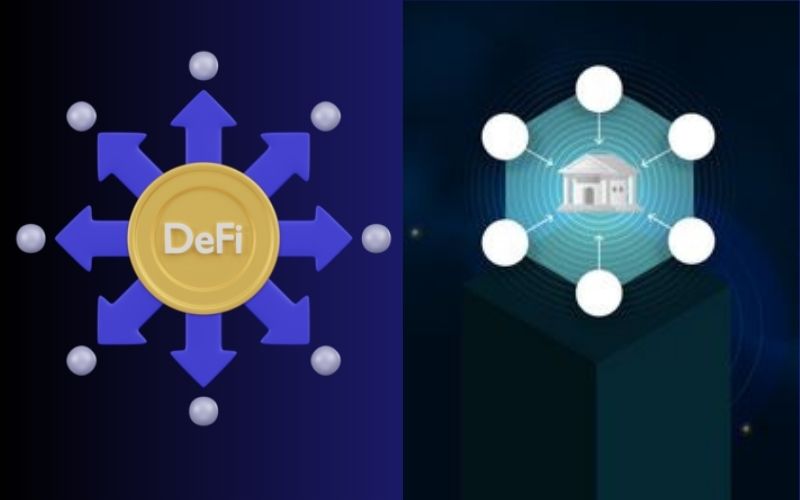
CeFi crypto loans are offered by centralized entities that act as intermediaries, similar to traditional financial institutions. Platforms like Binance and Coinbase manage the entire process, including matching lenders and borrowers, handling collateral, and setting interest rates. This model requires you to trust the platform to manage your funds and remain solvent. In exchange, you get a simple user interface, customer support, and, on some platforms, a degree of regulatory oversight that may feel familiar.
In contrast, decentralized finance (DeFi) loans operate on public blockchains using smart contracts lending. Protocols like Aave and Compound are automated and permissionless, meaning anyone can use them without an intermediary. Your assets are locked in a transparent, on-chain smart contract, and the rules of the loan are executed by code. This model is trustless because you don’t need to trust a company, only the code itself.
Security and Risk: Which Is Safer?
The security of DeFi vs CeFi platforms is a primary concern for all investors.
- CeFi Security: CeFi crypto loans are susceptible to what’s known as counterparty risk. The 2022 market downturn exposed vulnerabilities in this model, as several centralized lenders went bankrupt, and users lost their funds. While many platforms have since implemented more robust practices like proof-of-reserves, you still rely on the platform’s solvency and operational security.
- DeFi Security: DeFi is not immune to risk. Its main vulnerabilities are smart contract bugs and hacks. A flaw in a smart contract can lead to the loss of all funds locked within it. However, the transparent and open-source nature of most protocols allows for community audits and bug bounties, which can mitigate these risks. For advanced users, features like flash loans in DeFi and sophisticated crypto finance protocols also introduce a level of complexity that can be a security risk if not fully understood.
Ultimately, CeFi security is dependent on human management and institutional safeguards, while DeFi security relies on the integrity of its code.
Flexibility and User Experience
Flexibility and ease of use are major differentiators.
- CeFi Flexibility: For a beginner, a CeFi crypto loan is generally more flexible and user-friendly. You get dedicated customer support, a simple interface, and streamlined processes for borrowing against Bitcoin and other assets. Many platforms also offer a crypto-backed line of credit that is easier to manage than a decentralized loan.
- DeFi Flexibility: DeFi platforms offer unparalleled financial flexibility, especially for those comfortable with the technology. Since they’re permissionless, anyone can access decentralized finance (DeFi) loans regardless of location or credit history. This allows for a wide range of products and services, from earning yield from crypto lending to engaging in margin trading with crypto. However, this flexibility comes at the cost of a steeper learning curve and a lack of human support.
Regulatory Compliance and Future Outlook
In 2025, regulatory compliance for crypto loans is a major factor driving the evolution of both models. Regulators are increasingly scrutinizing CeFi crypto lending platforms, demanding clearer disclosures and stronger capital requirements. This increased oversight can provide a sense of security for traditional investors. DeFi, by its nature, is more resistant to regulation, as there is no central entity to enforce rules upon. This can be a double-edged sword, offering censorship resistance but also creating a less-regulated environment. As a result, the market share of DeFi lending over CeFi has grown in 2025, largely driven by its transparency and lack of censorship.
The Verdict: Which Is Right for You?
The choice between DeFi vs CeFi comes down to your priorities.
- Choose CeFi if you value simplicity, customer support, and a degree of regulatory oversight. It’s the best option for beginners who are just starting to explore digital asset lending.
- Choose DeFi if you prioritize self-custody, transparency, and a high degree of control over your assets. While it comes with a higher learning curve and risks like crypto loan liquidation and smart contract bugs, it offers a truly decentralized financial experience.
There is no one-size-fits-all answer, and the landscape is constantly changing. The most successful approach for many is to use both, leveraging CeFi for its convenience and DeFi for its unique financial tools.
FAQs
Q1: What is a collateralized crypto loan?
A1: A collateralized crypto loan is a loan where you use your crypto holdings as collateral to borrow a stablecoin or fiat currency. This is the foundation of most crypto borrowing and digital asset lending, and the loan-to-value (LTV) ratio is typically over 100% to protect the lender from market volatility.
Q2: What is a flash loan in DeFi?
A2: A flash loan in DeFi is a type of uncollateralized loan that allows users to borrow and repay a very large sum of money within the same blockchain transaction. These are primarily used by developers and advanced traders for arbitrage opportunities and have specific technical requirements.
Q3: Is my crypto at risk of liquidation with a loan?
A3: Yes. With both CeFi crypto loans and decentralized finance (DeFi) loans, your collateral is at risk of being liquidated if the value of your assets falls below a certain threshold. This event, known as crypto loan liquidation, is a key risk of the collateralized loan model. To avoid it, you must monitor your loan’s health and add more collateral if needed.
Q4: How do crypto lending platforms generate yield?
A4: The yield from crypto lending is generated from the interest payments made by borrowers. Lenders provide their assets to a pool on a platform, and those assets are then lent out to borrowers at a higher interest rate. The interest earned is then distributed to the lenders, minus any platform fees.