
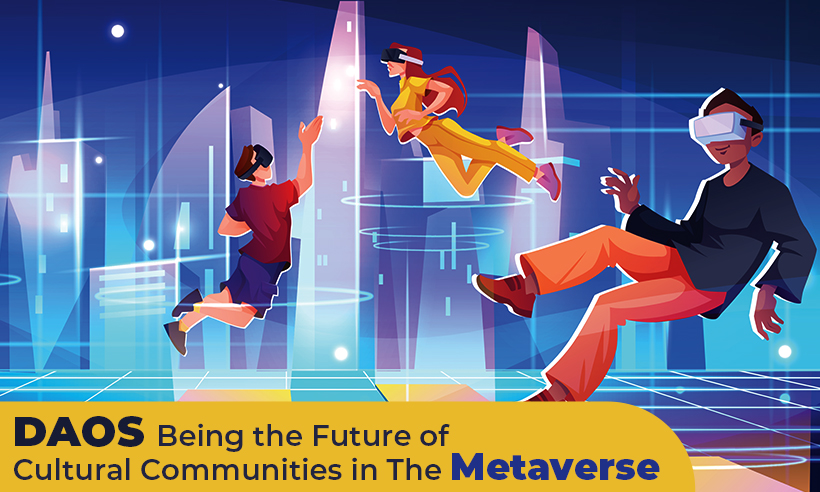
A decentralized autonomous entity (DAO) refers to an entity with no central leader. Instead, a community organized around the rules takes and controls decisions that blockchain enforces. DAOs are organizations on the internet that their members run and control. They have built-in treasury accounts that only the consent of their members can gain access to it. The group makes decisions through suggestions that the group votes on within a specific time.
A DAO is a non-hierarchical organization that has a wide variety of uses. For example, freelancer networks that share their money to purchase the software, charity organizations that allow donations from members, and venture capital firms that an organization owns are all feasible through these types of organizations.

What is the function of a DAO?
As previously mentioned above, a DAO is an organization that makes decisions from the bottom up; a group of members controls the company. DAOs work with smart contracts. These are blocks of code that perform a function when it satisfies a set of conditions. Smart contracts are used on a myriad of blockchains today, although Ethereum is the one that first began to use smart contracts.
Smart contracts define the DAO’s regulations. Anyone who is a shareholder in the DAO will have voting rights and can influence the operation of the DAO through the creation or decision-making process of new governance ideas.
This prevents DAOs from receiving a flood of proposals. A proposal can only get approval if most stakeholders agree with the proposal. Therefore, the method of determining the majority differs and is defined within the smart contract.
DAOs are fully independent and fully transparent. Anyone can examine their code because they’re built upon an open-source Blockchain. You can also check their built-in treasury accounts since the blockchain keeps track of every financial transaction.
Major corporations mostly determine how our society operates now regarding technology and progress. Corporations determine the future’s major thrust. Hundreds or thousands of workers within these monoliths strive to achieve their leaders’ vision by getting motivation by monetary rewards. The top tier makes all of the decisions and reaps most of the profit, as has been the case for many years. DAO wishes to alter that.
Our New World
The primary motivation for promoting DAOs that use Web3 is to increase public ownership. As previously stated, a company has a small number of people making the majority of the choices. Contributors own their values and act as stewards of their portion of the world in a DAO. An easier-to-understand analogy is provided by Chase Chapman, a DAO contributor, and entrepreneur.
“How can we lay a foundation that anyone can build on?” Chapman asks. That is important and something the internet has already accomplished. The difficulty is that it has never been straightforward to monetize or transact a value across borders and reward those who created it. DAOs enable us to accomplish just that. It is irrelevant whether this emerges as NFTs or tokens; what is important is that we establish a realm for individuals to build this world around. When you consider DAOs and what they do differently, you’ll see that they enable people to own a portion of the value they create. Allowing people to own this worth creates the appropriate incentives for them to go out and produce.”
What about Businesses?
Even though the world of Web3 and the open internet is exciting, there will still be a lot of big companies that want to be a part of the fun. So this question is about what role a big development company or publishing company could play in how things will work on the web in the future.
In Chapman’s words: “When we think about the token, NFT, and Web3, it can be very simple.” “It’s either you do it or you don’t.” That’s not the best way to say it. I think one of the most interesting ways to think about this is to think about communities and how to make containers for those communities to build. This is an opportunity for unlimited growth. As an institution, studio, or publisher, you can’t do as much work as you want to.
Standard models of consumption have become the norm for many people. Most of us live in a world based on supply and demand, where we trade our talents for money to satisfy our desires. Rich businesspeople will be in charge, and they’ll take home most of the rewards as a result. Open Meta DAO’s founder, Ryan Gill, is a firm believer in the collective power of its people.
Since I was a kid, I’ve been thinking about the open metaverse,” Gill adds. But, when it comes to the metaverse, “I’ve seen many corporate approaches.” I’m from a school of thought that believes it’s risky to just hand it up. Web3 puts communities in the driver’s seat. They’re scrambling to keep up. We’d have to give it away if we wanted a closed metaverse.”
The Metaverse: Life on the Web
Many proponents of an open metaverse envision a situation in which a major portion of the metaverse is under the control of a community. However, others may wonder, “Why are we trying to upend everything?” QGlobe co-founder Sarah Austin offers an answer for this.
Austin describes it as a way of life. “We are already so immersed in social media and games, but we’re used to centralized corporations being in charge in the old paradigm. We aren’t doing enough to make a real difference in the world. Spending time and resources on centralized entities that use our data as they see fit is a waste of time and money. The authorities have the power to impose restrictions on our speech. People throughout the world are starting to accept the cancel culture. Hence, we can express our disapproval of this in this manner: an entirely new way of living and thinking is emerging in the metaverse, thanks to the open-source movement.”
Chapman also adds: “Another interesting part is that a lot of this endeavor is ultimately about trust.” There must be trust that the time and effort put into developing and building value in ecosystems will be respected, even if a central institution controls what can and can’t be built.
What’s the Next Step?
Ryan Gill and Open Meta will unleash a positive force of good as they adapt to the new web. However, this time around, the public has a considerably more significant role to play than ever before.
“You can’t block open source software, no matter how powerful the corporate or the opposition force,” argues Gill. Despite your best efforts, no one will stop them from carrying out their plans. I believe there is a good and wrong side to history at this point.”In any case, the next phase in our worldwide network’s evolution is likely to be intriguing.