
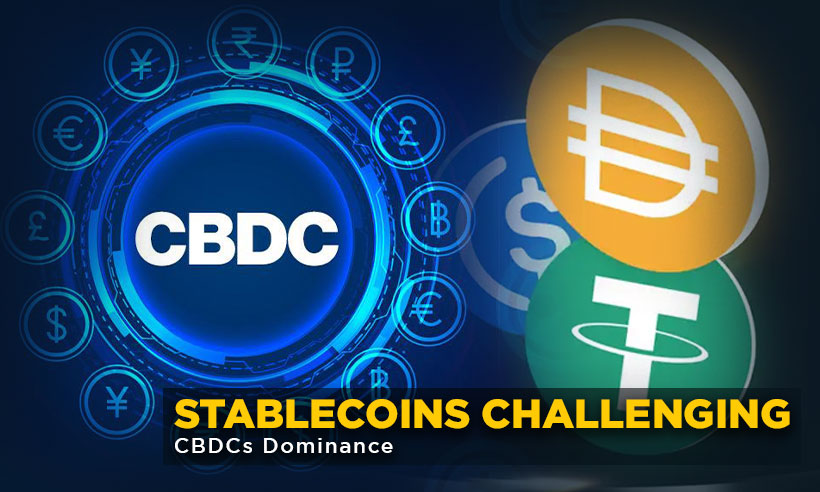
Governments have been quick to explore the possibilities of blockchain technology. With the possibility of digital currencies replacing paper money, several countries are exploring central bank digital currencies (CBDCs). That is setting the stage for stablecoins vs CBDCs. Are CBDCs prospects doomed from the word go? Read on to find out.
What Are Stablecoins and CBDCs?
A CBDC is simply a digital currency issued by a central bank. Such coins are inspired by the concepts behind cryptos but differ in the sense that a central arbitrator or the state issues them. As such, there is no need for a distributed ledger like the blockchain. They’re also called digital fiat. On the other hand, stablecoin is a cryptocurrency whose price lacks the high volatility generally associated with cryptos. To achieve price stability, stablecoins are pegged to a fiat currency such as the US dollar to achieve price stability. They will most often have a reserve asset held to maintain the pegged value, preferably of equal worth to its market cap.
Details on CBDCs
There are two types of CBDCs- wholesale CBDCs and Retail CBDCs. Wholesale CBDCs function similarly to bank reserves held in the Central bank. All financial institutions within an economy operate an account with the central bank in which funds are deposited to settle interbank transactions. Retail CBDCs are the ones similar to cryptos and direct competitors of stablecoins due to their use by consumers and ventures. Two types of retail CBDCs exist- token-based CBDCs and account-based CBDCs. Token-based CBDCs are accessible via private & public keys. Account-based CBDCs require digital identification to be accessed.
Stablecoins As Competitors of CBDCs
Given the stability in value offered by both retail CBDCs and stablecoins, they are in direct competition with each other. While many features are similar to the user, their underlying nature differs sharply. The difference is what gives each their pros and cons over each other.
Pros of Stablecoins Over Retail CBDCs
The first edge stablecoins have over CBDCs is with regards to anonymity. The main attraction for most people opting for cryptos has been high levels of anonymity. While stablecoins maintain the feature, CBDCs come with the flaw of lower to no anonymity. Users lose their independence from unilateral freezes of their financial assets by governments when they opt for CBDCs.
The second comes in the form of safety. With distributed ledgers made of thousands of different nodes, safety is almost a guarantee. For one to tamper with the network, they have to meet the 51% attack rule, which means controlling more than half of all nodes. With CBDCs, one just has to hack the central arbitrator’s servers and tamper with the system.
Stablecoins also lack the flaw of currency manipulation that may be present in CBDCs. The latter is a digital version of a nation’s fiat money. Governments are known to simply print money and allocate it wherever they wish, normally to the benefit of the corporate world.
In addition, these virtual assets possess the advantage of flexibility- thanks to open-source software and community backing. It gives them a higher reaction time to sort bugging issues and update their underlying architecture to suit emerging developments. CBDCs are geared to have closed access to their coding since a centralized arbitrator issues them.
Finally, stablecoins can be accepted as units of exchange across borders. That’s largely because of their private nature, which doesn’t limit their jurisdiction. CBDCs are quite luckily only acceptable as legal tender within the boundaries of the issuing government. That’s because each nation is bound to issue its own CBDC to promote its own currency’s use.
Pros of CBDCs over Stablecoins
CBDCs come with one key advantage over stablecoins- government backing. Such backing comes with the massive financial resources that the issuing government possesses, an advantage not enjoyed by cryptos.
The government backing also comes with much easier legal clearance. Stablecoins are subject to the prevailing government sentiment on cryptos, which hasn’t been positive for the most part. CBDCs don’t have to pass through the stringent and often changing government regulatory approvals since the government is the issuer.
Success of Wholesale CBDCs Could Be Challenged
Since wholesale CBDCs operate on a different economy segment compared to cryptos, they may be the only widely successful CBDC. Since reserve balances by financial institutions are held in central banks, the clearing of interbank transfers by CBDCs may prove more popular.
However, the adoption of Bitcoin as legal tender by El Salvador and the Central African Republic shows anything is possible. Stablecoins offer more usability as legal tender than Bitcoin due to their price stability. A future where countries adopt the assets as legal tender may be close. That would best the purpose of having such CBDCs in the first place since fiat money won’t be around.
Author’s Note
While CBDCs are a commendable attempt by governments to explore the world of digital currencies, the timing may be late. Stablecoins offer a daunting challenge to their success. Retail CBDCs are the most exposed to stablecoin competition. Lower anonymity, poorer safety, susceptibility to manipulation, inflexibility, and border constraints severely disadvantage the retail CBDCs. Wholesale CBDCs currently enjoy a niche that should make them safe from competition for now. But with stable coin adoption as legal tender highly likely, they may not keep off the contest indefinitely. Stablecoins are quite likely the death of tender.